While parts of Latin America’s real estate market may appear unstable and show limited inflation-adjusted growth, some countries stand out for their relative stability. Thanks to strong tourism sectors or expanding economies, they continue to offer real opportunities for investors.
By avoiding the most volatile markets, you’ll find places like Costa Rica, the Dominican Republic, and Colombia showing resilience and ongoing demand.
Whether you're aiming for capital appreciation, attractive rental yields, or a backup residency plan, Latin America and the Caribbean remain worth exploring.
Below are some of the most promising cities in the region for real estate investment, based on data from Global Property Guide.
1. Dominican Republic
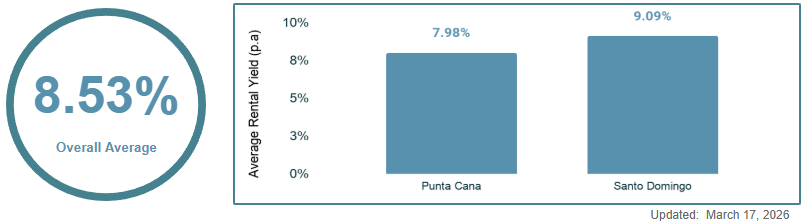
Where to invest: Punta Cana and Santo Domingo
The Dominican Republic offers some of the highest rental returns in the Caribbean and Latin America. This is largely driven by strong tourism demand combined with relatively low labor and maintenance costs.
Whether you are purchasing a holiday home or an income-generating property, it is essential to work with reputable agents and qualified legal professionals to ensure a secure and transparent transaction.
GPG Data (Santo Domingo):
Rental yields in the Dominican Republic are strong, and property prices remain relatively affordable. Investors seeking higher returns may achieve better or comparable results through short-term rentals (see example), especially in tourist-heavy areas. Currently, regulations on short-term rentals are minimal, though this could change in the coming years.
In terms of long-term value, inflation-adjusted property prices have remained broadly stable over the past five to ten years, with little evidence of significant appreciation.
There are no major restrictions on foreign ownership of property, and the country offers favorable tax policies for digital nomads and new residents.
2. Costa Rica
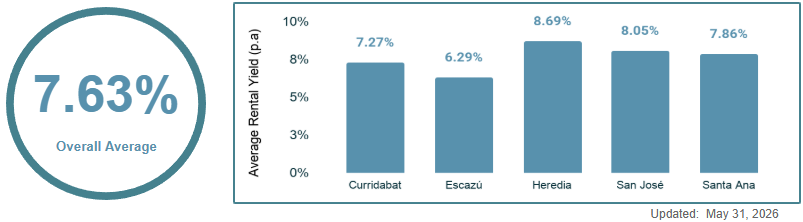
Where to invest: San Jose, Heredia, and Santa Ana
Costa Rica remains a popular choice for property buyers from the United States and Canada. Although its tourism season is not as long as in some other Latin American countries, it continues to attract steady interest from visitors across North America and Europe.
The country also ranks among the highest in Latin America in terms of GDP per capita and average salaries. These economic indicators contribute to a more stable real estate environment.
However, not every location in Costa Rica offers the same investment potential. Some areas are better positioned for capital growth and rental income. It is important to do proper research and focus on locations with strong tourism demand, reliable infrastructure, and favorable rental yields.
GPG Data (San Jose):
As of 2025, mortgage interest rates in Costa Rica range between 7 percent and 8 percent. In the capital, San Jose, average nominal prices per square meter have increased from $1,800 in 2022 to around $2,200 in 2026.
Long-term residential rental properties currently offer gross yields of approximately 8 percent, with some areas reaching up to 10 percent.
Short-term rental investments also remain attractive, especially in coastal areas such as Jaco, Tamarindo (see example), and Quepos. These regions benefit from strong tourist demand and solid income potential. Keep in mind that regulations are tightening and licenses are required.
3. Puerto Rico
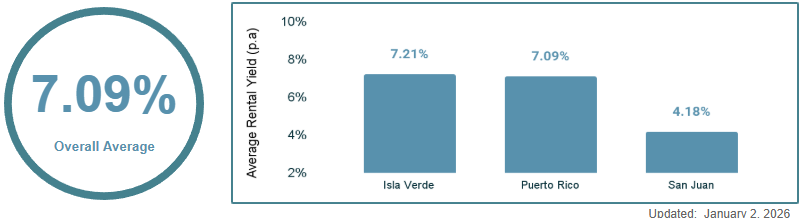
Where to invest: Isla Verde
Puerto Rico is a Caribbean island territory known for its tropical climate, strategic location, and close economic ties to the United States. Its property market has attracted growing investor interest in recent years, particularly in tourism-driven and high-demand coastal areas, with demand supported by favorable tax incentives, limited housing supply, and increasing migration from the U.S. mainland.
For investors, Puerto Rico presents a compelling combination of lifestyle appeal and long-term growth potential. Currently, the most sought-after location for real estate investment is Isla Verde, with the district surrounded by high-rise hotels and chic beach resorts.
GPG Data (Isla Verde):
-
Median studio and 1-bed price: $365,000
-
Median studio and 1-bed rent: $2,100/month
-
Gross rental yield: 7.21%/year
Real estate prices in Puerto Rico have been growing at an increasing rate over the past decade. On average, nominal property values have increased by 15 percent annually, while inflation-adjusted values have grown by around 13 percent annually.
Rental prices have followed a similar upward trend, reflecting strong demand in key markets across the country.
4. Colombia
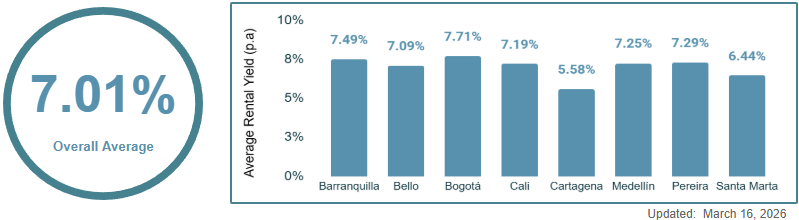
Where to invest: Barranquilla, Bogota and Pereira
Colombia has long been a market of contrasts for foreign investors. Cities like Medellin have attracted strong interest, with many believing it was a guaranteed win. While gross rental yields once reached double digits, they have now fallen to around 7 percent. This decline is largely due to an oversupply of rental properties.
Colombia remains popular among North American digital nomads, driving consistent demand for well-located, high-quality rentals.
As in many other Latin American countries, property prices in Colombia have increased in US dollar terms. However, when adjusted for inflation, the real growth has been far more modest.
GPG Data (Medellin):
Short-term rentals are possible in Colombian cities, but only in specific buildings where they are legally permitted. If you are seeking a more flexible and secure investment, consider properties located in buildings that allow both long-term and short-term rentals.
On a positive note, rental prices have seen strong growth over the past four to five years, which supports income potential for property investors.
5. Panama
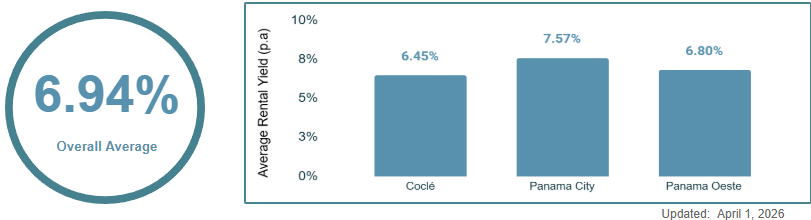
Where to invest: Panama City and Oeste
Panama is often highlighted for its strategic location and reputation as a reliable "Plan B" for tax-conscious investors. The country offers a combination of geographic stability, modern infrastructure, and investor-friendly regulations.
One of Panama’s biggest advantages is its favorable tax environment. Both corporate and personal taxes are relatively low, and foreign-sourced income is not taxed at all. This makes Panama especially appealing to individuals looking to optimize their global tax exposure.
While there are opportunities for property income, the real value for many buyers lies in Panama’s tax residency options, banking system, and legal protections for foreign investors.
GPG Data (Panama City):
-
Median studio & 1-bed price (combined): $235,000
-
Median studio & 1-bed rent (combined): $1,650/month
-
Gross rental yield: 7.57%/year
There is no widely available public source for consistently tracking house prices and rents in Panama. However, the most recent data from 2022 to 2025 indicates that both property values and rental rates are rising.
Panama, and especially Panama City, has seen a significant influx of foreign buyers in recent years. Despite this, there are still opportunities to achieve reasonable rental yields with the right property.
Short-term rentals are legally permitted in Panama, but returns tend to be lower than those from long-term rentals. From a financial standpoint, long-term leasing is generally the more profitable strategy for investors.
6. Uruguay
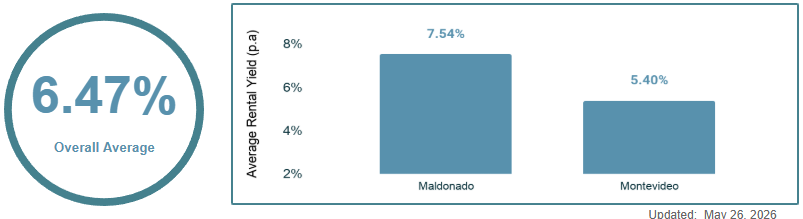
Where to invest: Maldonado
Uruguay is a stable and prosperous South American nation located between Argentina and Brazil, known for its high quality of life, strong institutions, and attractive Atlantic coastline. Its real estate market has steadily gained attention from international investors, with demand driven by tourism, foreign buyers, and a reputation as one of the safest and most business-friendly countries in Latin America.
Uruguay's housing market remains supported by strong underlying fundamentals, with consistent local demand, growing interest from international buyers, and a favorable economic backdrop contributing to market stability.
GPG Data (Maldonado):
-
Median studio & 1-bed price (combined): $167,000
-
Median studio & 1-bed rent (combined): $940/month
-
Gross rental yield: 7.54%/year
Uruguay's mortgage market remains relatively stable and is dominated by the state-owned Banco Hipotecario del Uruguay, which accounts for the majority of housing loans. Mortgage rates have remained broadly steady in recent years, supported by easing inflation and a gradual shift toward lower interest rates by the central bank.
Uruguay's housing market posted solid growth in the second quarter of 2025, with average prices for newly built homes rising nearly 6% year-over-year nationwide. Growth was particularly strong compared to the previous quarter, reflecting healthy demand and improving market conditions.
However, performance was more subdued in Montevideo, where price gains lagged the national average and real house prices declined slightly after adjusting for inflation.
Interested in researching more Latin American countries?
Global Property Guide offers in-depth data to help you compare and analyze property opportunities across the continent. Whether you're looking for affordability, rental income, or capital growth, our resources can help you make smarter decisions.
-
Square Meter Prices – Compare property prices across Latin American countries/cities
-
Long-Term Rental Yields – Find out where rental income is strongest
-
Median Buy Prices – See what it costs to purchase property in key markets
-
Median Rent Prices – Understand local rental dynamics at a glance
Explore the pages below for a clearer view of where value and opportunity lie in Latin America's real estate markets. If you're considering purchasing property in the region and would like guidance, feel free to get in touch.