More and more property investors are looking beyond their home countries in search of better yields, potential price growth, and tax-friendly markets. Europe continues to be a popular region, but not all countries are equally attractive right now.
In many places, high prices, low rental returns, sluggish price appreciation, and even political risk make it hard to justify buying. That said, there are still good opportunities if you know where to look — especially for buy-to-let investors willing to go beyond the obvious markets.
Here are some of the most promising countries in Europe to invest in real estate right now, based on real data from Global Property Guide — including rental yields, median prices, and rental income.
1. Moldova
Where to invest: Chisinau
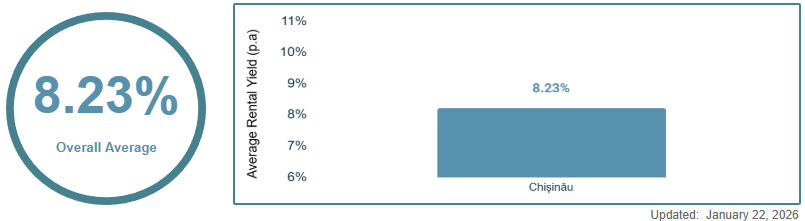
Moldova’s residential market continues to post strong price growth, although a stabilization phase is increasingly expected as demand softens and new supply expands.
For short-term rentals, apartment rents in the capital city of Chișinău increased 25-30% in 2024 compared to 2022-2023 levels. However, more recent assessments from local experts indicate that the capital’s rental market is more stable now, with demand drivers beyond traditional seasonal fluctuations not as significant.
GPG Data (Chisinau):
In Q3 2025, the Residential Property Price Index (RPPI) for Chișinău from the National Bank of Moldova (NBM) recorded a year-on-year increase of 33.91% (24.72% in real terms).
Short-term rentals have also stabilized after three years of agitation.
It's also worth noting that in line with the base rate trajectory, interest rates on real estate loans to individuals experienced an uptick from the low point previously reached at the end of 2024, but can be expected to decline as recent monetary policy decisions are passed on by the lenders.
2. Ireland
Where to invest: Dublin and Cork
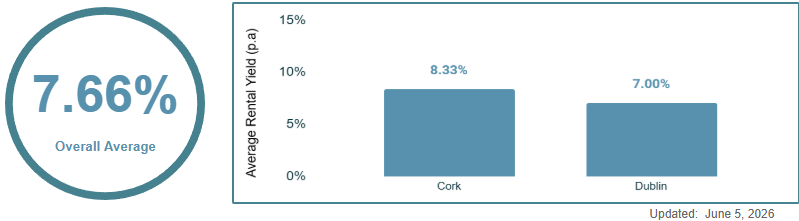
Dublin has some of the highest property prices in Europe, but it also commands some of the highest rental rates, which helps balance the equation for long-term investors—particularly in central neighborhoods. Cork is also worth considering, offering lower entry prices while still benefiting from solid rental demand and a growing local economy.
GPG Data (Dublin):
Unlike Spain and Italy, property prices in Ireland have surged since 2012. Over the past decade, home prices have nearly doubled—up 99% in nominal terms—with inflation-adjusted growth at just over 61%. Rents have also climbed significantly, rising by 71% over the same period.
Ireland imposes no restrictions on foreign buyers. Properties can be purchased either as an individual or through a company structure. As with most markets, net yields tend to be 1.5% to 2% lower than gross yields—so a 7% gross yield typically translates to around 5% net for long-term rentals.
Based on our research, short-term rentals in Ireland are generally not a viable strategy.
3. Italy
Where to invest: Catania and Palermo
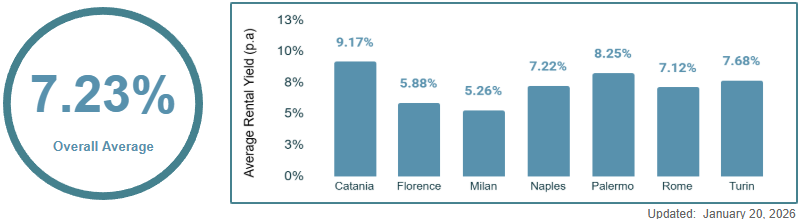
Italy remains an interesting option, especially in areas where prices are still reasonable. Catania has strong rental yields, while Palermo offer surprisingly affordable homes. Italy also has tax incentives for new residents, which can make a difference for foreigners moving in.
GPG Data (Catania):
Keep in mind that over the past five years, property prices in Italy have only risen by around 15% in nominal terms. Once adjusted for inflation — which has been relatively high since 2019 — real price growth is actually negative, at -2.22%.
Certain areas in Italy are also well-suited for short-term rentals, with the potential to generate net yields that are comparable to—or slightly higher than—those from long-term rentals. Here’s an example of a strong-performing Airbnb listed on Global Property Guide Listings.
4. Latvia
Where to invest: Riga
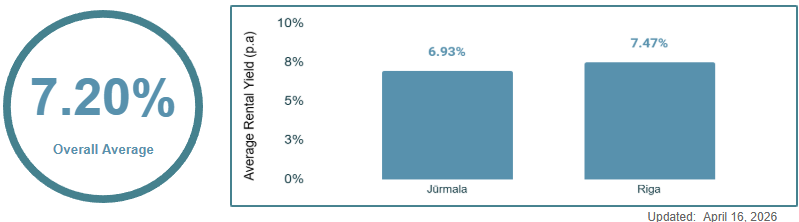
The residential real estate market in Riga continues to offer some of the best yields in Europe. Property prices are low, rental demand is steady, and both short- and long-term strategies can be profitable. While it’s not currently a strong market for capital appreciation, it’s definitely worth considering for cash flow-focused investors.
GPG Data (Riga):
Similar to Greece, inflation-adjusted property prices in Riga have yet to fully recover. In fact, Riga has underperformed significantly in recent years. Over the past five years, property prices have dropped by 23.66% in real (inflation-adjusted) terms, while nominal growth has been minimal—just 3.77%.
On the downside, this suggests a weak capital appreciation story and signals that the market may still be facing structural or economic headwinds. Investors looking for long-term price growth may find better opportunities elsewhere. However, this price stagnation has helped keep entry points low, and combined with strong rental yields, Riga can still be a compelling choice for investors focused on income rather than appreciation.
5. Romania
Where to Invest: Bucharest and Galati
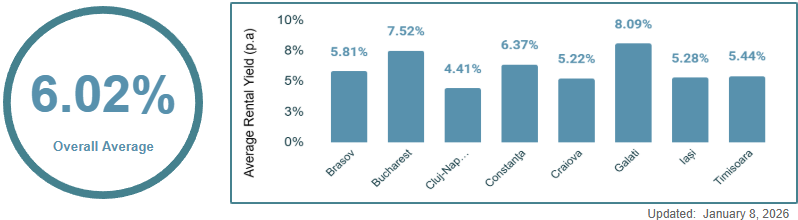
Romania offers some of the cheapest property in the Europe (similarly to Riga), especially in city centers like Bucharest. Rental demand is solid, and the taxes are low. It's not the most glamorous market, but if you’re focused on steady returns, it makes sense.
GPG Data (Bucharest):
Due to high inflation, Romania’s real (inflation-adjusted) property prices have mostly stagnated since 2022, even though nominal prices continue to rise. Compared to other markets in the region, Romania appears to be more volatile.
In Bucharest, short-term rentals can offer similar or slightly lower net yields than long-term rentals, but they may still be a good alternative depending on location and property type, especially for investors seeking more flexible strategies.
6. Poland
Where to invest: Warsaw, Lodz and Bydgoszcz
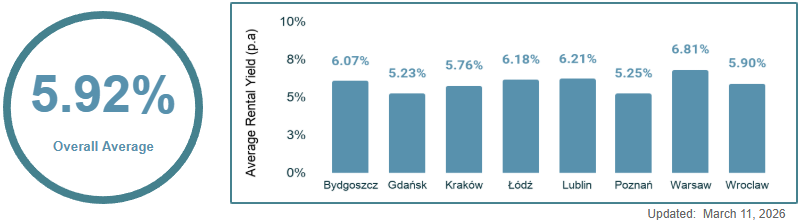
Poland is a strong, stable market with a growing middle class and solid long-term prospects. Warsaw and many other cities offer both reliable rental demand and fairly priced properties. It’s more of a slow-and-steady investment—less excitement, but strong fundamentals.
GPG Data (Warsaw):
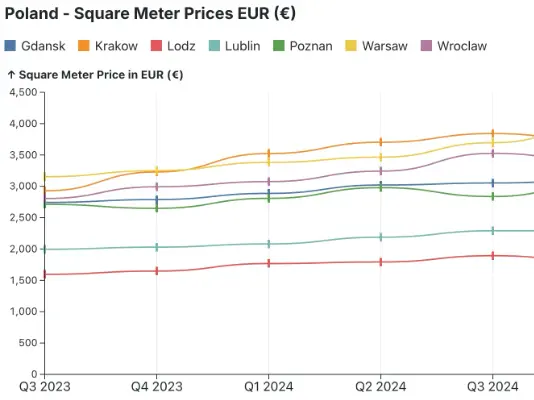
Like several other growing European real estate markets, Poland has experienced strong growth over the past five years. Nominal property prices have increased by 73%, while inflation-adjusted prices have risen by nearly 19%.
Interested in researching more European countries?
Global Property Guide offers in-depth data to help you compare and analyze property opportunities across the continent. Whether you're looking for affordability, rental income, or capital growth, our resources can help you make smarter decisions.
-
Square Meter Prices – Compare property prices across European countries/cities
-
Long-Term Rental Yields – Find out where rental income is strongest
-
Median Buy Prices – See what it costs to purchase property in key markets
-
Median Rent Prices – Understand local rental dynamics at a glance
Browse these pages to get a clearer picture of where value and opportunity lie in Europe's real estate landscape. If you need help buying a property in Europe, do not hesitate to contact us.