Property Investment in Ireland: Foreigner’s Guide (2025)
Ireland has increasingly become a sought-after destination for property investors — offering a blend of natural beauty, cultural depth, and economic stability. From Dublin’s dynamic tourist and expat scene to the scenic coasts of Cork, Ireland offers both steady long-term growth potential and the charm of one of Europe’s most welcoming nations.
This newly updated 2025 edition guide will take you through the basic steps and important things to consider when buying property in Panama as a foreign first-time buyer.
12 Things to Know Before Buying a Property in Ireland
- Can Foreigners Buy Property in Ireland
- Best Cities and Regions to Invest
- Square Meter / Square Foot Prices
- Median Asking Prices
- Rental Yields and Rents
- Market Performance (Past and Present)
- Landlord and Tenant Laws
- Property Related Taxes
- Buying (and Selling) Costs
- Short-Term Rental Regulations
- Mortgage and Financing Options
- How to Buy Property in Ireland: Step-by-Step
1) Can Foreigners Buy Property in Ireland?
Yes, foreigners generally can purchase property in Ireland.
This does not, however, grant citizenship rights, even for EU or EEA nationals — though they may find it easier to obtain mortgages and qualify for more favorable interest rates. Pathways to citizenship do exist for those with Irish ancestry or lawful employment in Ireland, both of which can also simplify the process of purchasing property.
2) Best Regions and Cities to Invest
Ireland offers a diverse range of real estate opportunities, from cosmopolitan urban centers and tech-driven cities to thriving regional hubs and scenic coastal towns.
Dublin
As Ireland’s capital and economic powerhouse, Dublin stands at the forefront of the country’s property market. The city combines strong international appeal with a consistent demand for both residential and commercial spaces. Areas such as Ballsbridge, Ranelagh, and Docklands are particularly sought after due to their mix of luxury housing, proximity to global tech companies, and vibrant city life. With a limited housing supply and continuous inward migration, Dublin remains one of the most competitive and high-performing real estate markets in Europe.
Cork
Cork, Ireland’s second-largest city, has seen significant growth in recent years, driven by major multinational employers in pharmaceuticals, technology, and finance. The city’s waterfront redevelopment projects and expanding infrastructure have made neighborhoods like Blackrock, Douglas, and Cork City Centre increasingly attractive to investors. Cork offers a balance of urban living and affordability compared to Dublin, making it a promising destination for long-term rental and capital appreciation.
Galway
Known for its cultural vibrancy and coastal beauty, Galway has become an increasingly desirable location for property investment. The city’s strong student population, thriving arts scene, and proximity to major employers in the medtech sector contribute to steady housing demand. Areas such as Salthill and Newcastle offer a mix of family homes and investment properties, with the city’s continued expansion positioning it as a stable regional market.
Limerick
Limerick has undergone a remarkable transformation, fueled by major regeneration initiatives and a growing presence of international businesses. The city’s strategic location on the Shannon River and its focus on innovation and education make it a compelling option for investors. Neighborhoods like Castletroy, near the University of Limerick, have a consistent rental market driven by students and professionals, while the city center offers opportunities for redevelopment and commercial investment.
3) Square Meter / Square Foot Prices
Ireland has some of the highest square meter prices in Europe. This is especially true in Dublin, where property rates are soaring due to high demand and limited supply, although prices and availability vary by neighborhood.
- Dublin - €8,014 sq. meter
4) Median Asking Prices
Median asking prices for 1-bedroom apartments in Ireland are moderate compared to other parts of Europe. Dublin has the highest overall rates across the country due to its high demand and low supply.
- Dublin - €295,000
- Cork - €220,000
5) Rental Yields and Rents
While Ireland’s rental yields remain strong, averaging around 7.5% for a one-bedroom apartment, returns vary by city and neighborhood. In recent years, Cork has outperformed Dublin, with two-bedroom apartments delivering average yields of about 9.45%. Cork’s higher returns are largely attributed to its more affordable property prices, ongoing infrastructure improvements, and city center revitalization projects.
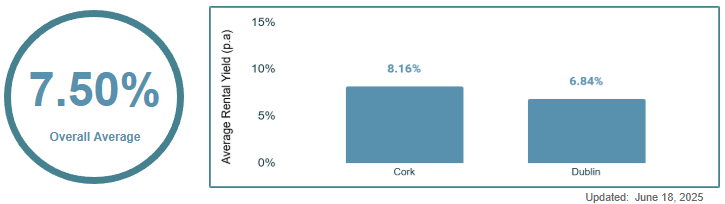
As of June 2025, rental rates for 1-bedroom properties in Ireland’s major cities are approximately as follows:
- Dublin (all locations) - 8.12%
- Cork (all locations) - 8.18%
Ireland's rent price index:
Data Source: OECD.
6) Market Performance (Past and Present)
In the early 2000s, Ireland’s housing prices rapidly increased due to strong economic growth and low interest rates. The housing market collapsed by 2007, with prices falling more than 30% from their highest rates. This drop contributed to the country’s banking and financial crisis, as developers cut back and the construction market collapsed.
The market began to steadily recover in 2013, and residential property development grew, thanks to limited supply and increased demand, which has continued since, peaking in 2023. Analysts expect slower but still steady growth to continue, especially as new development completions continue to fall behind government goals, contributing to higher property prices.
Ireland's house price annual change:
Data Source: Central Statistics Office Ireland.
7) Landlord and Tenant Laws
Ireland’s landlord and tenant laws are judged by the Global Property Guide to be Pro-Tenant between landlord and tenant. While both parties can determine rent amounts, prices cannot be higher than the market rent value, which are capped in Rent Pressure Zones (RPZs) – which, as of June 2025, includes the entire country. Landlords are also limited by how often and how much they can raise rent.
After six months with no significant rental issues, tenants are granted security of tenure, limiting landlords’ ability to end tenancy.
8) Property Related Taxes
Foreigners who own property in Ireland must obtain a PPS number to file taxes.
Annual property taxes vary, but are generally at .18% of the property’s market value for property up to €1 m or 0.25% for property above €1 m. Local authorities may charge an additional amount.
Annual taxes must also be paid on any rental income, minus applicable deductions. The annual rate is 20% on the first €44,000 of net rental income, then 40% on any income above that amount.
9) Buying (and Selling) Costs
Stamp duty is collected at closing and must be paid within 30 days of closing. The rate is 1% of the first €1,000,000, 2% on the portion over €1,000,000 up to €1.5m, and 6% on any amount above €1.5m.
Sellers of investment properties or second homes must pay capital gains taxes, which have a standard rate of 33% of the net profit.
Here's a full breakdown:
| Transaction Costs | ||
| Who Pays? | ||
| Property Transfer Tax | 1.00% - 6.00% | buyer |
| Legal Fees | 1.00% - 1.50% | buyer |
| Notary Fees | 0.10% - 0.20% | buyer |
| Real Estate Agent Fee | 1.00% - 2.50% | seller |
| Costs Paid by Buyer | 2.10% - 7.70% | |
| Costs Paid by Seller | 1.00% - 2.50% | |
| ROUNDTRIP TRANSACTION COSTS | 3.10% - 10.20% | |
| Source: Global Property Guide, PWC | ||
10) Short-Term Rental Regulations
Because of Dublin’s housing shortage, only primary residences can be rented short-term (i.e., 14 nights or less) unless the property has been granted special planning permission. Additionally, primary residences can be rented out for a maximum of 90 days per year without special planning permission, and no guest can stay longer than 14 consecutive nights. If the host decides to exceed 90 days, they must first apply for “change of use planning permission.”
Any short-term rental that is not a primary residence must be approved by the City. Property owners must also pay an annual registration fee, which generally ranges from €300 to €500.
An important nationwide change is underway that will require all short-term rentals to register with Fáilte Ireland, then update each year.
11) Mortgage and Financing Options
Foreigners may obtain a mortgage in Ireland, but it is not always easy. EU / EEA members, those with Irish heritage, and those whose income is already paid in euros often have an easier time qualifying than those without any of the above. Not all banks will provide loans to foreign investors. Those that do often charge higher interest rates and require a down payment of 30% or higher.
Unlike with many other countries, buyers in Ireland generally get preapproved for a mortgage before they begin looking for property. Preapproval is usually good for around six months.
Ireland's mortgage loan interest rates:
Data Source: ECB.
12) How to Buy Property in Ireland: Step-by-Step
- Get Loan Preapproval: In Ireland, buyers planning to take out a mortgage loan generally require preapproval, which can take anywhere from a couple of weeks to a couple of months. Serious buyers may want to start the process before or at around the same time that they start searching for property.
- Research and Find Property: When looking for Irish property, popular websites like Daft.ie, MyHome.ie, and Property.ie are good places to begin. Working with a licensed Irish real estate agent who is registered with the Property Services Regulatory Authority (PSRA) is recommended, as they have insights on communities, understand Irish regulations, and may have access to listings that are not online.
- Research Pricing, Yields, and Legal Restrictions: Ireland has no restrictions on non-residents purchasing property. Yields vary by region, with smaller areas like Cork often outperforming Dublin’s ROIs due to lower purchase prices and strong rental demand. Short-term rental laws are tightening, especially in Dublin.
- Research Long-Term Market Changes: Ireland’s housing market has grown steadily since the pandemic, driven by limited supply and strong population growth. Prices rose more than 30% between 2020 and 2025, with the sharpest increases outside Dublin. Government targets for new constructions are not being met, and supply remains below demand. The economy is resilient, but affordability pressures and interest rate fluctuations may slow future price growth. For investors, regional cities offer strong rental prospects and less saturation than Dublin.
- Research Local Taxation and Landlord Laws: Foreign investors pay the same taxes as Irish citizens. This includes stamp duty, property taxes, capital gains taxes, and income taxes. There are also laws on how rental income tax is collected – either through an Irish tax agent or by allowing tenants to withhold 20% of rent for Revenue. Irish tenants also have more rights than landlords, especially when it comes to rent limits and eviction requirements.
- Hire a Real Estate Attorney: In Ireland, attorneys (solicitors) – not notaries – handle all paperwork and due diligence. Solicitors are responsible for conducting title searches, confirming planning compliance, checking for liens or other encumbrances, and drafting or reviewing the sales contract. A solicitor will also advise on expected costs, including property taxes and closing costs.
- Make an Offer and Conduct Due Diligence: Offers are generally made verbally by the real estate agent, but are not legally binding until signed by both parties. When accepted, the buyer is expected to make a booking deposit – usually around €5,000 to €10,000 – which takes the property off the market while the solicitor conducts due diligence.
- Sign the Contract and Pay the Balance: When due diligence is completed, the buyer’s solicitor and the seller’s solicitor will agree on a Contract for Sale. At this time, the buyer will pay a 10% deposit, minus the booking deposit already paid. Both parties, or their representatives, sign the contracts, and the closing date is set.
- Registration and Title Transfer: The property transfer is complete once the buyer’s solicitor registers the property with the Property Registration Authority (PRAI). Buyers will receive the official proof of ownership and a certified title deed.
- Obtain a Tax ID: For property and income tax purposes, non-residents must obtain a Personal Public Service Number (PPSN).
Timeline: 2-4 months from offer acceptance to registration, though delays are common if financing.
Need Help?
Buying property in a foreign country can feel overwhelming, but we're here to help.
At Global Property Guide, we offer:
- Data-backed insights on property prices, rental yields, and taxes
- Country-specific legal and tax guidance through our partner network
- Pre-screened investment properties, including income-generating Airbnb units
- 1-on-1 consultations with real estate experts focused on international buyers
- Step-by-step buyer support, from due diligence to closing
Whether you're looking for your first investment in Ireland or expanding your international portfolio, we can help you make smart, secure decisions.
Contact our team or book a free consultation to get started.