Is the Irish house boom over?
The average house price nationally fell 1.43% during the quarter to April, but measured over 12 months the average price paid for a house in Ireland was 5.1% higher than the price paid in April 2006.
House prices in Ireland have risen further and faster than those of any other country for which figures are reported, except Estonia, having risen for 17 years without a break. Since 1996, when the surge began in earnest, national house prices have risen from €75,000, to €287,664 (2006), i.e., a rise of 283% in nominal terms.
House prices in Ireland have risen further and faster than those of any other country for which figures are reported, except Estonia, having risen for 17 years without a break. Since 1996, when the surge began in earnest, national house prices have risen from €75,000, to €287,664 (2006), i.e., a rise of 283% in nominal terms.
These price rises have one major explanation, the exceptional growth of the Irish economy. In 2006, Ireland experienced 5.6% real GDP growth, and 6.5% real GNP growth. Ireland’s economic growth is way beyond EU average growth. Unemployment has fallen from 15% in the early 1990s to 4.4% in the first quarter of 2007.
Ireland experienced average GDP growth of 9.8% during the six years 1995-2000, with no less than 10.7% real GDP growth achieved in 1999, and 11.7% in 1997. In 1993, GDP per capita was 84% of the EU average, but by 2002, it had risen to 126%. Few countries experience such stellar growth GDP rates without setting off major property price rises. One reassuring sign is that from 1980 to 2004 Irish GDP per capita has risen more than house prices.
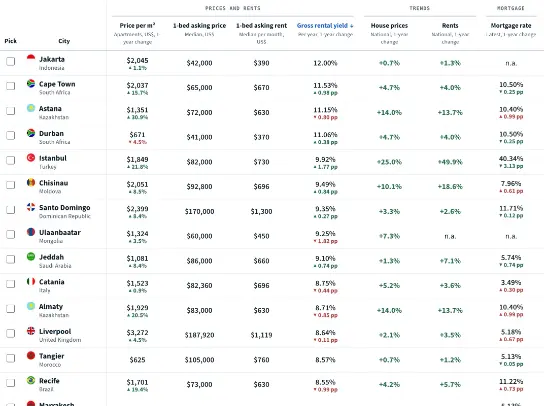
Yields across Ireland average 3.1%, according to the Daft Report. While gross rental yields in Dublin at around 4% are low, they are arguably not dangerously low, given that Ireland is a stable developed country (historical yield figures are unavailable, so it is hard to see whether there has been significant yield compression). Central Dublin’s per square meter prices of €3,750 to €5,000 are also high, but again arguably not perilously so.
Rents rose 11.9% across Ireland between May 2006 and May 2007, according to the Daft Report, a positive sign.
Ireland has the highest average household size in the OECD. Most dwellings are landed (97%), though provision of apartments is rising (20% of newbuild dwellings). Land shortages are developing, and distances traveled are rising, which is arguably positive for city-centre house prices.
Home ownership is exceptionally prevalent in Ireland, with 77% of all households in owner-occupied dwellings. A further 9% live in social rented housing, and only 9% live in private rented housing. Rents were decontrolled in the 1990s, leading to increased buy-to-lets. The government’s reaction was to impose distortionary tax measures, now mostly abolished, to dampen this new activity.
Home ownership is exceptionally prevalent in Ireland, with 77% of all households in owner-occupied dwellings. A further 9% live in social rented housing, and only 9% live in private rented housing. Rents were decontrolled in the 1990s, leading to increased buy-to-lets. The government’s reaction was to impose distortionary tax measures, now mostly abolished, to dampen this new activity.
The increase in supply of rental units had a tremendous effects on rents. The rent index produced by Daft.ie shows that rents fell by 18.17% from January 2002 to March 2004. This was in sharp contrast to the 60% growth in rents between 1998 and 2002. These developments in house prices and rents explain Ireland’s relatively low yields.
Are house price rises over?
Despite recent house price falls, there is good reason to believe that upward pressure on house prices is not at an end.
One reason is Ireland's position in the Euro. The combination of Euro membership and a high growth economy has a little-appreciated impact on asset price growth.
Risk factors
Risk factors for the housing market include the prevalence of variable- rate mortgages, and the large supply of new-build housing:
Like all common currency area members, Ireland adjusts its current account to equilibrium (i.e., balances exports and imports) not by exchange rate policy (since its exchange rate is fixed), nor by interest rate policy (it is a passive taker of European Central Bank interest rates), but through price inflation or deflation of non-internationally tradable assets, such as wages and houses. This factor has been partly behind the strong surge of house prices. As the economy has boomed, prices have risen, without the boom being cut off by a rise in interest rates or by a currency appreciation.
Interest rates are finally rising. But the European Central Bank's interest rates represent a compromise between the needs of its slow-growing members (who need relatively low rates) and its relatively fast-growing members (like Ireland and the new Eastern European members). European interest rates, in sum, tend never to be high enough to damp down prices in its rapidly growing outlying areas. The result is dramatic house price appreciation in those rapidly growing economies.
House prices may now still be still expected to grow Ireland, because while GDP growth is still strong. Consumer price inflation (CPI) has shot up to 4.9% in the year to June, so the real cost of borrowing is still negative – supportive of house prices.
Increases in labour force participation rates generated by women’s entry into the workforce have been slowing but migration from other EU countries is filling the void. Ireland allows citizens from EU new member states to access its labor market. Since May 2004, population inflows have amounted to 4% of Ireland’s population or 8% of its labor force. Like immigrants everywhere, these immigrants are initially tenants, not buyers.
Risk factors for the market
Risk factors for the housing market include the prevalence of variable- rate mortgages, and the large supply of new-build housing:
- Most mortgage loans are variable interest rate (78%). Most fixed-interest mortgages are for periods less than three years (60% of the total). Such high proportions of variable and short-term fixed rates could cause UK-style market instability, now that Euro-area interest rates rise. Rises in interest rates have historically had a large impact on the Irish market.
- There are signs of mortgage equity withdrawal to fuel current consumption, though not at the same rate as Americans and other Europeans. True, 60% of Irish homeowners have little or no mortgage. True, the volume of outstanding mortgages to GDP is still low, at 45% of GDP in 2005. But pushed by mortgage market deregulation, de-mutualization of building societies, and the entry of the Bank of Scotland to the market, the value of mortgage lending has been growing rapidly since 2000 by around 25% a year and by 30% in 2005. “Such mortgage levels suggest that significant housing equity withdrawal is now taking place,” says RICS. The new financial services regulator, the IFSRA, has been talking to mortgage lenders about tightening their lending criteria.
- The numbers of dwellings completed has risen very sharply, more than doubling from 30,000 in 1995 to nearly 81,000 in 2005. A third of current housing stock has been built since 1992.
These factors, and slowing economic growth, pose obvious potential long-term risks to the Irish housing market. The boom of the late 1990s was partly fueled by inward foreign investment, which has slowed since the end of the information and communications technology bubble.