House price increases stall
Finally, it happened - Indian real estate has stalled. High interest rates and high prices have cooled the growth of the market, though there is no crash yet.
Prices have not risen in key areas of cities in the last six months. Speculators have withdrawn, end-users are being cautious. Property transactions have dropped, and developers are being forced to add sweeteners such as parking lots to attract clients. The State Bank of India, the country’s largest lender, saw a home loan portfolio growth rate of 16 per cent in 2007, slower than the 20 per cent growth witnessed in 2006.
The dramatic decline of the stock market has also affected confidence.
Though we know property prices have stalled, everything we have written above is anecdotal. A property price index was recently released with great fanfare by the National Housing Bank, but its figures only go up to 2005 (!). There are also some numbers from HDFC, which go to 2006.
So we also know that residential property prices in India’s prime cities rose remarkably in 2006, and (anecdotally) we know they continued risimg in 2007.
Price in South Mumbai were the highest in India, reaching INR25,000 per sq. ft. (US$560) in 2006, according to HDFC figures, a 38.9% increase from INR18,000 per sq. ft. in 2005.
Other areas in Mumbai registered double-digit house price increases in 2006, ranging from 12% in Vashi to 55.6% in Prabhadevi.
Property prices
This price rises were caused by the rapid economic growth which India is now experiencing.
High prices, low yields
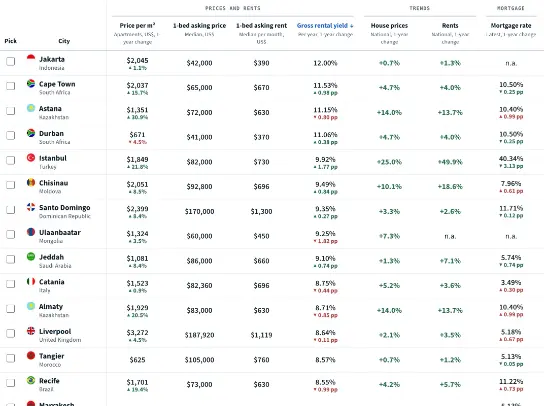
Mumbai, India’s financial capital is one of the most expensive places in the world to buy a condominium unit, according to a Global Property Guide survey. Apartments in South Mumbai cost around US$9,000 to US$10,200 per square metre, and such stellar prices can only be found in the world’s leading cities.
Property prices in other cities in India are significantly cheaper than in Mumbai. In New Delhi, the administrative capital, used apartments cost around US$2,000 to US$3,000 per sq. m. In Bangalore, India’s Silicon Valley, prices are around US$950 to US$2,000 per sq. m.
India’s rental market is still hindered by socialist laws protecting tenants. Although these laws are slowly being replaced by more market oriented laws, the rental market's full potential has yet to be realized.
Those Indian cities which have rent control laws have lower yields. Rents in Mumbai are frozen at their 1947 level, due to the Maharashtra Rent Act of 1999. This law, which extended the Bombay Rent Control Act of 1947, is slightly more pro landlord than the earlier law, but it does not still sufficiently protect landlords’ rights.
Ironically, these rent control laws help create a housing shortage which pushes up prices. Monthly rents in Mumbai are expensive at US$8,000 to US$10,000. Nonetheless, yields are low, at 3% to 4.7%.
Newer and smaller units in New Delhi fetch on average up to 8.4% rental yields yearly. But generally, yields are low to moderate in Delhi, at 4% to 5.8%. Bangalore’s more laxly-regulated rental market has higher annual yields at 7% to 10%.
India’s economic miracle
India’s rapid economic growth started after the government gradually opened the economy in the early 1990s. The government instituted economic reforms and reduced control over foreign trade and investment. From 1993 to 2002, average GDP growth was 5.8%.
GDP growth accelerated to more than 7% in 2003 and 2004, and to 9.2% in 2005 and 2006, making India one of the fastest growing economies in the world, and 8.5% in 2007 and 8% in 2008.
Future movements
The rapid price increases in the past prompted several observers to warn of a property bubble in India. While the fear is not unfounded a generalization for all of India’s property markets cannot be made.
Price increases in several areas are supported by strong fundamentals such as rapid business expansion and increases in real wages. On the other hand, speculative motives are clearly at play in several segments of the market. Based on international experience, overregulated property markets are more prone to property speculation.
Regulation may come in form of zoning and building restrictions, high property and capital gains taxes, or high transactions costs. These are all present in several Indian cities experiencing rapid price increases.