German house prices are accelerating!
Lalaine C. Delmendo | July 15, 2019
After more than four years of strong house price rises, Germany’s housing market remains very strong. In a country where the housing market has historically been extraordinarily stable, this is a significant shift.

The reasons? decade-long economic growth, more than 1 million refugees, high work-related immigration, record-low unemployment, weak construction supply and low interest rates.
The German hedonic price index rose by 9.01% (7.6% inflation-adjusted) in May 2019 from a year earlier (hedonic indices attempt to compare like-for-like exactly, so are the best measure of house price trends), based on Europace figures. It was the highest growth since December 2016.
During the year to May 2019:
- Apartment prices rose by 10.22% (8.79% inflation-adjusted), up from a y-o-y rises of 4.8% in May 2018 and the highest growth in almost six years.
- New home prices rose by 7.95% (6.55% inflation-adjusted), up from a y-o-y rise of 5.44% in a year earlier and the biggest increase since July 2017.
- Existing home prices rose by 8.91% (7.49% inflation-adjusted), slightly down from the previous year’s 9.03% growth.
The German housing market was one of the few that avoided a slump in the wake of the 2008-2009 global financial crisis.

Tailor your overseas property investment strategy!
Learn what returns you are likely to earn, and where are the best opportunities. Follow the latest developments in the international property markets through the Global Property Guide newsletter.
Already Subscribed? Manage your subscription
HEDONIC HOUSE PRICE INDEX, ANNUAL CHANGE (%) |
||
|
Year |
Nominal |
Inflation-adjusted |
|
2009 |
-1.89 |
-2.68 |
|
2010 |
3.56 |
2.23 |
|
2011 |
4.71 |
2.67 |
|
2012 |
4.57 |
2.48 |
|
2013 |
3.21 |
1.75 |
|
2014 |
3.71 |
3.51 |
|
2015 |
5.57 |
5.28 |
|
2016 |
10.22 |
8.40 |
|
2017 |
4.71 |
3.00 |
|
2018 |
7.96 |
6.14 |
|
Source: Europace |
||
Extremely low interest rates and bond yields have encouraged persistently growing demand, despite the fact that most German mortgage borrowers borrow on long-term interest rates, which are higher than “tracker” rates.
Residential property transaction volumes in Germany amounted to €15.1 billion (US$16.9 billion) in 2018, down 3% from the previous year, according to Savills. Despite this, it remains the third highest transaction volume in the last ten years. There were about 121,823 units traded during 2018, down 4% from a year earlier.
Low construction activity is another reason for the continued increase in house prices. Housing supply is not keeping up with demand. In 2018, dwelling permits dropped slightly by 0.2% y-o-y to 347,292 while dwelling completions rose by a minuscule 0.9% y-o-y to 287,352 units, according to Destatis. This is insufficient, due to a rising urban population and surge of migrants. In the medium term, the country needs to build around 400,000 flats annually to prevent housing shortages in cities, according to HDB President Thomas Bauer. In Q1 2019, dwelling permits fell by 2.8% to 75,600 units compared to the same period last year.
The migration crisis has added to the pressure. It was estimated that there are currently more than one million refugees in Germany.
Despite the price rises, Deutsche Bundesbank, Germany’s central bank, has ruled out the existence of a full-blown property bubble - at least not yet.
“The good news is that there is currently no real estate bubble that threatens financial stability in Germany,” said Bundesbank’s chief banking supervisor Andreas Dombret. “But the traffic light is clearly on yellow.”
This view is supported by Michael Voigtlaender of Cologne Institute of Economic Research. “Rising prices on their own aren’t enough to create a bubble - you have to look at the fundamentals,” said Voiglaender. “We have a stable mortgage market with steady equity ratios, and fairly moderate levels of home construction.”
“Market crashes are typically caused by too much construction, and the opposite is true in many German cities,” Voigtlaender added.
Strong house price rises are expected to continue in the coming years. “Led by immigration and the continuous labour market uptrend, house prices and rents will likely continue to rise. Even at current levels, the willingness to take out loans ought to persist, due to low interest rates. The nationwide cycle looks set to continue until 2022 or beyond,” said Deutsche Bank.
However Germany’s economy is now slowing. In 2018, the economy registered a lacklustre growth of just 1.4%, down from 2.2% in 2017 and the weakest expansion in five years, according to Destatis. Europe’s largest economy continues to struggle this year, with GDP rising by a meagre 0.4% y-o-y in Q1 2019. As such, the government recently cuts its growth projection this year to 0.5%, half the pace previously forecast.
Moderate rental yields in Germany
Germany’s rental yields are poor to moderate, partly because of recent price rises, but more importantly because investment in housing (including buy-to-let) used to be heavily subsidized by tax-breaks. Many Germans live in rented accommodation, while 51.8% of Germany’s total households own their homes, according to Eurostat.
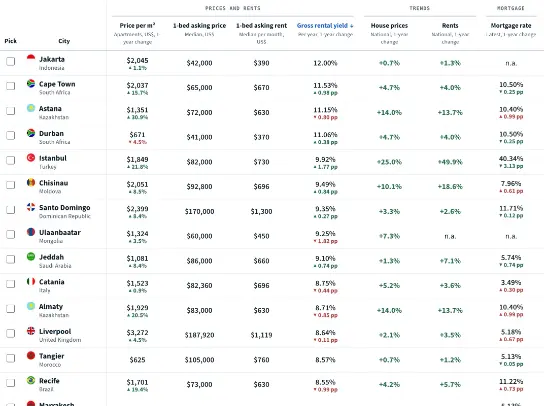
Rental yields range from 3.5% to 3.7% in Germany’s major cities, according to Global Property Guide research:
- In Munich a 120 sq. m. apartment might rent for around €2,250 a month, earning a yield of 3.5%.
- In Berlin a 120 sq. m. apartment might rent for around €1,500 a month, earning a yield of 3.5%
- In Frankfurt, a 120 sq. m. apartment might rent for around €1,700 a month, earning a yield of 3.7%.
Rent rises are broadly keeping pace with price rises. Rents for existing contracts rose by 111.1% from 1990 to 2018, while rents for new contracts rose by 73.6%. On the other hand, the average price of apartments rose by 114.9%, while the price of terraced houses rose by 98.8%, according to BulwienGesa.
Local house price variations
In North-East Germany:
- In Berlin apartments saw strong price rises of 11.16% in Q1 2019 to a median price of €4,050 (US$4,543) per square metre (sq. m.). The median price of one- and two-family houses rose by 11.24% y-o-y to €2,698 (US$3,026) per sq. m.
- In Hannover apartment prices rose by 7.42% to a median price of €2,401 (US$2,693) per sq. m. during the year to Q1 2019. Likewise, the median price of one- and two-family houses increased 7.29% to €2,101 (US$2,357) per sq. m.
- In Dresden, median apartment prices soared by 12.01% to €2,586 (US$2,901) per sq. m. during the year to Q1 2019, while one- and two-family houses increased 8.06% to €2,445 (US$2,743) per sq. m.
- In Hamburg, median apartment prices increased 7.52% y-o-y to €4,126 (US$4,628) per sq. m. in Q1 2019. One- and two-family houses rose by 7.84% to €2,740 (US$3,074) per sq. m.
In West Germany:
- In Dusseldorf, median apartment prices rose by 7.05% to €2,791 (US$3,131) per sq. m. during the year to Q1 2019. Prices of one- and two-family houses also rose by 7.25% to €2,513 (US$2,819) per sq. m.
- In Cologne, median apartment prices rose by 9.03% y-o-y to €3,107 (US$3,485) per sq. m. in Q1 2019. One- and two-family houses had a price increase of 6.46% y-o-y to €2,472 (US$2,773) per sq. m.
- Dortmund had the highest apartment price increase in the region, rising by 12.97% to €1,647 (US$1,848) per sq. m. during the year to Q1 2019 while the median price of one- and two-family houses increased 6.25% to €2,125 (US$2,384) per sq. m.
In South Germany:
- In Munich, the median apartment price rose by 8.71% to €6,726 (US$7,545) per sq. m. during the year to Q1 2019. Prices of one- and two-family houses rose by 5.16% to €5,054 (US$5,669) per sq. m. over the same period.
- In Frankfurt, apartment prices rose by 7.51% to €3,447 (US$3,867) per sq. m. during the year to Q1 2019. One- and two-family houses had a y-o-y price increase of 9.15% to €2,744 (US$3,078) per sq. m.
- Stuttgart had the strongest y-o-y apartment price hike in South Germany in Q1 2019, increasing by 10.77% y-o-y to a median price of €3,400 (US$3,814) per sq. m. On the other hand, the median price of one- and two-family houses rose by 7.01% to €3,206 (US$3,596) per sq. m.
All figures from Dr. Klein’s trend indicator of property prices (DTI).

Berlin
Germany’s capital, Berlin, is the seventh most populous urban area in the European Union. The city’s residential sector has been boosted by its young population and growing reputation as a European creative and media hub. It hosts several renowned universities, orchestras, museums, entertainment venues and other creative industries. For several years, Berlin has recorded a high population growth of about 40,000 to 60,000 annually, mainly due to inward migration. In 2018, Berlin had a population of around 3.75 million. It ranked 13th out of 231 cities included in the Mercer’s 2019 Quality of Living Index.
Berlin is currently facing a severe housing shortage. While there were around 12,790 housing completions in 2018, current annual requirements are for more than 20,000 residential units. If the excess demand of about 70,000 units over the past few years is added, it is estimated that Berlin needs around 194,000 new units by 2030.
"Berlin’s economy, which is exceptionally dynamic compared to other German cities, will continue to drive high population growth, suggesting that demand will continue to grow in the residential market," said JLL.
BERLIN: RESIDENTIAL DEVELOPMENTS UNDER CONSTRUCTION, 2019 |
|||
|
Project Name |
Location |
Units |
Completion |
|
EuropaCity |
Moabit |
2,800 |
2025 |
|
Mein Falkenberg |
Falkenberg |
1,240 |
2021 |
|
Maximilians Quartier |
Schmargendorf |
1,000 |
2020 |
|
Mittenmang Berlin |
Moabit |
800 |
2019 |
|
Stadtquartier Tacheles-Areal |
Mitte |
450 |
2020 |
|
Source: JLL |
|||
Hamburg
Hamburg is "Germany’s Gateway to the World", and its port is Europe’s third largest. It is Germany’s second largest city, and the eighth largest in the European Union. It is a major tourist destination, and its Speicherstadt was declared a World Heritage Site by UNESCO in July 2015.
The city has flourishing small and medium-sized enterprises, as well as its international trade and business services sectors. Hamburg’s population growth exceeds 5% between 2013 and 2018.
But like Berlin, construction activity in Hamburg is well below demand. In 2016 and 2017, housing completions averaged 7,000 units annually, less than half of the estimated annual requirements for 15,000 homes, according to JLL. Hamburg Senate recently set a new-build target of 10,000 homes per annum, which was estimated to have been achieved in 2018.
HAMBURG: RESIDENTIAL DEVELOPMENTS UNDER CONSTRUCTION, 2019 |
|||
|
Project Name |
Location |
Units |
Completion |
|
Quartier Vogelkamp-Neugraben |
Neugraben-Fischbek |
1,500 |
2019 |
|
Pergolenviertel |
Winterhude |
1,400 |
2020 |
|
Othmarscher Höfe |
Othmarschen |
1,000 |
2019 |
|
Tarpenbeker Ufer |
Lokstedt |
950 |
2021 |
|
Unter den Linden – Wohnquartier im OxPark |
Langenhorn |
450 |
2019 |
|
Source: JLL |
|||
Munich
Munich is Germany’s third largest city and is home to many major universities, museums, and architectural attractions. It is a traffic hub and is one of Germany’s fastest growing cities. It ranked highest (overall: 3rd out of 231 cities) among major German cities in Mercer’s 2019 Quality of Living Index.
Residential construction activity remains strong in Munich, so it seems possible that the city’s annual target of 8,500 completions will be achieved in the coming years, according to JLL. Nonetheless, the city’s housing market continues to be tight, amidst high demand. In the past five years, housing supply grew at only about 3.5% annually while demand increased by around 5%. According to the Federal Institute for Research on Building, Urban Affairs and Spatial Development (BBSR), about 15,000 to 20,000 units should be built annually to absorb the excess demand from previous years.
Construction activity in Munich has shifted increasingly from the city centre and downtown neighbourhoods towards the outskirts and less densely developed districts in the past few years, according to JLL. Despite the city government’s efforts to solve the housing shortage, the problem is expected to linger amidst robust population and economic growth.
“Considering the forecasts for further population and economic growth, and given the demand backlog from recent years, the problem of excess demand is unlikely to diminish over the coming years,” said JLL.
MUNICH: RESIDENTIAL DEVELOPMENTS UNDER CONSTRUCTION, 2019 |
|||
|
Project Name |
Location |
Units |
Completion |
|
Quartier Paul-Gerhardt-Allee |
Pasing-Obermenzing |
2,500 |
2021 |
|
Stadtquartier Am Südpark |
Thalk.Obersendl.-Forsten-Fürstenr.-Solln |
1,440 |
2019 |
|
Stadtquartier DiamaltPark |
Allach-Untermenzing |
800 |
2020 |
|
Junges Quartier Obersendling |
Thalk.Obersendl.-Forsten-Fürstenr.-Solln |
500 |
2019 |
|
Werkswohnungen Stadtwerke München |
Au-Haidhausen |
500 |
2019 |
|
Source: JLL |
|||
Cologne
Cologne, Germany’s fourth largest city, hosts more than thirty museums and hundreds of galleries.
With population growth of about 4% since 2013 and supply growth of barely 2%, there is clearly a housing shortage in the city. Completions were just between 2,000 and 3,000 units in recent years, significantly lower than the local government’s target of 6,000 new apartments annually, including about 1,000 planned subsidized units.
Major developments over the next few years include the Clouth site in Nippes, the Sürther Feld in Rodenkirchen and the Deutz AG site in Mülheim.
COLOGNE: RESIDENTIAL DEVELOPMENTS UNDER CONSTRUCTION, 2019 |
|||
|
Project Name |
Location |
Units |
Completion |
|
Clouth-Quartier |
Nippes |
1,200 |
2021 |
|
Park Linné |
Braunsfeld |
500 |
2020 |
|
Wohnquartier Ossendorfer Gartenhöfe |
Ossendorf |
430 |
2021 |
|
Wohn- und Geschäftskomplex Coloria |
Bickendorf |
400 |
2019 |
|
CologneApart (VauVau) |
Altstadt-Nord |
200 |
2020 |
|
Source: JLL |
|||
Frankfurt
Frankfurt is the fifth largest city in Germany. It is Germany’s financial centre and is known for its major trade fairs such as Messe Frankfurt, one of the largest in the world; Frankfurt Motor Show, the largest motor show in the world; and Frankfurth Book Fair, also the largest in the world. It ranked 7th in the Mercer’s 2019 Quality of Living Index.
The city’s population - which has climbed to about 760,000 in 2018 - is forecast to reach over 820,000 by 2035. Population growth is focused on the large new-build districts such as Riedberg in the north (peripheral districts) and the Eu ropaviertel (City Centre I). Housing completions averaged around 3,500 annually over the past five years. However, well below current demand for almost 6,000 units annually, amidst strong population growth.
FRANKFURT: RESIDENTIAL DEVELOPMENTS UNDER CONSTRUCTION, 2019 |
|||
|
Project Name |
Location |
Units |
Completion |
|
Quartier am Henninger Turm |
Sachsenhausen |
1,000 |
2019 |
|
Wohnquartier Wings |
Gallus |
630 |
2021 |
|
Hafenpark Quartier |
Ostend |
600 |
2022 |
|
Wohnquartier Westend-Ensemble |
Westend |
470 |
2021 |
|
Wohnquartier Mainwald |
Schwanheim |
400 |
2020 |
|
Source: JLL |
|||
Stuttgart
Stuttgart is Germany’s sixth largest city, and is known as the Cradle of the Automobile. It ranked 27th in Mercer’s 2019 Quality of Living Index.
Due to the strong local economy and the sustained demand for manpower, the city experiences high net inward migration and consequently a continuous growth in population. The number of households grew by 4.3% annually in the past five years while housing stock increased by just 2.4% units per year, according to JLL.
Publicly owned housing companies and cooperatives, were the city’s biggest net investors, followed by professional asset and fund managers.
STUTTGART: RESIDENTIAL DEVELOPMENTS UNDER CONSTRUCTION, 2019 |
|||
|
Project Name |
Location |
Units |
Completion |
|
Wohnquartier Giebel |
Giebel |
340 |
2023 |
|
Wohnquartier Olga-Areal |
West |
220 |
2019 |
|
Wohnen am Höhenpark Killesberg |
Feuerbach |
200 |
2019 |
|
Hansa-Areal |
Möhringen |
180 |
2020 |
|
Wohnquartier Am Schwanenplatz |
Stuttgart Ost |
100 |
2019 |
|
Source: JLL |
|||
Düsseldorf
Düsseldorf, Germany’s seventh largest city has a population of more than 600,000. In the past six years, the city’s population growth was around 7% while the number of households increased by almost 8%. It ranked 6th in Mercer’s 2019 Quality of Living Index.
Like other German cities, housing supply in Düsseldorf is not keeping up with demand. However with increasing housing approvals, JLL expects the gap between supply and demand to reduce in the coming years. Zoning for around 3,660 housing units is planned in 2019, higher than the local government’s stated annual completion target of 3,000 units.
DÜSSELDORF: RESIDENTIAL DEVELOPMENTS UNDER CONSTRUCTION, 2019 |
|||
|
Project Name |
Location |
Units |
Completion |
|
Le Quartier Central |
Derendorf |
1,500 |
2020 |
|
Gartenstadt Reitzenstein |
Mörsenbroich |
1,050 |
2020 |
|
Vierzig549 |
Heerdt |
1,000 |
2025 |
|
le flair |
Pempelfort |
900 |
2019 |
|
win win Wohnen im Medienhafen |
Hafen |
410 |
2021 |
|
Source: JLL |
|||
Supply remains insufficient despite slowing demand
Foreign investors, particularly from Israel, France, and the UK, represent about a quarter of direct residential property investments in Germany.
“Of the purchasers in 2018 known by name, almost 38% were investing in the German residential market for the first time in the last ten years. This further growth in the investor base is likely to ensure further high levels of investment activity in 2019, with the transaction volume likely to exceed €15bn once again,” said Savills.

Residential property transaction volumes in Germany amounted to €15.1 billion (US$16.9 billion) in 2018, down 3% from the previous year, according to Savills. In 2018, dwelling permits dropped slightly by 0.2% y-o-y to 347,292 while dwelling completions rose by a miniscule 0.9% y-o-y to 287,352 units, according to Destatis. In the medium term, the country needs to build around 400,000 flats annually to prevent housing shortages in cities, according to HDB President Thomas Bauer.
After the mid-1990s there was a substantial drop in housing completions, in part caused by policy changes such as a rise in VAT from 3% to 19% in 2007, and the abolition of owner purchase subsidies. From an annual average of 476,000 permits from 1992 to 1999, dwelling permits fell substantially to an average of 222,000 permits every year from 2001 to 2015.
Germany had a total dwelling stock of about 42 million units by early-2018, up by 0.6% from a year earlier.
In Q1 2019, dwelling permits fell by 2.8% to 75,600 units compared to the same period last year.
The influx of refugees exacerbates housing shortage
Germany took in around 1.1 million asylum seekers in 2015 and another 280,000 refugees in 2016. In September 2017, Chancellor Angela Merkel agreed to cap the number of refugees Germany accepts at 200,000 annually.
To house the refugees the German authorities have turned to public buildings, including former schools and sports centres, as well as a concert hall in Thuringia and a former barracks in Brandenburg, according to Financial Times (FT). But even these are not enough. Aside from tight housing supply, another problem is that refugees tend to locate themselves in big cities, such as Berlin, where the housing supply is even tighter. They compete for housing units with locals and migrants (mainly from other parts of Europe) who are in the country to work, resulting in a further surge in house prices.

In 2018, Germany spent a record €23 billion (US$25.8 billion) on refugee housing, healthcare, language lessons, and other integration programmes and in fighting the root causes of migration abroad – up by about 11% from the €20.8 billion refugee spending in the previous year, according to the Finance Ministry.
Germany’s conservative mortgage market
The mortgage market was equivalent to 41.1% of the country’s GDP in 2018 - an unusually low level for a developed economy, a huge plunge from 82% of GDP in 1998. As of Q1 2019, outstanding housing loans amounted to €1,404.9 billion (US$1,577.4 billion), up by 5% from a year earlier, according to the Deutsche Bundesbank.

Germans’ conservative borrowing is often attributed to the hyperinflation experienced in the 1920s, says Deutsche Bank real estate economist Jochen Moebert. However, the changes in tax incentives are likely to be a better explanation of the general decline in the mortgage loans to GDP ratio.
Housing loan interest rates continue to fall
Germany homebuyers mostly borrow loans at a fixed rate. In 2018, the share of loans with interest rate fixation (IRF) of 5 years or more was 79.5% of total loans, slightly lower than the previous year’s 79.8% but far higher than the 64.4% share in 2009.
In contrast, loans with IRF of up to one year have never exceeded 20% of new loans approved. Such declined to 11.8% of total loans approved in 2018, from 18.7% in 2004. This interest rate profile gives considerable stability to the German housing market, which tends not to suffer from the sudden lurches in rates, or in the value of houses.
An important explanation for Germany’s interest-rate stability is the loan sources of Germany’s banks, which borrow long, and so are keen to lend long-term.
In May 2019, the average interest rate for new housing loans was 1.63%, down from 1.91% a year earlier, according to Deutsche Bundesbank. Over the same period:
- IRF up to 1 year: 2%, down from 2.09% a year earlier
- IRF 1-5 years: 1.5%, down from 1.74% a year earlier
- IRF 5-10 years: 1.46%, down from the previous year’s 1.77%
- IRF over 10 years: 1.67%, down from the previous year’s 2%
Housing loan interest rates in Germany fell sharply from late-2008 to 2015, following ECB rate cuts. Since March 2016 the ECB base rate has been at 0%.
German economy slowing
Germany’s economy registered lacklustre growth in 2018, with real GDP growth of just 1.4%, down from 2.2% in 2017 and the weakest expansion in five years, according to Destatis. Europe’s largest economy continues to struggle this year, with GDP rising by a meagre 0.4% y-o-y in Q1 2019. The government recently cut its 2019 growth projection to 0.5%, half the pace previously forecast.
In 2018, Germany posted a budget surplus of €58 billion (US$65.1 billion), its fifth consecutive year of surpluses and the highest level since reunification, based on figures released by Destatis, equivalent to about 1.7% of the country’s GDP last year, up from 1% of GDP in 2017.

Germany’s unemployment rate was 3.1% in May 2019, far below the eurozone’s average jobless rate of 7.5%, according to Eurostat.
Germany’s annual inflation rate was 1.4% in May 2019, down from 2.1% a year earlier, according to the Destatis. Overall inflation rate is expected at 1.5% this year, according to the European Commission.
houses for sale in munich, apartments for sale in munich germany, houses for sale in munich germany, munich apartments for sale, munich property for sale, buy house in munich, 1 bedroom apartment for sale munich, real estate munich germany sale, homes for sale munich germany, homes for sale in munich germany, munich homes for sale, bavaria real estate, real estate germany bavaria, munich germany homes for sale, houses for sell in germany, houses for sale in germany, houses for sale germany ,driving in germany, german school system, dual citizenship germany, german education system, german wedding traditions, german school, german dual citizenship, kindergeld, oktoberfest munich, germany dual citizenship, oktoberfest germany, german spa, train travel in germany, munich oktoberfest, how to address a letter to germany, german citizenship, dual citizenship germany usa, german address format, german ancestry, german schools, german insurance, german birth records, germany school, german genealogy, south west germany, dual citizenship german us, german pension, education in germany, how to germany, german educational system, german driving laws, traditional german wedding dress, german housing, german court system, oktoberfest in germany, marriages in germany, high schools in germany, traditional german wedding, sw germany, germany address, care concept, german address, germany postal office, germany international airports, schools in german, german genealogy records, german tax rates, germany address format, german post office, german public records, german christmas market, german school schedule, germany post offices, airports in germany, german postal service, leaves in germany, southwest germany, german addresses, germany education system, germany babies, quedlinburg, german ancestry search, german residence permit, german ancestry records, german airlines, taxes in germany, germany tax rate, germany criminal justice system, moving to germany with pets, german mailing address, buy car in germany, international airports germany, germany oktoberfest, germany recycling, flights inside germany, car insurance germany, medical tourism germany, dual citizenship us german, school in germany, pharmacies in germany, germany post, dual citizenship usa germany, help in germany, dr in germany, german middle school, dual german citizenship, major german airports, german employment law, elterngeld, recycling in germany, bavarian international school, german oktoberfest, cell phone service in germany, blue card germany, berlin brandenburg international school, germany real estate, german legal system, how to address an envelope to germany, theme parks in germany, how much do doctors make in germany, real estate germany, frankfurt international school, largest german theme park, mr lodge, when does school start in germany, how to write a german address, german school system chart, elterngelds, eltnergeld, classes in germany, elterngeldes, how to address mail to germany, southwestern germany map, german american dual citizenship, health insurance in germany, german pharmacy, german holidays, german wedding ring finger, germany sofa, sale in germany, smoking in germany, germany school system, adult age in germany, germany housing, germany birth records, realschule, german school year, german health insurance, german birth records online, international school of stuttgart, how to move to germany, german wedding rings, benefits in germany, german traffic laws, can i use my cell phone in germany, germany health insurance, letter to germany, german high school system, germany doctor salary, german taxes, how to send a letter to germany, public schools in germany, german school facts, what time does school start in germany, munich international school, german engagement traditions, germany blue card, german spas, does germany allow dual citizenship, german school hours, germany residency permit, germany genealogy, germany hostels, how to format german address, cheap german airlines, driving germany, german birth certificate, german wedding, german organizations, letters to germany, schools german, sofa in germany, can you have dual citizenship in germany, german healthcare system pros and cons, doctor salary in germany, how to write german address, how to mail a letter to germany, how to address a letter to germany from us, german weddings, schools germany, school germany, germany residence permit, auto insurance germany, international school stuttgart, getting married in denmark, german works council, careconcept, german wedding dress, living in germany, amusement parks in germany, german birth records online free, address in germany, wedding german, international airports in germany, german income tax rate, german discount airlines, average house price in germany, school system in germany, german retirement system, what is school like in germany, how to address letter to germany, international school hamburg, denmark marriage, american schools in germany, germany insurance companies, business in germany, germany retirement age, real estate in germany, buying a car in germany, phone service in germany
Sources:
- Index EPX hedonic (Europace): https://www.europace.de/index-epx-hedonic/Germany property and metropolis market outlook 2019 (Deutsche Bank): https://www.dbresearch.com/PROD/RPS_EN-PROD/PROD0000000000488315/German_property_and_metropolis_market_outlook_2019.pdf
- Heterogene Preisentwicklung bei Immobilien im Norden und Osten (Dr. Klein): https://www.drklein.de/heterogener-immobilienmarkt-im-nord-osten.html Immobilienmarkt im Westen: Besonders Wohnungen sind begehrt und teuer (Dr. Klein): https://www.drklein.de/immobilienmarkt-im-westen-wohnungen-begehrt.html
- Immobilien im Süden: Ein Ende der Preissteigerung in Sicht? (Dr. Klein): https://www.drklein.de/immobilienpreise-sueden-stagnation.html Property Market Index 1975 – 2018 (bulwiengesa): https://www.bulwiengesa.de/sites/default/files/propertymarketindex_2019.pdf
- Market in Minutes Germany residential investment market (Savills): https://pdf.euro.savills.co.uk/germany-research/ger-eng-2018/mimgermanyresidentialinvestmentmarketq418.pdf
- Residential City Profile Berlin (JLL): https://www.jll.de/content/dam/jll-com/documents/pdf/research/emea/germany/en/Residential-City-Profile-Berlin-JLL-Germany.pdf
- Residential City Profile Hamburg (JLL): https://www.jll.de/content/dam/jll-com/documents/pdf/research/emea/germany/en/Residential-City-Profile-Hamburg-JLL-Germany.pdf
- Residential City Profile Munich (JLL): https://www.jll.de/content/dam/jll-com/documents/pdf/research/emea/germany/en/Residential-City-Profile-Munich-JLL-Germany.pdf
- Residential City Profile Cologne (JLL): https://www.jll.de/content/dam/jll-com/documents/pdf/research/emea/germany/en/Residential-City-Profile-Cologne-JLL-Germany.pdf
- Residential City Profile Frankfurt (JLL): https://www.jll.de/content/dam/jll-com/documents/pdf/research/emea/germany/en/Residential-City-Profile-Frankfurt-JLL-Germany.pdf
- Residential City Profile Stuttgart (JLL): https://www.jll.de/content/dam/jll-com/documents/pdf/research/emea/germany/en/Residential-City-Profile-Stuttgart-JLL-Germany.pdf
- Residential City Profile Dusseldorf (JLL): https://www.jll.de/content/dam/jll-com/documents/pdf/research/emea/germany/en/Residential-City-Profile-Dusseldorf-JLL-Germany.pdf
- Banks and other financial corporations (Bundesbank): https://www.bundesbank.de/dynamic/action/en/statistics/time-series-databases/time-series-databases/743796/743796?treeAnchor=BANKEN&statisticType;=BBK_ITS
- Loans for house purchase (Bundesbank): https://www.bundesbank.de/dynamic/action/en/statistics/time-series-databases/time-series-databases/759784/759784?listId=www_v17_frage_22.1
- Interest rates on deposits and loans (Bundesbank): https://www.bundesbank.de/en/statistics/money-and-capital-markets/interest-rates-and-yields/interest-rates-on-deposits-and-loans
- Poor yields in Germany’s big cities (Global Property Guide): https://www.globalpropertyguide.com/Europe/Germany/Rental-Yields
- Vienna Tops Mercer’s 21st Quality of Living Ranking (Mercer): https://www.mercer.com/newsroom/2019-quality-of-living-survey.html
- Germany closed 2018 with record budget surplus (Deutsche Welle): https://www.dw.com/en/germany-closed-2018-with-record-budget-surplus/a-47626726
- World Economic Outlook Database (International Monetary Fund): https://www.imf.org/external/pubs/ft/weo/2019/01/weodata/index.aspx
- Economic forecast for Germany (European Commission): https://ec.europa.eu/info/business-economy-euro/economic-performance-and-forecasts/economic-performance-country/germany/economic-forecast-germany_en
- Consumer price index for Germany (Destatis): https://www.destatis.de/EN/Themes/Economy/Short-Term-Indicators/Basic-Data/vpi001j.html
- Germany spends record 23 bln euros on refugees: document (Reuters):
https://www.reuters.com/article/us-germany-budget-refugees/germany-spends-record-23-billion-euros-on-refugees-document-idUSKCN1SQ182