Housing market cooling in Belgium
The average price of dwellings in Belgium rose by a mere 5.7% in 2007. When adjusted for inflation, dwelling prices were up by only 2.5%. The housing market is definitely cooling; in 2006 dwelling prices rose 13.2% (10.9% in real terms) and in 2005 prices rose 29.6% (26% in real terms).
Significant slowdowns also took place for apartments and villas. The average price of apartments rose by a mere 4.8% (1.7% in real terms) in 2007, down from impressive increases of 14.7% (12.5%) in 2004, 12% (9%) in 2005 and 11% (8.7%) in 2006.
The average price of villas increased 4.9% (1.7% in real terms) in 2007; down from a 8.8% (6.6%) increase in 2006.
Between 2000 and 2007, the average price of Belgian houses rose by 97% (70% in real terms), while apartment prices rose by 84% (59% when adjusted for inflation).
|
|
House prices (€) |
Annual house price change (%) |
||||
|
|
2004 |
2005 |
2006 |
2004 |
2005 |
2006 |
|
Detached Houses |
131,336 |
148,723 |
157,200 |
12.1% |
13.2% |
5.7% |
|
Apartments |
140,877 |
156,341 |
163,861 |
-11.3% |
11.0% |
4.8% |
|
Villas |
261,414 |
284,534 |
298,409 |
29.6% |
8.8% |
4.9% |
|
Source: Belgostat |
||||||
Mortgage market
Since 2001, the mortgage market has grown rapidly. Mortgage loans outstanding rose from €69.33 billion (26.8% of GDP) in 2001 to €121.83 billion (36.8% of GDP) in 2007. Competition among banks, combined with conducive interest rates, fueled the increase in the volume of mortgage loans.
Mortgage rates were at their lowest from 2003 to 2005. The average interest rate for floating rate mortgages dropped from 3.7% in 2003 to 3.5% in 2004 and 3.12% in 2005. With the interest rate hikes implemented since mid-2005 by the European Central Bank (ECB), mortgage rates moved up to 4.11% in 2006 and 4.97% in 2007.
Fixed-rate mortgages
In Belgium, the majority of housing loans are fixed rate mortgages (FRM), i.e. interest rates are fixed for 5 years or more. However, the sensitivity of households to interest rate changes has changed over the years.
At the end of 2002, less than 20% of new mortgage contracts were adjustable rate mortgages (ARM), i.e. loans with interest rates fixed for less than five years. But between 2003 and 2005 more households took out ARMs as interest rates fell. The share of ARMs rose to around 30% of the total by the end of 2003, and to more than 50% in 2004.
The share of households with ARMs with an initial fixation of less than one year was 36% and 35% in 2004 and 2005, respectively. On the other hand, the share of households with FRMs with an initial fixation of more than ten years dropped to 5% in 2004.
With the recent interest rate hikes, households taking out new contracts shifted to longer term FRMs. In 2007, more than 90% of new mortgage contracts had fixed interest rates, or an initial fixation of more than 10 years. As of March 2008, the interest rate for floating rate mortgages was 5.16% while the interest rate for fixed rate mortgages with an initial fixation of 10 years was 4.88%.
Nevertheless, the Belgian housing market is now more highly exposed to interest rate hikes than in the past, because of the many adjustable rate mortgage contracts signed in recent years.
Weaker economic growth ahead
The housing market’s strong performance in recent years was propelled by Belgium’s relatively strong economic growth. In 2007, Belgium’s GDP growth rate was 2.8%. The economy expanded by an average of 2.6% between 2004 and 2006, after an average annual 1.05% GDP growth from 2001 to 2003.
Real private sector wages rose by 3.8% in 2007, and by 3.2% in 2006. The unemployment rate was 7.5% in 2007, down from 8.2% in 2006 and 8.5% in 2005.
|
More Global Property Guide pages: |
In line with the housing market slowdown, the economy is expected to expand by only 1.7% in 2008 and 1.5% in 2009. Real wages are expected to rise by 3.5% in 2008.
Inflation fell to 1.8% in 2007, from 2.3% in 2006 and 2.5% in 2005, but is expected to rise to 3.6% in 2008.
Falling yields
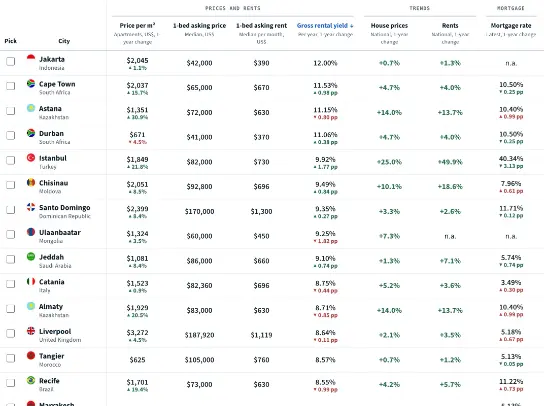
Belgium’s rapid price increases have pushed gross rental yields sharply down, to around 4.9% to 5.9% for apartments in Brussels, according to Global Property Guide research (see Rental Yields). Private sector rents rose by a mere 2.8% y-o-y to end-2007 after a 7.7% drop during 2006. From 2000 to 2007, rents in the private sector rose by only 4.12% while apartment prices rose 84%.
The rental market has been subdued for a number of years because of rent controls (see Landlord and Tenant section) and the rising number of homeowners. The rental market is significant, at about 30% of the housing stock (23% in the private sector, 7% in social housing); but this is falling, and is down from 38% in 1980 and 33% in 1990. However, 60% of households in Brussels are renters, a fact partly encouraged by Belgium’s unusually high buy/sell costs.