Malta's Residential Property Market Analysis 2026
Malta’s residential property market remains on a strong growth trajectory, amidst increasing transactions supported by fundamentally robust domestic demand, record-high tourist arrivals, and a surge in the number of foreign workers in the country. Also, residential construction activity is now booming. These positive trends are reinforced by the country’s strong economic growth.
Table of Contents
- Housing Market Snapshot
- Demand Highlights
- Supply Highlights
- Rental Market
- Mortgage Market
- Socio-Economic Context
Housing Market Snapshot
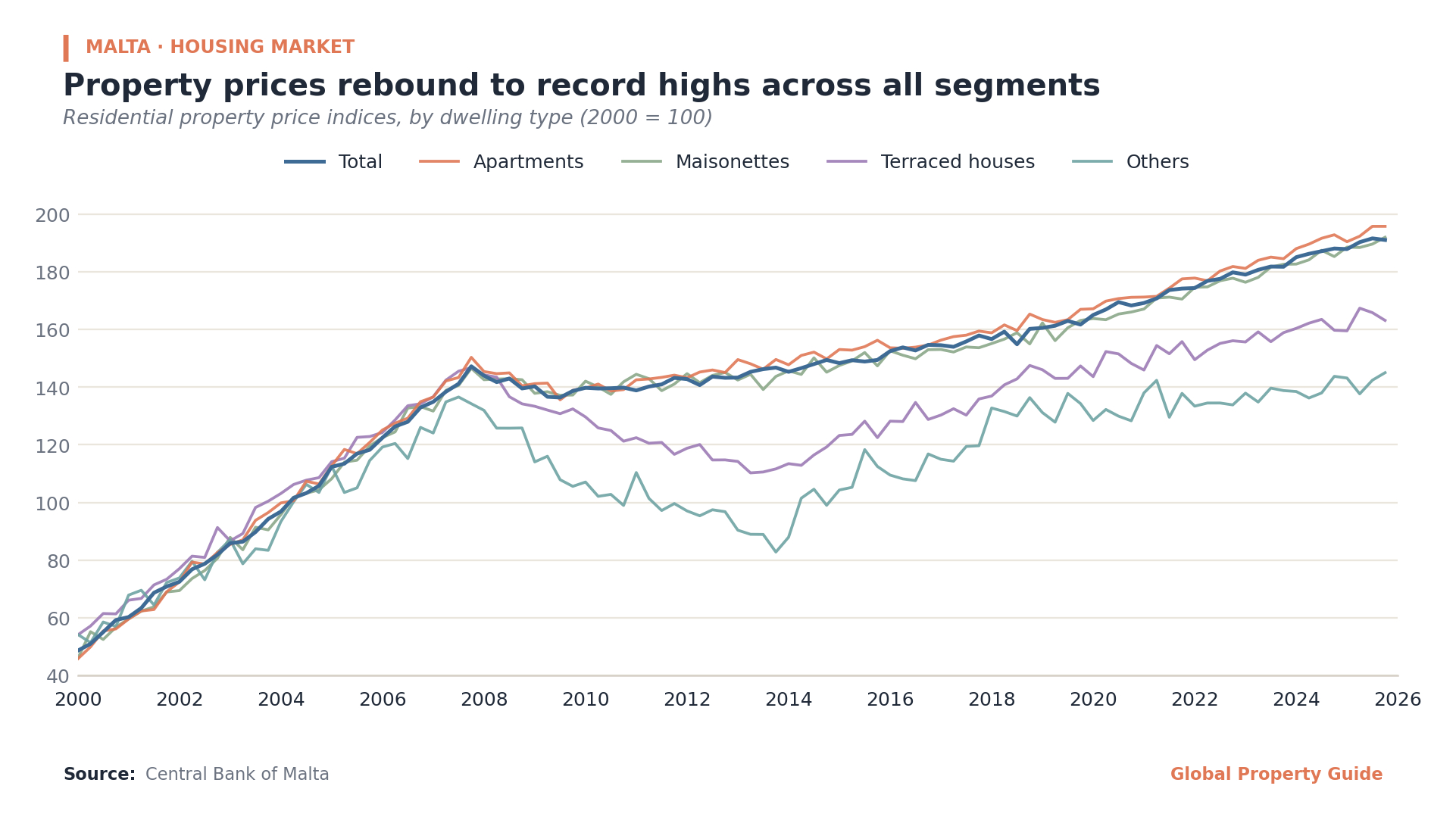
In the fourth quarter of 2025, the nationwide property price index in Malta increased by 6.1%, following year-on-year growth of 5.7% in Q3 2025, 5.6% in Q2 2025, 5.7% in Q1 2025 and 5.2% in Q4 2024, based on figures released by the National Statistics Office of Malta (NSO). When adjusted for inflation, property prices in the country were up by 3.61% over the same period.
Quarter-on-quarter, nationwide property prices were up by 1.3% (1.16% inflation-adjusted) in Q4 2025, its fifth consecutive quarter of price increase.
Malta's house price annual change:
Here are the changes in real estate prices by property type during the year to Q4 2025:
- Apartment prices rose by 6.2% compared to a year ago, on average, an acceleration from year-on-year increases of 5.3% in Q3 and 5.2% in Q2. When adjusted for inflation, prices were up by a more modest 3.71%.
- Maisonette prices increased by 5.3% y-o-y in Q4 2025, following annual increases of 5.9% in Q3 and 6.7% in Q2. When adjusted for inflation, prices were up by 2.83%.
- Terraced house prices rose by approximately 3.0% in Q4 2025 from a year earlier, in stark contrast to a y-o-y decline of 2.16% in Q3 and an increase of 2.1% in Q2. Prices were up by 0.55% in real terms.
- "Other houses", consisting of townhouses, houses of character, and villas, experienced average price growth of around 2.5% y-o-y in Q4 2025, recovering from a y-o-y decline of 7.23% in Q3 and growth of 6.9% in Q2. In real terms, prices were broadly flat.
Before the COVID-19 pandemic, property prices in Malta had been rising annually, registering a cumulative growth of 75% (62% inflation-adjusted) from 2012 to 2019.
After declining by 2.4% (-2.58% inflation-adjusted) in 2020 due to a fall in demand caused by pandemic-related restrictions, property prices in Malta bounced back again in recent years, rising by 6.94% (4.73% inflation-adjusted) in 2021, by a more modest 2.71% (-4.26% inflation-adjusted) in 2022, by 7.54% (3.71% inflation-adjusted) in 2023, by another 6.92% (4.98% inflation-adjusted) in 2024, and by an estimated 5.8% (3.4% inflation-adjusted) in 2025.
The sustained increase in residential property prices in recent years has been underpinned by several factors, including government schemes that support property demand, such as incentives for first-time and second-time buyers, purchases of properties located in Urban Conservation Areas (UCAs) and in Gozo, as well as refund schemes for restoration expenses, according to the Central Bank of Malta's latest Quarterly Review. The booming tourism sector, coupled with the continued increase in migrant workers in the country, is also supporting property price growth.
"Current price developments do not signal speculative behaviour. For the past three and a half years, our estimates show undervaluation of around 5%," said Alexander Demarco, Deputy Governor of the Central Bank of Malta, commenting on the Bank's house price misalignment index in late 2025.
| HOUSE PRICE CHANGE, YEAR-ON-YEAR (%) | ||
| Year | Nominal | Inflation-adjusted |
| 2008 | -4.36% | -8.90% |
| 2009 | -1.42% | -0.98% |
| 2010 | -1.98% | -5.79% |
| 2011 | 6.14% | 4.60% |
| 2012 | -2.21% | -4.82% |
| 2013 | 6.41% | 5.34% |
| 2014 | 4.73% | 4.33% |
| 2015 | 10.03% | 8.67% |
| 2016 | 13.80% | 12.71% |
| 2017 | 8.82% | 7.39% |
| 2018 | 11.85% | 10.48% |
| 2019 | 3.04% | 1.24% |
| 2020 | -2.40% | -2.58% |
| 2021 | 6.94% | 4.73% |
| 2022 | 2.71 | -4.26 |
| 2023 | 7.54 | 3.71 |
| 2024 | 6.92 | 4.98 |
| 2025 | 5.80 | 3.40 |
| Sources: Central Bank of Malta, NSO, Global Property Guide | ||
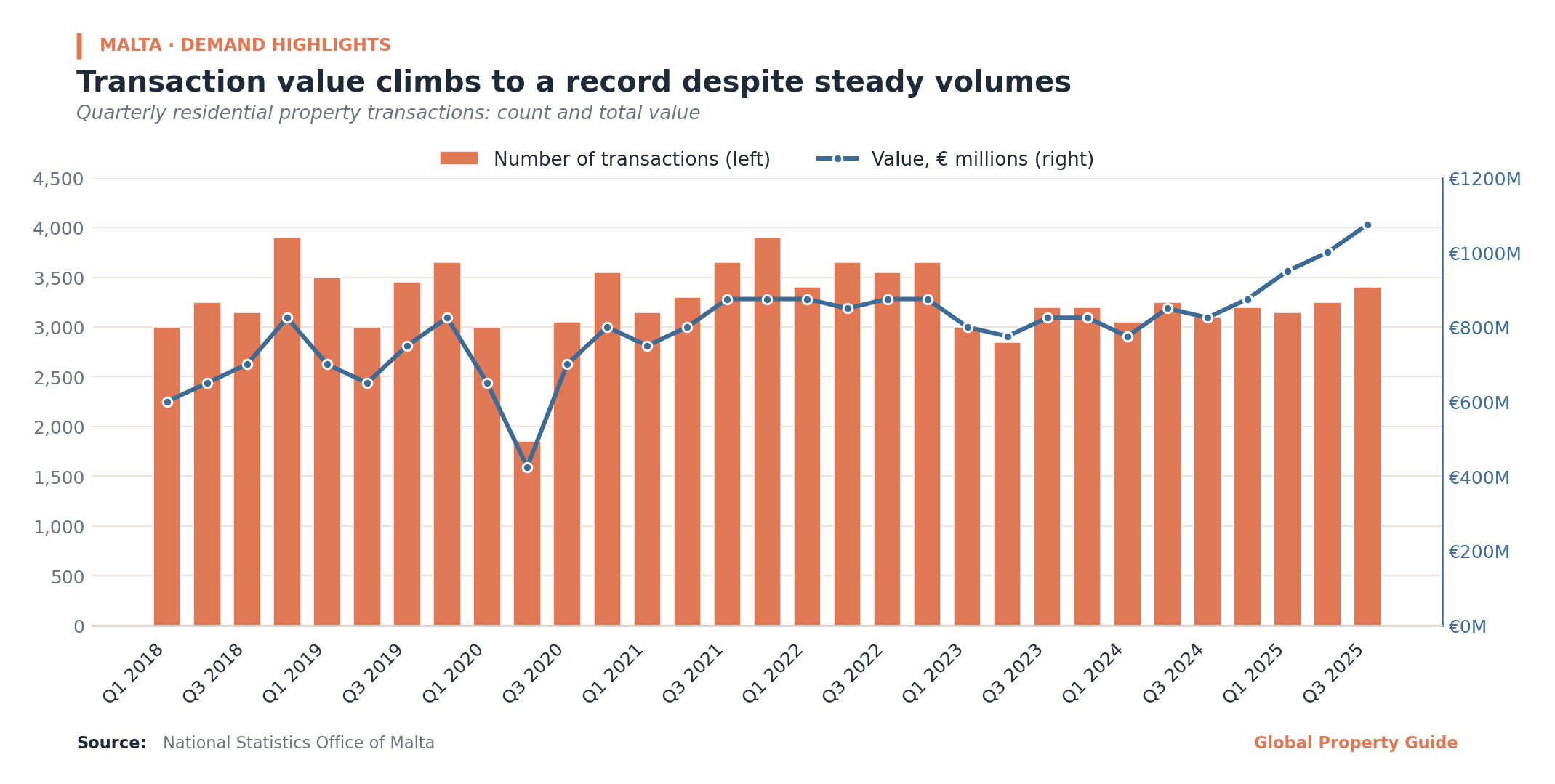
Demand continues to strengthen. During 2025, the total number of residential property transactions in the country rose by 5.9% y-o-y to 13,339 units, following annual increases of 3.7% in 2024 and declines of 15.3% in 2023 and 0.3% in 2022, according to figures from the National Statistics Office of Malta (NSO). Likewise, the total transaction value increased by approximately 12.5% y-o-y to €3.97 billion (US$4.65 billion) over the same period, following an annual increase of 8.4% in 2024 and a slight contraction of 1.2% in 2023.
The upward trend continued throughout 2025. In November 2025 alone, the number of residential property transactions rose by 8.4% y-o-y to 1,083 units, while transaction value was up by 4.5% to €321.5 million (US$376.5 million).
With increasing demand, residential construction activity has surged. During 2025, the total number of approved new dwelling permits in Malta is estimated to have soared by more than 41% y-o-y to over 12,300 units, following an annual increase of 7.4% in 2024 and a decline of 15.5% in 2023, according to figures released by the NSO.
Then in the fourth quarter of 2025, the total number of dwellings for which permits were issued surged by 54.4% to 3,487 units as compared to 2,259 units in the same period last year. This followed an even more dramatic 110.3% surge in Q3 2025.
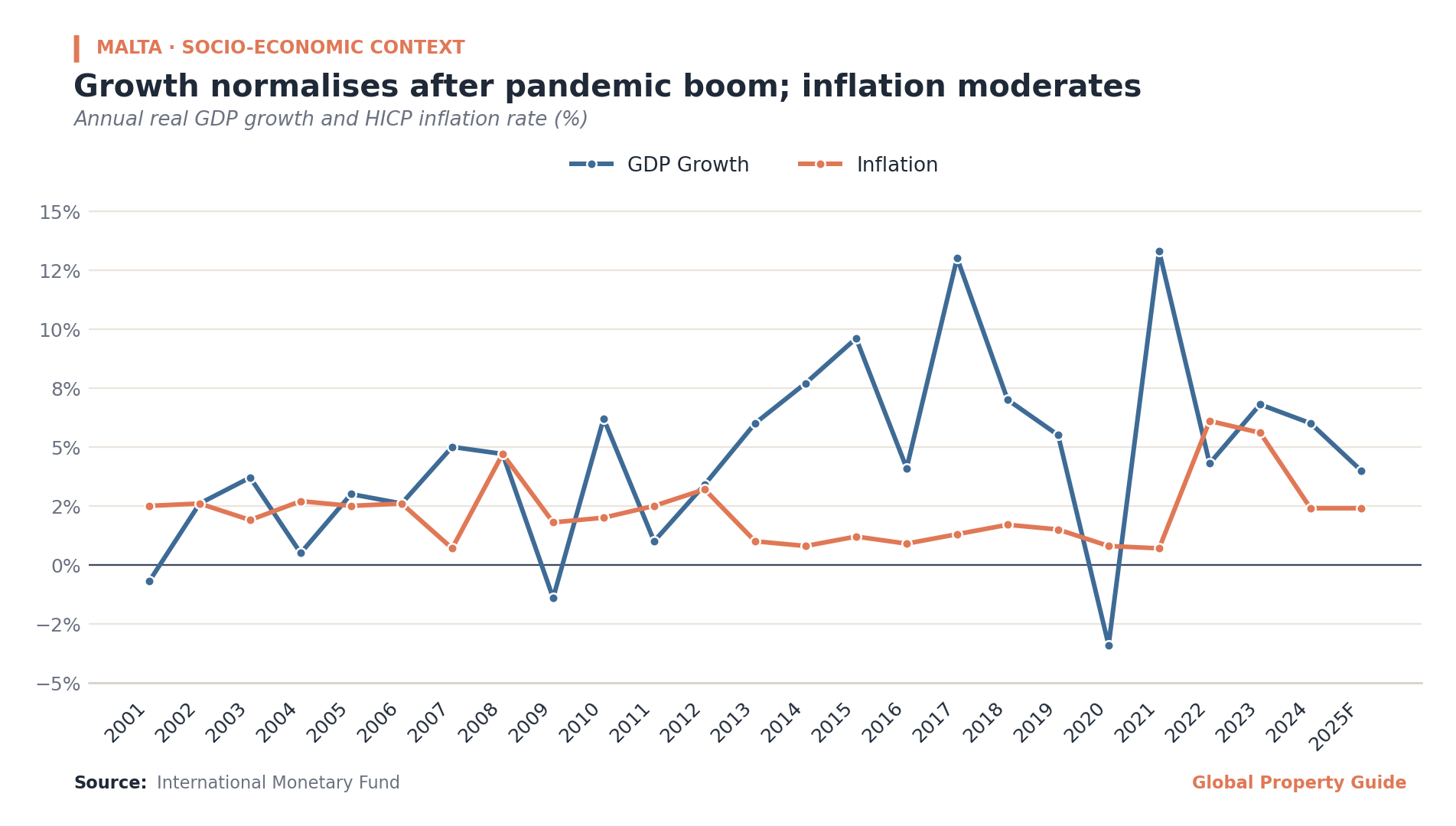
Malta's economy has been growing robustly in the past several years, as economic activity returns to pre-pandemic levels. The country registered real GDP growth rates of 13.3% in 2021, 4.3% in 2022, 6.8% in 2023, and 6.0% in 2024, fully offsetting the 3.4% contraction seen in 2020. The robust growth was driven by a rebound in domestic demand and export of services, benefiting from the recovery in tourism. Before the pandemic, the economy had been growing strongly, with an annual average growth of 6.2% from 2012 to 2019, based on IMF figures.
In the fourth quarter of 2025, the country registered an annual growth rate of 6.4% in volume terms as compared to a year earlier, following year-on-year expansions of 3.0% in Q3, 2.8% in Q2 and 3.6% in Q1, buoyed by strong household consumption and external trade, according to the NSO.
With this, the Maltese economy is expected to remain fundamentally healthy in the medium term. The European Commission expects Malta to post an economic growth of 4.0% in 2025, 3.8% in 2026, and 3.5% in 2027. The International Monetary Fund (IMF), on the other hand, released an economic growth forecast for the country of an annual average of 3.9% for 2025 and 2026.
The Central Bank of Malta's latest growth projections are not significantly different, expecting the domestic economy to grow by 3.9% in 2025, 3.5% in 2026, and 3.3% in 2027.
Demand Highlights:
Property demand continues to strengthen
During 2025, the total number of residential property transactions in the country rose by 5.9% y-o-y to 13,339 units, following an annual increase of 3.7% in 2024 and declines of 15.3% in 2023 and 0.3% in 2022, according to figures from NSO. Likewise, the total transaction value increased by about 12.5% y-o-y to €3.97 billion (US$4.65 billion) over the same period, following an annual increase of 8.4% in 2024 and a slight contraction of 1.2% in 2023.
The decline in demand in 2023 was partly due to the expiration of the temporary COVID-19 measures in September 2022, which provided for a reduced tax and duty rate of 5% and 1.5%, respectively, on the first €400,000 (US$468,500) of property transferred inter vivos. Fortunately, demand in the residential real estate market has been picking up again since 2024, amidst the country's strong economic growth.
In November 2025, both the number and value of residential property transactions increased by 8.4% and 4.5%, respectively, as compared to a year earlier. Of the 13,339 properties sold in 2025, around 12,000 were snapped up by individual buyers (households), while the remainder were acquired by companies.
The most popular locality for property sales in 2025 was, by some distance, San Pawl Il-Baħar (St Paul's Bay), where a little over 1,000 properties were sold. The only other towns to top the 500 mark were Il-Mosta, Marsaskala and Birkirkara.
Despite this, there are wide regional variations in property demand. In the first three quarters of 2025:
- In the Southern Harbour, which includes the localities of Valletta, Il-Birgu, L-Isla, Bormla, Ħaż-Żabbar, Il-Fgura, Floriana, Il-Kalkara, Ħal Luqa, Il-Marsa, Raħal Ġdid, Santa Luċija, Ħal Tarxien, and Ix-Xgħajra, the total number of residential property transactions rose by 4.7% y-o-y to 1,523 units.
- In the Northern Harbour, which consists of the localities of Ħal Qormi, Birkirkara, Il-Gżira, Il-Ħamrun, L-Imsida, Pembroke, Tal-Pietà, San Ġiljan, San Ġwann, Santa Venera, Tas-Sliema, Is-Swieqi, and Ta' Xbiex, transactions were up by 5.3% y-o-y to 2,825 units.
- In the South Eastern District, which consists of the localities of Iż-Żejtun, Birżebbuġa, Il-Gudja, Ħal Għaxaq, Ħal Kirkop, Marsaskala, Marsaxlokk, L-Imqabba, Il-Qrendi, Ħal Safi, and Iż-Żurrieq, residential property transactions increased strongly by 11.9% y-o-y to 1,392 units.
- In the Western District, which includes the localities of L-Imdina, Ħaż-Żebbuġ, Is-Siġġiewi, Ħ'Attard, Ħal Balzan, Ħad-Dingli, L-Iklin, Ħal Lija, Ir-Rabat, and L-Imtarfa, residential property transactions were up by a huge 14.7% y-o-y to 1,008 units.
- In the Northern District, which includes the localities of Ħal Għargħur, Il-Mellieħa, L-Imġarr, Il-Mosta, In-Naxxar, and San Pawl Il-Baħar, residential property transactions declined by 3.1% y-o-y to 1,797 units.
- In Gozo and Comino, which includes the localities of Ir-Rabat, Għawdex, Il-Fontana, Għajnsielem and Comino, L-Għarb, L-Għasri, Ta' Kerċem, Il-Munxar, In-Nadur, Il-Qala, San Lawrenz, Ta' Sannat, Ix-Xagħra, Ix-Xewkija, and Iż-Żebbuġ, the number of residential property transactions increased slightly by 0.2% y-o-y to 1,243 units.
Buying property in Malta has several restrictions
Unfortunately, there are many restrictions on property ownership in Malta. Foreign nationals and EU citizens can usually only buy one property in Malta, and usually only for owner-occupancy, though they can buy more properties in specially designated areas such as Tigne Point, Portomaso, Cottonera, Manoel Island, and Chambray.
Properties owned by foreigners can be rented out, but only if it resides in a special designated area, it is a villa, or it has a licence from the Malta Tourism Authority under the ‘superior’ and ‘comfort’ category.
Here are the specially designated areas:
- Portomaso, St Julian’s
- Cottonera Development, Cottonera
- Manoel Island/Tigne Point, Tigne/Gzira
- Tas-Sellum Residence, Mellieha
- Madliena Village Complex
- Smartcity
- Fort Cambridge Zone, Tignè
- Ta’ Monita Residence, Marsascala
- Pender Place and Mercury House Site
- Metropolis Plaza, Gzira
- Fort Chambray, Ghajnsielem
- Kempinski Residences, San Lawrenz
Thus, buying several properties in Malta for rental income can be complicated, but for buying a summer house abroad, the restrictions are not too severe.
Becoming a resident in Malta: Residency by Investment
The Government of Malta has established structured pathways for non-EU nationals seeking long-term residence or citizenship through significant economic contribution. Over the past decade, these frameworks have evolved considerably to respond to regulatory requirements, market conditions, and European Union legal standards.
In November 2020, Malta introduced the Maltese Exceptional Investor Naturalisation (MEIN) policy, replacing the former Malta Individual Investor Programme (MIIP), with salient differences being:
- Contribution: €600,000 for the standard residency route (36 months) and €750,000 for the expedited route (12 months), instead of €650,000
For dependents, the required contribution under the new policy is €50,000.
- Donation: the compulsory donation to an NGO has been raised to €10,000 from €5,000 previously.
- Residential property: the threshold for purchasing a property is raised to €700,000, from €350,000. However, the threshold for rental property remains unchanged at an annual rent of €16,000. The property needs to be held for 5 years from the issuance of the certificate of citizenship.
- Government bonds: the requirement to invest in government bonds is removed.
- Due diligence fees: for main applicants, due diligence fees increased to €15,000 from €7,500; for dependents, they also increased to €10,000 from €3,000-€5,000.
- Maximum age threshold: the maximum age threshold for dependents is raised to 29 from 27. Also, dependents who meet the legal definition of 'disability' can form part of a parent's application, regardless of age.
- Application for residence: all adult dependents are required to apply for residence, not just the main applicant. The non-refundable prepayment increases to €10,000, from €5,000 previously. There is also a €5,000 fee for the main applicant.
Under the MEIN, the number of citizenship certificates issued to principal applicants (i.e., excluding dependents) was capped at 400 every year, and 1,500 for the duration of the policy.
However, a significant policy shift occurred in 2025 following a ruling by the European Court of Justice, which resulted in Malta discontinuing the acceptance of new applications under its citizenship-by-investment framework. Consequently, the MEIN programme is no longer open to new applicants, and Malta has redirected its focus toward merit-based naturalisation and residency-linked investment schemes.
In this context, the Malta Permanent Residence Programme (MPRP) has emerged as the country's primary investment-based residency pathway. Between 2024 and 2025, the programme underwent substantial reforms to enhance transparency, regulatory compliance, and market alignment.
- Applicants are now required to demonstrate qualifying assets of either €500,000, including at least €150,000 in financial assets, or €650,000 with a minimum of €75,000 in financial assets.
- Property thresholds have been standardised nationwide, with a minimum purchase price of €375,000 or a minimum annual rental value of €14,000, eliminating previous regional distinctions between Malta and Gozo.
- Government contributions and administrative fees under the MPRP were revised upward, with the total administrative fee now amounting to approximately €60,000, payable in stages throughout the application process.
- Dependency rules were also refined, maintaining the maximum age of 29 years for financially dependent children, while exempting spouses, minor children, and dependents with disabilities from additional administration fees.
- Reduced fees apply to other eligible dependents.
A notable enhancement introduced in 2025 is the availability of a one-year renewable temporary residence permit, allowing applicants and their families to reside in Malta while their permanent residence application is under assessment. Furthermore, qualifying property owners may, subject to regulatory conditions and holding periods, lease or sublet their properties, adding flexibility to the investment requirement. Oversight of the programme has been strengthened through the centralisation of agent licensing and regulation under the Residency Malta Agency.
The enhanced Malta Permanent Residence Programme now represents the country's principal route for high-net-worth individuals seeking long-term residence, reflecting a policy direction that balances economic contribution, housing market considerations, and compliance with European Union standards.
Supply Highlights:
Residential construction activity surges
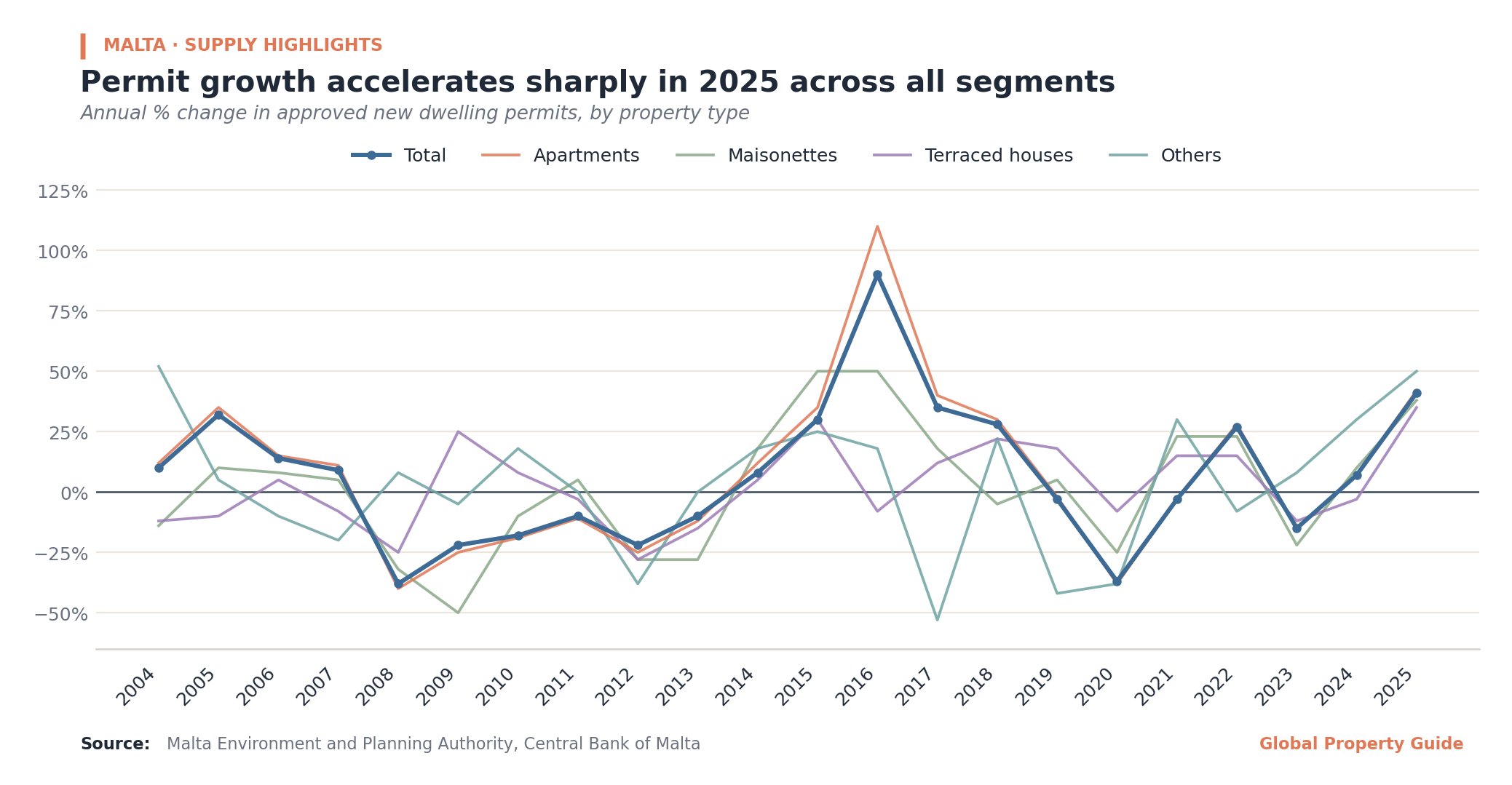
During 2025, the total number of approved new dwelling permits in Malta is estimated to have surged by more than 41% y-o-y to over 12,300 units, following annual increases of 7.4% in 2024 and a decline of 15.5% in 2023, according to figures released by the National Statistics Office of Malta (NSO).
The growth was particularly strong in the last two quarters of 2025. In Q3 2025, permits soared by 110.3% y-o-y to 3,668 units, while in Q4 2025, permits rose by another 54.4% y-o-y to 3,487 units.
By property type in Q4 2025:
- Apartments and penthouses, which together accounted for approximately 87.7% of the total dwelling permits approved, rose strongly to 3,056 units (apartments: 2,505; penthouses: 551).
- Maisonette permits reached 291 units in Q4 2025, accounting for 8.3% of total approved dwellings.
- Terraced house permits totalled 98 units, representing 2.8% of the total.
- For other types of houses, including bungalows, farmhouses, and villas, permits stood at 42 units in Q4 2025.
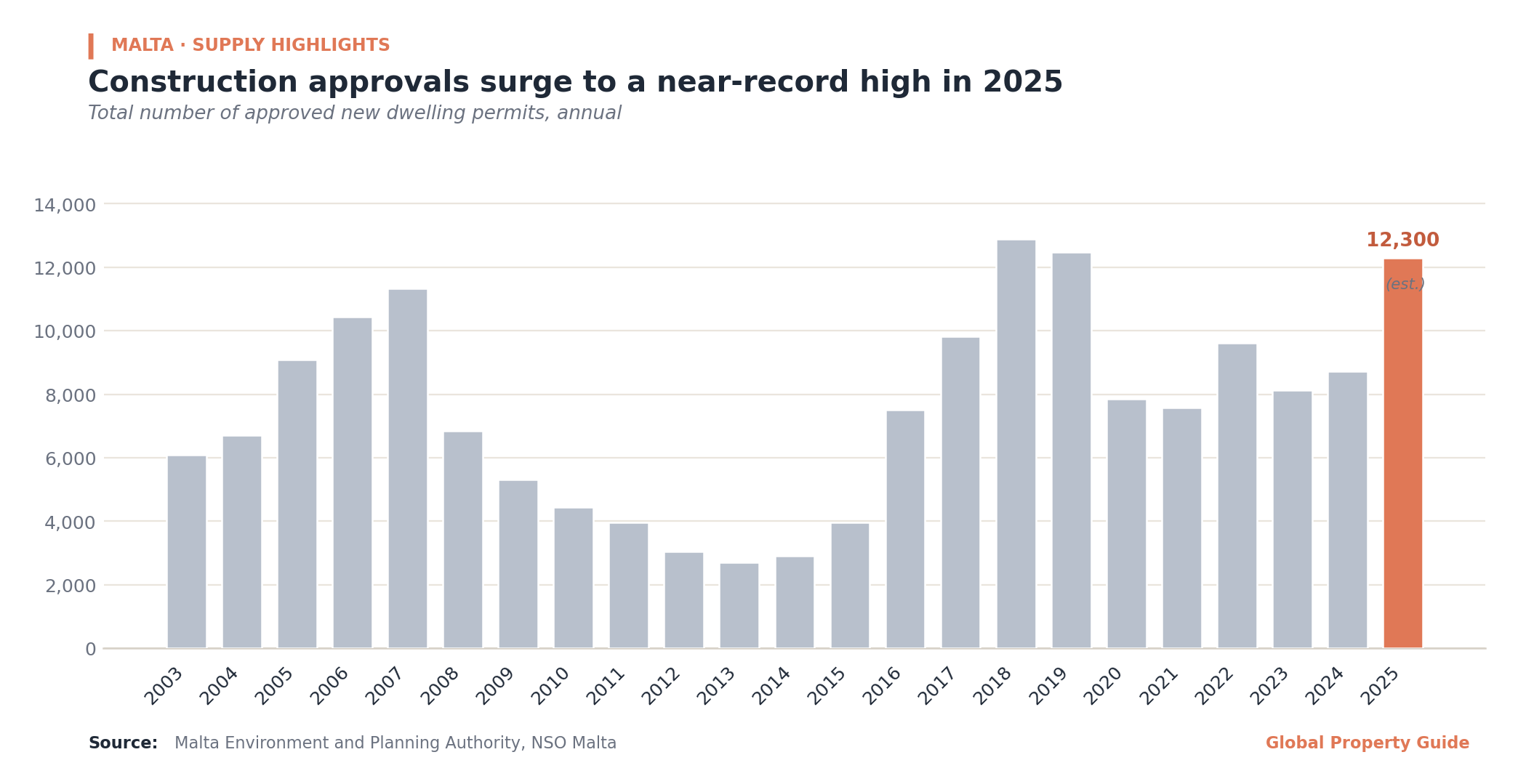
Then in the fourth quarter of 2025, the total number of dwellings for which permits were issued surged by 54.4% to 3,487 units as compared to 2,259 units in the same period last year.
The Northern Harbour district registered the largest absolute number of approved new dwellings in Q4 2025 at 1,276 units, followed by the Northern district. The highest number of approved new dwellings at locality level was registered in Santa Venera (263), followed by Ħal Qormi (197), Birkirkara (188), San Ġiljan (180) and Il-Mosta (157). The number of new dwellings approved in Malta increased by 53.6 per cent, while those in Gozo and Comino went up by 59.1 per cent compared to Q4 2024.
Rental Market:
Rental yields are low to moderate
Gross rental yields in Malta are low to moderate, averaging 3.92% in Q1 2026, slightly down from 4.05% in Q2 2025, according to research conducted by the Global Property Guide.
Apartments on the Malta mainland offer noticeably higher returns than those on Gozo. By area:
- On the Malta mainland, gross rental yields for apartments average 4.10% in Q1 2026. By bedroom count: 1-bedroom apartments average a purchase price of €210,000 and a monthly rent of €750, yielding 4.29%; 2-bedroom apartments average €285,000 and €1,000 monthly rent, yielding 4.21%; 3-bedroom apartments average €405,000 and €1,450 monthly rent, yielding 4.30%; and 4+ bedroom apartments average €1,000,000 and €3,000 monthly rent, yielding a more modest 3.60%.
- On Gozo, gross rental yields for apartments average 3.74% in Q1 2026. 1-bedroom apartments average €157,000 and €450 monthly rent, yielding 3.44%; 2-bedroom apartments average €190,000 and €600 monthly rent, yielding 3.79%; and 3-bedroom apartments average €240,000 and €800 monthly rent, yielding 4.00%.
All yields are gross - i.e., before taxes, repair costs, ground rents, estate agents' fees, and any other costs. Net yields are typically around 1.5% to 2% lower.
Round-trip transaction costs are rather high in Malta.
Free market rents continue to rise, albeit at a much slower pace
The residential rental market continues to recover from the trough reached in Q4 2020 during the onset of the COVID-19 pandemic, with advertised residential rents now significantly higher as compared to their pre-pandemic average.
Malta's rent price index:
However, rent growth is noticeably moderating. In recent quarters, advertised rents have increased at annual rates of approximately 2% to 3%, buoyed by the continued increase in tourists and foreign expat workers, according to the Central Bank of Malta. This is a sharp slowdown from the double-digit year-on-year rent growth recorded from the second half of 2021 to 2024.
"Rent growth has slowed sharply to ~4% projected for 2026 after double-digit increases 2021-2024," noted FreeMalta.com in its January 2026 rental market overview, attributing the deceleration to the surge in residential construction permits, up 110% y-o-y in Q3 2025.
According to the latest data, national average rents stand at approximately €800/month for studios, €900/month for one-bedroom apartments and €1,200/month for two-bedroom apartments. In premium areas such as Sliema and St Julian's, one-bedroom apartments command €1,100-1,500/month, while two-bedroom apartments fetch €1,500-2,200/month.
Tourists and foreign workers continue to buoy the rental market
According to survey results conducted by the Central Bank of Malta, only 10% of tenants in the country are Maltese, with the shares of EU and Third Country Nationals (TCN) tenants standing at 17% and 74%, respectively.
The total number of foreign workers in Malta reached 122,187 people in Q3 2024 and is currently estimated to have further increased to approximately 130,000 to 135,000 individuals, with the number of foreigners in employment rising for all types of occupation.
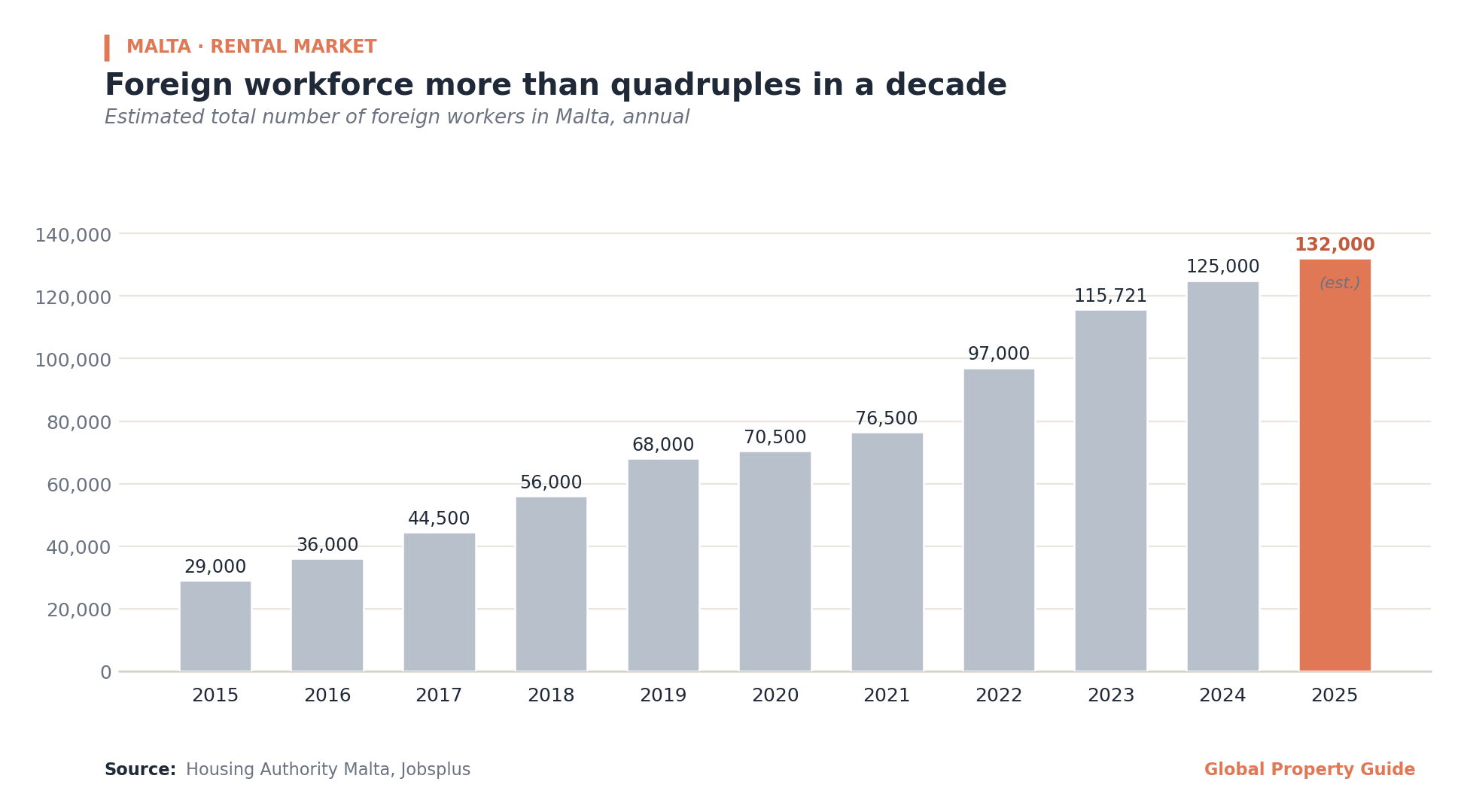
Foreign workers, particularly third-country nationals (TCN) and those from other EU countries, accounted for more than 90% of tenants in Malta.
The number of rental contracts continued to surge in the past two years. By the end of the first half of 2025, there were 70,589 active rental contracts in the country, up by 7.5% from the same period last year. This suggests sustained demand in the rental housing market.
However, Malta's rental market has a peculiar composition - only a minority of rental properties are rented at market prices, the rest being in the subsidized sector.
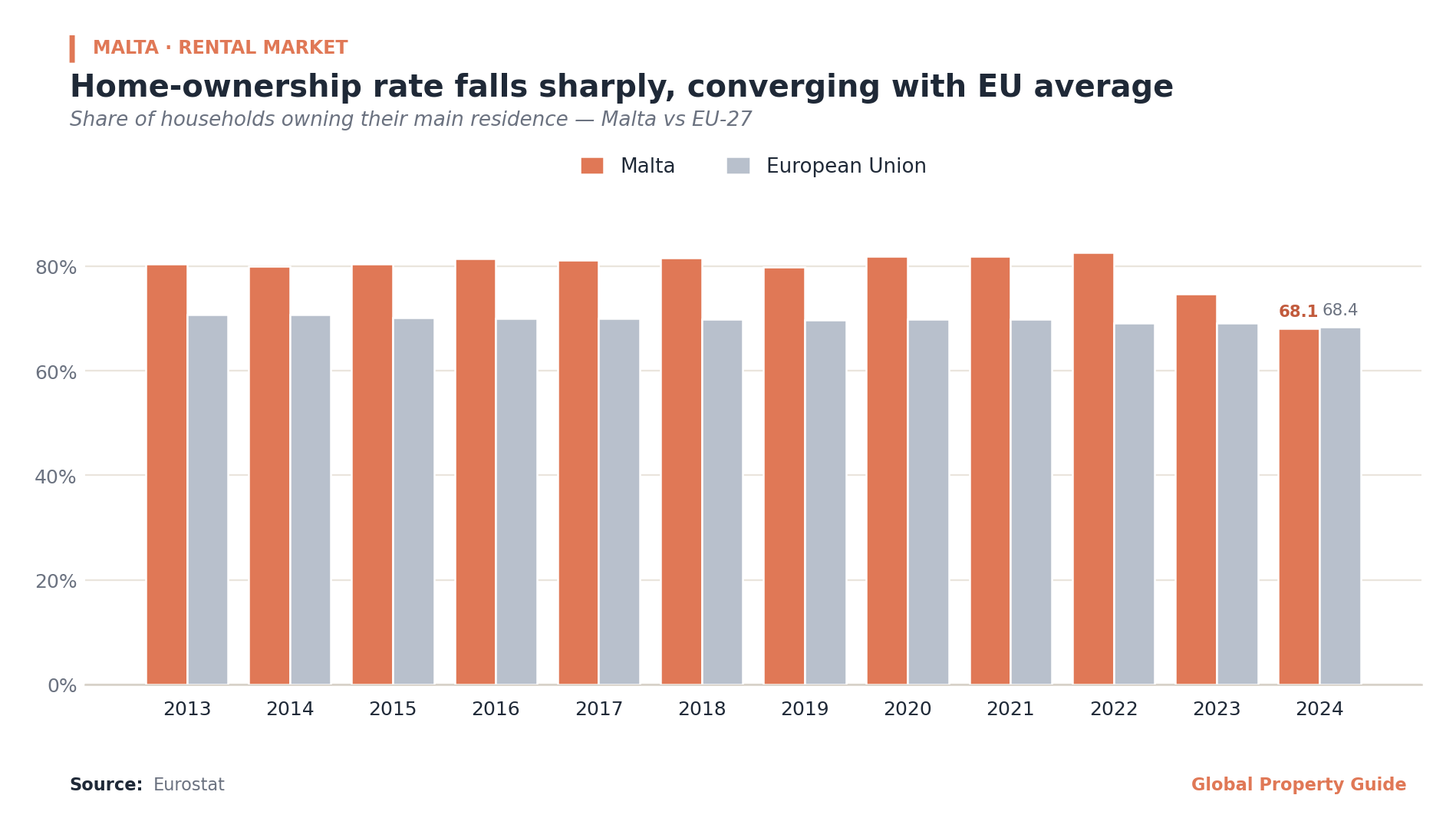
Most Maltese traditionally prefer to own property rather than rent. However, in recent years, the country's owner-occupancy rate has shown a noticeable decline. In 2024, the nationwide homeownership rate fell to 68.1%, down from 74.7% in 2023, 82.6% in 2022, and 81.9% in 2021. It is now the lowest level seen in recent memory and is at par with the 68% recorded in 1995. In fact, it is now lower than the EU-27 average of 68.4% in 2024, according to Eurostat.
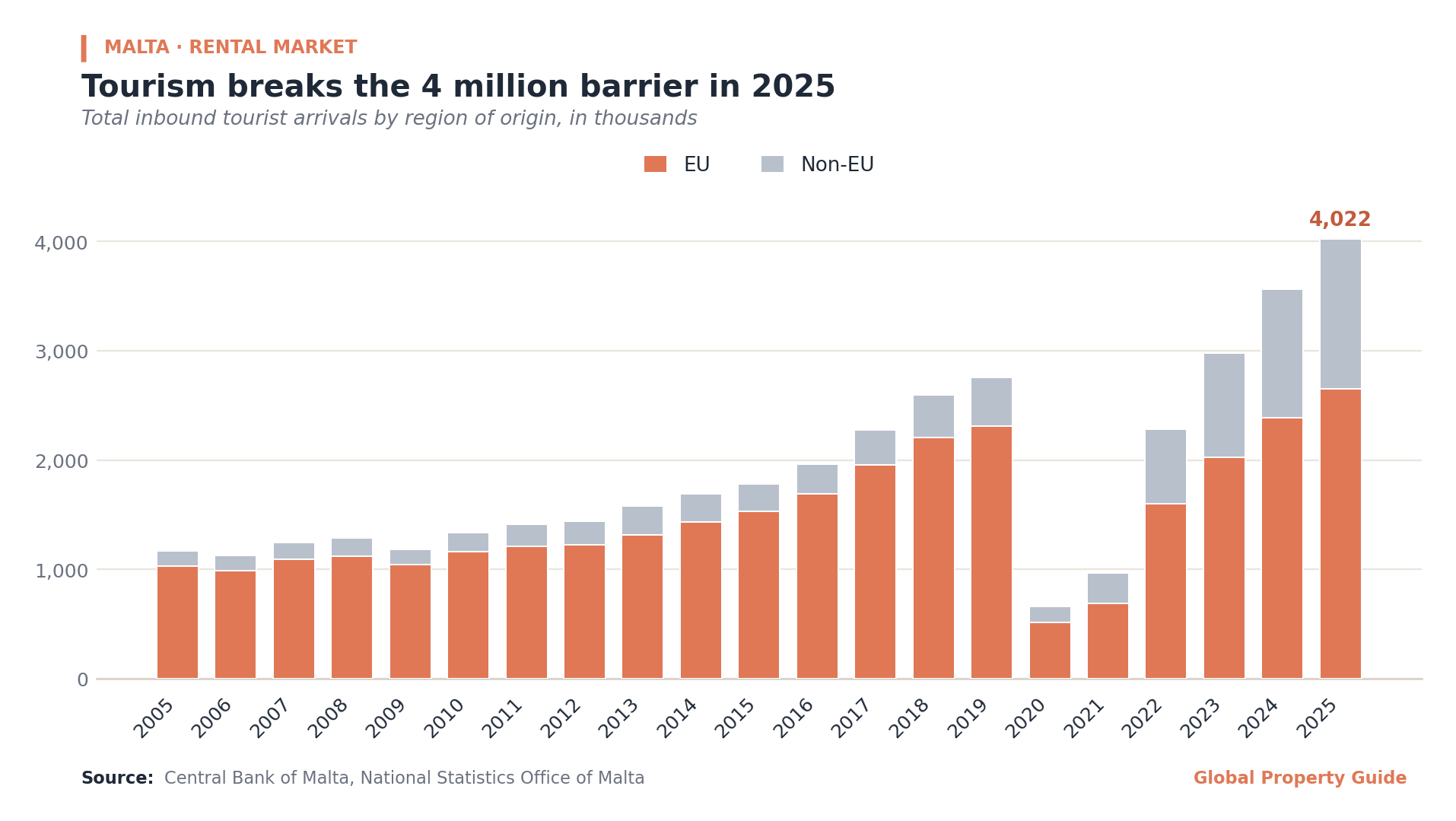
Before the pandemic, rents had been rising strongly in Malta, thanks to the increasing number of foreign workers, who mostly live in rented accommodation. Tourism, which increased by 10% annually from 2013 to 2019, and the introduction of the MIIP in 2013, increased rental demand further. However, in 2020, tourist arrivals plummeted by 76.1% to just 658,600 people, according to the Central Bank of Malta. With a lack of demand, rental rates dropped by double-digit figures.
With the easing of pandemic-related restrictions, the tourism sector started to show improvements in 2021, with the total number of tourist arrivals rising by 47% y-o-y to 968,100 people. In 2022, tourist arrivals reached 2.28 million, more than double the prior year's figure but still below the record 2.75 million tourists who visited Malta in 2019. In 2023, tourist arrivals surged by another 30.4% to 2.98 million visitors, then by 19.5% to 3.56 million in 2024.
During 2025, the total number of tourist arrivals in the country soared past the four-million milestone, reaching a new record-high of 4,022,310 visitors, up by 12.9% from a year earlier, according to the NSO. It is now more than 46% higher than the pre-pandemic peak of 2.75 million tourists seen in 2019.
Total nights spent by inbound tourists went up by 11.0% to 25.4 million nights in 2025, while total tourist expenditure was estimated at €3,904.4 million (US$4.57 billion), 18.6% higher than that recorded in 2024.
By nationality (full year 2025):
- United Kingdom: Britons remained Malta's largest source market, with 841,397 tourists in 2025, accounting for around 21% of total arrivals.
- Italy: Italians remained the second-largest market with strong contributions, particularly during the summer months.
- Poland: Polish tourists climbed to become the third-largest market, having seen the strongest percentage growth of any major source country in recent years.
- Germany and France: together represented around 14-15% of total arrivals.
- Other European markets: Strong growth was also recorded from Ireland, Switzerland, and Hungary.
"Today's figures – with the EU's highest increase in bed nights and a sharp increase in expenditure – show that the Government's actions in recent years have put us firmly on the global tourism map," said Deputy Prime Minister and Tourism Minister Ian Borg, commenting on the 2025 record figures.
Vacancy rate remains high
Paradoxically, over the past decade, Malta's residential vacancy rate has remained high, despite continuously rising house prices. The vacancy rate has long stood at around 18% of total dwelling stock - one of the highest in the European Union. Many say this is due to Malta's rent control system. To protect tenants, private rental market rents are frozen, and landlords are prohibited from evicting tenants unless a suitable alternative accommodation is offered. To increase the rent, the landlord needs the approval of the Rent Regulation Board, which is hardly ever granted.
To address the issue, the Rent Reform Law came into force on January 1, 2010. The new law established an annual minimum rent and was intended to gradually stop the inheritance of rented properties so that they revert to their owners.
Moreover, to address another source of vacant properties, the government recently reduced from 10 years to 3 years the period after which an inherited property in dispute can be sold, provided that most (but not all) heirs agree on the sale price.
To further encourage the use of vacant properties, the government reduced the stamp duty on transfers of properties within an urban conservation area from 5% to 2.5% in 2016. Also, transfers of restored properties within an urban conservation area now have a lower final withholding tax, reduced from 8% to 5%. In 2017, the government also lowered the stamp duty on properties acquired in Gozo from 5% to 2%.
Yet according to others, vacant properties don't pose a serious problem. This was the view of former Malta Developers' Association president Sandro Chetcuti. "Just drop this about vacant properties," said Chetcuti. "There is no problem with this. There are around 55,000 properties and more than half of these are second homes or summer residences, while half of the remainder are either dilapidated or being fought over by heirs. The rest are on the market, but they are simply overpriced and cannot sell."
In 2018, the Housing Authority introduced the Skeme Nikru Biex Nassistu program, encouraging private owners of one, two, or three-bedroom properties at least 30 years old that have been vacant for a year or more to enter into a lease agreement with the Authority for ten years.
The vacant property owner will receive a maximum grant of €25,000 to refurbish the property. The Housing Authority will then rent the property from the owner in a fully finished state, with the rental based on a set of criteria. During the 10-year period, the owner will receive constant rental payments, with a 2% increase annually. Moreover, the owner is exempt from paying tax on the dwelling rented.
Mortgage Market:
Mortgage interest rates remain low
Mortgage interest rates in Malta remain low, having been broadly stable through 2025 after the ECB cut its key rates in 2024-2025 amidst easing inflationary pressures. In late 2025, the average interest rate on new housing loans in Malta was around 2.0%, only marginally up from the previous year, according to the European Central Bank (ECB).
Malta's mortgage loan interest rates:
By initial rate fixation (IRF) for new business in October 2025:
- Floating rate and IRF of up to 1 year: approximately 2.69%, slightly higher than the 2.52% in the same period last year.
- IRF of over 1 and up to 5 years: approximately 1.74%, up from 1.39% in October 2024.
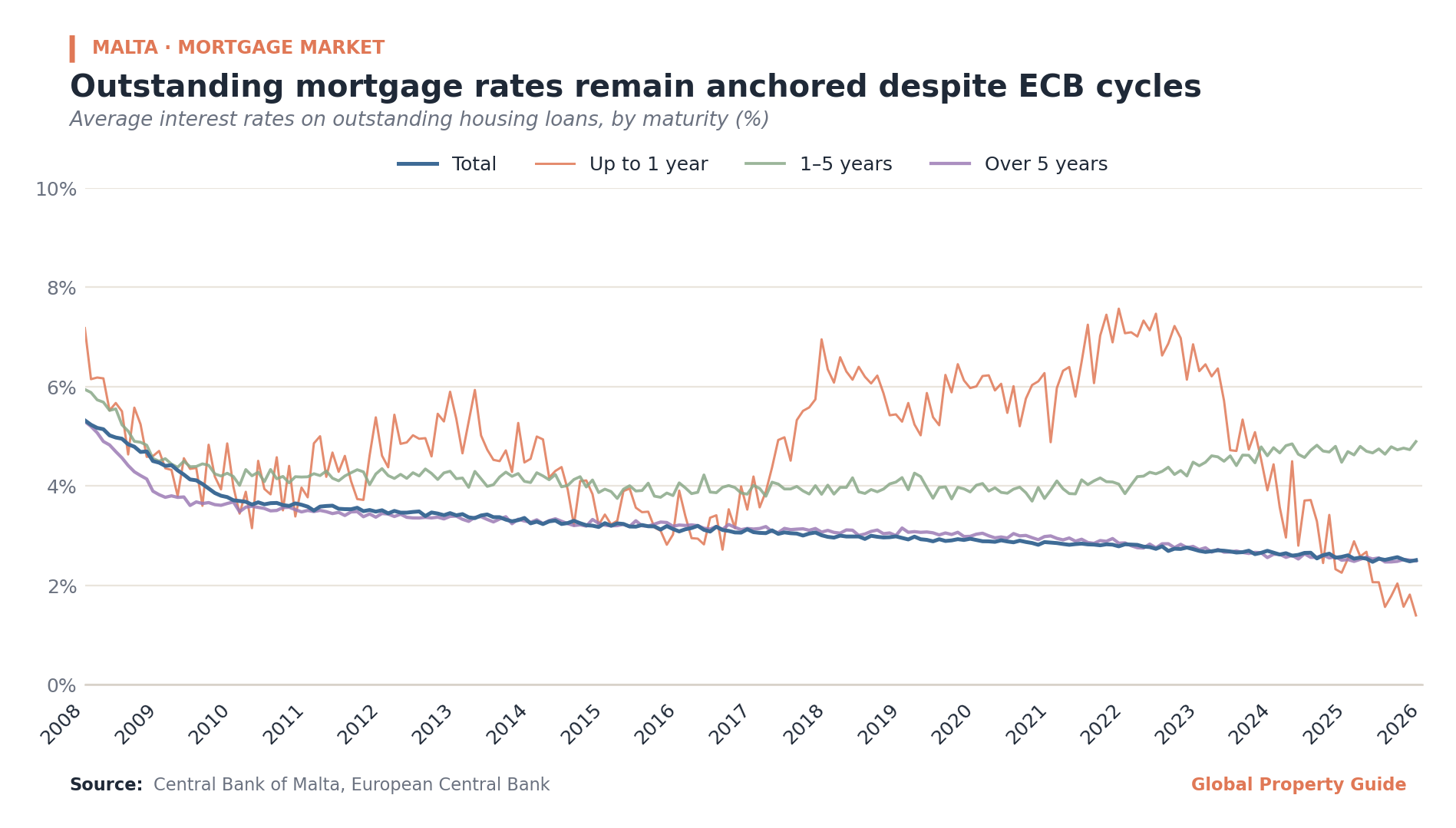
For outstanding housing loans, the average interest rate stood at 2.49% in October 2025, slightly down from 2.59% in the same period last year and 2.68% two years ago.
By maturity:
- Up to 1 year: 1.62% in October 2025, sharply down from 2.94% in October 2024 and 3.7% in October 2023.
- Over 1 and up to 5 years: 4.80%, slightly up from 4.74% in the previous year and higher than the 3.94% recorded two years earlier.
- Over 5 years: 2.49% in October 2025, slightly down from 2.58% in the same period last year and 2.68% two years ago.
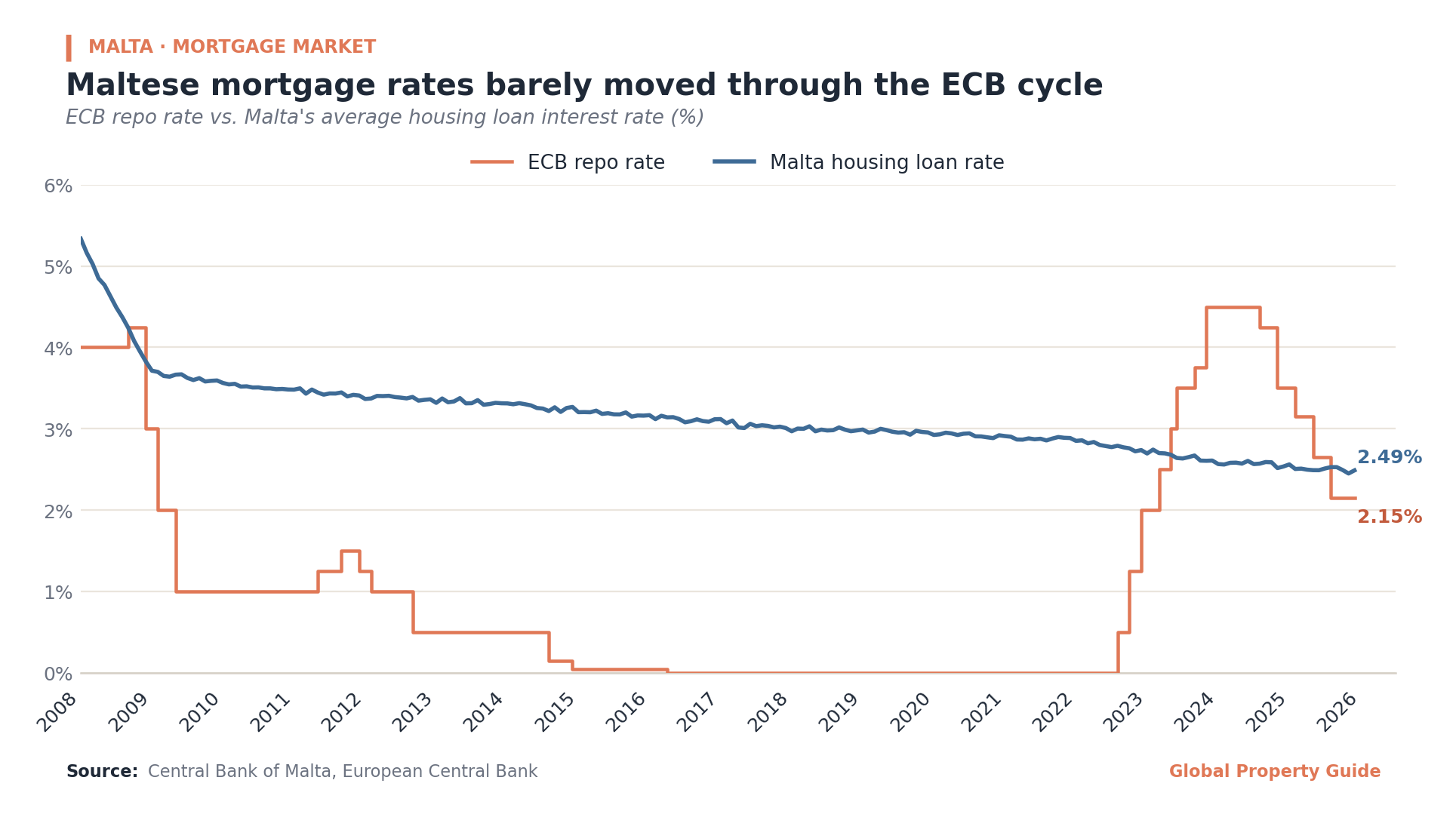
Housing loan interest rates in Malta have followed the ECB repo rate movements in the past. Housing loan rates fell sharply from late 2008, following ECB rate cuts. When the ECB cut its base rate to 0% in March 2016, where it remained until the first half of 2022, housing loan rates in Malta also stabilized at around 3%.
However, despite the successive rate hikes implemented by the ECB in the second half of 2022 to 2023 to rein in soaring inflation in the region, interest rates on housing loans in Malta have surprisingly remained more or less steady during the period. Even when the ECB implemented a monetary policy shift, cutting the ECB deposit facility rate from 4.0% in mid-2024 to 2.0% by mid-2025, mortgage interest rates in Malta hardly moved, except for the short-term loans. The ECB's key rates have remained unchanged since June 2025.
The mortgage market continues to grow
New mortgage transactions in Malta continue to increase, thanks to relatively low interest rates. In Q2 2025, the total number of new mortgage contracts rose by 3.1% to 1,315 as compared to a year earlier. This figure is far above the average quarterly transactions of 987 recorded since 2016.
"In the second quarter of 2025, the number of new mortgage contracts stood at 1,315. When compared with the second quarter of 2024, they rose by 3.1%. In absolute terms, the increases were observed mainly for maisonettes, terraced houses and apartments & penthouses, which were counteracted by lower mortgages for other types of houses, including townhouses and houses of character, captured in the 'Other' category," said the Central Bank of Malta.
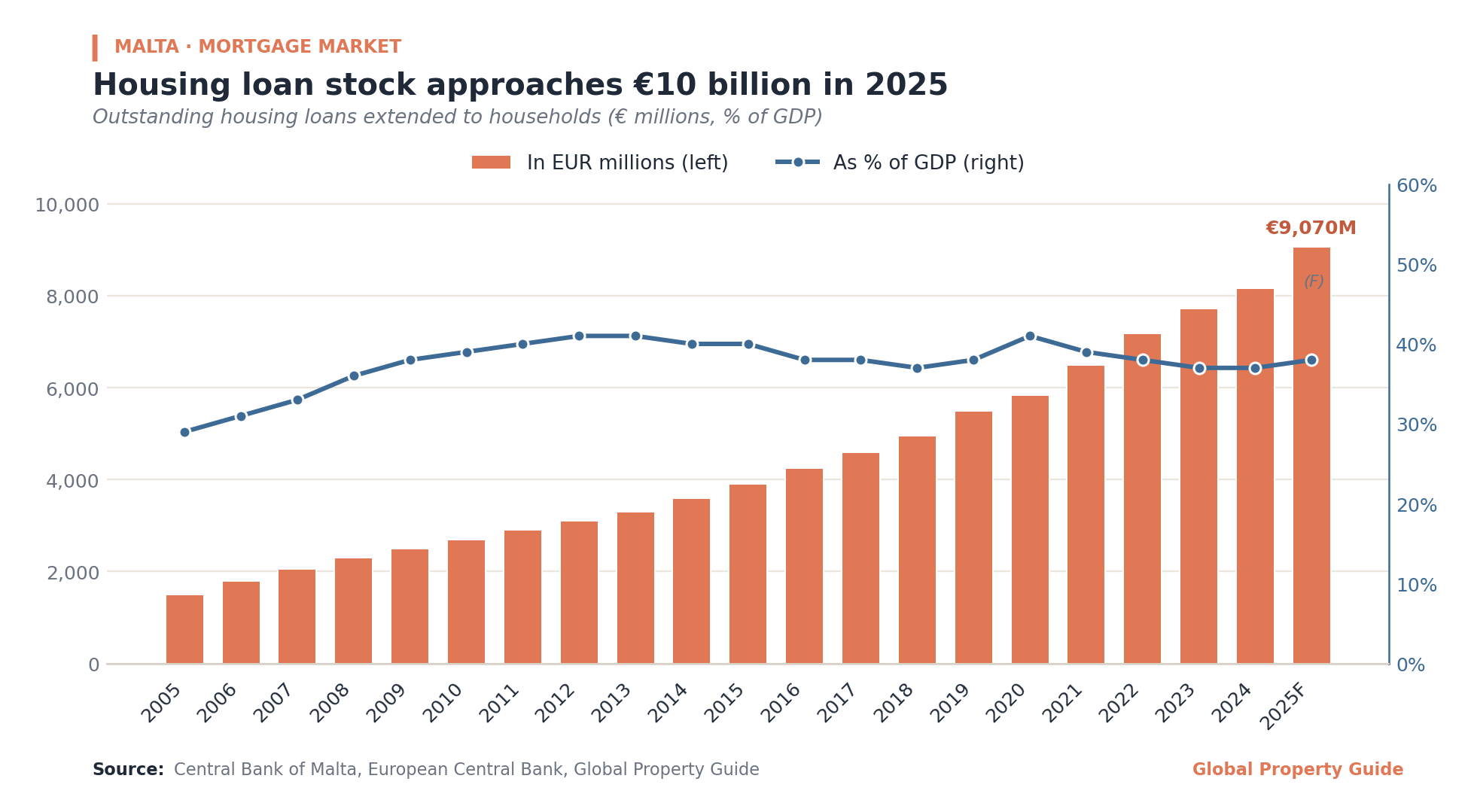
Housing loans grew by an average of 8.1% annually from 2010 to 2020, a slowdown from the annual average growth of almost 13% in 2006-2009. Housing loan growth continued in recent years, registering a nearly 11% increase in 2021, 10.4% in 2022, 7.9% in 2023, and 9.3% in 2024.
In October 2025, total housing loans outstanding in Malta rose further by 9% y-o-y to €9.07 billion (US$10.64 billion).
Accordingly, major domestic banks extended more than 90% of the credit to households and individuals, including mortgage loans.
The median loan-to-value ratio stood at 79.5% in 2024, up from 76.5% in the preceding year but still slightly down from 80% two years prior, according to the Hypostat 2025 report released by the European Mortgage Federation.
Malta's mortgage market is dominated by two major banks - Bank of Valletta plc and HSBC Bank Malta plc. According to the 2025 Hypostat report, mortgage loans are mainly provided by the core domestic banks, predominantly Bank of Valletta plc and HSBC Bank Malta plc, which together account for around 66% of the domestic retail market.
The size of Malta's mortgage market has stabilized to about 36% to 40% of GDP from 2009 to 2024, thanks to low and stable interest rates.
Accordingly, property investment in the country has become increasingly attractive in recent years due to several factors, including rising disposable income, the influx of foreign workers that boosted property demand, and the growth of tourism, which generated strong demand for private accommodations.
Socio-Economic Context:
Malta's robust economic growth, strong labor market
Malta's economy has been growing robustly in the past several years, as economic activity returns to pre-pandemic levels. The country registered real GDP growth rates of 13.3% in 2021, 4.3% in 2022, 6.8% in 2023, and 6.0% in 2024, fully offsetting the 3.4% contraction seen in 2020. The robust growth was driven by a rebound in domestic demand and export of services, benefiting from the recovery in tourism.
Before the pandemic, the economy had been growing strongly, with an annual average growth of 6.2% from 2012 to 2019, based on IMF figures.
"Malta has experienced remarkable growth over the past decade, primarily driven by export-oriented service industries, such as tourism and online gaming," said the International Monetary Fund (IMF). "Although growth is expected to moderate, it will remain among Europe's highest in the near term, along with tight labor markets."
In the fourth quarter of 2025, the country registered an annual growth rate of 6.4% in volume terms as compared to a year earlier, following year-on-year expansions of 3.0% in Q3, 2.8% in Q2 and 3.6% in Q1, buoyed by strong household consumption and external trade, according to the NSO. According to Eurostat, Malta recorded the largest expansion in GDP in the EU in Q4 2025, with quarter-on-quarter growth of 2.1%. Over the same period:
- Household consumption increased by 3.1% y-o-y in Q4 2025.
- Gross fixed capital formation increased by 0.7% y-o-y in Q4 2025.
- Government spending grew strongly by 6.3% y-o-y in Q4 2025.
- In terms of net trade, exports increased by 6.1% y-o-y in Q4 2025 while imports grew more slowly by 3.9%.
With this, the Maltese economy is expected to remain fundamentally healthy in the medium term. The European Commission expects Malta to post an economic growth of 4.0% in 2025, 3.8% in 2026, and 3.5% in 2027. The IMF, on the other hand, released an economic growth forecast for the country of an annual average of 3.9% for 2025 and 2026.
"Real GDP is projected to grow by 4.0% in 2025, driven mainly by robust private and public consumption, investment, and supported by growth in tourism, gaming and financial and professional services," said the European Commission. "Real GDP growth is forecast to remain robust, though slowing, at 3.8% in 2026 and 3.5% in 2027, reflecting capacity constraints and higher prices in the tourism sector along with labour shortages."
The Central Bank of Malta's latest growth projections are not significantly different, expecting the domestic economy to grow by 3.9% in 2025, 3.5% in 2026, and 3.3% in 2027.
The government's public finances continue to improve. The budget deficit is expected to fall to about 3.2% of GDP in 2025 and further to 2.8% of GDP in 2026, from 3.5% in 2024, 4.4% in 2023, 5.3% in 2022, 7% in 2021, and 8.7% in 2020, according to European Commission projections. The public debt-to-GDP ratio is expected to broadly stabilise at around 47.3% over the forecast horizon.
Inflation remains manageable. In December 2025, nationwide inflation, measured by the harmonized index of consumer prices (HICP), stood at 2.4%, according to the NSO. The Maltese annual rate of inflation was 0.4 percentage points higher than the 2.0% registered in the euro area.
Inflation averaged 2.9% in 2008-12 and 1.1% in 2013-21, before surging to 6.1% in 2022. It remained elevated at 5.6% in 2023 before easing to 2.4% in both 2024 and 2025.
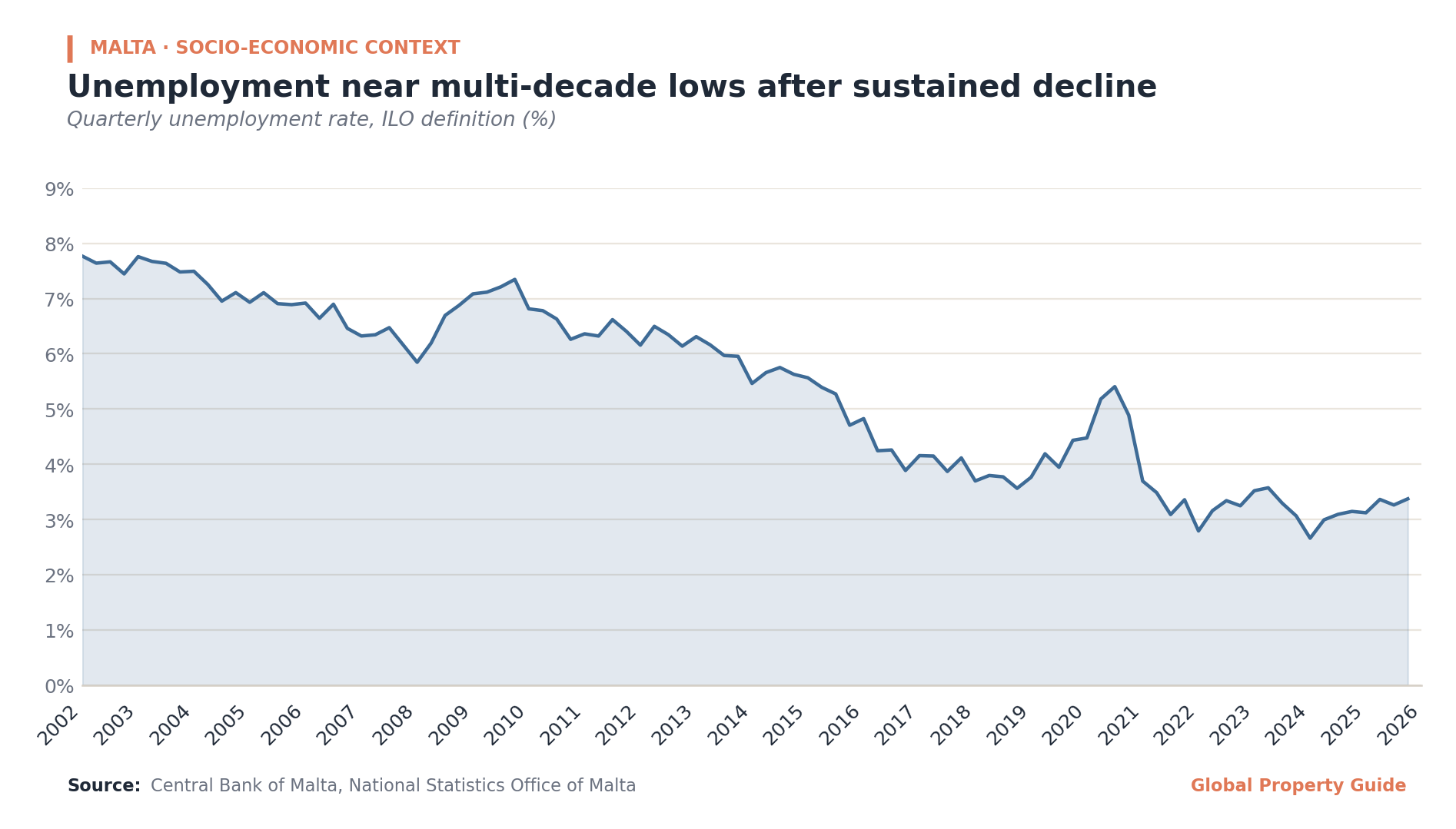
The labor market remains fundamentally strong. According to the NSO, unemployment stood at 3.4% in Q4 2025, slightly up from 2.7% in Q3 2025 and 3.1% a year earlier.
The total number of unemployed individuals stood at 11,544 in Q4 2025, while inactive persons amounted to 165,967 over the same period. Meanwhile, the employment rate edged up to 79.8%, with the number of employed persons rising by 9,465 to 330,614.
The country's unemployment rate is expected to remain low and stable at around 2.9% in 2026 and 2027, according to the European Commission.
"Labour shortages are expected to persist. Employment growth is expected to slow to 2.9% in 2026 and 2027. The unemployment rate is estimated to remain low and stable around 2.9%," said the European Commission.
Sources:
- Real Economy Indicators (Central Bank of Malta): https://www.centralbankmalta.org/
- Residential Property Price Index (RPPI): Q4/2025 (National Statistics Office): https://nso.gov.mt/
- Residential Building Permits: Q4/2025 (National Statistics Office): https://nso.gov.mt/
- Gross Domestic Product: Q4/2025 (National Statistics Office): https://nso.gov.mt/
- Inbound Tourism: December 2025 (National Statistics Office): https://nso.gov.mt/
- Malta Property sales up by 6% in 2025 (Move2Gozo / NSO): https://www.move2gozo.com/
- Residential Property Price Index up 6.1 per cent in Q4 2025 (The Business Picture): https://thebusinesspicture.com/
- Everything You Need to Know About the New Maltese Exceptional Investor Naturalization (MEIN) Regulations (IMI Daily): https://www.imidaily.com/
- Malta Citizenship by Investment Ending (Global Citizen Solutions): https://www.globalcitizensolutions.com/
- More than 70,000 active rental contracts with the Housing Authority in the first half of 2025 (Business Now): https://businessnow.mt/
- The Private Rental Market in Malta (Housing Authority): https://housingauthority.gov.mt/
- Quarterly Review (Central Bank of Malta): https://www.centralbankmalta.org/
- Housing affordability in Malta: What the data really shows (Malta Business Weekly): https://maltabusinessweekly.com/
- European Union Home Ownership Rate (Trading Economics): https://tradingeconomics.com/
- Key ECB interest rates (European Central Bank): https://www.ecb.europa.eu/
- Malta MFI Interest Rate Statistics (MIR) (ECB Data Portal): https://data.ecb.europa.eu/
- Hypostat 2025: A Review of Europe's Mortgage and Housing Markets (European Mortgage Federation): https://hypo.org/
- Stamp duty measures announced in the Budget Speech for 2017 (ACT): https://www.act.com.mt/
- 'No problem' with vacant properties, says developers' rep (Times of Malta): https://timesofmalta.com/
- Skema Nikru Biex Nassistu (Housing Authority): https://housingauthority.gov.mt/
- Nikru biex Nassistu (Housing Authority): https://housingauthority.gov.mt/
- Economic forecast for Malta (European Commission): https://economy-finance.ec.europa.eu/
- Malta (International Monetary Fund): https://www.imf.org/
- IMF Executive Board Concludes 2024 Article IV Consultation with Malta (International Monetary Fund): https://www.imf.org/
- Malta surpasses 4 million inbound tourists in 2025 (Business Now): https://businessnow.mt/
- Eurostatistics - data for short-term economic analysis (Eurostat): https://ec.europa.eu/eurostat/
- Harmonised Index of Consumer Prices (HICP): December 2025 (National Statistics Office): https://nso.gov.mt/
- Labour Force Survey (National Statistics Office): https://nso.gov.mt/