Greece's Residential Property Market Analysis 2026
Reflecting a gradual normalization after several years of sharp increases, sales prices and rents in the Greek housing market are showing slower, more uneven growth, determined by affordability constraints and greater consumer selectivity.
This extended overview from Global Property Guide covers key aspects of the Greek housing market and takes a closer look at its most recent developments and long-term trends.
Table of Contents
- Property Prices and Price Index
- Historic Perspective
- Property Demand Trends
- Property Supply Trends
- Rental Market: Rents and Rental Yields
- Mortgage Market and Interest Rates
- Economic and Social Factors
Property Prices and Price Index
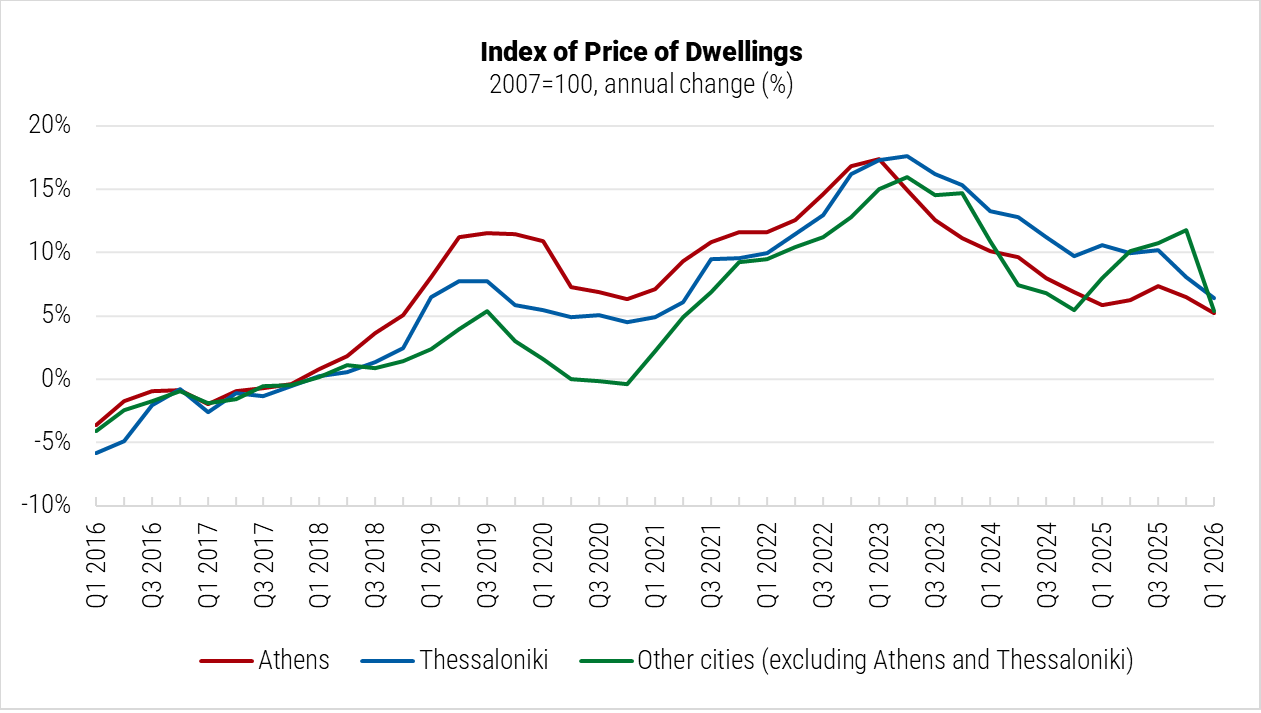
Residential property prices in Greece continued to rise in early 2026, although the pace of growth moderated further. According to provisional data from the Bank of Greece (BoG), the Index of Prices of Dwellings in Urban Areas increased by 5.6% year-on-year in Q1 2026, following average annual growth of 7.8% in 2025 and 8.8% in 2024.
The slowdown appears to reflect a gradual normalization of the market rather than a broad correction. Price growth remained supported by continued international demand and limited housing availability, while domestic buyers have become increasingly price-sensitive. A recent BoG study found that the upward movement in house prices remains broadly consistent with a higher long-term equilibrium, supported by persistent demand and supply constraints.
Greece's house price annual change:
At the regional level, Thessaloniki recorded the strongest increase among the main urban markets in Q1 2026, with apartment prices rising by 6.4% year-on-year. Prices increased by 5.4% in other cities, excluding Athens and Thessaloniki, and by 5.2% in Athens.
Newer apartments continued to outperform older properties. Prices for apartments up to five years old increased by 6.0% year-on-year in Q1 2026, compared with 5.5% for older apartments, reflecting the limited supply of recently completed and energy-efficient homes.
Data Source: BoG.
Asking-price data point to somewhat stronger growth. According to the property platform Spitogatos, the national average asking price for residential properties rose by 7.9% year-on-year in Q1 2026, down from an 8.8% increase a year earlier. Despite continued buyer interest, the platform reported that converting enquiries into completed transactions had become more difficult, suggesting growing resistance to sellers’ price expectations.
The highest asking-price levels were recorded in the prime districts of Athens. In Athens South, the average asking price reached EUR 4,167 (USD 4,877) per square meter in Q1 2026, up by 4.2% annually. Athens North followed at EUR 3,500 (USD 4,096) per square meter, an increase of 8.6%. In the municipality of Thessaloniki, the average asking price rose by 4.2% to EUR 2,667 (USD 3,121) per square meter.
Average asking price by submarket:
| Average Asking Price, Q1 2026, EUR/sqm |
Average Asking Price, Q1 2026, USD/sqm |
YoY, % | |
| Athens – Center | EUR 2,500 | USD 2,926 | 7.9% |
| Athens – North | EUR 3,500 | USD 4,096 | 8.6% |
| Athens – South | EUR 4,167 | USD 4,877 | 4.1% |
| Athens – West | EUR 2,255 | USD 2,639 | 9.7% |
| Athens – East | EUR 2,434 | USD 2,849 | 6.7% |
| Piraeus | EUR 2,558 | USD 2,994 | 2.3% |
| Piraeus suburbs | EUR 2,222 | USD 2,600 | 8.8% |
| Rest of Attica | EUR 2,086 | USD 2,441 | 4.3% |
| Thessaloniki – Municipality | EUR 2,667 | USD 3,121 | 4.2% |
| Thessaloniki – Suburbs | EUR 2,074 | USD 2,427 | 14.2% |
| Thessaloniki – Rest of Prefecture | EUR 1,125 | USD 1,317 | 16.7% |
| Note: Exchange rate as of Q1 2026, EUR 1 = USD 1.1703. | |||
| Data Source: Spitogatos. | |||
Affordability pressures are nevertheless becoming more pronounced. According to the International Monetary Fund (IMF), Greek house prices have increased by about 85% from their post-crisis low, compared with a 47% rise in disposable income per capita. The IMF estimates that average residential prices are around 10% above levels implied by selected market fundamentals, although conditions vary significantly across regions.
Looking ahead, residential prices are expected to continue rising during the remainder of 2026, although growth is likely to moderate further and become increasingly differentiated by location and property quality. Ellika Real Estate forecasts price growth of around 5% to 7% in Athens, with newly built and energy-efficient homes expected to outperform. The outlook for Thessaloniki is more mixed. A June 2026 industry survey found that 42% of brokers expected prices for older homes to remain stable over the following six months, while 64% anticipated further increases for newly built properties.
Overall, limited supply should continue to support residential values, but affordability constraints and greater buyer selectivity are likely to result in slower and more uneven price growth. Newer, renovated, and well-located properties should remain relatively resilient, while older or overpriced stock may experience weaker appreciation.
Historic Perspective
From Deep Correction to Moderating Growth
Between the early 2000s and 2007, Greece’s housing market experienced sustained price growth, supported by economic expansion, low borrowing costs, and rapid credit growth. The cycle reversed following the global financial crisis and subsequent sovereign debt crisis. Between 2007 and 2017, the Index of Prices of Dwellings in Urban Areas declined by 41.87% in nominal terms and 48.42% in real terms, amid a deep recession, austerity measures, high unemployment, and severe credit contraction.
Recovery began in 2018, coinciding with Greece’s exit from its final economic adjustment program. Price growth strengthened in the following years and remained positive even during the pandemic. The rebound was supported by improving economic conditions, foreign investment, the Golden Visa program, tourism-related demand, and limited housing supply.
After peaking in 2023, price growth began to moderate. In 2025, urban residential prices increased by 7.78% in nominal terms and 4.76% in real terms. Despite the slowdown, constrained supply and continued foreign demand kept growth relatively strong, pointing to a more measured phase of expansion rather than a broad correction.
20-year annual house price change (based on the annual Index of Prices of Dwellings in Urban Areas and Consumer Price Index):
| Year | Nominal house prices (%) |
Inflation-adjusted house prices (%) |
Year | Nominal house prices (%) |
Inflation-adjusted house prices (%) |
|
| 2006 | 12.98% | 9.37% | 2016 | -2.41% | -2.43% | |
| 2007 | 6.19% | 3.10% | 2017 | -1.10% | -2.21% | |
| 2008 | 1.46% | -2.66% | 2018 | 1.84% | 1.05% | |
| 2009 | -4.30% | -5.57% | 2019 | 7.36% | 6.82% | |
| 2010 | -4.37% | -8.67% | 2020 | 4.76% | 6.09% | |
| 2011 | -5.52% | -8.37% | 2021 | 7.99% | 7.38% | |
| 2012 | -11.76% | -12.66% | 2022 | 12.39% | 2.83% | |
| 2013 | -10.92% | -10.15% | 2023 | 14.22% | 9.65% | |
| 2014 | -7.98% | -6.68% | 2024 | 8.79% | 5.63% | |
| 2015 | -5.09% | -4.04% | 2025 | 7.78% | 4.76% | |
| Data Sources: BoG, OECD, Global Property Guide. | ||||||
Property Demand Trends
International Demand Holds Firm Despite Golden Visa Normalization
Housing demand in Greece remains resilient, although the market is becoming more selective after several years of exceptionally strong growth. International buyers continue to provide substantial support, particularly in Athens, Thessaloniki, and the country’s main tourism and second-home destinations, while domestic demand is increasingly constrained by affordability pressures, high prices, and limited suitable supply.
According to the latest annual survey by Cerved Property Services, more than one-third of real estate professionals estimated that foreign purchasers accounted for over 30% of transactions in their respective markets. Their presence was considerably higher in major urban centers and prime second-home locations, exceeding 70% in some parts of the Cyclades, the Ionian Islands, Halkidiki, and Ermionida.
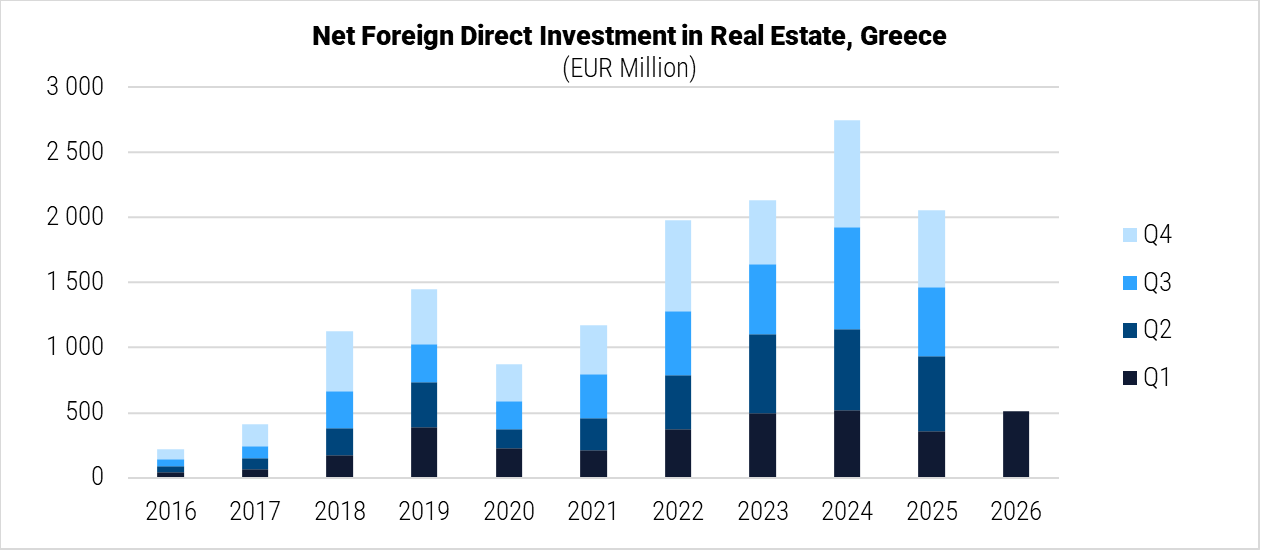
Official balance-of-payments data from the BoG confirms that foreign investment remains substantial, despite some volatility. Net inflows into Greek real estate reached a record of approximately EUR 2.75 billion in 2024, before declining by 25.26% to around EUR 2.06 billion in 2025. The trend strengthened again in Q1 2026, when inflows rose by 43.4% year-on-year to EUR 511.6 million. The increase partly reflected comparison with a relatively weak Q1 2025, following the earlier rush to complete transactions before the introduction of higher Golden Visa thresholds.
Data Source: ELSTAT.
The Golden Visa has historically supported foreign housing demand, although its importance is gradually declining as international buying broadens beyond residence-linked investment. Under Law No. 5100/2024, Article 64, effective for new investments from September 2024, minimum thresholds rose to EUR 800,000 (USD 936,240) in Attica, Thessaloniki, Mykonos, Santorini, and islands with populations above 3,100, and to EUR 400,000 (USD 468,120) elsewhere. Standard investments must generally involve one property of at least 120 sqm, while a EUR 250,000 (USD 292,575) route remains available for qualifying conversions and listed-building restorations. Short-term rentals are prohibited.
The higher thresholds have contributed to a normalization in new applications. According to the Greek Ministry of Migration and Asylum’s official statistics, initial Golden Visa applications declined by 25.1% to 7,029 in 2025. In Q1 2026, applications fell by a further 57.8% year-on-year to 1,236, even as property-related foreign investment increased strongly. Market professionals cited by Kathimerini interpreted this divergence as evidence that foreign demand is becoming less dependent on residency incentives.
This broader demand profile is also reflected in data from RE/MAX Greece. Among foreign buyers recorded by the network in 2025, 52% purchased a second or holiday home, 30% bought primarily for investment, and only 8% cited residence-permit eligibility as their main motivation. Around 90% purchased without mortgage financing, while most transactions were concentrated in the EUR 100,000 (USD 117,030) to EUR 300,000 (USD 351,090) price range.
Domestic demand remains present but is increasingly price-sensitive. Lower borrowing costs and government-supported purchase schemes are providing some support, but high residential prices and limited suitable supply continue to restrict the buyer pool. The European Mortgage Federation (EMF) describes the outlook as “moderately positive,” while identifying worsening affordability, high housing costs, supply shortages, and frequent legislative changes as the main impediments.
Forward-looking indicators also point to greater caution. The fifth Real Estate Market Barometer, compiled by the University of Macedonia, found that active sellers now substantially outnumber buyers. Older dwellings also generally needed to be priced 25% to 30% below comparable new properties to attract interest, highlighting the growing importance of condition, energy efficiency, and renovation costs.
Property Supply Trends
Regulatory Clarity Supports a Recovery in Housing Activity
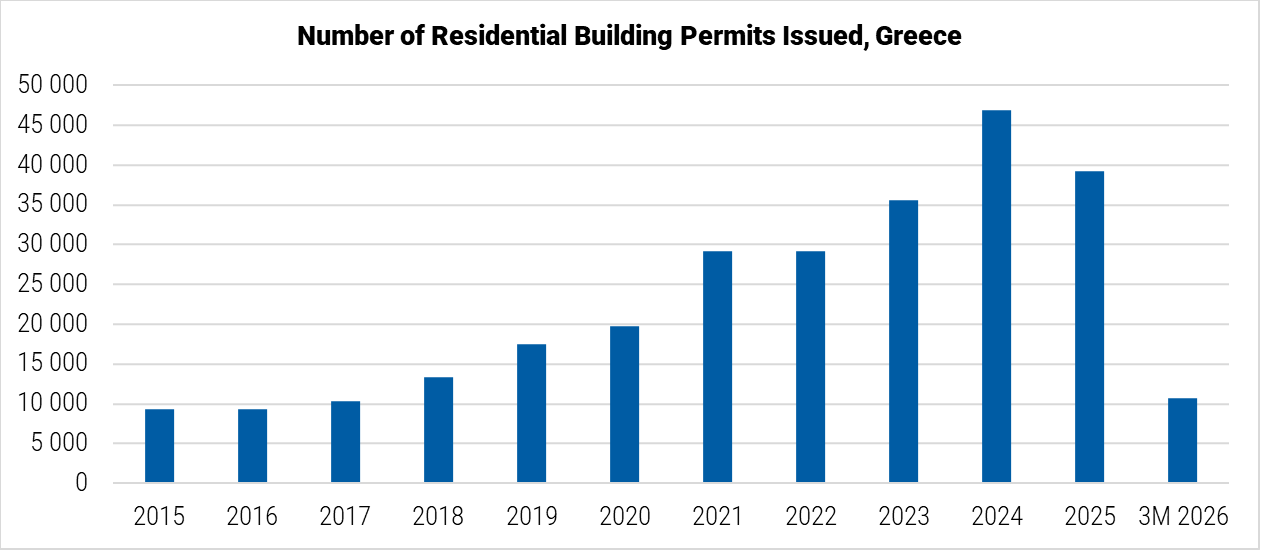
Residential development activity in Greece weakened sharply in 2025, before showing signs of recovery in early 2026. According to the Hellenic Statistical Authority (ELSTAT), 39,219 dwellings were authorized nationwide in 2025, down 16.8% year-on-year.
The downturn partly reflected uncertainty over Greece’s New Building Regulation (NOK), which allowed qualifying projects to add floor area or height. After these bonuses were suspended nationwide in December 2024, developers faced uncertainty over whether existing permits could proceed, resulting in delays, redesigns, and postponed projects. The framework was clarified in May 2025: developments already under construction could generally continue, while those not yet started had to revise their permits without the disputed bonuses. Similar incentives may now be introduced only through area-specific urban plans. The BoG subsequently noted that the revised framework contributed to a recovery in private building activity during the second half of 2025.
Against this backdrop, 10,730 dwellings were authorized during January–March 2026, up 72.5% year-on-year. Attica recorded the strongest increase, at 138.9%, followed by Northern Greece, at 93.7%, based on the regional groupings. The strong increase partly reflects normalization from an unusually weak comparison period and will take time to translate into completed homes. Despite the recent rebound, the BoG continues to describe the replenishment of Greece’s housing stock as “historically sluggish”, indicating that new construction remains insufficient to address the country’s supply constraints in the near term.
Data Source: ELSTAT.
Residential construction activity by region:
| Number of Dwellings Authorized, Jan-Mar 2026 |
YoY, % | |
| Attica | 3,373 | 138.88% |
| Northern Greece | 3,739 | 93.73% |
| Central Greece | 1,870 | 30.50% |
| Aegean Islands, Crete | 1,748 | 21.05% |
| Greece | 10,730 | 72.54% |
| Note: Regional groupings are as follows: Northern Greece includes Eastern Macedonia and Thrace, Central Macedonia, Western Macedonia, Thessaly, and Epirus; Central Greece comprises Central Greece, the Ionian Islands, Western Greece, and the Peloponnese; Aegean Islands and Crete include the North Aegean, South Aegean, and Crete. | ||
| Data Source: ELSTAT. | ||
The outlook is therefore cautiously positive. The American-Hellenic Chamber of Commerce’s Real Estate & Development Committee expects residential property to remain among the stronger-performing segments in H1 2026, supported by continued demand and limited housing supply. However, high construction costs, skilled-labor shortages, regulatory constraints, and bureaucratic delays remain significant obstacles to development. The European Construction Industry Federation (FIEC) likewise projects residential investment to remain positive in 2026, although the weaker 2025 permit pipeline may gradually constrain new supply.
Rental Market: Rents and Rental Yields
Positive, Albeit Moderating, Momentum for Rents Continues
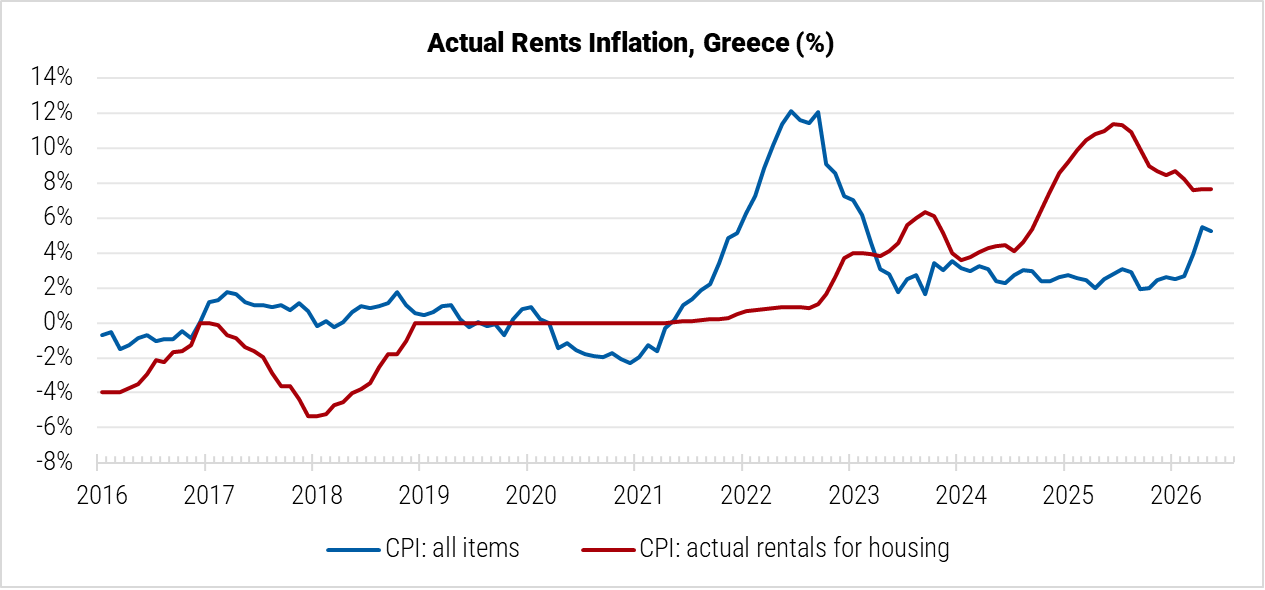
Against the backdrop of insufficient supply, exacerbated by units being repurposed for short-term rentals in popular tourist locations, rental inflation in the traditional long-term rental segment in Greece continues to outpace overall price growth, although it is past peak, with a slowdown observed since mid-2025. According to ELSTAT, in May 2026, the actual rentals for the housing component of the consumer price index (CPI) recorded 7.7% year-on-year growth (down from a peak of 11.4% in June 2025).
Greece's rent price index:
In parallel, market-based indicators point to positive, albeit moderating, dynamics for asking rents in key submarkets, suggesting continued upward pressure on rents in the coming periods, especially in large metropolitan areas such as Thessaloniki and Athens.
“Residential rental average asking prices in Greece continued to show mixed trends in recent quarters, with a clear slowdown in the pace of growth across several regions compared to the previous period, while some markets even recorded negative changes,” said the Q1 2026 market analysis from the property platform Spitogatos. “Overall, the data reflects a market that remains under strong demand pressure but is gradually moving toward a more balanced phase following earlier periods of sharp increases.”
Data Source: ELSTAT.
In nominal terms, as of Q1 2026, the average asking rent reported by Spitogatos exceeded EUR 10 per square meter in Central, North, and South Athens, as well as Piraeus and the Thessaloniki Municipality. More pronounced year-on-year growth in asking rents was observed in Central Athens (6.9%), followed by Thessaloniki - Rest of Prefecture (6.4%), and Rest of Attica (6.0%).
As for gross rental yields for residential properties in Greece, research by Global Property Guide found them at the average of 4.38% in May 2026, slightly down from 4.60% previously reported in June 2025. The highest potential performance among the surveyed submarkets was estimated for rental properties in Athens (5.52%) and Patra (4.68%), while the lowest yields were observed in Kavala (3.44%).
Average asking rent in selected submarkets:
| EUR/sqm, Q1 2026 |
USD/sqm, Q1 2026 |
YoY, % Q1 2026 vs Q1 2025 |
|
| Athens - Center | EUR 11.92 | USD 13.95 | 6.9% |
| Athens - North | EUR 11.54 | USD 13.51 | 2.7% |
| Athens - South | EUR 13.27 | USD 15.53 | 3.2% |
| Athens - West | EUR 9.09 | USD 10.64 | 5.5% |
| Athens - East | EUR 9.38 | USD 10.98 | 4.8% |
| Piraeus | EUR 10.15 | USD 11.88 | -1.8% |
| Piraeus suburbs | EUR 8.97 | USD 10.50 | 4.4% |
| Rest of Attica | EUR 9.52 | USD 11.14 | 6.0% |
| Thessaloniki - Municipality | EUR 10.44 | USD 12.22 | 5.1% |
| Thessaloniki - Suburbs | EUR 7.83 | USD 9.16 | 4.4% |
| Thessaloniki - Rest of Prefecture | EUR 4.63 | USD 5.42 | 6.4% |
| Note: Exchange rate as of Q1 2026, EUR 1 = USD 1.1703. | |||
| Data Source: Spitogatos. | |||
Overall, reflecting a strong expansion of underlying demand, the share of the country’s population renting rather than owning their residence increased from 22.8% in 2010 to 30.6% in 2025, according to Eurostat. Against this background, rental inflation remains a concern in terms of housing affordability (as Greece already has the highest housing cost overburden in the EU).
“Rents <…> have increased at a much faster rate than households’ purchasing power in recent years. Those who rent are, therefore, actually experiencing a decrease in disposable income, effectively losing the benefits of wage increases and tax cuts,” Kathimerini wrote in December.
To address the deepening affordability crisis, at the end of 2025, the Greek authorities announced a package of six housing measures, including tax incentives to private developers who build new or convert older buildings and rent them out for at least 10 years, curbs on short-term rentals (ban on new registrations expanded to central Thessaloniki), and subsidies for renovations to boost the supply of affordable homes.
More recently, in June 2026, the Ministry of Social Cohesion and Family unveiled a comprehensive National Strategy for Housing Policy covering the period from 2026 to 2035 and combining existing and proposed measures for increasing housing supply. Among other solutions, the plan (currently undergoing public consultations) proposes a new specialized category of Golden Visa that would allow investors to acquire portfolios of more than one property, provided the homes are offered exclusively for long-term rental within a specified period.
Mortgage Market and Interest Rates
Supported by Subsidized Programs, New Lending Grows, but Affordability Remains a Constraint
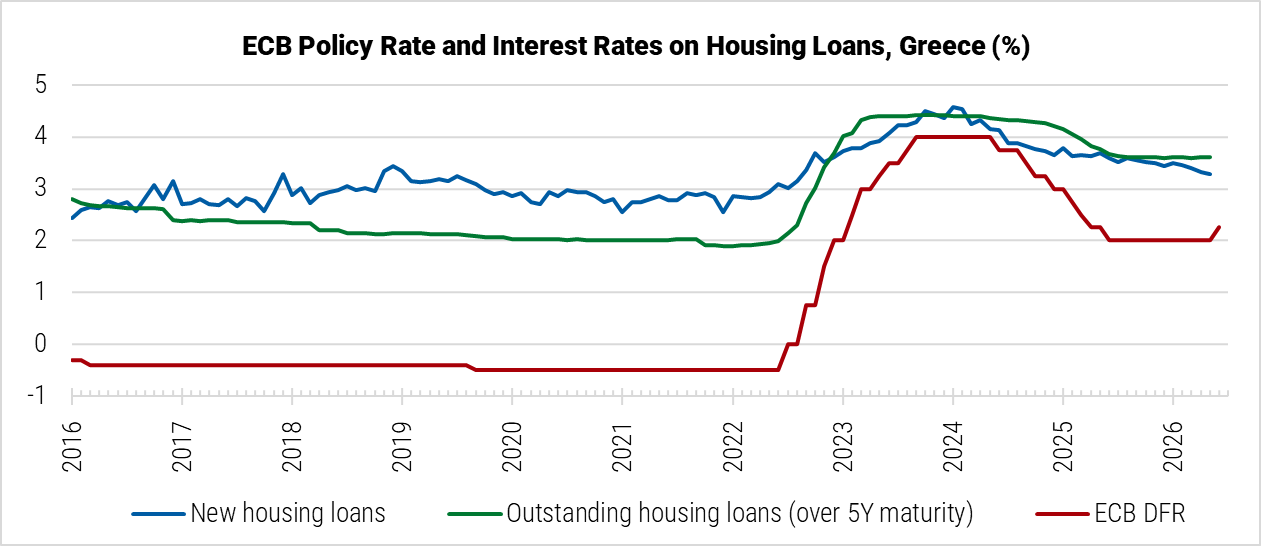
After a year-long hold, the European Central Bank (ECB) announced a 25 bps increase in its policy rates in June 2026, bringing the deposit facility rate to 2.25%, the main refinancing operations rate to 2.40%, and the marginal lending facility rate to 2.65% to address energy-driven inflationary pressures stemming from the Middle East conflict. Commenting on the decision in a press release, the regulator noted that “the outlook remains uncertain, with upside risks for inflation and downside risks for economic growth”, and most economists recently polled by Reuters agree that another key rate increase is likely in September.
Greece's mortgage loan interest rates:
As the Greek mortgage market remains defined by variable-rate loans, in the coming months, this shift will likely reflect in domestic interest rates, which had previously continued to decline gradually from their 2023-2024 peak levels. As of May 2026, the BoG reported the weighted average interest rate on new housing loans to individuals and private non-profit institutions at 3.28%, down from 3.68% a year ago. For outstanding housing loans with an original maturity of over 5 years, the weighted average interest rate reached 3.60%, down from 3.76% a year prior.
Data Sources: ECB, BoG.
Weighted average interest rates on housing loans to individuals and private non-profit institutions:
| May 2026 | YoY | May 2025 | YoY | May 2024 | |
| New housing loans | 3.28% | ↓ | 3.68% | ↓ | 4.15% |
| Floating rate and IRF up to 1 year | 3.50% | ↓ | 3.57% | ↓ | 4.96% |
| IRF of over 5 and up to 10 years | 3.85% | ↓ | 4.36% | ↑ | 4.07% |
| Outstanding housing loans | |||||
| Original maturity over 1 and up to 5 years | 5.17% | ↓ | 5.37% | ↓ | 5.45% |
| Original maturity of over 5 years | 3.60% | ↓ | 3.76% | ↓ | 4.36% |
| Data Source: BoG. | |||||
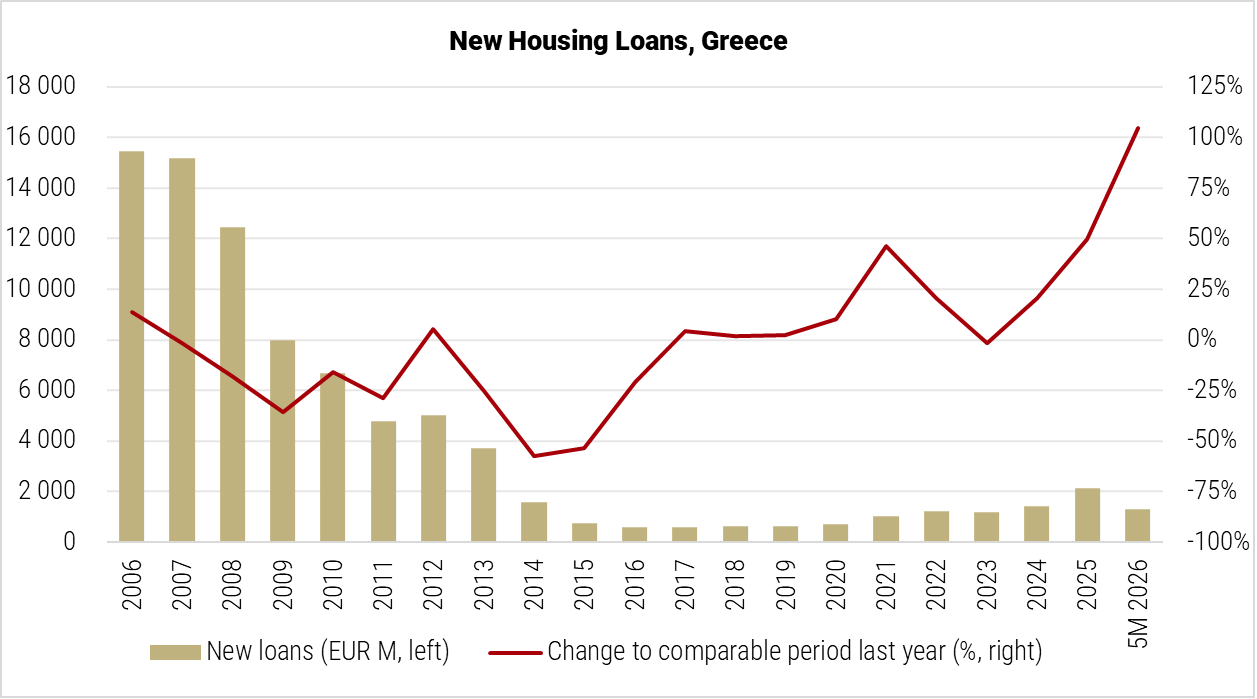
According to the central bank’s assessment, the overall reduction in mortgage interest rates, combined with the upward trend in the house price index, positively impacted demand for housing loans in Greece. Another notable factor behind the pick-up in lending activity was the launch of the subsidized programs with a total budget of over EUR 2 billion, funded in part by the EU Recovery and Resilience Facility. The BoG estimated that in early 2026, approximately 30% of all newly granted housing loans were linked to the Hellenic Development Bank (EAT) managed programs for the purchase of new (“My Home II”) or the upgrading of existing homes (“Upgrading My Home”).
Aiming to attract prospective homebuyers who do not qualify for subsidized programs, some Greek banks have also reportedly launched special offers on loans for the purchase of a main residence and introduced discounted interest rates for prospective borrowers up to 50 years old.
As a result, the total value of new loans for house purchase reported by monetary financial institutions in Greece notably rebounded in 2024 (20.4% year-on-year), with even stronger positive dynamics observed in 2025 (49.8% year-on-year) and early 2026. In the first five months of this year, a total of EUR 1.3 billion (USD 1.5 billion) in new housing loans were issued by banks, which was 104.7% more than during the same period in 2025.
At the same time, lending volumes in the country remain substantially below pre-crisis levels, with only 20% of housing purchases in the Greek market estimated to be financed with credit. Data presented by Theodoros Mitrakos, director-adviser and former deputy governor of the BoG, at the Prodexpo North real estate conference in 2025 showed that the annual number of concluded home purchase loan contracts dropped from 80,000 before the financial crisis to not exceeding 14,000 in recent years.
Mitrakos tied the pick-up in lending volumes observed since 2024 to subsidized programs, noting that the underlying landscape of the mortgage market still differs significantly from the pre-crisis period. “This is explained by the reluctance of today’s young people to commit for such a long period of time and is naturally linked to two critical parameters, the high precariousness of the labor market and the low disposable income of young couples,” he said, as quoted by Kathimerini.
More recently, the IMF also outlined affordability as one of the main issues slowing the recovery of Greece’s mortgage market. “Even when household income is sufficient to satisfy typical DSTI [debt service-to-income] requirements, the downpayment required to access mortgage credit remains a major barrier. <…> Access to mortgage credit is further constrained by the crisis legacy, which translates into conservative bank lending standards,” said the IMF’s selected issues report published in May 2026.
Data Source: BoG.
Overall, given large repayments originating from the credit boom period, net credit growth for housing loans in the domestic banking system remains in negative territory. ECB banking sector data showed a 3.2% annual decline in the total value of outstanding housing loans in the country in 2025, following declines of 6.9%, 4.4%, and 3.7% drops in 2024, 2023, and 2022, respectively. As of May 2026, the housing loan stock stood at EUR 25.3 billion (USD 29.5 billion), demonstrating a further 0.5% decline since the beginning of the year.
The relative size of the market, as measured by the ratio of outstanding housing loans to GDP at current prices, also continued to decline, dropping from its peak of an estimated 40.1% in 2012 to just 10.2% in 2025. The share of Greece’s population living in owned residences with an outstanding mortgage or housing loan decreased from 15.2% to 8.9% during the same period, according to Eurostat figures.
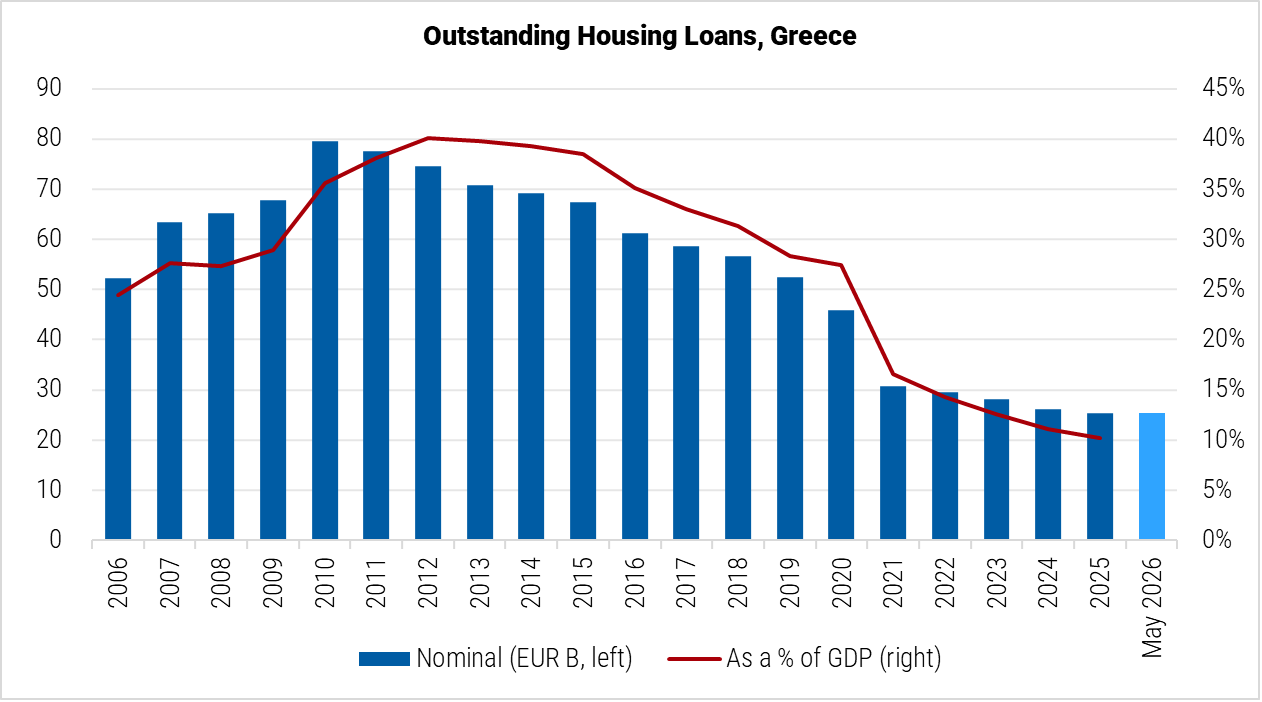
Data Source: ECB.
Economic and Social Factors
Moderating Momentum Amid External Headwinds and Structural Challenges
Although the energy price shock from the Middle East conflict recently presented a considerable headwind, driven by steady consumption and investments supported by EU funds, the Greek economy continues to expand, with real GDP growth maintained at 2.1% in 2025 and projected to remain above the EU average over the next two years, while moderating to 1.8% in 2026 and 1.6% in 2027.
Fueled by the sharp increase in energy prices, consumer price index (CPI) inflation in Greece, which had previously eased to an annual average of 3.0% in 2024 and 2.9% in 2025, re-accelerated over the past several months, most recently reported by ELSTAT at 5.2% in May 2026. The European Commission projects the indicator to average 3.7% this year, before dropping to 2.4% in 2027, when an assumed correction in energy prices should support disinflation.
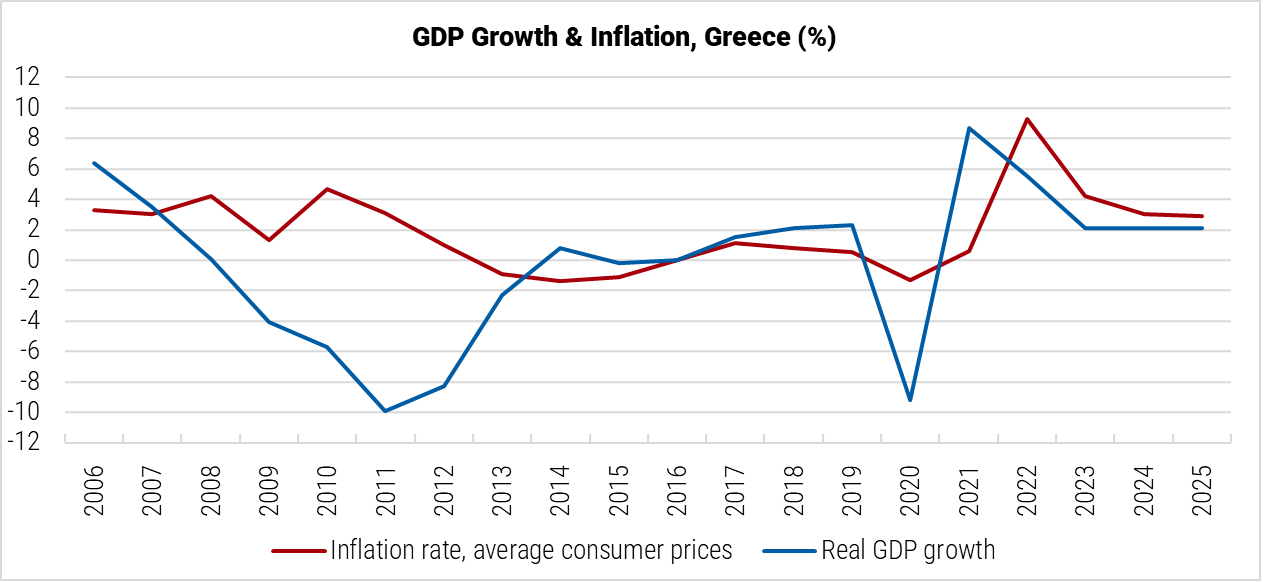
Data Source: IMF.
In the Greek labor market, the expansion continued in 2025 and early 2026, as evidenced by a further decline in the unemployment rate, which reached 8.1% in May 2026, the lowest level since 2008, which is still above the EU average, however. The spring 2026 European Commission forecast also noted that the long-term unemployment rate in Greece remains broadly unchanged and the highest in the EU (close to 5%), reflecting the economy’s “long-standing structural challenges such as skill gaps, and insufficient child- and elderly care solutions”.
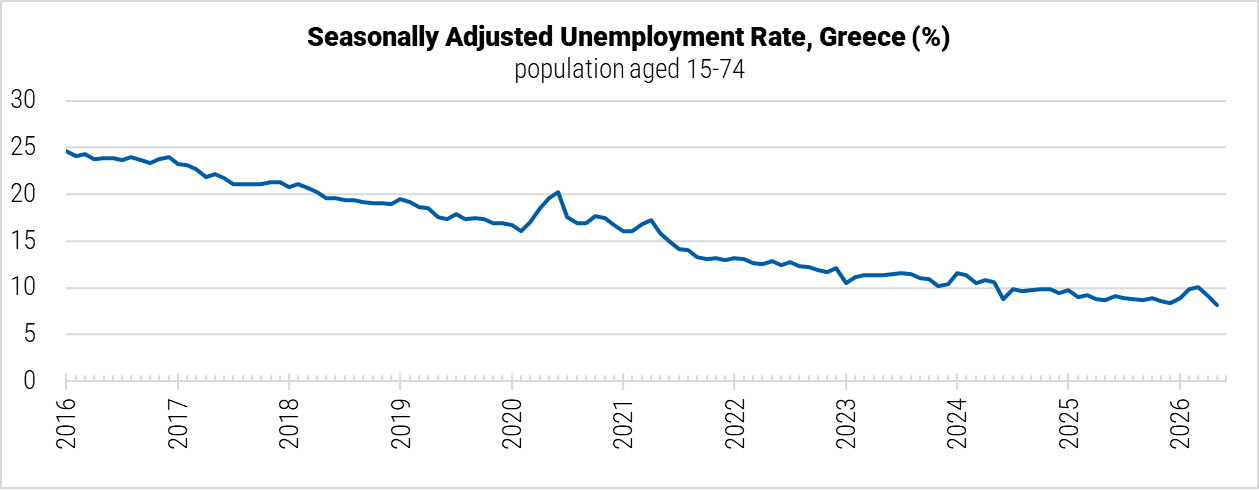
Data Source: ELSTAT.
After upgrading Greece’s sovereign rating from ‘BBB-’ to ‘BBB’ in the fall of 2025, based on firm debt decline trajectory (debt-to-GDP ratio expected to approach 120% by 2030), continued strong budget performance (1.7% surplus in 2025, 0.8% projected for 2026), as well as resilient economic growth and other factors, Fitch Ratings recently affirmed the country’s credit standing with a stable outlook.
Overall, as outlined in the IMF’s 2026 Article IV staff report, Greece met the shock from the escalation in the Middle East with strengthened fiscal sustainability and financial stability. At the same time, the remaining crisis legacies and structural imbalances, such as a still elevated public debt level (146.1% of GDP in 2025, projected at 140.7% in 2026), with a significant amount of crisis legacy distressed private debt still present in the financial system, still low levels of overall investment, a declining working-age population with low labor force participation, and sluggish productivity growth, continue to weigh on the economy’s medium-term growth prospects.
Sources:
- Hellenic Statistical Authority (ELSTAT)
- Gross Domestic Product: https://www.statistics.gr/
- Consumer Price Index (CPI) - National Index: https://www.statistics.gr/
- Labour force (Monthly Data): https://www.statistics.gr/
- Building Activity Survey: December 2025: https://www.statistics.gr/
- Building Activity Survey: March 2026: https://www.statistics.gr/
- Bank of Greece (BoG)
- Indices of Residential Property Prices: Q1 2026: https://www.bankofgreece.gr/
- Working Paper: Modelling House Price Dynamics in Greece: https://www.bankofgreece.gr/
- Residential and Commercial Property Price Indices and Other Short-Term Indices: https://www.bankofgreece.gr/
- Direct Investment – Flows: https://www.bankofgreece.gr/
- Financial Stability Review, May 2026: https://www.bankofgreece.gr/
- Monetary Policy Report 2025-2026 (EL): https://www.bankofgreece.gr/
- Bank Deposit and Loan Interest Rates: May 2026 (EL): https://www.bankofgreece.gr/
- Monetary and Banking Statistics: https://www.bankofgreece.gr/
- Note on the Greek Economy, June 2026: https://www.bankofgreece.gr/
- Ministry of Finance
- Greece 2.0: National Recovery and Resilience Plan - Housing loans: https://greece20.gov.gr/
- Ministry of Social Cohesion and Family
- National Strategy for Housing Policy 2026-2035 (GR): https://www.opengov.gr/
- Domna Michaelidou: "For the First Time, the Country Acquires a National Housing Strategy" (GR): https://minscfa.gov.gr/
- Ministry of Environment and Energy
- Restoring Stability in Construction Activity. Harmonization in the Case Law of the Council of Europe… (EL): https://ypen.gov.gr/
- Ministry of Migration & Asylum
- Golden Visa (EL): https://migration.gov.gr/
- Legal Immigration Service: Laws (EL): https://migration.gov.gr/
- Migration Statistics, Annex B, Analytical Tables (EL): https://migration.gov.gr/
- Hellenic Development Bank (EAT)
- Current Programs (EL): https://hdb.gr/
- European Central Bank (ECB)
- ECB Data Portal: https://data.ecb.europa.eu/
- Key ECB Interest Rates: https://www.ecb.europa.eu/
- Monetary Policy Decisions, 11 June 2026: https://www.ecb.europa.eu/
- European Commission
- Economic Forecast for Greece: https://economy-finance.ec.europa.eu/
- Distribution of Population by Tenure Status, Type of Household, and Income group: https://ec.europa.eu/
- Living conditions in Europe - Housing: https://ec.europa.eu/
- International Monetary Fund (IMF)
- Country Overview: Greece: https://www.imf.org/
- 2026 Article IV Staff Report: https://www.imf.org/
- IMF Country Report No. 26/109. Greece. Selected Issues: https://www.imf.org/
- Greece’s Remarkable Recovery: https://www.imf.org/
- European Construction Industry Federation (FIEC)
- Country Reports: Greece: https://fiec-statistical-report.eu/
- American Hellenic Chamber of Commerce
- Property Outlook for Greece: Insights for 2025 H2 and a Brief Forecast for 2026 H1: https://www.amcham.gr/
- Spitogatos
- SPI - Spitogatos Property Index: https://www.spitogatos.gr/
- Q1 2026: The Evolution and Annual Changes in Average Asking Property Prices in Greece: https://en.spitogatos.gr/
- Housing market in Greece – Q1 2026: Upward Trend in Sale and Rental Prices: https://en.spitogatos.gr/
- RE/MAX Greece
- REMAX Greece Survey: The Profile of Foreign Buyers for 2025: https://www.remax.gr/
- Ellika Real Estate
- How Will the Real Estate Market Move in 2026 in Athens?: https://www.ellika.gr/
- European Mortgage Federation (EMF)
- EU 27 Country Reports: Greece: https://hypo.org/
- Cerved Property Services
- Cerved Property Services Annual Survey: https://www.cervedpropertyservices.com/
- Fitch Ratings
- Fitch Affirms Greece at 'BBB'; Outlook Stable: https://www.fitchratings.com/
- Ilias Papageorgiadis
- The 5th Barometer: "The Old Apartment Should be 25-30% Cheaper Than the Newly Built One" (EL): https://iliaspapageorgiadis.com/
- Reuters
- ECB June Hike a Done Deal, Another Likely in September, Economists Say: https://www.reuters.com/
- Kathimerini
- Property FDI Jumped 43.4% in Q1: https://www.ekathimerini.com/
- Multibillion-Euro Housing Plan Unveiled: https://www.ekathimerini.com/
- Mortgages for Just One in Every Five House Purchases: https://www.ekathimerini.com/
- Rents in Attica Have Climbed 35% in Five Years: https://www.ekathimerini.com/
- Greeks Afraid of Mortgages: https://www.ekathimerini.com/
- Soaring Rents Could Threaten the Economy: https://www.ekathimerini.com/
- Greece Unveils Housing Measures to Boost Supply, Curb Short-Term Rentals: https://www.ekathimerini.com/
- Naftemporiki
- Thessaloniki – Real estate market… (EL): https://www.naftemporiki.gr/