Bulgaria's Residential Property Market Analysis 2026
After a year of strong growth in sales prices and rents prior to the country’s accession to the Euro area, the Bulgarian housing market appears to be normalizing, shifting from rapid acceleration to a more moderate growth phase.
This extended overview from Global Property Guide covers key aspects of the Bulgarian housing market and takes a closer look at its most recent developments and long-term trends.
Table of Contents
- Property Prices and Price Index
- Historic Perspective
- Property Demand Trends
- Property Supply Trends
- Rental Market: Rents and Rental Yields
- Mortgage Market and Interest Rates
- Economic and Social Factors
Property Prices and Price Index
Residential property prices in Bulgaria continued to rise strongly in 2025, although the latest official data points to a clear loss of short-term momentum. According to the National Statistical Institute (NSI), Bulgaria’s House Price Index increased by 12.6% year-on-year in Q4 2025, while quarterly growth slowed to only 0.3%.
Price growth was still underpinned by solid domestic fundamentals: the Bulgarian National Bank (BNB) pointed to rising labor income, favorable housing loan conditions, negative real returns on deposits, limited alternatives for accumulated household savings, the role of housing as a value-preserving asset, and elevated construction costs as key factors supporting the market. At the same time, the sharp slowdown in quarterly HPI growth suggests that the market had already started to move from rapid acceleration toward a more moderate phase by the end of the year.
Bulgaria's house price annual change:
The breakdown by property type shows that existing dwellings have recently become the stronger driver of national price growth. In Q4 2025, prices of existing dwellings increased by 15.0% year-on-year, compared with 9.0% for newly built dwellings. This pattern was also visible in the main urban markets, where resale stock generally outperformed new housing. The real estate consultancy Foros, commenting on NSI data, noted that “growth remains, but the speed is falling”, and interpreted the stronger growth in existing dwellings as an indicator of limited availability of completed, ready-to-use housing.
HPI in the main urban markets, year-on-year change, %:
| Total HPI, Q4 2025 |
New dwellings, Q4 2025 |
Existing dwellings, Q4 2025 |
|
| Sofia | 12.7% | 11.3% | 14.0% |
| Plovdiv | 8.6% | -0.8% | 16.8% |
| Varna | 15.1% | -1.0% | 23.4% |
| Burgas | 13.1% | 7.3% | 17.6% |
| Ruse | 4.4% | - | 5.2% |
| Stara Zagora | 19.8% | 10.5% | 23.3% |
| Nationwide | 12.6% | 9.0% | 15.0% |
| Note: Due to low reliability, NSA does not publish figures for new dwellings in Ruse. | |||
| Data Source: NSI. | |||
Nominal market prices also point to still-elevated but moderating growth. Following Bulgaria’s adoption of the euro on 1 January 2026, with the conversion rate fixed at BGN 1.95583 per EUR 1, market prices are increasingly quoted in euros, which is now the local currency. According to Bulgarian Properties, average residential prices in February 2026 reached about EUR 2,500 (USD 2,926) per square meter in Sofia, up 18% year-on-year; EUR 1,900 (USD 2,224) per square meter in Varna, up 17%; EUR 1,700 (USD 1,990) per square meter in Burgas, up 19%; and EUR 1,520 (USD 1,779) per square meter in Plovdiv, up 13%. The agency further noted that monthly price growth had slowed to below 2%, materially under the pace observed at the end of 2025, suggesting that the euro adoption effect had largely been priced in during 2025.
More recent data for Sofia confirms the same direction. According to Bulgarian Properties, the average transaction price in the capital stood at EUR 2,680 (USD 3,136) per square meter in Q1 2026, slightly below EUR 2,790 (USD 3,265) per square meter recorded at the end of 2025, but still 29% higher than the EUR 2,080 (USD 2,434) per square meter registered at the beginning of 2025, confirming that the market remained significantly above year-earlier levels even as short-term momentum softened.
The near-term outlook is therefore positive but more moderate than in 2024-25. Local professionals broadly expect slower price growth rather than a market correction. Foros expects the market to enter a normalization phase, with annual growth stabilizing at around 5-10%, provided that geopolitical risks do not intensify. The residential real estate brokerage Imoteka similarly forecasts single-digit price growth in 2026, around 5-8%, supported by more balanced supply-demand conditions and continued mortgage availability after the reduction in banks’ minimum reserve requirements following eurozone entry.
In Sofia specifically, Bulgarian Properties likewise expects prices to continue rising in 2026, but at a slower pace, potentially easing toward around 10% by the end of the year. The agency projects low mortgage interest rates, rising incomes, and new project supply to maintain market activity, while geopolitical risks, inflationary pressure, higher prices, weaker transaction activity, and increased supply are likely to keep buyers more cautious and reduce speculative expectations.
Demand Highlights: Residential Activity Moderates Following a Strong Pre-Euro Period
Property Demand Trends
Residential Activity Moderates Following a Strong Pre-Euro Period
Bulgaria’s residential demand remained active in 2025, but official transaction indicators point to a market moving beyond its peak growth phase. According to NSI’s transaction-volume series, the number of transacted dwellings declined by 2.5% compared with the previous year. The slowdown became much more visible in Q4 2025, when dwelling transactions fell by 22.5% year-on-year. The decline was concentrated in the existing-home segment, where transactions dropped by 28.5% year-on-year, while newly built dwelling transactions recorded a more moderate decline of 6.3%.
At the same time, the total value of dwelling transactions fell by 10.2% year-on-year during the last quarter of 2025, demonstrating a much smaller decline than the drop in transaction numbers, while the value of newly built dwelling transactions still increased by 1.2%. This suggests that the market was not experiencing a broad demand collapse, but rather a shift toward fewer, higher-value transactions and greater concentration in new or better-quality housing stock.
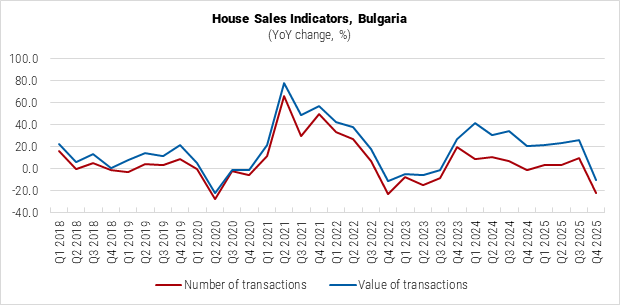
Data Source: NSI.
The six-city breakdown shows that demand conditions varied significantly across Bulgaria’s main urban markets. In Q4 2025, transaction volumes declined across most large cities, including Sofia, Varna, Burgas, Ruse, and Stara Zagora, while Plovdiv was the only major city to record annual growth. The value data followed the same pattern, although declines were generally milder than the fall in transaction numbers. Sofia, the country’s largest residential market, recorded a 24.6% year-on-year drop in transaction volume, but a smaller 13.4% decline in transaction value, again pointing to fewer but higher-value transactions. Plovdiv stood out as the most resilient large city, with both transaction numbers and transaction value still increasing in Q4 2025.
House sales indicators in the main urban markets, year-on-year change, %:
| Number of transactions, Q4 2025 |
Value of transactions, Q4 2025 |
|||||
| Total | New dwellings | Existing dwellings | Total | New dwellings | Existing dwellings | |
| Sofia | -24.6% | -19.3% | -28.8% | -13.4% | -9.5% | -16.7% |
| Plovdiv | 12.0% | 69.9% | -27.3% | 15.8% | 64.1% | -17.9% |
| Varna | -15.1% | 18.2% | -29.6% | -5.0% | 24.9% | -17.4% |
| Burgas | -24.7% | -19.6% | -28.0% | -13.2% | -9.7% | -15.2% |
| Ruse | -15.6% | 151.6% | -29.0% | -5.7% | 180.5% | -26.4% |
| Stara Zagora | -32.8% | -12.9% | -38.8% | -19.6% | -3.7% | -25.5% |
| Data Source: NSI. | ||||||
The sharp Q4 2025 decline appears to reflect the unwinding of an unusually active pre-euro period rather than a sudden loss of housing need. Market commentary suggests that buyer urgency had been brought forward earlier in 2025 by euro-area accession expectations, rapid price growth, and limited supply. By late 2025 and early 2026, buyers were becoming more cautious. Forbes Bulgaria, citing Bulgarian Properties, noted that after two years of strong activity, the market was gradually losing the momentum created by eurozone-related expectations and was “starting to return to a more normal environment”, with buyers having more time for comparison and negotiation. Polina Stoykova, CEO of Bulgarian Properties, described the slowdown as a rebalancing after a period of strong demand, limited supply, and accelerated purchases linked to the expected euro changeover, rather than a signal of market collapse.
Sorenda Real Estate similarly noted that the market is entering a new stage in 2026, with more segmented demand and a clearer distinction between quality and compromise projects, especially in Sofia. Evgeni Vasilev, Managing Director of Sorenda Real Estate, summarized the expected shift by saying that 2026 is likely to be the first year in which Bulgaria’s property market is driven less by fear or speculation and more by real needs, sustainable financing, and project quality. Buyers are becoming more sensitive to location, functionality, energy efficiency, and completion stage, while demand is expected to remain strongest for well-located new construction, modern residential complexes, and energy-efficient buildings.
Demographics remain the main long-term constraint on broad-based housing demand. Bulgaria’s population stood at 6.42 million at the end of 2025, down 0.2% from a year earlier, according to NSI. However, national population decline masks strong regional concentration. The Yugozapaden region, which includes Sofia, was the only statistical region to record population growth in 2025, while Sofia city remained by far the country’s largest district, accounting for 20.3% of the national population. Demand is therefore not population-growth-led at the national level, but is supported by urban concentration, internal migration, and income opportunities in Sofia, Plovdiv, Varna, Burgas, and selected resort markets.
Property Supply Trends
Record Completions Mask a More Uneven Development Pipeline
Bulgaria’s residential development cycle reached an exceptional delivery peak in 2025. According to NSI, newly completed dwellings increased to 37,571 units, up 78.9% year-on-year. Local brokerage iBrokers, commenting on NSI data, described the 2025 result as a “historical record” and linked it to projects launched during the earlier period of stronger economic growth and low interest rates, as well as to the final completion of long-running developments that had accumulated in the pipeline, rather than as evidence of a uniform acceleration in current construction activity.
The completion cycle moderated sharply at the beginning of 2026. In Q1 2026, newly completed dwellings fell to 4,151 units, down 48.7% year-on-year. This decline partly reflects the very high comparison base of Q1 2025 and reinforces the view that 2025 was an exceptional delivery year, rather than the start of a permanently higher completions run-rate. The quarterly figure should also be interpreted with some caution, as NSI noted a reporting gap for residential buildings in Pancharevo within Sofia City.
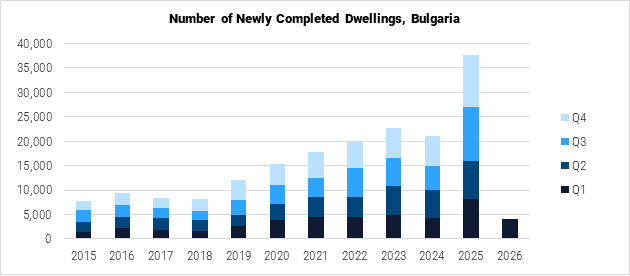
Data Source: NSI.
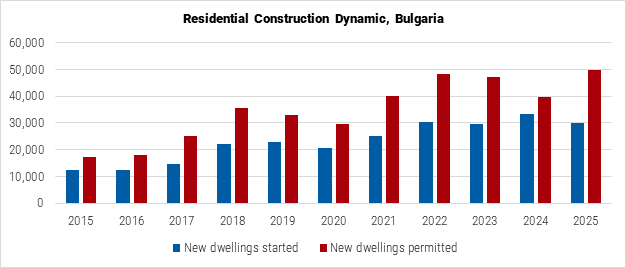
Forward-looking indicators were less uniformly expansionary. In 2025, municipalities issued building permits for 49,848 dwellings, up 25.1% year-on-year, indicating a sizeable approved pipeline. However, construction started on 29,774 dwellings, down 10.3% compared to 2024. The data therefore points to a market with substantial planned supply, but more selective execution, influenced by project phasing, administrative timelines, cost pressures, and developer caution.
At the beginning of 2026, forward-looking indicators showed a renewed pick-up in development activity. In Q1 2026, permits were issued for 13,567 dwellings, up 28.3% year-on-year, while construction started on 10,193 dwellings, up 67.4% year-on-year. The sharp increase in starts partly reflects a weaker comparison base following the slowdown recorded in 2025, but it also suggests that the pipeline has not stalled. The pace at which this renewed activity translates into completed stock will depend on the time lag between permitting, construction starts, and final commissioning.
Data Source: NSI.
Regionally, the 2025 data shows a highly uneven supply cycle. Sofia City remained the dominant completed-supply market, reflecting the final delivery of a large number of projects already under construction. Plovdiv stood out on the permitting side, with its approved dwelling pipeline slightly exceeding that of the capital. The two main Black Sea markets moved in different directions: Varna continued to record a sizeable approved pipeline but saw a sharp decline in starts, while Burgas showed stronger conversion from permits into actual construction. Ruse and Stara Zagora remained much smaller markets, although Stara Zagora recorded a comparatively active starts profile.
Residential construction in selected districts:
| Dwellings Completed, 2025 |
YoY, % | Dwellings Started, 2025 |
YoY, % | Dwellings Permitted, 2025 |
YoY, % | |
| Sofia City | 16,855 | 144.7% | 6,621 | -30.3% | 12,484 | 7.2% |
| Plovdiv | 5,344 | 149.1% | 4,654 | -11.2% | 12,666 | 41.0% |
| Varna | 3,494 | 46.4% | 3,220 | -39.2% | 6,035 | 40.0% |
| Burgas | 3,479 | 20.9% | 5,762 | 25.2% | 5,885 | 40.7% |
| Ruse | 352 | 90.3% | 243 | -26.1% | 512 | 45.9% |
| Stara Zagora | 830 | -11.4% | 1,647 | 22.4% | 1,359 | -15.2% |
| Data Source: NSI. | ||||||
Administrative factors are becoming increasingly relevant to the supply outlook, particularly in Sofia. Georgi Shopov, chair of the National Association of Construction Entrepreneurs, argued in an interview with Bloomberg TV Bulgaria that delays in issuing construction permits in Sofia are constraining new supply and redirecting part of developer interest toward the metropolitan periphery, including locations such as Elin Pelin and Kostinbrod.
Cost pressures remain another key constraint on delivery. Economic.bg noted that the cost structure of the sector is changing, with land prices and rising labor costs becoming more important drivers of new housing prices than construction materials. Colliers’ Sofia residential market overview also reported that, since the beginning of 2021, construction costs for house compounds had increased by 63% by mid-2025, while house prices in the segment rose by more than 75%. As a result, Colliers noted that investors are increasingly looking at areas with cheaper land, which provides more flexibility amid growing competition and escalating material and labor costs.
Rental Market: Rents and Rental Yields
Rental Inflation Eases Somewhat After a Year of Strong Growth
Similar to other post-transition economies in the region, Bulgaria is characterized by a high homeownership rate and a relatively small rental sector. Based on the latest Eurostat figures, 13.9% of the population are tenants, and only 2.2% rent at market prices.
Bulgaria's rent price index:
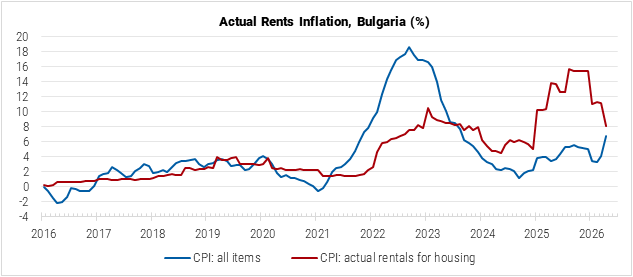
In this relatively small and dynamic market, rental inflation, as measured by the annual change in actual rentals for the housing component of the consumer price index, began to ease in early 2026 after a year of double-digit growth. According to the NSI, the indicator fell from the peak of 15.7% in August 2025 to 11.0% in January and 8.1% in April 2026. It continues, however, to track above the overall price growth, which reached 6.8% during the same period.
Regionally, the National Real Estate Association (NSNI) estimated that in 2025, rents in Sofia increased by approximately 20%, while in Varna and Burgas, growth was in the 10-15% range. This strong upward dynamic was attributed by brokers to increased demand for rental housing, driven by labor mobility, postponed home purchases, and increased economic activity in large cities.
Looking ahead, the association expects market dynamics to normalize this year, as the market continues to gradually mature and professionalize. Further adjustments in rent levels are expected to be determined by the overall inflationary environment, established contractual practices, and solvent demand. "I do not expect step-like jumps in rents," said Ivan Semkov, Deputy Chairman of NSNI.
Data Source: NSI.
In nominal terms, according to the survey conducted by Eurostat in cooperation with real estate agencies in major European cities, the average monthly rent for quality apartments in Sofia (within residential areas of good quality, typically favored by expatriates and professional people) in 2025 reached EUR 650 (USD 735) for 1-bedroom units, EUR 900 (USD 1,017) for 2-bedroom units, and EUR 1,300 (USD 1,469) for 3-bedroom units.
Across a wider spectrum of properties in key Bulgarian submarkets, the January 2026 research by Global Property Guide found average asking rents at EUR 240-460 (USD 282-540) for studio units, EUR 330-715 (USD 387-839) for 1-bedroom units, EUR 410-1,100 (USD 481-1,291) for 2-bedroom units, and EUR 410-1,400 (USD 481-1,878) for 3-bedroom units, with Sofia remaining the most expensive among the cities.
The corresponding gross rental yields across Bulgaria averaged 4.19%, down from 4.53% previously reported in April 2025. Regionally, the highest yields among the assessed submarkets were observed in Burgas (4.58%), while the capital city of Sofia showed somewhat weaker potential performance (3.75%).
Mortgage Market and Interest Rates
Interest Rates Stable, Lending Activity Grows
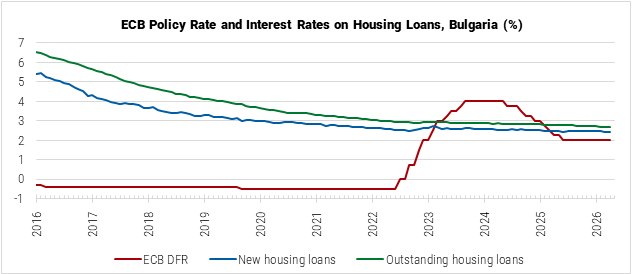
After a series of cuts through 2024 and early 2025, the European Central Bank (ECB) has kept its key rates unchanged since last June, making no further moves at the latest meeting of the monetary policy committee in April 2026. In a post-decision press statement, however, the regulator noted that upside risks to inflation and downside risks to growth have intensified, as the war in the Middle East has led to a sharp increase in energy prices, pushing up inflation and weighing on economic sentiment. Most economists polled by Reuters in May agreed that the ECB is likely to raise rates in June and possibly once more later in 2026 due to war-driven inflation pressures.
Bulgaria's mortgage loan interest rates:
Although future mortgage rate movements in Bulgaria may increasingly track ECB policy rather than just domestic factors following the country’s accession to the euro area since the beginning of 2026, previously, the transmission of the European regulator’s key rate adjustments to interest rates on housing and consumer loans in Bulgaria had been very weak, even during the latest upward phase of the cycle in 2022-2023.
Based on data from the Bulgarian National Bank (BNB), as of April 2026, the average interest rate on loans to households for house purchase in the country stood at 2.45% for new loans and 2.68% for outstanding loans, with both indicators largely stable and demonstrating only marginal downward movement since the same period a year ago.
“Ample liquidity in the banking system and the unchanged key euro area interest rates from mid-2025 to date do not constitute a precondition for changes in the interest rates on deposits and loans in Bulgaria,” said the latest economic review from the BNB.
Data Source: BNB, ECB.
Average interest rates on loans to households for house purchase:
| Apr 2026 | YoY | Apr 2025 | YoY | Apr 2024 | |
| New housing loans | 2.45% | ≈ | 2.46% | ↓ | 2.52% |
| - Floating rate and IRF up to 1 year | 2.44% | ≈ | 2.45% | ↓ | 2.51% |
| - IRF of over 1 and up to 5 years | 3.04% | ↓ | 3.30% | ≈ | 3.32% |
| - IRF of over 5 and up to 10 years | 4.05% | n/a | n/a | n/a | 4.06% |
| - IRF of over 10 years | 2.52% | n/a | n/a | n/a | n/a |
| Outstanding housing loans | 2.68% | ↓ | 2.79% | ↓ | 2.87% |
| - Original maturity up to 1 year | 3.97% | ↓ | 4.80% | ↑ | 2.59% |
| - Original maturity over 1 and up to 5 years | 2.71% | ↓ | 2.80% | ↓ | 2.97% |
| - Original maturity of over 5 years | 2.68% | ↓ | 2.79% | ↓ | 2.87% |
| Data Source: BNB. | |||||
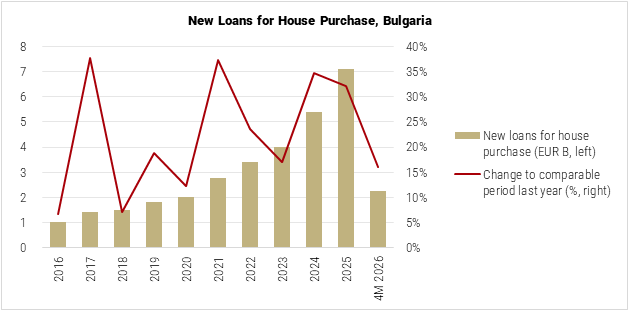
The gradual decline and subsequent stabilization of mortgage interest rates over the past decade, as well as the overall housing market outlook, supported strong, uninterrupted growth in lending activity, with the value of new loans for house purchase produced annually growing from just over EUR 1 billion in 2016 to EUR 7.1 billion in 2025. The upward trend, albeit slowing, appears to have carried into 2026, with BNB reporting EUR 2.3 billion (USD 2.6 billion) in new housing loans in the first four months of the year, which was 16.0% above the same period in 2025.
At the same time, the central bank’s Q1 2026 lending survey noted decreased demand for housing loans compared to the last quarter of 2025, with further weakening anticipated by lenders in the next period. “The main factors for the weaker demand, indicated by the banks, are consumer sentiment, the level of interest rates, as well as other factors, including the completion of the process of Bulgaria's accession to the eurozone,” said the report.
Data Source: BNB.
In this environment, the country’s overall housing loan stock has been expanding rapidly, with double-digit annual growth rates observed since 2017. As of April 2026, the total value of outstanding housing loans reached EUR 17.9 billion (USD 20.9 billion), according to BNB figures. In relative terms, the size of Bulgaria’s mortgage market has also been on an upward trajectory over the past decade, with the loan-to-GDP ratio increasing from 6.8% in 2016 to an estimated 14.4% in 2025.
Nonetheless, only 1.7% of the country’s population currently lives in owner-occupied residences with an outstanding mortgage or housing loan, according to Eurostat.
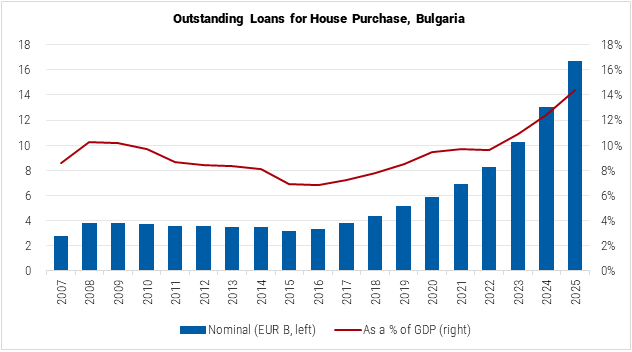
Data Sources: BNB, ECB.
Economic and Social Factors
Inflation Elevated, Growth Set to Moderate
Driven by domestic demand, with private and public consumption and investment increasing strongly, Bulgaria’s real GDP growth reached 3.1% in 2025, following a 3.4% expansion in 2024. However, over the next two years, growth is forecast to moderate, reflecting slower private consumption growth amid lower wage and employment growth, as well as lower private investment.
“The conflict in the Middle East is expected to weigh on activity in 2026, as the adverse terms-of-trade shock reduces households’ purchasing power and weakens confidence. The conflict is also set to dampen aggregate demand through weaker employment growth and a slight downward revision to expected wage growth,” said the spring forecast from the European Commission, which puts Bulgaria’s growth at 2.5% for 2026 and 2.2% for 2027. Similarly, the International Monetary Fund (IMF) expects growth to decelerate to 2.8% and 2.5%, respectively.
In parallel, consumer price index (CPI) inflation in the country reaccelerated from the average annual level of 2.6% in 2024 to 3.5% in 2025 and has been trending upward in 2026 to date. In April, NSI reported the indicator at 6.8%. Considering increased input costs, second-round effects from higher energy prices linked to the conflict in the Middle East, and persistent services inflation, the European Commission expects inflation to remain elevated over the forecast horizon, reaching 4.2% this year and 2.6% in 2027. The IMF projects the indicator at 3.8% in 2026 and 3.7% in 2027.
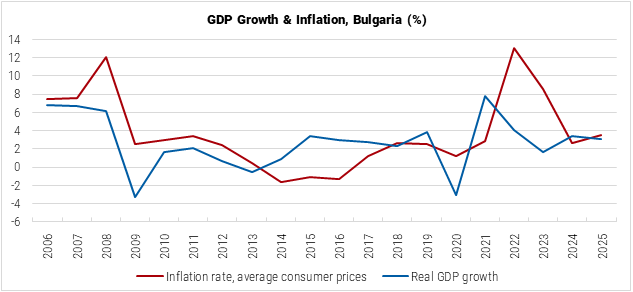
Data Source: IMF.
Bulgaria’s labor market remained tight in 2025, supporting strong wage growth, with compensation per employee increasing by 10.4%. In the upcoming period, however, wage growth is expected to moderate as the economic slowdown eases private sector wage pressures. The nationwide unemployment rate declined to a historic low in 2025 and was most recently reported by NSI at 3.2% in Q1 2026.
“Significant labor shortages persist in key sectors, including manufacturing, construction, education, and health, reflecting demographic trends and the shrinking working-age population,” pointed out the latest European Commission assessment. “As a result, the labor market is expected to remain tight, with the unemployment rate staying below 4% over the forecast horizon. Continued labor market tightness is also expected to sustain wage pressures, albeit to a lesser extent than in recent years.”
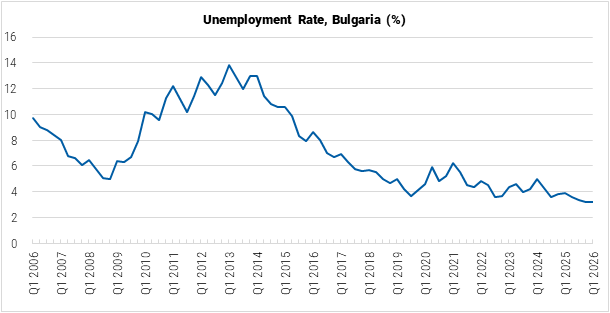
Data Source: NSI.
Overall, as outlined in the latest Article IV staff report from the IMF, Bulgaria’s accession to the euro area since January 2026 is expected to provide a near-term boost to its economic outlook and offer an opportunity to reinforce institutions, bolster policy credibility, and raise medium-term growth.
Earlier this year, Fitch Ratings affirmed the country’s ‘BBB+’ standing, noting that the stable outlook for the rating is based on the agency’s expectation that domestic political uncertainty and external geopolitical risks will not derail Bulgaria's solid economic growth nor lead to a build-up of macroeconomic, fiscal, or external imbalances.
In April 2026, following the resignation of the previous cabinet after only 11 months in power, Bulgaria held yet another parliamentary election (the eighth vote since 2021), resulting in the victory of former president Rumen Radev's Progressive Bulgaria party. The new government set out to restore political stability and plans to focus on economic stabilization and domestic reforms necessary to unlock EU Recovery and Resilience funds.
Sources:
- National Statistical Institute (NSI)
- Housing Price Statistics – Fourth Quarter of 2025 and 2025: https://www.nsi.bg/
- House Sales Indicators (HSI): https://www.nsi.bg/
- Short-Term Statistics of Residential Buildings – 2025: https://www.nsi.bg/
- Short-Term Statistics of Residential Buildings – Q1 2026: https://www.nsi.bg/
- Building Permits Issued and Construction Started – Fourth Quarter of 2025: https://www.nsi.bg/
- Population and Demographic Processes – 2025: https://www.nsi.bg/
- Inflation and Consumer Price Indices - April 2026: https://www.nsi.bg/
- Main Labour Force Survey Results - First quarter of 2026: https://www.nsi.bg/
- Bulgarian National Bank (BNB)
- Statistics: https://www.bnb.bg/
- Interest Rates Statistics, April 2026: https://www.bnb.bg/
- Economic Review 1/2026: https://www.bnb.bg/
- Macroeconomic Forecast, March 2026: https://www.bnb.bg/
- Bank Lending Survey, Q1 2026 (BG): https://www.bnb.bg/
- European Central Bank (ECB)
- ECB Data Portal: https://data.ecb.europa.eu/
- Key ECB Interest Rates: https://www.ecb.europa.eu/
- Monetary Policy Decisions, 30 April 2026: https://www.ecb.europa.eu/
- Bulgaria Joins the Euro Area: https://www.ecb.europa.eu/
- European Commission
- Economic Forecast for Bulgaria: https://economy-finance.ec.europa.eu/
- Distribution of Population by Tenure Status, Type of Household, and Income group: https://ec.europa.eu/
- Average Rent per Month in Cities by Type of Dwelling: https://ec.europa.eu/
- International Monetary Fund (IMF)
- Country Overview: Bulgaria: https://www.imf.org/
- 2025 Article IV Staff Report: https://www.imf.org/
- The Organisation for Economic Co-operation and Development (OECD)
- OECD Economic Surveys: Bulgaria 2026: https://www.oecd.org/
- National Real Estate Association (NSNI)
- Rents in Bulgaria in 2026 Between Inflation and Market Sustainability (BG): https://nsni.bg/
- Bulgarian Properties
- The Real Estate Market in Bulgaria After the Euro…: https://www.bulgarianproperties.com/
- Sofia Housing Market in Q1 2026: Analysis: https://www.bulgarianproperties.com/
- Colliers
- Housing Market Overview. Sofia. H1 2025: https://colliers.bg/
- Foros
- Housing Prices: There Is Growth. The Speed Is Falling (BG): https://foros.bg/
- iBrokers
- New Construction in Bulgaria: NSI Data 2025 (BG): https://ibrokers.bg/
- Fitch Ratings
- Fitch Affirms Bulgaria at 'BBB+'; Outlook Stable: https://www.fitchratings.com/
- Reuters
- ECB to Hike Rates in June and at Least Once More on War-Led Inflation Spike: Reuters Poll: https://www.reuters.com/
- Eurozone Accession to Bring Economic Growth, Bulgaria PM Says: https://www.reuters.com/
- Bulgaria's Kremlin-Friendly Ex-President Wins Election in Landslide: https://www.reuters.com/
- Radev Sets Out Plans for New Bulgarian Government After Election Win: https://www.reuters.com/
- Forbes Bulgaria
- After the 2025 Boom: Buyers Are in No Hurry… (BG): https://forbesbulgaria.com/
- Property Market Expectations in 2026: More Moderate Price Growth… (BG): https://forbesbulgaria.com/
- Money.bg
- Imoteka: Housing Prices in 2026 Will Increase by a Single Digit Percentage (BG): https://money.bg/
- Investor.bg
- G. Shopov: Without Building Permits in Sofia… (BG): https://www.investor.bg/
- Economic.bg
- The Issuance of Building Permits is Delayed to Early 2026 (BG): https://www.economic.bg/