Bosnia and Herzegovina's Residential Property Market Analysis 2026
The activity in the Belgian housing market is expected to moderate this year, as the effects of the regional tax reset (which previously supported a rebound in demand across the country) fade, while mortgage interest rates continue to edge upwards.
This extended overview from the Global Property Guide covers key aspects of Belgium’s housing market and takes a closer look at its most recent developments and long-term trends.
Table of Contents
- Property Prices and Price Index
- Property Demand Trends
- Property Supply Trends
- Rental Market: Rents and Rental Yields
- Mortgage Market and Interest Rates
- Economic and Social Factors
Property Prices and Price Index
After several years of rapid appreciation, Bosnia and Herzegovina’s for-sale housing market began to show clearer signs of stabilization in late 2025, although prices continued to rise. According to the latest data from the Agency for Statistics of Bosnia and Herzegovina (BHAS), the average price of newly built dwellings sold nationwide increased by 1.96% year-on-year in the fourth quarter of 2025, reaching BAM 3,126 (USD 1,872) per square meter.
In Sarajevo, the country’s capital and largest residential market, the average price of new-build dwellings stood at BAM 4,131 (USD 2,473) per square meter, marking an 11.84% annual increase, while in Banja Luka, the second-largest city, prices rose by 5.92% year-on-year to BAM 3,936 (USD 2,357) per square meter.
Bosnia and Herzegovina's house price annual change:
Comprehensive average sale prices for both new and existing homes are not published for Bosnia and Herzegovina as a whole, but are instead reported separately by the statistical authorities of the Federation of Bosnia and Herzegovina and Republika Srpska. As a result, while the BHAS quarterly series reflects pricing in the new-build segment, the entity-level data provides a broader view of apartment transaction prices across the country’s main urban markets.
This data shows that the average price of apartments sold continued to rise across the key submarkets in 2025, with Sarajevo’s central municipalities continuing to rank as the country’s most expensive apartment submarkets. Stari Grad Sarajevo recorded the highest average apartment price, followed by Novo Sarajevo and Centar Sarajevo, confirming the continued premium attached to the capital’s most central and established locations. Banja Luka also remained relatively high-priced in absolute terms, although annual growth there was more moderate.
Sales price dynamics in key submarkets:
| City/Municipality | Average Price of Apartments Sold, per sqm, 2025 |
YoY | Min Price of Apartments Sold, per sqm, 2025 |
Max Price of Apartments Sold, per sqm, 2025 |
| Sarajevo | ||||
| - Stari Grad Sarajevo | BAM 4,550 (USD 2,724) |
13.18% | BAM 1,530 (USD 916) |
BAM 9,000 (USD 5,389) |
| - Centar Sarajevo | BAM 4,220 (USD 2,527) |
8.21% | BAM 1,460 (USD 874) |
BAM 7,480 (USD 4,478) |
| - Novo Sarajevo | BAM 4,350 (USD 2,604) |
13.58% | BAM 1,150 (USD 689) |
BAM 7,220 (USD 4,323) |
| - Novi Grad Sarajevo | BAM 3,490 (USD 2,090) |
12.22% | BAM 1,230 (USD 736) |
BAM 6,020 (USD 3,604) |
| Banja Luka | BAM 3,308 (USD 1,981) |
6.43% | - | - |
| Mostar | BAM 2,670 (USD 1,599) |
21.36% | BAM 500 (USD 299) |
BAM 5,070 (USD 3,036) |
| Tuzla | BAM 2,930 (USD 1,754) |
13.57% | BAM 280 (USD 168) |
BAM 4,950 (USD 2,964) |
| Zenica | BAM 2,890 (USD 1,730) |
22.46% | BAM 500 (USD 299) |
BAM 5,120 (USD 3,065) |
| Exchange rate as of December 2025, USD 1= BAM 1.6702. | ||||
| Note: Minimum and maximum sale prices are not available for Banja Luka due to differences in reporting methodologies across statistical systems. | ||||
| Data Sources: FIS, RZS-RS. | ||||
Looking ahead, the outlook points to continued price firmness, but with slower and more selective growth than during the sharp upswing of 2023 and 2024. In comments cited by Bloomberg Adria, Haris Kadić, owner of Stanpromet Sarajevo, said that only “natural growth” in residential prices should be expected in 2026, with future price movements likely to depend on factors such as the domestic political environment, broader global economic trends, the completion of major infrastructure projects, and the availability and cost of housing finance. Faris Hadžiibrahimović of NN Nekretnine expressed a similar view, noting that the earlier pattern of annual price increases of up to 20% was unlikely to be repeated.
At the same time, a meaningful correction still appears unlikely in the near term, as demand in Sarajevo and other larger urban centers remains relatively firm, new-build supply is limited, larger residential projects are being delivered more slowly, and construction costs continue to support achieved sale prices. Buyers appear to be more cautious and selective than during the peak phase of the boom, but current conditions still point to stability or gradual further appreciation.
Property Demand Trends
Healthy Buyer Activity, with Demand Increasingly Focused on Liquid Urban Apartment Submarkets
Demand for housing in Bosnia and Herzegovina remained broadly resilient in 2025, although momentum became more uneven across cities, product types, and market segments. Nationally, the primary market softened only slightly, while the wider transaction picture continued to point to active demand in the more liquid urban apartment markets.
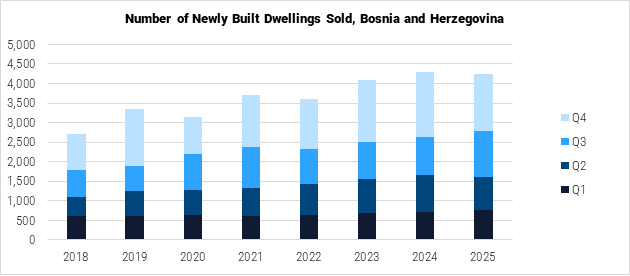
According to BHAS, a total of 4,235 newly built dwellings were sold nationwide in 2025, marking a modest 1.49% decrease compared to the previous year. The total useful floor area of these dwellings amounted to 228,498 square meters, down by 2.27% year-on-year. Among the key urban markets, Sarajevo recorded 343 newly built property sales throughout the year, reflecting a solid 24.73% annual increase and suggesting a firmer recovery in primary-market demand. In Banja Luka, by contrast, 946 newly built properties were sold, representing an 18.59% year-on-year decline.
Data Source: BHAS.
While aggregate data on total residential transactions across both primary and secondary markets is not available at the national level, disaggregated figures from the Federation of Bosnia and Herzegovina (FBiH) and Republika Srpska, provided by the Federal Administration for Geodetic and Real Property Affairs (FGU) and the Republic Authority for Geodetic and Property Affairs (RGURS), capture total registered sales contracts and therefore provide a wider view of for-sale housing demand than the BHAS new-build series.
In Republika Srpska, RGURS reported 8,713 registered residential sales contracts in 2025, up by 2.01% year-on-year. Of these, 5,853 contracts related to apartments, up 6.83%, while 2,860 were for detached houses, down 6.60%. In the Federation of Bosnia and Herzegovina, the housing market performed somewhat better, with 5,867 residential sales contracts registered, up by 4.43% year-on-year. Apartment sales rose by 8.68% to 3,379 units, while detached house sales were broadly stable, edging down by just 0.84%. Taken together, the entity-level data suggest that overall for-sale housing demand remained resilient in 2025, but increasingly concentrated in apartments rather than houses.
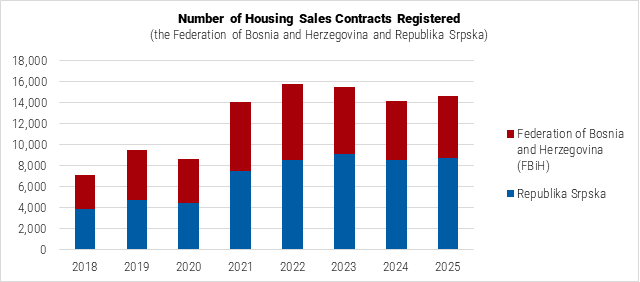
Note: The data reflects registered sales contracts for apartments and houses in the Federation of Bosnia and Herzegovina (FBiH) and Republika Srpska; the Brčko District is not included.
Data Source: RGURS, FGU.
Performance across the main regional markets remained mixed. Banja Luka recorded the highest apartment volume and one of the strongest annual increases, while Sarajevo also stayed active, with apartment transactions rising despite a decline in house sales. Within Sarajevo, growth was concentrated in Centar and Novo Sarajevo, while Novi Grad recorded a marked contraction. Tuzla also stood out, posting solid apartment growth alongside by far the strongest increase in house transactions. By contrast, Mostar and Zenica showed softer trends overall, with apartment activity either declining or remaining broadly flat and house sales weakening.
Sales dynamics in key submarkets:
| City/Municipality | Number of Sales Contracts Registered, Apartments, 2025 |
YoY | Number of Sales Contracts Registered, Houses, 2025 |
YoY |
| Sarajevo | 1,126 | 7.85% | 190 | -10.80% |
| - Stari Grad Sarajevo | 86 | 13.16% | 84 | -9.68% |
| - Centar Sarajevo | 420 | 17.65% | 53 | 17.78% |
| - Novo Sarajevo | 449 | 18.47% | 46 | -9.80% |
| - Novi Grad Sarajevo | 171 | -26.29% | 7 | -70.83% |
| Banja Luka | 1,581 | 31.75% | 413 | 4.56% |
| Mostar | 208 | -20.91% | 80 | -1.23% |
| Tuzla | 322 | 24.32% | 136 | 122.95% |
| Zenica | 214 | -2.28% | 153 | -15.47% |
| Note: The data reflects registered sales contracts for apartments and houses in the Federation of Bosnia and Herzegovina (FBiH) and Republika Srpska; the Brčko District is not included. | ||||
| Data Sources: RGURS, FGU. | ||||
Overall, the 2025 sales data points to a market that remained healthy, but clearly segmented by product type and micro-location. Apartments continued to outperform detached houses, especially in the main urban centers, indicating that buyer demand remained focused on more liquid, urban stock.
In its Financial Stability Risk Assessment, the Central Bank of Bosnia and Herzegovina (CBBH) stated that the real estate market “stayed strong with no serious trend reversal indications in the near future” and added that “favorable financing conditions and growth of lending are boosting demand.” In a separate 2025 macroeconomic assessment, the CBBH also highlighted demand from “the diaspora and non-residents” as an important support factor.
Property Supply Trends
Formal Supply Remains Active, Though Delivery Timelines Have Stretched
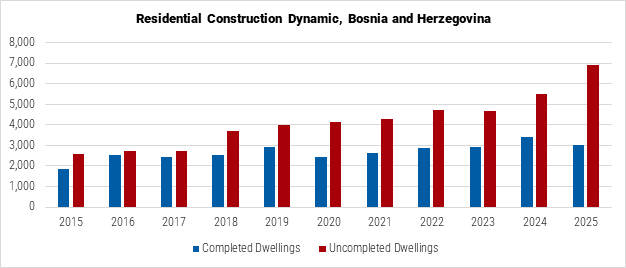
Supply conditions in Bosnia and Herzegovina remained mixed in 2025. According to BHAS, 3,016 dwellings were completed during the year, representing an 11.81% decline compared to 2024. At the same time, the number of dwellings under construction rose sharply to 6,926, up 26.41% year-on-year. Taken together, these figures suggest that residential activity remained present, but that a greater share of projects stayed in the construction phase rather than being finalized within the year.
Data Source: BHAS.
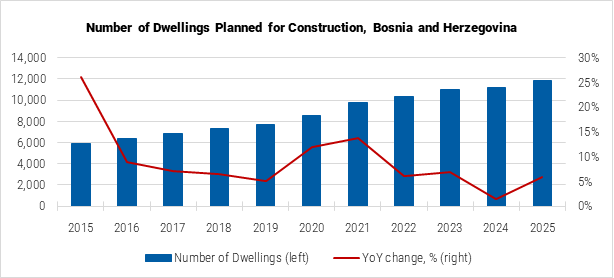
At the same time, the forward pipeline continued to expand. BHAS recorded 11,849 dwellings planned for construction in 2025, a 5.93% increase year-on-year, indicating that developers are still bringing new projects forward. Bloomberg Adria, citing Sarajevo real estate professional Haris Kadić, noted that effective supply remains constrained by limited new-build stock, as larger residential projects are being delivered more slowly and rising construction costs continue to weigh on execution. Echoing this view, Mile Petrović, secretary of the Association of Construction and Building Materials Industry at the Chamber of Commerce of Republika Srpska, said that there has been a “continuous increase in the value of executed works relative to completed dwellings,” pointing to a market where activity remains solid but the conversion of works into finished housing stock is becoming slower and more capital-intensive.
Data Source: BHAS.
Cost pressures remain an important part of the story. The CBBH noted in late 2025 that economic activity was being shaped by “high inflationary pressures on average consumer prices and labor costs,” while BHAS data shows that residential construction producer prices continued to rise in Q4 2025. In comments reported by Capital, Petrović added that construction costs are being pushed up by more expensive permits, land-development fees, contractor works, materials, design services, and project documentation. Labor availability appears to be another factor behind slower completion rates. Bloomberg Adria notes that shortages of qualified workers leave contractors overstretched, often working across several projects at once and struggling to keep to agreed deadlines.
Looking ahead, the near-term supply outlook remains cautiously positive, though likely uneven. BHAS’s January 2026 release showed the number of dwellings planned for construction up 120.0% year-on-year, albeit from a low base, suggesting that formal pipeline activity remained active at the start of 2026. Even so, with labor costs still rising, construction input costs remaining elevated, and local professionals continuing to point to the slower realization of larger projects, any recovery in completed supply is likely to be gradual rather than abrupt.
Rental Market: Rents and Rental Yields
Rental Inflation Remains High Amid Limited Supply
Alongside other post-transition economies in the region, Bosnia and Herzegovina is characterized by a high homeownership rate and a relatively small rental market. According to BHAS data, as of 2021/22, the share of dwellings in the country occupied by paying tenants was 4.4%, up from 2.7% previously reported in 2015. The market remains largely unregulated, with many private landlords renting out their properties unofficially.
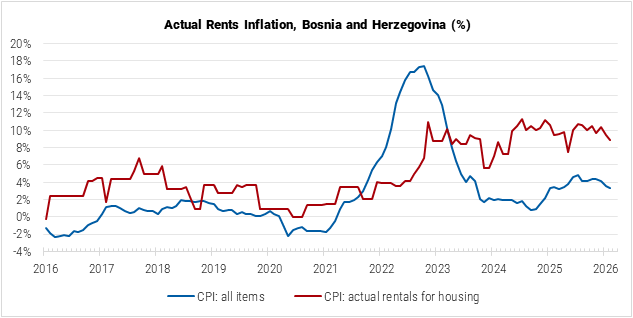
Bosnia and Herzegovina's rent price index:
Despite the overall limited size of the rental sector, demand for rental apartments is strong in larger cities, driven by students and those arriving in urban centers from smaller settlements and rural areas for work. Against the backdrop of consistent demand and limited supply of available properties, rental inflation has accelerated in the last few years, with the actual rentals for the housing component of the consumer price index (CPI) reported by BHAS notably outpacing the growth of the all-items CPI since mid-2023. Most recently, in February 2026, the actual rentals sub-index registered a 8.9% year-on-year growth, while the overall inflation stood at 3.3%.
Local specialists note that, apart from overall inflation, upward pressure on rents has been put by heightened demand arising from increased sales prices and limited supply, which is further exacerbated by some landlords switching their properties from long-term rentals to more profitable daily rentals, as well as the growing number of vacant but not listed for rent apartments in Sarajevo assumed to be owned by members of the diaspora living abroad but planning to return to Bosnia and Herzegovina at some point.
Data Source: BHAS.
In nominal terms, according to the survey conducted by the EUROSTAT in cooperation with real estate agencies in major European cities, the average monthly rent for quality apartments in Sarajevo (within residential areas of good quality, typically favored by expatriates and professional people) in 2025 reached EUR 770 (USD 870) for 1-bedroom units, EUR 1,150 (USD 1,300) for 2-bedroom units, and EUR 1,600 (USD 1,808) for 3-bedroom units. For all types of units surveyed, the average rate increased by over 90% within the previous five years.
Across a wider spectrum of properties, the research by Global Property Guide conducted in October 2025 found average asking rents in Bosnia and Herzegovina’s key urban submarkets of Sarajevo and Banja Luka at EUR 260-280 (USD 302-326) for 1-bedroom units, EUR 330-380 (USD 384-442) for 2-bedroom units, and EUR 410-560 (477-651) for 3-bedroom units. The corresponding gross rental yields averaged 3.99%, with Banja Luka (4.08%) demonstrating slightly higher potential performance than Sarajevo (3.90%).
Mortgage Market and Interest Rates
Interest Rates Stable, Lending Volumes Continue Growing
The Central Bank of Bosnia and Herzegovina (CBBH) doesn’t conduct traditional monetary policy but functions as a currency board, pegging the national currency to the euro at a fixed exchange rate and holding euro reserves at least equal to the amount of the convertible mark in circulation.
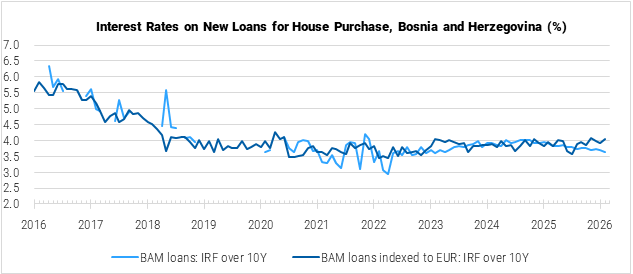
Bosnia and Herzegovina's mortgage loan interest rates:
With the limited role of the central bank, commercial banks in the country independently determine their lending interest rates based on individual borrowers’ financial position, loan value, and the quality of the collateral. Against this background, the rise in interest rates in Bosnia and Herzegovina over the last several years lagged the much faster increases observed in the euro area and other neighboring countries, and lending rates have remained generally flat and close to historical lows, especially for mortgages.
Data Source: CBBH.
To contain the possible increase in interest rates during the 2022 spike in Europe, the authorities implemented temporary measures (subsequently extended several times, with the latest amendments prolonging them until June 2026). According to the International Monetary Fund (IMF) insights, however, local banks have been reluctant to increase lending rates anyway, mostly due to fears about asset quality, as well as strong competition among the lenders, with anecdotal evidence suggesting the rates would not have been significantly increased even in the absence of restrictions.
As of February 2026, the CBBH reported the weighted average interest rate on new loans for house purchase at 3.63% (loans in BAM) and 4.03% (loans in BAM indexed to EUR) for loans with the initial rate fixation (IRF) period of over 10 years, both indicators demonstrating only marginal movement compared to their standing a year and two years prior. A similar dynamic was also observed for new loans with other IRF periods.
Weighted average interest rates on new loans for house purchase:
| Feb 2026 | YoY | Feb 2025 | YoY | Feb 2024 | |
| BAM loans | |||||
| - Floating rate and IRF up to 1Y | n/a | n/a | n/a | n/a | 4.97% |
| - IRF over 1Y and up to 5Y | 3.25% | ↑ | 3.08% | ↓ | 3.45% |
| - IRF over 5Y | 3.42% | ↓ | 3.99% | ↑ | 3.43% |
| - IRF over 10Y | 3.63% | ↓ | 3.92% | = | 3.92% |
| BAM loans indexed to EUR | |||||
| - Floating rate and IRF up to 1Y | 4.80% | ↓ | 4.84% | ↑ | 4.47% |
| - IRF over 1Y and up to 5Y | n/a | n/a | n/a | n/a | n/a |
| - IRF over 5Y | 4.31% | ↑ | 4.24% | ↑ | 4.19% |
| - IRF over 10Y | 4.03% | ↑ | 3.94% | ≈ | 3.90% |
| Data Source: CBBH. | |||||
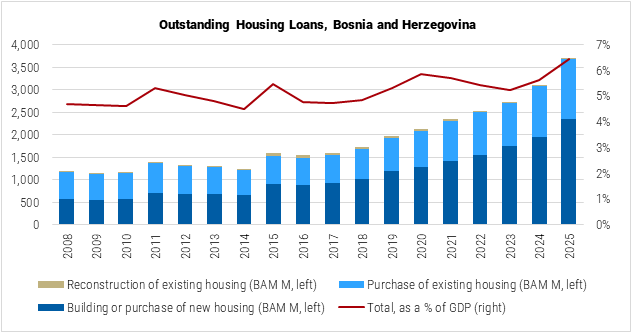
The fact that, beyond deposits, real estate remains the only investment option for many households in the country, coupled with relatively low and stable interest rates, supports the continued growth in new mortgage lending. Based on the CBBH data, the annual value of allocated housing loans to households (including credit for the construction, reconstruction, or purchase of homes) in 2025 reached BAM 1.2 billion (USD 676.5 million), a 27.0% increase compared to 2024. Housing loans represented 13.1% of total allocations to households.
In this environment, the total value of outstanding housing loans in Bosnia and Herzegovina also demonstrated a strong 19.8% increase in 2025, reaching BAM 3.8 billion (USD 2.3 billion) by February 2026, according to the CBBH. The relative size of the market, although still limited, grew from 5.2% to an estimated 6.4% of GDP at current prices in 2025. By purpose, the largest share of outstanding credit is represented by loans for the construction or purchase of new housing (62.8%), followed by the purchase of existing housing (36.6%) and reconstruction of existing housing (0.6%).
In parallel, the share of home purchase transactions financed by mortgages grew from 36.5% in 2022 to 53.8% 2024, according to a recent IMF analysis.
Data Source: CBBH.
Economic and Social Factors
Modest Growth and Elevated Inflation Amid Continued Political Uncertainty
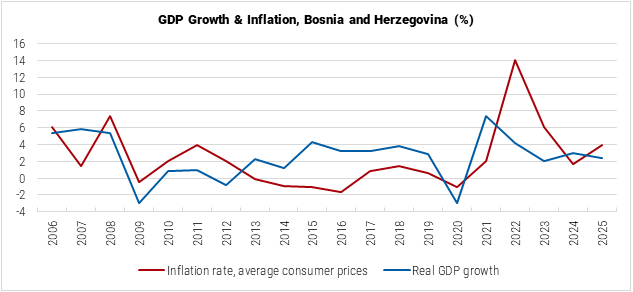
Due to weak external demand and rising domestic inflation, economic activity in Bosnia and Herzegovina slowed in 2025, with the annual real GDP growth projections between 1.8% (European Commission forecast) and 2.4% (IMF forecast). Over the next two years, activity is also projected to remain muted in the environment of subdued external demand, stable private consumption, and only a slight boost from increased EU financial support. The fall forecast from the European Commission projected growth of 2.2% in 2026 and 2.5% in 2027.
After easing substantially from 14.0% in 2022 to 1.7% in 2024, driven by higher prices for food, restaurants, and hotels, and health services, consumer price index (CPI) inflation in the country re-accelerated to the average annual level of 4.0% in 2025 and was most recently reported by BHAS at 3.3% in February 2026. With domestic price pressures expected to persist due to strong wage growth and overdue electricity price adjustments, inflation is projected to remain elevated in 2026 and 2027.
Data Source: IMF.
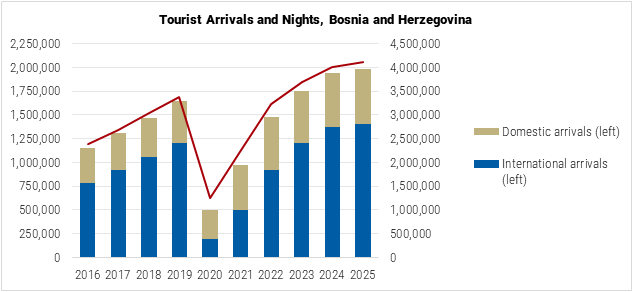
The growth in Bosnia and Herzegovina’s tourism sector, which previously supported the country’s economic recovery, has also slowed. In 2025, BHAS reported 1.98 million tourist arrivals (of which over 1.4 million foreign tourists), a moderate 2.2% annual increase after double-digit growth rates observed over the past decade (with the exception of 2020). The total number of nights spent reached 4.1 million (of which 2.9 million were by foreign tourists), a 2.6% increase year-on-year.
Unlike the previous years, in 2025, growth was more pronounced in the domestic segment (3.0% increase in arrivals and 3.6% increase in nights spent, against the respective 1.9% and 2.2% increases demonstrated by the foreign segment). The top countries of origin for foreign visitors to Bosnia and Herzegovina are Turkey (13.9% of international arrivals), Croatia (13.0%), and Serbia (10.7%).
Data Source: BHAS.
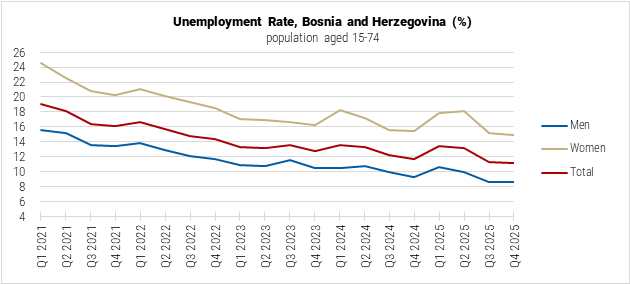
The labor market in Bosnia and Herzegovina has tightened over the past few years, with the largest employment gains observed in tourism and trade, while employment declined in other sectors, such as mining and agriculture. At the same time, the market faces persistent challenges due to high emigration, which shrinks the supply of qualified labor, and widespread job informality encouraged by increases in the minimum wage. The overall unemployment rate declined from 16.1% in Q4 2021 to 11.1% reported in Q4 2025, although it remains relatively high, especially among young people and women (14.9% in Q4 2025, compared to 8.6% for men during the same period).
“Indications of a continued outflow of qualified labor suggest increased labor shortages in sectors such as construction and health. This is set to contribute to further wage pressures exceeding productivity growth, while also helping to reduce the unemployment rate,” said the European Commission analysis.
Data Source: BHAS.
Overall, Bosnia and Herzegovina continues to face significant headwinds in achieving stronger growth and narrowing gaps with advanced Europe. As outlined in the latest Article IV staff report from the IMF, the country’s income per capita is among the lowest in Europe (35% of the EU average), and its current potential growth rate is insufficient for rapid income convergence. Domestic political uncertainty continues to risk undermining investor and consumer confidence and weakening growth drivers, while global trade tensions pose risks to exports and borrowing costs.
Heightened political tensions are also slowing reforms and progress toward EU integration. Previously, the European Council decided to formally open accession negotiations with Bosnia and Herzegovina in March 2024; however, according to the European Commission’s most recent candidate country report, the “reform dynamic stalled” and “only a very limited number of reforms were adopted” in the period between September 2024 and September 2025.
Sources:
- Agency for Statistics of Bosnia and Herzegovina (BHAS)
- Business Statistics: Prices of New Dwellings Sold in Bosnia and Herzegovina, 4th Quarter 2025: https://bhas.gov.ba/
- Business Statistics: Residential Construction in Bosnia and Herzegovina, January – December 2025: https://bhas.gov.ba/
- Business Statistics: Building Permits Issued in BiH, December 2025: https://bhas.gov.ba/
- Business Statistics: Building Permits Issued in BiH, January 2026: https://bhas.gov.ba/
- Producer Price Index in Construction / Residential Buildings in Bosnia and Herzegovina, IV Quarter 2025: https://bhas.gov.ba/
- Prices: https://bhas.gov.ba/
- Labor Market: https://bhas.gov.ba/
- Living Conditions, Income, and Consumption: https://bhas.gov.ba/
- Tourism: https://bhas.gov.ba/
- Central Bank of Bosnia and Herzegovina (CBHH)
- Statistics Web Portal CBBH: https://cbbh.ba/
- Statistical Appendix: https://cbbh.ba/
- Financial Stability Risk Assessment, December 2025: https://www.cbbh.ba/
- Report on Macroeconomic Imbalances, December 2025: https://www.cbbh.ba/
- Institute of Statistics of the Federation of Bosnia and Herzegovina (FIS)
- Construction Market Statistics (BS): https://fzs.ba/
- Republika Srpska Institute of Statistics (RZS-RS)
- Construction Market Statistics (SR): http://www3.rzs.rs.ba:8080/
- Banking Agency of Republika Srpska
- Banking Agency of Republika Srpska Issued the Decision on Temporary Measures to Mitigate the Risk of Increase in Interest Rates…: https://abrs.ba/
- Decision on Temporary Measures to Mitigate the Risk of Increase in Interest Rates: https://abrs.ba/
- Federal Administration for Geodetic and Real Property Affairs (FGU)
- Report of Real Estate Market in the Federation of BH for Year 2025: https://fgu.com.ba/
- Republic Authority for Geodetic and Property Affairs (RGURS)
- Annual Report of the Real Estate Market of Republika Srpska, 2025 (SR): https://rcn.rgurs.org/
- European Commission
- EU-Bosnia and Herzegovina Relations: https://enlargement.ec.europa.eu/
- Bosnia and Herzegovina Report 2025: https://enlargement.ec.europa.eu/
- Autumn 2025 Economic Forecast, Bosnia and Herzegovina: https://economy-finance.ec.europa.eu/
- Average Rent Per Month in Cities by Type of Dwelling: https://ec.europa.eu/
- International Monetary Fund (IMF)
- Country Overview: Bosnia and Herzegovina: https://www.imf.org/
- 2025 Article IV Staff Report: https://www.imf.org/
- The Real Estate Market in Bosnia and Herzegovina: https://www.imf.org/
- Bosnia and Herzegovina: Selected Issues, September 2025: https://www.imf.org/
- Bosnia and Herzegovina: Selected Issues, June 2024: https://www.imf.org/
- Chamber of Commerce of the Republic of Srpska
- Expansion of Housing in Bajna Luka (SR): https://komorars.ba/
- Bloomberg Adria
- Real Estate in Sarajevo Has Reached Its Ceiling… (BS): https://ba.bloombergadria.com/
- BiH Construction Paradox... (BS): https://ba.bloombergadria.com/
- Capital
- Over 100 Buildings Under Construction in Bajna Luka (BS): https://capital.ba/
- Sarajevo Times
- The Phenomenon of Empty Apartments Continues to Affect Sarajevo: Is a Tax the Solution: https://sarajevotimes.com/
- Oslobodjenje
- Apartment Rental Prices Have Also Increased Significantly in Bosnia and Herzegovina…(BS): https://www.oslobodjenje.ba/