Property Investment in Bosnia and Herzegovina: Foreigner's Guide (2025)
Bosnia and Herzegovina (BiH) is an emerging destination, known for its stunning landscapes, rich cultural heritage, warm hospitality, and affordable prices. This once war-torn European nation is steadily recovering and expanding its expat and tourism sectors, particularly in major cities such as Sarajevo and Banja Luka.
As a still-developing country, BiH’s rental yields remain among the lowest in Europe. However, its low property prices, investor-friendly tax policies, and potential for long-term growth make BiH an appealing choice for real estate investors willing to take a patient, strategic approach.
This newly updated 2025 edition guide will take you through the basic steps and important things to consider when buying property in Bosnia and Herzegovina as a foreign first-time buyer.
11 Things to Know Before Investing in Bosnia and Herzegovina
- Can foreigners buy property in Bosnia and Herzegovina
- Best cities and regions to invest
- Median asking prices
- Rental yields and rents
- Market performance (past and current)
- Landlord and Tenant Laws
- Property-related taxes
- Buying (and Selling) Costs
- Short-term rental regulations
- Mortgages and financing options
- How to buy property in Bosnia and Herzegovina: step-by-step
1) Can Foreigners Buy Property in Bosnia and Herzegovina?
Yes, foreigners can purchase real estate in Bosnia and Herzegovina as long as a reciprocity agreement with their home country permits Bosnian citizens to purchase property there as well. Most European nations, along with many countries outside of Europe, maintain these agreements. Residents of non-reciprocal countries can still buy property by creating a business in BiH, then purchasing property through the company.
However, foreign investors cannot purchase agricultural land or property located in protected natural areas. Additionally, owning property in BiH does not automatically provide citizenship or residency rights.
2) Best Regions and Cities to Buy
Bosnia and Herzegovina offers a diverse range of real estate opportunities, combining historical charm, emerging urban development, and natural beauty.
Sarajevo
As the capital and cultural heart of Bosnia and Herzegovina, Sarajevo stands out as the most dynamic real estate market in the country. The city blends Ottoman, Austro-Hungarian, and modern architecture, creating a unique urban atmosphere. Neighborhoods such as Baščaršija, Marijin Dvor, and Grbavica are particularly popular for residential and commercial investments. Demand for rental properties is strong, driven by the growing tourism sector, a rising number of international organizations, and an expanding student population.
Banja Luka
The administrative center of Republika Srpska, Banja Luka, has seen consistent development and modernization over the past decade. Its stable economy, business-friendly environment, and infrastructure projects make it a promising location for investors. Residential developments in areas like Nova Varoš and Borik, as well as commercial projects near the city center, attract both local buyers and foreign investors seeking long-term returns.
Mostar
Famous for its iconic Stari Most (Old Bridge) and rich history, Mostar offers a blend of cultural heritage and emerging real estate potential. The city’s growing tourism industry has boosted demand for hospitality properties, short-term rentals, and renovated historic homes. Neighborhoods near the Neretva River and the old town area are particularly desirable for investors focused on tourism-driven income.
Tuzla
Known for its strong industrial base and expanding university sector, Tuzla provides solid opportunities in both residential and commercial real estate. The presence of young professionals and students creates a steady demand for apartments and rental housing, especially around the city center and the Slatina district. Ongoing infrastructure improvements and proximity to regional transport networks further enhance Tuzla’s investment appeal.
Trebinje
Located in the country’s south near the Adriatic coast and the borders with Croatia and Montenegro, Trebinje has become one of the most promising emerging real estate markets in Bosnia and Herzegovina. Its Mediterranean climate, scenic surroundings, and increasing tourism make it an attractive option for vacation homes and boutique hospitality investments. The city’s relaxed lifestyle and lower property prices compared to nearby coastal areas add to its appeal.
3) Median Asking Prices
Bosnia and Herzegovina has some of the lowest asking prices in Europe, as war-era challenges have slowed growth, keeping prices lower.
The average prices for a one-bedroom apartment are as follows:
- Sarajevo - €92,000
- Banja Luka - €79,000
4) Rental Yields and Rent Prices
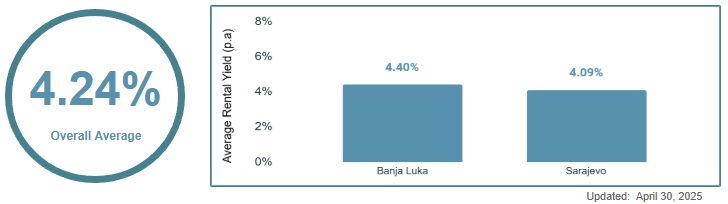
Bosnia and Herzegovina’s rental yields are some of the lowest across Europe, averaging 4.24% in April 2025. However, not all areas are the same. In Sarajevo’s Ilidža district, for example, one-bedroom apartments yielded the highest average at 6.10%. Interestingly, the same area’s two-bedrooms yielded the lowest at just 2.89%.
Bosnia and Herzegovina's rent price index:
Data Source: Agency for Statistics of Bosnia and Herzegovina.
5) Market Performance (Past and Present)
The end of the Bosnian war in 1995 left the country with widespread destruction, ownership disputes, and large immigration challenges, all of which still impact the area to some extent. Since 2021, the BiH housing market has steadily grown, especially in cities like Sarajevo and Banja Luka, where demand for new developments is increasing despite rising construction costs. By late 2024, average home prices had climbed by over 16% over 2023.
The housing market is likely to keep steadily growing, but prices may rise due to limited supply, rising material prices, and increased labor costs. As for Q3 2025, BiH has some of the lowest real estate prices in Europe, which may make it an attractive option for potential investors. While the general BiH rental market is relatively small, demand is larger in big cities where the expat and tourism sectors are growing.
Bosnia and Herzegovina's house price annual change:
Data Source: Agency for Statistics of Bosnia and Herzegovina.
6) Landlord and Tenant Laws
Bosnia and Herzegovina’s landlord and tenant laws are judged by the Global Property Guide to be slightly pro-tenant between landlord and tenant. While the law provides safeguards for both sides, tenant protections – especially when it comes to eviction hurdles in urban areas – make the system more tenant-friendly.
7) Property Related Taxes
Rental income gained in Bosnia and Herzegovina is taxed at 10%, which includes any capital gains from the sale of the property as well.
Property taxes vary depending on the area of the country. In the Federation of BiH (FBiH) – which is the district where Sarajevo is located – property taxes range from 0.05% to 3.00%. Exact taxes are determined on local cantonal levels and based on both the property’s size and value.
In the Republika Srpska (RS) district – which governs Banja Luka – the standard property tax rate is approximately 0.20% of the property’s market value.
Additionally, a value-added tax (VAT) of 17% may be applied to new construction properties. In 2025, the government passed a law allowing for the 17% to be refunded up to certain limits, but the new refund appears to apply to first-time buyer BiH residents, not foreign investors.
8) Buying and Selling Costs
Compared to other European countries, Bosnia and Herzegovina’s average transaction costs are in the moderate range. In addition to the purchase price, buyers should expect to pay an additional 5.2 to 5.70%, while sellers can expect to pay 2% to 3%.
Here's a full breakdown:
| Cost Component | Percentage of Property Value | Who Pays? |
| Property Transfer Tax | 5.00% | Buyer |
| Legal Fees | 0.10% - 0.50% | Buyer |
| Notary Fees | 0.10% - 0.20% | Buyer |
| Agent Fee (Seller) | 2.00 - 3.00% | Seller |
| Round-trip Transaction Cost | 7.20% - 8.70% | Buyer & Seller |
| Source: Global Property Guide, PWC, KPMG | ||
9) Short-Term Rental Regulations
Short-term rental rules in Bosnia and Herzegovina vary by location, but there are a few national rules. First, the property must be properly zoned for short-term rentals. Guests who stay in private accommodations rather than a hotel for more than three days must be registered with the property authorities within 48 hours. This is usually handled by the host, not the guests.
In Sarajevo, the Tourism Law lays out the rules for registering, licensing, and collecting tourist (residence) tax from accommodation providers, which may vary in peak seasons. In Banja Luka, the hospitality law governs how lodging can be offered. As of 2025, private rentals must pay tourist tax per overnight stay and vary based on the specific location.
With tourism rising, more national laws, restrictions, and crackdowns are likely on the horizon.
10) Mortgage and Financing Options
Qualifying for a mortgage in Bosnia and Herzegovina requires the buyer to be from a nation that falls under the BiH reciprocity rule. Even then, it can be difficult to obtain funding from a BiH-based bank.
Opening a BiH-based bank account and regularly transferring money to it prior to applying for a loan may help. Some international banks also provide mortgage loans in Bosnia and Herzegovina. Expect to pay a large down payment – generally ranging from 30% to 40%.
Bosnia and Herzegovina's mortgage loan interest rates:
Data Source: The Central Bank of Bosnia and Herzegovina.
11) How to Buy Property in Germany: Step-by-Step
- Confirm Reciprocity: Foreigners can purchase property in Bosnia and Herzegovina if their home country has a reciprocity agreement with BiH. Most European nations, the United States, and Canada currently qualify. Investors in countries without an agreement can still purchase property by establishing a BiH-based company and buying through that entity.
- Research Pricing, Yields, and Legal Restrictions: Bosnia and Herzegovina’s real estate market is still developing, which keeps property prices lower than in much of Europe. Sarajevo and Banja Luka are the most active and popular areas for investment. Rental yields vary by region but tend to be highest in urban centers. Because the market is young, laws and regulations can differ significantly by municipality, so local guidance is essential.
- Research Long-Term Market Changes: While the country continues to recover from its post-war years, the market is gradually strengthening. Tourism growth and rising demand for both residential and vacation properties are boosting development. Ongoing infrastructure improvements and foreign investment incentives are helping stabilize the market and create long-term potential.
- Understand Local Taxation and Landlord Laws: Foreign owners pay an annual property tax, which varies by district. Sarajevo is in the Federation of Bosnia and Herzegovina (FBiH), while Banja Luka is in the Republika Srpska (RS). Each entity has its own tax structure and property-related regulations. Landlord–tenant laws are considered tenant-friendly, particularly in the Federation, where eviction can be slow. Rental contracts are usually negotiated freely, but must be registered with local tax authorities to stay compliant. Buyers must also obtain a Bosnian tax identification number (JMBG) before finalizing the sale.
- Research Properties: Start with real estate sites such as Indomio.ba, which lists detailed property information and agent contacts. Properstar and JamesEdition also feature some BiH listings, though not all properties appear online. Working with a licensed, bilingual real estate agent can help locate off-market opportunities and navigate the negotiation process.
- Hire a Bilingual Real Estate Attorney: Bosnia’s property system can be complex, involving three jurisdictions, occasional mismatches between land registry and cadastre records, and potential ownership disputes dating back to the pre-war period. A notary is required to certify the contract, but does not protect the buyer’s interests. A real estate attorney ensures the property title is clear, drafts the purchase contract, secures translations, assists with tax ID paperwork, and registers the sale. Attorneys can also represent buyers through a power of attorney. Because all documents are in Bosnian, it is essential to use a trusted bilingual attorney or certified translator.
- Make an Offer and Conduct Due Diligence: Offers are typically negotiated, with buyers often starting at 5%-10% below the asking price. Once terms are agreed upon, an initial contract is signed and a 10% deposit is paid. Your attorney will verify ownership by checking the land registry to confirm there are no unresolved “use and disposal rights” or other encumbrances — a holdover from the socialist era that can complicate sales.
- Secure Financing: Foreigners may find it challenging to obtain mortgages from local banks. Many investors use international lenders or pay partially in cash. Expect to contribute 30%-40% of the property’s value as a down payment.
- Apply for a Tax ID (JMBG): Your attorney can assist with obtaining a tax identification number, which typically takes up to one week to process.
- Finalize the Contract: The sales contract, written in Bosnian, must be signed and notarized before a public notary, who checks that all paperwork is complete and legally compliant. At this point, taxes and fees are paid.
- Register Ownership: The buyer or their representative submits the registration proposal to the appropriate land and real estate registries. The registry updates ownership records, notes any encumbrances, and issues an updated extract showing the buyer as the new owner.
Timeline: Expect 2 to 6 months.
Need Help?
Buying property in a foreign country can feel overwhelming, but we're here to help.
At Global Property Guide, we offer:
- Data-backed insights on property prices, rental yields, and taxes
- Country-specific legal and tax guidance through our partner network
- Pre-screened investment properties, including income-generating Airbnb units
- 1-on-1 consultations with real estate experts focused on international buyers
- Step-by-step buyer support, from due diligence to closing
Whether you're looking for your first investment in Bosnia and Herzegovina or expanding your international portfolio, we can help you make smart, secure decisions.
Contact our team or book a free consultation to get started.