Moscow just keeps on booming!
If you thought Moscow property prices couldn’t go any higher – well, they just have!
The Moscow property boom is an amazing phenomenon. Apartments in the centre of the city are being sold and rented at prices which would appear to defy all reason - except that Moscow is a city, now, of extraordinary wealth.
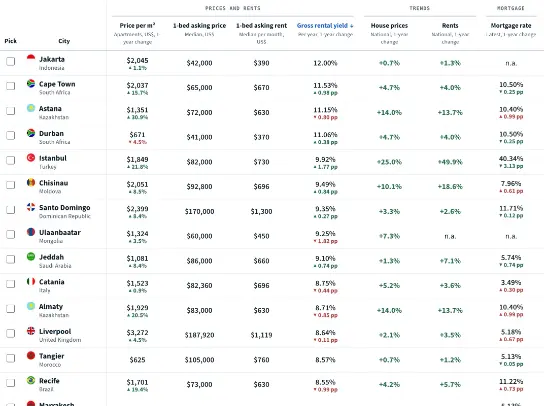
The average price of an apartment rose to US$19,093 per sq. m. in prime Moscow districts in December 2006, according to Knight Frank, Moscow. Re-sale apartment prices rose 69.4% in the year to December 2006. Newly built apartment prices rose by 92.2% in the year to December 2006. A small three-room apartment (60 sq. m.) in central Moscow is now worth well over US$1 million. First-class apartments can command twice that or more – US$40,000 per sq. m. and up is not unknown.
Property is not all that’s booming. The Russian economy grew by 6.5% per annum in 2006, though that is down on previous years. Shopfront after shopfront in Moscow glitters with Western brand names. Huge limousines ferry wives and mistresses to their destinations.
All this wealth is being fuelled by the oil and gas boom. Russia now pumps more oil than the Saudis. Never in its history has Russia been so rich as it is today.
The stock market reflects the prosperity. Here are annual returns from the Russian stock market (in dollar terms):
- 2002 - 38%
- 2003 - 58%
- 2004 - 4%
- 2005 - 83%
- 2006 - 71%
"The art market reflects the boom - the global figure for Russian art sales in London and New York in 2000 was US$14 million. In 2005 it was US$157 million. In 2006 it was around US$240 million. The oligarchs, naturally, prefer figurative and semi-erotic 19th and early 20th century art, rather than revolutionary art like Malevich.
Moscow’s highly priced districts are mostly within the Garden Ring, led by classic aristocratic areas such as Ostozhenka. Central Moscow’s dwelling prices are twice or three times those in the suburbs, which in turn are three times those in the regions. St. Petersburg residential prices are half Moscow prices.
Russia’s housing market has tended to advance by fits and starts. From 2000 to 2004, prices in the primary market rose by around 115%, while secondary market prices rose by around 145%. There was a brief pause in late 2004, then house prices rose by about 15% in 2005, while apartment prices rose by around 32%, according to Kirsanova Realty. Then in 2006 the market surged again, pushed partly by very attractive yields.
The property boom is fuelled by real housing shortages. Though the volume of dwelling construction grew by 44% between 2000 and 2005, that is only 7.5% a year, i.e., the equivalent of Russia’s GDP growth. The average Russian inhabits 20.8 sq. m. - less than half the European average. But around one third of this space is run down and unusable, so real per capita space is nearer 13.5 sq. m.
However, in 2006, residential construction growth rates increased 12%, and 48 million square metres were added to existing stock, with a market value of US$60 billion, according to Trust Bank. That is about one sq. m. for every adult in the country.
A construction lull in 2004 fed through to the enormous price rises of 2006. Toward the end of 2006 strong supply began again to be evident, and may have been reflected in the slowdown of central Moscow rentals.
In the entire year of 2006, central Moscow rents rose by 30.9%, according to Knight Frank. But in the last six months , rents rose by only 10.9%, a significant slowing.
The boom is fueled by the development of the mortgage market. High as prices are, many Russians, tasting their first wealth, can now borrow money. The choice is to buy on credit, or apparently miss the escalator of a housing market which is becoming more expensive every day.
The volume of mortgage loans last year topped the $5.5 billion mark, up from about $1 billion in 2003, when mortgages were effectively introduced. Last year saw the introduction of laws underpinning mortgage-backed securities, allowing banks to refinance housing loans for the first time. Russia's state-owned bank VTB, the second-largest bank in the country, is leading the growth. Its mortgage portfolio increased by 270% in 2006, to reach $875 million by end-2006.
Experts say that 30% of credits last year were used to buy newly built housing, while 50% to 55% of mortgages went to the secondary housing market. Mortgage lending is expected to reach $8.3 billion by end-2007, with more money being spent on new housing than on the secondary market.
Interest rates on loans extended to households (no specific mortgage interest rate statistics are available) fluctuated during 2006 between 10.1% and 13.3%; which represents a tightening of rates on the period 2002-2005, when rates around 10.3% were the norm. Nevertheless with inflation at 9.5%, real interest rates are low.
While central Moscow prices may have room for further growth, prices in the provinces are pushing against affordability limits, experts believe. The ratio between per square metre prices and GDP per capita in Russia is one of the highest in the world – always a danger signal.
Bribery, risks
Getting permits for renovation and everything else also almost always involves bribes. This is a highly corruption prone country, and the environment makes no-one’s life easy.
Given the extent of bureaucracy in Russia, buying land is also not easy. One problem is the system of land registration. Changes in law and transfer of ownership are not well documented. Title search must be conducted to ensure that there is no lien in the property.
In turn this creates a fundamental insecurity for owners. Predatory mafia-like groups make a business of launching attacks on private owners, liaising with corrupt municipality officials and corrupt land registry officials to dispossess the rightful owners.
Because of the lack of a trustworthy legal environment, property sales are almost always done with cash. The amount is paid in full in dollars. This creates serious security concerns. Buyers also have to reserve dollars days in advance.
Real estate transactions, purchases or leases, in Russia are quoted and paid in US dollars. This creates another concern because property prices and rents move not because the value of the property changed but simply because the ruble has appreciated or depreciated.
All these dangers tend to restrict the supply of new units, raising prices and rents.