The Netherlands’ Residential Property Market Analysis 2025 H1
The Dutch housing market experiences accelerating growth in sales prices and rents due to persistent supply shortages exacerbated by bottlenecks in infrastructure and planning, as well as recently enacted changes to the rent control system.
This extended overview from Global Property Guide covers key aspects of the Dutch housing market and takes a closer look at its most recent developments and long-term trends.
Table of Contents
- Housing Market Snapshot
- Historic Perspective
- Demand Highlights
- Supply Highlights
- Rental Market
- Mortgage Market
- Socio-Economic Context
Housing Market Snapshot
Following a subdued performance in 2023, the Dutch housing market recorded a notable rebound in 2024. According to Statistics Netherlands (CBS), the House Price Index for Existing Homes Sold rose by 8.77% year-on-year, or 5.24% when adjusted for inflation. "The main drivers [for price increases] were falling mortgage rates, the supply shortage, and higher household incomes," noted experts from ABN AMRO.
As of April 2025, price growth accelerated further, with the index up 10.23% year-on-year, or 5.89% in real terms. Experts from Rabobank attribute this sustained momentum to a combination of strong demand, underpinned by rising disposable incomes, low unemployment, and more flexible lending criteria, and a persistent supply shortage, compounded by weak new housing completions.
Netherlands' house price annual change:
[hp_graph]
Price trends remain uneven across regions. Provincially, Utrecht and Groningen posted the strongest annual increases in Q1 2025, with the House Price Index for Existing Homes Sold rising by 12.96% and 12.95%, respectively. Drenthe (12.66%) and Overijssel (12.36%) also reported robust gains. Among the four monitored municipalities, Utrecht led again with a 14.19% year-on-year increase, followed by The Hague (10.75%), Rotterdam (8.83%), and Amsterdam (6.36%).
In the first quarter of 2025, the average sales price for existing owner-occupied homes nationwide reached EUR 470,028 (USD 494,610), increasing by 8.79% year-on-year. Among the four largest cities, Amsterdam recorded the highest average price at EUR 632,733 (USD 665,825), while Rotterdam remained the most affordable at EUR 406,180 (USD 427,423) - 13.58% below the national average.
Average price of owner-occupied dwellings sold in the four largest municipalities:
| Average sales price of owner-occupied dwellings sold, Q1 2025, EUR |
Average sales price of owner-occupied dwellings sold, Q1 2025, USD |
YoY, % Q1 2025 vs Q1 2024 |
|
| Amsterdam | EUR 632,733 | USD 665,825 | 7.99% |
| The Hague | EUR 443,785 | USD 466,995 | 3.01% |
| Rotterdam | EUR 406,180 | USD 427,423 | 6.37% |
| Utrecht | EUR 556,988 | USD 586,118 | 9.84% |
| Nationwide | EUR 470,028 | USD 494,610 | 8.79% |
| Exchange rate as of Q1 2025, EUR 1 = USD 1.0523. | |||
| Data Sources: Land Registry, CBS. | |||
Looking ahead, experts anticipate continued upward pressure on prices, supported by rising wages and improved market sentiment amid ongoing supply constraints. Most forecasts project annual growth between 5% and 9% in 2025, followed by more moderate gains in 2026.
"With a robust year behind us and trends being unchanged, we expect price growth to continue in 2025. We therefore maintain our latest forecast of +7% price growth for 2025 and +3% for 2026," said experts from ABN AMRO. Rabobank expects average home prices to rise by 8.6% in 2025, moderating to 5.7% in 2026.
Analysts also highlight regional disparities, with price growth in the four largest cities expected to remain more restrained. This is primarily due to investor-driven sell-offs of rental properties. "In the G4 cities (Amsterdam, Rotterdam, The Hague, and Utrecht), investors sell a relatively large number of rental homes, partly because the share of commercial rental homes is relatively large there. Due to this extra housing supply, price growth in these regions is expected to be lower," comments Rabobank.
Historic Perspective:
Core Trends and Economic Drivers Behind the Dutch Housing Market Evolution
Following a prolonged downturn in the aftermath of the global financial crisis, the Dutch housing market entered an extended phase of robust price growth. After reaching a low in mid-2013, house prices began a steady upward trajectory, culminating in a peak annual increase of 20.21% (13.72% in real terms) in the price index for existing homes in December 2021.
This sustained appreciation was underpinned by historically low mortgage interest rates and favorable financing conditions, including high loan-to-value ratios and the widespread availability of interest-only mortgages. The tax framework further bolstered demand by offering strong incentives for homeownership. Demographic dynamics also played a significant role, with consistent growth in net migration and the emergence of smaller, more numerous households contributing to increased housing demand.
By late 2022, however, the pace of growth began to moderate. In 2023, the Price Index for Existing Homes posted a 2.91% annual decline, reflecting the impact of rising mortgage rates, heightened geopolitical uncertainty, and a weakening economic outlook. The downturn proved short-lived. As inflation eased, mortgage rates began to fall, household incomes improved, and demand rebounded. Coupled with ongoing supply constraints, these factors drove a renewed upswing in prices, which rose by 8.77% year-on-year in 2024.
20-year annual house price change (based on annual price index for existing homes and consumer price index):
| Year | Nominal house prices (%) | Inflation-adjusted house prices (%) | Year | Nominal house prices (%) | Inflation-adjusted house prices (%) | |
| 2005 | 3.86% | 2.14% | 2015 | 3.27% | 2.65% | |
| 2006 | 4.55% | 3.41% | 2016 | 5.47% | 5.13% | |
| 2007 | 4.35% | 2.69% | 2017 | 8.19% | 6.71% | |
| 2008 | 3.16% | 0.65% | 2018 | 9.21% | 7.38% | |
| 2009 | -3.18% | -4.32% | 2019 | 7.04% | 4.30% | |
| 2010 | -2.02% | -3.26% | 2020 | 7.87% | 6.52% | |
| 2011 | -2.32% | -4.56% | 2021 | 15.10% | 12.10% | |
| 2012 | -6.21% | -8.46% | 2022 | 13.29% | 2.99% | |
| 2013 | -6.34% | -8.63% | 2023 | -2.91% | -6.50% | |
| 2014 | 1.20% | 0.22% | 2024 | 8.77% | 5.24% | |
| Data Sources: CBC, OECD, Global Property Guide. | ||||||
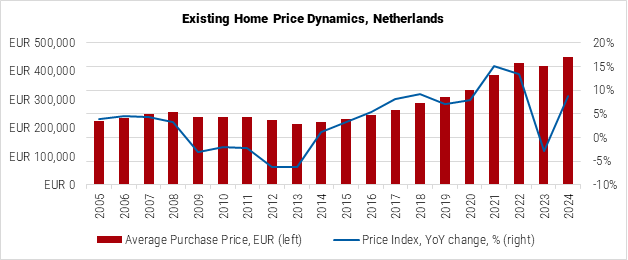
Data Sources: Land Registry, CBS.
Demand Highlights:
Transaction Growth Accelerates, Driven by Investor Sell-Offs
Demand for homes in the Netherlands remains strong, supported by rising wages, an increasing number of households, and low unemployment. In 2024, the number of owner-occupied dwellings sold rose sharply by 13.19% year-on-year to 206,460 units, according to data from the Land Registry. This increase is partly driven by residential investors selling former rental properties, largely in response to new tax measures and the introduction of the Affordable Rent Act. "Renting out homes has become less attractive in recent years due to higher transfer taxes, increased interest rates, higher wealth tax, and stricter rent regulation. <…> Investors are therefore selling their rental properties en masse," noted experts from Rabobank.
The momentum has continued into 2025. In the first quarter of the year, the Land Registry recorded 51,474 transactions of owner-occupied dwellings, reflecting a 15.82% increase year-on-year and marking the highest first-quarter result since 2021. Ongoing sales by buy-to-let investors have continued to drive market activity. "These small and relatively cheaper rental properties, mostly located in urban areas, are in high demand and sell quickly due to their affordability. This rapid turnover helps to sustain market activity," stated experts from DMFCO Asset Management.
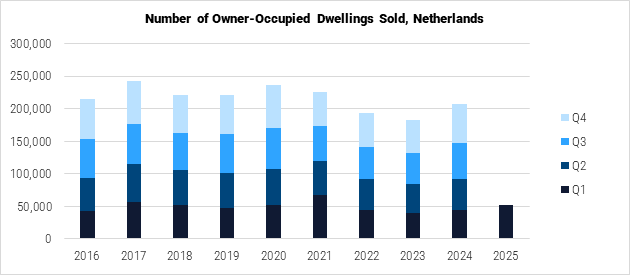
Data Sources: Land Registry, CBS.
Growth in transaction volume has varied significantly across regions, with the strongest increases seen in urban municipalities, where the share of rental properties is typically higher and investor sell-offs have had a greater impact. In the four major cities, transaction growth has notably outpaced the national average, ranging from 23.38% year-on-year in Amsterdam to 27.51% in The Hague.
Number of owner-occupied dwellings sold in key submarkets:
| Number of owner-occupied dwellings sold, Q1 2025 |
YoY, % Q1 2025 vs Q1 2024 |
|
| Amsterdam | 2,908 | 23.38% |
| The Hague | 1,766 | 27.51% |
| Rotterdam | 1,851 | 26.43% |
| Utrecht | 1,278 | 26.53% |
| Nationwide | 51,474 | 15.82% |
| Data Sources: Land Registry, CBS. | ||
Experts expect demand to remain elevated throughout 2025, supported by further increases in household income due to a tight labor market and collective bargaining agreements, as well as additional mortgage rate reductions expected to reach their lowest point in late 2025 or early 2026. "The combination of higher wages and stable interest rates contributes to improving the affordability of owner-occupied homes and increasing the maximum mortgage," commented experts from ING.
In its April Housing Market Monitor, ABN AMRO revised its forecast upward, now expecting a 5% year-on-year increase in transactions for 2025, compared to the previously projected 2.5%. The bank cites sustained market liquidity and continued investor sell-offs as key drivers of growth through the end of 2025. From 2026, however, this trend is expected to taper off, and transaction growth is projected to stabilize at around 1%.
Rabobank has also updated its outlook, projecting 222,000 residential sales in 2025 - an increase of nearly 8% from 2024. For 2026, the bank forecasts 227,000 transactions, representing a further 2% year-on-year rise.
Supply Highlights:
Long-Term Shortages Persist Amid Structural Imbalances
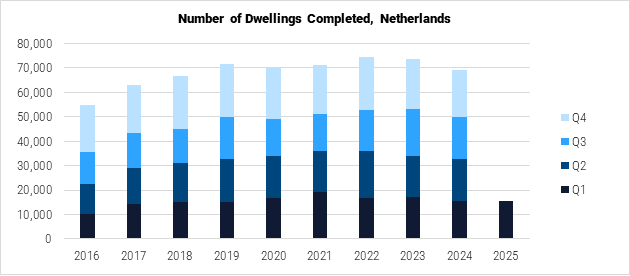
The Dutch housing market continues to experience sustained pressure amid ongoing efforts to address a persistent national housing shortage. According to CBS, a total of 69,129 dwellings were completed in 2024, reflecting a 6.12% decline compared to the previous year. In the first quarter of 2025, an additional 15,630 units were delivered, remaining largely unchanged year-on-year, with only a marginal increase of 0.04%.
The housing shortfall is currently estimated at approximately 400,000 homes - a figure that continues to rise annually. This persistent deficit exerts upward pressure on prices and further undermines affordability. In response, the government has set a target of delivering 100,000 new housing units per year. However, this goal significantly exceeds the average number of completions recorded over the past decade and appears increasingly difficult to achieve, particularly given the subdued start to 2025.
"High interest rates and rising costs" are cited as the primary factors behind construction delays, according to a report from the Housing Ministry. While moderate improvement is expected in 2025, the Ministry indicates that the annual target is unlikely to be reached before 2027. As part of efforts to accelerate housing delivery, Housing Minister Mona Keijzer signed an agreement in December 2024 with housing corporations, developers, and investors to build 75,000 new homes, primarily concentrated in the Utrecht-Nieuwegein region.
Data Source: CBS.
Despite strengthening demand favoring new residential construction, supply continues to fall short due to systemic bottlenecks in infrastructure and planning. Analysts at ING point to limited land availability, complex project development processes, and protracted legal procedures as key constraints. Experts at ABN AMRO also highlight regulatory uncertainty as a growing concern for investors: "We think that among all the bottlenecks, such as energy grid expansions and nitrogen, the biggest problem is the lack of investors to fill a sustainable pipeline. It seems investors especially lack planning stability."
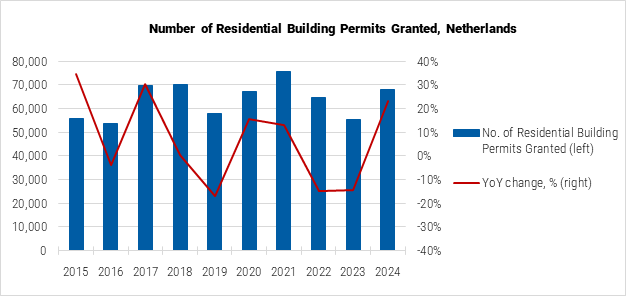
Looking forward, the volume of residential building permits issued remains volatile. The CBS reports that 68,112 permits were granted in 2024, marking a robust 23.06% increase year-on-year. However, the first quarter of 2025 saw a sharp decline, with permit approvals falling by 22.09% to just 12,500 units. A spokesperson from the Housing Ministry told DutchNews that officials were "concerned" by the latest figures and are working to identify the underlying causes of the downturn.
Data Source: CBS.
Rental Market:
New Rent Control Measures Destabilize the Market
In the highly regulated Dutch rental market, caps for starting rates in new contracts and allowed annual increases are determined by the point-based system, which segments rental housing according to such factors as surface area, energy efficiency, and value of each property determined by local authorities.
Netherlands' rent price index:
[rp_graph]
The system was recently revised by the Affordable Rent Act, which went into effect in July 2024, bringing turmoil to the country's rental market. The controversial legislation introduced a new mid-range tier to the regulated segment of the market, effectively widening the spectrum of properties falling under both base rent and rent increase control and narrowing the so-called liberalized private segment, limited only in terms of maximum annual increases. These changes, in turn, prompted many smaller landlords to sell off their properties due to anticipated loss of profitability, while larger players shifted their focus to higher-end homes not subject to the new rules.
"The act, which was designed to make homes more affordable, ended up exacerbating the country's housing crisis. It led to controls on 300,000 rental units, moving them out of the unregulated market. It has also effectively made it unprofitable for many landlords to lease their homes," Bloomberg wrote.
In their latest quarterly report, the popular rental platform Pararius notes the continued investor sell-offs in the private rental sector, coupled with a weakening inflow of owner-occupied homes into the market. According to Pararius, the number of private sector rental homes available to new tenants on the platform dropped by 35.5% in Q1 2025, compared to the same period last year, while the number of responses per listed rental property recorded a 47% increase, demonstrating shrinking supply amid steadily growing demand. "These developments are pushing rents upward, especially in the more affordable housing segments," says the report.
At the same time, recent insights from public broadcaster NOS show that the Dutch government is already looking to soften the impact of the controversial rent control measures to contain the shrinking of rental supply and stabilize the market. The currently discussed roll-back changes would be subject to a parliamentary vote and are intended to take effect in 2026.
Data Source: CBS.
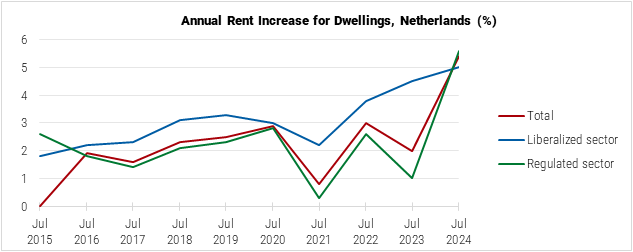
Before the enactment of the Affordable Rent Act, the CBS reported the average annual increase in rents across the country at 5.4% between July 2023 and July 2024 - the steepest increase in over 30 years. The liberalized rental sector demonstrated a 5.0% growth in rates, while the regulated sector (including social and other landlords) - a 5.6% growth.
Among key submarkets, the most pronounced growth was observed in the municipality of Rotterdam, where rents rose by 5.9%, on average, followed by Utrecht with a 5.8% increase, while in the capital city of Amsterdam and The Hague rent increases remained below the national average at 5.2% and 5.4%, respectively.
Under the adjusted system, in 2025, the maximum base rent for new contracts is set at EUR 900.07 for social housing (properties with up to 143 points) and EUR 1,184.82 for mid-range housing (properties with 144-186 points). For liberalized private housing (properties with 187 or more points), base rents have no upper limit. As for maximum rent increases, in 2025, the Ministry of Housing and Spatial Planning set the following limits for each of the tiers: liberalized private sector - 4.1%, mid-range sector - 7.7%, social sector - 5.0%.
In nominal terms, according to Pararius, the nationwide average asking rent for private sector housing reached EUR 19.64 (USD 20.67) per sqm in Q1 2025, apartments generally being more expensive with an average rate of EUR 20.77 (USD 21.86) per square meter, while for single-family homes the indicator stood at EUR 15.84 (USD 16.67) per square meter. Among the major cities, Amsterdam recorded the highest rates per square meter, and Rotterdam saw the strongest annual increase in average rents.
Average asking rent for private sector housing in key submarkets:
| City | Avg Monthly Rent, EUR/sqm, Q1 2025 |
Avg Monthly Rent, USD/sqm, Q1 2025 |
YoY, Q1 2025 vs Q1 2024 |
| Amsterdam | EUR 27.03 | USD 28.44 | 1.2% |
| Rotterdam | EUR 20.84 | USD 21.93 | 8.0% |
| The Hague | EUR 20.58 | USD 21.66 | 6.4% |
| Eindhoven | EUR 18.09 | USD 19.04 | 4.5% |
| Utrecht | EUR 21.16 | USD 22.27 | 4.0% |
| Exchange rate as of Q1 2025, EUR 1 = USD 1.0523. | |||
| Data Source: Pararius. | |||
Mortgage Market:
Interest Rates Fall Gradually, Demand Picks Up
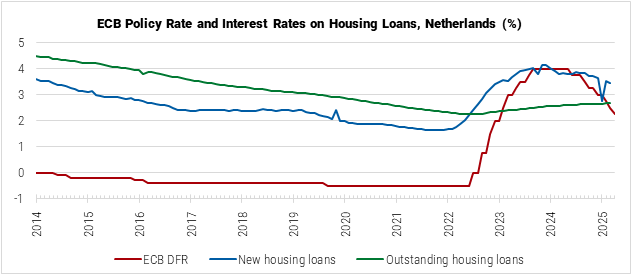
While the European Central Bank (ECB) lowered its policy rates by 175 b.p. since the beginning of the policy easing cycle in June 2024, with the most recent cut in April 2025 bringing the deposit facility rate to 2.25%, the main refinancing operations rate to 2.40%, and the marginal lending facility rate to 2.65%, the corresponding decline in the Dutch new lending rates has been very gradual and the upward trend for interest rates on outstanding loans has not reversed yet.
Netherlands' mortgage loan interest rates:
[mortgage_graph]
According to the ECB figures, as of March 2025, the average interest rate on loans to households for house purchase in the Netherlands reached 3.46% for new loans, a 33 b.p. decrease since the same period a year ago. As for the outstanding loans, the indicator stood at 2.68%, up 10 b.p. since March 2024.
ABN AMRO, one of the largest banks in the Netherlands, expects lending rates to continue falling this year, although the achievable bottom for mortgages might be near. "The European Central Bank (ECB) is expected to further reduce its deposit rate, which is a benchmark for mortgage rates. However, risk premiums are rising slowly, so lenders will struggle to pass on all of the ECB's interest rate cuts. We therefore expect mortgage rates to bottom out in late 2025, early 2026," said the bank's most recent housing market monitor.
Data Source: ECB.
Average interest rates on loans to households for house purchase:
| Mar 2025 | YoY | Mar 2024 | YoY | Mar 2023 | |
| New housing loans | 3.46% | ↓ | 3.79% | ↑ | 3.55% |
| - Floating rate and IRF up to 1 year | 4.57% | ↓ | 5.12% | ↑ | 4.26% |
| - IRF of over 1 and up to 5 years | 3.80% | ↓ | 4.16% | ↓ | 4.31% |
| - IRF of over 5 and up to 10 years | 3.35% | ↓ | 3.60% | ↑ | 3.47% |
| - IRF of over 10 years | 2.86% | ↓ | 2.96% | ↓ | 2.99% |
| Outstanding housing loans | 2.68% | ↑ | 2.58% | ↑ | 2.40% |
| - Original maturity up to 1 year | 4.94% | ↓ | 5.40% | ↑ | 3.77% |
| - Original maturity over 1 and up to 5 years | 4.48% | ↓ | 4.50% | ↑ | 3.53% |
| - Original maturity of over 5 years | 2.65% | ↑ | 2.56% | ↑ | 2.38% |
| Data Source: ECB. | |||||
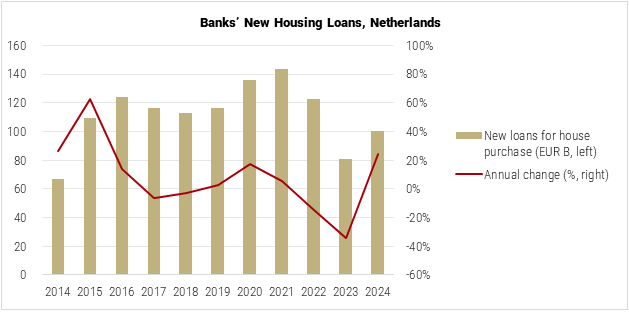
The gradually declining mortgage interest rates, along with rising wages and strong demand for housing, exacerbated by supply shortages, supported the rebound in new lending volumes in the Netherlands. The total amount of new housing loan business reported by monetary financial institutions (banks) in 2024 reached EUR 100.1 billion (USD 108.3 billion), which was 24.2% more than in 2023, although still notably below the levels observed before 2022.
The recovery in demand for residential mortgages was also registered by the quarterly bank lending survey published by De Nederlandsche Bank (DNB), the country's central bank, which returned to a neutral and positive assessment of the demand dynamic since Q2 2024 after two years of declines perceived by the majority of lenders.
The reporting from the Hypotheken Data Netwerk (HDN), a digital platform facilitating the submission of approximately 85% of all mortgage requests in the country, shows that the average mortgage amount requested in 2024 was EUR 359,500, almost EUR 27,000 or 8% higher than in 2023. First-time buyers were responsible for just over half of the applications in the buyers' market, with over 160 thousand applications. HDN also notes that the demand for mortgages grew in all provinces, with the strongest increase observed in Friesland, while the largest buyers' market was traditionally found in South Holland, with nearly 55 thousand new applications.
Data Source: ECB.
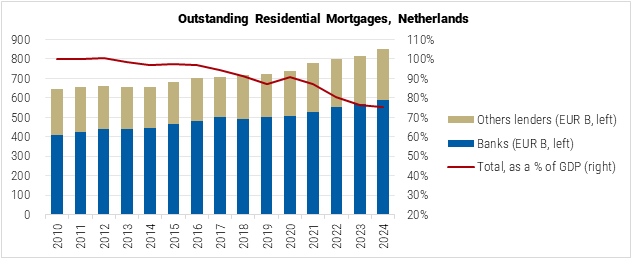
Most recent EUROSTAT figures show that 58.1% of Dutch households are currently homeowners with an outstanding mortgage or housing loan. Despite the dip in new lending in 2022-2023, the housing loan stock maintained by the country's banking system continues to increase steadily. The total value of the Dutch banks' outstanding housing loans grew by 4.1% in 2024 and reached EUR 600.2 billion (USD 648.7 billion) in March 2025, as reported by the ECB.
In addition to bank credit, DNB reports over EUR 260 billion in residential mortgages held by non-banking institutions, such as insurers, pension funds, investment funds, and others, bringing the overall size of the market to EUR 851.3 billion (USD 921.5 billion) at the end of 2024 (+4.3% year-on-year).
In relative terms, however, the size of the mortgage market in the Netherlands has been on a long-term downward trajectory, with the ratio of outstanding housing loans to GDP at current prices dropping from an estimated 90.6% in 2020 to 75.1% in 2024, marking the lowest level in over a decade.
Data Sources: DNB, ECB.
Socio-Economic Context:
Growth Set to Pick Up, Inflation Remains Relatively High
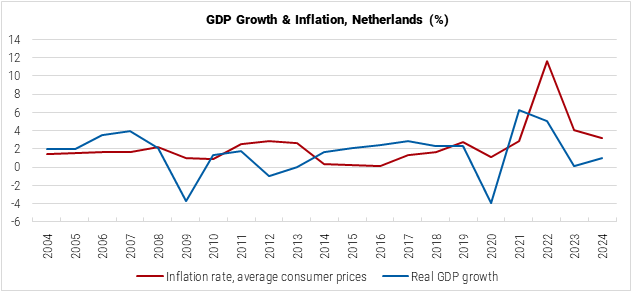
Despite facing challenges like persistent inflation, the Dutch economy remained resilient in 2024, supported by strong household spending and a tight labor market. The real GDP growth rebounded after a notable slowdown in 2023 and reached 1.0% in 2024. Rising wages are expected to continue driving consumption and sustaining economic momentum this year, with growth projected to pick up to 1.4%, according to the International Monetary Fund (IMF) forecast, and 1.3%, according to the forecast from the European Commission.
"Wage growth in the Netherlands accelerated to well above 6% in 2024 and is forecast to remain robust in 2025. This is set to improve households' real disposable income by more than 3% in 2025 and drive strong growth in private consumption. Domestic demand is further supported by an ambitious public investment agenda in, among others, the areas of defense, the green transition, and the housing market," said the latest forecast from the European Commission. "At the same time, economic uncertainty has increased substantially because of the US tariffs and the potential retaliatory actions by trading partners. <…> The imposition of US tariffs is also projected to lower both export and import growth in 2025. With about 5% of total Dutch goods exports going to the US, the negative impact of the tariffs on total trade is estimated to be relatively small. However, certain sectors, such as the (relatively large) steel industry and the machinery and vehicle sectors, are set to be disproportionately affected."
Consumer Price Index (CPI) inflation in the country continued to ease, falling from the annual level of 11.6% in 2022 to 4.1% in 2023 and 3.2% in 2024. It remains, however, more persistent than in other European economies due to high services and processed food inflation. Most recently, CBS reported the indicator at 4.1% in April 2025, up from 3.7% in March and 3.3% in January.
The European Commission expects the inflation in the Netherlands to average 3.0% in 2025, while the IMF forecast sees the indicator at 2.8% for this year.
Data Source: IMF.
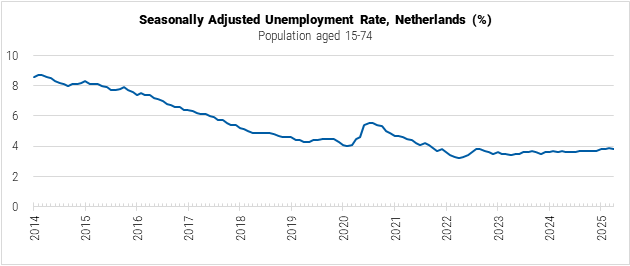
According to the European Commission assessment, the tightness of the Dutch labor market has been easing somewhat, with the number of vacancies well exceeding the number of unemployed in the past three years, but the ratio is gradually becoming more balanced and reaching parity in the first quarter of 2025. Employment growth has been slowing down in recent months, and the unemployment rate has increased slightly from 3.6% in mid-2024 to 3.8%, as reported by the CBS in April 2025. Going forward, the European Commission expects the slowdown in employment growth to result in a marginal pick-up in unemployment to 3.9% in 2025 and 4.0% in 2026.
Data Source: CBS.
Overall, the Dutch economy is seen as wealthy and highly competitive. In January 2025, Fitch Ratings affirmed the Netherlands' 'AAA' standing with a stable outlook, pointing out that its strong institutional set-up, reinforced by eurozone membership, supports consensus-based policy-making and fiscal responsibility. While the economy's openness and relatively small size make it sensitive to global trade developments, the negative impact of tariffs is expected to be offset by strong domestic demand backed by rising purchasing power, moderate expansive fiscal policy, and easing of financial conditions.
Sources:
- Statistics Netherlands (CBS)
- Existing Owner-Occupied Homes Almost 9 Percent More Expensive in 2024 (NL): https://www.cbs.nl/
- Homes For Sale in April More than 10 Percent More Expensive Than a Year Earlier (NL): https://www.cbs.nl/
- As Many New Homes Added as a Year Ago (NL): https://www.cbs.nl/
- Rent Increases the Highest in Over 30 years: https://www.cbs.nl/
- Inflation Increases to 4.1 Percent in April: https://www.cbs.nl/
- Unemployment Rate 3.8 Percent in April: https://www.cbs.nl/
- De Nederlandsche Bank (DNB)
- Size and Breakdown of the Mortgage Market: https://www.dnb.nl/
- Bank Mortgage Lending Rates: https://www.dnb.nl/
- Mortgage Supply and Demand (Bank Lending Survey): https://www.dnb.nl/
- Government of the Netherlands
- Rented Housing: https://www.government.nl/
- Housing Summit: Concrete Agreements for 100,000 New Homes per Year (NL): https://www.rijksoverheid.nl/
- What is the Maximum Rent I Pay for My Home? (NL) https://www.rijksoverheid.nl/
- What is the Maximum Rent Increase in 2025? (NL) https://www.rijksoverheid.nl/
- Land Registry (Kadaster)
- Housing Market in Q4 2024 (NL): https://www.kadaster.nl/
- Housing Market in Q1 2025 (NL): https://www.kadaster.nl/
- Ministry of Housing and Spatial Planning
- Maximum Rent Increase From 1 January 2025 (NL): https://www.volkshuisvestingnederland.nl/
- European Central Bank (ECB)
- ECB Data Portal: https://data.ecb.europa.eu/
- Key ECB Interest Rates: https://www.ecb.europa.eu/
- Monetary Policy Decisions. April 17, 2025: https://www.ecb.europa.eu/
- US Dollar/Euro, Monthly: https://data.ecb.europa.eu/
- US Dollar/Euro, Quarterly: https://data.ecb.europa.eu/
- US Dollar/Euro, Annual: https://data.ecb.europa.eu/
- European Commission
- Project: Centralized Planning to Increase Housing Supply: https://commission.europa.eu/
- Economic Forecast for Netherlands: https://economy-finance.ec.europa.eu/
- International Monetary Fund (IMF)
- Country Overview: The Netherlands: https://www.imf.org/
- ABN AMRO
- Housing Market Monitor - April 2025: https://www.abnamro.com/
- Housing Market Monitor - EU Housing Markets Share Common Problems: https://www.abnamro.com/
- Hypotheken Data Netwerk (HDN)
- Annual Review 2024 (NL): https://hdn.nl/
- Pararius
- Rents in Dutch Unregulated Housing Sector Outpace Inflation: https://www.pararius.com/
- Rental Report Q1 2025: https://www.pararius.com/
- ING
- The Dutch Housing Market - Our Expectations for 2025: https://www.ing.nl/
- Rabobank
- Dutch Housing Market Quarterly: https://www.rabobank.com/
- Dynamic Credit
- Dutch Housing Market Update 2025-Q1: https://assets.ctfassets.net/
- DMFCO Asset Management
- Dutch Housing and Mortgage Market, Q1 2025: https://www.dmfco.nl/
- Capital Value
- Dutch Senate Approves Affordable Rent Act: https://www.capitalvalue.nl/
- CBRE
- The Netherlands Real Estate Market Outlook 2025: https://mediaassets.cbre.com/
- Fitch Ratings
- Fitch Affirms the Netherlands at 'AAA'; Outlook Stable: https://www.fitchratings.com/
- Dutch Housing and Mortgage Volumes Increase; Arrears Remain Low: https://www.fitchratings.com/
- Bloomberg
- Netherlands Seeks to Soften Controversial Rental Controls, NOS Says: https://www.bloomberg.com/
- Dutch Central Bank's Knot Calls for Rent Control Reversal: ANP: https://www.bloomberg.com/
- DutchNews
- Drop in Housing Permits Despite Push to Boost Construction: https://www.dutchnews.nl/
- Free Sector Rental Housing Market Shrinks Again, Rents Rise: https://www.dutchnews.nl/
- NOS
- Cabinet Wants to Allow Higher Rents Again, More Room for Private Landlords (NL): https://nos.nl/