Germany's Residential Property Market Analysis 2025 H1
After a two-year phase of decline, prices in the German housing market have begun to stabilize, aided by easing interest rates and early signs of macroeconomic recovery against the backdrop of persistent demand-supply imbalance.
This extended overview from Global Property Guide covers key aspects of the German housing market and takes a closer look at its most recent developments and long-term trends.
Table of Contents
- Housing Market Snapshot
- Historic Perspective
- Supply and Demand Highlights
- Rental Market
- Mortgage Market
- Socio-Economic Context
Housing Market Snapshot
After a period of decline in late 2022 and throughout 2023, house prices in Germany have begun to stabilize, aided by easing interest rates and signs of a cautious economic recovery. In the fourth quarter of 2024, the Federal Statistical Office (Destatis) reported a 1.93% year-on-year increase in the House Price Index - the first positive annual change recorded in nine consecutive quarters. However, when adjusted for inflation, the index still posted a marginal year-on-year decline of 0.35%.
Germany's house price annual change:
[hp_graph]
According to VALUE Marktdatenbank, as of the first quarter of 2025, the average purchase prices for both existing and newly built apartments showed upward momentum. The nationwide average reached EUR 3,403 (USD 3,581) per square meter for secondary properties, reflecting a 1.6% year-on-year increase, while primary properties averaged EUR 5,478 (USD 5,764) per square meter, marking a 2.9% annual rise. Among Germany's ten largest cities, Munich recorded the highest prices, at EUR 8,476 (USD 8,919) per square meter for existing properties and EUR 11,454 (USD 12,053) for new builds. In contrast, Dortmund remained the most affordable among the top ten urban markets.
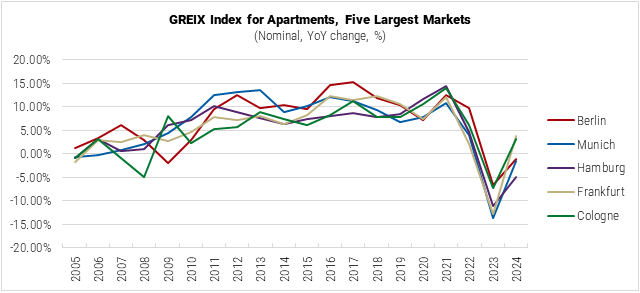
The latest data from the Kiel Institute's GREIX index confirmed similar trends. "The wait-and-see approach has come to an end," noted Jonas Zdrzalek, real estate market expert at the Kiel Institute for the World Economy. "Those who want to buy have obviously come to terms with the new circumstances - and are speculating that the real estate market has bottomed out for the time being."
Average purchase price in the ten largest cities:
| Average purchase price, existing apartments, Q1 2025 |
YoY, % Q1 2025 vs Q1 2024 |
Average purchase price, newly built apartments, Q1 2025 |
YoY, % Q1 2025 vs Q1 2024 |
|
| Berlin | EUR 5,451 (USD 5,736) |
2.7% | EUR 8,300 (USD 8,734) |
2.2% |
| Hamburg | EUR 5,560 (USD 5,851) |
-0.4% | EUR 8,589 (USD 9,038) |
7.7% |
| Munich | EUR 8,476 (USD 8,919) |
3.7% | EUR 11,454 (USD 12,053) |
0.9% |
| Cologne | EUR 4,836 (USD 5,089) |
5.2% | EUR 6,879 (USD 7,239) |
-0.1% |
| Frankfurt | EUR 6,116 (USD 6,436) |
4.8% | EUR 8,236 (USD 8,667) |
0.3% |
| Stuttgart | EUR 4,527 (USD 4,764) |
-1.2% | EUR 8,320 (USD 8,755) |
-3.5% |
| Düsseldorf | EUR 4,583 (USD 4,823) |
3.1% | EUR 7,654 (USD 8,054) |
-3.0% |
| Dortmund | EUR 2,431 (USD 2,558) |
0.8% | EUR 4,310 (USD 4,535) |
-0.8% |
| Essen | EUR 2,453 (USD 2,581) |
6.2% | EUR 5,415 (USD 5,698) |
0.4% |
| Leipzig | EUR 3,014 (USD 3,172) |
4.0% | EUR 5,195 (USD 5,467) |
-5.0% |
| Nationwide | EUR 3,403 (USD 3,581) |
1.6% | EUR 5,478 (USD 5,764) |
2.9% |
| Exchange rate as of Q1 2025, EUR 1 = USD 1.0523. | ||||
| Data Source: VALUE Marktdatenbank. | ||||
Looking forward, experts anticipate that the country's housing market will regain some of the ground lost in previous years, supported by additional ECB rate cuts. A February 2025 Reuters survey of 13 market analysts projected a 3.5% year-on-year increase in average house prices for 2025, up from the 3.0% growth forecasted in the prior November poll. The outlook is expected to moderate to 3.0% in both 2026 and 2027. However, nearly two-thirds of respondents still identified downside risks, citing the potential drag of economic weakness and ongoing trade uncertainties.
"The lasting recession weighs on wage growth and affordability due to rising unemployment and insolvencies, but falling mortgage rates may overcompensate this negative effect," said Jochen Moebert, senior economist at Deutsche Bank Research. He added that strong demand and a persistent supply shortage are expected to continue driving both house prices and rent increases in 2025.
Historic Perspective:
Structural Factors Behind Germany's Housing Market Shifts
In the early 2000s, Germany's housing market was marked by stability, reflecting a broader macroeconomic context of low inflation, moderate wage growth, and limited domestic investment in residential property. The House Price Index exhibited only modest fluctuations, with average annual growth remaining below 2% and several years of negative real (inflation-adjusted) growth. Notably, Germany avoided the housing market distortions experienced by many other countries during the global financial crisis of 2008-2009. This relative stability was largely attributed to the country's high share of renters and conservative lending practices.
A pronounced shift occurred from 2010 onward. In the wake of the Eurozone debt crisis, the introduction of ultra-low interest rates, coupled with increasing urbanization and rising demand from both domestic and institutional investors, placed sustained upward pressure on residential property prices. Between 2010 and 2021, nominal prices increased at an average annual rate of 6%, with particularly sharp gains recorded in 2016 (8.45%) and 2021 (12.61%). Real price growth remained consistently positive throughout this period, peaking at 9.29% in 2020. The expansion was underpinned by a structural undersupply in high-demand urban centers and increased investor interest in property as a store of value amid persistently low returns on conventional savings instruments.
From 2022, the market entered a correction phase as inflation accelerated and the European Central Bank moved to tighten monetary policy. The resulting increase in borrowing costs, alongside declining consumer confidence and broader macroeconomic uncertainty, contributed to a marked decline in residential property values. Nominal prices fell by 3.94% in 2022 and by 7.11% in 2023, with real price declines of -11.53% and -10.30%, respectively. This downward trend moderated in 2024, when nominal prices posted a modest increase of 1.93%, although real values continued to contract slightly by -0.35%
20-year annual house price change (based on end-of-year house price index and consumer price index):
| Year | Nominal house prices (%) | Inflation-adjusted house prices (%) | Year | Nominal house prices (%) | Inflation-adjusted house prices (%) | |
| 2005 | 1.74% | 0.06% | 2015 | 5.82% | 5.49% | |
| 2006 | 1.22% | -0.07% | 2016 | 8.45% | 7.25% | |
| 2007 | -1.69% | -4.62% | 2017 | 6.25% | 5.04% | |
| 2008 | 0.25% | -1.35% | 2018 | 6.22% | 4.16% | |
| 2009 | 2.93% | 2.52% | 2019 | 6.50% | 5.19% | |
| 2010 | -0.48% | -1.83% | 2020 | 8.74% | 9.29% | |
| 2011 | 4.18% | 1.91% | 2021 | 12.61% | 7.55% | |
| 2012 | 4.93% | 2.86% | 2022 | -3.94% | -11.53% | |
| 2013 | 1.53% | 0.19% | 2023 | -7.11% | -10.30% | |
| 2014 | 3.44% | 2.92% | 2024 | 1.93% | -0.35% | |
| Data Sources: Destatis, OECD, Global Property Guide. | ||||||
Data Source: Kiel Institute for the World Economy.
Supply and Demand Highlights:
Undersupply Intensifies as Urban Demand Continues to Rise
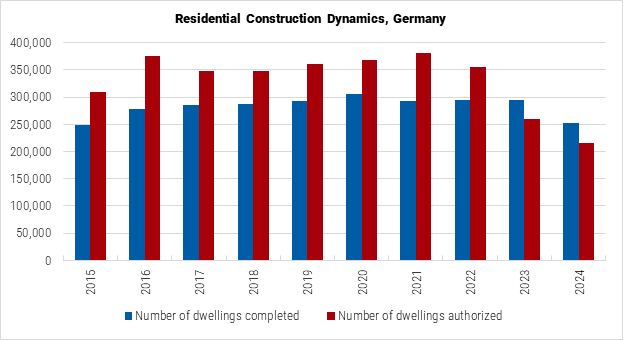
Germany's housing market continues to struggle with a persistent and worsening undersupply of residential units. In 2024, the number of newly built dwellings dropped significantly. According to Destatis, 251,937 residential units were completed during the year, marking a 14.42% year-on-year decline. "This was the first significant decrease after the number of completed homes stood at 294,000 in each of the years 2021 to 2023," the press release noted. Destatis attributes the downturn to rising interest rates and escalating construction costs, which have prompted many developers to abandon their projects and discouraged new investment.
This negative trend is also evident in building permit data. The number of approved dwellings fell to 215,920 in 2024, representing a 16.98% year-on-year decrease and the lowest level since 2010. While the first quarter of 2025 brought a modest year-on-year increase of 3.36% in approved dwellings (totaling 55,432 units), analysts caution against overinterpreting this as a recovery, emphasizing that it follows an already weakened baseline from recent years.
"Political mistakes have contributed to the drastic decline in the number of building permits issued," said Felix Pakleppa, managing director of the German Construction Confederation (ZDB). "The unsteady and, in view of stricter energy efficiency standards, inadequate subsidy policy has added to the pressure."
Note: Data includes dwellings in residential and non-residential buildings.
Data Source: Destatis.
Simultaneously, demand for housing is increasing, driven largely by population growth, especially through net migration to Germany's largest urban centers. According to Destatis, the country's population reached 83.6 million in 2024 - an increase of over 3% over the past decade.
Looking ahead, the most recent spatial planning forecast, based on the 2022 census, anticipates that population growth will stabilize between 2025 and 2045. However, regional variations are expected. BNP Paribas Real Estate projects a 1% population decline in medium-sized cities (up to 100,000 inhabitants), while forecasting a 2% increase in large cities (over 250,000 inhabitants) and a 5% rise in so-called A-cities, including Munich, Hamburg, Düsseldorf, Berlin, Cologne, Frankfurt, and Stuttgart.
The growing number of new households continues to outpace the supply of residential units, resulting in a pronounced imbalance between demand and availability - particularly acute in major cities and metropolitan areas. This housing shortage is being intensified further by the continued decline in construction activity.
In its spring 2025 update, the Federal Institute for Research on Building, Urban Affairs, and Spatial Development (BBSR) projected a need for approximately 2.56 million new dwellings between 2023 and 2030, equating to about 320,000 units annually. Although this is below the previous political target of 400,000 units per year, it still exceeds current construction output by a considerable margin. "We now have to go through a valley of tears," said Ralph Henger of the IW in March. "We have a huge gap between what needs to be built and what is currently being built and will come onto the market in the next few years."
The housing demand is particularly high in Germany's major cities. The BBSR estimates that Berlin alone will require 23,000 new flats per year, followed by Munich (11,300) and Hamburg (10,200). A combined total of 15,000 annual units will be needed in Cologne, Frankfurt, Stuttgart, and Düsseldorf.
With construction volumes lagging far behind demand, many experts expect further increases in rents and property prices. In response, the new conservative-led government, which took office in May 2025, has pledged to address the crisis. Construction Minister Verena Hubertz has promised a "housing construction boost," announcing plans to streamline approval procedures, promote modern construction techniques, and expand the availability of land for residential development.
Rental Market:
Rent Increases Slow Down, Regional Dynamics Vary
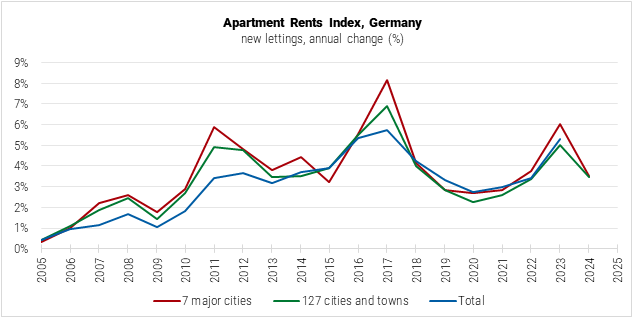
According to the Eurostat figures, there are more tenants than homeowners in Germany, with the share of households renting rather than owning their residence up from 47.5% in 2014 to 52.2% in 2024. The consistently strong demand in the rental market continues to support rent increases across the country, although the pace of growth has slowed.
Germany's rent price index:
[rp_graph]
The transaction-weighted annual apartment rent index for 127 cities and towns published by the Deutsche Bundesbank (DB), based on data from the real estate research company Bulwiengesa, showed a more moderate 3.5% growth in 2024, compared to 5.0% in 2023. For the 7 major cities (Berlin, Dusseldorf, Frankfurt, Hamburg, Cologne, Munich, and Stuttgart), the index recorded an even more notable slowdown from a 6.0% increase in 2023 to 3.5% in 2024.
The H2 2024 housing market overview from JLL also notes that rents in the country's largest cities demonstrated positive but subdued dynamics: "Overall, the rental housing market in German metropolises shows a tendency towards stabilization, with specific local market dynamics continuing to play an important role." According to JLL, above-average increases in asking rents were observed in Leipzig, Frankfurt, and Düsseldorf. At the same time, the capital city of Berlin experienced a trend reversal with a slight decrease in offer rents, which indicates a possible stabilization of the previously particularly dynamic submarket.
Data Source: Deutsche Bundesbank, based on data provided by Bulwiengesa.
In nominal terms, Munich remained the most expensive among the major cities, with the average asking apartment rent reaching EUR 23.33 (USD 25.25) per square meter in H2 20204, according to JLL. Berlin followed with EUR 19.23 (USD 20.81) per square meter, while Leipzig recorded the most affordable average rent at EUR 10.45 (USD 11.31) per square meter.
Against this background, Global Property Guide research conducted in March 2025 found gross rental yields for apartments in Germany average 3.82%, slightly up from 3.69% previously reported in July 2024. Among the monitored regional submarkets, the highest potential performance was observed in Leipzig (4.99%), Berlin (4.76%), and Stuttgart (4.49%).
Average asking apartment rent in key submarkets:
| City | EUR/sqm, H2 2024 | USD/sqm, H2 2024 | YoY, H2 2024 vs H2 2023 |
| Berlin | EUR 19.23 | USD 20.81 | -1.0% |
| Munich | EUR 23.33 | USD 25.25 | 3.7% |
| Hamburg | EUR 16.62 | USD 17.99 | 7.7% |
| Cologne | EUR 15.49 | USD 16.77 | 3.3% |
| Frankfurt | EUR 18.33 | USD 19.84 | 8.6% |
| Stuttgart | EUR 16.50 | USD 17.86 | 3.1% |
| Düsseldorf | EUR 14.51 | USD 15.71 | 8.1% |
| Leipzig | EUR 10.45 | USD 11.31 | 9.9% |
| Exchange rate as of 2024, EUR 1 = USD 1.0824. | |||
| Data Source: JLL. | |||
Looking ahead, the rents in major German cities are expected to keep growing, with the dynamic in each submarket to be determined by the demand-supply balance. "For 2025, a further increase in rents in the metropolises is expected, albeit at lower rates than in previous years. Rent development is likely to increasingly differentiate according to regional conditions, depending on local demand surpluses and the availability of rental apartments," the report from JLL said.
The latest assessment from Bulwiengesa also points towards a further upward dynamic in rents: "In the property year 2025, purchase prices will be under pressure, rents will tend to rise, too little will be built, and it will usually be too expensive."
To combat housing affordability issues, the new government that took office in Germany after the federal elections in early 2025 plans to extend rent control measures for the major cities by another four years. If passed, the extension will maintain the cap for new contract rates in urban centers at 10% above the comparable rents in the area. The Ministry for Housing, Urban Development, and Building is also reportedly considering additional measures, such as stricter rules on index-linked rents and curbs on furnished lets, often used to bypass existing rent caps.
Mortgage Market:
Demand for Loans Recovers, Return to Historically Low Interest Rates Unlikely
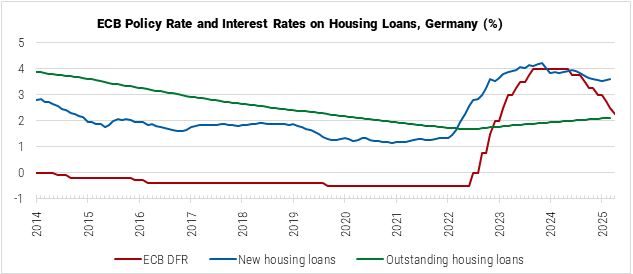
In the second half of 2024, mortgage interest rates in Germany declined consistently, along with the lowering of policy rates by the European Central Bank (ECB). Since the beginning of the policy easing cycle in June 2024, the ECB lowered its rates by 175 b.p., with the most recent cut in April 2025 bringing the deposit facility rate to 2.25%, the main refinancing operations rate to 2.40%, and the marginal lending facility rate to 2.65%.
Germany's mortgage loan interest rates:
[mortgage_graph]
In parallel, the average interest rate on new loans to households for house purchase in Germany reached the lowest level in two years by the end of 2024. More recently, however, the indicator ticked up slightly from 3.52% in January to 3.60% in March 2025. For outstanding housing loans, the average interest rate stood at 2.11% in March 2025, up from 1.96% a year ago and 1.80% two years ago.
Data Source: ECB.
Analysts from ING tie the uptick in interest rates to the German government's landmark decision to reform the debt brake, which loosened the country's borrowing limits and allowed new investments in defense, infrastructure, and climate. The consequent surge in the capital market interest rates, driven by rising expectations of government debt and improving growth prospects, in turn, led to an upward fluctuation in mortgage rates.
While the market has stabilized since then, the analysts cited by Berliner Morgenpost in a recent article warn that a significant drop in mortgage interest rates and a return to pre-2022 levels is unlikely this year.
"We have to expect that, due to the increased issuance of government debt - and here we see a Europe-wide trend - yields on the bond markets will rise. As a result, mortgage interest rates in this country are likely to remain in a range between 3 and 4 percent," commented Rainer Eichwede of the building society Bausparkasse Schwäbisch Hall.
"The impression that real estate loans are particularly expensive at the moment is misleading. Current interest rates remain moderate. The period of historically low interest rates between 2015 and the beginning of 2022, with housing loan rates sometimes below one percent, was an exception, not the rule, and will not be repeated anytime soon," said Mirjam Mohr, Chief Sales Officer at the mortgage broker Interhyp.
Average interest rates on loans to households for house purchase:
| Mar 2025 | YoY | Mar 2024 | YoY | Mar 2023 | |
| New housing loans | 3.60% | ↓ | 3.83% | ↓ | 3.88% |
| - Floating rate and IRF up to 1 year | 4.41% | ↓ | 5.28% | ↑ | 4.44% |
| - IRF of over 1 and up to 5 years | 3.62% | ↓ | 4.09% | ↓ | 4.10% |
| - IRF of over 5 and up to 10 years | 3.39% | ↓ | 3.55% | ↓ | 3.64% |
| - IRF of over 10 years | 3.54% | ↓ | 3.61% | ↓ | 3.80% |
| Outstanding housing loans | 2.11% | ↑ | 1.96% | ↑ | 1.80% |
| - Original maturity up to 1 year | 4.63% | ↓ | 5.68% | ↑ | 4.45% |
| - Original maturity over 1 and up to 5 years | 3.89% | ↑ | 3.75% | ↑ | 2.77% |
| - Original maturity of over 5 years | 2.08% | ↑ | 1.93% | ↑ | 1.78% |
| Data Source: ECB. | |||||
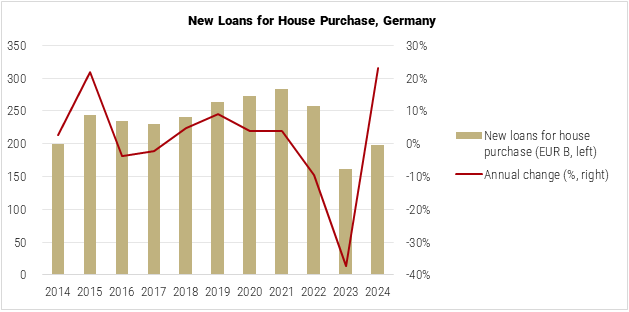
With lower interest rates, demand for housing loans in the country began recovering in 2024. Based on the figures reported by the ECB, the total amount of new housing loan business by German banks in 2024 reached EUR 198.4 billion (USD 214.7 billion), which was 23.1% more than in 2023, although still notably below the levels observed in 2022 and before. In the first three months of 2025, the volume of new lending for house purchase continued to grow, demonstrating a substantial 37.5% increase against the comparable period last year.
According to the CEO of Commerzbank, Bettina Orlopp, recently cited by Bloomberg, Germany's mortgage market has bounced back from an unprecedented slump in the previous years and could now be poised to benefit from the new government's plans to bolster the economy. "Price development is also more favorable than a year ago," she said. "And so, therefore, we expect a positive impact there."
Data Source: ECB.
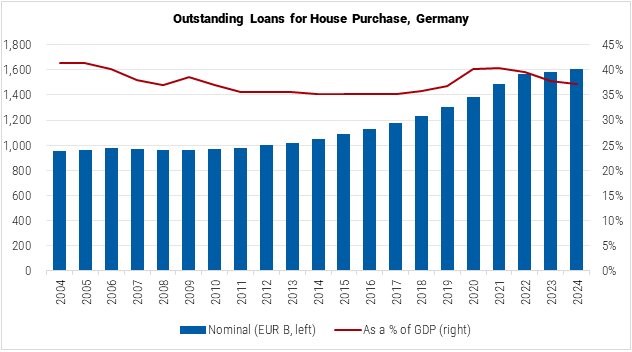
Based on Eurostat figures, 23.2% of German households are homeowners with an outstanding mortgage or housing loan. The expansion of the housing loan stock in the country re-accelerated in 2024, registering a 1.3% year-on-year growth compared to 1.1% in 2023. As of March 2025, the total value of outstanding loans for house purchase maintained by German banks stood at EUR 1.61 trillion (USD 1.74 trillion). The relative size of this market, represented by the ratio of outstanding loans to GDP at current prices, was estimated at 37.3% in 2024, down from a decade peak of an estimated 40.4% in 2021.
Indicating the ongoing stabilization in the market, at the end of April 2025, the Federal Financial Supervisory Authority (BaFin) lowered the share of capital that banks are required to hold to alleviate risks from residential mortgage loans.
Data Source: ECB.
Socio-Economic Context:
Economic Activity Stagnates, New Government Plans Reforms to Revive Growth
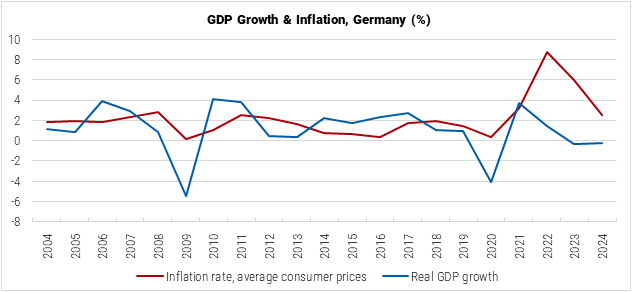
The German economy has begun to gradually recover from the energy-price shock. After slightly contracting for two years in a row (-0.3% in 2023 and -0.2% in 2024), economic activity is expected to broadly stagnate in 2025 before returning to a moderate 1.1% real GDP growth in 2026. The European Commission forecast highlights that although private consumption in the country is projected to expand slightly this year, boosted by increases in purchasing power and lower interest rates, global trade tensions are set to significantly weigh on exports, constraining growth potential.
Consumer Price Index (CPI) inflation in the country decelerated from the annual level of 8.7% in 2022 to 2.5% in 2024, according to the International Monetary Fund (IMF) figures, and is expected to subside further to 2.1% in 2025 and 1.9% in 2026. The most recent report from Destatis showed the indicator at 2.1% in April and May 2025.
Data Source: IMF.
According to the European Commission assessment, the overall economic stagnation leaves its mark on the country's labor market. As output contracted, employment growth has been decelerating since 2022, with declining employment in manufacturing largely offset by job growth in public services, education, and the health sector.
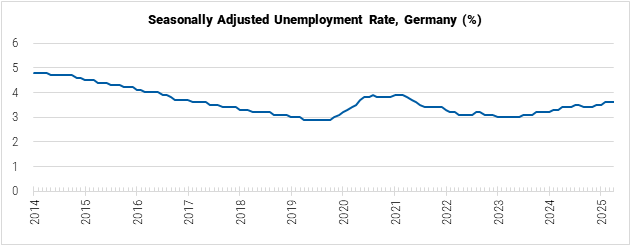
At the same time, as of early 2025, 28% of German companies still reported labor shortages, and the market is set to remain tight against the background of a rapidly aging population, according to the European Commission. In April 2025, Destatis reported the seasonally adjusted unemployment rate in the country at 3.6%, slightly up from 3.4% recorded during the same period a year ago, but the indicator is, however, expected to fall back to 3.3% next year as employment growth picks up again.
Data Source: Destatis.
The most recent rating action from Fitch Ratings affirmed Germany's 'AAA' standing with a stable outlook, noting at the same time that despite its large and diversified economy and strong institutional framework, the country continues to face significant structural headwinds to growth, including export-oriented nature of the economy (which makes it sensitive to rising competition from China and US tariffs), decreased competitiveness of the manufacturing sector due to high energy and labor costs, high corporate taxes, and other factors.
Against this background, in the next few years, the development vectors for the country's economy will be determined by the new coalition government recently formed in Germany under Chancellor Friedrich Merz after the federal elections in February 2025. The new government now aims to revive growth in Europe's largest economy, planning to achieve a medium-term free trade deal with the United States, reduce electricity prices by cutting taxes and grid fees, modernize the debt brake, ramp up defense spending, and reform the corporate tax system in the country, among other measures.
Sources:
- Federal Statistical Office (Destatis)
- Inflation Rate of +2.1% Expected in May 2025: https://www.destatis.de/
- Employment Unchanged in April 2025 After Seasonal Adjustment: https://www.destatis.de/
- Prices Of Residential Property In The Fourth Quarter Of 2024: https://www.destatis.de/
- 14.4% Fewer Completed Apartments in 2024 (DE): https://www.destatis.de/
- 16.8% Fewer Building Permits for Apartments in 2024 (DE): https://www.destatis.de/
- Population Increased by 100,000 People in 2024 (DE): https://www.destatis.de/
- Deutsche Bundesbank (DB)
- System of Indicators for the German Residential Property Market: https://www.bundesbank.de/
- Monthly Report - May 2025: https://publikationen.bundesbank.de/
- Federal Financial Supervisory Authority (BaFin)
- BaFin Lowers Systemic Risk Buffer for Residential Real Estate and Maintains Countercyclical Capital Buffer: https://www.bafin.de/
- Federal Institute for Research on Building, Urban Affairs and Spatial Development (BBSR)
- Housing Demand Forecast by 2030 (DE): https://www.bbsr.bund.de/
- European Central Bank (ECB)
- ECB Data Portal: https://data.ecb.europa.eu/
- Key ECB Interest Rates: https://www.ecb.europa.eu/
- Monetary Policy Decisions, 17 April 2025: https://www.ecb.europa.eu/
- US Dollar/Euro, Monthly: https://data.ecb.europa.eu/
- US Dollar/Euro, Quarterly: https://data.ecb.europa.eu/
- US Dollar/Euro, Annual: https://data.ecb.europa.eu/
- European Commission
- Economic Forecast for Germany: https://economy-finance.ec.europa.eu/
- Distribution of Population by Tenure Status, Type of Household and Income group: https://ec.europa.eu/
- International Monetary Fund (IMF)
- Country Overview: Germany: https://www.imf.org/
- 2024 Article IV Staff Report: https://www.imf.org/
- Kiel Institute for the World Economy
- GREIX Index: https://www.greix.de/
- Real Estate Prices on the Rise, Especially in Major Cities: https://www.ifw-kiel.de/
- VALUE Marktdatenbank
- Real Estate Market Data, Update Q1-2025 (DE): https://www.value-marktdaten.de/
- BNP Paribas
- Residential Report, Germany, H2 2024: https://www.realestate.bnpparibas.de/
- Bulwiengesa
- Bulwiengesa Property Market Index, 1975-2024: https://bulwiengesa.de/
- JLL
- Housing Market Overview H2 2024: https://www.jll.de/
- Cushman & Wakefield
- Top Housing Markets Stabilize - Rent Prices Rise More Slowly: https://www.cushmanwakefield.com/
- ING
- Germany's Latest Fiscal Reform Poses Obstacles for the Housing Market's Recovery: https://think.ing.com/
- Dr Klein
- Interest Rate Commentary (05/2025): Detailed Forecast of Interest Rate Developments: https://www.drklein.de/
- Fitch Ratings
- Fitch Affirms Germany at 'AAA'; Outlook Stable: https://www.fitchratings.com/
- DW
- Germany's Bundestag Votes in Favor of Reforming 'Debt Brake': https://www.dw.com/
- Bloomberg
- Commerzbank CEO Sees Brighter Outlook for German Mortgage Market: https://www.bloomberg.com/
- Reuters
- Germany Proposes Rent Control Extension to Dampen Housing Costs: https://www.reuters.com/
- Germany's Future Coalition Government: What Has Been Agreed? https://www.reuters.com/
- German House Prices to Climb 3.5% This Year, But Risk is for Weaker Rise: https://www.reuters.com/
- Refire
- New Building Minister Hubertz Signals Shift in Housing Policy: https://www.refire-online.com/
- Germany's Housing Pipeline Crumbles As Permits Plunge To 15-Year Low: https://www.refire-online.com/
- Berliner Morgenpost
- Will Mortgage Interest Rates Fall or Rise? Forecast & Development for 2025 (DE): https://www.morgenpost.de/
- Fintel
- Number Of New Homes Built In Germany Drops By 14% In 2024: https://fintel.io/