Cambodia's Residential Real Estate Market Analysis 2026
Cambodia’s residential property market remains sluggish amid persistent price declines, weak absorption rates, and cautious buyer sentiment. Ongoing economic headwinds, including slower domestic spending and tight credit conditions, have contributed to the persistent weakness in the residential property market.
This in-depth analysis examines recent trends in Cambodia’s residential property prices, market demand and supply, and mortgage lending, while exploring the economic, financial, and policy factors driving developments across Phnom Penh and provincial markets.
Table of Contents
- Property Prices and Price Index
- Historic Perspective
- Property Demand Trends
- Property Supply Trends
- Rental Market: Rents and Rental Yields
- Mortgage Market and Interest Rates
- Economic and Social Factors
Property Prices and Price Index
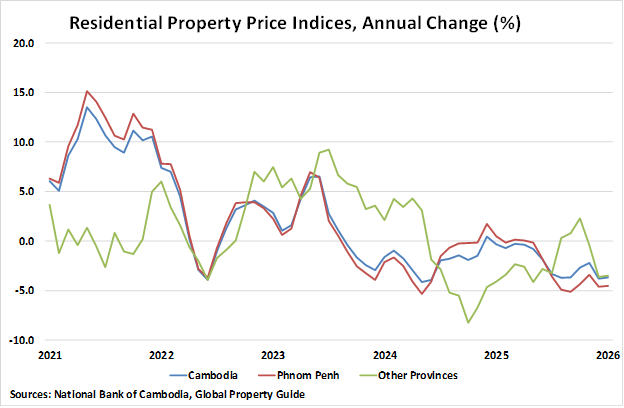
In January 2026, the nationwide residential property price index (RPPI) fell by 3.67% from a year earlier, following an annual decline of 3.8% in 2025, a minuscule growth of 0.45% in 2024, and a contraction of 2.95% in 2023, based on figures from the National Bank of Cambodia (NBC), the country’s central bank. When adjusted for inflation, real prices actually fell by 4.87 % year-on-year in January 2026.
Residential property prices in Cambodia have been declining for 29 consecutive months, with the only exception being December 2024, when prices increased slightly.
Cambodia's house price annual change:
By location:
- In Phnom Penh, the RPPI declined by 4.52% in January 2026 from a year earlier, its ninth consecutive month of year-on-year fall, according to NBC figures. When adjusted for inflation, prices in the capital city were down by 5.7%.
- In other provinces, the index was down by 3.49% y-o-y in January 2026. In real terms, residential property prices dropped 4.69% over the same period.
“Inevitably, heightened geopolitical uncertainty and weaker external demand have weighed on sales performance in both the High-end and mid-tier condominium segments,” said Knight Frank. “Ongoing Cambodia-Thailand border tensions have adversely affected investor sentiment, particularly among foreign and speculative buyers, leading to a moderation in transaction activity. As a result, the average sales rate of monitored projects declined to approximately 3%-4%, the lowest in recent decades.”
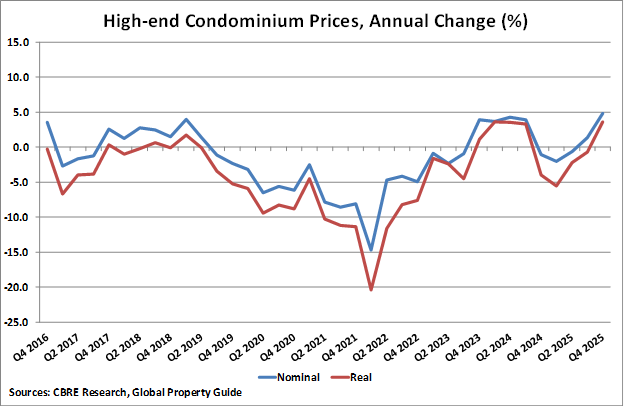
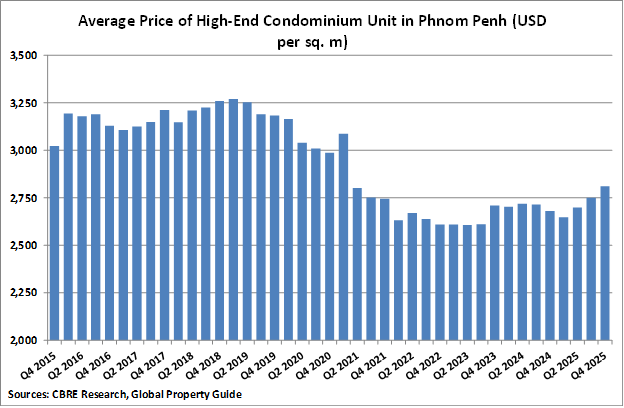
CBRE Cambodia presents a more optimistic view. After a subdued first half of 2025, the high-end condominium market in Phnom Penh showed signs of recovery in the second half of the year, with average sales prices rising by around 5% year-on-year to surpass US$2,800 per square meter (sqm) in Q4 2025. When adjusted for inflation, condo prices were up modestly by 3.8%.
The residential property market in Cambodia in 2026 is expected to remain soft and under pressure, with continued price declines, constrained demand, and cautious buyer sentiment. A strong, broad-based recovery is unlikely, and the sector may continue to struggle until overall economic conditions and credit availability improve significantly.
“Although the Core segment still accounts for the majority of transactions, demand remains restrained due to geopolitical uncertainty, weaker external demand, and reduced speculative interest. Compared to previous cycles, buyers are more price-sensitive and focused on value, affordability, and payment flexibility,” noted Knight Frank.
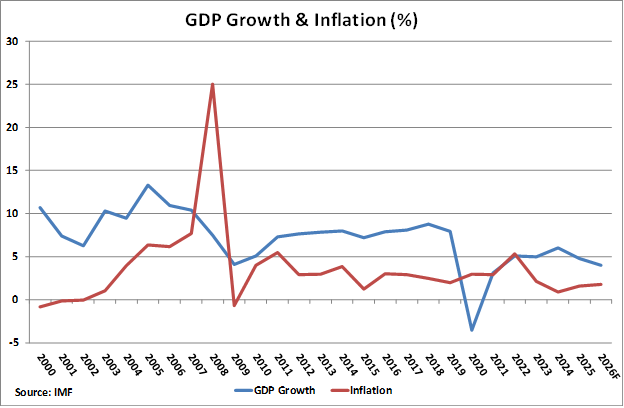
Cambodia’s broader economy is also gradually slowing. Both the World Bank and the International Monetary Fund (IMF) reported that the country’s economic growth eased to 4.8% in 2025, weighed down by external challenges such as trade policy uncertainty and regional geopolitical tensions. This followed economic expansions of 6% in 2024, 5% in 2023, 5.1% in 2022, and 3.1% in 2021.
The World Bank projects Cambodia’s economic growth to moderate to 4.3% in 2026, before rebounding to 5.1% in 2027, while the IMF offers a more cautious outlook, forecasting growth of 4% this year and 4.5% in 2027.
Nevertheless, the Ministry of Economy and Finance remains confident that Cambodia can achieve a 5% economic growth in 2026.
Cambodia saw strong, uninterrupted growth for most of the past two decades. From 2000 to 2003, the economy grew by an average of 8.3%, and then by an average of 11.1% from 2004 to 2007. After a slight pause during the global crisis, from 2011 to 2019, the economy expanded by an average of 7.2% per year, fuelled by strong tourism, garments manufacturing, and agriculture. But in 2020, Cambodia’s economy suffered a pandemic-induced contraction of 3.6%, marking its first decline in decades.
Historic Perspective:
Housing market cycle
Cambodia’s housing market experienced a period of rapid expansion from 2004 to 2007, with property prices rising by an estimated 25% to 40% annually. Initially concentrated in major urban and tourism hubs such as Phnom Penh, Siem Reap, and Sihanoukville, the boom quickly spread across the country, including key border areas with Vietnam and Thailand, and to a lesser extent, Laos.
In Phnom Penh, residential land prices surged sharply, reaching around KHR 6.25 million (US$1,557) per sq. m. in 2007, up from KHR 2.34 million (US$583) per sq. m. in 2006. This rapid escalation was underpinned by a pro-investment policy environment that encouraged large-scale development, accelerating urban transformation, and reshaping the country’s real estate landscape.
In mid-2008, the bubble burst because South Korea, one of the country’s biggest investors, was badly hit by the global economic and financial crisis. Investments in real estate developments fell from US$3.19 billion in 2008 to US$1.99 billion in 2009 and finally to just US$840 million in 2010, according to the Ministry of Land Management, Urban Planning, and Construction. By the end of 2010, land values in Phnom Penh, the capital, were about 40% to 50% down on their peak values in mid-2008.
The market started to recover in 2011, buoyed by strong economic growth and by the new foreign ownership law. In Phnom Penh, the average condo sales price more than doubled from 2012 to 2019, from US$1,460 to US$3,184 per sqm.
The housing market started to cool in 2019 due to the supply glut. Then COVID-19 aggravated the situation, causing condo sales prices to fall by 6.2% (-8.8% inflation-adjusted) in 2020.
The housing market has been generally weak since, with condo sales prices in Phnom Penh falling further by 8.1% (-11.4% inflation-adjusted) in 2021 and by 5% (-7.6% inflation-adjusted) in 2022. After a short-lived recovery in 2023, condo sales prices dropped again by 1.1% (-4% inflation-adjusted) in 2024.
After remaining subdued in the first half of 2025, the high-end condominium market in Phnom Penh began to show signs of recovery in the latter half of the year, with sales prices rising 4.81% year-on-year (3.57% in real terms) in the final quarter. Despite this uptick, residential property prices nationwide continued to decline, reflecting ongoing weakness across the market.
Wide variations in land prices in Phnom Penh
Land prices in Phnom Penh vary widely. During the second half of 2025, the average land prices in major districts in the capital were as follows, based on figures from the Cambodian Valuers and Estate Agents Association (CVEA).
- 7 Makara District, consisting of the communes of Mittapheap, Monourom, Ou Ruessei Ti Buon, Ou Ruessei Ti Bei, Ou Ruessei Ti Pir, Ou Ruessei Ti Muoy, Boeng Proluet, and Veal Vong, has one of the most expensive lands in the capital, with prices ranging from US$2,100 to US$6,600 per sqm in H2 2025.
- In Sen Sok District, which includes Khmuonh, Krang Thnong, Phnom Penh Thmei, Kouk Khleang, Tuek Thla, and Ou Baek K'am, land prices ranged from just US$180 to US$2,430 per sqm.
- In Toul Kork District, consisting of Boeng Kak Ti Muoy, Boeng Kak Ti Pir, Tuek L'ak Ti Muoy, Phsar Depou Ti Bei, Phsar Depou Ti Pir, Tuek L'ak Ti Pir, Phsar Depou Ti Muoy, Tuek L'ak Ti Bei, Phsar Daeum Kor, and Boeng Salang, land prices ranged from US$1,400 to US$4,800 per sqm.
- In Boeung Keng Kang District, consisting of the communes of Tuol Svay Prey Ti Muoy, Tuol Svay Prey Ti Pir, Olympic, Boeng Keng Kang Ti Muoy, Boeng Keng Kang Ti Pir, Boeng Keng Kang Ti Bei, and Tumnob Tuek, land prices ranged from US$1,700 to US$6,300 per sqm.
- In Chamkarmorn District, which includes the communes of Tuol Tumpung Ti Muoy, Tuol Tumpung Ti Pir, Boeng Trabaek, Phsar Daeum Thkov, and Tonle Basak, residential lots are offered from US$1,200 to US$5,800 per sqm.
- In Chroy Changvar District, which consists of Bak Kaeng, Preaek Ta Sek, Chrouy Changvar, Preaek Lieb, and Kaoh Dach, residential lots are sold for low prices ranging from just US$19 to US$2,380 per sqm.
- In Dangkor District, consisting of Dangkao, Prey Sa, Prey Veaeng, Pong Tuek, Cheung Aek, Spean Thma, Sak Sampov, Krang Pongro, Kong Noy, Tien, Roluos, and Preaek Kampues, land prices are affordable at US$18 to US$1,530 per sqm.
- In Daun Penh District, which includes Srah Chak, Voat Phnum, Phsar Thmei Ti Muoy, Phsar Chas, Phsar Kandal Ti Muoy, Phsar Kandal Ti Pir, Phsar Thmei Ti Bei, Phsar Thmei Ti Pir, Boeng Reang, Chey Chumneah, and Chakto Mukh, land prices are relatively high, ranging from US$1,600 to US$10,400 per sqm.
- Kamboul District, which consists of Snaor, Ovlaok, Kamboul, Kantaok, Phleung Chheh Roteh, Prateah Lang, and Boeng Thum has some of the most affordable land in the capital, with prices ranging from just US$18 to US$990 per sqm.
- In Mean Chey District, consisting of Stueng Mean Chey 1, Stueng Mean Chey 2, Stueng Mean Chey 3, Boeng Tumpun 1, Boeng Tumpun 2, Chak Angrae Leu, and Chak Angrae Kraom, land prices ranged from US$380 to US$2,850 per sqm.
- In Por Senchey District, which consists of Kakab 1, Kakab 2, Samraong Kraom, Chaom Chau 1, Chaom Chau 2, Chaom Chau 3, and Trapeang Krasang, land prices ranged from US$50 to US$1,890 per sqm.
- In Russey Keo District, which includes the communes of Svay Pak, Chrang Chamreh Ti Muoy, Chrang Chamreh Ti Pir, Kilomaetr Lekh Prammuoy, Ruessei Kaev, Tuol Sangkae 1, and Tuol Sangkae 2, residential lots are offered for about US$290 to US$2,470 per sqm.
- Prek Pnov District, which consists of Pongsang, Ponhea Pon, Samraong, Preaek Pnov, and Kouk Roka, has one of the cheapest land in the capital, with prices ranging from just US$9 to US$900 per sqm.
- In Chbar Ompov District, which includes Chhbar Ampov Ti Muoy, Chbar Ampov Ti Pir, Nirouth, Veal Sbov, Preaek Aeng, Kbal Kaoh, Preaek Thmei, and Preaek Pra, residential lots are priced from US$20 to US$2,280 per sqm.
Property Demand Trends
First-time homebuyers continue to enjoy tax incentives in 2026
To support the real estate market and encourage homeownership, the Cambodian government has extended its tax incentive program for first-time homebuyers into 2026. Originally introduced by the Ministry of Economy and Finance on December 31, 2024, the initiative provides exemptions on transfer taxes for those purchasing their first residential property, whether a landed home (Borey) or a condominium.
| EXEMPTIONS ON TRANSFER TAX | ||
| Subject | House Price | Exemption |
| First home | US$210,000 and below | Full exemption |
| Above US$210,000 | Exemption on US$210,000 from the house price Example: House price is US$300,000. Transfer tax = 4% x (US$300,000 - US$210,000) = US$3,600 |
|
| Second home and beyond | US$70,000 and below | Full exemption |
| Above US$70,000 | Exemption on US$70,000 from the house price Example: House price is US$300,000. Transfer tax = 4% x (US$300,000 - US$70,000) = US$9,200 |
|
| Data Sources: CBRE Cambodia, Global Property Guide | ||
The program not only reduces the initial cost burden for first-time buyers but also encourages broader participation in the housing market. According to Notification No. 001 issued on January 16, 2026, the scheme has been officially extended through the end of 2026, allowing new buyers to continue benefiting from the same exemptions and deductions.
This initiative complements Cambodia’s ongoing efforts to strengthen its real estate sector, improve housing affordability, and support sustainable market growth.
Capital gains tax implementation on real estate delayed until 2027
A capital gains tax (CGT) for individuals, set at a flat rate of 20%, was introduced in April 2020 under Prakas 346. The tax is designed to apply to all capital gains, including the sale of immovable property, leasing, stocks, foreign currency, and other investment assets. Taxpayers are required to file a CGT return and pay the tax to the General Department of Taxation (GDT) within three months of realizing a gain.
Originally scheduled to take effect in July 2020, the CGT’s implementation has been postponed multiple times due to economic and market considerations – first to January 2021, then January 2022, followed by January 2024, and later until the end of 2025. The latest update, announced in early 2026, extends the real estate portion of the tax to January 1, 2027, while CGT on other capital gains, such as leases, investment assets, intellectual property, and foreign currency, is expected to take effect from January 1, 2026.
The repeated delays, particularly for real estate, reflect the government’s efforts to balance fiscal reforms with support for a recovering property market. Analysts note that once implemented, the CGT could place additional pressure on property transactions, though the postponement gives buyers, developers, and investors more time to prepare for compliance.
Foreign homeownership rules
Under the Foreign Ownership Property Law of April 2010, foreigners can own apartments and condominium units, but not land, and therefore not the first floor of buildings. Also, foreign investors are allowed to own up to 70% of a condominium project.
In 2005, the Cambodian government amended its investment law to allow foreign ownership of buildings. However, the law was not then implemented, and the idea floundered.
Land ownership is against the Constitution and is still out of the question. Land can, however, be held by foreigners on long (renewable) leases and through majority locally-owned companies incorporated in Cambodia. These structures are argued by lawyers in Cambodia to be safer than legal schemes in any other Southeast Asian country in which foreign land ownership is formally prohibited.
The majority of foreign homebuyers in Cambodia, especially in Phnom Penh, come from China, Hong Kong, Malaysia, and Singapore. Phnom Penh is home to almost half of the expats residing in the country. Other sought-after destinations for real estate investment in Cambodia included Siem Reap, Sihanoukville, Battambang, and Kampot.
Property Supply Trends
Residential supply increasing
The total residential supply for both condominium units and landed properties continues to increase. During 2025, the total condominium supply in Phnom Penh was estimated to have reached nearly 80,000 units, up from around 72,000 units in the prior year and from 57,000 units two years ago, based on figures from CBRE Cambodia.
By the end of 2025, the Phnom Penh condominium market witnessed the completion and handover of two high-end developments – Vue Aston with 895 units and La Vista One River View with 875 units – adding a total of 1,770 new condominiums to the market in the second half of the year, according to Knight Frank. The average selling price for these new launches stood at US$676 per sqm of net saleable area.
More than half of these are mid-range condominium units. Affordable condo units make up roughly one-quarter of the total supply, and the remaining 20% comprise high-end and prime units.
“Location wise, Chamkarmon remains the district with highest concentration of condominiums within existing supply, the latest incoming new entries spread across various districts have reduced its overall share to 21%, followed by Sen Sok (18%), Chroy Changva (14%), Meanchey (14%), Toul Kork (9%) and Boeung Keng Kang (9%). The remaining districts, Daun Penh, Chbar Ampov, Russey Keo, Porsenchey, and all recorded less than 6% share each,” noted Knight Frank.
Accordingly, Chamkarmon, Sen Sok, and Meanchey districts continue to account for a large portion of future condominium supply, while affordable projects in peripheral areas dominate the development pipeline. Dangkor district, in particular, remains a key growth area, with a substantial number of affordable unit launches planned. Most of these projects are expected to reach completion only by 2027 and 2028.
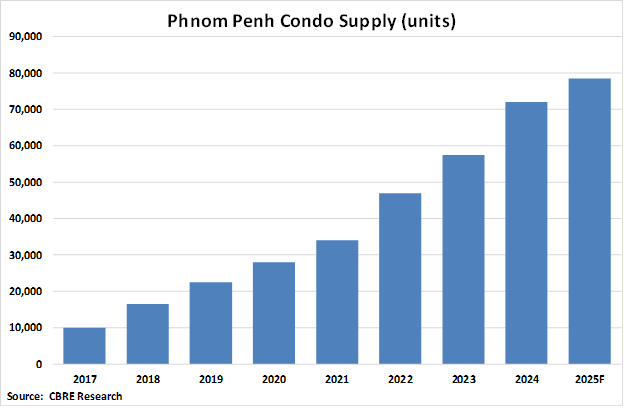
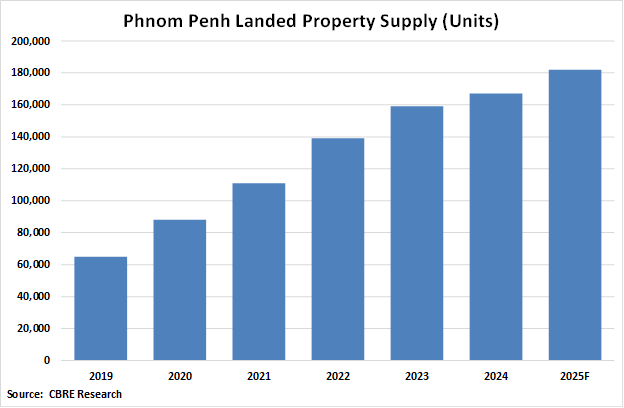
Likewise, the supply of landed property in Phnom Penh is also increasing. During 2025, the total number of landed properties reached around 180,000 units, up from 167,000 units in the prior year and 159,000 units two years earlier.
The affordable segment made up approximately 50% of all landed properties in the capital, while the mid-range market represented 44%, and the high-end segment comprised the remaining 6%.
However, conflicts in landed property projects remain a challenge. “The conflicts between the developers and homebuyers are anticipated to persist, due to the ongoing delay of construction and seizure of properties, primarily within affordable boreys. This may require further mediation and intervention from the relevant authorities,” said an earlier CBRE report.
Rental Market: Rents and Rental Yields
Attractive rental yields, improving rental market
Cambodia has very attractive gross rental yields. In Q1 2026, gross rental yields for apartments in the country ranged from 4.9% to 9.75%, with a national average of 7.54%, according to a recent study conducted by the Global Property Guide. This is slightly lower than the average yield of 7.68% recorded in Q3 2025 but higher than the 7.4% seen in Q1 2025.
By major areas:
- In Phnom Penh, apartments offer rental yields ranging from 5.22% to 7.4% in Q1 2026, with a city average of 6.5%.
- In Kep and Kampot, gross rental yields ranged from 6.95% to 7.14% in Q1 2026, with an area average of 7.04%.
- In Chroy Changvar, apartments earn rental yields from 4.9% to 6.75%, with an area average of 5.83%.
- In Koh Rong and Koh Rong Samloem, gross rental yields ranged from 6.12% to 6.98%, with an area average of 6.55%.
This was supported by an article published by Invest Asian, noting that rental yields in Phnom Penh, especially for older shophouse apartments, is the second highest in Asia next to Jakarta, at above 6%.
“Cambodia’s economic growth is equally impressive as its rental yields. Like many other frontier markets, Cambodia’s record of avoiding recessions is strong. They skipped the tech-bubble of the 2000s along with the 2008 crisis,” said Invest Asian.
“Predicting capital appreciation is hard. But we think Phnom Penh’s property market has better growth prospects compared to just about anywhere else in Asia,” added Invest Asian.
Phnom Penh is home to about 150,000 expats, most of whom are employed as teachers, NGO workers, officers of multinational companies, or embassy staff. Nearly all live in rental properties.
However, during the onset of the Covid-19 pandemic, rental demand fell sharply, particularly from foreigners and expats. This led to high vacancy rates, estimated at around 30% to 50% during the period, said CBRE Cambodia Managing Director Ann Sothida.
In the past three years, there were signs of a gentle recovery in rental demand.
Cambodia’s residential rental market continued to show modest improvement in 2025, with rents rising gradually. Year-on-year rent growth for 2026 is projected at around 1% to 3% nationwide, with prime areas in Phnom Penh expected to record stronger increases of 3% to 6%.
Currently, one-bedroom apartments in Phnom Penh are offered for an average monthly rent of US$550 per month, according to Global Property Guide. Two-bedroom apartments in the capital city are rented for an average of US$1,000 per month; three-bedroom apartments for US$2,000 per month; and four and more bedroom apartments for US$4,500 per month.
Mortgage Market and Interest Rates
Mortgage market contracts further
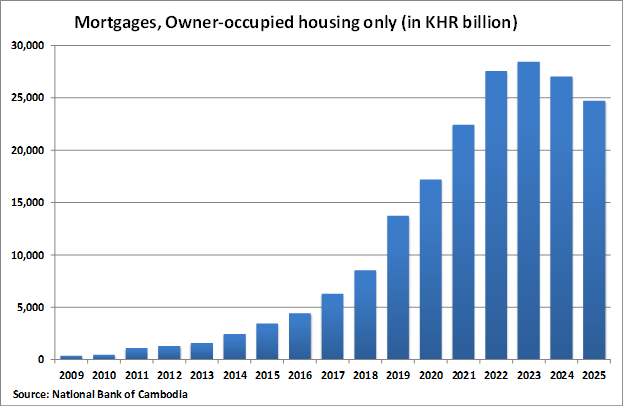
Mortgages and housing loans were introduced to the real estate sector only in 2008. The size of the mortgage market rose from less than 1% of GDP in 2009 to about 16.8% of GDP in 2022. However, it noticeably slowed in the past three years, to 16% of GDP in 2023, then to 14% of GDP in 2024, and finally to 12.1% of GDP in 2025.
Total outstanding mortgages (owner-occupied housing only) stood at KHR 24.72 trillion (US$6.17 billion) in December 2025, down by 8.5% from the preceding year, according to the National Bank of Cambodia (NBC). It was the second consecutive annual contraction seen since mortgage loans were introduced in the country 17 years ago.
After more than 40% annual growth from 2010 to 2022, the mortgage market growth slowed sharply to just 3.3% in 2023 before declining in the past two years.
Market analysts cite tighter lending standards, weak housing demand, and a growing inventory of unsold residential units as key factors behind the slowdown in mortgage uptake and overall market momentum. In the residential segment, subdued demand is reflected in sluggish absorption rates, particularly for condominium and borey developments, despite modest increases in project launches and sales activity.
Interest rates falling
Cambodia does not operate with a conventional policy rate like many central banks, as monetary policy is constrained by high dollarization. Instead, the National Bank of Cambodia (NBC) relies on liquidity management tools and indicative rates.
As of early 2026, the country’s benchmark interest rate, proxied by the average savings deposit rate, remains very low at around 0.41%, reflecting accommodative monetary conditions. More recently, in January 2026, the NBC reduced the Marginal Lending Facility (MLF) rate from 5.0% to 4.75%, signaling a continued supportive stance to ease liquidity and sustain economic recovery amid external uncertainties.
Against this backdrop, term loan interest rates provide a clearer view of borrowing costs and overall credit conditions in the economy.
For new term loans:
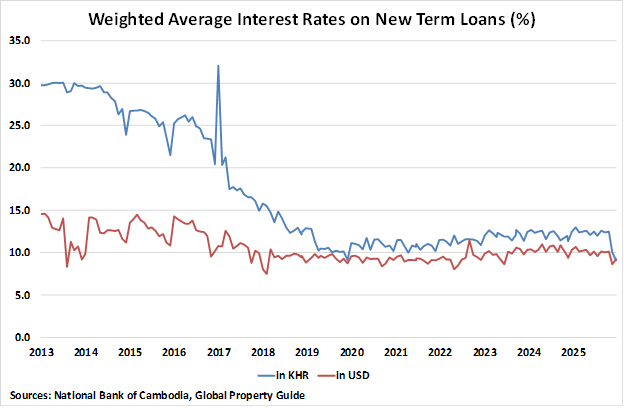
- KHR-denominated term loans: the weighted average lending rate was 8.76% in December 2025, declining markedly from 11.32% in December 2024, 11.4% in December 2023, and 10.88% in December 2022, based on figures from the NBC.
- USD-denominated term loans: the weighted average lending rate stood at 8.61% in December 2025, down from 9.39% in December 2024, 9.78% in the past two years, and 9.1% three years ago.
For outstanding term loans:
- KHR-denominated term loans: the average interest rate was 8.9% in December 2025, down sharply from 11.4% in December 2024, 11.32% in December 2023, and 10.62% three years ago.
- USD-denominated term loans: the average interest rate was around 9.2% in December 2025, down from in 9.87% in the preceding year, 9.75% two years ago, and 9.22% in December 2022.
Economic and Social Factors
Economic growth moderating, inflation easing
Both the World Bank and the International Monetary Fund (IMF) reported that Cambodia’s economic growth eased to 4.8% in 2025, weighed down by external challenges such as trade policy uncertainty and regional geopolitical tensions. This followed economic expansions of 6% in 2024, 5% in 2023, 5.1% in 2022, and 3.1% in 2021.
“Cambodia is navigating a challenging period amid combined domestic and external shocks,” said Tania Meyer, World Bank Country Manager for Cambodia. “Strong buffers and targeted reforms can help the country withstand these economic pressures. Protecting vulnerable households, including returnees, remains essential. At the same time, improving the business environment, supporting informal enterprises, and easing formalization are critical to unlock growth, level the playing field, and create better-quality jobs.”
The World Bank projects Cambodia’s economic growth to moderate to 4.3% in 2026, before rebounding to 5.1% in 2027, while the IMF offers a more cautious outlook, forecasting growth of 4% this year and 4.5% in 2027.
“Risks to the outlook are heavily tilted to the downside. A sharper-than-expected escalation in trade and border tensions could further weaken exports, tourism, and growth. Domestically, financial sector vulnerabilities are a key concern. High private sector debt and rising NPLs, which have surpassed 7 percent – particularly in the tourism and real estate sectors – could lead to corporate and household financial stress and weigh on the recovery,” said Mr. Kenichiro Kashiwase of the IMF.
Nevertheless, the Ministry of Economy and Finance remains confident that Cambodia can achieve a 5% economic growth in 2026.
Cambodia saw strong, uninterrupted growth for most of the past two decades. From 2000 to 2003, the economy grew by an average of 8.3%, and then by an average of 11.1% from 2004 to 2007. After a slight pause during the global crisis, from 2011 to 2019, the economy expanded by an average of 7.2% per year, fuelled by strong tourism, garments manufacturing, and agriculture.
Then in 2020, Cambodia’s economy suffered a pandemic-induced contraction of 3.6%, marking its first decline in decades.
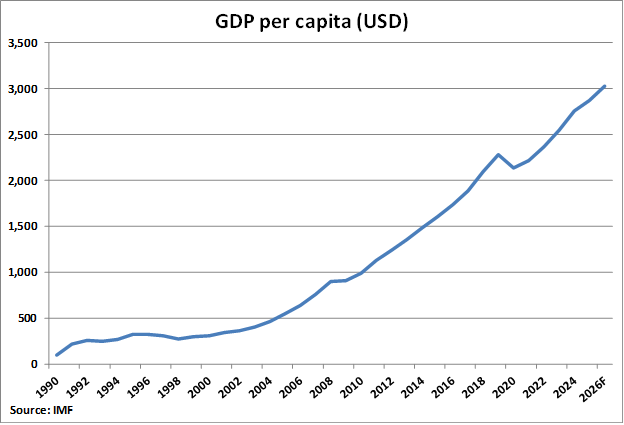
Cambodia was upgraded by the World Bank from a low-income to a lower-middle-income economy in August 2016. Cambodia’s GNI per capita stood at US$1,690 in 2017, and increased to US$2,100 in 2019, but declined slightly to US$2,050 in 2020 due to the adverse effects of the Covid-19 pandemic. The country’s GNI per capita is now currently around US$2,550.
Cambodia’s GDP per capita, at current prices, is higher, at US$2,870 in 2025, based on IMF figures.
Cambodia has made remarkable progress in reducing poverty over the past two decades. The national poverty rate fell dramatically from 47.8% in 2007 to around 12.9% by 2018, driven largely by rising labor earnings and economic growth. However, this progress was partially reversed during the COVID‑19 pandemic, when job losses and income shocks pushed many households into poverty. In January 2021, more than 710,000 households received government cash transfers, compared with about 560,000 in 2020, suggesting that at least 150,000 households or roughly 500,000 people were newly poor, and pushing the poverty rate back up to around 18% during the pandemic.
The ensuing surge in global energy and food prices following the Russian-Ukrainian conflict further strained household budgets. Nevertheless, expanded social assistance for poor and vulnerable families helped cushion some of the economic impact.
More recent estimates indicate continued progress in reducing multidimensional poverty. According to the UNDP’s 2025 Global Multidimensional Poverty Index (MPI), Cambodia’s poverty rate stood at about 16.6%, with an additional 20.5% of the population classified as vulnerable to poverty. Despite these recent improvements, poverty levels remain elevated compared with pre‑pandemic lows, and economic inequalities and vulnerabilities persist.
With improving economic conditions and expanding employment, Cambodia’s poverty rate is expected to gradually decline, with the government targeting a reduction below 10% by 2028.
Inflationary pressures continue to ease. In January 2026, the annual inflation rate stood at just 1.26%, sharply down from the prior year’s 6%, based on figures released by the National Bank of Cambodia.
With this, inflation is projected to be low at an average of 1.8% this year, according to the IMF forecast.
From an annual average of 11.3% from 2005 to 2008, inflation declined to just 2.8% annually from 2009 to 2021. After accelerating to 5.3% in 2022, growth in consumer prices eased again to 2.1% in 2023 and 0.9% in 2024. It remained manageable at 1.6% in 2025.
Tourism weakening
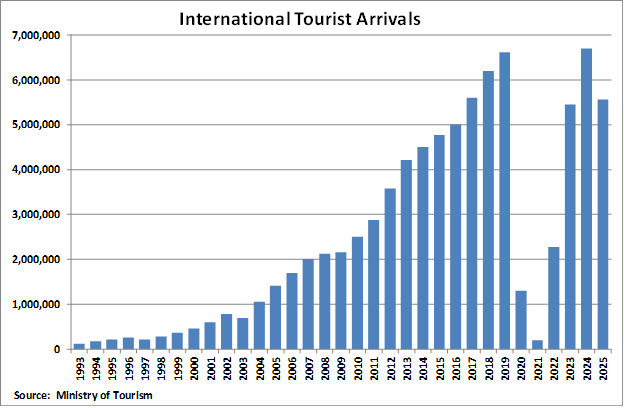
During 2025, there were about 5.57 million international tourist arrivals in Cambodia, sharply down by 16.9% as compared to the record high 6.7 million arrivals seen in the preceding year. This followed annual increases of 22.9% in 2024, 139.5% in 2023, and a staggering 1,058.6% in 2022 and pandemic-induced declines of 85% in 2021 and 80.2% in 2020.
Vietnam accounted for 21.9% of the total tourist arrivals in Cambodia last year, closely followed by China (21.6%) and Thailand (18.4%). Collectively, these three countries comprised nearly two-thirds of all international tourist arrivals in 2025. Other key source markets included the United States (3.7%), South Korea (2.7%), Indonesia (2.7%), Laos (2.4%), France (2.4%), and the United Kingdom (2.3%).
Thong Mengdavid, Deputy Director at the China-ASEAN Studies Center, said the overall decline in international tourist arrivals reflects both regional economic slowdowns and intensified competition from neighboring destinations.
“The Cambodia-Thailand border conflict is also one of the reasons for the decrease in international tourist arrivals to the kingdom,” said Thong Mengdavid. “The drop also highlights lingering challenges in air connectivity and destination diversification.”
Despite the drop in arrivals, gross tourism receipts reached US$3.87 billion in 2025, up by 6.6% from US$3.63 billion in 2024, according to the Ministry of Tourism. This suggests that visitors spent more even as fewer arrived.
Phnom Penh, the capital city of Cambodia and the country’s primary economic hub, remained the top destination. It was followed by Siem Reap, home to the iconic Angkor Wat, as well as the coastal provinces of Preah Sihanouk and Kampot. The revival of international flights, improved infrastructure, and promotional efforts by the government have played key roles in boosting tourism in recent years.
Cambodia is targeting a strong tourism resurgence this year. A major boost comes from the Techo International Airport (KTI), which began operations in September 2025 and can accommodate large aircraft like the Airbus A380, strengthening Phnom Penh’s position as a regional air hub. To further increase arrivals, the government is also focusing on the Chinese market, with plans to pilot a visa exemption program from June 15 to October 15, 2026, according to Tourism Minister Huot Hak.
The tourism industry currently generates around 420,000 direct jobs, underscoring its critical role in the national economy. Together with agriculture, construction, and the export-oriented garments and footwear sector, tourism stands as one of the four key pillars sustaining Cambodia’s economic resilience and financial stability.
Garment industry continues to grow strongly
Cambodia’s garment industry is a cornerstone of its economy, playing a pivotal role in employment and export revenues. The garments sector is the country’s largest foreign exchange earner. It consists of more than 1,500 factories and branches, employing over 900,000 workers, mostly women. In fact, Cambodia is the world’s eighth-largest exporter of apparel and footwear, with the textile and apparel sector contributing over one-third of the nation’s GDP.
In 2025, Cambodia exported garments, shoes, and travel goods worth US$15.5 billion, representing a year-on-year increase of 15.7%. Garments remained the dominant contributor to the sector’s export profile, while footwear emerged as the fastest-growing category. Travel goods, including bags and luggage, also posted gains, albeit at a more moderate pace.
Collectively, the garment, footwear, and travel goods (GFT) industry accounts for around 50 percent of Cambodia’s total export value.
Cambodia’s GFT industry grew strongly in 2025, fueled by rising global demand, trade preferences, competitive labor costs, improved logistics, and higher demand for travel goods. This growth also benefited from international brands diversifying production to Cambodia as part of the “China+1” strategy.
GFT exports maintained strong momentum in early 2026, rising 6.19% year-on-year to approximately US$2.59 billion in the first two months of this year, up from US$2.44 billion during the same period in 2025, according to the General Department of Customs and Excise (GDCE).
Cambodia’s garment exports remain largely dependent on demand from key markets such as the US, Canada, the EU, and several Asian nations. However, according to Thong Mengdavid, deputy director of the China-ASEAN Studies Center at the Cambodia University of Technology and Science, the sector’s double-digit growth also reflects the country’s successful efforts to diversify beyond these traditional trading partners.
“I think the Regional Comprehensive Economic Partnership (RCEP) agreement has also given a boost to this growth,” said Thong Mengdavid. “And this upward trend is likely to continue this year, supported by external demand and new investment inflows from China, South Korea, and Japan.”
Sources:
- Cambodia: housing price and price/m² (Properstar): https://www.properstar.ph/
- Phnom Penh Mid-Year Review 2025 (CBRE Cambodia): https://aps.com.kh/
- The top 3 Phnom Penh Sangkat land prices at the end of 2025 (Khmer Times): https://www.khmertimeskh.com/
- Cambodia Real Estate Highlights H2 2025 (Knight Frank): https://content.knightfrank.com/
- Phnom Penh Land Prices 2025 (H2): Full District Breakdown & Investment Insights (realestate.com.kh): https://www.realestate.com.kh/
- 2026 Fearless Forecast (CBRE Cambodia): https://aps.com.kh/
- Gross rental yields in Cambodia: Phnom Penh and 3 other locations (Global Property Guide): https://www.globalpropertyguide.com/
- Cities With the Highest Rental Yields in the World (Invest Asian): https://www.investasian.com/
- How to Buy Property in Cambodia as a Foreigner (Global Property Guide): https://www.globalpropertyguide.com/
- Strong Buffers and Targeted Reforms Can Help Cambodia Withstand Economic Pressures, says World Bank (World Bank): https://www.worldbank.org/
- Cambodia looks ahead after a turbulent 2025 (East Asia Forum): https://eastasiaforum.org/
- IMF Staff Completes 2025 Article IV Mission to Cambodia (International Monetary Fund): https://www.imf.org/
- Cambodia (International Monetary Fund): https://www.imf.org/en/countries/khm
- Cambodia’s economy will slow down to 4.3% in 2026 before rebounding to 5.1% in 2027, World Bank says (Khmer Times): https://www.khmertimeskh.com/
- Cambodia 2026 Growth Outlook of 4.3% In Line With Regional Peers and Well Above Global Average of 2.6%, World Bank Says (Cambodia Investment Review): https://cambodiainvestmentreview.com/
- Cambodia is now a lower-middle-income economy: What does this mean? (World Bank): https://blogs.worldbank.org/
- GNI per capita, Atlas method (current US$) – Cambodia (World Bank): https://data.worldbank.org/
- Cambodia targets poverty reduction to below 10% by 2028 at UN assembly (The Phnom Penh Post): https://www.phnompenhpost.com/
- Multidimensional Poverty Index 2025 (United Nations Development Programme): https://hdr.undp.org/
- Notification on the Delay of the Implementation of Capital Gains Tax on Immovable Property (Rajah & Tann Asia): https://kh.rajahtannasia.com/
- GDT Postpones Implementation of Capital Gains Tax (AKP Agence Kampuchea Presse): https://akp.gov.kh/
- Tax Incentives for Siem Reap Tourism Businesses (Andersen Global): https://kh.andersen.com/
- Tourism Statistics Report December 2025 (Ministry of Tourism): https://asset.cambodia.gov.kh/
- Cambodia records 5.57 mln int'l tourists in 2025, down 16.9 pct (Xinhua): https://english.news.cn/
- Cambodia Looks to Rebuild Tourist Confidence After 2025 Arrival Drop (CamNess): https://cambodianess.com/
- Cambodia tourism revenue rises to $3.87 billion despite falling arrivals (Khmer Times): https://www.khmertimeskh.com/
- Cambodia Pushes for Tourism Revival in 2026: K-WAVE Peace Concert Signals New Era, Efforts to Eradicate ‘Scam’ Reputation and Boost International Confidence (Travel and Tour World): https://www.travelandtourworld.com/
- Cambodia’s GFT exports rise over 6% in first two months (Khmer Times): https://www.khmertimeskh.com/
- Garments: $11.4 billion in exports, up 16.5 percent from the previous year, accounting for the largest share of total shipments (Xinhua): https://english.news.cn/
- Cambodia’s Garment, Footwear and Travel Goods Exports Hit $15.5 Billion in 2025 as Regional Trade Drives Growth (Cambodia Investment Review): https://cambodiainvestmentreview.com/