Switzerland Residential Property Market Analysis 2026
Despite softening demographic and employment momentum, persistent supply scarcity and low financing costs in the Swiss housing markets continue to support growth in sales prices, while rental inflation decelerates further.
This extended overview from Global Property Guide covers key aspects of Switzerland’s housing market and takes a closer look at its most recent developments and long-term trends.
Table of Contents
- Property Prices and Price Index
- Property Supply and Demand Trends
- Rental Market: Rents and Rental Yields
- Mortgage Market and Interest Rates
- Economic and Social Factors
Property Prices and Price Index
Swiss owner-occupied housing prices continued to rise in early 2026, as scarce supply and a lower-rate financing environment supported demand among qualified buyers, even as broader demographic and employment momentum began to soften. In the first quarter of 2026, Wüest Partner’s Transaction Price Index for owner-occupied apartments, published by the Swiss National Bank (SNB), recorded a 4.48% year-on-year increase. Quarter-on-quarter, the index rose by 1.32%. Single-family homes showed a comparable trend, with a 4.30% year-on-year increase and a 0.70% gain from the previous quarter.
Switzerland's house price annual change:
Regionally, the strongest annual growth in apartment prices was observed in Central Switzerland, Northwestern Switzerland, and the Zurich region, where prices increased by 7.52%, 5.61%, and 5.47%, respectively. In the single-family house segment, Central Switzerland was the clear leader, with prices up 7.93% year-on-year. This regional pattern reflects the continued strength of owner-occupied demand in economically resilient, well-connected, and supply-constrained markets.
Regional price dynamic, Wüest Partner’s Transaction Price Index:
| Region | Privately Owned Apartments, Q1 2026 vs Q1 2026, % |
Single-family Houses, Q1 2026 vs Q1 2026, % |
| Zurich Region | 5.47% | 4.21% |
| Eastern Switzerland | 4.20% | 4.01% |
| Central Switzerland | 7.52% | 7.93% |
| Northwestern Switzerland | 5.61% | 3.34% |
| Bern Region | 2.73% | 4.55% |
| Southern Switzerland | 3.28% | 2.86% |
| Lake Geneva Region | 3.61% | 4.77% |
| Western Switzerland | 3.67% | 4.85% |
| Data Source: Wüest Partner via SNB. | ||
Zurich remained the most expensive city for apartment purchases. According to Wüest Partner’s latest data for Q1 2026, average transaction prices reached CHF 23,350 (USD 29,811) per square meter, representing a 10.61% year-on-year increase. Geneva followed closely at CHF 21,640 (USD 27,628) per square meter.
Privately owned apartments in the five largest cities:
| Transaction Price, CHF/sqm, Q1 2026 |
Transaction Price, CHF/sqm, Q1 2026 |
YoY, % Q1 2026 vs Q1 2025 |
|
| Zurich | CHF 23,350 | USD 29,811 | 10.61% |
| Bern | CHF 10,750 | USD 13,725 | -6.11% |
| Basel | CHF 14,080 | USD 17,976 | 7.56% |
| Lausanne | CHF 17,150 | USD 21,895 | 10.72% |
| Geneva | CHF 21,640 | USD 27,628 | 3.24% |
| Note: Exchange rate as of Q1 2026, USD 1 = CHF 0.78327. | |||
| Data Source: Wüest Partner via SNB. | |||
A similar pattern was evident in the single-family home segment, with Zurich and Geneva continuing to dominate the upper end of the market. As of Q1 2026, the national average transaction price for a single-family home stood at CHF 1,280,000 (USD 1,634,175), while Zurich approached CHF 4,507,000 (USD 5,754,082), more than three and a half times the national average. Geneva followed with an average of CHF 3,187,000 (USD 4,068,840).
Single-family house prices in the five largest cities:
| Transaction price, per unit, Q1 2026, CHF |
Transaction price, per unit, Q1 2026, USD |
YoY, % Q1 2026 vs Q1 2025 |
|
| Zurich | CHF 4,507,000 | USD 5,754,082 | 5.38% |
| Bern | CHF 2,251,000 | USD 2,873,849 | 2.97% |
| Basel | CHF 2,992,000 | USD 3,819,883 | 7.09% |
| Lausanne | CHF 3,097,000 | USD 3,953,937 | 12.50% |
| Geneva | CHF 3,187,000 | USD 4,068,840 | -5.60% |
| Note: Exchange rate as of Q1 2026, USD 1 = CHF 0.78327. | |||
| Data Source: Wüest Partner via SNB. | |||
The current price momentum is being driven by a combination of limited supply, low vacancy, improved financing conditions, and continued pressure in the rental market. Raiffeisen Economic Research argues that recent interest-rate cuts have widened the cost advantage of ownership compared with renting for households able to buy, helping to revive demand after the cooling triggered by the post-pandemic rise in mortgage rates. The Federal Office for Housing (BWO/OFL) similarly notes that owner-occupied housing prices are benefiting from the downward trend in interest rates, while the continued decline in vacancy rates reflects the broader shortage of available housing.
Against this backdrop, Wüest Partner expects owner-occupied prices to continue rising in 2026, albeit at a more moderate pace. Limited supply is expected to remain the key support factor, while slower population and employment growth should dampen demand somewhat. For 2026, Wüest Partner forecasts transaction prices to increase by 3.5% for owner-occupied apartments and 3.3% for single-family houses.
Property Supply and Demand Trends
Limited Construction Keeps Housing Market Tight
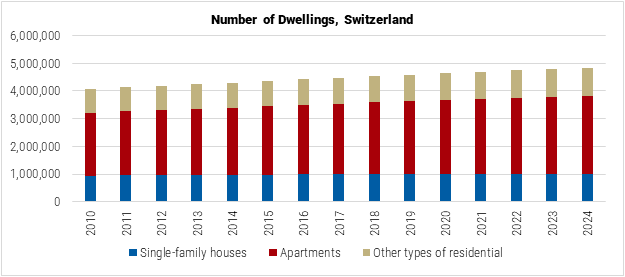
Switzerland’s housing market remains shaped by a persistent imbalance between resilient demand and limited new supply. According to the latest available data from the Federal Statistical Office (FSO), the country’s housing stock comprised 1.80 million residential buildings and 4.84 million dwellings at the end of 2024. Multifamily apartment buildings accounted for approximately 58% of all dwellings, while dwellings in single-family houses represented about 21%. The remaining 21% were located in other building categories, mainly residential buildings with ancillary use and buildings with partial residential use.
The country remains predominantly tenant-oriented. At the end of 2024, around 58% of dwellings were occupied by tenants or subtenants. Owner-occupied single-family homes accounted for 24% of the market, owner-occupied apartments for 12%, while 6% were occupied by cooperative members or provided rent-free. This rental-oriented structure makes Switzerland particularly sensitive to shifts in rental supply, vacancy rates, and new-tenancy rents.
Data Source: FSO.
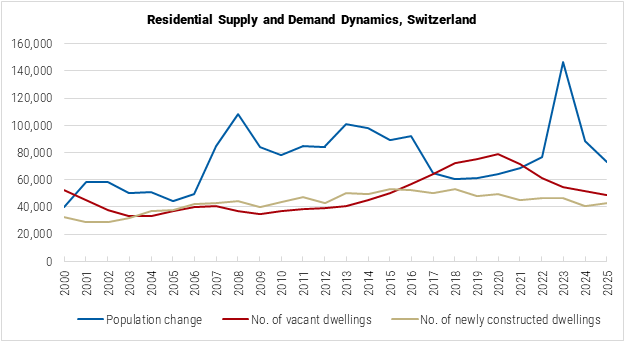
On the supply side, construction activity has weakened markedly from the levels recorded in the second half of the 2010s. Between 2013 and 2018, more than 51,000 new dwellings were completed annually on average, but residential construction has since slowed, with the trough appearing to have been reached in 2024, when only about 40,800 dwellings were completed according to FSO provisional data. Wüest Partner estimates completions to have picked up slightly to 42,769 units in 2025, up by around 5% year-on-year, with a further increase to 45,754 dwellings projected for 2026. While this points to some recovery in construction output, completions are still expected to remain well below the levels recorded in the mid-to-late 2010s.
Forward-looking supply indicators suggest only a tentative recovery. BWO/OFL indicates that building authorizations have increased again since 2024, although only modestly recently, while building applications declined slightly in both 2024 and 2025. A recovery in housing production, therefore, appears possible, but is unlikely to be sufficient to ensure adequate supply if demand remains elevated.
The supply response also remains constrained by elevated development costs and lengthy approval procedures. BWO/OFL states that, although construction-cost inflation has eased, building remains much more expensive than before the pandemic. UBS adds that the sharp increase in construction and financing costs between 2021 and 2023 has had a lasting dampening effect on planning activity, while current political uncertainty and housing-policy initiatives, including the “Wohnschutzinitiative” in the city of Zurich (a tenant-protection proposal for redevelopment projects), continue to weigh on supply development.
Note: Data for 2024 is provisional; figures for 2025 and 2026 include Wüest Partner forecasts.
Data Sources: FSO, Wüest Partner.
Meanwhile, demand pressures remain robust, although demographic momentum has eased from the exceptionally strong levels recorded in 2023 and 2024. According to provisional FSO figures, Switzerland’s permanent resident population grew by 0.8% in 2025, compared with 1.0% in 2024 and 1.7% in 2023. Net international migration remained the main driver of population growth, declining from 82,800 people in 2024 to 77,300 in 2025, but still remaining above the roughly 65,000 long-term average.
The easing in migration should reduce some short-term pressure, but it does not remove the underlying imbalance. As BWO/OFL noted in its May 2026 market overview, supply and demand in the housing market have been diverging for several years, and this divergence is continuing. UBS similarly notes that, beyond immigration, housing demand continues to be supported by structural trends, including smaller and more individualized households, population ageing, and continued urbanization. These pressures are most visible in cities and agglomerations, where demand is concentrated, and the ability to expand supply remains limited.
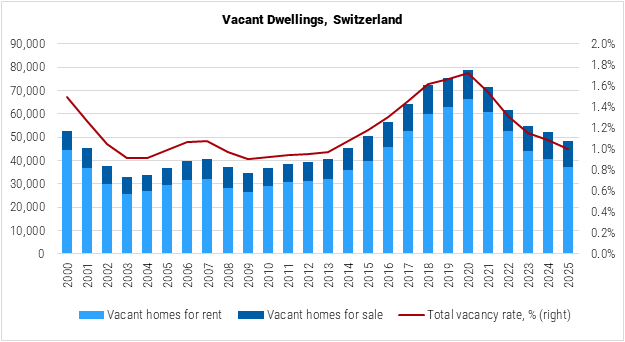
The mismatch is clearly reflected in vacancy figures. According to the FSO, the national housing vacancy rate fell for the fifth consecutive year, declining from 1.08% in June 2024 to 1.00% in June 2025. A total of 48,455 dwellings were vacant, 3,519 fewer than a year earlier, representing a 6.8% year-on-year decline and bringing the vacancy rate to its lowest level since 2013.
The tightening has been especially pronounced in the rental market. In June 2025, 37,194 vacant dwellings were offered for rent, down 8.0% year-on-year. Vacancies in the owner-occupied segment also declined, with the number of vacant dwellings for sale falling by 2.5% to 11,261 units.
Regionally, the decline in available homes was broad-based. The largest reduction in the vacancy rate was recorded in Canton Ticino, where the share of vacant dwellings fell from 2.08% to 1.92%. The Lake Geneva region recorded the next-largest decline, from 0.96% to 0.83%. Among individual cantons, Geneva again had the lowest vacancy rate, at only 0.34%, followed by Zug at 0.42% and Zurich at 0.48%. In total, 15 cantons recorded vacancy rates below 1%. Jura, at 3.03%, and Solothurn, at 2.05%, were the only cantons above the 2% threshold.
Data Source: FSO.
| Number of Vacant Units, June 2025 |
Vacancy Rate, June 2025 |
|
| Lake Geneva Region | 8,072 | 0.83% |
| Midland Switzerland | 14,630 | 1.39% |
| Northwestern Switzerland | 6,377 | 1.04% |
| Zurich Region | 3,815 | 0.48% |
| Eastern Switzerland | 7,845 | 1.09% |
| Central Switzerland | 2,780 | 0.65% |
| Ticino | 4,936 | 1.92% |
| Switzerland | 48,455 | 1.00% |
| Data Source: FSO. | ||
Overall, the outlook is one of gradual rebalancing. Lower demographic momentum should ease some short-term demand pressure, but the expected recovery in completions remains modest, while planning lags, high construction costs, lengthy approval procedures, and regulatory uncertainty continue to limit the supply response. Against this backdrop, BWO/OFL expects the vacancy rate, which has been declining since 2021, to fall further in 2026. This should keep rental-market conditions tight and continue to support owner-occupied housing prices, particularly in the lower interest-rate environment. Supply scarcity is therefore expected to remain one of the main forces shaping Switzerland’s housing market over the coming quarters.
Rental Market: Rents and Rental Yields
Weakening Momentum for Rents Despite Tight Supply
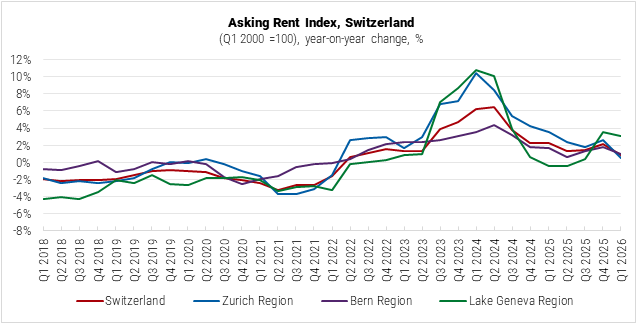
Strong demand for rental housing set against limited supply in major centers (with available listings 25% below levels observed 10 years ago, according to Wüest Partner) continues to support growth in rental rates across Switzerland, although rental inflation has been losing momentum in recent quarters. In Q1 2026, the nationwide asking rent index published by the SNB based on Wüest Partner data increased by 0.90% year-on-year, down from the 2.25% growth rate observed a year prior in Q1 2025. Regionally, the most pronounced annual growth was reported in the Lake Geneva region (3.03%), followed by Northwestern Switzerland (1.81%) and Central Switzerland (1.70%), while Zurich and the surrounding region recorded a much more moderate increase of 0.50%. In Southern Switzerland, the index posted a 3.40% year-on-year decline.
Switzerland's rent price index:
Looking ahead, Wüest Partner expects asking rents to continue rising modestly, while existing rents are likely to decline due to prior reductions in the mortgage reference rate (which is used to determine rent adjustments in existing agreements).
“For 2026, a slight decline of -0.8% is expected for existing rents. This is mainly due to the two reductions in the reference mortgage interest rate, whose dampening effect typically materialises with a time lag,” the company’s latest property market report explained. “For asking rents, the stabilization observed in 2025 is expected to continue in 2026. Although the rental market will remain characterized by excess demand, momentum is likely to weaken somewhat. Overall, a moderate increase of around +1.0% is expected.”
The expectation of slower rental momentum this year is shared by experts from Julius Bär. “On the one hand, the already high level of rents and subdued growth in employment income are putting a limit on what households are prepared to pay,” said their Q1 2026 property market report. “On the other hand, immigration numbers are declining, which is removing some of the additional demand for housing.”
Data Source: Wüest Partner via SNB.
In nominal terms, based on Wüest Partner figures, the median annual asking rent for apartments in Switzerland stood at CHF 240 (USD 305) per square meter of usable space in Q1 2026, unchanged from the same period in 2025. Regionally, the highest asking rents were observed in Geneva (CHF 420 / USD 534) and Zurich (CHF 400 / USD 508).
In parallel, research carried out by Global Property Guide in March 2026 found gross rental yields for residential units in Switzerland at an average level of 2.91%, nearly unchanged from 2.96% previously reported in April 2025. Regionally, the highest yields among the assessed submarkets were observed in the cantons of Valais (3.57%) and Fribourg (3.34%), while Zurich, Geneva, Bern, Vaud, Ticino, and Aargau all showed yields below 3%.
Wüest Partner estimates even lower performance potential for prime properties in major metropolitan centers, with yields for rental apartments in this category ranging from 2.35% in Basel to 2.15% in Geneva and only 1.85% in Zurich, as of Q1 2026.
Apartment asking rents in major centers:
| Median Annual Rent, CHF/per sqm Q1 2026 |
Median Annual Rent, USD/per sqm Q1 2026 |
YoY, % Q1 2026 vs Q1 2025 |
|
| Zurich | CHF 400 | USD 508 | -4.8% |
| Bern | CHF 280 | USD 356 | 3.7% |
| Basel | CHF 260 | USD 330 | 0.0% |
| Lausanne | CHF 310 | USD 394 | 3.3% |
| Geneva | CHF 420 | USD 534 | 0.0% |
| Note: Exchange rate as of March 2026, USD 1 = CHF 0.78678. | |||
| Data Source: Wüest Partner. | |||
With the majority of households living in rented housing and a large share of rental dwellings owned by institutional landlords rather than private individuals (over 43% nationwide, according to FSO data), government regulation of the rental sector remains a highly relevant issue for Switzerland, with key updates on changes in housing policies and tenancy law published by the The Federal Office for Housing (BWO/OFL).
Last year, the Federal Council amended the Ordinance on Tenancies and Leases for Residential and Commercial Premises (OBLF) to increase the transparency of rental leases and allow tenants to better assess the initial rent in new contracts and whether there are grounds to challenge it. The changes took effect in October 2025.
Mortgage Market and Interest Rates
Interest Rates Low and Relatively Stable, Lending Activity Grows
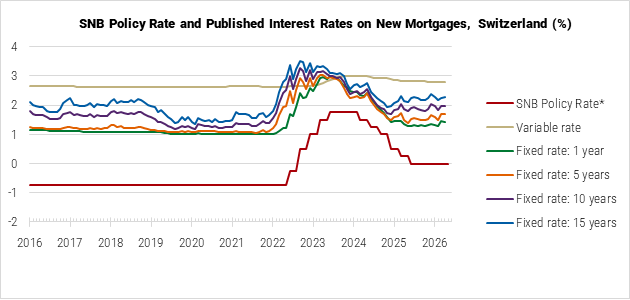
In the second half of 2025 and early 2026, the SNB has kept its policy rate at 0.0%, and based on global and domestic developments, experts anticipate the Swiss regulator’s monetary policy will remain stable in the next few quarters. Most economists polled by Reuters in March agreed that the SNB is likely to keep the policy rate on hold through 2026, as Switzerland faces a lesser risk of rising inflation from higher global oil prices than many of its peers. A similar outlook is presented in the UBS April 2026 interest rate forecast.
Switzerland's mortgage loan interest rates:
In this environment, published interest rates on new mortgages have also been relatively stable, showing only marginal movement in recent months, according to SNB data. As of April 2026, the average rate stood at 2.79% for variable-rate loans, 1.98% for 10-year fixed-rate loans, and 2.27% for 15-year fixed-rate loans.
In parallel, the mortgage reference rate published by the Federal Office for Housing (BWO/OFL), based on the average interest on existing loans and used to determine rent adjustments, was previously reduced to 1.50% in March and 1.25% in September 2025 and has remained at this level since.
Overall, despite a slight uptick in fixed-rate loans due to a rise in government bond yields following the escalation in the Middle East, USB experts believe the mortgage rate level is likely to remain low. “In Switzerland, the risk of inflation is limited, and the SNB’s bar for raising the key interest rate is high, which limits the potential for a rise in yields on Swiss government bonds,” said their forecast. “As long as the SNB maintains its zero-interest-rate policy, interest rates are expected to remain very low by historical standards. SARON-based mortgage rates are likely to move sideways.”
Note: *SNB policy rate applied from June 2019; for prior periods, the SNB target for the three-month Swiss franc Libor is displayed.
Data Source: SNB.
Published interest rates on new mortgage loans:
| Avg Interest Rate, April 2026 |
YoY | Avg Interest Rate, April 2025 |
YoY | Avg Interest Rate, April 2024 |
|
| Variable rate | 2.79% | ↓ | 2.83% | ↓ | 3.00% |
| SARON-linked rate: 3-year maturity | 1.09% | ↓ | 1.31% | ↓ | 2.49% |
| SARON-linked rate: 5-year maturity | 1.07% | ↓ | 1.32% | ↓ | 2.52% |
| SARON-linked rate: unlimited maturity | 1.16% | ↓ | 1.33% | ↓ | 2.52% |
| Fixed rate: 1-year maturity | 1.44% | ↑ | 1.34% | ↓ | 2.33% |
| Fixed rate: 5-year maturity | 1.70% | ↑ | 1.50% | ↓ | 2.28% |
| Fixed rate: 10-year maturity | 1.98% | ↑ | 1.85% | ↓ | 2.43% |
| Fixed rate: 15-year maturity | 2.27% | ↑ | 2.14% | ↓ | 2.68% |
| Data Source: SNB. | |||||
Data Source: SNB.
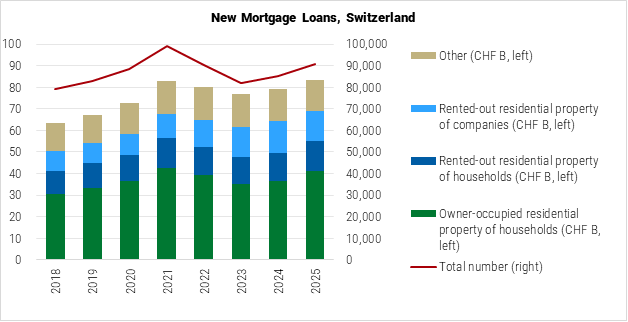
Low and relatively stable interest rates continue to support lending activity in Switzerland. According to central bank data, 90,777 new mortgage loans totaling CHF 83.2 billion (USD 100.2 billion) were advanced in 2025, representing a 6.3% increase in volume and a 5.3% increase in the total value of new lending compared with the previous year.
Of the newly originated mortgages during the year, nearly half were loans on owner-occupied residential properties of households (49.7%), with the remaining share split between rental properties of households (16.3%), rental properties of companies (16.6%), and other types of mortgages (17.3%). The most pronounced growth in new loan value (13.1% year-on-year) was observed in the owner-occupied residential properties category, while the value of loans on rental properties of companies and other types of mortgages actually declined.
Data Source: SNB.
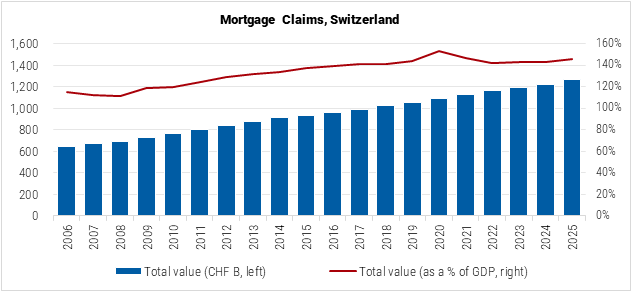
The total value of mortgage claims held by banks in Switzerland has been growing steadily at an average annual rate of 3.6% over the past 20 years. As of March 2026, the mortgage stock stood at CHF 1.27 trillion (USD 1.62 trillion).
Sized against the Swiss economy, the mortgage market moderated from the pandemic-related 153.2% spike in the ratio of outstanding loans to GDP in 2020 to an estimated 145.8% in 2025. Over the long term, however, the ratio continues to trend upward from around 137% a decade ago and around 118% two decades ago.
Data Source: SNB, SECO.
Economic and Social Factors
Growth Still Below Average, Foreign Migration Moderates Further
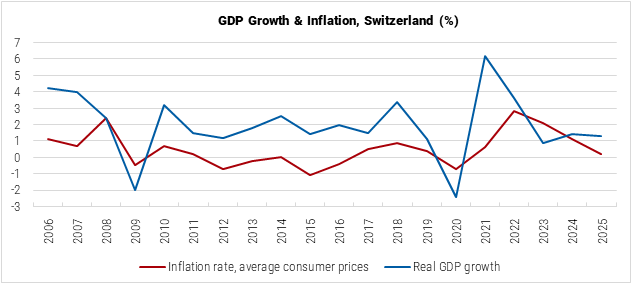
Switzerland’s real GDP growth in 2025 was largely stable at 1.3%, remaining, however, below the country’s long-term average. The muted performance is attributed to weak external demand from key trading partners, partly due to the temporary US import tariffs. Considering global developments, the latest European Commission projections indicate the economy will expand by 1.1% in 2026 and 1.3% in 2027, while the International Monetary Fund (IMF) forecasts a table 1.3% annual growth rate over the next two years.
Against this backdrop of heightened uncertainty dampening the international economic outlook, the spring economic forecast from the State Secretariat for Economic Affairs (SECO) also expects a weaker momentum in private consumption and slower growth of the export sectors in 2026, with growth forecast for the year lowered to 1.0% (compared to 1.1% previously forecast in December), while inflation is expected to be slightly higher than previously anticipated.
Consumer price index (CPI) inflation in the country previously fell from an average annual level of 2.8% in 2022 to 0.2% in 2025, and despite re-accelerating somewhat in recent months, it remains low (0.6% in April 2026, as reported by the FSO). Due to higher energy prices, inflation is expected to rise slightly this year, although Switzerland’s strong currency and low share of energy imports in total imports are expected to help contain inflationary pressures. The IMF projects inflation at 0.5% in 2026 and 2027, while SECO forecasts 0.4% and 0.5%, respectively.
Data Source: IMF.
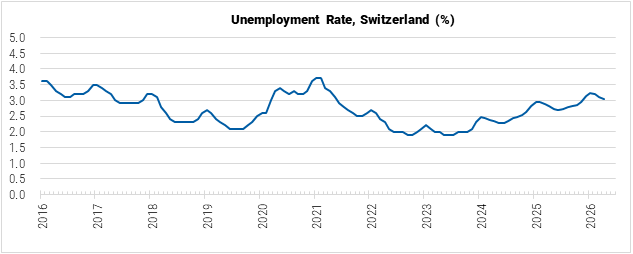
In the Swiss labor market, sluggish economic growth has translated into subdued employment growth and a gradually climbing unemployment rate over the past two years. As of April 2026, the nationwide unemployment rate reached 3.0%, up from 2.8% and 2.3% during the same period in 2025 and 2024, respectively.
“Although still close to its 10-year average, the upward trend in unemployment reflects further softening in labor demand,” commented the 2025 Article IV staff report from the IMF. “Real wages likely remained positive given the disinflationary environment, but employment prospects weakened.”
Data Source: SECO via FSO.
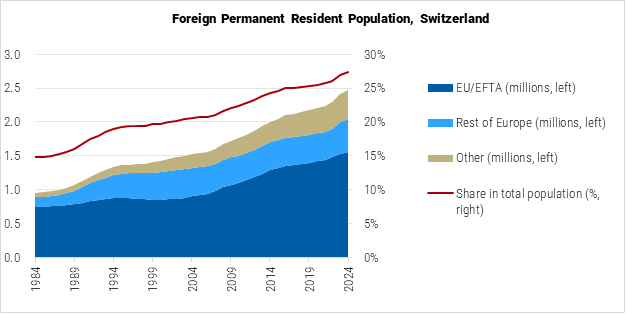
While dropping from the peak of 139.1 thousand people in 2023 to 82.8 thousand in 2024 and 77.3 thousand in 2025, net migration to Switzerland remains historically high, contributing to labor force growth and helping to counter the declines in the domestic population. Over the last 30 years, the foreign population (including stateless persons and other non-Swiss categories) permanently residing in Switzerland grew from about 953 thousand in 1984 to nearly 2.5 million in 2024, its share in the total population increasing from 14.8% to 27.4%.
In the first four months of 2026, the State Secretariat for Migration (SEM) reported net foreign migration of permanent residents of 4.9 thousand, compared to 5.1 thousand during the same period last year (-4.0% year-on-year), indicating further moderation of the trend.
Data Source: FSO.
In general, the Swiss economy remains resilient, supported by strong institutions, prudent policies, and a skilled labor force, as outlined in the IMF staff report. At the same time, it continues to experience headwinds from a number of internal and external factors, including demographic trends, skills gaps, global uncertainty, trade fragmentation, and intensified safe-haven flows that challenge Switzerland's export-oriented growth model. According to experts, the economy’s near-term growth is likely to remain below potential, with a gradual recovery anticipated through 2030.
In March 2026, Fitch Ratings affirmed the country’s ‘AAA’ sovereign rating with a stable outlook.
Sources:
- Swiss National Bank (SNB)
- SNB Data Portal: https://data.snb.ch/
- Real Estate Price Indices: https://data.snb.ch/
- Monetary Policy Assessment of 19 March 2026: https://www.snb.ch/
- Quarterly Bulletin 1/2026: https://www.snb.ch/
- Federal Statistical Office (FSO)
- Gross Domestic Product: https://www.bfs.admin.ch/
- Consumer Prices: https://www.bfs.admin.ch/
- Components of Population Change: https://www.bfs.admin.ch/
- International Migration: https://www.bfs.admin.ch/
- Foreign Permanent Resident Population Change: https://www.bfs.admin.ch/
- The Labor Market Situation, April 2026 (FR): https://www.bfs.admin.ch/
- Empty Dwellings Census of 1 June 2025: https://www.bfs.admin.ch/
- Rented Dwellings: https://www.bfs.admin.ch/
- Construction and Housing: https://www.bfs.admin.ch/
- Tenants/Owners: https://www.bfs.admin.ch/
- Buildings and Dwellings Statistics 2024: https://www.bfs.admin.ch/
- Federal Office for Housing (BWO/OFL)
- Reference Interest Rate (FR): https://www.bwo.admin.ch/
- Tenancy Law (FR): https://www.bwo.admin.ch/
- Housing policy (FR): https://www.bwo.admin.ch/
- Housing Market Overview, 2/2026 (FR): https://www.bwo.admin.ch/
- News Service Bund of the Swiss Government
- The Federal Council Amends the OBLF to Increase the Transparency of Rental Leases (FR): https://www.news.admin.ch/
- State Secretariat for Economic Affairs (SECO)
- Economic Forecasts: https://www.seco.admin.ch/
- Gross Domestic Product Quarterly Data: https://www.seco.admin.ch/
- State Secretariat for Migration (SEM)
- Foreigners Statistics (FR): https://www.sem.admin.ch/
- International Monetary Fund (IMF)
- Country Overview: Switzerland: https://www.imf.org/
- 2025 Article IV Staff Report: https://www.imf.org/
- European Commission
- Spring 2026 Economic Forecast, EFTA: https://economy-finance.ec.europa.eu/
- Wüest Partner
- Property Market Switzerland 2026 | 2: https://www.wuestpartner.com/
- Property Market Switzerland 2025 | 2: https://www.wuestpartner.com/
- UBS
- Real Estate Outlook – Switzerland, Edition 1H26: https://www.ubs.com/
- Mortgage Interest Rates: Interest Rate Forecast and Trend: https://www.ubs.com/
- Julius Bär
- Property Market Report Switzerland, Q1 2026: https://www.juliusbaer.com/
- Raiffeisen Switzerland
- Raiffeisen Transaction Price Index: Q1 2026 (DE): https://www.raiffeisen.ch/
- Fitch Ratings
- Fitch Affirms Switzerland at 'AAA'; Outlook Stable: https://www.fitchratings.com/
- Reuters
- SNB to Hold Rates at Zero Through 2026…: https://www.reuters.com/