Slovakia's Residential Real Estate Market Analysis 2025
Following a correction phase, housing prices in Slovakia resumed growth on the back of sustained demand supported by falling mortgage rates and wage increases, with especially strong gains observed in regional submarkets outside traditional hotspots.
This extended overview from Global Property Guide covers key aspects of the Slovak housing market and takes a closer look at its most recent developments and long-term trends.
Table of Contents
- Housing Market Snapshot
- Historic Perspective
- Demand Highlights
- Supply Highlights
- Rental Market
- Mortgage Market
- Socio-Economic Context
Housing Market Snapshot
After a correction phase in 2023 and 2024, housing prices in Slovakia returned to growth. In Q2 2025, the nationwide average home price reported by the National Bank of Slovakia (NBS) posted a second consecutive quarter of double-digit gains, rising 12.79% year-on-year (8.39% inflation-adjusted) to EUR 2,777 (USD 3,149).
"The upswing is driven by strong demand, supported by monetary policy easing, falling mortgage rates, and a still-robust labor market underpinned by rapid wage growth. At the same time, new apartment supply remains weak, with a disappointing outlook that is further deepening the imbalance between supply and demand," commented experts from Erste Group.
Slovakia's house price annual change:
Regional dynamics highlight broad-based growth. The strongest increases were recorded in the Košice (20.17%) and Prešov (19.80%) regions, while Bratislava remained the most expensive market, reaching EUR 3,549 (USD 4,024) per square meter, up 13.50% year-on-year.
"This time, growth is not only driven by Bratislava but also by regional markets. For instance, the Košice and Banská Bystrica regions outpaced the capital. This shows that beyond traditional hotspots, buyers and investors are increasingly turning to more affordable markets outside the largest centers," noted Tomáš Boháček, analyst at 365.bank.
Regional home price dynamics:
| City | Average Residential Property Price, Q2 2024, EUR/sqm |
Average Residential Property Price, Q2 2024, USD/sqm |
YoY, Q2 2025 vs Q2 2024 |
| Bratislava Region | EUR 3,549 | USD 4,024 | 13.50% |
| Trnava Region | EUR 1,935 | USD 2,194 | 5.33% |
| Nitra Region | EUR 1,503 | USD 1,704 | 7.90% |
| Trenčín Region | EUR 1,690 | USD 1,916 | 7.71% |
| Žilina Region | EUR 2,038 | USD 2,311 | 12.04% |
| Banská Bystrica Region | EUR 1,714 | USD 1,943 | 9.73% |
| Košice Region | EUR 2,508 | USD 2,844 | 20.17% |
| Prešov Region | EUR 2,178 | USD 2,469 | 19.80% |
| Slovakia | EUR 2,777 | USD 3,149 | 12.79% |
| Note: Exchange rate as of Q2 2025, EUR 1 = USD 1.1338. | |||
| Data Source: NBS. | |||
Looking ahead, experts point to continued demand pressures amid constrained supply. Expectations of weaker new construction inflows suggest conditions remain in place for further price increases. However, the growing gap between housing prices and household disposable income, together with a deterioration in sentiment, is expected to temper the pace of growth.
Price growth is projected to slow gradually as affordability declines, falling below 10% annually by 2026. A recent Deloitte study ranked three Slovak cities among the seven least affordable in Europe, placing Slovakia among the countries facing the most severe housing affordability challenges across the continent.
Historic Perspective:
Housing Cycles Shaped by Credit Conditions and Limited Supply
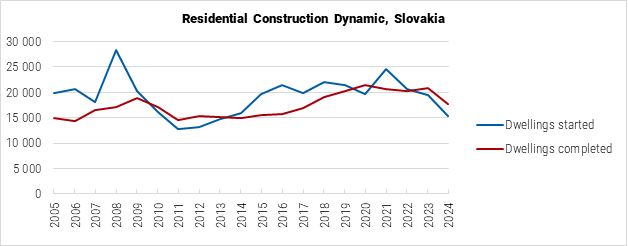
After Slovakia's EU accession in 2004, the housing market entered a period of expansion. Between 2006 and 2008, strong economic growth, rising household incomes, and the rapid development of the mortgage market drove house prices upward, with Bratislava showing the steepest increases. The global financial crisis in 2008-2009 brought this boom to an abrupt end: property prices fell by over 11% in nominal terms, while construction activity slowed, with annual dwelling completions dropping from pre-crisis levels of around 18,000 units to closer to 15,000 in the early 2010s.
Between 2010 and 2013, the market remained subdued, with stagnant or falling real prices and limited new supply. Recovery began around 2014, supported by low interest rates and improving macroeconomic conditions. From 2015 onward, prices started to rise steadily across the country, with urban centers leading growth. Housing demand was reinforced by historically cheap mortgages, while the pace of new construction lagged behind, constrained by long permitting processes and rising construction costs.
The years 2020-2022 marked a period of extraordinary growth. Despite the initial uncertainty caused by the COVID-19 pandemic, ultra-low borrowing costs and strong demand pushed prices to record highs, with annual growth exceeding 20% in 2021 and 2022. Affordability concerns intensified, particularly in Bratislava and other regional centers.
From late 2022, rapidly rising interest rates triggered a market correction. Mortgage costs more than tripled within two years, which curbed demand, reduced transaction volumes, and led to the first nominal price declines in over a decade. Construction activity also weakened: permits and housing starts fell, while completions stagnated around 20,000 annually.
In 2024, the market showed signs of stabilization. Prices leveled off after the earlier correction, but new housing supply remained subdued, suggesting that affordability challenges will persist as long as structural constraints on construction remain unresolved.
20-year annual house price change (based on annual NBS average home prices):
| Year | Nominal house prices (%) | Inflation-adjusted house prices (%) | Year | Nominal house prices (%) | Inflation-adjusted house prices (%) | |
| 2005 | -10.17% | -12.61% | 2015 | 1.72% | 2.08% | |
| 2006 | 16.69% | 11.92% | 2016 | 4.92% | 5.43% | |
| 2007 | 23.80% | 21.50% | 2017 | 6.69% | 5.23% | |
| 2008 | 22.05% | 17.43% | 2018 | 5.48% | 2.87% | |
| 2009 | -11.05% | -11.86% | 2019 | 7.51% | 4.61% | |
| 2010 | -5.13% | -5.80% | 2020 | 11.94% | 9.74% | |
| 2011 | -2.12% | -5.95% | 2021 | 23.50% | 20.11% | |
| 2012 | -1.04% | -4.61% | 2022 | 21.28% | 8.17% | |
| 2013 | -0.65% | -2.08% | 2023 | -6.03% | -15.33% | |
| 2014 | -0.65% | -0.55% | 2024 | 0.81% | -2.28% | |
| Data Source: NBS. | ||||||
20-year construction activity dynamic (started and completed housing units):
Data Source: SOSR.
Demand Highlights:
High Homeownership and Renewed Buying Intentions
Homeownership in Slovakia remains among the highest in Europe. According to Eurostat, the homeownership rate reached 93.1% in 2024, up from 89.3% in 2015, reflecting both the long-standing preference of Slovaks for owning their homes and the growing inclination to purchase property.
A survey conducted by Ipsos on a representative sample of 1,003 adults between October 27 and November 1, 2024, showed that 22.6% of Slovaks plan to buy real estate within the next five years. The majority expressed interest in apartments (10.1%) and houses (9.0%), while 2.3% intend to build a house and 1.2% are considering a holiday cottage or chalet.
Regional differences are notable. Interest in purchasing property within the next five years is strongest in the Bratislava (39.5%), Banská Bystrica (25.9%), and Trenčín (22.0%) regions. Demand in Bratislava and Trenčín is skewed towards apartments, whereas in Banská Bystrica, houses are preferred.
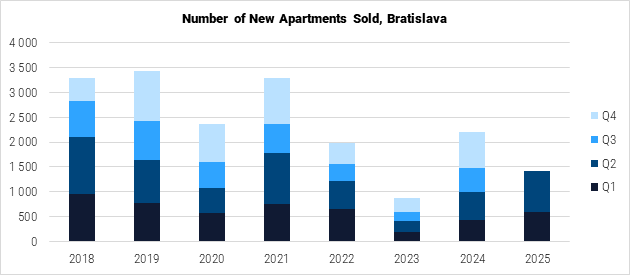
Market activity confirms these trends. Data from the real estate agency Herry's Slovakia shows that 1,409 new apartments were sold in Bratislava in the first half of 2025, a year-on-year increase of 42.04%. Analysts attribute the surge in demand to a combination of falling interest rates, rising real wages, low unemployment, and demographic factors such as population growth and migration to urban centers.
"The decline in interest rates has significantly improved housing affordability, leading to a renewed preference for apartment ownership. At the same time, investment demand has gradually returned to the market after the rebound in prices and lower financing costs," said Rudolf Bruchánik, Chief Analyst at Bencont Investments.
Psychological factors also play a role. "Many households expect prices to continue rising, which motivates them to accelerate their decision to purchase rather than delay it," noted Eva Sadovská, Analyst at Wood & Company.
Data Source: Herry's Slovakia.
While the short-term outlook remains favorable, medium-term developments could be influenced by new government consolidation measures, particularly in taxation. "An increase in property taxes would translate into higher costs for owners and could dampen demand, though the extent of the impact would depend on the scope and timing of the measures," said Tomáš Boháček, analyst at 365.bank.
Overall, experts agree that the market fundamentals remain solid, with demand supported by demographic trends and financial conditions. However, risks linked to broader economic performance cannot be overlooked. "Demand is very strong at present and macroeconomic risks have not yet exerted pressure. Looking ahead, once interest rates stabilize, the development of real wages in relation to inflation will become a decisive factor for future housing demand," added Mr. Bruchánik.
Supply Highlights:
Shortfall in New Dwellings Intensifies Price Pressures
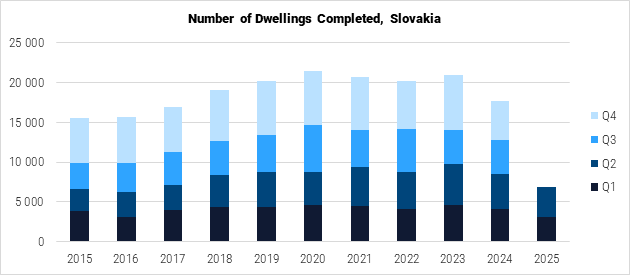
Housing construction in Slovakia remains subdued, with completions falling well below historical averages. According to the Statistical Office of the Slovak Republic (SOSR), 6,836 dwellings were completed nationwide in the first half of 2025, a 19.4% year-on-year decline and 16.9% lower than the 10-year half-year average of 8,226 units.
"Residential construction continues to contract, with developers taking a cautious stance on new projects," said Tomáš Boháček, analyst at 365 Bank. He noted that uncertainty around the economic outlook, alongside concerns over the purchasing power of both households and investors, is discouraging new developments.
Marián Kočiš, analyst at Slovenská sporiteľňa, emphasized that the slowdown has been building over several years, citing rising construction and labor costs, as well as lengthy approval procedures and regulatory hurdles, as key factors delaying project implementation.
Data Source: SOSR.
Regional trends were uneven. Five of Slovakia's eight regions recorded a decline in completions, most notably Bratislava, where just 974 dwellings were finished in H1 2025 - down 54% from a year earlier and far below the 10-year average of 2,217. By contrast, three regions registered growth, with Banská Bystrica posting a 10.3% year-on-year increase.
Residential completions, by region:
| Region | Number of Dwellings Completed, H1 2025 |
YoY, % |
| Bratislava Region | 974 | -54.01% |
| Trnava Region | 1,104 | -16.55% |
| Trenčín Region | 829 | -8.80% |
| Nitra Region | 945 | 2.94% |
| Žilina Region | 936 | -20.68% |
| Banská Bystrica Region | 493 | 10.29% |
| Prešov Region | 1,060 | 2.42% |
| Košice Region | 495 | -10.16% |
| Slovakia | 6,836 | -19.40% |
| Data Source: SOSR. | ||
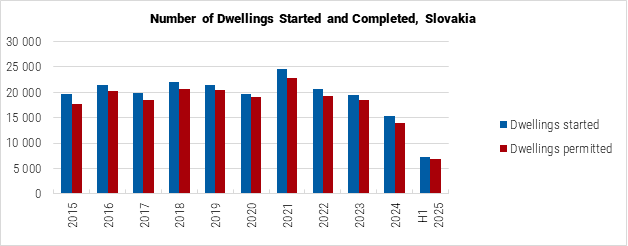
Forward-looking indicators point to further weakness ahead. In H1 2025, construction started on 7,241 dwellings, representing a 14.5% year-on-year drop. The number of building permits issued also fell sharply, down 13.7% to 6,834 dwellings.
Data Source: SOSR.
The combination of limited new supply and persistent demand is tightening the housing market. "The current construction trend will restrict the availability of new apartments in the short term. Together with sustained demand, this suggests that price pressures will not ease. In fact, they are likely to intensify," Boháček added.
Analysts argue that addressing these structural issues will require systemic policy measures. Priorities include simplifying and accelerating permitting procedures, reducing corruption, improving access to cheaper development financing, and lowering the value-added tax on new apartments. Without such reforms, supply-side constraints will continue to drive affordability challenges.
Rental Market:
Rental Growth Moderates, Regional Cities Outpace the Capital
In contrast to many other European countries, the residential rental market in Slovakia remains limited, with demand generated by foreign workers, expatriates, and students primarily concentrated in the capital city of Bratislava. The latest figures from Eurostat show that as of 2024, only 6.9% of the Slovak households were paying tenants, compared to 10.7% in 2015 and 17.9% in 2005. At the same time, the homeownership rate in the country has increased from 82.1% to 93.1% in the last two decades, supported by the wide availability of mortgage financing.
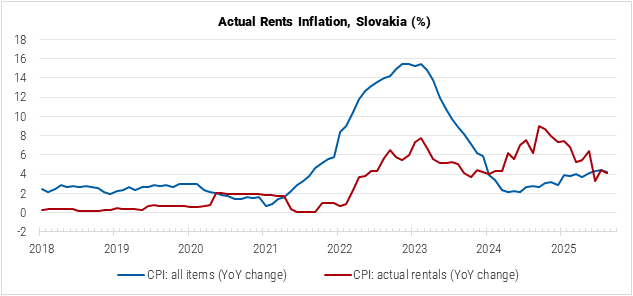
Slovakia's rent price index:
In this relatively small sector of the housing market, rental inflation has demonstrated notable fluctuations in the last few years and continued to trend substantially above the overall price growth throughout 2024 and early 2025, despite the stabilization of the wider macroeconomic environment. The most recent reporting from the SOSR, however, showed a 4.1% annual increase in the actual rentals for the housing component of the consumer price index (CPI) in August 2025, which was on par with the 4.2% inflation observed for the all-item CPI during the same period.
"According to current data, it seems that average rental prices are also starting to stabilize after a period of growth," Michal Pružinský, an analyst at the real estate portal Nehnutělnosti.sk, commented on the market dynamic. "We are seeing slight increases, but also decreases, which is a signal that the ideal price for landlords and tenants is somewhere in the middle. At the same time, however, it is showing that positive news can significantly influence local markets, as we see in Prešov," he added.
Data Source: SOSR.
In nominal terms, the Q2 2025 edition of Deloitte's Rent Index series showed the average asking rent for apartments listed on real estate portals at EUR 727 (USD 824) nationwide (2.1% year-on-year) and EUR 890 (USD 1,009) in Bratislava (-0.7% year-on-year).
Within the capital city, the highest average asking rents were observed in Staré Mesto (EUR 1,181 / USD 1,339), Nové Mesto (EUR 849 / USD 963), Karlova Ves (EUR 796 / USD 903), and Ružinov (EUR 790 / USD 896), while other districts remained more affordable with average rents ranging from EUR 630 to EUR 740 (USD 714-839).
Among key regional submarkets, the most expensive apartment rents were reported in Košice at EUR 723 (USD 820), and the strongest positive dynamic for listed rents was observed in Prešov (11.2% year-on-year), followed by Banská Bystrica (10.6% year-on-year), and Košice (7.1% year-on-year).
"The real estate market in Prešov is growing <…> This is probably related to the announced investments that may bring long-awaited development. It can be assumed that this may be a trend that will continue in the longer term," Michal Pružinský from Nehnutělnosti.sk noted on the especially pronounced increases in rents in that city.
Average asking apartment rents in key submarkets:
| Average Monthly Rent, EUR Q2 2025 |
Average Monthly Rent, USD Q2 2025 |
YoY, Q2 2025 vs Q2 2024 |
|
| Bratislava | EUR 890 | USD 1,009 | -0.7% |
| Trnava | EUR 617 | USD 700 | 3.7% |
| Nitra | EUR 637 | USD 722 | 1.6% |
| Trenčín | EUR 544 | USD 617 | 4.0% |
| Žilina | EUR 626 | USD 710 | -2.5% |
| Banská Bystrica | EUR 575 | USD 652 | 10.6% |
| Poprad | EUR 563 | USD 638 | -4.9% |
| Prešov | EUR 607 | USD 688 | 11.2% |
| Košice | EUR 723 | USD 820 | 7.1% |
| Slovakia | EUR 727 | USD 824 | 2.1% |
| Note: Exchange rate as of Q2 2025, EUR 1 = USD 1.1338. | |||
| Data Source: Deloitte. | |||
Against the background of re-accelerated home price growth and comparably slower rent increases, the research conducted by Global Property Guide in June 2025 found gross rental yields for residential units in the country at the average level of 4.88%, down from 5.29% previously reported in June 2024. Regional performance varied, with yields above the national average observed in Nitra (5.70%), Košice (5.24%), and Banská Bystrica (5.16%), while Bratislava demonstrated a notably weaker potential performance (3.92%).
Mortgage Market:
Lending Activity Continues to Recover as Interest Rates Ease
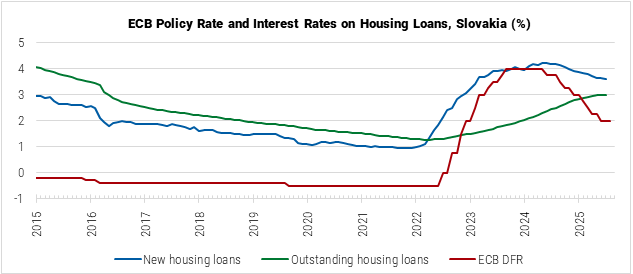
The interest rate environment for housing loans in Slovakia continues to improve as the European Central Bank (ECB) is believed to be approaching the end of its monetary policy easing cycle. After the most recent cut to its benchmark rates in June 2025 (which brought the deposit facility rate to 2.00%, the main refinancing operations rate to 2.15%, and the marginal lending facility rate to 2.40%), the ECB has maintained its stance in the last two months, making no further moves at the September meeting of the Governing Council.
Slovakia's mortgage loan interest rates:
The June cut being the eighth since the easing cycle began a year earlier, monetary policy observers now generally agree that the ECB is nearing the end of its rate-cutting cycle, expecting the rates to be cut just one or two more times by the end of the year, with the deposit rate reaching 1.5%.
Data Source: ECB.
Against this background, the average interest rates to households for house purchase in Slovakia still remain above the euro area average but are gradually moving towards stabilization in both new and existing credit categories. In July 2025, the interest rate on new loans reached 3.59%, down from 3.86% in January and 4.19% a year prior in July 2024. As for the outstanding housing loans, the average interest rate continues to demonstrate an upward dynamic year-on-year, still reflecting the lasting impact of sharp increases in recent years, although the pace of growth has slowed. In July 2025, the indicator was reported at 3.01%, up from 2.85% at the beginning of the year and 2.44% during the same period in 2024.
"Banks have so far taken a cautious approach in lowering mortgage rates," commented the NBS in its spring financial stability report. "In the near term, however, mortgage rates are expected to fall further, as several banks cut their standard rates during the spring months. At the same time, households expect mortgages to become steadily cheaper, hence they are increasingly opting for short-term fixed rates."
Average interest rates on loans to households for house purchase:
| Jul 2025 | YoY | Jul 2024 | YoY | Jul 2023 | |
| New housing loans | 3.59% | ↓ | 4.19% | ↑ | 3.91% |
| - Floating rate and IRF up to 1 year | 4.06% | ↓ | 4.82% | ↑ | 4.04% |
| - IRF of over 1 and up to 5 years | 3.59% | ↓ | 4.19% | ↑ | 3.93% |
| - IRF of over 5 and up to 10 years | 3.05% | ↓ | 3.48% | ↓ | 3.73% |
| - IRF of over 10 years | 4.71% | ↓ | 4.99% | ↑ | 3.52% |
| Outstanding housing loans | 3.01% | ↑ | 2.44% | ↑ | 1.74% |
| - Original maturity up to 1 year | 4.50% | ↑ | 4.24% | ↓ | 4.54% |
| - Original maturity over 1 and up to 5 years | 2.87% | ↓ | 2.86% | ↑ | 2.83% |
| - Original maturity of over 5 years | 3.01% | ↑ | 2.44% | ↑ | 1.73% |
| Data Source: ECB. | |||||
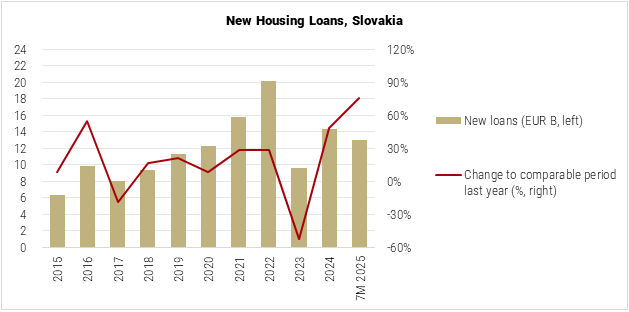
A changing interest rate environment has revived demand for mortgages in the country, with the NBS noting increases in both the number and the average loan value for pure new mortgages in recent quarters. "Households have thus begun to take advantage of the financial room created by previous real wage growth and persistently low unemployment. In addition, a new factor is gradually coming to the fore - expectations of further interest rate cuts and the corollary of rising housing prices. This is making households less inclined to postpone home purchase decisions - including households that temporarily deferred such decisions during the previous upturn in interest rates," said the central bank.
According to the ECB data, the total value of new loans to households for house purchase produced in Slovakia between January and July 2025 (including pure new loans and renegotiations) reached EUR 13.04 billion (USD 15.2 billion), which was 76.1% above the comparable period in 2024, although still below the previous peak of 2022.
Data Source: ECB.
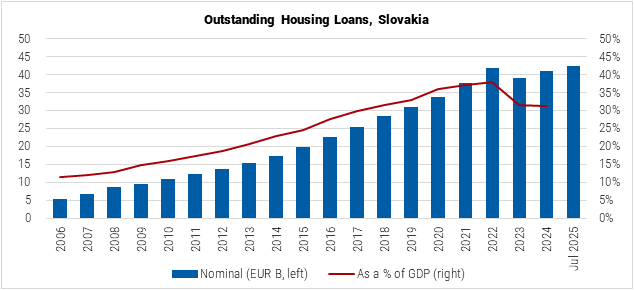
Supported by recovering loan production, the overall size of the mortgage market in Slovakia returned to growth as well, expanding by 4.4% year-on-year in 2024, after a 6.2% decline in 2023. In July 2025, the total value of outstanding housing loans for house purchase maintained by the country's banking sector reached EUR 42.3 billion (USD 49.4 billion), demonstrating a 3.8% increase since the end of last year. The relative size of the housing loan market, measured by the credit stock to GDP ratio, dropped from a 37.8% peak in 2022 to an estimated 31.1% of GDP at current prices in 2024.
"While this upturn [in mortgage portfolio growth] is more subdued compared with the housing market, the trend is relatively stable," summarized the NBS in the financial stability report.
According to the latest figures from Eurostat, 27.4% of Slovak households are homeowners with an outstanding mortgage or housing loan.
Data Source: ECB.
Socio-Economic Context:
Public Finances Remain a Challenge, Growth Set to Moderate
Slovakia's economy outpaced the euro area in 2024, with real GDP growth reaching 2.0%, up from 1.4% in 2023. Private consumption was the main driver behind this expansion, fueled by positive real wage growth, the extension of energy support, and more generous pensions. As Slovak export recovery slows due to the direct and indirect effects of increased global protectionism, and government fiscal consolidation weighs on domestic demand, growth is expected to moderate to 1.5% in 2025 and 1.4% in 2026, according to the European Commission's spring forecast.
"Although output in the Slovak automobile industry grew significantly, some exports were already suspended in response to the imposition of US tariffs," said the European Commission. "Export growth is therefore expected to moderate as of Q2 2025. While Slovakia is expected to continue expanding its exports, a weaker economic performance of the country's major trading partners poses an important downside risk."
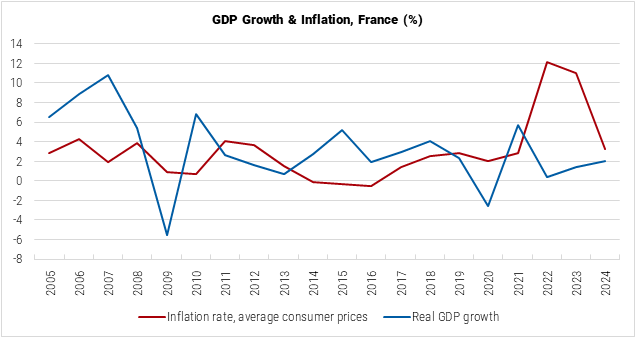
In parallel, after dropping from the annual level of 11.0% in 2023 to 3.2% in 2024, consumer price index (CPI) inflation in the country re-accelerated in recent quarters, most recently reported by the SORS at 4.2% in August 2025. The European Commission analysis ties this dynamic to increases in VAT and other taxes included in the fiscal consolidation package, as well as price increases in the services sector, driven by strong wage growth. Annual inflation level in the country is projected to increase to 4.0% this year, before moderating to 2.9% in 2026.
Data Source: IMF.
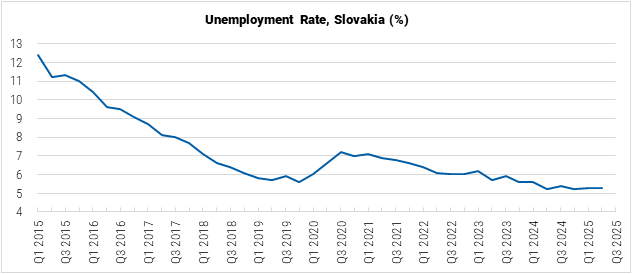
In Slovakia's labor market, persistently low unemployment (reported by the SORS at 5.3% in Q2 2025) is supported by robust labor demand. The European Commission expects the market to remain tight in the upcoming periods, with record-low levels of unemployment (stable at 5.4% in 2025-2026, as slowing employment growth will be offset by a shrinking labor force), the highest unfilled vacancies, and the highest presence of foreign workers.
The tight labor market is also projected to maintain real wage growth, even though the economy is set to slow down. Starting in 2025, the implementation of higher corporate income taxes and limited public sector wage increases are projected to slow down growth in compensation of employees. Nevertheless, it is still expected to grow faster than inflation over the forecast horizon, resulting in a slight increase in real wages, according to the European Commission.
Data Source: SOSR.
In public finances, Slovakia's above-EU growth in recent years has come with a significant widening of the fiscal deficit. In 2024, the general government deficit increased to 5.3% of GDP due to higher compensation of public employees and higher spending in several social benefits, which were mostly of a permanent nature. The deficit is forecast by the European Commission to decrease to 4.9% in 2025, driven by the previously introduced fiscal consolidation package.
Nonetheless, permanent expenditure measures combined with worsening macroeconomic conditions and the absence of new consolidating measures are expected to increase the deficit to 5.1% of GDP by 2026. Due to significant deficits projected over the forecast period, the government debt-to-GDP ratio is expected to increase from 59.3% in 2024 to 60.3% in 2025 and reach 63.0% of GDP in 2026, spilling over the EU target threshold. Aiming to reduce the budget deficit, the Slovak government approved a package of austerity measures, which fueled nationwide protest rallies.
In May 2025, Fitch Ratings affirmed Slovakia's 'A-' standing with a stable outlook, pointing out that its economy's strengths such as relatively credible macroeconomic framework, developed export sector, and stable foreign direct investment are constrained by high deficits and rising debt, ageing population, as well as high exposure to the automotive sector, Germany and the US, and potential disruptions in energy supplies from Russia.
Overall, as summarized in the 2025 Article IV staff report from the International Monetary Fund (IMF), EU membership, adoption of the euro, and integration into global value chains helped Slovakia's convergence towards the living standards of more advanced EU countries. However, structural headwinds related to geoeconomic fragmentation, high energy costs, and demographic change are putting pressure on its manufacturing-based growth model and challenging policymakers. The political environment in the country is increasingly polarized, further complicating policymaking.
Sources:
- Statistical Office of the Slovak Republic (SOSR)
- Housing Construction in the 2nd Quarter of 2025: https://slovak.statistics.sk/
- Inflation - Consumer Price Indices in August 2025: https://slovak.statistics.sk/
- Unemployment in the 2nd Quarter of 2025: https://slovak.statistics.sk/
- National Bank of Slovakia (NBS)
- Development of Residential Property Prices: https://nbs.sk/
- Economic and Monetary Developments, Summer 2025: https://nbs.sk/
- Financial Stability Report - May 2025: https://nbs.sk/
- European Central Bank (ECB)
- ECB Data Portal: https://data.ecb.europa.eu/
- Key ECB Interest Rates: https://www.ecb.europa.eu/
- Monetary Policy Decisions, 11 September 2025: https://www.ecb.europa.eu/
- International Monetary Fund (IMF)
- Country Overview: Slovak Republic: https://www.imf.org/
- 2025 Article IV Staff Report: https://www.imf.org/
- European Commission
- Economic Forecast for Slovakia: https://economy-finance.ec.europa.eu/
- Distribution of Population by Tenure Status, Type of Household and Income Group: https://ec.europa.eu/
- Deloitte
- Rent Index Q2 2025: https://www.deloitte.com/
- Three Slovak Cities Are Among the Seven Least Affordable Places to Live... (SK): https://www.deloitte.com/
- Fitch Ratings
- Fitch Affirms Slovakia at 'A-'; Outlook Stable: https://www.fitchratings.com/
- Morningstar
- Will the ECB Cut Interest Rates Again in 2025? https://global.morningstar.com/
- Hospodárske Noviny
- Rental Prices Grew More Slowly, and in Some Cities They Even Fell… (SK): https://hnonline.sk/
- AP News
- Thousands Rally Across Slovakia Against Austerity Measures and Pro-Russian Policies: https://apnews.com/
- Slovaks Hold Nationwide Protests Against Economic Policies of Populist PM Robert Fico: https://apnews.com/
- Herry's Slovakia
- New Apartment Market Overview. Q2 2025 (SK): https://www.herrys.sk/
- Bencont Investments
- Secondary Supply and Rental in Bratislava. Q2 2025 (SK): https://www.bencont.sk/
- Erste Group
- Double-Digit Growth in Real Estate Prices Continues (SK): https://www.erstegroup.com/
- Wood & Company
- 23% of Slovaks Plan to Buy a Home Within 5 Years… (SK): https://wood.sk/
- Real Estate Market: Demand For Housing in Slovakia Continues to Grow… (SK): https://wood.sk/
- Právne Noviny
- Slovak Real Estate Market Breaks Records: Housing Prices Rose by Over 11% (SK): https://pravnenoviny.sk/
- TREND Reality
- Real Estate Prices Are Breaking Records… (SK): https://reality.trend.sk/
- The Slovak Spectator
- Bratislava Completions Hit 22-year Low: https://spectator.sme.sk/
- oPeniazoch.sk
- Apartment Prices in Slovakia Are Rising Again: Why the Situation Get Even Worse in 2025 (SK): https://openiazoch.zoznam.sk/
- Tema 21
- There are Extremely Few Apartments Being Built… (CZ): https://tema21.cz/