Property Investment in Poland: Foreigner’s Guide (2025)
Poland consistently offers real estate investors more affordable prices and higher yields than many other parts of Western Europe. In recent years, Poland’s larger cities have seen steady rental demand from students, young professionals, and growing tech sectors, especially given the country’s history of housing shortages. Buying property in Poland is fairly straightforward, especially for EU/EEA citizens who receive the same ownership rights as Polish citizens, and it offers stability for foreign investors.
This recently updated 2025 edition guide will walk you through the basic steps and important considerations for first-time buyers looking to invest in Poland.
12 Things to Know Before Buying a Property in Poland
- Can Foreigners Buy Property in Poland
- Best Cities and Regions to Invest
- Square Meter / Square Foot Prices
- Median Asking Prices
- Rental Yields and Rents
- Market Performance (Past and Present)
- Landlord and Tenant Laws
- Property Related Taxes
- Buying (and Selling) Costs
- Short-Term Rental Regulations
- Mortgage and Financing Options
- How to buy property in Poland: step-by-step
1) Can Foreigners Buy Property in Poland?
Yes, but property purchasing rights and processes vary. While EU, EEA, and Swiss buyers mostly have the same property purchasing rights as Polish citizens, investors from other countries must obtain a special permit from the Polish Ministry of Interior for houses and other buildings that involve land purchases. Apartments are exempt from these requirements, making them the easiest form of property for foreign investors.
2) Best Regions and Cities to Invest
The following cities in Poland offer a wide range of real estate opportunities, from historic urban centers and fast-growing business hubs to student-driven rental markets and modern residential developments, making them suitable for different investment strategies and lifestyle preferences.
Warsaw
As Poland’s capital and largest economic center, Warsaw is the country’s most dynamic real estate market. Districts such as Śródmieście, Mokotów, and Wola are particularly attractive due to their strong business presence, modern office developments, and excellent transport connections. The city benefits from a large corporate and expat population, a strong rental market, and continuous infrastructure growth, which together support long-term demand and value appreciation.
Kraków
Kraków is one of Poland’s most popular cities for both living and investing, thanks to its rich history, strong tourism sector, and large student population. Areas like Stare Miasto, Kazimierz, and Podgórze are highly sought after for short-term and long-term rentals. The presence of international companies and universities creates consistent housing demand, making Kraków especially attractive for rental-focused investors.
Wrocław
Known for its high quality of life and growing tech and business services sector, Wrocław has become a major investment hotspot. Neighborhoods such as Stare Miasto, Krzyki, and Fabryczna offer a mix of modern apartments and well-connected residential areas. The city’s young population, strong job market, and international workforce help maintain steady rental demand and long-term growth potential.
Gdańsk (Tricity)
Part of the Tricity area along the Baltic coast, Gdańsk combines seaside living with a strong economy driven by logistics, shipbuilding, and technology. Districts like Oliwa, Wrzeszcz, and the city center attract both residents and investors looking for coastal appeal and solid rental returns. Seasonal tourism adds opportunities for short-term rentals, while ongoing development supports long-term investment value.
Poznań
Poznań is a well-balanced market known for its strong business environment, trade fairs, and large student population. Areas such as Jeżyce, Stare Miasto, and Grunwald are popular for residential investments due to their central location and good transport links. The city offers relatively stable property prices compared to Warsaw, making it appealing for investors seeking steady returns with lower entry costs.
3) Square Meter / Square Foot Prices
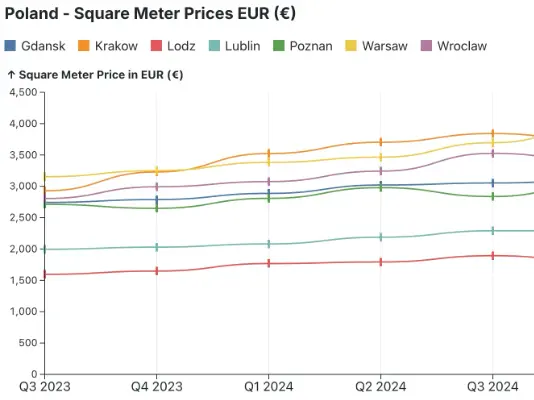
Poland’s square meter prices are moderately low, with popular larger cities like Warsaw and Kraków having the highest rates. Prices are lowest in Poland’s third-largest city, Łódź, averaging half that of Warsaw’s rates.
- Warsaw – €3,846
- Kraków – €3,560
- Wroclaw – €2,989
- Gdańsk – €2,896
- Poznań – €2,554
- Lublin – €2,342
- Łódź – €1,840
4) Median Asking Prices
Poland’s average asking prices are low compared to much of Europe, with Warsaw averaging similar rates to Moscow..
As of September 2025, Poland’s average rates for a one-bedroom apartment are as follows:
- Warsaw – €174,000
- Kraków – €165,000
- Gdańsk – €155,000
- Wroclaw – €141,000
- Poznań – €128,000
- Lublin – €110,000
- Łódź – €102,000
- Bydgoszcz – €92,000
5) Rental Yields and Rents
Rental yields in Poland are considered good. Yields average between 5.25% to 6.75%, which is higher than many parts of Europe.
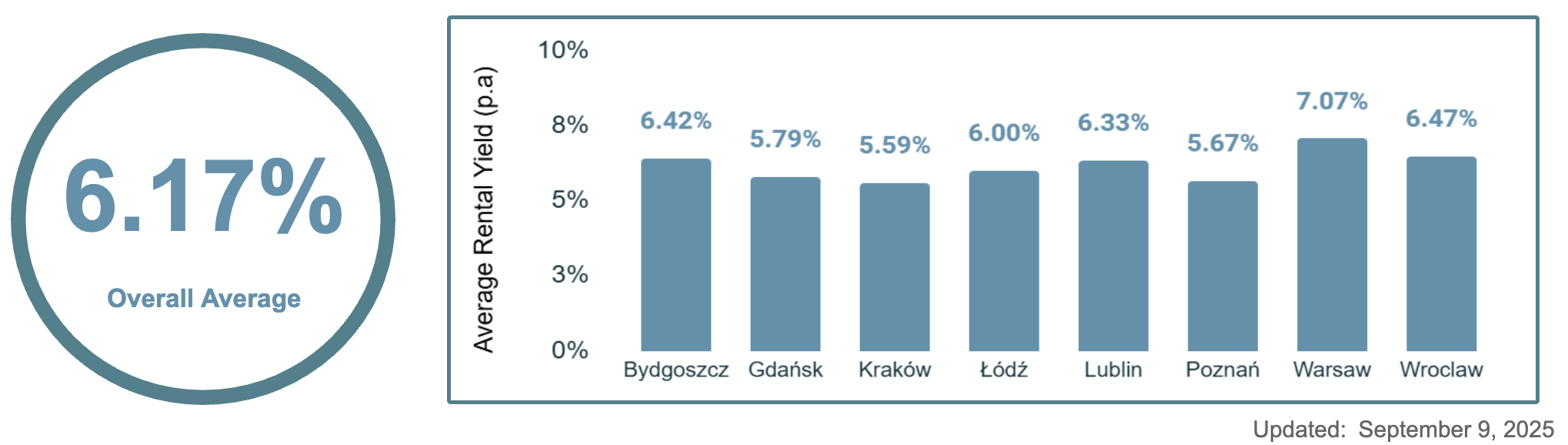
As of September 2025, rental yields for one-bedroom apartments across Poland were as follows:
- Warsaw – 6.07%
- Wroclaw – 5.86%
- Kraków – 5.32%
- Gdańsk – 5.65%
- Poznań – 5.99%
- Łódź – 6.15%
- Bydgoszcz – 6.81%
- Lublin – 6.42%
Poland's rent price index:
Data Source: OECD.
6) Market Performance (Past and Present)
When Poland began transitioning to a market economy in the 1990s, the housing market changed significantly, with urbanization and increased income driving demand. The market stabilized in the 2010s, attracting more investors due to Poland's lower prices and strong yields compared to other Western European countries.
While Poland’s residential market is doing well, it is slowing down after rapid growth in 2023 and 2024. This is partly due to the discontinuation of a first-time buyer mortgage subsidy program by the Polish government. Nonetheless, foreign investors continue to see Poland’s market appeal as demand outpaces supply, prices remain moderate, and yields are higher than in many other European countries.
Poland's house price annual change:
Data Source: Narodowy Bank Polski (NBP).
7) Landlord and Tenant Laws
Global Property Guide deems Poland’s laws as being Pro-Tenant between tenant and landlord. Poland’s laws are similar to those of other EU-member countries, which offer tenant safeguards, especially relating to rent increases and evictions. Additionally, Poland’s courts are backlogged, and inflexible Polish laws make the eviction process long and cumbersome for landlords.
8) Property Related Taxes
Anyone who does business in Poland must obtain a tax identification number (“Numer Identyfikacji Podatkowej” or NIP).
Property owners must pay an annual local real estate tax, but rates vary by location. Property taxes can either be paid all at once or they can be divided into quarterly payments.
Any income earned in Poland is taxed at a rate of 8.5% for up to 100,000 PLN or 12.5% for income above 100,000 PLN.
A value-added tax (VAT) applies only to new-build properties that are purchased from a developer. The amount depends on the property size and type, and is 8% for properties up to 150 m² (flats) or 300 m² (houses), or 23% for larger residential units and some mixed-use or commercial properties.
9) Buying (and Selling) Costs
If a Polish property is bought and resold within 5 years, the seller must pay a 19% capital gains tax. Property purchased after January 1, 2007, and owned for at least 5 years is exempt from capital gains taxes. Residential property purchased before 2007 requires a 10% capital gains tax, minus applicable transaction costs.
Buyers of secondary property must pay a transfer tax, which is 2% of the property value. New properties are exempt from this fee.
The buyer is required to use a notary, and fees are capped at 0.5% to 2% depending on the region.
Here's a full breakdown:
| Transaction Costs | ||
| Who Pays? | ||
| Property Transfer Tax | 2.00% | buyer |
| Legal Fees | 1.00% | buyer |
| Notary Fees | 0.25% - 0.40% | buyer |
| Real Estate Agent Fee | 2.00% - 3.00% | seller |
| Costs Paid by Buyer | 3.25% - 3.40% | |
| Costs Paid by Seller | 2.00% - 3.00% | |
| ROUNDTRIP TRANSACTION COSTS | 5.25% - 6.40% | |
| Source: Global Property Guide, PWC | ||
10) Short-Term Rental Regulations
There are no national laws regarding short-term rentals, but some local municipalities have their own rules, which are subject to change. For example, several cities require that hosts register their property with the local authorities.
All short-term rentals must follow residential rental laws under the Polish Civil Code, meaning there must be a signed agreement that outlines the rental terms.
11) Mortgage and Financing Options
Non-EU buyers can get mortgage loans in Poland, but it is more difficult. Polish banks highly prefer when applicants have some form of Polish income. A high down payment of 30% to 40% may help improve loan chances. Opening a bank account with the lender in advance can also sometimes help.
In addition to a copy of the preliminary sales agreement, banks require buyers to provide a copy of their passport, proof of income, and Polish ID number (PESEL number).
Poland's mortgage loan interest rates:
Data Source: Narodowy Bank Polski (NBP).
12) How to Buy Property in Poland: Step-by-Step
- Apply for a Polish national identification number (PESEL): If you are going to need a mortgage, it’s best to apply for a PESEL beforehand. A PESEL (Powszechny Elektroniczny System Ewidencji Ludności) number is a national identification number, similar to a social security number in the US. While it is not always required, it can make the loan and purchasing process easier. Obtaining a PESEL is free, but it must be applied for in Poland. Buyers can use a legal representative with power of attorney if they are not able to apply in person. Approval generally takes up to seven business days.
- Apply for mortgage preapproval: Unlike some other countries, it is best to apply for a mortgage prior to making an offer. Getting a mortgage loan in Poland is harder for non-EU/EEA citizens than in some other parts of the world, and many banks will only provide mortgage loans to non-EU/EEA citizens if they reside or work in Poland. Those banks that may approve a mortgage require that applicants show a good income and a good credit history. They also may require a high down payment, sometimes up to 40%. Preapproval is not binding, but it does help speed up the purchasing process and gives buyers a good idea of their budget.
- Research and find property: You can start your search by looking at popular Polish real estate websites, like Otodom.pl, Nieruchomosci-online.pl, and Morizon.pl. While working with a bilingual Polish real estate professional is not required, it is recommended. They will be able to provide more insights on properties, communities, and other important considerations. A real estate professional can also help negotiate prices when it’s time to make an offer.
- Research Pricing, Yields, and Legal Restrictions: Prices vary by city, with the capital city of Warsaw coming in at the highest rates. Unlike some other European countries, Poland tends to attract fewer tourists but draws students and digital nomads. Yields are higher in Poland than many other countries. Citizens of EU, EEA, and Swiss countries have the same property purchasing rights as Polish citizens and no special permits are required to buy property. However, buyers from all other countries may require a special permit from the Polish Ministry of Interior and Administration (Ministerstwo Spraw Wewnętrznych i Administracji — MSWiA) when purchasing property that involves land. No special permit is required for apartments or other property where land is not being purchased.
- Research long-term market trends: While Poland is still considered a strong investment market, it has slowed down somewhat since the rapid growth in 2023 and 2024. This is due in part to the government discontinuing its first-time mortgage subsidies. The near future may also bring increased pressure to help reduce housing prices.
- Research local taxation and landlord laws: Real estate and income taxes are less than in many countries, but are still required. Property taxes vary by the local municipality, while income taxes range from 8.5% to 12.5%. Poland’s laws tend to favor tenants over landlords, especially when it comes to evictions.
- Make an offer and pay a deposit: Once you’ve found the right property, it is time to make an offer. If accepted, buyers will pay a deposit – usually 10%. If the buyer backs out without legal cause, the seller keeps the deposit. If the seller backs out, they pay back double the deposit.
- Hire a bilingual attorney to complete thorough due diligence: This step is optional, but highly recommended. In Poland, a notary handles all paperwork to ensure it is legally binding, but the notary’s focus is not on protecting the buyer’s interest. A real estate attorney can conduct thorough due diligence, check for liens, debts, and other unpaid fees, as well as check zoning and permit restrictions, and review all documents prior to signing. Attorneys can also act as the buyer’s representative if given power of attorney, which allows them to sign paperwork if the buyer is not available in person.
- Sign and file final paperwork: This step takes place at the notary’s office. The deed must first be legally read and allowed. Then both parties or their legal representatives sign the paperwork and pay any required fees. The notary then submits the application to the land registry. At this point, the sale is considered final.
Timeline: Expect 1 to 3 months from accepted offer to closing.
Need Help?
Buying property in a foreign country can feel overwhelming, but we're here to help.
At Global Property Guide, we offer:
- Data-backed insights on property prices, rental yields, and taxes
- Country-specific legal and tax guidance through our partner network
- Pre-screened investment properties, including income-generating Airbnb units
- 1-on-1 consultations with real estate experts focused on international buyers
- Step-by-step buyer support, from due diligence to closing
Whether you're looking for your first investment in Poland or expanding your international portfolio, we can help you make smart, secure decisions.
Contact our team or book a free consultation to get started.