Poland's Residential Property Market Analysis 2026
After a period of rapid growth, the Polish housing market has entered a more selective, affordability-sensitive stabilization phase, with sales prices broadly flat and rents adjusting downwards in the largest cities, although regional disparities remain pronounced.
This extended overview from Global Property Guide covers key aspects of the Polish housing market and takes a closer look at its most recent developments and long-term trends.
Table of Contents
- Property Prices and Price Index
- Historic Perspective
- Property Demand Trends
- Property Supply Trends
- Rental Market: Rents and Rental Yields
- Mortgage Market and Interest Rates
- Economic and Social Factors
Property Prices and Price Index
Poland’s housing market entered 2026 in a stabilization phase, with transaction prices in the largest cities broadly flat or slightly lower after the rapid growth recorded in previous years. In Q1 2026, the average price of existing homes sold across Poland’s seven largest urban markets, including Warsaw, Gdańsk, Gdynia, Kraków, Łódź, Poznań, and Wrocław, stood at PLN 13,477 (USD 3,725) per square meter, down by 0.7% year-on-year according to the National Bank of Poland (NBP). The primary market showed a similarly subdued trend, with average transaction prices declining by 0.3% year-on-year to PLN 14,245 (USD 3,938) per square meter.
Poland's house price annual change:
Regional disparities remained pronounced. Warsaw continued to lead the market, with average transaction prices of PLN 16,393 (USD 4,531) per square meter on the secondary market and PLN 16,475 (USD 4,554) per square meter for new dwellings in Q1 2026. Kraków retained its position as the second most expensive market, while Łódź remained among the more affordable major cities.
Average prices of transacted dwellings in key submarkets:
| Secondary Dwellings, Q1 2026, PLN/sqm |
Secondary Dwellings, Q1 2026, USD/sqm |
YoY, % | Primary Dwellings, Q1 2026, PLN/sqm |
Primary Dwellings, Q1 2026, USD/sqm |
YoY, % | |
| Warsaw | PLN 16,393 | USD 4,531 | -1.73% | PLN 16,475 | USD 4,554 | 0.23% |
| Kraków | PLN 15,110 | USD 4,177 | -0.01% | PLN 15,384 | USD 4,253 | -1.73% |
| Łódź | PLN 7,971 | USD 2,203 | 0.12% | PLN 9,758 | USD 2,697 | -0.24% |
| Wrocław | PLN 12,632 | USD 3,492 | -0.34% | PLN 13,903 | USD 3,843 | -2.48% |
| Poznań | PLN 10,677 | USD 2,951 | -1.68% | PLN 12,627 | USD 3,490 | 2.07% |
| Gdańsk | PLN 13,870 | USD 3,834 | 6.22% | PLN 14,647 | USD 4,049 | 5.35% |
| Gdynia | PLN 12,357 | USD 3,416 | 4.28% | PLN 13,320 | USD 3,682 | 3.20% |
| Note: Exchange rate as of Q1 2026, USD 1 = PLN 3.61773. | ||||||
| Data Source: NBP. | ||||||
Professional market commentary points to stabilization rather than a broad price correction. Cushman & Wakefield described the secondary market as moving into a “soft landing” scenario, with prices still relatively resistant to deeper corrections. However, the consultancy also noted that further growth is being constrained by competition from the primary market, including ready-to-occupy developer stock, as well as more selective demand and greater buyer sensitivity to property standards and location.
CBRE similarly expects the market to remain broadly stable in 2026, noting that significant price declines are unlikely, particularly in popular locations. According to the analysts, the more realistic scenario is stabilization or moderate growth, although new regulatory and cost pressures, including planning reform, shelter-related requirements, higher construction, labor, and energy costs, and new technical standards, are likely to affect developers.
The short-term outlook is therefore for limited and uneven price growth. JLL and CBRE project residential prices to rise by around 2-3% year-on-year in 2026, broadly close to inflation, while Colliers expects price growth to resume as early as Q2 2026. However, large available inventories and affordability constraints should continue to limit upward pressure in weaker markets, while Warsaw, Tri-city, and selected well-located projects are likely to remain more resilient.
Historic Perspective
From Post-Accession Boom to Subsidy-Driven Growth
Poland’s recent price stabilization follows a long period of cyclical but generally strong housing-market growth. After the sharp pre-crisis upswing of 2006–2007, the market went through a prolonged correction in 2008–2013, as tighter lending conditions, weaker economic sentiment, and a large stock of unsold new dwellings weighed on prices. Price growth returned more steadily from the mid-2010s, supported by improving labor-market conditions, lower interest rates, and the gradual absorption of excess supply. The upswing strengthened in 2017–2019 and accelerated further during 2020–2021, when very low interest rates, strong household savings, and pandemic-related housing preferences pushed prices higher.
From 2022 onward, the market became more affordability-constrained. Rising interest rates sharply reduced mortgage availability, although nominal prices remained supported by high construction costs, inflation, and limited supply in major urban areas. The government’s Safe 2% Loan program temporarily revived demand in 2023–2024 and contributed to renewed price growth, particularly in the largest cities. After the program ended and its backlog was absorbed, price dynamics weakened again. By 2025 and early 2026, the market had shifted from subsidy-driven expansion to a more selective, affordability-sensitive phase, with broadly stable or slightly lower transaction prices in major cities.
20-year annual house price change (based on end-of-year Average Transaction Prices of Existing Properties in 7 cities and Consumer Price Index):
| Year | Nominal house prices (%) |
Inflation-adjusted house prices (%) |
Year | Nominal house prices (%) |
Inflation-adjusted house prices (%) |
|
| 2006 | n/a | n/a | 2016 | 2.69% | 2.44% | |
| 2007 | 29.47% | 25.19% | 2017 | 7.74% | 5.22% | |
| 2008 | -1.08% | -4.51% | 2018 | 10.95% | 9.29% | |
| 2009 | -6.81% | -10.07% | 2019 | 11.04% | 8.16% | |
| 2010 | -2.28% | -5.04% | 2020 | 10.27% | 7.32% | |
| 2011 | -0.59% | -4.80% | 2021 | 11.52% | 3.46% | |
| 2012 | -8.29% | -10.75% | 2022 | 9.69% | -6.66% | |
| 2013 | -0.98% | -1.78% | 2023 | 8.87% | 2.51% | |
| 2014 | 1.82% | 2.45% | 2024 | 16.40% | 11.01% | |
| 2015 | 0.91% | 1.71% | 2025 | 0.14% | -2.30% | |
| Data Sources: NBP, OECD, Global Property Guide. | ||||||
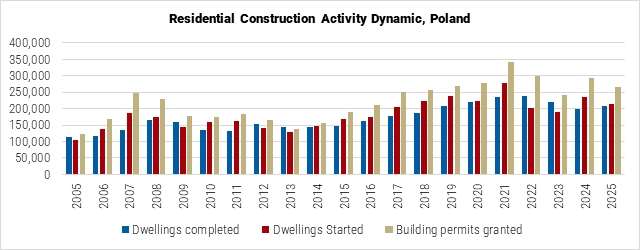
Residential construction activity dynamic (started and completed dwellings, and the number of building permits granted):
Data Source: GUS.
Property Demand Trends
Primary Market Sales Recover as Deferred Demand Returns
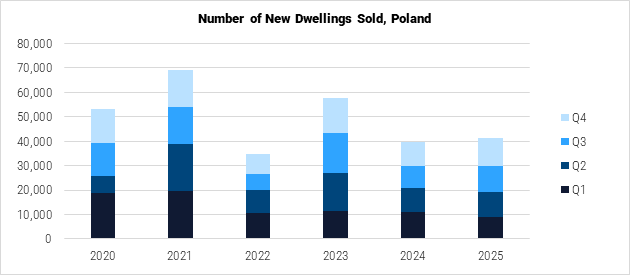
Primary market sales in Poland showed signs of recovery in 2025, although activity remained moderate by historical standards. According to JLL data cited by the NBP, a total of 41,227 new residential units were sold across the six largest markets during the year, up 3.98% year-on-year.
The recovery was not evenly distributed through the year: quarterly sales in the first half of the year remained close to the subdued levels seen in 2024, while the second half brought a more visible improvement in buyer activity. According to JLL, the monetary-easing cycle that began in May 2025 gradually helped release deferred demand, while buyers also benefited from a wide choice of available apartments and stronger competition between developers.
Note: Aggregated data for Warsaw, Kraków, Wrocław, Tri-City, Poznań and Łódź.
Data Source: NBP based on JLL data.
The improvement continued into early 2026, although the latest JLL figures are reported on a broader seven-market basis and are therefore not fully comparable with the six-market annual NBP/JLL series. In Q1 2026, developers sold 12,900 apartments across the seven largest markets, representing an 11.1% increase compared with the previous quarter and a 35.2% increase year-on-year. JLL attributed the stronger sales result to improved creditworthiness, purchases by cash buyers for own use, and renewed activity from some investment buyers. In Warsaw, shrinking available inventory and concerns over future price increases also supported buyer decisions toward the end of March.
Number of new dwellings sold by submarket:
| Submarket | Number of New Dwellings Sold, Q1 2026 |
YoY change, % |
| Warsaw | 4,500 | 45.16% |
| Kraków | 1,700 | 30.77% |
| Łódź | 1,300 | 44.44% |
| Wrocław | 1,700 | 30.77% |
| Poznań | 1,300 | 30.00% |
| Tri-City | 1,900 | 26.67% |
| Data Source: JLL. | ||
Other professional market commentary points to a similar picture of improving but still selective demand. Cushman & Wakefield described Q1 2026 sales performance as a marked rebound in market activity, supported by previously accumulated demand, a broad supply pipeline, and a greater willingness among developers to offer discounts, particularly in the latter part of the quarter. This suggests that the demand recovery is being supported not only by improved financing conditions, but also by a more buyer-friendly market environment after the sharp increase in available supply in 2024-2025.
Looking ahead, JLL expects sales to increase by a double-digit rate over the next 12 months, supported by the gradual release of postponed purchases and the still-wide availability of apartments, which strengthens buyers’ negotiating position. At the same time, uncertainty is seen to remain an important factor shaping buyer sentiment, particularly in relation to geopolitical risks, inflation expectations, and future interest-rate decisions.
Property Supply Trends
High Delivery Volumes, but a More Selective Development Pipeline
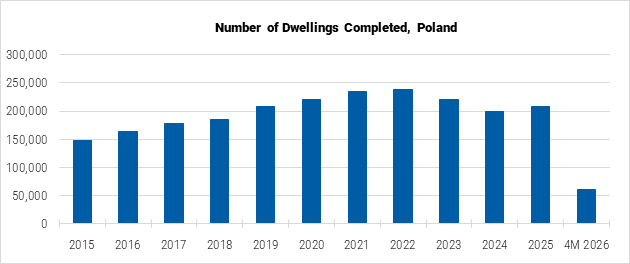
Poland’s residential supply remains high, but new development activity is becoming more selective. According to Statistics Poland (GUS), 208.3 thousand dwellings were completed in 2025, up by 4.1% year-on-year. The increase was driven by the developer segment, where completions rose by 7.6% year-on-year, while completions by individual investors declined by 2.8%. In January-April 2026, delivery volumes softened slightly, with completed dwellings down by 1.5% year-on-year to 60.9 thousand units.
Data Source: GUS.
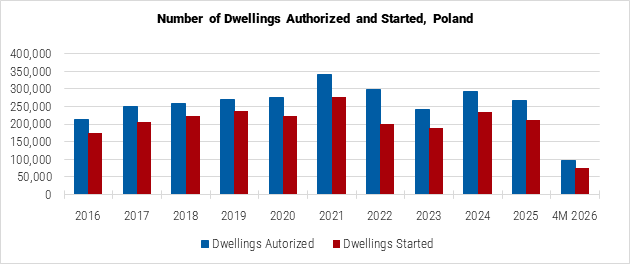
Forward-looking indicators were weaker in 2025, suggesting that developers and individual investors were adjusting new activity after the strong rebound recorded in 2024. Building permits and construction notifications declined by 8.7% year-on-year, while housing starts fell by 9.2%. The slowdown was mainly concentrated in the developer segment, where starts dropped by 14.9%. In the first four months of 2026, permits rebounded by 17.1% year-on-year, but starts remained slightly lower, down by 1.9%, indicating that stronger project preparation has not yet translated into a clear acceleration in construction activity.
Data Source: GUS.
Overall, the official data points to a market where supply remains substantial, but new construction is being managed more carefully. Cushman & Wakefield noted that, despite a weaker start to 2026, developer completions remained elevated by historical standards, reflecting the large pipeline built during the period of stronger development activity in 2020-2022. Analysts noted that, given the very high number of developer starts in 2024, completions may rise more dynamically in 2026–2027 and could exceed the previous developer delivery peak.
At the same time, JLL expects developers to align new supply more closely with sales, while the already available offer remains an important factor shaping new launches. The consultancy also identified municipal planning reform and new shelter-related requirements as important factors for the future supply outlook. These changes may increase uncertainty around land transactions and raise development costs, although much of the 2026 pipeline is still likely to come from projects filed under the previous rules.
Cost and infrastructure obligations are also becoming increasingly relevant. The Polish Association of Developers (PZFD) has highlighted the growing role of developers in financing public infrastructure connected with new residential projects, particularly road infrastructure. While these investments support local urban development, they also add to the cost and complexity of residential delivery.
Residential supply outlook, thus, remains relatively strong in terms of completions, supported by the large pipeline accumulated in previous years. However, new construction activity is likely to stay more disciplined, with weaker starts indicating more selective phasing of actual launches.
Rental Market: Rents and Rental Yields
Price Correction Observed in Largest Cities, Smaller Submarkets Continue to Grow
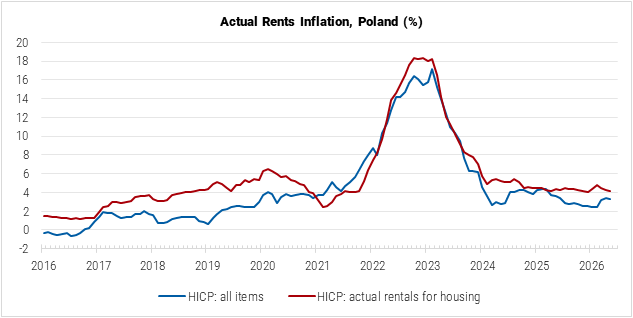
Following the expiration of multiple shocks that had previously affected Poland’s rental market (the pandemic, the influx of refugees, and the housing boom), rental inflation has stabilized at moderate levels. The most recent data from Eurostat showed a 4.1% annual increase in the actual rentals for housing component of the Harmonized Index of Consumer Prices (HICP) in May 2026, with only marginal fluctuations observed in the growth rate over the previous twelve months. It continues to trend above the overall inflation, however, with the all-items HICP registering a 3.3% increase over the same period.
Poland's rent price index:
“In Poland, the previously strong growth in rental rates has visibly weakened <…> indicating a stabilization of the market following a period of rapid increases,” summarized the Q1 2026 market assessment from Cushman & Wakefield, adding that over the past five years, rents in the country increased by as much as 60%, a growth rate twice the EU average.
Data Source: Eurostat.
In nominal terms, according to the March 2026 rental market report from Otodom, the average asking rent in Poland stood at PLN 3,553 (USD 961), 0.8% lower than during the same period last year, also pointing to a correction in the market, which continues to adapt to a new reality after the turbulent years of 2021-2023.
Regionally, average asking rents continued to demonstrate significant variety among the Polish cities, ranging from PLN 2,073 (USD 561) a month in Kielce to PLN 4,807 (USD 1,300) in Warsaw, with the capital maintaining its leading position in terms of rent (despite a notable year-on-year correction of -2.0%), followed by Tri-City, Kraków, and Wrocław.
Overall, the platform’s analysis suggests an ongoing price convergence in Poland’s rental market, with the largest submarkets adjusting rates downward, while smaller cities continue to raise them. It also notes a larger supply of properties listed for rent in most of the analyzed cities in early 2026, which could be explained by anticipated regulatory changes for short-term rentals. “Due to [STR regulations] implementation in 2026, some apartment owners, particularly in the largest cities, may already be deciding to transfer their properties to the long-term rental market,” said the Otodom report.
In this environment, according to research by Global Property Guide, gross rental yields for residential properties in Poland averaged 5.92% in March 2026, down from 6.08% reported a year prior. Among the monitored regional submarkets, the highest average yields were observed in Warsaw (6.81%), Lublin (6.21%), and Łódź (6.18%), while the lowest potential performance was estimated in Poznań (5.25%) and Gdańsk (5.23%).
Average asking rent in key submarkets:
| City | Average monthly rent, PLN March 2026 |
Average monthly rent, USD March 2026 |
YoY, % March 2026 vs March 2025 |
| Warsaw | PLN 4,807 | USD 1,300 | -2.0% |
| Kraków | PLN 3,107 | USD 840 | -5.1% |
| Łódź | PLN 2,278 | USD 616 | 4.0% |
| Wrocław | PLN 3,083 | USD 834 | 0.9% |
| Poznań | PLN 2,596 | USD 702 | 1.2% |
| Tri-City | PLN 3,146 | USD 851 | -0.6% |
| Note: Exchange rate as of March 2026, USD 1 = PLN 3.69696. | |||
| Data Source: Otodom. | |||
In general, as of 2025, 12.8% of Poland’s population were tenants, according to Eurostat figures. Apart from additional demand in metropolitan areas generated by Ukrainian refugees and other foreign migrants in recent years, rental demand in the country largely comes from young people migrating to major cities for higher education or job opportunities.
On the supply side of the Polish rental market, the role of institutional landlords representing the dynamically evolving private rental sector (PRS) continues to gain prominence. As of Q1 2026, Cushman & Wakefield estimated the country’s operational PRS stock at over 24,000 apartments in the largest cities (35% of those concentrated in Warsaw), with another 14,000 currently under construction and in the announced pipeline for the coming years.
Mortgage Market and Interest Rates
Interest Rates Continue to Decline Gradually, Lending Volumes Grow
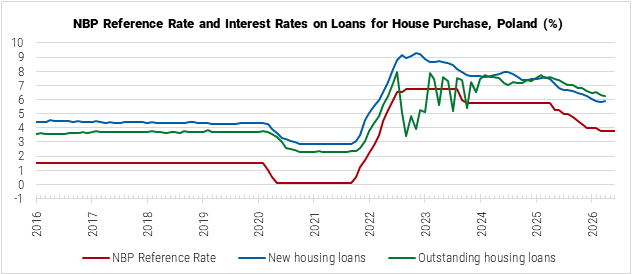
Prompted by a favorable inflation forecast and weaker economic activity observed in the country at the beginning of the year, the NBP began rapidly easing its monetary policy in May 2025, with seven cuts made to its policy benchmarks since then, eventually bringing the reference rate from 5.75% to the current level of 3.75%.
Poland's mortgage loan interest rates:
Following the latest cut announced in March 2026, the NBP took a holding stance, assessing the impact of the recent energy shock on the inflation outlook and the real economy prospects. It has since been indicated that although key rates could rise if inflation exceeds the 3.5% upper limit of the target range, the regulator is not in any rush to tighten monetary policy, as the current price shock is much smaller than that of 2022. "The Polish economy has a very good starting position to withstand the consequences [of the current price shock]," said NBP Governor Adam Glapinski, as quoted by Reuters. Most experts agree that no further policy action from the NBP is likely this year.
Data Source: NBP.
Along with earlier downward adjustment of the NBP reference rate, average interest rates on loans to households for house purchase in Poland continued to ease. For PLN-denominated new housing loans, the indicator was most recently reported at 5.88% in April 2026, down 1.55 points over twelve months. For outstanding PLN-denominated housing loans, it reached 6.25%, 1.31 points down from the level observed during the same period a year prior.
Average interest rates on PLN-denominated loans to households for house purchase:
| Apr 2026 | YoY | Apr 2025 | YoY | Apr 2024 | |
| New housing loans | 5.88% | ↓ | 7.43% | ↓ | 7.72% |
| - Floating rate and IRF up to 3 months | 5.67% | ↓ | 7.80% | ↓ | 7.93% |
| - IRF of over 1 year | 5.95% | ↓ | 7.33% | ↓ | 7.61% |
| Outstanding housing loans | 6.25% | ↓ | 7.56% | ↓ | 7.62% |
| - Original maturity over 1 and up to 5 years | 6.42% | ↓ | 8.16% | ↑ | 7.70% |
| - Original maturity of over 5 years | 6.25% | ↓ | 7.56% | ↓ | 7.62% |
| Data Source: NBP. | |||||
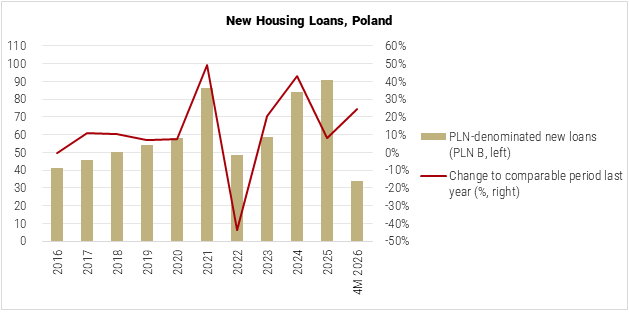
As outlined in NBP lending surveys, the decline in interest rates on housing loans, as well as continued easing of lending standards on loans to households implemented by banks across the country throughout 2025 and early 2026, boosted the demand for mortgages in Poland, despite the government’s withdrawal from the subsidized programs, which had previously supported the market in 2023-2024.
Based on figures reported by the NBP, the total value of PLN-denominated new loans for house purchase issued between January and December 2025 grew by 8.0% compared with 2024 and surpassed the 2021 peak level. In the first four months of 2026, the value of newly issued housing loans reached PLN 33.8 billion (USD 9.3 billion), a strong 24.6% increase compared to the same period in 2025.
Data Source: NBP.
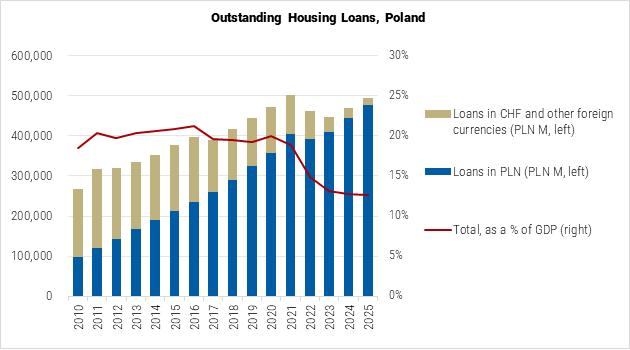
The notable increase in new lending volumes over the past two years reversed the overall shrinking of the mortgage market in Poland. Based on banking sector data published by the NBP, after decreasing by 7.8% in 2022 and 3.4% in 2023, the housing loan stock registered 4.8% year-on-year growth in 2024 and 5.7% growth in 2025. As of April 2026, the total value of outstanding housing loans in Poland stood at PLN 508.4 billion (USD 139.7 billion), of which 96.7% were PLN-denominated loans and 3.3% were loans denominated in foreign currencies.
At the same time, the relative size of the market, as measured by the ratio of outstanding housing loans to GDP at current prices, continued to decline, dropping from an estimated 20.0% in 2020 to 12.7% in 2025.
As of last year, 12.5% of Poland’s population lived in owned residences with with an outstanding mortgage or housing loan, according to Eurostat.
Data Sources: NBP, Statistics Poland.
Economic and Social Factors
Resilient Growth Momentum to Continue, Fiscal Challenges Remain
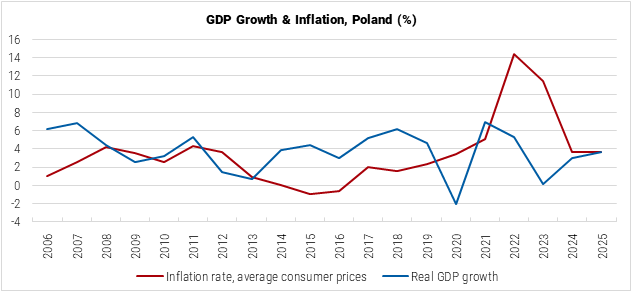
Poland has shown significant resilience to recent global shocks. After a notable slowdown to just 0.2% expansion in 2023, the economy demonstrated an impressive recovery. Real GDP growth accelerated to 3.0% in 2024 and 3.6% in 2025 on the back of strong private consumption, supported by a rebound in real wages, and increased spending backed by recently unlocked NexGen EU Funds (NGEU). This strong momentum broadly offsets the assumed impact of the Middle East conflict, with growth projected by the European Commission to reach 3.5% in 2026, before moderating somewhat to 2.8% in 2027. The most recent growth projections from the International Monetary Fund (IMF) stand at 3.3% and 2.4%, respectively.
At the same time, consumer price index (CPI) inflation in the country remains elevated, averaging 3.6% in 2025 and most recently reported by Statistics Poland at 3.1% in May 2026. The European Commission expects the indicator to remain at an average annual level of 3.6% average in 2026 due to a sharp increase in energy prices, before easing to 2.9% in 2027.
Data Source: IMF.
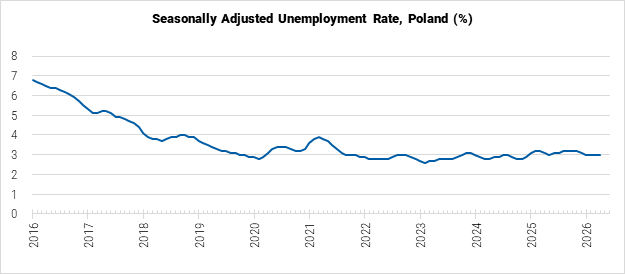
In the Polish labor market, employment is to remain broadly stable over the forecast horizon, with demographic decline in labor supply partly offset by additional workers from abroad. The nationwide seasonally adjusted unemployment rate, as reported by Eurostat, was 3.0% in April 2026 and is expected to remain around this level in the next two years. Considering lower minimum wage increases than in previous years and anticipated disinflation, the European Commission projects growth in nominal compensation per employee to ease gradually from 8% in 2025 to about 6% in 2027.
Data Source: Eurostat.
Overall, according to a recent assessment by the IMF, Poland’s economy is now performing near potential, and its near-term growth outlook remains positive; meanwhile, fiscal vulnerabilities continue to present a challenge over the medium term.
The country’s fiscal deficit widened to 7.3% of GDP in 2025 due to higher spending on military equipment deliveries, public sector wages, and social benefits. According to the European Commission’s assessment, fiscal consolidation will advance somewhat in the next two years, with the deficit moderating to 6.3% of GDP by 2027. Nevertheless, Poland’s debt-to-GDP ratio is set to increase over the forecast horizon, from 59.7% in 2025 to 68.3% in 2027.
In February 2026, Fitch Ratings affirmed Poland’s ‘A-’ sovereign rating with a negative outlook, noting that the strengths of its large, diversified, and resilient economy are set against wide fiscal deficits, rapidly rising government debt, and slow consolidation efforts hindered by domestic political tensions, which constrain the country's ability to implement economic policies and reforms.
Sources:
- Statistics Poland (GUS)
- Residential Construction in the Period of January-December 2025: https://stat.gov.pl/
- Residential Construction in the Period of January-April 2026: https://stat.gov.pl/
- Poland Macroeconomic Indicators: https://stat.gov.pl/
- Consumer Price Indices in May 2026: https://stat.gov.pl/
- National Bank of Poland (NBP)
- House Prices Database: https://nbp.pl/
- Information on Apartment Prices and the Situation on the Residential and Commercial Real Estate Market in Poland in Q4 2025 (PL): https://nbp.pl/
- NBP Interest Rates: https://nbp.pl/
- Interest Rate Statistics: https://nbp.pl/
- Banking Sector Financial Data: https://nbp.pl/
- Press Release from the Meeting of the Monetary Policy Council Held on 3-4 March 2026: https://nbp.pl/
- Senior Loan Officer Opinion Survey: https://nbp.pl/
- Core Inflation: https://nbp.pl/
- Ministry of Sport and Tourism
- Regulation of Short-Term Rentals - a Proposal to Bring Order to the Accommodation Service Market: https://www.gov.pl/
- European Commission
- Economic Forecast for Poland: https://economy-finance.ec.europa.eu/
- Distribution of Population by Tenure Status, Type of Household and Income group: https://ec.europa.eu/
- HICP - Monthly Data (Annual Rate of Change): https://ec.europa.eu/
- Unemployment by Sex and Age - Monthly Data: https://ec.europa.eu/
- International Monetary Fund (IMF)
- Country Overview: Poland: https://www.imf.org/
- 2025 Article IV Staff Report: https://www.imf.org/
- Organisation for Economic Co-operation and Development (OECD)
- OECD Economic Outlook, Volume 2026 Issue 1, Poland: https://www.oecd.org/
- Federal Reserve Economic Data (FRED)
- Currency Conversions: US Dollar Exchange Rate: Average of Daily Rates: National Currency: USD for Poland: https://fred.stlouisfed.org/
- Polish Association of Developers (PZFD)
- Private Billions for Public Infrastructure (PL): https://www.pzfd.pl/
- JLL
- Residential Market in Poland, Q1 2026 (PL): https://www.jll.com/
- Polish Housing Market: Interest Rate Cuts as a Demand Impulse in 2026 (PL): https://www.jll.com/
- Colliers
- 2026 – A Year of Accelerated Investment. Will This Also Apply to Commercial Real Estate?: https://www.colliers.com/
- Cushman & Wakefield
- Marketbeat Poland: Residential Sector Q1 2026: https://assets.cushmanwakefield.com/
- CBRE
- Housing Market 2026 – Stabilization, Wide Offer and New Challenges for Developers (PL): https://www.cbre.pl/
- Otodom
- Rental Market Report – March 2026 (PL): https://www.otodom.pl/
- ING Think
- National Bank of Poland’s Governor Says the Current Level of Interest Rates is Adequate: https://think.ing.com/
- Fitch Ratings
- Fitch Affirms Poland at 'A-'; Outlook Negative: https://www.fitchratings.com/
- Reuters
- Polish Central Bank Ready to Act but Will Take Its Time to Assess, Glapinski Says: https://www.reuters.com/
- Business Insider
- Housing Market Recovery in 2025. Here are the Challenges for 2026 (PL): https://businessinsider.com.pl/
- Will There Be Subsidies for Mortgages? (PL): https://businessinsider.com.pl/