Japan Residential Real Estate Market Analysis 2026
Sales prices and rents continue to rise in Japan’s diverse housing market, segmented by asset type and geography, with the strongest growth drivers concentrated in metropolitan condominium segments, especially in Tokyo, where robust demand is supported by steady inward migration.
This extended overview from Global Property Guide covers key aspects of the Japanese housing market and takes a closer look at its most recent developments and long-term trends.
Table of Contents
- Property Prices and Price Index
- Property Demand Trends
- Property Supply Trends
- Rental Market: Rents and Rental Yields
- Mortgage Market and Interest Rates
- Economic and Social Factors
Property Prices and Price Index
Residential property prices in Japan continued to rise into late 2025, although the market remained clearly segmented by asset type and geography. According to the Residential Property Price Index from the Ministry of Land, Infrastructure, Transport and Tourism (MLIT), nationwide residential prices increased by 5.00% year-on-year in November 2025. Condominium prices continued to lead the market, rising by 7.95%, compared with 3.18% for residential land and just 1.64% for detached houses, indicating that national price growth was still being driven primarily by apartment-based urban housing rather than by uniform strength across all residential asset types.
The condominium-led pattern was even more pronounced in the Tokyo metropolitan resale market. The December 2025 Japan Real Estate Institute’s (JREI) Existing Condominium Price Index demonstrated year-on-year growth of 12.20% for the metropolitan area as a whole and 15.89% for Tokyo itself, indicating that price momentum was not limited to newly launched projects but was also firmly visible in existing urban stock. The strength of the resale segment partly reflects spillover from the primary market, as buyers shift toward second-hand units when new-build supply remains scarce and expensive. As noted by Tosei Group, “sales prices [in the existing condominium segment] continue to rise due to a decrease in supply of new units and the reflection of soaring construction costs in prices.”
Japan's house price annual change:
The January 2026 regional transaction data reinforce this picture and suggest that pricing pressure in the primary market remains even stronger. According to the Land Research Institute, the average transaction price of a newly built condominium in the Capital Region reached JPY 83.83 million (USD 534,858) in January 2026, rising by 14.16% year-on-year. In the Kinki Region, the average unit price stood at JPY 45.88 million (USD 292,727), up 13.79% year on year. These figures indicate that the strongest price growth continues to be concentrated in metropolitan condominium markets, especially Tokyo, a trend the Bank of Japan (BOJ) attributes to a combination of supply-side pressures, including surging material costs and labor shortages, and robust demand supported by a moderately recovering economy.
Sales price dynamics, selected submarkets:
| Capital Region | Kinki Region | |
| New Condominiums | ||
| Average Price (JPY/unit, Jan 2026) | JPY 83,830,000 | JPY 45,880,000 |
| Average Price (USD/unit, Jan 2026) | USD 534,858 | USD 292,727 |
| YoY change, % | 14.16% | 13.79% |
| Average Price (JPY/sqm, Jan 2026) | JPY 1,249,000 | JPY 999,000 |
| Average Price (USD/sqm, Jan 2026) | USD 7,969 | USD 6,374 |
| YoY change, % | 11.92% | 14.17% |
| Existing Condominiums | ||
| Average Price (JPY/unit, Jan 2026) | JPY 54,930,000 | JPY 32,180,000 |
| Average Price (USD/unit, Jan 2026) | USD 350,468 | USD 205,317 |
| YoY change, % | 6.72% | 0.41% |
| Average Price (JPY/sqm, Jan 2026) | JPY 870,000 | JPY 472,000 |
| Average Price (USD/sqm, Jan 2026) | USD 5,551 | USD 3,011 |
| YoY change, % | 6.23% | -1.05% |
| Existing Detached Houses | ||
| Average Price (JPY/unit, Jan 2026) | JPY 44,690,000 | JPY 24,280,000 |
| Average Price (USD/unit, Jan 2026) | USD 285,134 | USD 154,913 |
| YoY change, % | 6.08% | -0.21% |
| Note: Exchange rate as of January 2026, USD 1= JPY 156.7332. | ||
| Data Source: Land Research Institute (compiled from Real Estate Economic Institute Co., LTD and East Japan Real Estate Transaction Organization). | ||
Looking ahead, residential prices in Japan are expected to continue rising in 2026, though the pace of growth is likely to remain uneven across market segments. Fitch Ratings forecasts nationwide home price growth of 3% to 4%, supported by tight supply and rising incomes. At the same time, Mitsubishi UFJ Trust and Banking’s latest developer survey suggests that price pressures will remain more pronounced in metropolitan condominium markets, especially in higher-end Tokyo projects, while the pass-through to the broader residential sector is likely to be slower and more selective. This view is reinforced by local media reports indicating that Tokyo’s new condominium prices are likely to stay elevated in 2026 because central supply remains scarce and land acquisition conditions remain challenging.
Property Demand Trends
Structural Urban Demand Continues to Support Market Activity
Japan’s housing demand remains concentrated in major metropolitan areas and prime urban locations, where competition for limited new supply continues to sustain market resilience. Demand is still supported by steady inward migration to the Capital Region, even if momentum softened somewhat in 2025. According to the Statistics Bureau of Japan (SBJ), Tokyo recorded a net population inflow of 65,219 in 2025, down from 79,285 in 2024, while the broader Tokyo metropolitan area attracted a net 123,534 residents. Net inflows were again strongest among younger age cohorts, underlining the continued structural pull of the Capital Region as Japan’s largest employment and education hub.
Foreign demand also remains a support factor for prime condominium markets, especially in central Tokyo, with the weak yen continuing to enhance the relative attractiveness of Japanese residential assets to overseas buyers. Survey data from Mitsubishi UFJ Trust & Banking indicates that foreign participation is significantly more pronounced in prime Tokyo districts, reaching 19.0% in Chiyoda, Minato, and Shibuya, compared with 12.7% in the rest of the 23 wards in H1 2025.
Outside the main metropolitan cores, demand conditions are much weaker, reflecting Japan’s broader demographic and spatial divide. This contrast is particularly visible in regional markets with elevated vacancy and ageing housing stock, underscoring the concentration of effective housing demand in Tokyo, Osaka, and other large urban centers.
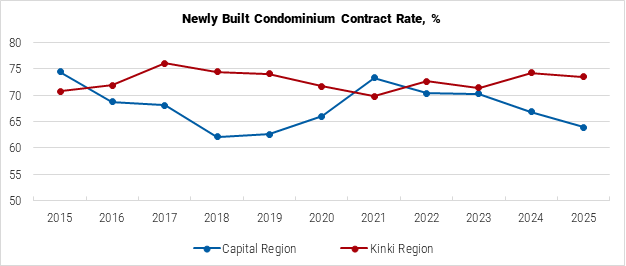
The contract rate for newly built condominium units, defined as the percentage of units sold within the first month of sales and widely used as a benchmark of market demand, softened slightly in 2025 in both the Capital Region and the Kinki Region, as monitored by the Real Estate Economic Institute Co., Ltd. A rate of around 70% is typically regarded as an indicator of healthy demand, with higher levels suggesting strong absorption and lower levels pointing to weaker market conditions.
In the Capital Region, the average contract rate eased to 63.9% from 66.9% in 2024, while Tokyo’s 23 wards recorded 64.6%. In the Kinki Region, the contract rate also declined slightly to 73.5% from 74.3% a year earlier, but remained above the 70% threshold generally associated with healthy absorption. Despite this modest softening, market commentary suggests that underlying demand in the main metropolitan areas remains comparatively firm, supported by continued urban inflows, still-accommodative borrowing conditions, and stronger wage growth. As Savills noted, demand fundamentals continue to benefit from “consistent population growth [in the main metros], relatively low interest rates, and stronger wage growth following consecutive robust Shunto wage negotiations.”
Data Source: Real Estate Economic Institute Co., Ltd.
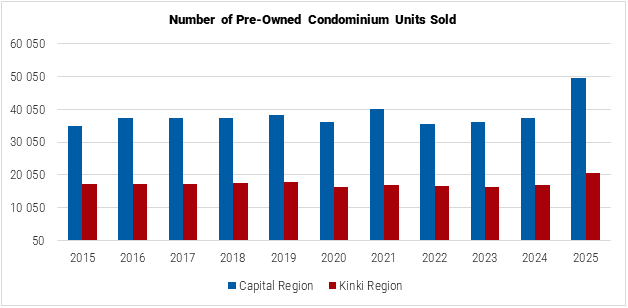
With the supply of newly built condominiums still constrained and launch prices continuing to rise, a growing share of demand has shifted toward the second-hand market. In the Capital Region, 49,491 pre-owned condominium units were sold in 2025, a year-on-year increase of 31.93%, according to statistics compiled by the Land Institute of Japan. The Kinki Region showed similar momentum, with sales rising 21.15% year on year to 20,739 units. This shift reflects the widening mismatch between buyer demand and the availability of new stock, particularly in the more affordable segments of the market. As Tosei Group observed, “the shift in demand from newly-built condominiums to pre-owned condominiums is strengthening,” as limited new supply and rising launch prices continue to redirect households toward resale properties.
Data Source: Land Research Institute.
Property Supply Trends
New Supply Continues to Contract as Affordability and Demographics Reshape the Market
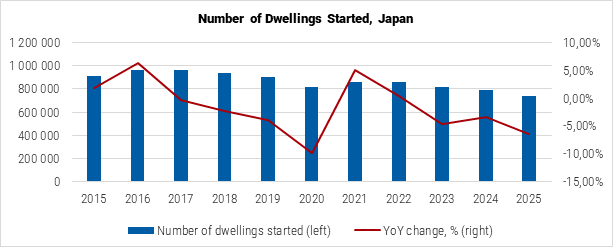
Supply of new housing in Japan remains subdued. According to the MLIT, in 2025, annual housing starts declined 6.5% year-on-year to 740,667 units, marking a third consecutive annual decline and leaving starts below 800,000 for a second straight year. The weakness was broad-based across product types: owner-occupied housing starts fell by 7.7% to 201,285 units, rental housing starts declined by 5.0% to 324,991 units, and built-for-sale housing dropped by 7.6% to 208,169 units. Within the for-sale segment, condominium starts were particularly weak, down 12.2% year on year to 89,888 units, while detached built-for-sale housing fell by a milder 4.3% to 115,935 units. Regionally, the decline was most pronounced outside the three main metropolitan areas, down 9.2% year-on-year, while the Kinki Region proved relatively more resilient, posting only a modest year-on-year decrease of 1.6%.
Data Source: MLIT.
Residential construction dynamics, by submarket:
| Region | Number of Dwellings Started, 2025 |
YoY |
| Capital Region | 268,730 | -5.86% |
| Chubu Region | 85,056 | -7.15% |
| Kinki Region | 130,020 | -1.60% |
| Other regions | 256,861 | -9.24% |
| Nationwide | 740,667 | -6.50% |
| Data Source: MLIT. | ||
Part of the 2025 weakness also reflects timing distortions. In its January 2026 Outlook Report, the BOJ stated that housing investment had been affected by a “reactionary decline” following the front-loading of construction starts ahead of revisions to the Building Standards Act and other regulations that took effect in April 2025. At the same time, the central bank has consistently argued that housing starts are on a longer-run downtrend driven by higher housing prices and adverse demographic developments. This suggests that 2025 combined a temporary payback from earlier front-loading with more entrenched structural constraints, notably worsening affordability and softer long-run demand.
Structural constraints remain especially significant outside the major metropolitan areas. Official population estimates by the SBJ show that Japan’s total population stood at 123.8 million as of October 1, 2024, down by 550,000 from a year earlier, while people aged 65 and over accounted for 29.3% of the population. At the same time, the latest Housing and Land Survey recorded over 9 million vacant dwellings nationwide as of 2023, equivalent to a 13.8% vacancy rate, both record highs. Of these, 3.856 million units were neither for rent nor for sale nor used as second homes, pointing to a large pool of underutilized housing stock that dilutes the case for new construction in weaker local markets.
Looking ahead, the near-term outlook remains soft, although some stabilization is expected after the 2025 payback effect fades. The latest Research Institute of Construction and Economy (RICE) forecast projects total housing starts at 737,000 units in fiscal year 2025 (from April 1, 2025 to March 31, 2026), down 9.8% year on year, followed by a partial recovery to 777,200 units in fiscal year 2026 (April 1, 2026 to March 31, 2027), up 5.5%. Even so, RICE still flags headwinds such as high housing prices, weak traffic to housing exhibition halls, and higher mortgage rates, suggesting that the rebound is likely to be modest and is better understood as partial normalization.
Rental Market: Rents and Rental Yields
Solid Growth in Asking Rates for Tokyo Condominiums
The rental segment represents a substantial share of the Japanese housing market. According to the results of the 2023 Housing and Land Survey published by the SBJ, 35.0% of the country’s dwellings are rented, with an even higher share of tenants observed in major cities such as Tokyo (48.9%), Yokohama (37.1%), Osaka (53.9%), Nagoya (48.8%), and Kyoto (42.6%).
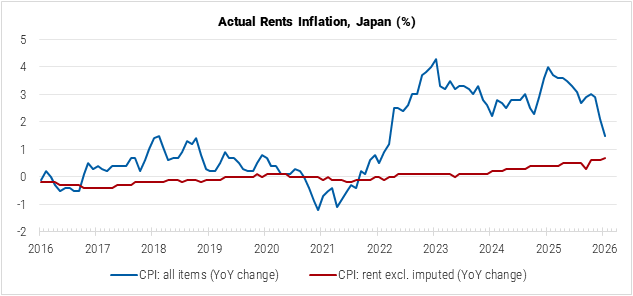
Japan's rent price index:
An ample supply of older rental properties in many urban areas, coupled with comparatively low financing costs of new development and demographic trends supporting stable but not intensifying nationwide rental demand, have kept rental inflation for existing contracts in the country relatively low, even during the periods of accelerated overall price growth. The indicator, however, has continued to trend upwards in the second half of 2025 and early 2026, with the actual rents (excluding imputed) component of the consumer price index (CPI) reported by the SBJ showing a 0.7% year-on-year increase in January 2026, up from 0.4% a year ago and just 0.2% two years ago. The all-item CPI increased by 1.5% over twelve months to January 2026.
At the same time, asking rents for newly listed properties are growing at a much faster pace, according to the apartment rent index developed by the real estate platform At Home and Sumitomo Mitsui Trust Research Institute. In Q3 2025, the index recorded year-on-year increases in all key submarkets across the country, from 7.82% in Tokyo 23 Wards to 4.91% in Tokyo Suburbs, 4.25% in Nagoya City, 4.25% in Osaka City, and 3.57% in Kyoto City.
Data Source: SBJ.
In nominal terms, figures from At Home also reveal a diverse dynamic in average asking rents for condominiums across Japan’s cities, with Tokyo 23 Wards consistently standing out among other submarkets due to substantially higher rates and generally faster growth for all unit categories.
As of January 2026, asking rents in the capital ranged from JPY 107,658 (USD 699) for units of up to 30 square meters to JPY 407,200 (USD 2,642) for larger units exceeding 70 square meters. For small and medium-sized units up to 50 square meters, the annual increase in average rents reached double digits.
Moderate Rental Yields
As for gross rental yields for residential properties in Japan, according to research conducted by Global Property Guide, the indicator averaged 4.55% across the monitored submarkets in February 2025, up from 4.34% previously reported in August and 4.22% in January 2025. The highest potential performance was observed in Sapporo (5.03%), while in Tokyo, the average yield was recorded at just 3.27%.
Average asking condominium rents in selected submarkets by property size:
| Avg rent, up to 30 sqm Jan 2026 |
YoY | Avg rent, 30-50 sqm Jan 2026 |
YoY | Avg rent, 50-70 sqm Jan 2026 |
YoY | Avg rent, over 70 sqm Jan 2026 |
YoY | |
| Tokyo 23 Wards | JPY 107,658 (USD 699) |
11.1% | JPY 177,931 (USD 1,155) |
12.6% | JPY 256,544 (USD 1,665) |
9.9% | JPY 407,200 (USD 2,642) |
8.8% |
| TokyoSuburbs | JPY64,674 (USD 420) |
5.8% | JPY 98,458 (USD 639) |
5.6% | JPY 142,779 (USD 926) |
8.3% | JPY 204,308 (USD 1,326) |
12.8% |
| Osaka City | JPY 71,812 (USD 466) |
8.0% | JPY 112,420 (USD 729) |
8.8% | JPY 164,541 (USD 1,068) |
11.4% | JPY 269,156 (USD 1,746) |
-0.7% |
| Kyoto City | JPY 59,241 (USD 384) |
7.5% | JPY 88,860 (USD 577) |
1.4% | JPY 122,125 (USD 792) |
1.0% | JPY 199,653 (USD 1,296) |
5.7% |
| Nagoya City | JPY 64,039 (USD 416) |
6.6% | JPY 83,538 (USD 542) |
3.7% | JPY 101,697 (USD 660) |
2.7% | JPY 154,811 (USD 1,005) |
4.6% |
| Note: Exchange rate as of January 2026, USD 1 = JPY 154.11204. | ||||||||
| Data Source: At Home Co. | ||||||||
Looking ahead, Tokyo’s market is expected to remain resilient, supported by its status as a global city that continues to attract both domestic and foreign residents, constrained supply of new rental housing, and a growing proportion of fixed-term leases, which facilitates more frequent rental repricing.
“Tokyo’s market fundamentals remain strong, supported by steady wage growth and sustained demographic inflows, providing further opportunity for rental growth <…> Persistently elevated construction and land costs are expected to maintain a tight supply-demand equilibrium, with rental growth extending across the Tokyo 23W,” said the latest residential leasing report from Savills.
Within the Greater Tokyo area, an analysis by the local real estate investment and management company Kenedix highlights the continued overall net population inflow (including domestic and international), but notes shifting patterns in submarkets within the capital region. “It is important to note that while population inflows continue into Tokyo's 23 wards, their momentum is slowing,” said their Q4 2025 market report. “In contrast, the momentum of population inflow in the surrounding areas, particularly the suburbs of Tokyo, is strengthening, and rising housing demand is likely to be anticipated.”
Mortgage Market and Interest Rates
Interest Rates Increased Across the Board Reflecting Monetary Tightening
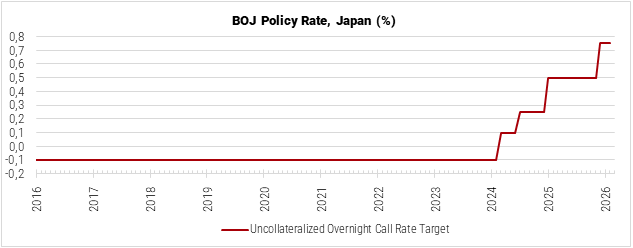
While still at low levels, interest rates on housing loans in Japan have been trending upwards along with the normalization of the central bank’s monetary policy. After years of maintaining a negative rate of -0.1%, the BOJ increased the target for the uncollateralized overnight call rate four times throughout 2024 and 2025, bringing it to the current level of around 0.75%.
At the most recent monetary policy meeting in January 2026, the BOJ decided to maintain the current stance, encouraging the rate to remain at around 0.75%. However, based on the macroeconomic environment, local experts polled by Reuters anticipate further increases, with the next 25 bps hike expected in the upcoming quarter.
“The next BOJ rate hike is expected to be around June or July,” said the mortgage screening platform Mogecheck in their latest market overview. “While there has been talk of a March or April rate hike, given the actions of the Takaichi administration [signaling reluctance to raise interest rates], it is safe to assume that this is unlikely.”
Data Source: BOJ.
A higher policy rate translates into higher interest rates on mortgages across the board. According to data accumulated by Mogecheck, in March 2026, interest rates on variable loans stood at around 0.8%-1.0%, up from 0.4%-0.6% during the same period two years ago, with internet banks offering slightly cheaper credit than the country’s three megabanks and regional banks. For 10-year fixed mortgages, interest rates were reported at around 3.2%, up from 1.4% in 2024. For loans under the government-backed Flat 35 program, interest rates increased from about 1.8% to about 2.3% within the last twenty-four months.
Previously, most Japanese banks reviewed their base interest rates for new mortgage loans every April and October, creating a time lag between a shift in the policy rate and market adjustment. The latest analysis from Mogecheck suggests that this pattern might be changing, however. According to the platform, following the BOJ policy rate hike in December, two megabanks raised their variable interest rates ahead of schedule (which was unusual), and it is now “expected that more banks will revise their regulations to allow for more flexibility in raising base interest rates”.
Interest rates on mortgages by type:
| Mar 2026 | 2Y Trend | Mar 2024 | |
| Variable mortgages (megabanks) | 0.965% | ↑ | 0.398% |
| Variable mortgages (regional banks) | 0.995% | ↑ | 0.645% |
| Variable mortgages (internet banks) | 0.841% | ↑ | 0.374% |
| 10Y fixed mortgages (megabanks) | 3.157% | ↑ | 1.390% |
| Flat 35mortages | 2.250% | ↑ | 1.840% |
| Data Source: Mogecheck. | |||
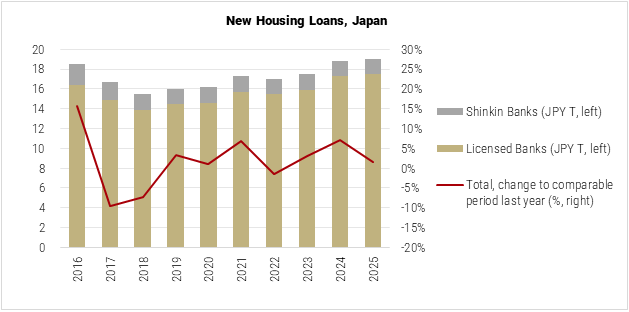
Despite a clear uptick in interest rates, new loan production in Japan has continued to grow last year, albeit at a more moderate pace. Based on the BOJ reporting, the combined value of new housing loans produced by the country’s licensed banks and shinkin banks (regional cooperative financial institutions) increased by 1.4% year-on-year in 2025 and reached a decade high of JPY 19.0 trillion (USD 127.2 billion).
Data Source: BOJ.
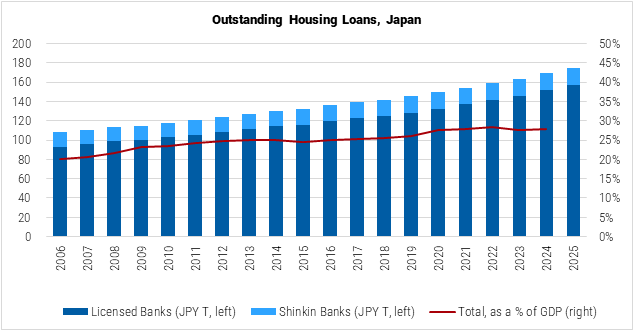
Supported by resilience in new production, the overall size of the housing loan market in Japan also continues to expand gradually. At the end of 2025, the BOJ reported the total value of outstanding housing loans at JPY 174.9 trillion (USD 1.2 trillion), up 3.5% year-on-year. Of the combined stock, 89.7% was represented by loans maintained by licensed banks, with the remaining 10.3% made by loans from shinkin banks. In relative terms, Japan’s housing loan market has remained stable over the last five years, estimated to equal 27.8% of GDP at current prices as of 2024.
Data Sources: BOJ, World Bank.
Economic and Social Factors
Economy Returns to Growth With Moderate Prospects
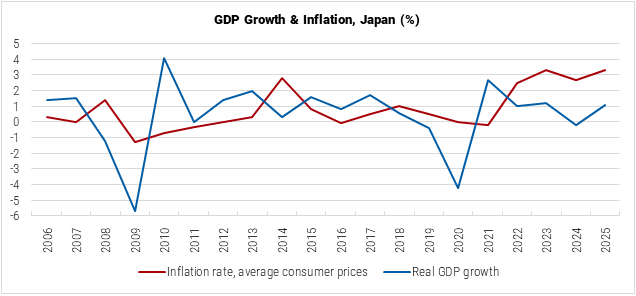
After three decades of near-zero inflation, Japan’s economy is attempting to reach a new equilibrium amid elevated inflation and a global slowdown, while also facing domestic challenges, such as its aging population and high public debt. Following a 0.2% contraction in 2024, the economy rebounded to an estimated 1.1% real GDP growth in 2025, supported by domestic demand and business investment, and is expected to continue expanding over the next two years, albeit at a more moderate pace due to weaker external demand. The International Monetary Fund (IMF) currently projects a growth rate of 0.7% and 0.6% in 2026 and 2027, respectively.
“Japan's economy is likely to continue growing moderately, with overseas economies returning to a growth path, and as a virtuous cycle from income to spending gradually intensifies, supported by factors such as the government's economic measures and accommodative financial conditions, while the economy is projected to be affected by trade and other policies in each jurisdiction,” summarized the January 2026 macroeconomic outlook from the BOJ.
Boosted by soaring rice prices, consumer price index (CPI) inflation in the country last year was stronger than previously expected, accelerating from an average annual level of 2.7% in 2024 to 3.3% in 2025. Most recently, however, the SBJ reported the indicator at 1.5% in January 2026, and the latest available IMF assessment (prior to military escalation in the Middle East) expected inflation to moderate this year and converge toward the BOJ’s target in 2027, reflecting easing global prices, stabilization in domestic rice prices, and the impact of fiscal policy measures.
Data Source: IMF.
With an aging population and demographic decline among Japan's most pressing issues, the country’s labor market continues to suffer from a contracting labor force. As outlined in the 2025 Article IV staff report from the IMF, the working-age population of Japan declined by around 13% over the two decades before the pandemic, and the share of the population aged 65 or older is now the highest in the world. “Aging has already had a considerable impact on Japan’s labor market, contributing to current labor shortages <…> These trends are expected to continue with the working age population expected to decline by a further 35% by 2065,” said the report.
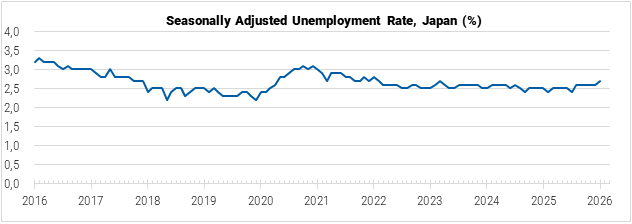
In this environment, labor market tightness is supporting low unemployment (most recently reported by the SBJ at 2.7% in January 2026) and higher nominal wage growth than has been seen in decades.
At the same time, real wages in the country continue to contract as headline price increases outpace wage gains. “Real wage growth, which is critical for supporting domestic consumption, has been elusive despite rising labor shortages,” noted the concluding statement of the IMF’s 2026 Article IV Mission.
Data Source: SBJ.
In general, Japan’s advanced, wealthy economy with correspondingly robust governance standards and public institutions faces weak medium-term growth prospects, currently weighed down by very high public debt ( estimated at 229.6% of GDP in 2025), domestic demographic challenges, and global trade headwinds. Fitch Ratings affirmed the country’s ‘AA’ sovereign rating with a stable outlook in January 2026.
The IMF most recently assessed risks to Japan’s economic outlook as tilted to the downside and pointed out that deepening geoeconomic fragmentation and rising trade restrictions (including recent strains in Japan-China relations) could further disrupt supply chains and dampen business sentiment.
Domestically, an abrupt deterioration of financial conditions could weaken confidence and domestic demand.
Easing political uncertainty, a landslide victory of Prime Minister Sanae Takaichi’s Liberal Democratic Party in the snap elections in February 2026 established the ruling party’s supermajority in the lower chamber of the parliament and gave it a wider mandate for reforms aiming to “overhaul past economic and fiscal policy”.
Sources:
- Statistics Bureau of Japan (SBJ)
- Basic Resident Register Population Movement Report 2025 Results (JPA): https://www.stat.go.jp/
- Population Estimates Report, October 2025 (JPA): https://www.stat.go.jp/
- 2023 Housing and Land Survey (JPA): https://www.stat.go.jp/
- Report on Internal Migration in Japan: https://www.stat.go.jp/
- Consumer Price Index Nationwide, January 2026 (JPA): https://www.stat.go.jp/
- Labor Force Survey, Results for January 2026 (JPA): https://www.stat.go.jp/
- The Bank of Japan (BOJ)
- Statement on Monetary Policy, January 23, 2026: https://www.boj.or.jp/
- Change in the Guideline for Money Market Operations, December 19, 2025: https://www.boj.or.jp/
- Deposits and Loans Market: https://www.boj.or.jp/
- Outlook for Economic Activity and Prices, January 2026: https://www.boj.or.jp/
- Financial System Report, October 2025: https://www.boj.or.jp/
- Ministry of Land, Infrastructure, Transport and Tourism (MLIT)
- Real Estate Price Index: November 2025, Q3 2025. Press Release (JPA): https://www.mlit.go.jp/
- Construction Statistics Report, 2025 (JPA): https://www.mlit.go.jp/
- Japan Real Estate Institute (JREI)
- December 2025 JREI Home Price Indices: https://www.reinet.or.jp/
- Land Research Institute
- Monthly Data on Real Estate Economy. March 2026 (JPA): https://www.lij.jp/
- Real Estate Economic Institute Co., Ltd
- Summary of Trends in the New Condominium Market in Tokyo Metropolitan Area in 2025 (JPA): https://www.fudousankeizai.co.jp/
- Summary of Trends in the New Condominium Market in the Kinki Region in 2025 (JPA): https://www.fudousankeizai.co.jp/
- Research Institute of Construction and Economy (RICE)
- Construction Investment Outlook Based on the Construction Economic Model, January 2026 (JPA): https://www.rice.or.jp/
- International Monetary Fund (IMF)
- Country Overview: Japan: https://www.imf.org/
- Staff Concluding Statement of the 2026 Article IV Mission: https://www.imf.org/
- 2025 Article IV Staff Report: https://www.imf.org/
- The Impact of Aging and AI on Japan's Labor Market: Challenges and Opportunities: https://www.imf.org/
- World Economic Outlook Update, January 2026: https://www.imf.org/
- Organization for Economic Co-operation and Development (OECD)
- Japan: OECD Economic Outlook, Volume 2025 Issue 2: https://www.oecd.org/
- World Bank
- World Development Indicators: https://databank.worldbank.org/
- Federal Reserve Economic Data (FRED)
- US Dollar Exchange Rate: Average of Daily Rates: National Currency: USD for Japan: https://fred.stlouisfed.org/
- At Home Co
- Apartment Rent Index, Q3 2025 (JPA): https://business.athome.jp/
- Rent Trends for Rental Apartments and Condominiums in Major Cities Across Japan, January 2026 (JPA): https://www.athome.co.jp/
- Kenedix
- KENEDIX Real Estate Market Report 4Q 2025: https://ssl4.eir-parts.net/
- Mogecheck
- Latest Trends in Mortgage Interest Rates in March 2026 (JPA): https://mogecheck.jp/
- Tosei Group
- Financial Results for the Fiscal Year 2025. Real Estate Market Conditions.: https://pdf.irpocket.com/
- Mitsubishi UFJ Trust and Banking
- Developer Survey. Second Half of Fiscal Year 2025. (JPA): https://www.tr.mufg.jp/
- Real Estate Market Research Report Vol. 288 (JPA): https://www.tr.mufg.jp/
- Savills
- Tokyo Residential Sales, H2 2025: https://pdf.savills.asia/
- Tokyo Residential Leasing Q4 2025: https://pdf.savills.asia/
- Deloitte
- Japan Economic Outlook, January 2026: https://www.deloitte.com/
- Fitch Ratings
- APAC Home Prices Set to Rise in 2026, Except in China: https://www.fitchratings.com/
- Fitch Affirms Japan at 'A'; Outlook Stable: https://www.fitchratings.com/
- Reuters
- BOJ to Raise Interest Rates Next Quarter With Expectations Unchanged by Middle East War: Reuters Poll: https://www.reuters.com/
- Japan's Snap Election and Tax Pledge Keep Nation's Finances in Spotlight: https://www.reuters.com/
- Japan's 'Iron Lady' Takaichi Forges Historic Election Win: https://www.reuters.com/
- TV Asahi
- Tokyo’s 23 Wards Apartments to Exceed 100 Million Yen Next Year (JPA): https://news.tv-asahi.co.jp/