Turkey Residential Real Estate Market Analysis 2024
Turkey's seemingly strong house price growth is just an illusion, when in fact, real values are actually falling by double-digit figures. This is mainly due to persistent hyperinflation in the country.
Table of Contents
- Housing Market Snapshot
- Demand Highlights
- Supply Highlights
- Rental Market
- Mortgage Market
- Historic Perspective
- Socio-Economic Context
Housing Market Snapshot
In July 2024, overall inflation was still extraordinarily high at 61.8%. From an annual average of just 10.9% from 2003 to 2021, inflation surged to a whopping 72.3% during 2022 and remained elevated since.
Turkey's house price annual change
As such, Turkey's nationwide house prices rose by a whopping 42% in May 2024 from a year earlier, to an average of TRY 33,460 (US$999) per square meter (sqm), according to the Central Bank of the Republic of Türkiye (CBRT), following y-o-y increases of 71.7% in 2023, 178.6% in 2022, 64% in 2021, 32.6% in 2020, and 2.9% in 2019.
However, there is a huge difference between the nominal and real figures. When adjusted for inflation, nationwide house prices actually plummeted by 19% during the year to May 2024.
In Turkey's major cities:
- In Istanbul, Turkey's largest city and most expensive housing market, the average house price soared by 31.6% during the year to May 2024 to TRY 47,299 (US$1,412) per sq. m. But when adjusted for inflation, house prices were down by 25% y-o-y.
- In Ankara, the country's capital, house prices skyrocketed by 52.6% y-o-y in May 2024 to an average of TRY 26,930 (US$804) per sqm. When adjusted for inflation, house prices dropped 13%.
- In Izmir, the country's third largest city, house prices were up by 43.3% y-o-y in May 2024 to TRY 38,874 (US$1,161) per sqm. Yet house prices actually declined by 18.3% in real terms.
New dwelling prices rose strongly by 48.8% (but fell by 15.2% in real terms) y-o-y in May 2024 while existing dwelling prices increased by 45.4% (but dropped 17.1% inflation-adjusted).

Demand for residential properties in Turkey continues to weaken, with the total number of home sales falling by 17.5% to 1.23 million units in 2023 from a year earlier, far worse than the y-o-y declines of 0.4% in 2022 and 0.5% in 2021, according to the TurkStat. The weakness of demand continues this year. In the first half of 2024, home sales were down by 3.7% y-o-y to 545,074 units.
Foreign demand is also plunging. During 2023, foreign home purchases in Turkey dropped by a whopping 48.1% to 35,005 units as compared to 67,490 units sold in the prior year. Then in the first half of 2024, foreign home purchases in the country fell further by 45.7% y-o-y to just 10,461 units, indicating that property demand from foreigners remains depressed this year.
Yet, the overall economy continues to grow. Turkey's economy grew by about 4.5% during 2023, following annual expansions of 5.5% in 2022, 11.4% in 2021, 1.9% in 2020, and 0.8% in 2019, buoyed by strong household spending and improved investor confidence, based on figures released by the International Monetary Fund (IMF). The IMF projects the Turkish economy to expand by a modest 3.6% in 2024 - more optimistic as compared to the World Bank's forecast of a 3% growth.

Demand Highlights
Demand is falling rapidly
Residential property demand continues to weaken in Turkey, with the total number of home sales falling by 17.5% to 1.23 million units in 2023 from a year earlier, far worse than the y-o-y declines of 0.4% in 2022 and 0.5% in 2021, according to the TurkStat.
Over the same period, sales of new houses fell by 17.5% y-o-y to 379,542 units while second-hand house sales also dropped by 17.5% to 846,384 units.
There are wide regional variations, but demand is falling in most of Turkey's major cities in 2023:
- In Istanbul, which has more than 16% share of transactions, home sales fell sharply by 23.5% y-o-y to 198,739 units.
- In Ankara, which accounted for a market share of 9.3%, the number of home sales dropped 9.3% y-o-y to 114,432 units.
- In Izmir, which represented more than 5% of the market, home sales fell sharply by 21.6% y-o-y to 65,465 units.
- In Antalya, which also captured more than 5% market share, the number of home sales dropped by 19.6% y-o-y to 64,721 units last year.
- In Bursa, which took 3.7% of the market, home sales declined by 16.3% y-o-y to 45,416 units.
- In Mersin, which accounted for nearly 3% of the market, home sales fell by 13.1% y-o-y to 34,990 units.
The weakness of demand continues this year. In the first half of 2024, home sales were down by 3.7% y-o-y to 545,074 units, based on TurkStat figures.
In H1 2024, sales of new houses increased slightly by 1.3% y-o-y to 173,324 units while second-hand house sales continued to fall by 5.8% to 371,750 units.

Foreign homebuyers plummeting
During 2023, foreign home purchases in Turkey plunged by a whopping 48.1% to 35,005 units as compared to 67,490 units sold in the prior year, based on figures released by TurkStat. This was in stark contrast to the robust y-o-y growth of 15.2% registered in 2022 and 43.5% seen in 2021.
As a result, foreign homebuyers' share of the market fell to less than 3% in 2023, down from 4.5% in the prior year.
Then in the first half of 2024, foreign home purchases in the country fell further by 45.7% y-o-y to just 10,461 units, indicating that property demand from foreigners remains depressed.
Except for the years 2016 and 2020 due to the Covid-19 pandemic, property sales to foreigners have been generally rising in Turkey. Foreign buyers had been buying large amounts of Turkish property, mirroring a substantial increase in Gulf tourism. As the Lira has fallen, visitors have been attracted to Turkey. Istanbul is now so full of Arab visitors that it resembles a Gulf city, with Arabic spoken in shops, and restaurants catering to Gulf tastes.
Between 2013 and 2022, foreign home purchases more than quadrupled from 12,181 units to about 67,490 units. Russians, Iranians, and Iraqis accounted for almost one-third of the total foreign purchases during the period. They regard Turkey as a safe haven and they feel culturally close to the country.

In the first half of 2024, the Russians led the foreign home purchases in Turkey, representing about 23% share. The Iranians were a distant second, with a market share of 10.1%. They were followed by the Ukrainians with a market share of 6.9%, Germans with a 4.7% share, Iraqis also with a 4.7% share, and Kazakhstanis with 4.5% share.
With the surge in Russian homebuyers, Turkish banks began to open ruble accounts.
Most foreign buyers bought dwellings in Antalya, accounting for about 37% of total sales in H1 2024, followed by Istanbul (34.5%), Mersin (9%), Ankara (2.4%) and Yalova (2.3%).

Foreign homeownership rules eased
It was only in 2002 that the Turkish property market was first opened to foreign buyers. But they were only allowed to purchase properties in a few zones, and under the "reciprocity clause". This means that only nationals of countries allowing Turkish citizens reciprocal rights - like Britain, Germany, and the Netherlands - were allowed to buy properties. In 2005, the zones were abolished, but reciprocity remained.
The reciprocity requirement was finally abolished in August 2012, and since then nationals from 183 countries have been allowed to buy properties in Turkey. Nationals of China, Russia, India, and Gulf Arab states, previously banned because of the reciprocity rules, are now allowed. The size of land foreigners can buy without special permission was increased to 33 hectares, up from 2.5 hectares.
Tens of thousands of foreigners have successfully acquired properties in Turkey, most notably in the Marmara and Mediterranean regions, Turkey's major finance and tourist hubs.
"The regulation easing requirements for foreigners to acquire Turkish citizenship, the volatility in the Turkish lira against other currencies, and the VAT exemption for foreigners helped spur the sales," said Melih Tavukçuoğlu, head of Istanbul's Asian-side Contractors' Association.
Turkey has granted citizenship to foreigners through various means since January 2017, which includes purchasing property worth at least US$1 million. During the same year, the government introduced other measures to entice foreign homebuyers:
- Reduction of Land Registry's title deed fees from 2% to 1.5%, which are payable by both the buyer and the seller (or around 3% in total).
- VAT exemptions for property owners who buy a Turkish property but do not live in Turkey, on the condition that they pay for the property with foreign currency. Homebuyers must also hold the property for 12 months after purchase.
- Stamp duty for "promise to sell agreements" reduced to 0%, from 0.95%.
New regulations were introduced in September 2018 cutting the investment amount required for Turkish citizenship:
- Purchasing real estate worth at least US$250,000 now gives you citizenship.
- Or a fixed capital investment of US$500,000
- Or keeping at least US$500,000 in a Turkish bank account for a minimum of three years, down from the earlier cap of US$ 3 million;
- Or generating 50 jobs, down from 100 jobs.
However effective June 13, 2022, the minimum threshold to obtain citizenship through real estate investment was raised from US$250,000 to US$400,000. This was amidst the surge in foreign interest in buying a home in Turkey during 2021-22.
To obtain residency in the country through real estate, foreign buyers need to invest a minimum of US$50,000. The amount increases to US$75,000 for purchases in metropolitan cities like Istanbul, Ankara, Izmir, Mugla, and Antalya. Though effective October 16, 2023, the minimum investment to become a resident was raised to US$200,000 across all cities in Turkey.
Price variations in primary and secondary markets
In May 2024, new dwelling prices in Turkey surged by 48.8% compared to a year earlier, following annual increases of 80% in 2023, 161% in 2022, 66.7% in 2021, 31.6% in 2020, and 10.7% in 2019. However, in real terms, new dwelling prices fell by 15.2% y-o-y over the same period.
For new dwellings:
- In Istanbul, new dwelling prices were up 38.9% (but dropped 20.8% inflation-adjusted) y-o-y in May 2024.
- In Ankara, nominal prices surged 40.6% y-o-y in May 2024 but fell by 19.8% when adjusted for inflation.
- In Izmir, nominal prices climbed by 45.5% but declined by 17.1% in real terms.
The same pattern is observed in the secondary market. In May 2024, nationwide existing dwelling prices increased by 45.4% y-o-y, after registering an annual growth of 76.1% in 2023, 169% in 2022, 57.9% in 2021, 30.2% in 2020, and 8.8% in 2019. However, in real terms, prices were down by 17.1%.
For existing dwellings:
- In Istanbul, existing dwelling prices increased by 35.1% (but fell by 23% inflation-adjusted) in May 2024 from a year earlier.
- In Ankara, existing dwelling prices rose by a huge 54.5% over the same period (but actually declined by 11.9% in real terms).
- In Izmir, nominal prices rose by 47.4% (but fell by 16% inflation-adjusted).

Supply Highlights
Residential construction activity increasing
Surprisingly, construction activity continues to increase, despite weak demand. During 2023, the total number of dwelling units in residential buildings granted with construction permits in Turkey rose strongly by 22.3% to 855,265 units from a year earlier, according to figures from TurkStat. This is in contrast with an annual decline of 3.8% in 2022.
Residential construction activity continues to strengthen this year. In the first quarter of 2024, dwelling permits rose further by a huge 35.5% y-o-y to 178,598 units.
In Q1 2024:
- One-dwelling residential buildings: 10,786 dwelling units, up by 11.3% from the same period in the prior year.
- Two- or more dwelling buildings: 167,376 dwelling units, up strongly by 37.5% from a year ago.
The total number of residential construction permits rose by 19.9% y-o-y to 28,662 in Q1 2024, following an annual increase of 9.1% in 2023, a decline of 7.7% in 2022, and strong growth of 44% in 2021 and 72.6% in 2020.

The luxury housing tax came into effect
The luxury housing tax and other tax measures entered into force in January 2021. It is imposed on residences with a value of over TRY 5.25 million (US$156,768). The following shows the revised tax rates:
- Residential properties valued below TRY 5.25 million (US$156,768) are tax-exempt.
- Residential properties valued between TRY 5.25 million (US$156,768) and TRY 7.87 million (US$235,003) are taxed 0.3% of the amount over the base level.
- For properties worth up to TRY 10.5 million (US$313,537), an extra tax rate of 0.6% is levied for the amount over TRY 7.87 million (US$235,003).
- Houses with a value of more than TRY 10.5 million (US$313,537) are taxed TRY22,500 (US$672) plus 1.0% of the amount over the base level.
There are some exemptions. Those who own only one residence will not be subject to the said tax. Moreover, those who own more than one residence will not be subject to the luxury housing tax on whichever residence has the lowest value.
Rental Market
Good gross rental yields
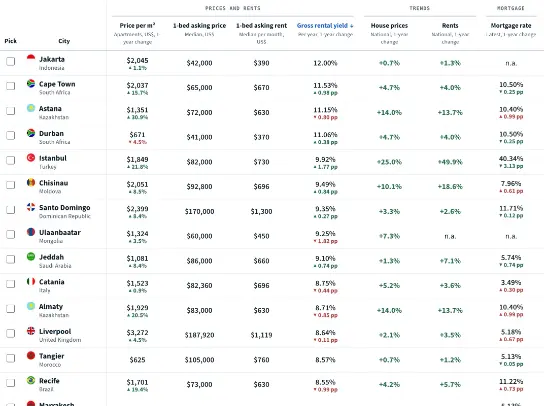
Turkey's rental yields are good, with a nationwide average gross rental yield of 7.13% in Q2 2024, up from 6.36% in the previous quarter, according to a recent Global Property Guide research.
In Istanbul, the gross rental yields on apartments - the return earned on the purchase price of a rental property, before taxation, vacancy costs, and other costs - range from 3.75% to 9.72% with a city average of 6.63% in Q2 2024. This is slightly higher as compared to the city average of less than 6% recorded in the past two years.
In other major cities:
- In Ankara, gross rental yields fall between 6.31% and 10.32%, with a city average of 8.19%.
- Antalya produces rental yields between 3.25% and 6.94%, with a city average of 5.17%.
- Izmir's rental yields range from 5.67% to 9.53%, with a city average of 7.22%.
- In Adana, gross rental yields are between 6.36% and 9.99%, with a city average of 8.12%.
- In Konya, gross rental yields range from 4.66% to 9.38%, with a city average of 7.08%.
- In Bursa, rental yields range from 6.38% to 7.49%, with a city average of 6.87%.
- Kayseri yields are between 6.45% and 9.23%, with a city average of 7.72%.
Round-trip transaction costs are reasonable in Turkey.
Mortgage Market
Residential mortgage growth slowing rapidly
The growth of the country's residential mortgage loans is slowing sharply and the size of the mortgage market relative to GDP is now shrinking.
In June 2024, the total value of outstanding housing loans increased by 1.9% to TRY 446.52 billion (US$13.33 billion), a sharp slowdown from y-o-y growth of 21.7% by end-2023, 20.4% in 2022, 7.5% in 2021, 39.7% in 2020, and 5.8% in 2019, based on figures from the Central Bank of the Republic of Turkey (CBRT).
By type of financial institution (as of June 2024):
- Deposit banks: total housing loans outstanding were up by just 1.1% y-o-y to TRY403.38 billion (US$12.05 billion), a sharp slowdown from an annual growth of 20.1% in 2023.
- Participation banks: housing loans outstanding were up by 9.6% y-o-y to TRY43.14 billion (US$1.29 billion), a deceleration from an annual growth of 38.4 in 2023.
- Development and investment banks: housing loans outstanding fell by 5.8% y-o-y to TRY6.02 million (US$179,610), in contrast to a huge growth of 332.3% in 2023.
Over the past seventeen years, housing loans in Turkey have grown by an annual average growth of about 23% from 2005 to 2023. Despite this, the size of the mortgage market relative to GDP has shrunk to below 2% in 2023, from 5.8% in 2016 - an indication that, on average, the economy is still growing faster than the residential mortgage market.

Historic Perspective
A brief history of Turkey's currency and debt crisis
The global crisis of 2008 caused house prices in Turkey to fall 14.65% (after inflation), then by 2.82% in 2009, by 3.54% in 2010, and by 2.39% in 2011. The market then surged between 2012 and 2016, largely due to the rising middle class gaining access to mortgage finance for the first time.
House price rises started to slow after the 2016 coup attempt due to economic and political turmoil, including terrorist attacks and political uncertainty. Istanbul's prime market particularly suffered in 2016, mostly due to the sharp depreciation of the Turkish Lira. The slower pace of house price rises continued in 2017 and 2018.
However President Recep Tayyip Erdogan, in response to multiple crises, continually expanded the Turkish economy. He needed to generate a feel-good atmosphere to change the constitution in 2017 and to win the presidential election in 2018. But putting his foot on the economic accelerator caused problems - an overheated economy, high inflation, a current account deficit, a debt build-up, and a currency decline - which have recently required tough measures from the central bank. High interest rates and economic restraint have had an impact on the economy which they always do, and one result has been a decline in real estate prices.
President Erdogan has long held eccentric views on monetary policy, believing that inflation is caused by high interest rates which he has dubbed the "mother and father of all evil". His views cowed the monetary authorities, and the result has been inflation, pushing the lira down.

This is ironic because Erdogan's period in office began with a conspicuous display of fiscal orthodoxy, causing housing loan rates to decline sharply from an average of 48.43% in 2002 to just 9.7% in 2013 - one of the great successes of Turkey's AKP government. However as inflation took off, housing loan interest rates started to rise again to double digits and by December 2018, the average interest rate was 27.82%.
After falling to a record low of 9.11% in July 2020 as the government facilitated access to credit to stimulate the economy amidst the Covid-19 pandemic, housing loan interest rates have risen sharply again, reaching 20% in December 2022, despite several rate cuts by the central bank amidst surging inflation. Interest rates for housing loans surged further to a whopping 42.1% in December 2023 and to 44.1% in July 2024.
Inflation averaged 15% annually from 2017 to 2021, before surging to an annual average of 62% in 2022 to 2023.
Rising inflation has sapped the currency, but the lira's sharp nosedive in September 2018 was partly attributable to Turkey's worsened relationship with the US, which raised import tariffs on Turkish steel by 50% and on aluminum by 20% in protest at the detention of American pastor Andrew Brunson, who faced charges in relation to the failed coup attempt in 2016. Brunson was released after two years of detention.
The current account deficit widened from US$33.1 billion in 2016 to US$47.5 billion in 2017, a surge of almost 44%, according to the CBRT. The Turkish Lira plunged to TRY 6.3 per USD 1 in September 2018, from TRY 3.48 per USD 1 the previous year - an almost 45% drop. The lira has remained weak since.
Turkey has now amassed a large amount of foreign-currency debt due to years of current account deficits but does not have sufficient reserves to support its liabilities.
The current account balance recorded a surplus of US$1.67 billion in 2019, its first and highest surplus since 2001, largely due to the lira's decline. However, the current account balance returned to deficit in recent years, as the COVID-19 pandemic hit. Turkey run a current account shortfall of US$36.7 billion in 2020 and US$14.88 billion in 2021. Then in 2022, the deficit climbed further to US$49.1 billion. In 2023, Turkey's current account deficit narrowed slightly to US$45.2 billion.
The country's budget deficit widened by nearly 900% in a year marked by a presidential election and two ravaging earthquakes. During 2023, the budget deficit reached TRY1.4 trillion (US$41.8 billion), from TRY142.7 billion (US$4.26 billion) in the prior year, according to the Treasury and Finance Ministry.
In recent years, the Turkish lira lost about 69% of its value from just TRY 5.85 per USD 1 in December 2019 to TRY 18.66 per USD 1 in December 2022, as the central bank continued its unorthodox rate-cutting policy against a backdrop of soaring prices and trade imbalances. Despite soaring inflation, the central bank slashed its key interest rate by 1,000 basis points from September 2021 to February 2023 demanded by President Erdogan to buoy economic growth.
However, with persistently high inflation, the central bank started to reverse gear and aggressively raise its key interest rates. In March 2024, the central bank raised its benchmark one-week repo rate by 500 basis points to 50%, its ninth consecutive rate hike in recent months. It is now the highest level since April 2002. The benchmark interest rate has been raised by a cumulative 4,150 basis points, from 8.5% in June 2023 to 50% in March 2024 where it remained unchanged since.
Despite this, the Turkish lira lost another 43.3% of its value against the US dollar in just nineteen months, reaching a monthly average exchange rate of TRY 32.90 = USD 1 in July 2024.

Socio-Economic Contex
Turkish economy continues to grow, inflation remains elevated
Turkey's economy grew by about 4.5% during 2023, following annual expansions of 5.5% in 2022, 11.4% in 2021, 1.9% in 2020, and 0.8% in 2019, buoyed by strong household spending and improved investor confidence, based on figures released by the International Monetary Fund (IMF).
"The recent actions to raise the policy rate, increase taxes, and liberalize some financial sector measures have reduced risks and lifted investor confidence, compressing spreads and improving the reserve position of the Central Bank of the Republic of Türkiye (CBRT)," said the IMF.
The IMF projects the Turkish economy to expand by a modest 3.6% in 2024 - more optimistic as compared to the World Bank's forecast of a 3% growth.
"Longstanding macro and structural challenges that undermine potential growth-including high inflation, low productivity growth, low labor force participation, and employment levels, and weakening foreign direct investment-would require robust fiscal measures and ambitious structural reforms to help accelerate sustainable economic growth," said the World Bank.
The seasonally adjusted unemployment rate stood at 8.4% in May 2024, down from 8.5% in the previous month and 9.5% in the same period last year, according to TurkStat. The jobless rate was 7% for men and 11% for women. Overall unemployment averaged 10.6% from 2010 to 2023.

In July 2024, nationwide inflation was 61.78%, a slowdown from the previous month's 71.6% but still up from 47.83% in the same period last year, based on figures from TurkStat.
Inflation averaged 10.1% from 2004 to 2021, before skyrocketing to 72.3% in 2022. Inflation remained extraordinarily elevated at an average of 53.9% in 2023.

Sources:
- Residential Property Price Index, May 2024 (Central Bank of the Republic of Türkiye): https://www.tcmb.gov.tr/
- House Sales Statistics, June 2024 (Turkish Statistical Institute): https://data.tuik.gov.tr/
- Turkey offers citizenship to foreign property buyers (Al Jazeera): https://www.aljazeera.com/
- The measures transforming Turkey's property market (Property Turkey): https://www.propertyturkey.com/
- New Turkish citizenship rules to encourage investment (Daily Sabah): https://www.dailysabah.com/
- A Guide to Buying Property in Turkey for Expats - Pt. 2 (Ikamet): https://ikamet.com/
- Building Permits, Quarter I: January-March, 2024 (Turkish Statistical Institute): https://data.tuik.gov.tr/
- Consumer Prices (Central Bank of the Republic of Türkiye): https://www.tcmb.gov.tr/
- Banking Sector - Loans (Thousand TRY)(Monthly) (Central Bank of the Republic of Türkiye): https://evds2.tcmb.gov.tr/
- Gross rental yields in Turkey: Istanbul and 7 other cities (Global Property Guide): https://www.globalpropertyguide.com/
- How to Buy Property in Turkey as a Foreigner (Global Property Guide): https://www.globalpropertyguide.com/
- 'Luxury' homes in Turkey to attract new tax (Tranio): https://tranio.com/
- Turkey's economic crisis deepens as Trump doubles tariffs (The Guardian): https://www.theguardian.com/
- Turkey sees a modest improvement in its current account deficit (ING): https://think.ing.com/
- Türkiye's current account posts a lower-than-expected $5.3B gap (Daily Sabah): https://www.dailysabah.com/
- Turkey Relieved Despite Budget Deficit Blowout of Almost 900% (Bloomberg): https://www.bloomberg.com/
- Turkey interest rate (Trading Economics): https://www.reuters.com/
- Turkey country profile (BBC News): https://www.reuters.com/
- IMF Staff Concludes Staff Visit to Türkiye (International Monetary Fund): https://www.imf.org/
- Türkiye (The World Bank): https://www.worldbank.org/
- Labour Force Statistics, May 2024 (Turkish Statistical Institute): https://data.tuik.gov.tr/