Boom - or bubble - in Taiwan?
Taiwan has enjoyed four years of rising house prices. Prices rose by 8.86% across Taiwan in the year to end-Q1 2008, according to the Sinyi House Price Index. Residential property prices in Taipei city increased by 7.06% over the year.
Sales of upscale properties worth more than NT$30 million per unit (US$922,500) jumped 70% in the year to November 2007, according to a report by Yungching Real Estate Agency, while sales of houses costing less than NT$6 million (US$184,500) dropped 10%.
Real estate agents have observed a noticeable increase in returning Taiwanese businesspeople buying houses or apartments, especially in Taipei, thus boosting demand for luxury homes.
The election of president Ma Ying-jeou of the Kuomintang party (KMT) promises to boost the market further. The expectation is that Ma will move quickly to improve relations with China and will ease restrictions on real estate purchases by Chinese investors.
The Taiwanese press has been full of stories about the ‘property bubble’. Will it deflate suddenly? Will it deflate slowly? Or will it not deflate at all?
So serious has concern become that in April, Ma announced that he would take measures to curb speculative Chinese capital from disrupting the local real estate market. He suggested the new administration might forbid Chinese investors from reselling local property for five years after purchase.
|
More Global Property Guide pages: |
At the bottom end of the market the complaint is that house prices have climbed beyond ordinary affordability levels.
“With property prices soaring, many would-be homeowners, who have long felt they cannot afford their ideal homes, have become even more conservative and pessimistic," Professor Chang Chin-oh of National Chengchi University was quoted as saying in a press conference announcing the results of a survey by the Institute for Physical Planning and Information.
Chang added that further price increases would be the result of speculation, rather than home buyers investing their life savings in residences. More than 40% of a recent survey's 2,000 respondents expected real-estate prices to decline within a year, while only 26.4% believed prices would continue to rise.
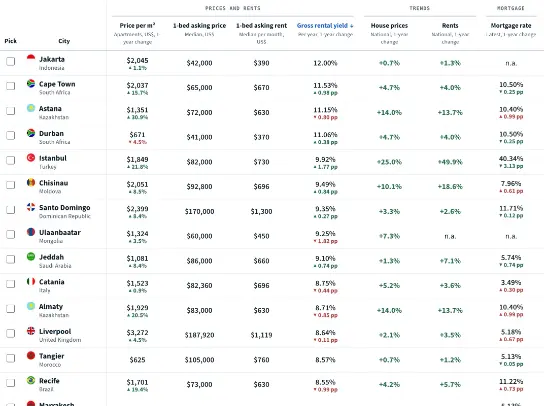
Gross rental yields in Taiwan are unusually low, often a sign of an overvalued market. It would take 42 years of rent payments to buy an apartment - the highest price/rent ratio in Asia, exceeding even the levels of Hong Kong, Singapore, and Bombay, India.
However, dramatic increases in interest rates are unlikely. Inflation was subdued in 2007 at around 1.5%. A warning was issued in April that inflation might possibly rise to 3.2% by the Chung-Hua Institution for Economic Research (CIER). This however exceeds estimates by the Directorate General of Budget, Accounting and Statistics, which forecast inflation rising only moderately this year, to 1.98%, while economic growth would be 4.3%.
Nevertheless, the high house prices are beginning to have their own effect. Time on market has increased, according to various surveys. Numbers of mortgage applications have fallen. Confidence in the property market’s prospects has declined to its lowest level since Q2 2003 when SARS hit the nation, according to the Institute for Physical Planning and Information survey.
Market analysts are nervous because they feel they have seen this before.
An extraordinary residential property boom took place from 1986 to 1991, associated with the stock market bubble.
There followed a bust from 1991 to 2002. By the end of 2002 property prices in Taipei City had dropped by around 20%, in Taipei County by 30%, in Taichung area by 40%, and in Kaohsiung area by 50%.
To revive the housing market, in October 2001 a bill allowing foreigners to buy property was ratified. Other measures included:
- Low-interest mortgage loans;
- Allowing enterprises with capital from mainland China to invest in Taiwan's real estate market;
- Slashing land value incremental tax rate
- Helping organize private asset management corporations; and
- Expanding the supply of new housing units to people with lower incomes, workers, government employees, and families of servicemen.
The base lending rate was lowered from 7.1% in 2002, to an average of 3.7% in 2003.
The medicine worked. The economy bounced back from negative growth of 2.2% in 2001. Taiwan’s GDP rose by 6.1% in 2004, by 4.0% in 2005, 4.6% in 2006 and 4.2% in 2007. The present housing boom has been the result.
Taiwan has one of the highest home ownership rates in the world at 87%, while social housing accounts for about 5% of households. And the trend towards home ownership is increasing. Because of this, Taiwan’s rental market is quite small, around 8% of around seven million households.