Switzerland Residential Property Market Analysis 2025 H1
Prices in the Swiss housing market are rising at an accelerated pace due to strengthening demand for owner-occupied homes, underpinned by improved financing conditions and a persistent mismatch between migration-driven population growth and lagging construction.
This extended overview from Global Property Guide covers key aspects of Switzerland’s housing market and takes a closer look at its most recent developments and long-term trends.
Table of Contents
- Housing Market Snapshot
- Supply and Demand Highlights
- Rental Market
- Mortgage Market
- Socio-Economic Context
Housing Market Snapshot
The growth of residential property prices in Switzerland is accelerating as demand for owner-occupied homes strengthens, driven by robust population growth and improved financing conditions, amid a persistently limited supply of new housing. In the first quarter of 2025, Wüest Partner's Transaction Price Index for privately owned apartments, published by the Swiss National Bank (SNB), registered a 4.42% year-on-year increase (4.05% inflation-adjusted), significantly above the 10-year average of 2.87%. On a quarterly basis, the index rose by 1.33% (1.07% inflation-adjusted).
Switzerland's house price annual change:
[hp_graph]
Single-family houses exhibited a similar pattern, with the index showing a 4.69% year-on-year increase (4.31% inflation-adjusted) and a 1.62% rise over the previous quarter (1.36% inflation-adjusted). Wüest Partner expects prices to continue rising throughout 2025, though at a more moderate pace, with projected annual growth of 3.6% for privately owned apartments and 3.8% for single-family homes.
These projections are consistent with the latest estimates from UBS, which foresee a 3-4% increase in residential property prices in 2025. While declining interest rates and improved financing conditions are expected to support the market, lingering geopolitical uncertainties may temper upward pressure. "We also assume prices for owner-occupied homes will rise in the medium term. A stable economy, low mortgage interest rates, and limited supply will further support people's willingness to pay up. But stretched affordability should limit any major price increases," the report stated.
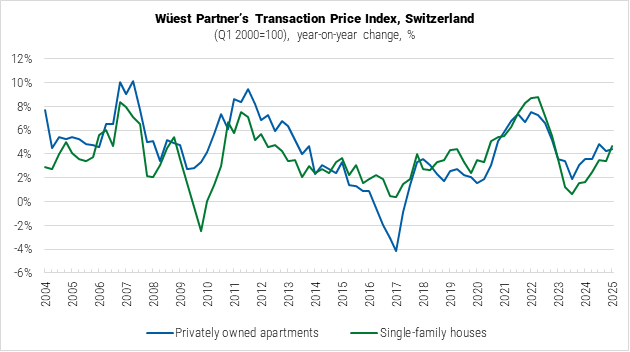
Data Source: Wüest Partner via SNB.
On a regional level, the strongest annual growth in apartment prices was recorded in Southern Switzerland (5.16%), the Bern region (5.10%), and the Zurich region (4.46%). For single-family homes, Western Switzerland led the market with a notable 7.26% year-on-year increase.
Regional price dynamics, Wüest Partner's Transaction Price Index:
| Region | Privately Owned Apartments, Q1 2025 vs Q1 2024, % |
Single-family Houses, Q1 2025 vs Q1 2024, % |
| Zurich region | 4.46% | 4.05% |
| Eastern Switzerland | 3.66% | 3.64% |
| Central Switzerland | 4.30% | 4.41% |
| Northwestern Switzerland | 2.88% | 5.04% |
| Bern region | 5.10% | 4.65% |
| Southern Switzerland | 5.16% | 5.41% |
| Lake Geneva region | 4.17% | 4.09% |
| Western Switzerland | 4.32% | 7.26% |
| Switzerland | 4.42% | 4.69% |
| Data Source: Wüest Partner via SNB. | ||
Zurich remains the most expensive city for apartment purchases, with average transaction prices reaching CHF 21,110 (USD 23,894) per square meter in Q1 2025, reflecting a 3.73% year-on-year increase. Geneva follows closely at CHF 20,960 (USD 23,724) per square meter.
Privately owned apartment prices in the five largest cities:
| Transaction price, CHF/sqm Q1 2025 |
Transaction price, USD/sqm Q1 2025 |
YoY, % Q1 2025 vs Q1 2024 |
|
| Zurich | CHF 21,110 | USD 23,894 | 3.73% |
| Bern | CHF 11,450 | USD 12,960 | 3.43% |
| Basel | CHF 13,090 | USD 14,816 | -0.08% |
| Lausanne | CHF 15,490 | USD 17,533 | 0.26% |
| Geneva | CHF 20,960 | USD 23,724 | 3.51% |
| Exchange rate as of March 2025, USD 1 = CHF 0.8835. | |||
| Data Source: Wüest Partner. | |||
This pricing trend is mirrored in the single-family home segment, with Zurich and Geneva maintaining their positions as the most expensive markets. As of Q1 2025, the national average price for a single-family home stood at CHF 1,220,000 (USD 1,380,872), while Zurich approached CHF 4,300,000 (USD 4,840,973), more than 3.5 times the national average. Geneva followed with an average of CHF 3,376,000 (USD 3,821,166).
Single-family house prices in the five largest cities:
| Transaction price, per unit, Q1 2025, CHF |
Transaction price, per unit, Q1 2025, USD |
YoY, % Q1 2025 vs Q1 2024 |
|
| Zurich | CHF 4,277,000 | USD 4,840,973 | 1.6% |
| Bern | CHF 2,186,000 | USD 2,474,250 | -0.5% |
| Basel | CHF 2,794,000 | USD 3,162,422 | 1.8% |
| Lausanne | CHF 2,753,000 | USD 3,116,016 | 7.4% |
| Geneva | CHF 3,376,000 | USD 3,821,166 | -0.5% |
| Exchange rate as of March 2025, USD 1 = CHF 0.8835. | |||
| Data Source: Wüest Partner. | |||
Foreign buyers face specific restrictions when purchasing property in Switzerland. The Federal Act on the Acquisition of Immovable Property in Switzerland by Foreign Non-Residents (ANRA, also known as the Lex Koller) requires prior authorization within an annual permit quota for non-residents. Authorization rules vary by canton, and further details are available through the Federal Office of Justice (FOJ) and the Federal Land Registry and Real Estate Law Office.
Supply and Demand Highlights:
Population Growth and Lagging Construction Sustain Price Pressures
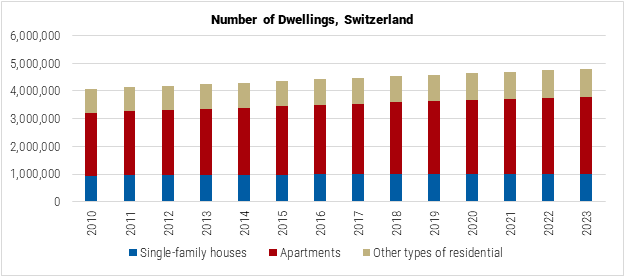
According to the Federal Statistical Office (FSO), Switzerland's housing stock comprised more than 1.79 million residential buildings with a total of 4.79 million dwellings at the end of 2023. Multifamily apartment buildings account for approximately 58% of all dwellings, while single-family homes represent about 21%.
Switzerland remains largely a nation of tenants, with 58% of dwellings occupied by tenants or subtenants. Owner-occupied single-family homes make up 24% of the total housing market, owner-occupied apartments account for 12%, and the remaining 6% are occupied by cooperative members or provided rent-free.
Data Source: FSO.
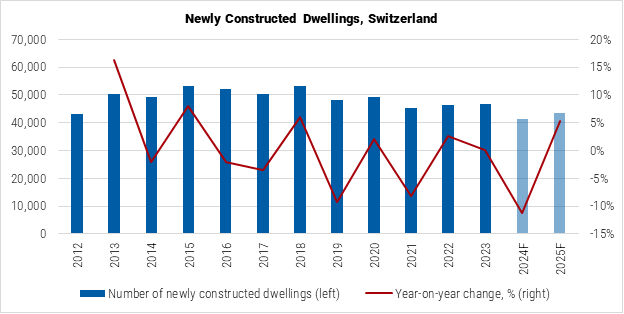
During the peak years between 2013 and 2018, an average of more than 51,000 new dwellings were completed annually. In recent years, however, the pace of new construction has slowed significantly. Wüest Partner estimates that only 41,300 units were delivered in 2024, representing an 11.28% year-on-year decline. A slight recovery is anticipated in 2026, with projections of 43,500 new units.
According to UBS, sentiment in the residential construction sector is showing signs of improvement, as the number of building applications begins to rise, supported by interest rate cuts, better financing conditions, and stabilizing construction costs. However, the growing discrepancy between the number of applications and approved permits points to increasingly complex and time-consuming approval procedures. "An increase in housing production is probably not yet expected this year, but it is realistic for 2026," noted the Federal Office for Housing (FOH) in its most recent market overview.
This outlook is echoed in the Q2 2025 construction index published by the Swiss Contractors' Association (SBV), which suggests a rebound in housing construction in the second half of 2025 and growth extending into 2026. However, the association remains cautious, stating: "It is unlikely that the required 50,000 new homes per year will be built."
Data Sources: FSO, Wüest Partner.
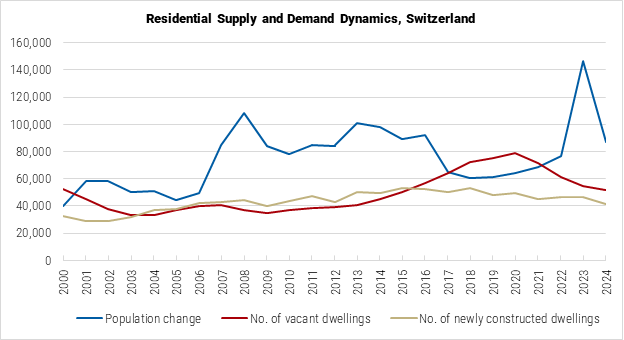
At the same time, demand pressures continue to mount. Switzerland's population grew by nearly 147,000 in 2023, driven primarily by net migration, which accounted for around 139,000 people, including more than 50,000 Ukrainian nationals fleeing conflict. While net population growth eased to around 86,600 in 2024, the persistent undersupply of housing continues to strain market conditions.
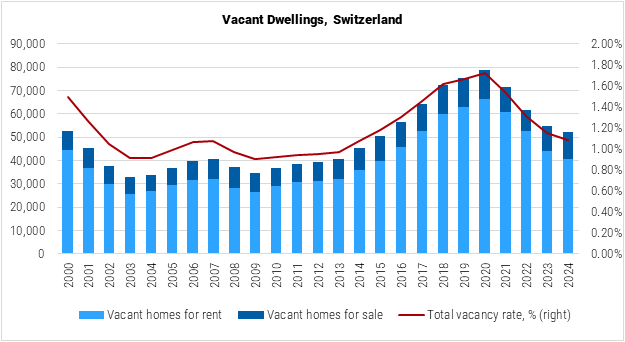
From a peak of 1.7% in 2020, the national housing vacancy rate, reported by FSO annually, has declined for four consecutive years, reaching 1.08% in June 2024 - its lowest level in nearly a decade and a rate last seen in 2014. The International Monetary Fund (IMF) previously noted that Switzerland has "one of the lowest vacancy rates among OECD countries."
Note: The number of newly constructed dwellings in 2023 and 2024 includes Wüest Partner estimates.
Data Sources: FSO, Wüest Partner.
The downward trend in vacancies has been most pronounced in the rental market. In 2024, the number of unoccupied rental apartments dropped by 8.6% year-on-year to 40,423 units, a continuation of the tightening that began in 2021. By comparison, the number of vacant rental apartments fell by 13.5% in 2022 and 15.9% in 2023.
In contrast, the number of owner-occupied flats available for sale rose by 9.5% - an increase of 999 units - to a total of 11,551, reflecting the lingering effects of elevated mortgage interest rates since late 2021. However, this trend is expected to reverse as financing conditions continue to ease. Raiffeisen Switzerland observed: "With the consensus forming around a return to a prolonged low interest rate environment, the financial appeal of homeownership is strengthening once again. Demand for owner-occupied housing is likely to increase not only due to improved financing conditions but also as a result of a tight and increasingly competitive rental market. This is prompting financially secure tenants with strong equity positions to shift their focus toward purchasing homes."
Data Source: FSO.
The supply-demand imbalance is particularly severe in Switzerland's largest urban centers. In Zurich, the housing vacancy rate has remained below 0.22% since 2000, while Geneva also continues to face acute shortages, with vacancy rates in some surrounding municipalities even lower than those within the city.
As of 2024, the national vacancy rate for rental apartments stood at 1.4%, while rates for owner-occupied apartments and single-family homes were 0.6% and 0.7%, respectively, according to Wüest Partner. Zurich's rental apartment vacancy rate was just 0.1%, highlighting the ongoing scarcity of housing in the country's major metropolitan areas.
Housing vacancy rate in the five largest cities:
| Rental | Owner-occupied | |||||
| Rental Apartments Stock, 2023 |
Vacancy Rate, June 2024 |
Owner-occupied apartments stock, 2023 |
Vacancy Rate, June 2024 |
Single-family Houses Stock, 2023 |
Vacancy Rate, June 2024 |
|
| Zurich | 199,100 | 0.1% | 26,500 | 0.0% | 9,500 | 0.0% |
| Bern | 67,100 | 0.5% | 11,000 | 0.0% | 4,000 | 0.1% |
| Basel | 85,800 | 0.9% | 12,400 | 0.1% | 6,300 | 0.2% |
| Lausanne | 68,900 | 0.6% | 10,500 | 0.2% | 2,200 | 0.3% |
| Geneva | 97,700 | 0.6% | 14,700 | 0.3% | 700 | 0.7% |
| Switzerland | 2,815,600 | 1.4% | 962,100 | 0.6% | 1,016,600 | 0.7% |
| Data Sources: FSO, Wüest Partner. | ||||||
Rental Market:
Slower Growth in Asking and Existing Contract Rents
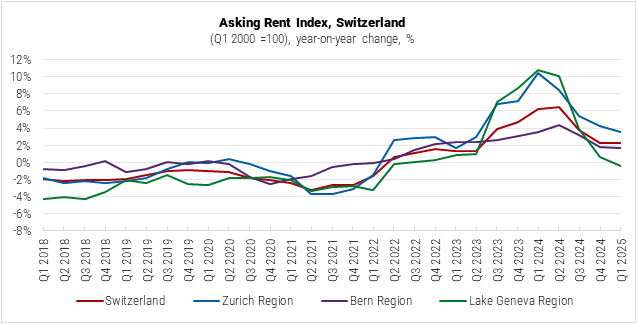
Strong demand for rental housing, fueled by limited supply in major centers and international immigration, continues to drive up rental rates across Switzerland, although rental inflation has slowed significantly in the second half of 2024 and early 2025. In Q1 2025, the nationwide asking rent index published by the SNB based on Wüest Partner data increased by 2.25% year-on-year, down from the 6.26% growth observed a year prior in Q1 2024. Regionally, the most pronounced annual growth was reported in Central Switzerland (4.87%) and Zurich with the surrounding region (3.58%), while asking rents in the Lake Geneva region recorded an annual 0.39% decline.
Switzerland's rent price index:
[rp_graph]
The slowing trend for asking rent inflation is likely to continue this year. "Although further rises in asking rents are likely in the current year, the rate of increase can be expected to slow somewhat," said the latest property market report from Julius Bär. "On the one hand, the acquisition of privately owned property has become more attractive once again for affluent households due to lower interest rates. On the other hand, construction activity in the Swiss multi-family housing segment is gradually picking up due to the resurgence in appeal of property market investments."
Existing rents can also be expected to grow at a slower pace this year after the mortgage reference rate (which is used to determine rent adjustments in existing agreements) was reduced from 1.75% to 1.50% in March 2025.
Data Source: Wüest Partner via SNB.
According to Wüest Partner reporting, the median annual asking rent for apartments in Switzerland reached CHF 240 (USD 272) per square meter of usable space in Q1 2025, up from CHF 230 during the same period in 2024 and CHF 220 in 2023. Regionally, the highest asking rents were observed in Zurich and Geneva, with median annual rents in both cities at CHF 420 (USD 475).
Slower growth in rents compared to sales prices translates into weaker potential performance of rental properties as investment assets. According to the research carried out by Global Property Guide in April 2025, gross rental yields for residential units in Switzerland averaged 2.96%, down from 3.04% previously reported in October 2024. Regionally, the highest yields among the assessed submarkets were observed in the cantons of Valais (3.80%) and Fribourg (3.35%), while Zurich, Geneva, Bern, Vaud, and Aargau all showed yields below 3%.
The latest property market report from Wüest Partner shows even lower estimates for prime properties in major metropolitan centers, with yields for rental apartments in this category ranging from 2.40% in Basel to 2.15% in Geneva and only 1.70% in Zurich, as of Q4 2024.
The rental segment of the housing market in Switzerland maintains its attractiveness to investors, however, according to experts. "Strong demand for rental apartments is providing buoyancy to the residential investment property segment in particular. The outlook for direct real estate investment markets remains positive, despite a trend of more rigorous regulation," believes Julius Bär.
Apartment asking rents in major centers:
| Median Annual Rent, CHF/per sqm Q1 2025 |
Median Annual Rent, USD/per sqm Q1 2025 |
YoY, Q1 2025 vs Q1 2025 |
|
| Zurich | CHF 420 | CHF 475 | 5.0% |
| Bern | CHF 270 | CHF 306 | 3.8% |
| Basel | CHF 260 | CHF 294 | 4.0% |
| Lausanne | CHF 300 | CHF 340 | 3.4% |
| Geneva | CHF 420 | CHF 475 | 5.0% |
| Exchange rate as of March 2025, USD 1 = CHF 0.88351. | |||
| Data Sources: Wüest Partner. | |||
With more than 60% of households living in rented housing and a large share of rental dwellings owned by institutional landlords rather than private individuals (over 43% nationwide, according to the FSO data), government regulation of the rental sector remains a highly relevant issue for Switzerland, with key updates on changes in housing policies and tenancy law published by the Federal Office for Housing (FOH).
At the end of November 2024, two highly debated issues relating to subletting and lease termination were decided by a popular vote, with citizens rejecting both changes in the law, which would give more power to landlords.
More recently, in March 2025, the Federal Council amended the Ordinance on Tenancies and Leases for Residential and Commercial Premises (OBLF) to increase the transparency of rental leases and allow tenants to better assess the initial rent in new contracts and whether there are grounds to challenge it. The changes will go into effect from October 2025.
In May 2025, the Swiss Tenants' Association (Asloca) launched a nationwide popular initiative aimed at controlling rising rents. It proposes rent-setting based on actual costs and a limited return, as well as automatic and regular rent monitoring to avoid excessive charges by landlords. If it gained sufficient support, the initiative could spark a national debate about the balance between housing affordability and market dynamics, a dilemma increasingly central to Switzerland's politics.
Mortgage Market:
Lower Interest Rates Support Growth in New Lending
In the second half of 2024 and early 2025, the SNB continued to lower its policy rate, the most recent 25 b.p. cut in March bringing it to the current standing of 0.25%. Based on global and domestic developments in recent months, the experts from UBS anticipate further easing of the central bank's stance this year. "Since the SNB's last monetary policy assessment in March, the outlook for the global financial situation and the Swiss economy has worsened. Consequently, we are currently assuming that there will be a further interest rate cut and a key interest rate of 0% from June 2025," said their May 2025 interest rate forecast.
Switzerland's mortgage loan interest rates:
[mortgage_graph]
The overall ease in inflation and corresponding monetary policy dynamic reflected in published interest rates on new mortgages, which decreased year-on-year for all categories of loans, according to the SNB data. Variable mortgage rates and rates linked to SARON (average overnight interest rate on the secured money market) continued to decrease gradually. At the same time, while remaining below last year's levels, published rates for fixed-rate mortgages ticked up in the first three months of 2025, in line with interest rate movements in the capital market. As of March 2025, the average interest on fixed-rate mortgages reached 2.03% for 10-year loans and 2.33% for 15-year loans.
The mortgage reference rate published by the Federal Office for Housing, based on average interest on existing loans and used to determine rent adjustments, has been reduced from 1.75% to 1.50% in March 2025 and has remained unchanged since. "Due to the high proportion of fixed-rate mortgages in Switzerland, the decline in mortgage interest rates over the course of 2024 showed with a certain delay but became apparent in the reference interest rate published on 3 March 2025. As the underlying average mortgage rate dropped from 1.63% to 1.52%, the reference interest rate was lowered," UBS commented in their latest real estate outlook.
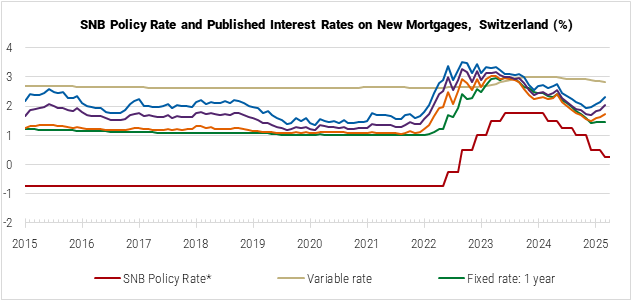
*SNB policy rate applied from June 2019; for prior periods, the SNB target for the three-month Swiss franc Libor is displayed.
Data Source: SNB.
Published interest rates on new mortgage loans:
| Avg Interest Rate, March 2025 |
YoY | Avg Interest Rate, March 2024 |
YoY | Avg Interest Rate, March 2023 |
|
| Variable rate | 2.84% | ↓ | 3.00% | ↑ | 2.71% |
| SARON-linked rate: 3-year maturity | 1.38% | ↓ | 2.54% | ↑ | 2.12% |
| SARON-linked rate: 5-year maturity | 1.42% | ↓ | 2.57% | ↑ | 2.16% |
| SARON-linked rate: unlimited maturity | 1.38% | ↓ | 2.61% | ↑ | 2.26% |
| Fixed rate: 1-year maturity | 1.44% | ↓ | 2.34% | ↓ | 2.93% |
| Fixed rate: 5-year maturity | 1.72% | ↓ | 2.23% | ↓ | 3.04% |
| Fixed rate: 10-year maturity | 2.03% | ↓ | 2.38% | ↓ | 3.14% |
| Fixed rate: 15-year maturity | 2.33% | ↓ | 2.64% | ↓ | 3.32% |
| Data Sources: SNB. | |||||
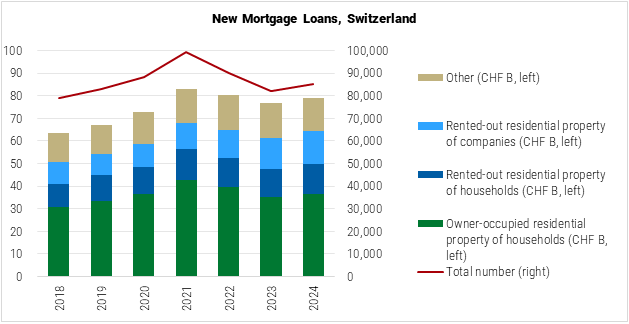
Lower interest rates led to solid increases in mortgage lending volumes. According to the central bank's data, 85,378 new mortgage loans amounting to CHF 79.0 billion (USD 89.8 billion) were advanced in 2024, a 3.9% annual increase in volume and a 2.8% annual increase in the total value of new lending, both indicators, however, still below the peak levels observed in 2021.
Of the newly originated mortgages, the largest share was represented by owner-occupied residential properties of households (47.6%), the remaining amount split between rental properties of households (17.1%), rental properties of companies (19.0%), and other types of mortgages (19.1%).
The most pronounced growth in new loans value (7.7% year-on-year) was observed in the rental properties of households category.
Data Source: SNB.
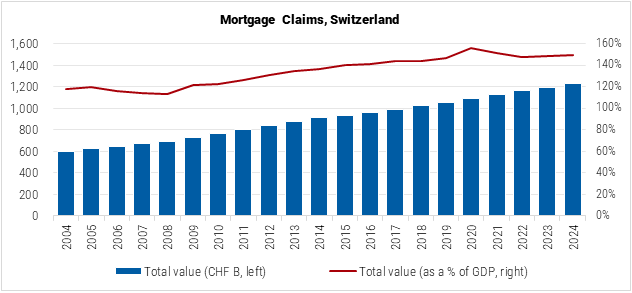
The total value of mortgage claims held by banks in Switzerland continues to grow steadily. In 2024, it expanded by 3.2%, following a 2.3% increase in 2023, 3.7% in 2022, and 3.4% in 2021. As of March 2025, the mortgage stock stood at CHF 1.24 trillion (USD 1.40 trillion).
Sized against the Swiss economy, the mortgage market moderated from the pandemic-related 156.1% spike in the ratio of outstanding loans to GDP at current prices in 2020 to an estimated 149.0% in 2024. The ratio, however, continues to trend upward long-term, compared to about 136% a decade ago and about 118% two decades ago.
Data Sources: SNB, SECO.
Socio-Economic Context:
Inflation Subdued, Growth at Below-Average Levels
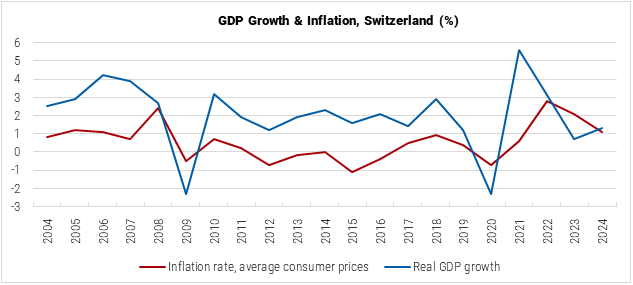
The real GDP growth of the Swiss economy accelerated from 0.7% in 2023 to 1.3% in 2024, although, when correcting for accounting effects, actual economic growth in Switzerland remained at around 1%, according to the European Commission. In the upcoming periods, private consumption is expected to remain the primary driver of growth, fueled by a robust labor market and rising real wages in the context of moderate inflation. At the same time, investment growth is projected to remain subdued in view of the uncertain international environment. The latest European Commission projections see the economy expanding by 0.8% in 2025 and 1.5% in 2026, which is in line with the forecast from the International Monetary Fund (IMF), expecting 0.9% and 1.6% growth in the respective periods.
The spring 2025 economic forecast from the State Secretariat for Economic Affairs (SECO) highlights the considerable uncertainty weighing on the global, and consequently, Switzerland's economic outlook, stating that even without escalation of the global trade war, the Swiss economy "would continue to grow below its historical average for another two years".
At the same time, after easing from 2.8% in 2022 to 2.1% in 2023 and 1.1% in 2024, the Consumer Price Index (CPI) inflation in the country was most recently reported by the FSO in the negative territory at -0.1% in May 2025. The indicator is expected to remain subdued in 2025 and 2026, reflecting lower international energy prices and the strength of the Swiss currency. The IMF expects the annual inflation level to reach 0.2% in 2025 and 0.5% in 2026.
Data Source: IMF.
Immigration remains a key factor for Switzerland's economy. According to the data published by the FSO, net migration to the country has been persistently positive for over two decades, contributing to the labor force growth and helping to counter the declines in the domestic population. While dropping from the peak level of 131.1 thousand people in 2023, the net migration in 2024 remained historically high, reaching 87.1 thousand people.
In the first four months of 2025, the State Secretariat for Migration (SEM) reported net foreign migration of permanent residents at 25.9 thousand, compared to 28.2 thousand during the same period last year.
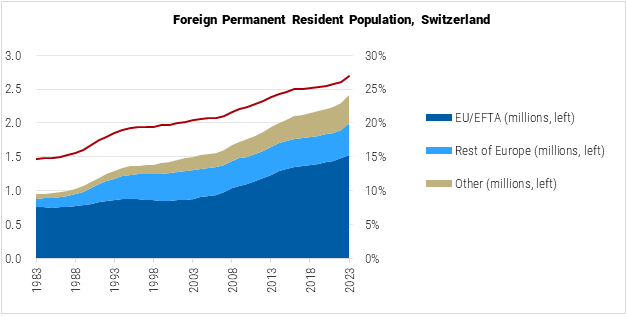
Overall, according to the FSO, between 1983 and 2023, the foreign population (including stateless persons and other non-Swiss categories) permanently residing in Switzerland grew from about 946 thousand to 2.4 million, its share in the total population increasing from 14.7% to 27.0%.
Data Source: FSO.
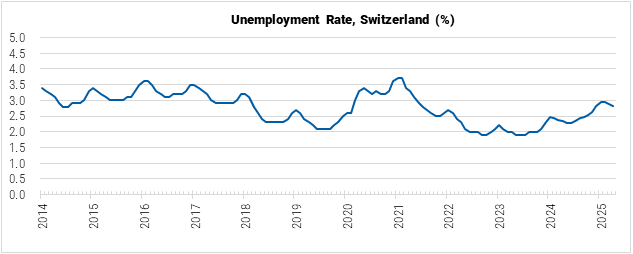
Supported by the consistent inflow of foreign workers, the Swiss labor market remains resilient, although unemployment has risen from the historic lows observed in the previous years. "Labor market developments were subdued in the past three months," noted the SNB in its latest quarterly bulletin. "Employment continued to grow at a below-average rate, while unemployment increased."
According to the figures reported by the State Secretariat for Economic Affairs (SECO), in April 2025, the nationwide unemployment rate reached 2.8%, up from 2.3% and 2.0% during the same period in 2024 and 2023, respectively. The authority's most recent forecast expects the indicator to average 2.8% in 2025 and 2026.
At the same time, even though recruitment difficulties decreased, companies in Switzerland continue to have trouble finding suitable personnel, according to the national job statistics cited by the SNB. Previously, the 2024 Article IV staff report from the IMF listed labor shortages and skill gaps among medium-term challenges affecting the development of the Swiss economy.
Data Source: SECO via FSO.
In general, the high-value-added Swiss economy demonstrates resilience in the face of challenges; it continues, however, to experience headwinds from a number of internal and external factors, including demographic trends, skills gaps, regional conflicts, and lower trading partner growth. In addition, the current outlook is characterized by significant uncertainty over the US tariff rates and their implementation timelines.
In April 2025, Fitch Ratings affirmed the country's 'AAA' standing with a stable outlook, citing its strong credit fundamentals, low debt levels, and stable public finances, as well as the reserve currency status of the Swiss franc. At the same time, the potential direct and second-order (via the EU) impact of tariffs on investments and exports poses downside risks to growth.
Sources:
- Swiss National Bank (SNB)
- SNB Data Portal: https://data.snb.ch/
- Real Estate Price Indices: https://data.snb.ch/
- Foreign Exchange Rates - Month: https://data.snb.ch/
- Monetary Policy Assessment of 20 March 2025: https://www.snb.ch/
- Quarterly Bulletin 1/2025: https://www.snb.ch/
- Federal Statistical Office (FSO)
- Gross Domestic Product: https://www.bfs.admin.ch/
- Consumer Prices: https://www.bfs.admin.ch/
- Population Statistics: https://www.bfs.admin.ch/
- Components of Population Change: https://www.bfs.admin.ch/
- International Migration: https://www.bfs.admin.ch/
- Foreign Permanent Resident Population Change: https://www.bfs.admin.ch/
- Situation on the Labor Market in April 2025 (FR): https://www.bfs.admin.ch/
- Dwellings Statistics: https://www.bfs.admin.ch/
- Empty Dwellings Census: https://www.bfs.admin.ch/
- Rented Dwellings: https://www.bfs.admin.ch/
- Tenants/Owners: https://www.bfs.admin.ch/
- Federal Office for Housing (FOH)
- Reference Interest Rate (FR): https://www.bwo.admin.ch/
- Tenancy Law (FR): https://www.bwo.admin.ch/
- Housing policy (FR): https://www.bwo.admin.ch/
- Housing Market Overview (FR): https://www.bwo.admin.ch/
- Annual Report 2024 (FR): https://www.bwo.admin.ch/
- Housing Market Overview II/2025 (FR): https://www.bwo.admin.ch/
- The Federal Council
- Popular Vote on 24 November 2024: https://www.admin.ch/
- News Service of the Swiss Government
- The Federal Council Amends the OBLF to Increase the Transparency of Rental Leases (FR): https://www.news.admin.ch/
- State Secretariat for Economic Affairs (SECO)
- Economic Forecasts: https://www.seco.admin.ch/
- Gross Domestic Product Quarterly Data: https://www.seco.admin.ch/
- State Secretariat for Migration (SEM)
- Foreigners Statistics (FR): https://www.sem.admin.ch/
- Federal Office of Justice (FOJ)
- Acquisition of Property by Foreign Non-Residents: https://www.bj.admin.ch/
- Publication Platform for Federal Law (Fedlex)
- Federal Act on the Acquisition of Immovable Property in Switzerland by Foreign Non-Residents: https://www.fedlex.admin.ch/
- Swiss Contractors' Association (SBV)
- Construction Index (FR): https://baumeister.swiss/
- International Monetary Fund (IMF)
- Country Overview: Switzerland: https://www.imf.org/
- European Commission
- Spring 2025 Economic Forecast, EFTA: https://economy-finance.ec.europa.eu/
- Wüest Partner
- Property Market Switzerland 2025 | 2: https://www.wuestpartner.com/
- Property Market Switzerland 2024 | 2: https://www.wuestpartner.com/
- UBS
- Price Developments on the Real Estate Market: https://www.ubs.com/
- Real Estate Focus 2025: https://www.ubs.com/
- Switzerland Real Estate Outlook - Edition May 2025: https://www.ubs.com/
- Mortgage Interest Rates: Interest Rate Forecast and Trend: https://www.ubs.com/
- Julius Bär
- Property Market Report Switzerland, Q1 2025: https://realestate.juliusbaer.com/
- Raiffeisen Switzerland
- Real Estate Study: Unloved but Necessary Replacement Building (DE): https://www.raiffeisen.ch/
- Fitch Ratings
- Fitch Affirms Switzerland at 'AAA'; Outlook Stable: https://www.fitchratings.com/
- Reuters
- Swiss Voters Reject More Powers for Landlords on Subletting: https://www.reuters.com/
- RTS
- Asloca Launches an Initiative to Counter Rising Rents (FR): https://www.rts.ch/