Poland's Residential Property Market Analysis 2025 H1
The Polish housing market moves towards stabilization, with notable moderation in the growth of sales prices and rents against the background of softer demand and slower development activity.
This extended overview from Global Property Guide covers key aspects of the Polish housing market and takes a closer look at its most recent developments and long-term trends.
Table of Contents
- Housing Market Snapshot
- Demand Highlights
- Supply Highlights
- Rental Market
- Mortgage Market
- Socio-Economic Context
Housing Market Snapshot
After a period of strong acceleration at the turn of 2023 and 2024, Poland's housing market is showing signs of stabilization, with annual house price growth moderating over the past three quarters. This deceleration follows the ruling coalition's failure to reach a consensus on reinstating a subsidized mortgage program for first-time buyers. The initiative, originally introduced by the previous Law and Justice (PiS) government, was widely credited with fueling one of the fastest rates of house price growth in the EU. As market confidence in the program's return diminished, upward price momentum began to weaken.
In the first quarter of 2024, the average price of existing homes sold across Poland's seven largest urban markets - Warsaw, Gdańsk, Gdynia, Kraków, Łódź, Poznań, and Wrocław - stood at PLN 13,404 (USD 3,463) per square meter, representing an 8.12% increase year-on-year, according to data from the National Bank of Poland (NBP). Growth in the primary market was more subdued, with prices rising by 4.44% year-on-year to an average of PLN 14,265 (USD 3,686) per square meter.
Poland's house price annual change:
[hp_graph]
Regional price disparities remain pronounced across the cities monitored by the NBP. Bydgoszcz remains the most affordable market, with average transaction prices ranging from PLN 7,417 (USD 1,916) per square meter for existing homes to PLN 9,389 (USD 2,426) for new units. At the opposite end of the spectrum, Warsaw continued to lead, with average prices reaching PLN 16,459 (USD 4,253) for secondary properties and PLN 16,383 (USD 4,233) for new dwellings. Kraków and Wrocław followed as the next most expensive urban markets.
Average prices of transacted dwellings in key submarkets:
| Avg price of secondary dwellings transacted in Q1 2025, PLN/sqm |
YoY, % Q1 2025 vs Q1 2024 |
Avg price of primary dwellings transacted in Q1 2025, PLN/sqm |
YoY, % Q1 2025 vs Q1 2024 |
|
| Warsaw | PLN 16,459 (USD 4,253) |
8.07% | PLN 16,383 (USD 4,233) |
3.07% |
| Kraków | PLN 15,099 (USD 3,901) |
10.58% | PLN 15,686 (USD 4,053) |
6.62% |
| Łódź | PLN 7,799 (USD 2,015) |
4.05% | PLN 9,781 (USD 2,527) |
0.27% |
| Wrocław | PLN 12,675 (USD 3,275) |
9.32% | PLN 14,257 (USD 3,684) |
11.06% |
| Poznań | PLN 10,831 (USD 2,799) |
6.06% | PLN 12,328 (USD 3,185) |
5.25% |
| Gdańsk | PLN 12,279 (USD 3,173) |
0.31% | PLN 13,240 (USD 3,421) |
6.91% |
| Gdynia | PLN 11,544 (USD 2,983) |
8.23% | PLN 12,907 (USD 3,335) |
7.81% |
| Note: Exchange rate as of March 2025, USD 1 = PLN 3.87022. | ||||
| Data Source: NBP. | ||||
Despite a notable decline in demand and a record-high supply of listings, the outlook for the housing market remains broadly stable. "In 2025, we anticipate the market will move towards greater equilibrium. We do not expect price declines, although the rate of growth is likely to align with or fall slightly below the level of inflation," commented Leszek Stankiewicz, Vice President of the Management Board and CFO at Dom Development.
Tomasz Mądry, Senior Analyst on the Sustainable Development team at the Polish Economic Institute (PIE), highlighted the potential impact of monetary policy, noting that anticipated interest rate cuts could spur demand for housing loans and exert upward pressure on prices. However, this is expected to be tempered by a substantial pipeline of unsold inventory and new completions throughout the year. Experts from PKO Bank Polski added: "We do not expect prices to return to the levels seen in the first half of 2023, particularly if the forecast 100-basis-point rate cut materializes in 2025."
Demand Highlights:
Sales Dip Moderates, Setting Stage for Stabilization
Demand for housing in Poland continues to feel the aftershocks of earlier policy changes and elevated borrowing costs. Primary market sales remained under pressure, hindered by persistently high interest rates and ongoing uncertainty surrounding future housing policy. According to JLL data cited by the NBP, 39,649 new residential units were sold across the six largest markets in 2024, representing a 31.18% year-on-year drop. In Q1 2025, the pace of decline eased but remained significant, with 9,100 units sold, down 17.47% from the same period last year.
"Mortgage rates remain elevated," noted JLL experts. "At the same time, political proposals to increase taxes on the third and subsequent apartments are discouraging investors. Some households are holding off, waiting for the government's subsidized loan program, while others are hoping for price reductions or special promotions. Ongoing geopolitical instability is also dampening buyer sentiment."
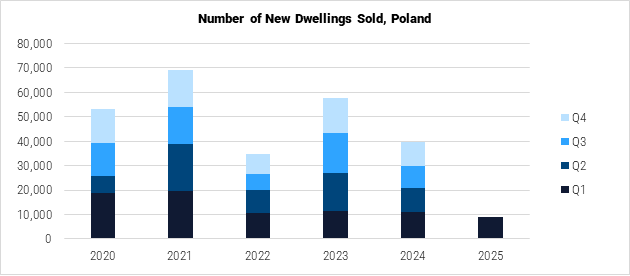
Note: Aggregated data for the Warsaw, Kraków, Wrocław, Tri-City, Poznań and Łódź.
Data Source: NBP based on JLL data.
Regionally, Kraków saw the steepest year-on-year decline in new units sold in Q1 2025 at 27.78%, followed by Łódź (25.00%) and Poznań (23.08%). The mismatch between supply and demand continues to grow in several markets, extending the average time needed to sell new units. "Warsaw remains the most favorable market in this respect, followed closely by Tri-City," said JLL. "But the rising stock of unsold new properties in Kraków and Wrocław means both cities are now facing the same imbalance as Poznań. In Łódź, the situation is most challenging - the current stock would take over two years to clear at today's sales pace."
Number of new dwellings sold by submarket:
| Submarket | Number of New Dwellings Sold, Q1 2025 |
YoY change, % |
| Warsaw | 3,100 | -16.22% |
| Kraków | 1,300 | -27.78% |
| Łódź | 900 | -25.00% |
| Wrocław | 1,300 | -7.14% |
| Poznań | 1,000 | -23.08% |
| Tri-City | 1,500 | -6.25% |
| Data Source: JLL. | ||
Despite recent declines, market experts expect demand to stabilize, supported by broad-based wage growth and additional impulse from interest rate reductions. A report by Otodom and Polityka Insight anticipates that "[In 2025] sales will not return to the levels seen in 2020-2021 or 2023, but they should remain stable, avoiding a major downturn or a wave of developer bankruptcies." However, the report also cautions about the effects of the potential housing policy changes, with new regulations sometimes introduced suddenly and reshaping the market. Past government interventions have temporarily boosted demand but often led to volatility once the support was withdrawn.
At the same time, foreigners are becoming a significant force in Poland's housing market, especially in major urban centers and their suburbs. A recent survey among leading developers, prepared by RynekPierwotny.pl, highlights a systematic increase in interest from foreign buyers, with the share of clients from outside Poland exceeding 30% in selected development projects in 2024. The largest group consists of Ukrainian citizens, followed by Belarusians and individuals from various Asian as well as Central and Eastern European countries.
"We're seeing a clear upward trend, especially among clients planning long-term settlement in Poland with families, jobs, and children's education," noted Zachariasz Nercz, Member of the Board and Director of Marketing and Sales at Novisa Development. "For many, buying property is not just a personal decision but also an investment, as Poland's real estate market is viewed as stable and full of potential." Grzegorz Woźniak, CEO of Q3D Locum, added that the trend is driven by Poland's growing appeal as a place to live and work, economic stability compared to neighbors, and still-attractive real estate prices.
Supply Highlights:
Construction Activity Eases Amid Softening Demand and Policy Changes
Despite a cooling in housing demand, residential construction remained strong in 2024. According to data from Statistics Poland, 233,832 residential dwellings were started nationwide, marking a 23.66% increase compared to the previous year. In contrast, the number of dwellings completed declined by 9.56% year-on-year, reflecting the sharp drop in building permits issued in 2022 following the economic slowdown triggered by the Russia-Ukraine conflict and a significant reduction in new housing investment.
In the first quarter of 2025, the trend began to shift. A total of 48,382 dwellings were completed, down 4.87% year-on-year, while the number of dwellings started dropped by 7.26% to 55,717. "This decline is not necessarily a cause for concern," says Patryk Kozierkiewicz, legal counsel at the Polish Association of Developers (PZFD). "It stems from a high baseline at the beginning of last year, when developers accelerated investment in response to strong demand created by the 'Safe 2% Mortgage' program and expectations of further government support."
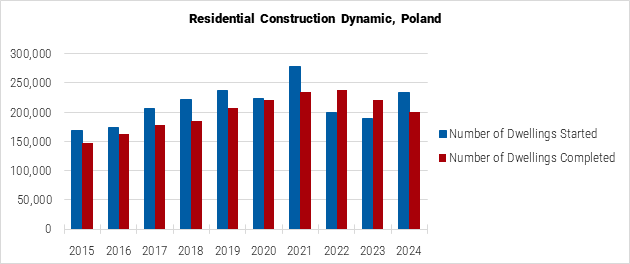
Data Source: Statistics Poland.
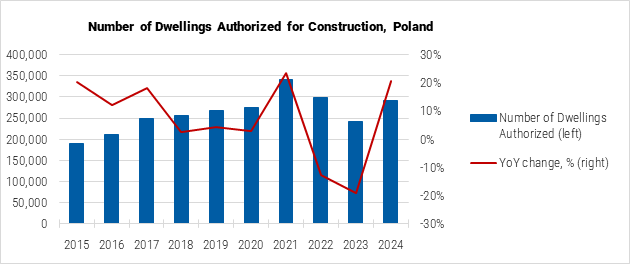
A key forward-looking indicator - the number of building permits issued - also showed strong performance in 2024. A total of 291,280 dwellings were authorized for construction, a 20.58% increase year-on-year. Experts at Cushman & Wakefield attribute this to two major regulatory developments: the introduction of new technical standards in the second quarter of 2024 and the upcoming urban planning reform set to take effect in January 2026.
"There is a risk that the reform will make many undeveloped plots ineligible for future construction, particularly in areas not designated for infill development," Cushman & Wakefield experts explain. "This has prompted investors, rather than developers, to seek permits proactively to avoid future restrictions. In many cities, the permitting process remains lengthy and challenging. As a result, plots with valid permits are becoming more valuable, with owners often choosing to wait for more favorable market conditions before building."
In early 2025, however, the pace of permit issuance slowed. Between January and March, 61,864 dwellings were authorized, down 11.58% year-on-year, according to Statistics Poland. Experts from RynekPierwotny.pl point to a high comparison base, as many developers rushed to file applications in early 2024 ahead of the new regulations. On the other hand, Patryk Kozierkiewicz of the PZFD notes that the decline may reflect subdued demand and a surplus of unsold units. "If developers are struggling to sell existing stock, they're likely to postpone new projects," he says. "This could lead to fewer dwellings started in the coming quarters, particularly among smaller firms that lack the capacity to manage multiple developments."
Data Source: Statistics Poland.
With a record number of new units already on the market, looking ahead, developers are expected to remain cautious about launching new projects. However, the situation could shift if demand rebounds. Announcements from the Monetary Policy Council about potential interest rate cuts may improve credit affordability and encourage hesitant buyers to return. "Stronger demand would improve sales absorption and create the conditions for renewed investment activity," says Kozierkiewicz.
Jarosław Jędrzyński, an expert at property portal RynekPierwotny.pl, adds that supply-side activity in the second half of 2025 will hinge on macroeconomic factors, particularly interest rates and government programs. "If the policy environment supports a pickup in demand, we could see the first signs of sustained recovery in both transactions and new construction starts emerging later in the year," he concludes.
Rental Market:
Moderate Rent Increases and Growing PRS Sector
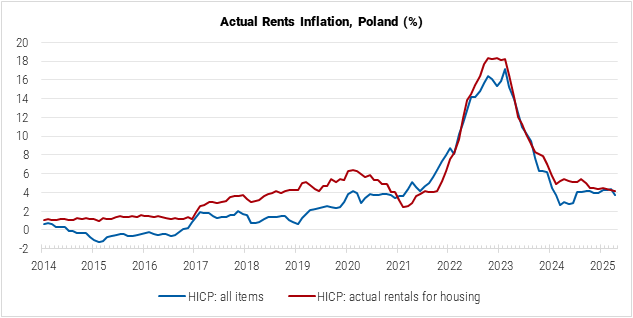
Along with the overall stabilization of the macroeconomic landscape in the country, rental inflation in Poland has been moderating, with the most recent data from Eurostat showing a 4.2% annual increase in the actual rentals for housing component of the Harmonized Index of Consumer Prices (HICP) in April 2025, down from 5.4% reported a year ago and only slightly above the all-items HICP year-on-year growth, which stood at 3.7%.
Poland's rent price index:
[rp_graph]
"The stable, moderate pace of growth results from the expiration of a number of shocks that have affected the rental market in recent years: the pandemic, inflation, the influx of refugees, the housing boom," explained Polityka Insight analytical platform in their latest quarterly report on the situation on the housing market prepared together with the real estate platform Otodom.
Data Source: Eurostat.
In nominal terms, according to the March 2025 rental market report from Otodom, the average asking rent in Poland stood at PLN 3,581 (USD 925) - the lowest level since September last year and about 2% higher than in March 2024. Based on data from listings on the Otodom platform, the rental market has experienced moderate but systematic rate increases, by an average of 0.3% from month to month in the last year.
Regionally, the average asking rents varied significantly between the largest Polish cities, ranging from PLN 2,019 (USD 522) a month in Kielce to PLN 4,906 (USD 1,268) in Warsaw, with the capital city consistently maintaining its leading position in terms of rent, followed by Kraków, Tri-City, and Wrocław.
In parallel, gross rental yields for apartments in Poland averaged 6.13%, according to research by Global Property Guide conducted in March 2025, slightly up from 6.03% previously reported in September 2024. Among the monitored regional submarkets, the highest average yield was observed in Bydgoszcz (6.65%), Warsaw (6.49%), and Gdańsk (6.27%), while the lowest potential performance was estimated in Poznań (5.36%).
Average asking rent in key submarkets:
| City | Average monthly rent, PLN March 2025 |
Average monthly rent, USD March 2025 |
YoY, March 2025 vs March 2024 |
| Warsaw | PLN 4,906 | USD 1,268 | 0.3% |
| Kraków | PLN 3,273 | USD 846 | 3.7% |
| Łódź | PLN 2,191 | USD 566 | 3.9% |
| Wrocław | PLN 3,057 | USD 790 | 0.3% |
| Poznań | PLN 2,564 | USD 662 | 3.4% |
| Tri-City | PLN 3,164 | USD 818 | 3.0% |
| Note: Exchange rate as of March 2025, USD 1 = PLN 3.87022. | |||
| Data Source: Otodom. | |||
Overall, the Otodom analysis suggests that the rental market in Poland is now gradually moving to balance, demonstrating moderate but steady growth in asking rates and increases in supply listed for rent against persistently high demand.
As of 2024, 12.9% of Polish households were tenants, according to Eurostat figures. Apart from additional demand in metropolitan areas generated by Ukrainian refugees and other foreign migrants in recent years, rental demand in the country is largely driven by young people migrating to major cities for higher education or job opportunities. "For young Poles, often students, who are in the first stage of adult life or want to be more mobile due to various forms of employment, renting an apartment is the first choice," points out a 2025 Living Sector in Poland report from JLL, noting that the trend is long-term and likely to continue.
On the supply side of the Polish rental market, the role of institutional landlords representing the dynamically evolving private rental sector (PRS) can be expected to become more prominent. In a recent report, Cushman & Wakefield estimated the country's PRS stock at over 21,000 apartments in the largest cities (39% of those concentrated in Warsaw), with another 25,000 to be added in the coming years by already announced projects.
Mortgage Market:
Lending Volumes Boosted by Subsidized Program, Interest Rates Decline Gradually
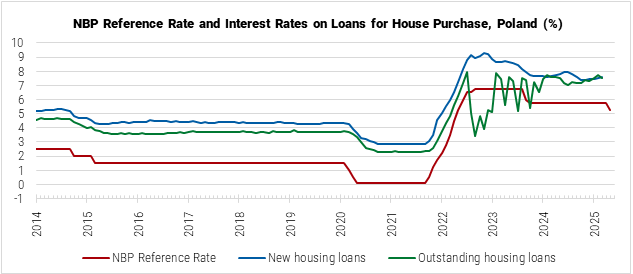
In early May 2025, the NBP announced a 50 b.p. cut to its policy benchmarks, bringing the reference rate to 5.25%. The first reduction since September 2023 was prompted by a favorable inflation forecast and weaker economic activity observed in the country in the first quarter of the year. At the same time, the regulator remains cautious of the domestic and international uncertainty factors that could impact further policy shifts.
Poland's mortgage loan interest rates:
[mortgage_graph]
"Further decisions of the Council will depend on incoming information regarding prospects for inflation and economic activity. Developments in demand pressure and situation in the labor market in subsequent quarters, as well as the level of administered energy prices and further fiscal policy measures, remain an uncertainty factor. Uncertainty stems also from inflation developments abroad, following, among others, from changes in trade policies of major economies," said the central bank in a press release.
Data Source: NBP.
This recent downward adjustment of the NBP reference rate has not yet been reflected in the average interest rates on loans to households for house purchase in Poland, which, however, stabilized somewhat over the last year. The average interest rate on PLN-denominated new housing loans has been decreasing gradually from the late-2022 peak levels and was most recently reported at 7.57% in March 2025, the same trend observed for loans of varying initial rate fixation periods. For outstanding PLN-denominated housing loans, the average interest rate reached 7.55%, only marginally down from the same period a year prior but above the level observed two years ago in March 2023.
Average interest rates on PLN-denominated loans to households for house purchase:
| Mar 2025 | YoY | Mar 2024 | YoY | Mar 2023 | |
| New housing loans | 7.57% | ↓ | 7.63% | ↓ | 8.68% |
| - Floating rate and IRF up to 3 months | 7.88% | ↓ | 8.03% | ↓ | 9.21% |
| - IRF of over 3 months and up to 1 year | 8.10% | n/a | n/a | n/a | n/a |
| - IRF of over 1 year | 7.47% | ↓ | 7.51% | ↓ | 8.33% |
| Outstanding housing loans | 7.55% | ↓ | 7.58% | ↑ | 7.44% |
| - Original maturity up to 1 year | n/a | n/a | n/a | n/a | n/a |
| - Original maturity over 1 and up to 5 years | 8.14% | ↑ | 7.72% | ↓ | 8.39% |
| - Original maturity of over 5 years | 7.55% | ↓ | 7.58% | ↑ | 7.43% |
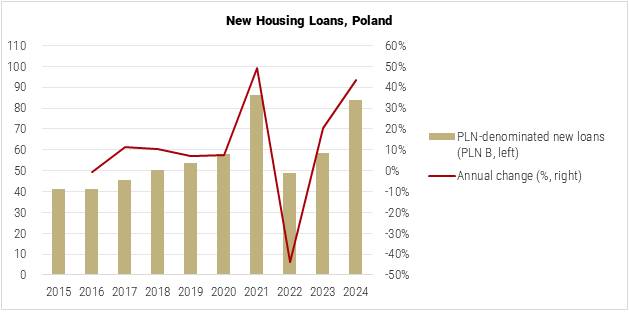
While the average interest rates on new loans have been decreasing gradually, demand for mortgages in Poland spiked in 2023-2024, boosted by the state-subsidized "Bezpieczny Kredyt 2%" (2% Safe Mortgage) program. Based on the figures reported by the NBP, the total value of PLN-denominated new loans for house purchase issued between January and December 2024 reached PLN 83.9 billion (USD 21.1 billion), a 43.2% increase compared to the 2023 level.
Originally intended to improve housing affordability in the country, the subsidized loans program has been criticized for contributing to the accelerated growth of residential property prices in Poland. In response, the authorities abandoned the plans for the follow-up initiative "Kredyt na Start" (Start Credit) previously announced in 2024, and developed a new preferential loan program called "Pierwsze Klucze" (First Keys), which is expected to improve first-time buyers' access to cheaper properties on the secondary market, rather than fueling demand for new developments.
"We are eliminating from support [coverage] what is offered on the primary market. Not a single złoty from this program will go to developers," Minister of Development Krzysztof Paszyk said at a press conference dedicated to Poland's housing strategy in February 2025.
Data Source: NBP.
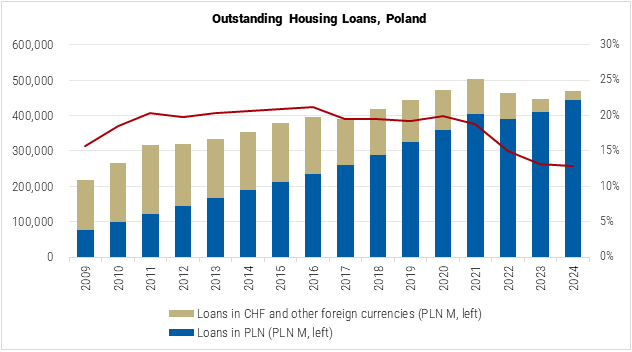
The notable increase in new lending volumes reversed the overall shrinking of the mortgage market in Poland observed in the previous two years. Based on the banking sector data published by the NBP, after decreasing by 7.8% in 2022 and 3.4% in 2023, the housing loan stock in the country registered a 4.8% year-on-year growth in 2024. As of March 2025, the total value of outstanding housing loans in Poland stood at PLN 472.3 billion (USD 122 billion), of which 95.3% were PLN-denominated loans and 4.7% were loans denominated in foreign currencies.
At the same time, the relative size of the market, represented by the ratio of outstanding housing loans to GDP at current prices, continued to decline, dropping from an estimated 20.0% in 2020 to 13.1% in 2023 and 12.9% in 2024. According to the most recent Eurostat figures, 11.3% of Polish households are homeowners with an outstanding mortgage or housing loan.
Data Sources: NBP, Statistics Poland.
Socio-Economic Context:
Growth Picks Up, Set to Remain Robust
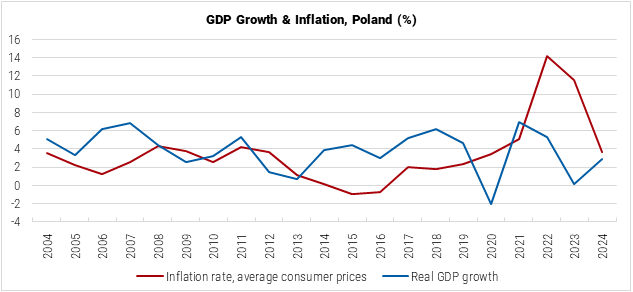
After a notable slowdown to just 0.1% annual growth in 2023, Poland's economy rebounded, supported by private consumption underpinned by rising real wages, increased government spending on benefits for families, and receding inflationary pressures. The real GDP growth reached 2.9% in 2024 and is expected to accelerate further this year. The European Commission expects the Polish economy to grow by 3.3% in 2025 and 3.0% in 2026, which is in line with projections from the International Monetary Fund (IMF), currently at 3.2% and 3.1%, respectively.
Consumer Price Index (CPI) inflation in the country has fallen steeply from the average annual level of 11.5% in 2023 to 3.7% in 2024 and was most recently reported by Statistics Poland at 4.3% in April 2025. The IMF projects the indicator at 4.3% in 2025 and 3.4% in 2026.
Data Source: IMF.
At the same time, the country's fiscal deficit widened to 6.6% of GDP in 2024, as permanent increases in public sector wages and social benefits, as well as higher than estimated defense investments, outweighed savings from the lower cost of energy support measures. According to the European Commission's assessment, in 2025, public spending in Poland is set to remain high, driven by increasing defense spending, interest expenditures, indexation of pensions, and new social benefits, including the 'Active Parent' program, social contribution holidays for entrepreneurs, and the widow's pension.
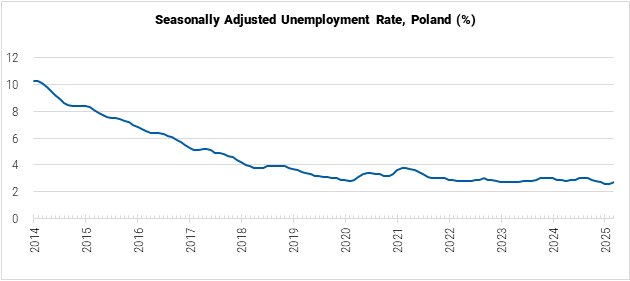
Employment in the Polish labor market fell in 2024 but is projected to remain broadly stable in 2025 and pick up in 2026. The nationwide seasonally adjusted unemployment rate was reported by Eurostat at 2.7% in March 2025 and is expected to remain broadly stable in the next two years, according to the European Commission.
Data Source: Eurostat.
Overall, as outlined in the 2025 Article IV staff report from the IMF, the Polish economy has roughly doubled in size over the last two decades, demonstrating growth among the fastest historically for an economy of its income level and size, and notably improving its social indicators. After weathering the successive COVID and energy shocks, the country's near-term outlook has improved, and the ongoing recovery is now supported by recently unlocked NexGen EU Funds (NGEU). Longer-term economic prospects for Poland, however, are clouded by fiscal pressures and domestic and global headwinds to growth, including diminishing cost competitiveness, population aging, and a subdued growth outlook in the main trading partners.
In March 2025, Fitch Ratings affirmed Poland's 'A-' standing with a stable outlook, pointing out that the country's large and diversified economy and a record of sound macroeconomic policies anchored by EU membership are currently balanced against wider fiscal deficits, lower (albeit rising) income levels, and weaker governance indicators.
The vector of the country's development in the upcoming years is expected to be defined by the outcome of the 2025 presidential elections, which went into a run-off scheduled for June 1 after the first round in May failed to determine a winner between the leading contenders: the centrist Mayor of Warsaw Rafał Trzaskowski and the right-wing candidate Karol Nawrocki.
Sources:
- Statistics Poland
- Residential Construction in the Period of January-December 2024: https://stat.gov.pl/
- Residential Construction in the Period of January-March 2025: https://stat.gov.pl/
- Poland Macroeconomic Indicators: https://stat.gov.pl/
- Consumer Price Indices in April 2025: https://stat.gov.pl/
- National Bank of Poland (NBP)
- House Prices Database: https://nbp.pl/
- Information on Apartment Prices and the Situation on the Residential and Commercial Real Estate Market in Poland in Q4 2024 (PL): https://nbp.pl/
- NBP Interest Rates: https://nbp.pl/
- Interest Rate Statistics: https://nbp.pl/
- Banking Sector Financial Data: https://nbp.pl/
- Press Release from the Meeting of the Monetary Policy Council Held on 6-7 May 2025: https://nbp.pl/
- Information on Home Prices and the Situation in the Housing and Commercial Real Estate Market in Poland in Q4 2024 (PL): https://nbp.pl/
- Core Inflation: https://nbp.pl/
- Government of the Republic of Poland
- 2% Safe Mortgage and Home Savings Account Now Available to Poles: https://www.gov.pl/
- First Apartment Program (PL): https://www.gov.pl/
- #naStart Housing Loan on the Legislative Path (PL): https://www.gov.pl/
- Key to the Apartment (PL): https://www.gov.pl/
- Draft Act on Investments and Housing Loans "First Keys" (PL): https://www.gov.pl/
- European Commission
- Economic Forecast for Poland: https://economy-finance.ec.europa.eu/
- Distribution of Population by Tenure Status, Type of Household and Income group: https://ec.europa.eu/
- HICP - Monthly Data (Annual Rate of Change): https://ec.europa.eu/
- Unemployment by Sex and Age - Monthly Data: https://ec.europa.eu/
- International Monetary Fund (IMF)
- Country Overview: Poland: https://www.imf.org/
- 2024 Article IV Staff Report: https://www.imf.org/
- Republic of Poland: Selected Issues: https://www.imf.org/
- Federal Reserve Economic Data (FRED)
- Currency Conversions: US Dollar Exchange Rate: Average of Daily Rates: National Currency: USD for Poland: https://fred.stlouisfed.org/
- JLL
- Residential Market in Poland, Q1 2025: https://www.jll.pl/
- Cushman & Wakefield
- Marketbeat Poland: Residential Sector Q4 2024: https://assets.cushmanwakefield.com/
- Polish Economic Institute (PIE)
- Housing Prices in Poland are Stabilizing (PL): https://pie.net.pl/
- PKO Bank Polski
- Economic Outlook 2025: A Voyage Into the Unknown (PL): https://centrumanaliz.pkobp.pl/
- Otodom
- Rental Market Report - March 2025 (PL): https://www.otodom.pl/
- Polityka Insight
- Housing Quarterly: Report on the Situation on the Housing Market in Q4 2024 (PL): https://www.politykainsight.pl/
- Fitch Ratings
- Fitch Affirms Poland at 'A-'; Outlook Stable: https://www.fitchratings.com/
- Strefa Inwestorów
- Real Estate Market Forecasts: Here's How Developer Company CEOs See Apartment Prices In 2025 (PL): https://strefainwestorow.pl/
- CEO Magazine Poland
- More and More Foreigners are Buying Apartments in Poland - a Growing Trend in Large Cities (PL): https://ceo.com.pl/
- Poland Insight
- Foreigners are Buying More Apartments in Poland - a Growing Trend in Major Cities: https://polandinsight.com/
- 2025 Begins Cautiously: Fewer Building Permits, Stable Number of New Housing Projects: https://polandinsight.com/
- Q1 2025 Housing Investment Data Signals Cautious Optimism: https://polandinsight.com/
- Investor Real Estate Expert Portal
- Growth Recovery of Residential Construction in 2024 (PL): https://investorrealestateexpert.co/
- Polish Press Agency (PAP)
- "Key to the Apartment" program. Minister: Support Only for Purchases From the Secondary Market (PL): https://www.pap.pl/
- Politico
- Centrist Warsaw Mayor Narrowly Wins Polish Presidential Vote - But Runoff Looms: https://www.politico.eu/