House of Badawi crumbling, housing market vulnerable too
Creeping political uncertainty in Malaysia is hurting the economy, the stock market and the housing market as well.
Prime Minister Abdullah Ahmad Badawi faces allegations of cronyism, ineptness and corruption. His fiercest critic is no less than Mahathir Mohammad, his mentor, anointer and predecessor. The opposition, led by former deputy prime minister Anwar Ibrahim, claim they have the numbers to topple Badawi.
Adding to the already volatile situation is historically high fuel and food prices. Although Malaysia is an oil exporter, pump prices were raised by 40% in June 2008, agitating the people.
Weak consumer and business confidence combined with high inflation have led to a slack in demand for housing. Although property prices are still inching up, there is a substantial amount of oversupply of mid-price to luxury condominiums, especially in Kuala Lumpur, the capital.
Several property developers such as Glomac and Selangor Dredging are reviewing their property launches. They have cited rising construction costs amid slowing demand for residential properties as the reasons for the review.
As the end to the political impasse is nowhere in sight, the housing market is likely to languish. No immediate nominal price falls are expected but inflation-adjusted figures will show price falls.
House price changes
In 2007, the house price index rose 4.8% (2.6% in real terms), according to Bank Negara Malaysia statistics - an improvement on the 2.1% price increase in 2006 and 2.3% rise in 2005. When adjusted for inflation, house prices fell by 1.4% in 2006 and by 0.7% in 2005.
In Kuala Lumpur, house prices increased by 7.9% (5.7% in real terms) in 2007, following price increases of 5.3% (1.7%) in 2006, 6.5% (3.35%) in 2005 and 6.5% (5%) in 2004. All other states registered stronger price increases in 2007 than in the previous two years.
The relatively strong performance of residential prices in 2007 was due partly to strong economic growth, at 6.3% in 2007 and 5.9% in 2006. Low interest rates have also been pushing Malaysian households to look at putting their money elsewhere than in the bank. Finally, the Employees Provident Fund (EPF) now allows monthly mortgage withdrawals from Account II (a change which could potentially free inject RM9 billion cash annually into the housing market).
Despite the recent price increases, house price indices in Malaysia are still below their pre-Asian Crisis level. House prices rose rapidly in the early 1990s with two particularly dramatic upward surges – in 1991, when 25.5% (20.3% in real terms) price rises were achieved, and in 1995 which saw 18.4% price growth (14.7% in real terms). After the Asian Crisis hit Malaysia, prices fell 39% between 1997 and 1999 for luxurious detached houses in Kuala Lumpur.
Over-supply concerns
The growing supply of high-end condominiums is something of a concern, as rental take-up rates have not matched supply. Some analysts, such as the CLSA, suggest that some discrimination is likely to take place between iconic projects in prime locations, with some pressure on the prices of other projects.
The subdued mass market is generally due to the constant flow of supply of mass housing for poor households, as a result of the government’s attempt to make housing more affordable. From 2004 to 2008, more than 100,000 low cost housing units were built by various government agencies nationwide. According to a Global Property Guide study on housing affordability, Malaysia has one of the lowest house-price-to-income ratios in Asia.
|
More Global Property Guide pages: |
Malaysia’s rental market is small, only 6% of the housing stock is in the private rental sector. About 85% of the total stock is owner-occupied, while government-provided housing accounts for 7% of the housing stock.
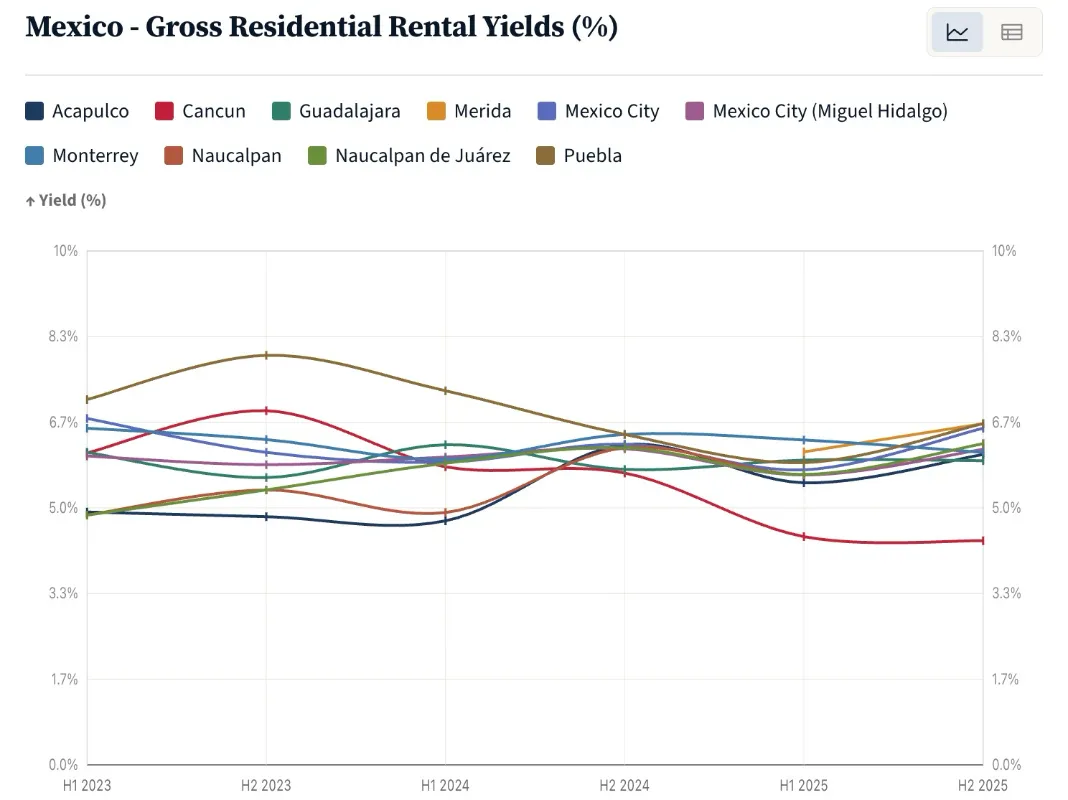
The active luxury rental market caters mainly to expatriates, centred on Kuala Lumpur. Rental yields in Kuala Lumpur are relatively healthy, ranging from 5% to 8% with smaller units earning higher yields.
Ownership limits eased, CGT abolished
Foreign ownership rules were relaxed in Dec 21, 2006. Foreigners no longer need to ask permission from the government when buying properties worth MYR250,000 (approx US$74,000) or above. Further, the limit on the number of properties foreigners can buy has been removed. There are also no more restrictions on the use of property. Before, foreigners could only buy at most two units, and they could not use them investment purposes.
The relaxation of the foreign ownership limits is in line with “Malaysia: My Second Home Programme.” The programme allows people who meet certain criteria to stay in the country as long as possible on a social visit pass with a multiple entry visa.
In addition, the government abolished capital gains tax in April 2007 to boost the property sector. Previously, non-resident individuals were charged Real Property Gains Tax (RPGT) at a flat rate of 30% on gains made on the disposal of real property within the first five years, and 5% thereafter.