Japan’s growth tails off
Japan's property market has slowed in the past few months, after the growth of the past few years. The reason is the ripple effect of the credit squeeze triggered by the U.S. subprime mortgage loan crisis.
This follows a significant recovery in Japanese property prices. There was a 8.41% rise during 2007 (8.62% when adjusted for inflation) in the six cities land price index (In Japan, land prices are used as a proxy for residential prices). This follows a 4.12% rise in 2006, a 0.89% fall in 2005. So after years of stagnation, the momentum has been up.
Both residential and commercial land prices in Tokyo and its neighbours — Kanagawa, Saitama and Chiba prefectures — have grown at double-digit rates between the October-December quarter of 2006 and the January-March quarter of 2008, according to independent appraiser Sanyu Appraisal Corp. in Tokyo.
Now there is a pause. Outside the US and Europe, Japan has been the hardest hit by the credit crunch. In March, Reicof, a listed property investor, failed with debts of Y42.6 billion (US$422 million).
Deals are now being postponed, and the credit squeeze is hitting private real estate funds, which tend to be highly leveraged, and have borrowed mainly from foreign banks. These private funds are finding it hard to refinance and are being forced to unload property. Both foreign and domestic banks in Japan have cut real estate lending, becoming more conservative in the wake of the subprime loan crisis.
|
More Global Property Guide pages: |
There is the possibility that more small real estate companies could go bankrupt as a result of the credit squeeze. However The Financial Services Agency, Japan's financial regulator, in its attempt to prevent the creation of another property bubble like the early 1990s, has put pressure on banks not to make excessive loans – so the impact on the financial system of any downturn would probably be limited.
The picture is somewhat mixed, because the total number of condominiums sold dropped 14.2% to 133,000 units in 2007, according to Tokyo-based Real Estate Economic Institute Co., which is forecasting a third consecutive decline in 2008.
Post-war recovery
From the sixties to the eighties, Japan achieved one of the highest economic growth rates in the world, with an annual growth of 8%.
As part of PM Tanaka Kakuei’s macroeconomic policy, money supply was increased rapidly; leading to rampant speculation in the commodities and real estate markets. By 1980 land prices had risen by 235.85% in the six biggest cities, and by 181.9% nationally since 1970.
Property speculation continued into the 1980s resulting in a massive housing bubble. Between 1980 and 1990, urban residential land prices in the six biggest cities rose by another 272% (and 103% nationally). The Stock Market index also rose by 542% over the same period.
When the government put on the brakes to control inflation, it led to the biggest financial crash in modern Japanese history. When the Japanese stock market crashed in 1989, it wreaked havoc on the financial system. Banks found themselves under heavy pressure to find capital to meet international standards, but easy capital to borrow didn’t come around easy.
To exacerbate the problem, the local real estate bubble burst in 1991. Many loans to small businesses were backed by property, and three quarters of the local banks' lending were to these small businesses. The result was more than a decade of economic stagnation.
Housing Investment
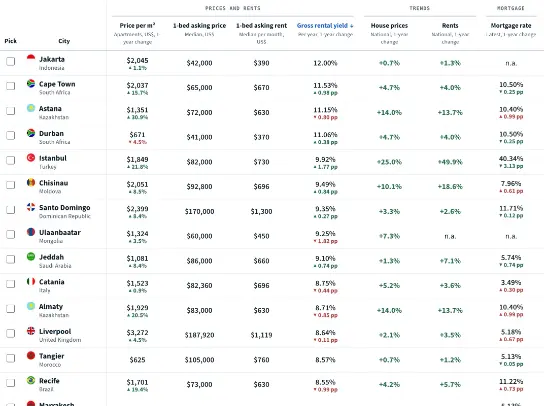
Despite the relatively slow growth of the Japanese economy, on normal metrics the Japanese housing market is a good investment option. House prices have been falling faster than rents. Therefore gross rental yields are high.
Global Property Guide research shows that the gross rental yield for properties in Tokyo ranges from 4.7% to 7.2%. This is high for a country where mortgage interest rates are around 2%.
From 1995 to 2005, rents fell by 11.4% nationwide and by 10.7% in Tokyo. Over the same period, residential land prices in Japan fell by 32% and 40% in Tokyo. The result is that the property market yields are now quite attractive.