Indonesia’s real estate boom on hold
After many hopeful signs of recovery, Indonesia’s housing market took a hit in 2008. Though the national house price index rose 5.6% during the year to end-Q2 2008, adjusted-for-inflation prices actually fell by 4.2%.
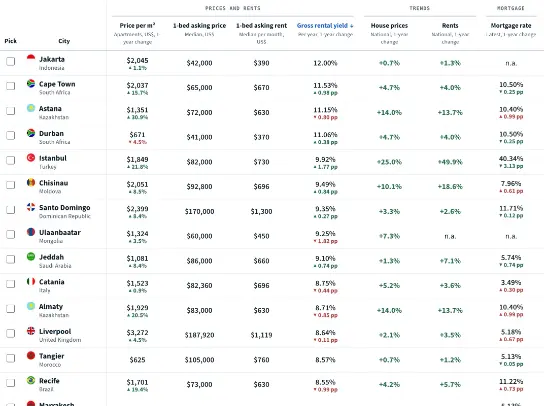
In Jakarta the average price of strata-title apartments remained relatively unchanged since end-2007 at IDR 10.7 million (US$1,060) per sq. m. in Q2 2008, according to Colliers.
A disappointment since 2007 had been such a good year, with optimism strong.
Jakarta luxury apartments saw price increases last year of 8% - 10% in 2007, propelled by the strong economy, although the over-all national house price index fell 0.6% in real terms (5.8% in nominal terms).
GDP growth in 2007 was 6.3%, the highest for a decade. Inflation was only 6.2%. Bank credits for house purchases were up almost 30%, due to low interest rates. In all, 2007 was a year of rising expectations.
Then in 2008, all the news turned bad.
Inflation soared to more than 10% in May, and 12% in September. Indonesia was forced to pull out of the Organization of the Petroleum Exporting Countries (OPEC) to control domestic prices.
To tame inflation, the Bank of Indonesia, the central bank, hiked the key interest rate for seven consecutive months to 9.5%. Then came the early collapse of the stock market in October 2008, which suspended trading for several days. By October 28, the stock market was at its lowest level for three years and the Rupiah fell to IDR11,200 per US dollar, down 22% from August, and the lowest level since July 2001.
House prices have disappointed
Crisis aside, the poor performance of residential real estate prices in Indonesia has been something of a puzzle. There is tremendous pent-up housing demand. Indonesia’s population is the world’s fourth largest, at 225 million. Rapid urbanization has led to high urban densities, especially in Jakarta.
And there has been good economic growth. By the early 2000s the Indonesian economy had stabilized after the Asian Crisis. GDP growth averaged 4.6% from 2000 to 2003, then 5.4% from 2004 to 2006, and finally 6.3% in 2007.
But economic growth never translated to strong house price increases. In 2008 the Indonesian house price index was still about 50% below its 1994 peak.
|
More Global Property Guide pages: |
One possible reason is Indonesia’s highly unpredictable inflation rate, increasing the uncertainty in the economy. From 58% in 1998 and 20% in 1999, inflation was wrestled down to 3.8% in 2000. In 2001 and 2002, inflation soared to more than 11%. Then it eased to 6.7% in 2004 and 6% in 2004. Then the consumer price index jumped again to 10.5% in 2005, and 13% in 2006, before inflation dipped back to 6.2% in 2007.
Construction boom
Yet the main reason for Indonesia’s lacklustre residential prices has been the construction boom.
Before the Asian Crisis, the supply of apartments rose from around 6,000 units in 1996 to around 18,000 in 1997, with an additional 2,000 units completed in 1998 and 1999.
Scant new supply came onto the market from 2000 to 2003, mostly projects started pre-crisis.
Real estate sales picked up in Q4 2001, encouraging developers to launch new projects, albeit slowly. With strong take-up and increasing occupancy rates, construction picked up pace.
- In 2004 around 9,500 new units were completed, bringing total supply to around 31,500 units.
- In 2005 and 2006, more than 5,000 units were completed annually.
- In 2007 construction exploded, and more than 15,500 units were completed, pushing total supply to 57,353 units, according to Colliers International.
- During the first half of 2008, 7,500 units were added to the stock, with another 11,107 units expected during the rest of 2008.
- Over the next two years the total stock is expected to almost double, with 50,613 units expected by end-2010.
This massive rise in the number of apartment units has impacted prices – and some say the downward pressure is likely to continue.
Mortgage market weak
Surprisingly, all the building has taken place despite a relatively lacklustre mortgage market.
Indonesia’s mortgage market has grown by 34% annually from 2003 to 2007 in nominal terms. But some apparent growth is due to inflation, and mortgage lending has come from a very low base.
Outstanding credits for house and apartment purchases have risen from IDR15,976 billion (US$1.58 billion) in 2000, to IDR94,253 billion (US$9.34 billion) in 2007. Credit for house purchases rose 37% y-o-y to August 2008, up from 29.6% in December 2007.
Interest rates are still relatively low, compared to the post-Asian Crisis period. 75.4% of property buyers used housing loan facilities with a 11% interest rate, relatively low by Indonesia’s standards, according to a recent survey.
And yet, despite tremendous growth for the past five years, mortgage credits were just 2.4% of GDP in 2007, still below the 2.8% of GDP in 1997.
Why? Perhaps because banks have been cautious about housing loans. Despite the recent financial turmoil, Indonesian banks remain strong and adequately capitalized. Memories of the Asian crisis are still vivid. According to a 2Q 2008 Residential Property Survey by the Bank of Indonesia:
- 54.4% of residential property development projects were financed internally
- 31.6% were financed through bank loans
- 10.9% of projects were financed by consumer payments (pre-selling)
The survey also showed that 17.1% of buyers used progressive cash payments, while 6.5% bought using hard cash.
Yudhoyono, the reformer
Why has investment in housing grown so strongly? In a word – optimism.
The 2004 election of Susilo Bambang Yudhoyono, Indonesia’s first directly-elected president, has been followed by a revival of confidence and substantial economic reforms. A retired general with a doctorate in economics, he has had the political and intellectual acumen to implement reforms, including unpopular ones.
New laws and reforms on Yudhyono’s watch:
- Laws to improve the investment climate and the delivery of public services
- A landmark investment law providing equal treatment regardless of nationality, to attract more foreign investments
- A new tax administration law strengthening the rights of taxpayers, while limiting arbitrary decision-making by tax officials
- Streamlined business licensing procedures
- Higher corporate governance and risk management standards for state-owned banks.
The fruits of the reforms are visible. Approved foreign direct investments (FDI) surged to US$40 billion in 2007, after steadily rising from US$10.2 billion in 2004. FDI to the “Housing and Offices” sector rose from US$57.2 million in 2006. to US$1.04 billion in 2007.
President Yudhoyono is seeking reelection in April 2009. He is widely expected to win the crowded race (more than 10 candidates are running, including two former presidents), despite the current financial and economic crisis.
Now for pump-priming
Indonesia’s growth is expected to slow to 5.5% - 6% in 2008 and 2009. The government relies on continued net inflow of investment and strong consumption growth to fuel the economy. The government also plans to accelerate the release of development projects to pump-prime the economy and real estate sector. Over-all inflation in 2008 is expected to be around 10%, before slightly easing to 8% in 2009.
Foreign property options may be widened
The government is considering extending the property usage rights of foreigners to 70 years, from the current 25 years, with two extensions possible, of 20 and 25 years. However, the government is not thought likely to allow foreigners to own real estate outright. The new regulations are expected to be implemented in early 2009.
The impact on property prices is hard to judge, as foreigners can now acquire real estate through other means. Foreigners can own Indonesian properties by setting-up a Penanaman Model Asing (PMA) Company with a right to buy. Some foreigners establish long-term leases, with the right to buy if the ownership laws are changed.