Greece's Residential Property Market Analysis 2025
Sustained by strong domestic demand and growing foreign buyer activity, sales prices in the Greek housing market continue to trend upward; in parallel, rental inflation accelerates in metropolitan centers and popular tourist destinations.
This extended overview from Global Property Guide covers key aspects of the Greek housing market and takes a closer look at its most recent developments and long-term trends.
Table of Contents
- Housing Market Snapshot
- Historic Perspective
- Demand Highlights
- Supply Highlights
- Rental Market
- Mortgage Market
- Socio-Economic Context
Housing Market Snapshot
Residential property prices in Greece continued to trend upward in early 2025, though the pace of growth has begun to moderate. According to provisional data from the Bank of Greece (BoG), the Index of Prices of Dwellings in Urban Areas rose by 6.19% year-on-year in Q1 2025, corresponding to a 3.53% increase in real terms (inflation-adjusted). For the full year 2024, revised figures show an average annual increase of 8.60%, or 5.44% when adjusted for inflation.
"The sector benefited from a combination of strong domestic demand, sustained foreign investment, and favorable macroeconomic conditions, solidifying Greece's position as an attractive destination for real estate investment", commented experts from Savills.
Greece's house price annual change:
[hp_graph]
Data Source: Bank of Greece.
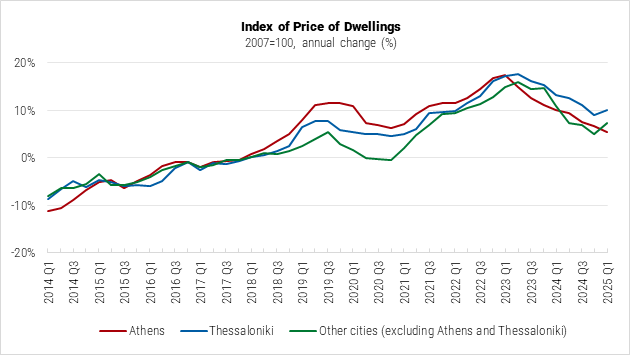
At the regional level, Thessaloniki recorded the strongest price growth in Q1 2025, with residential values increasing by 10.00% year-on-year. In Athens, the annual increase was more moderate at 5.47%, while other urban areas (excluding Athens and Thessaloniki) saw prices rise by 7.31% over the same period.
Data Source: BoG.
Data from the property platform Spitogatos further illustrates the trend, with national average asking prices for residential properties rising by 8.8% year-on-year in Q1 2025. The highest price levels were observed in prime districts of Athens. In Athens South, asking prices reached EUR 4,000 (USD 4,209) per square meter, up 9.17% annually. Athens North followed at EUR 3,222 (USD 3,391) per square meter, reflecting a 7.40% increase. In the municipality of Thessaloniki, the average asking price rose to EUR 2,558 (USD 2,692), marking a 12.54% year-on-year gain.
Average asking price by submarket:
| Average Asking Price, Q1 2025, EUR/sqm |
Average Asking Price, Q1 2025, USD/sqm |
YoY, % Q1 2025 vs Q1 2024 |
|
| Athens - Center | EUR 2,317 | USD 2,438 | 11.77% |
| Athens - North | EUR 3,222 | USD 3,391 | 7.40% |
| Athens - South | EUR 4,000 | USD 4,209 | 9.17% |
| Athens - West | EUR 2,055 | USD 2,162 | 9.31% |
| Athens - East | EUR 2,281 | USD 2,400 | 9.51% |
| Piraeus | EUR 2,500 | USD 2,631 | 7.16% |
| Piraeus suburbs | EUR 2,042 | USD 2,149 | 8.91% |
| Rest of Attica | EUR 2,000 | USD 2,105 | 5.88% |
| Thessaloniki - Municipality | EUR 2,558 | USD 2,692 | 12.54% |
| Thessaloniki - Suburbs | EUR 1,815 | USD 1,910 | 10.20% |
| Thessaloniki - Rest of Prefecture | EUR 964 | USD 1,014 | 15.31% |
| Exchange rate as of Q1 2025, EUR 1 = USD 1.0523. | |||
| Data Source: Spitogatos. | |||
Looking ahead, the housing market is expected to maintain positive momentum in the near term, underpinned by continued economic resilience and sustained investor activity. However, over the medium to long term, downside risks remain. These include heightened global economic and geopolitical uncertainty, as well as persistent structural imbalances between housing demand and available supply. The BoG has warned that continued price increases may begin to weigh on domestic demand, particularly in areas where values exceed household affordability or where properties fail to meet buyer expectations. As noted in the central bank's latest monetary policy report, "A further rise in housing prices is expected to lead to fatigue of domestic demand in those areas where values exceed affordability levels for households and where properties for sale do not meet the requirements of prospective buyers."
According to projections from the European Banking Authority, as quoted by Kathimerini, housing prices are expected to rise by 4.4% in 2025. Over the 2025-2027 period, the average annual increase is forecast to remain below 3.4%, modestly above inflation, suggesting a gradual stabilization following the rapid appreciation recorded between 2022 and 2024.
Historic Perspective:
From Crisis-Led Contraction to Investor-Driven Growth
Between the early 2000s and 2007, Greece's housing market experienced sustained price growth, particularly in coastal and urban areas, where values increased at double-digit rates. This expansion was largely driven by abundant credit availability and strong consumer confidence. The upward trajectory came to an abrupt end with the onset of the global financial crisis in 2008. From 2007 to 2017, the Index of Prices of Dwellings in Urban Areas declined by 41.87% (-48.42% in real terms), reflecting the broader economic downturn marked by severe austerity measures, soaring unemployment, and a prolonged credit contraction that brought residential construction to a near halt.
Recovery began to take hold in 2018, following Greece's exit from its final bailout program. Modest GDP growth and the gradual return of bank lending helped restore market confidence. House prices increased by 1.84% in 2018 and accelerated to 7.36% in 2019. Despite a temporary slowdown in 2020 due to the pandemic, prices continued to rise, recording a nominal gain of 4.76% (6.09% in real terms). The recovery was further supported by foreign capital inflows, particularly through the Golden Visa program, as well as the disbursement of EU recovery funds and a strong rebound in tourism, which sustained demand for both ownership and rental properties.
In 2024, residential price growth in urban areas remained positive but showed clear signs of deceleration, with prices increasing by 8.60% year-on-year, down from 14.22% in 2023. The moderation reflected a combination of factors, including persistent supply shortages, growing affordability constraints, and the government's decision to raise the Golden Visa investment threshold in high-demand zones to curb speculative foreign demand. After several years of rapid recovery, the market began to enter a more measured phase of expansion.
20-year annual house price change (based on annual price index for existing homes and consumer price index):
| Year | Nominal house prices (%) |
Inflation-adjusted house prices (%) |
Year | Nominal house prices (%) |
Inflation-adjusted house prices (%) |
|
| 2005 | 10.89% | 7.16% | 2015 | -5.09% | -4.04% | |
| 2006 | 12.98% | 9.37% | 2016 | -2.41% | -2.43% | |
| 2007 | 6.19% | 3.10% | 2017 | -1.10% | -2.21% | |
| 2008 | 1.46% | -2.66% | 2018 | 1.84% | 1.05% | |
| 2009 | -4.30% | -5.57% | 2019 | 7.36% | 6.82% | |
| 2010 | -4.37% | -8.67% | 2020 | 4.76% | 6.09% | |
| 2011 | -5.52% | -8.37% | 2021 | 7.99% | 7.38% | |
| 2012 | -11.76% | -12.66% | 2022 | 12.39% | 2.83% | |
| 2013 | -10.92% | -10.15% | 2023 | 14.22% | 9.65% | |
| 2014 | -7.98% | -6.68% | 2024 | 8.60% | 5.44% | |
| Data Source: BoG, OECD, Global Property Guide. | ||||||
Demand Highlights:
Foreign Buyers and Low Entry Costs Drive Housing Sector Resilience
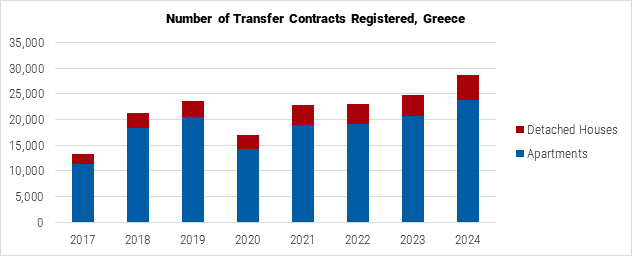
The residential real estate market in Greece continues to show notable resilience, underpinned by strong tourism performance and persistent interest from foreign buyers. According to the Real Estate Transfer Value Registry, 28,694 residential property transfer contracts were registered throughout 2024, marking a 15.80% increase compared to the previous year. Apartments made up the majority of transactions, with 23,816 units changing hands - an annual rise of 15.40% and accounting for 83% of all residential transfers. The remaining 17%, or 4,878 units, were detached houses, which recorded an annual growth of 17.77%.
Data Source: Registry of Real Estate Transfer Values.
In parallel, non-resident direct investment in Greek real estate rose significantly in 2024, increasing by 28.93% year-on-year, as reported by the BoG. Insights from the Cerved Property Services annual survey of real estate professionals indicate that while 46.4% of respondents believe non-Greek buyers represent less than 20% of the market, 35.6% estimate their share exceeds 30%. In key urban and tourist markets such as Athens, Thessaloniki, and major holiday destinations, foreign involvement is considerably higher. In fact, 90% of professionals active in these areas report that international buyers make up more than 30% of the market, while in locations such as the Cyclades, Ionian Islands, Halkidiki, and Ermionida, their share can exceed 70%.
"Real estate prices in Greece remain lower compared to many countries abroad, which acts as a magnet for foreigners who are not only looking to secure returns but also wish to relocate to a popular tourist destination," explained Kosmas Theodoridis, president of the European Real Estate Brokers Association, to Kathimerini.
Greece's Golden Visa program has become a key pathway for foreign investors pursuing residency through property acquisitions. Introduced in 2013, the scheme initially granted five-year renewable residence permits for a minimum real estate investment of EUR 250,000, aiming to boost the post-crisis property market. As demand intensified, the government raised investment thresholds: first to EUR 500,000 in prime zones, and most recently in 2024 to EUR 800,000 in high-demand areas (Athens, Thessaloniki, and major islands), while the threshold was set at EUR 400,000 for other regions. The original EUR 250,000 tier remains in effect only for conversions of commercial properties into residences. New requirements also stipulate a minimum property size of 120 sqm, prohibit short-term rentals, and restrict eligibility to a single qualifying property per investor.
Despite these stricter conditions, the program reported a record 9,407 applications in 2024 - an 11% rise from 2023. An additional 3,506 applications were submitted between January and April 2025, according to the Ministry of Migration & Asylum. Chinese nationals account for the largest share of Golden Visa holders at 47.8%, followed by applicants from Turkey (12.2%), Lebanon (5.6%), and the United Kingdom and Iran, each with 4.2%.
Looking ahead, the market outlook remains optimistic. According to the Cerved survey, 57% of real estate professionals expect demand to continue outpacing supply. Only 12.8% foresee supply surpassing demand, while 30% consider the market relatively balanced. As for transaction volumes, 47.4% anticipate stable levels, 41% predict an increase, and just 11.6% expect a decline.
Supply Highlights:
New Construction Spikes in 2024 Followed by Post-Incentive Contraction
Residential construction activity in Greece remained robust throughout 2024, driven by sustained housing demand and a series of government incentives aimed at stimulating new residential development. According to the Hellenic Statistical Authority (ELSTAT), a total of 46,904 new dwellings were completed across the country during the year, marking a 31.77% year-on-year increase. Regionally, the most significant growth in residential completions was recorded in Northern Greece (+48.80%), followed by Central Greece (+28.37%) and Attica (+26.26%).
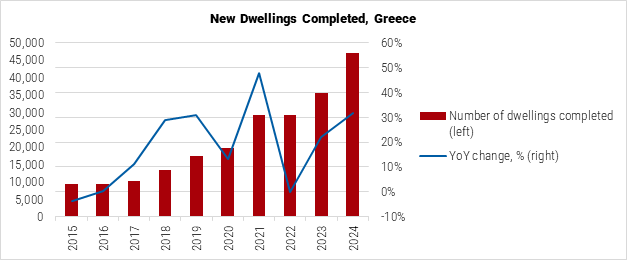
Data Source: ELSTAT.
Residential construction activity by region:
| Number of Dwellings Completed, 2024 |
YoY, % 2024 vs 2023 |
|
| Attica | 13,207 | 26.26% |
| Northern Greece | 16,648 | 48.80% |
| Central Greece | 8,601 | 28.37% |
| Aegean Islands, Crete | 8,448 | 16.56% |
| Greece | 46,904 | 31.77% |
| Note: Regional groupings are as follows: Northern Greece includes Eastern Macedonia and Thrace, Central Macedonia, Western Macedonia, Thessaly, and Epirus; Central Greece comprises Central Greece, the Ionian Islands, Western Greece, and the Peloponnese; Aegean Islands and Crete includes the North Aegean, South Aegean, and Crete. | ||
| Data Source: ELSTAT. | ||
Leading indicators also pointed to strong momentum. In 2024, a total of 30,678 building permits, including both residential and commercial properties, were issued to the private sector, reflecting a 14.91% year-on-year increase.
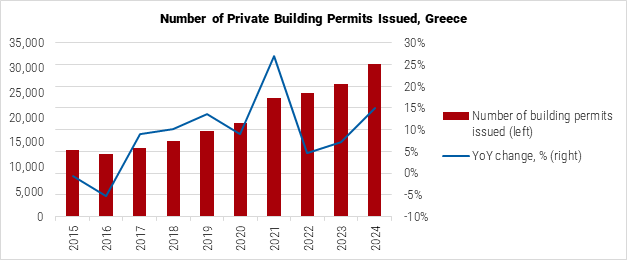
Note: The term "Building Permit" refers to all types of construction permits and is not limited to residential properties. It includes permits for new buildings as well as for additions, repairs, renovations, demolitions, legitimizations, amendments, and modifications.
Data Source: ELSTAT.
However, this upward trajectory reversed at the start of 2025 following the expiration or withdrawal of several construction-related incentives at the end of the previous year. The ELSTAT data shows that during the first two months of 2025, the number of completed dwellings declined sharply by 50.80% year-on-year, while the number of building permits issued dropped by 20.02%.
"The recent decisions of the Council of State, which directly impact the smooth development of construction activity, have been added to the existing pressures on the market, including rising construction costs, labor shortages, and procedural delays in property transfers," noted the BoG.
Simultaneously, the housing market continues to grapple with worsening affordability challenges. With demand outpacing supply, particularly in metropolitan centers and popular tourist destinations, the structural shortage of housing is expected to remain a pressing issue in the near term.
Rental Market:
Rental Inflation Accelerates Fueled by STR Boom and Supply Shortages
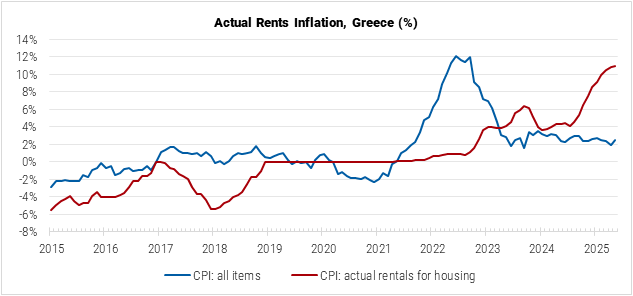
Against the backdrop of insufficient supply, exacerbated by units repurposed into short-term rentals (STR) in popular tourist locations, rental inflation in the traditional long-term rental segment in Greece has been accelerating in the second half of 2024 and early 2025, notably outpacing general price growth.
Greece's rent price index:
[rp_graph]
Data Source: OECD.
The actual rentals for the housing component of the consumer price index (CPI) reported by the ELSTAT registered a 10.9% year-on-year growth in May 2025, up from 9.2% in January and 4.4% a year prior in May 2024. During the same period, the overall inflation remained relatively stable, with the all-items CPI growth fluctuating only marginally between 2.4% in May 2024 and 2.5% in May 2025.
"The housing crisis is raging, especially in large urban centers, where homeownership rates are lower than the already declining average, leading rental rates ever higher," Kathimerini wrote earlier this year. Reflecting a strong expansion of the underlying demand, in the last fifteen years, the share of households in Greece renting rather than owning their residence increased from 22.8% in 2010 to 30.3% in 2024, according to Eurostat.
Analyzing market trends in Attica in a recent report, Savills also pointed out ongoing urban regeneration and infrastructure development projects, such as the announcement of new metro stations, as an additional factor driving up rents on top of high demand and limited supply in major cities.
Data Source: ELSTAT.
In nominal terms, as of Q1 2025, the average asking rent reported by the property platform Spitogatos exceeded EUR 10 per square meter in Central, North, and South Athens, as well as Piraeus. At the same time, the most pronounced year-on-year growth in asking rents was observed in relatively more affordable locations in Thessaloniki.
"Rental markets have <…> intensified, particularly in tourist-centric and upscale districts," Spitogatos summarized in their Q1 2025 market trends overview.
Average asking rent by submarket:
| EUR/sqm Q1 2025 | USD/sqm Q1 2025 | YoY Q1 2025 vs Q1 2024 | |
| Athens - Center | EUR 11.15 | USD 11.73 | 7.60% |
| Athens - North | EUR 11.24 | USD 11.83 | 2.70% |
| Athens - South | EUR 12.86 | USD 13.53 | 4.10% |
| Athens - West | EUR 8.62 | USD 9.07 | 5.40% |
| Athens - East | EUR 8.95 | USD 9.42 | 4.40% |
| Piraeus | EUR 10.34 | USD 10.88 | 5.70% |
| Piraeus suburbs | EUR 8.59 | USD 9.04 | 5.70% |
| Rest of Attica | EUR 8.98 | USD 9.45 | 4.40% |
| Thessaloniki - Municipality | EUR 9.93 | USD 10.45 | 13.50% |
| Thessaloniki - Suburbs | EUR 7.50 | USD 7.89 | 11.80% |
| Thessaloniki - Rest of Prefecture | EUR 4.35 | USD 4.58 | 5.60% |
| Exchange rate as of Q1 2025, EUR 1 = USD 1.0523. | |||
| Data Source: Spitogatos. | |||
Despite the recent notable acceleration in rent increases across Greece, they are still generally outpaced by sales prices, leading to continued yield compression in the market. The research conducted by Global Property Guide in June 2025 showed gross rental yields for residential properties in Greece at the average level of 4.50%, down from 4.73% previously reported in December 2024 and 4.85% in March 2024. The highest potential performance among the surveyed submarkets was estimated for rental properties in Athens (5.03%) and Patra (4.72%), while the lowest yields were observed in Kavala (3.76%).
"While rental prices have risen significantly, they have generally grown at a slower pace compared to sale prices," Savills explained. "This divergence can be attributed to the slower transmission of construction cost increases to the rental market, as well as the broader economic pressures faced by tenants, such as rising living costs and stagnant wage growth."
Looking ahead, considering the high share of tenants in the country, soaring rental inflation not only raises concerns for housing affordability (as Greece already has the highest housing cost overburden in the EU) but also presents a risk to the national economy. A recent report from Morgan Stanley, cited by Kathimerini and other outlets, points out that a large increase in rents could hit the disposable income of poorer households, potentially posing a threat to real consumption.
Mortgage Market:
Demand Picked Up, Lending Volumes Still Subdued by Historical Standards
Continuing the monetary policy easing cycle, in June 2024, the European Central Bank (ECB) further lowered its benchmark rates by 25 b.p., bringing the deposit facility rate to 2.00%, the main refinancing operations rate to 2.15%, and the marginal lending facility rate to 2.40%. As the Greek mortgage market remains defined by variable-rate loans, the ECB's policy relaxation throughout the second half of 2024 and early 2025 eventually translated into lower interest rate levels for both new and existing housing loans in the country, although some analysts noted a delay in the local banks passing the cuts to consumers.
Greece's mortgage loan interest rates:
[mortgage_graph]
Data Source: ECB.
"The cost of bank lending to businesses and households has generally declined this year, in line with the Eurosystem's monetary policy stance. The cost of bank lending to businesses has declined somewhat more, as the majority of new loans have carried a floating or fixed interest rate of up to one year. <…> For households, the pass-through of policy rate cuts into bank lending rates has been more limited than for businesses, as a larger share of new loans had a fixed interest rate," noted the BoG in their most recent monetary policy report.
As of April 2025, the BoG reported the weighted average interest rate on housing loans to individuals and private non-profit institutions at 3.63%, down from 4.33% a year ago. For outstanding housing loans with an original maturity of over 5 years, the weighted average interest rate reached 3.82%, down from 4.40% a year prior.
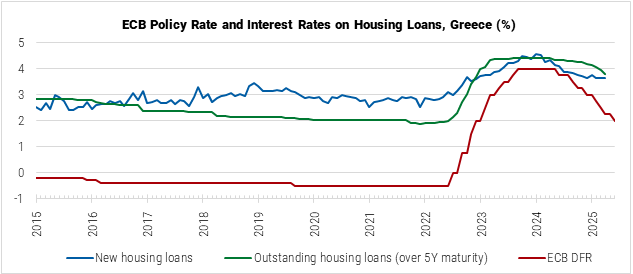
Data Sources: ECB, BoG.
Weighted average interest rates on housing loans to individuals and private non-profit institutions:
| Apr 2025 | YoY | Apr 2024 | YoY | Apr 2023 | |
| New housing loans | 3.63% | ↓ | 4.33% | ↑ | 3.88% |
| - Floating rate and IRF up to 1 year | 3.65% | ↓ | 5.11% | ↑ | 4.06% |
| - IRF of over 5 and up to 10 years | 4.47% | ↑ | 4.12% | ↑ | 3.66% |
| Outstanding housing loans | |||||
| - Original maturity over 1 and up to 5 years | 5.33% | ↓ | 5.46% | ↑ | 4.67% |
| - Original maturity of over 5 years | 3.82% | ↓ | 4.40% | ↑ | 4.38% |
| Data Source: BoG. | |||||
According to the BoG, the overall reduction in housing loan interest rates contributed, among other factors, to increased demand for housing loans, which was recorded by the Q1 2025 Bank Lending Survey. The pick-up in new lending can also be attributed to the launch of the subsidized programs with a total budget of EUR 2.4 billion, funded in part by the EU Recovery and Resilience Facility. The BoG estimates that in the first four months of this year, 10% of new mortgage contracts (worth approximately EUR 50 million) were linked to the Hellenic Development Bank (EAT) managed programs for the purchase of new ("My Home II") or the upgrading of existing homes ("Upgrading My Home").
Based on the ECB figures, the total value of new loans for house purchase reported by monetary financial institutions (banks) in Greece demonstrated a notable rebound in 2024 (20.4% year-on-year), with the positive dynamic continuing in 2025. In the first four months of this year, a total of EUR 478 million (USD 536 million) in new housing loans was issued by banks, demonstrating a 5.8% increase compared to the same period in 2024.
At the same time, lending volumes in the country remain substantially below pre-crisis levels, with only 20% of housing purchases in the Greek market currently estimated to be financed with credit. Data presented by Theodoros Mitrakos, director-adviser and former deputy governor of the BoG, at the Prodexpo North real estate conference in March 2025 showed that the number of annually concluded home purchase loan contracts dropped from 80,000 before the financial crisis to not exceeding 14,000 today.
Mitrakos tied last year's pick-up in lending volumes to subsidized programs, noting that the underlying landscape of the mortgage market still differs a lot from the pre-crisis period. "This is explained by the reluctance of today's young people to commit for such a long period of time and is naturally linked to two critical parameters, the high precariousness of the labor market and the low disposable income of young couples," he was quoted as saying by Kathimerini.
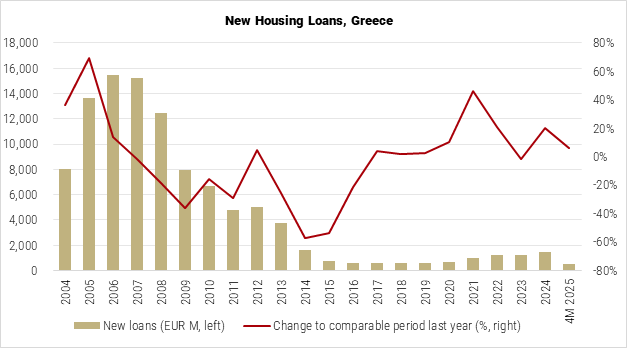
Data Source: BoG.
Despite the growth observed in new lending volumes in 2024 and early 2025, given large repayments originating from the credit boom period, net household housing credit growth in Greece remains in negative territory. The ECB banking sector data showed a 6.9% annual decline in the total value of outstanding housing loans in the country in 2024, following 4.4% and 3.7% drops in 2023 and 2022, respectively. As of April 2025, the housing loan stock stood at EUR 26.1 billion (USD 29.2 billion).
The relative size of the market, represented by the ratio of outstanding housing loans to GDP at current prices, also continues to decline, dropping from the peak level of an estimated 40.1% in 2012 to just 11.0% in 2024. The share of Greek households owning their residences with an outstanding mortgage or housing loan decreased from 15.2% to 8.0% during the same period, according to Eurostat figures.
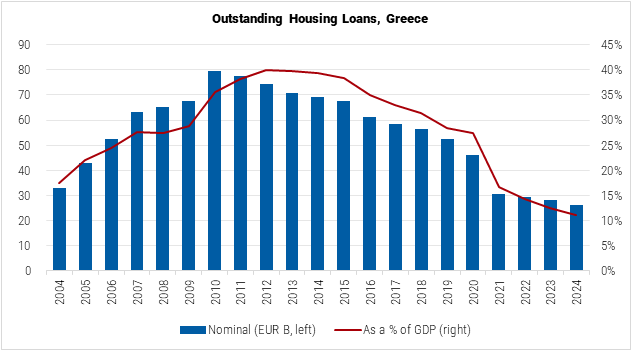
Data Source: ECB.
Socio-Economic Context:
Economy Maintains Momentum Despite Headwinds
The Greek economy continued to expand at a robust pace in 2024, with the real GDP growth maintained at 2.3% at the back of resumed NGEU-funded investment projects, buoyant private consumption underpinned by rising real income and higher employment, and high tourism flows that have surpassed pre-pandemic levels. The European Commission expects the momentum to continue in 2025 before moderating somewhat in 2026, with the respective growth levels projected at 2.3% and 2.2%.
"With the progress of the recovery and resilience plan, EU-funded investments are expected to be significant in 2025 and 2026. Together with sustained robust consumption, supported by steady income growth, these are expected to be the main drivers of economic growth. <…> The Greek economy is expected to be only mildly affected by the US tariffs due to its relatively weak direct and indirect trade links with the United States," said the European Commission.
In parallel, Consumer Price Index (CPI) inflation in the country has continued to ease gradually, averaging 3.0% in 2024 and most recently reported by the ELSTAT at 2.5% in May 2025. It remains, however, above the eurozone average due to accelerating services prices and the uptick in electricity prices. Looking forward, the European Commission anticipates wages to continue exerting upward pressure on prices and services inflation to slow down only gradually over the forecast horizon, bringing the overall inflation to projected annual levels of 2.8% in 2025 and 2.3% in 2026.
In the medium term, the International Monetary Fund (IMF) forecasts the Greek economy's growth to moderate to 1.4% against the backdrop of demographic headwinds and the expiration of the EU funding, which has been driving investment.
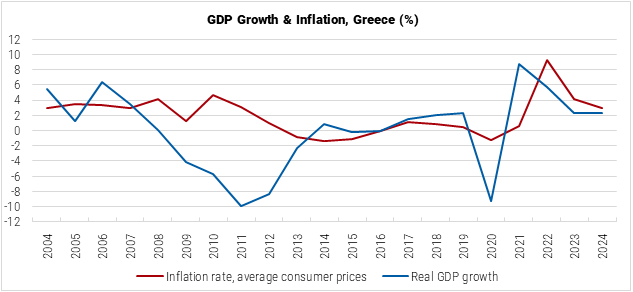
Data Source: IMF.
The Greek labor market notably improved in recent years, and favorable momentum carried over to early 2025 as evidenced by a further decline in the unemployment rate, which reached 8.3% in April 2025, a nearly 17 p.p. decline from 25.2% observed a decade ago in April 2015. According to the European Commission assessment, following a peak in the first quarter of 2024, vacancy rates (reflecting labor shortages) have begun to decrease but still indicate a tight market, particularly in sectors related to tourism and those requiring high skills. Employment is expected to keep expanding, although at a slower pace, as skills gaps and low participation, especially among women, limit labor supply. Against this background, real wages are set to rise further, supported by recent minimum wage increases and a reduction in social security contributions.
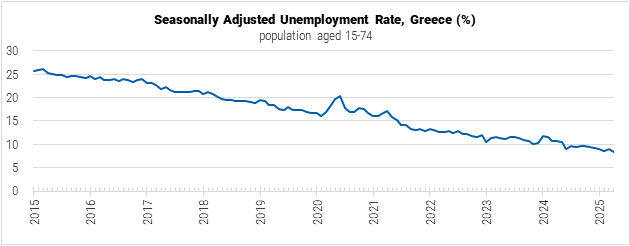
Data Source: ELSTAT.
While the near-term outlook for the Greek economy remains favorable, remaining crisis legacies and structural challenges continue to weigh on medium-term growth prospects. The 2025 Article IV staff report from the IMF points out a still elevated public debt level (153.6% of GDP in 2024), with a significant amount of crisis legacy distressed private debt still present in the financial system, as well as persistent structural imbalances, including the still low levels of overall investment, a declining working-age population with low labor force participation, and sluggish productivity growth.
At the same time, the IMF's overall assessment indicates that the current economic landscape in Greece establishes a solid foundation to address remaining crisis legacies and imbalances necessary for achieving sustainable growth in the medium to long term.
In May 2025, Fitch Ratings affirmed the country's 'BBB-' standing and revised the outlook to positive, noting the general government balance significantly outperforming expectations, the budget surplus leading to a drop in public debt, and the prudent and credible fiscal framework, underpinned by the record of the post-pandemic period.
Sources:
- Hellenic Statistical Authority (ELSTAT)
- Gross Domestic Product: https://www.statistics.gr/
- Consumer Price Index (CPI) - National Index: https://www.statistics.gr/
- Labour force (Monthly Data): https://www.statistics.gr/
- Building Activity Survey: December 2024: https://www.statistics.gr/
- Building Activity Survey: February 2025: https://www.statistics.gr/
- Bank of Greece (BoG)
- Indices of Residential Property Prices: Q1 2025: https://www.bankofgreece.gr/
- Residential and Commercial Property Price Indices and Other Short-Term Indices: https://www.bankofgreece.gr/
- Monetary Policy 2024-2025 (EL): https://www.bankofgreece.gr/
- Bank Deposit and Loan Interest Rates: April 2025 (EL): https://www.bankofgreece.gr/
- Monetary and Banking Statistics: https://www.bankofgreece.gr/
- Note on the Greek Economy: https://www.bankofgreece.gr/
- Ministry of Finance
- Greece 2.0: National Recovery and Resilience Plan - Housing loans: https://greece20.gov.gr/
- Ministry of Migration & Asylum
- Golden Visa (EL): https://migration.gov.gr/
- Article 64, Part D: Other Emergency Provisions, Residence Permit Linked to Investment in Real Estate… (EL): https://migration.gov.gr/
- Migration Statistics, Annex B, Analytical Tables: https://migration.gov.gr/
- Hellenic Development Bank (EAT)
- Current Programs (EL): https://hdb.gr/
- Real Estate Transfer Value Registry
- Real Estate Transactions Valuation Register (EL): https://www.gsis.gr/
- Cerved Property Services
- Cerved Property Services Annual Survey: https://www.cervedpropertyservices.com/
- European Central Bank (ECB)
- ECB Data Portal: https://data.ecb.europa.eu/
- Key ECB Interest Rates: https://www.ecb.europa.eu/
- Monetary Policy Decisions, 5 June 2025: https://www.ecb.europa.eu/
- European Commission
- Economic Forecast for Greece: https://economy-finance.ec.europa.eu/
- Distribution of Population by Tenure Status, Type of Household and Income group: https://ec.europa.eu/
- Living conditions in Europe - Housing: https://ec.europa.eu/
- International Monetary Fund (IMF)
- Country Overview: Greece: https://www.imf.org/
- 2025 Article IV Staff Report: https://www.imf.org/
- Greece: Selected Issues: https://www.imf.org/
- Spitogatos
- SPI - Spitogatos Property Index: https://www.spitogatos.gr/
- Q1 2025 Real Estate Market Trends in Greece: Strong Growth Driven by Housing Demand & Regional Hotspots: https://en.spitogatos.gr/
- Savills
- Athens Residential Market, 2025: https://www.kentriki.gr/
- Fitch Ratings
- Fitch Revises Greece's Outlook to Positive; Affirms at 'BBB-': https://www.fitchratings.com/
- Kathimerini
- Property Rally to Slow Down: https://www.ekathimerini.com/
- Foreign Buyers Replace Greeks: https://www.ekathimerini.com/
- Mortgages for Just One in Every Five House Purchases: https://www.ekathimerini.com/
- Rents Increase by Up to 49%: https://www.ekathimerini.com/
- Soaring Rents Could Threaten the Economy: https://www.ekathimerini.com/
- The National Herald
- Greece's Housing Shortage Spikes Rent, Home Prices, Dries Supply: https://www.thenationalherald.com/