House prices plunge in Estonia
Last Updated: Jan 17, 2009
House prices plunge in Estonia
As the global financial meltdown continues to unfold, Estonia’s housing market has emerged as one of the biggest losers.
Property prices in Estonia’s residential real estate market continued to slide in 2008, especially in Talinn and Parnu, Estonia’s summer capital, after starting to fall in 2007. Tighter credit conditions, combined with a sharp drop in demand from EU buyers, and an oversupply of new flats caused house prices to crash.
In Tallinn, Estonia’s capital city, the average price of 2-room apartments plunged 17.2% to end-Q3 2008 from a year earlier. When adjusted for inflation, the average price actually dropped 25.3% over the same period, according to Statistics Estonia.
The house price falls in Estonia in 2008 were among the biggest in the world, rivaled only by Latvia. These falls were in sharp contrast to enormous annual price increases in the past, peaking at an annual price increase of 77.5% during the year to end-Q1 2006.
The average price of 3-room apartments In Tallinn plunged 11.5% to EKK20,800 (€1,328) per sq. m. during the year to end-Q3 2008. It was down 18.4% from the peak level of EEK25,500 (€1,629) per sq. m. in Q2 2007.
In Tartu, Estonia’s second largest city, the average price of 2-room flats was up 3% y-o-y to end-Q3 2008, but it was still 4.5% below peak level. The average price of 3-room flats, on the other hand, dropped 10.3% y-o-y to Q3 2008.
In Parnu, known as Estonia’s summer capital, average prices plunged by around 30% to end-Q3 2008 from a year earlier.
|
|
AVERAGE PRICE* (EKK PER SQ. M.) |
ANNUAL HOUSE PRICE CHANGE* (%) |
||||||
|
|
2005 |
2006 |
2007 |
2008** |
2005 |
2006 |
2007 |
2008** |
|
2-ROOMS & KITCHEN |
|
|
|
|
|
|
||
|
Tallinn City |
15,350 |
23,300 |
25,650 |
23,600 |
30.9 |
51.8 |
10.1 |
-17.2% |
|
Tartu city |
10,325 |
16,125 |
16,875 |
17,000 |
23.7 |
56.2 |
4.7 |
3.0% |
|
Pärnu city |
10,150 |
17,000 |
18,767 |
15,500 |
9.4 |
67.5 |
10.4 |
-29.2% |
|
3-ROOMS & KITCHEN |
|
|
|
|
|
|
||
|
Tallinn City |
14,350 |
22,400 |
24,575 |
20,800 |
22.1 |
56.1 |
9.7 |
-11.5% |
|
Tartu city |
9,300 |
15,733 |
15,975 |
13,000 |
28.7 |
69.2 |
1.5 |
-10.3% |
|
Pärnu city |
9,475 |
16,250 |
16,400 |
11,800 |
10.2 |
71.5 |
0.9 |
-30.2% |
|
*average of period **3Q Source: Statistics Estonia |
||||||||
Transaction volumes sharply down
The volume of real estate transactions reached EEK39.8 billion in 2008, down from EEK57.6 billion in 2007 and EEK73.8 billion in 2006. The number of transactions in 2008 was 50,528, slightly up compared with 49,464 transactions in 2007 but significantly lower than the 60,208 transactions in 2006.
|
More Global Property Guide pages: |
The number of building permits for dwellings has also fallen. Permits for only 4,301 dwellings were filed in the first three quarters of 2008, significantly down compared with 7,795 permits in 2007.
Estonia’s economy is expected to move out of recession after 2009. So property prices are expected to stabilise by end-2009 or early 2010. However, it might take longer before the market overhang is cleared.
Extraordinary price rises
Estonia’s housing market had, before the crunch, been in almost continuous boom since 2000, due to low interest rates, low inflation, strong economic growth, rapid wage increases and huge foreign demand.
Demand for properties in Tallinn reached an all time high in 2006, with foreigners particularly attracted by the city’s potential. Tallinn accounted for more than half of all real estate transactions in Estonia.
House prices in Estonia rose by double-digit levels from 2000 to 2007. In Tallinn, for instance, average price of 2 room flats rose by an average of 27% annually from 2001 to 2005. House price growth truly accelerated in 2006, with prices rising by more than 50% y-o-y.
Overall, the average price of 2-room flats in Tallinn rose by 448.7% from 2000 to 2007, in Tartu by 431.5% and in Parnu by 440%. Prices of three-room flats were equally impressive, going up by 412% in Tallinn, Tartu by 481% and Parnu by 471.5%.
Meanwhile owner-occupancy rates rose strongly, up from 85% in 2002, to 96% in 2004. The rental market shrank from 12% of households (with 9% privately renting and 3% in social rents) in 2002, to just 4% in 2004.
Mortgage market boom
The house price boom was supported by a massive expansion of the mortgage market, growing by an average of 62% yearly from 2002 to 2006. Outstanding housing loans grew from EEK4.5 billion (€286 million) in 2000 to EEK88 (€5.6) billion in 2007 and EEK 97 (€6.2) billion in 2008; from 4.7% of GDP in 2000, to 37% in 2007.
The mortgage market boom was pushed by a favorable macroeconomic environment, financial market reforms, the entry of foreign banks and lower interest rates. At the peak of the boom, banks were willing to provide loans with a maximum lending period of 30 years and loan-to-value ratio of 100%.
Interest rate conundrum
One cause of the boom was the pegging of the Estonian kroon (EEK) to the deutschemark in 1992 (and eventually to the euro in 2001), which led to lower inflation and interest rates.
Mortgage interest rates fell from over 10% during the late-1990s, to below 4% between 2004 and 2006. Estonia managed to bring down inflation from 89% in 1992 to the single-digit level of 8.2% in 1998. Between 2002 and 2006, inflation was below 5% (an average of 3.3%).
As a consequence of the peg to the euro, interest rates in Estonia followed key rates set by the European Central Bank (ECB). Hence when the ECB began to raise key rates in mid-2005, mortgage rates also increased in Estonia. ECB base rates were gradually raised in 25 basis point steps, from 2% in October 2005 to 4% in May 2007, and again to 4.25% in July 2008.
Clearly these rates were lower than warranted by Estonia’s inflation. Yet the monetary authorities have been relatively powerless because the kroon’s peg to the euro means the central bank cannot raise interest rates further. Nevertheless there has been a divergence in mortgage rates between euro and kroon-denominated loans, with kroon-denominated mortgage rates rising above Euro rates.
By November 2008, the interest rates for kroon denominated housing loans were at 7.37%, up from below 4% from July 2004 to April 2006. For euro denominated loans, housing loan rates rose to 6.27% in October 2008, from below 4% from November 2004 to May 2006.
These interest rate hikes proved too much for Estonia’s housing market to bear.
In an effort to ease the credit crunch and economic downturn, the ECB reduced key interest rates, drastically adjusting them from 4.25% in September 2008 to 3% in December 2008. With this, the euro housing loan rate fell to 5.95% in November 2008. Interest rates for kroon-denominated housing loans are expected to drop within the first quarter of 2009.
Dramatic increases in supply
After the break-up of the Soviet Union in 1991, housing construction in Estonia dramatically decelerated. From 1996 to 2001 less than 1,000 dwellings were added to the dwelling stock annually - not enough to meet demand. Most apartments were sold before completion.
In 2001, housing construction started accelerating. In 2007, around 7,200 units were added to the dwelling stock, up from 5,100 units in 2006. Developers have been mainly building suburban homes, for middle class Estonians seeking to upgrade from their Soviet-era block buildings.
The massive increase in dwelling completions led to oversupply, pushing house prices down. Another 4,282 new dwelling units were completed within the first three quarters of 2008. Although lower than the 4,911 completions over the same period in 2007, it added significantly to the 645,400 dwelling stock.
Constrained rents and yields
The construction of new apartments has exerted pressure on rents, which have risen only modestly compared to property prices. From Q1-2003 to Q4-2007, the average rent for 2 room flats in Tallinn rose 34%, while the selling price rose by 179%. For 3 room apartments, the average rent rose by a mere 10.6%, while prices soared 203%.
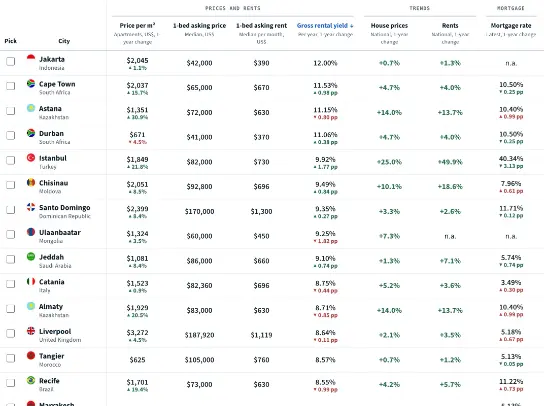
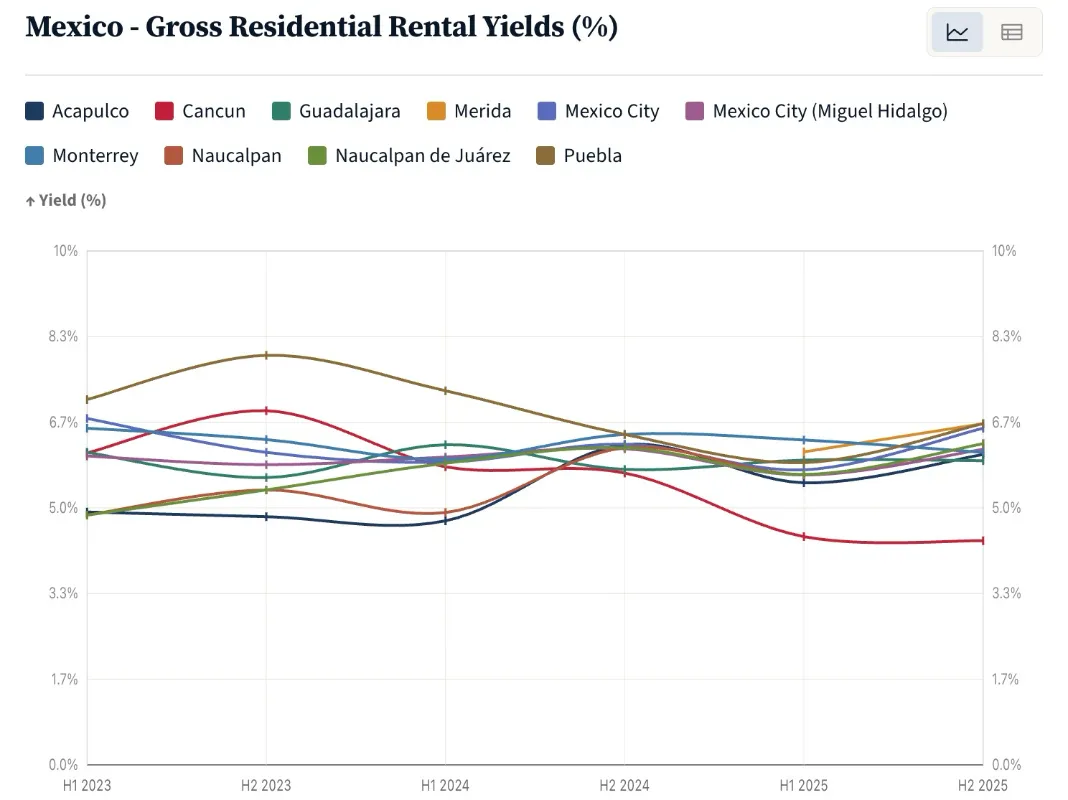
Relatively, stagnant rents combined with rocketing prices have lowered rental yields. From around 20% at the beginning of the decade, gross rental yields are now down to around 4% - 5% per annum, according to Global Property Guide research.
Rents can be expected to move ahead now that prices have stalled – because those who would previously have bought are now somewhat more likely to choose to rent - but this has not happened yet. In some cases, rents have fallen much faster than property prices.
The average rent for a 2-room apartment in Tallinn fell 14% y-o-y to Q3 2008, compared with 17% fall in property prices. For three-room flats, the average rent fell 18.7% while selling prices fell by only 11.5%.
Economic recession
Estonia’s economy grew at Asian rates, previously unheard of in Europe, earning the moniker the Baltic Tiger. The real growth spurt began in 2000, with 9.6% GDP growth.
From 2001 to 2006, Estonia’s economy expanded by an average of 8.7% annually, including resounding 11.2% GDP growth in 2006 and 10.2% growth in 2005. In 2007, GDP growth was 7.1%, one of the highest economic growth rates in the EU.
GDP per capita increased from US$4,100 in 2000 to US$15,850 in 2007. Likewise, real wages rose by an average annual rate of 7.5% from 2001 to 2006. Unemployment fell from 13.6% in 2000 to just 4.7% in 2007.
Now that the housing boom has ended, demand for construction materials and services have fallen. The economy entered recession in Q3 2008 with GDP shrinking 3.3% from a year earlier (after a 1.1% y-o-y contraction to Q2 2008). The overall economic contraction for 2008 is estimated to be around 1.5%. The recession is expected to continue in 2009 with GDP shrinking by 1.1%.
The weaker economy will in turn, lead to weaker demand for property. The cycle that pushed prices up in Estonia is now pulling them down.
Euro-adoption delayed
The current economic debacle will likely postpone anew Estonia’s adoption of the euro. Estonia originally planned to adopt the euro in 2007, but was forced to move it to 2012. Inflation was the main problem in 2007, but budget deficits will likely be the problem in future.
Even with the remarkable drop in inflation from 2000 to 2006, it was still above the EU limit (currently at 3.2%). Historically high global fuel and food prices pushed inflation up to 6.6% in 2007 and to 10% in 2008. Despite the economic recession, inflation is expected to be around 5% in 2009, and 4.0% in 2010.
The convergence criteria for EU adoption also restricts government’s debt and deficit. After years of budget surpluses, Estonia posted a budget deficit of 0.4% of GDP in 2008. Although it was safely below the 3% budget deficit limit, it is likely that the government will breach the limit within the next few years, due to additional spending for the economy combined with lower revenues.