Sustained housing market growth in Canada
House price increases
The new housing price index dramatically rose 10.7% from December 2005 to December 2006, the highest end-of-year growth rate since 1990. The average residential resale price grew 10.8% in 2006; the average house price increased to CA$ 276,325 from CA$249,365 in 2005.
The western provinces kept the lead in house price growth in 2006. Alberta recorded a 29.5% house price increase, from an average of CA$218,266 in 2005 to CA$282,686 in 2006. The Canadian Mortgage and Housing Corporation (CMHC) cited shortage in active listings and soaring demand as factors causing the price escalation. British Columbia still has the most expensive housing among all provinces, with an average residential resale price of CA$ 387,062. Alberta ranked second with CA$ 282,686 average residential resale price.
Canada's housing market is in its eighth year of continued house price growth, with prices up by 74% (49% in real terms) from 1999 to 2006. A more balanced housing market is seen in 2007 with shrinking demand and higher supply. This is expected to lead to a more moderate house price increases. CMHC forecasts residential price growth to slow to 5.9% in 2007.
Higher house starts and resale
Residential resale slightly increased in 2006 with 483,337 units sold, up from 482,788 units in 2005. A large proportion of the sales were made during the first quarter.
Residential sales have been growing since 2001. Unfortunately, growth is expected to halt in 2007 as demand moderates. In 2007, house resale are projected to fall to 464,500 units, a 3.9% drop from resales in 2005.
The total housing starts increased by 0.8% in 2006, after a drop of 3.4% in 2005. The 2006 level of housing starts was the second highest level registered since 1988. Alberta experienced a remarkable increase of 19.9%. Declines in housing starts were recorded in Prince Edward Island (-14.4%), Newfoundland (-10.6%), Quebec (-6.8%) and Ontario (-6%).
Although housing starts in all provinces are expected to fall in 2007 due to moderate resale house price growth and rising construction prices, CMHC is still optimistic that figure will be above 200,000.
Average rent increases
Across Canada’s 28 major centers, average rents of 2-bedroom units went up by 3.2% in 2006, led by Alberta (up by 13.3%) and British Columbia (4.8%). Among cities, pronounced rent increases were seen in Calgary (19.5%), Edmonton (9.9%) and Hamilton (5.1%). Average rents increased sluggishly vis-à-vis the increase in house prices. From 1999 to 2006, average rents for two-bedroom units rose by only 20%, while house prices grew by 75%.
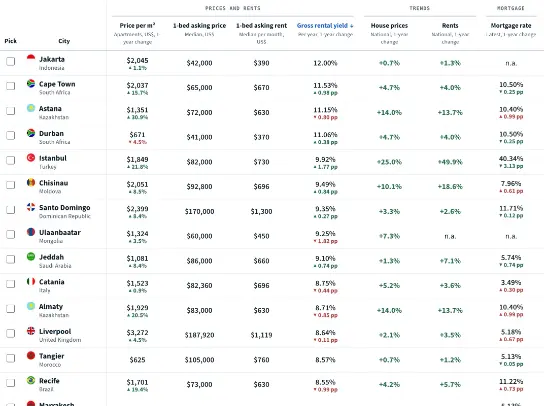
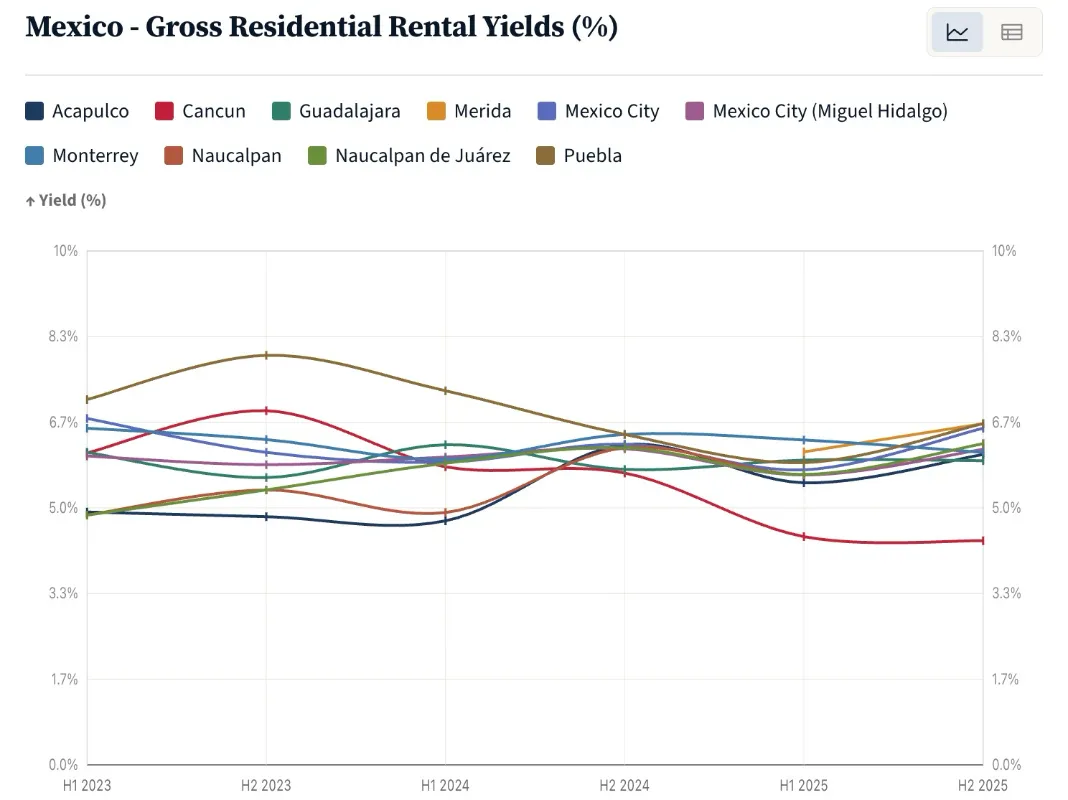
Despite the increasing gap between average rent growth and house price growth, Canada still managed to produce high yields. Global Property Guide research shows that 100-square metre apartments in Montreal and Ottawa have the highest returns of around 7.18%. Vancouver houses and apartments have the lowest yields at around 3.10%.
The vacancy rate was 2.6% in 2006, slightly lower compared to 2.7% in 2005, yet significantly better than the vacancy rates in the 90s which averaged 4.3%. Escalating net migration boosted demand for rented accommodation. However, increased demand for home ownership supported by low mortgage rates muted rental demand.
Strong economy, healthy housing market
Three main factors are driving the current housing boom: the strong economy, high immigration levels, and low mortgage rates.
Canada’s GDP has been continuously increasing since 1992, at an average growth rate of 3% per year. The GDP growth rate in 2006 was 2.7%, with an expected 2.4% growth rate in 2007.
The strength of the labor market fueled the demand for houses, both for ownership occupancy and rental. Unemployment was at a historic low of 6.3%, significantly lower than the peak unemployment rate of 11.4% in 1993. Real wages increased by 3.2% in 2006, while inflation was at 2.1%. The labour market is expected to retain its vigor in 2007.
Canada continues to attract immigrants as the economy remains strong. Between 2001 and 2006, Canada’s population increased by 5.4%, with two-thirds of the population growth contributed by international migration. CMHC estimates net migration at 219,670 in 2006, and expects 224,450 net migrants in 2007.
Alberta, with its outstanding economic performance, draws the most number of immigrants, followed by Ontario and British Columbia. Most migrants initially rent accommodation before acquiring houses.
The five-year mortgage rate inched up to 6.45% in Dec 2006, from 5.95% in Dec 2005. The mortgage rate is forecasted to range from 6.25% to 7.25% in 2007.
“Mortgage rates are low and are expected to remain that way. Weaker U.S. economic growth is a good news for Canadian interest rates, as slowing Canadian economic growth will keep mortgage interest rates low and the housing market on a solid footing,” says Gregory Klump, Chief Economist of Canada Real Estate Association.