Russia's Residential Property Market Analysis 2026
As elevated mortgage costs after the end of a large-scale subsidized program continue to impact demand, sales prices in the Russian housing market are growing at a slowing pace, with notable moderation also observed in the rental sector.
This extended overview from the Global Property Guide covers key aspects of Russia’s housing market and takes a closer look at its most recent developments and long-term trends.
Table of Contents
- Housing Market Snapshot
- Historic Perspective
- Demand Highlights
- Supply Highlights
- Rental Market
- Mortgage Market
- Socio-Economic Context
Housing Market Snapshot
Residential property prices in Russia continue to rise, but the pace of growth is slowing, as elevated mortgage costs and subdued demand weigh on activity. According to the Federal State Statistics Service (Rosstat), the average price per square meter for new housing in the third quarter of 2025 reached RUB 208,268 (USD 2,582), translating into a 1.55% quarter-on-quarter increase (0.85% in real terms) and an 18.96% year-on-year increase (10.17% in real terms).
According to Laura Kuznetsova, Managing Expert at PSB's Centre for Analytics and Expertise, the current price dynamics in the primary segment are driven by two main factors: a reduction in new project launches and a shift in the structure of demand towards higher-end housing, where purchasing power has proved more resilient. "Given the weakening of demand, price growth in the primary market will continue to slow. According to our estimates, by the end of 2025, the average price in this segment could reach RUB 210,500 per square meter (up 18.3% year-on-year). We still see a price correction as unlikely, as developers are maintaining a wait-and-see stance," she noted.
In the secondary market, prices are increasing at a more moderate pace. In the third quarter of 2025, the average secondary-market price stood at RUB 129,074 (USD 1,600) per square meter, up 0.80% quarter-on-quarter (0.12% in real terms) and 16.01% year-on-year (7.44% in real terms). The price gap relative to new-builds is substantial, at around 61%. "Unlike the primary market, where there is a shortage of supply, the secondary market looks stable. Against this backdrop, there are no clear drivers for a faster increase in the price per square meter," Kuznetsova added.
Russia's house price annual change:
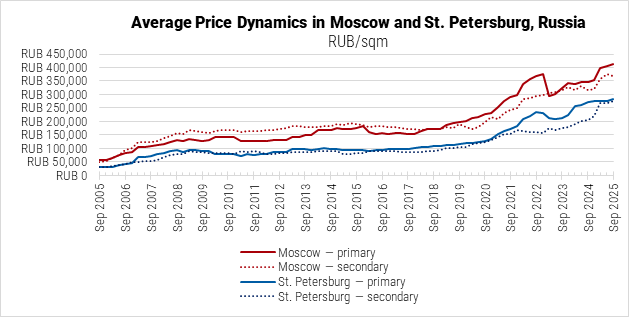
Regional patterns underscore the divergence. In Moscow, primary-market prices reached RUB 414,371 (USD 5,137) per square meter, an annual increase of 19.97%, while secondary-market prices rose to RUB 369,497 (USD 4,581), up 16.27% year-on-year.
In St. Petersburg, primary-market growth was much more subdued, with prices rising by 3.77% year-on-year to RUB 282,215 (USD 3,499) per square meter, whereas secondary-market prices surged by 33.97% to RUB 274,427 (USD 3,402).
Data Source: Rosstat.
Looking ahead, Gazprombank highlights several factors that are likely to shape the housing market in 2026, including the easing of monetary policy and lower rates on market-rate mortgages; declining deposit yields, which may redirect part of household savings into real estate; intensifying competition among developers against a backdrop of still-moderate demand; and possible changes to the family mortgage program, which could curb demand for new-builds. "The combination of these opposing forces means that housing price growth in 2026 is likely to be only slightly above inflation. However, trends in the primary and secondary markets will diverge," argues Vladislav Fadeyev, Director of the Economic Forecasting Center at Gazprombank. "As market mortgage rates fall, price growth in the secondary market will begin to outpace that in the primary segment. But for this to happen, mortgage rates would need to decline below roughly 14-15%."
Analysts at the property portal Cian also expect a differentiated performance between market segments: "Higher price growth in new-builds relative to the secondary market will persist for the time being. This is driven by continued increases in construction costs, the heavy burden of expensive bank financing on developers, and, in some cases, also limited supply," explains Cian's Chief Analyst, Alexey Popov.
Historic Perspective:
Drivers Behind Russia's Property Boom and Bust
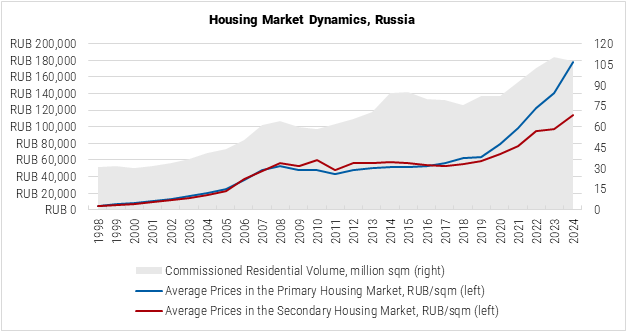
Since the early 2000s, Russia's economy has begun recovering from the financial crisis of 1998, supported by rising oil revenues, which significantly improved consumer purchasing power. This period saw a sharp surge in house prices. From 2000 to 2008, the price per square meter of residential properties increased fivefold in the primary market and sevenfold in the secondary market. Simultaneously, the volume of newly commissioned residential housing doubled, driven by an expanding mortgage market, which further fueled housing demand.
The 2008 global financial crisis had a substantial impact on Russia's real estate industry. Residential property prices began to decline, with a year-on-year drop of 9% in the primary segment and 6% in the secondary segment in 2009. The volume of newly commissioned housing decreased by 7% during the same period, reflecting a market slowdown. Nevertheless, government support for mortgages and subsequent economic stabilization helped the market recover in the following years.
In 2014, Russia's economy faced new challenges as international sanctions and a sharp depreciation of the ruble, alongside falling oil prices, led to rising inflation and a decline in purchasing power. While real estate prices in the primary market continued to grow modestly in ruble terms, the overall growth was constrained by economic stagnation. In dollar terms, prices experienced a significant decline due to the ruble's devaluation.
In response to the economic challenges of the COVID-19 pandemic in 2020, the government introduced subsidized mortgage programs, which triggered a sharp rise in housing demand. These low-interest mortgage schemes became accessible to a broader range of buyers, spurring heightened interest in newly built apartments. During the first two years of the subsidized mortgage programs (2020-2022), prices for primary market apartments surged, averaging an annual growth rate of 24%. This increase was primarily driven by artificially induced demand, as buyers hurried to secure homes under favorable loan conditions, fearing the program's potential discontinuation or less favorable terms. Contributing factors also included inflationary pressures, rising construction material costs, and limited market supply.
Although growth in primary-market prices slowed to the mid-teens year-on-year in 2023, subsidized mortgage programs continued to underpin demand, particularly in major cities, even as a large share of solvent demand had already been realized during the first two years of these schemes. In the first half of 2024, activity briefly picked up again as households rushed to secure loans ahead of the program's expiry in July, before weakening sharply thereafter; at the same time, construction remained very active, with the volume of housing under construction reaching a six-year high and new project launches in 2024 broadly matching the record levels of 2023.
Data Source: Rosstat.
Demand Highlights:
Primary Sales Reset to a Lower Plateau Ahead of a Projected Medium-Term Rebound
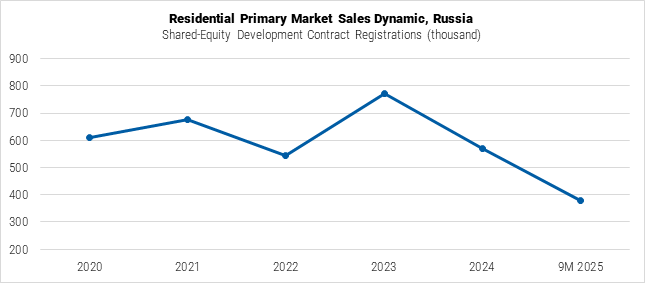
Demand for newly built housing in Russia remains subdued, even though activity accelerated in Q3 2025, supported by increased use of both subsidized and market-rate mortgage programs. Data from the Federal Service for State Registration, Cadastre and Cartography (Rosreestr) compiled by DOM.RF indicates that in Q3 2025, households registered 148 thousand contracts for participation in shared-equity construction for residential units, translating into a 29% year-on-year increase and the best quarterly result since mid-2024. Despite the pick-up, the number of contracts registered since the beginning of the year (380,000) remained 12% below the level recorded a year earlier.
Participation contracts, under which the buyer co-finances a residential development while it is under construction in exchange for the right to receive a specified dwelling upon completion, are the standard form of pre-completion purchase in Russia, and their number is widely used as a key indicator of primary market activity.
Data Sources: Rosreestr, Dom.RF.
According to the Unified Information System for Housing Construction (EISZHS), Q3 2025 saw an increase in primary sales volumes in physical terms in 67 regions, including nine of the ten largest regions by size of the housing construction pipeline. In the top ten regions, sales reached 3.3 million square meters, up 14% year-on-year. Recovery in the remaining regions has been even stronger, with sales rising by 22% year-on-year to 3.0 million square meters. Among the largest construction regions, the most pronounced growth was observed in Rostov Region (+44% year-on-year) and Tyumen Region (+33% year-on-year).
Sales of new-built housing by region:
| Region | Q3 2025, thousand sqm |
YoY change, % | 9M 2025, thousand sqm |
YoY change, % |
| Moscow | 954 | 6% | 2,728 | -9% |
| Krasnodar Krai | 287 | 14% | 662 | -38% |
| Moscow Region | 461 | 17% | 1,290 | -11% |
| Sverdlovsk Region | 294 | 20% | 745 | -24% |
| St Petersburg | 336 | -9% | 908 | -27% |
| Rostov Region | 212 | 44% | 572 | -9% |
| Leningrad Region | 193 | 25% | 510 | -1% |
| Tyumen Region | 240 | 33% | 571 | -12% |
| Novosibirsk Region | 194 | 22% | 477 | -25% |
| Republic of Bashkortostan | 153 | 27% | 357 | -26% |
| Top 10 total | 3,325 | 14% | 8,820 | -17% |
| Other regions | 2,996 | 22% | 7,718 | -11% |
| Total | 6,320 | 17% | 16,538 | -14% |
| Data Sources: Rosreestr, Dom.RF. | ||||
For 2025 as a whole, experts from the ERZ.RF portal and consultancy Yakov & Partners expect the number of participation contracts registered to reach around 475,000, almost 17% below last year's result (568,900). In their baseline scenario, demand for new-builds in 2026 is seen to remain broadly in line with 2025, at around 480,000 contracts.
Sberbank analysts are somewhat more optimistic about the medium-term trajectory. They project the Russian primary housing market to enter a more pronounced recovery phase in 2026, with sales of housing under construction potentially increasing by around 9%. "After two years of substantial declines in the number of participation contracts, 2026, and especially its second half, could mark the beginning of a new phase of recovery and growth in both prices and volumes, supported by gradual easing of monetary policy," notes Natalia Zagvozdina, Head of Sberbank's Research Department.
Supply Highlights:
Cooling Completions, Extended Delivery Timelines, and an Elevated Pipeline
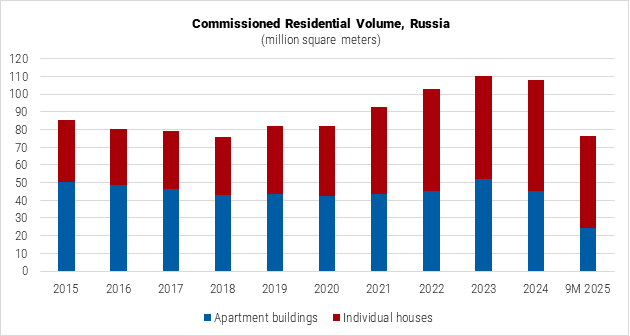
Residential construction activity in Russia continues to cool after the record-breaking year of 2023. According to Rosstat, 76.6 million square meters of housing were commissioned across the country in the first three quarters of 2025, representing a 5.6% year-on-year decline.
Individual housing remained the dominant segment. Detached houses accounted for almost 70% of total completions, with 52.3 million square meters commissioned throughout Q1-Q3 2025, down 5.6% year-on-year. The remaining 30% (24.2 million square meters) were attributed to apartments in multi-family buildings, where the annual decline was slightly steeper at 5.7%.
Data Source: Rosstat.
Market observers link the reduction in commissioning volumes in part to delays on the developer side. Estimates suggest that around one-third of new-build multi-apartment projects in Russia are missing their planned completion dates. Deputy Minister of Construction Nikita Stasishin cites several factors behind the postponements, including insufficient funds accumulated on escrow accounts, higher construction material costs and delays in their delivery, as well as labor shortages.
Legal experts interviewed by RBC note that the moratorium on penalties for developers who delay handing over units to buyers is also likely encouraging completion dates to be pushed back. Initially set to expire on 30 June 2025, the moratorium has been extended by the government until 31 December 2025.
Despite weaker commissioning, the construction pipeline remains substantial. According to DomM.RF, the stock of multi-apartment housing under construction in Russia increased by 2% year-on-year in Q3 2025, reaching 120.1 million square meters as of 1 October 2025. The report notes that the elevated volume of housing under construction is supported in part by the postponement of project completion dates, which mechanically slows down the flow of new supply to the market. DOM.RF estimates that, as of Q3 2025, the current pipeline would be sufficient to sustain the present level of housing completions for roughly 3-4 years even if no new projects were launched.
On current projections, Deputy Prime Minister Marat Khusnullin expects total housing completions in 2025 to exceed 100 million square meters. "We are now reaping the fruits of 2023, when a large volume of mortgages was issued, and developers launched many projects," he commented. However, he also points to a downward trend in commissioning volumes and a decline in new building permits, cautioning that this could result in lower completions by 2028.
Rental Market:
Rental Growth Moderates, Yields Still Attractive
In 2025, the rental market in Russia saw a notable moderation of the previously reported strong upward trend for both existing and asking rents. "This year has been quieter for the long-term rental market than in 2024. For the first time in several years, demand and rates have not increased, remaining at last year's levels," Yelena Bobrovskaya from Cian observed in December, adding that steady growth is likely to resume in June-July 2026.
Russia's rent price index:
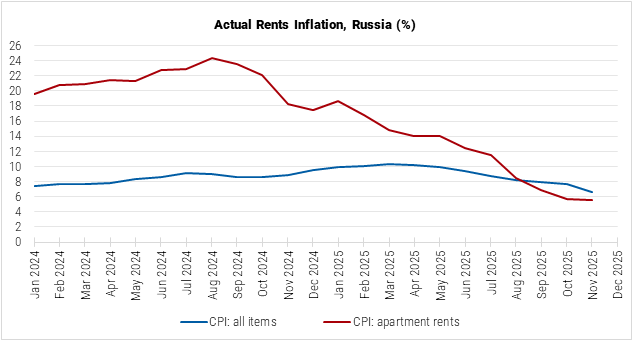
For actual rents, rental inflation has been trending below the overall price growth since August 2025, based on Rosstat figures. In November 2025, the apartment rents component of the consumer price index (CPI) registered a 5.5% year-on-year growth, down from the peak level of 24.3% in August 2024 and 18.3% reported a year prior in November 2024. The all-items CPI during the same period increased by 6.6%.
Data Source: Rosstat.
The slowdown, primarily attributed by local experts to weaker economic conditions and slowing wage growth, as well as increased offers, was also observed for asking rents across major Russian cities. According to the Q3 2025 report from DOM.RF, average asking rents in Moscow and St. Petersburg demonstrated annual increases of just 3% and 4%, respectively, while in other major cities with populations over one million, they actually declined by 11% year-on-year. In cities with populations between 500,000 and one million, rental rates remained flat compared to the same period in 2024.
In nominal terms, asking rents averaged RUB 114,800 (USD 1,423) per month in Moscow, RUB 57,300 (USD 710) in St. Petersburg, RUB 39,000 (USD 483) in cities with populations over one million, and RUB 35,600 (USD 441) in cities with populations between 500,000 and one million.
Against this background, analysts from DOM.RF estimated rental yields at 6.4% in Moscow, 6.0% in St. Petersburg, and 6.3% in other cities, as of Q3 2025. Research carried out by Global Property Guide earlier last year found gross rental yields for residential units in Russia at the average level of 6.15%. Regionally, the highest yields among the assessed submarkets were observed in Novosibirsk (7.48%) and Rostov-on-Don (7.43%), while the largest cities (Moscow and St. Petersburg) both showed lower yields at 4.86% and 6.82%, respectively.
Average asking rents in major cities, Q3 2025:
| City | Average Monthly Rent, RUB Q3 2025 |
Average Monthly Rent, USD Q3 2025 |
QoQ (%) | YoY (%) | |
| Moscow | RUB 114,800 | USD 1,423 | 23% | 4% | |
| St. Petersburg | RUB 57,300 | USD 710 | 3% | 3% | |
| Novosibirsk | RUB 41,600 | USD 516 | 12% | 0% | |
| Yekaterinburg | RUB 46,700 | USD 579 | 12% | -12% | |
| Kazan | RUB 41,300 | USD 512 | -2% | -13% | |
| Nizhny Novgorod | RUB 47,000 | USD 583 | +9% | +1% | |
| Chelyabinsk | RUB 32,900 | USD 408 | +11% | -8% | |
| Samara | RUB 43,500 | USD 539 | +23% | +4% | |
| Ufa | RUB 31,000 | USD 384 | +10% | -1% | |
| Krasnodar | RUB 35,800 | USD 444 | +7 | -29% | |
| Rostov-on-Don | RUB 39,000 | USD 483 | +11% | -15% | |
| Omsk | RUB 32,900 | USD 408 | +11% | -1% | |
| Krasnoyarsk | RUB 36,700 | USD 455 | +14% | +1% | |
| Voronezh | RUB 31,600 | USD 392 | +10% | -10% | |
| Perm | RUB 38,100 | USD 472 | +11% | +7% | |
| Volgograd | RUB 35,000 | USD 434 | +15% | 0% | |
| Note: Average rental price based on current listings (for Moscow and St. Petersburg, excluding apartments over 100 sqm). Exchange rate as of Q3 2025, USD 1 = RUB 80.66252. | |||||
| Data Sources: Cian, calculated by DOM.RF. | |||||
Looking ahead, Cian doesn't expect significant changes for the market in 2026: rental rates are likely to show moderate growth comparable to inflation levels.
Over the medium term, analysts from Expert RA rating agency anticipate that the excess rental demand previously fueled by the rapid growth of market mortgage rates and termination of state-subsidized lending program will decline somewhat, starting from 2026, but the overall limited supply and established effective demand will support rental rates growth above inflation throughout the forecast period to 2030. "Rental housing remains an attractive investment option as a source of regular income," the forecast summarizes.
Mortgage Market:
Market Interest Rates Still Prohibitive, New Lending in Decline
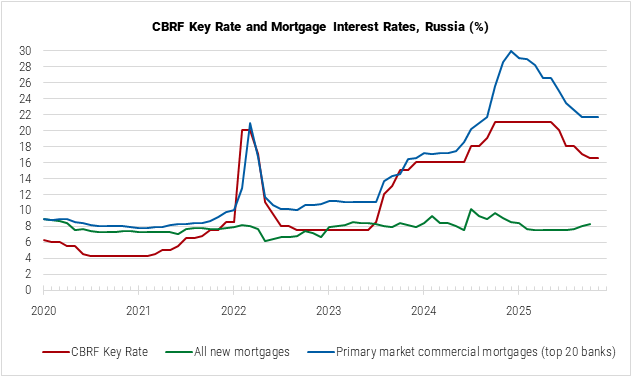
The Bank of Russia (CBRF) began gradually lowering its key rate from a decade-high level of 21% in mid-2025. At the most recent policy meeting in December 2025, the regulator announced another 50 b.p. cut, which brought the benchmark to its current standing of 16%. Based on the inflationary environment in the country, the central bank stipulates that monetary policy "will remain tight for a long period", with local market experts anticipating further cuts only to a 13-15% level in 2026.
Along with the key rate trajectory, interest rates on commercial mortgages (general market offers by banks, excluding state-backed programs) have eased somewhat in 2025 following a period of rapid growth previously observed in the second half of 2024, after the termination of the largest government-subsidized lending program, the so-called Preferential mortgage. According to the reporting on the top 20 mortgage banks in Russia by the research company Frank RG, in October 2025, the weighted average interest rate on commercial loans stood at 21.7% for the primary residential market and 21.2% for the secondary residential market, down 8.2 and 8.0 points from the respective peak levels recorded in December 2024.
The substantial overall increase in interest rates on commercial mortgages in recent years brought them beyond affordable levels for the majority of the population. This, in turn, led to a substantial decline in new disbursements in this segment, with the demand for lending now mainly supported by the remaining subsidized programs such as the so-called Family mortgage, IT-mortgage, and Far-Eastern & Arctic mortgage - niche programs available to specific groups rather than the general population, all offering reduced rates significantly below market levels. In this environment, the monthly weighted average interest rate on all new mortgages issued (including subsidized) was reported by the CBRF at 8.24% in October 2025.
Data Sources: CBRF, Frank RG.
Interest rates on new mortgages, monthly weighted average:
| October 2025 | YoY | October 2024 | YoY | October 2023 | |
| New mortgages issued: all programs (incl. subsidized) | 8.24% | ↓ | 9.65% | ↑ | 8.35% |
| - Primary market offer: commercial programs (top 20 banks) | 21.70% | ↓ | 25.50% | ↑ | 14.50% |
| - Secondary market offer: commercial programs (top 20 banks) | 21.20% | ↓ | 25.30% | ↑ | 14.40% |
| Data Sources: CBRF, Frank RG. | |||||
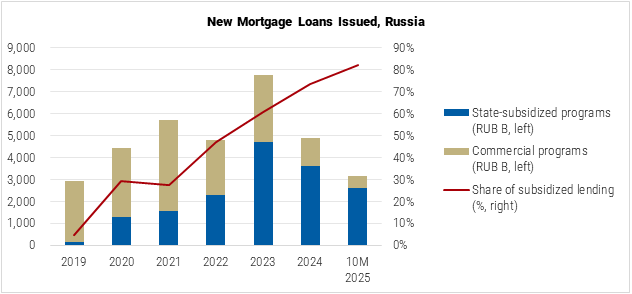
Following strong growth in the value and volume of mortgage loans extended in 2023, new lending in Russia plummeted in the second half of 2024 after the end of the state-subsidized Preferential mortgage program and has continued to decrease since. In the ten months of 2025, the CBRF reported a little over 696 thousand new mortgage loans amounting to RUB 3.1 trillion (USD 38.8 billion), representing a 39.8% decline in volume and 27.4% decline in value compared to the same period the previous year. The total value of subsidized lending during this period dropped by 18.1% year-on-year, and the total value of commercial lending by 52.3% year-on-year. At the same time, the share of state-subsidized loans in total new lending increased notably from 27.5% in 2021 to 73.4% in 2024 and 82.2% in the 10 months of 2025.
Looking ahead, considering the expected lowering of the central bank's key rate and a pick-up in refinancing of existing credit, analysts from Frank RG project mortgage disbursements to return to 2024 levels in 2026, reaching around RUB 4.9 trillion for the full year.
Data Source: CBRF.
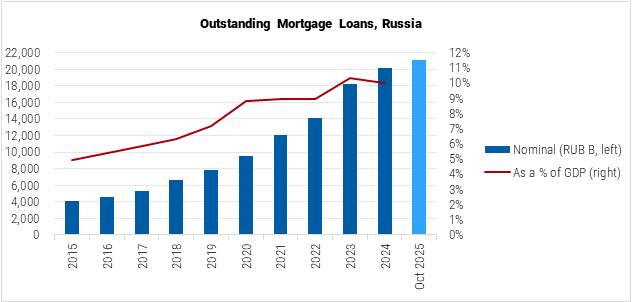
Overall, over the last decade, the mortgage market in Russia has expanded nearly fivefold, with an average annual growth of 18.8.% between 2015 and 2024. Its relative size, while still limited compared to the national economy, grew from an estimated 4.9% of GDP at current prices in 2015 to 10.0% in 2024.
In the upcoming periods, however, market expansion will likely be slowed by prohibitively high interest rates in the commercial segment and the general population's limited access to the remaining government-backed programs. As of October 2025, the total value of outstanding mortgage loans reported by the CBRF reached RUB 21.1 trillion (USD 260.5 billion), a 4.8% increase since the beginning of the year. Mortgages comprise over half (57%) of outstanding credit extended to households in Russia.
Data Sources: CBRF, Rosstat.
Socio-Economic Context:
Growth Decelerates, Inflation Still Above Target
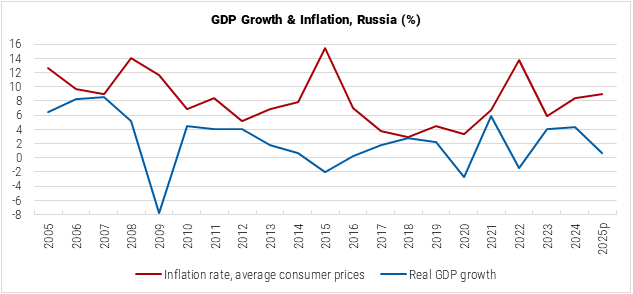
After two years of overheated expansion (over 4% annually), Russia's economic growth has decelerated considerably in 2025 due to capacity constraints and the central bank's tight monetary policy, with real GDP growth for the year projected at 0.6%-0.8%. The European Commission's assessment attributes the downturn to the adverse effects of the ongoing war in Ukraine, with international sanctions exacerbating the country's pre-existing macroeconomic imbalances, such as high inflation, rising private debt levels, and a deteriorating fiscal situation. For the next two years, growth is forecast at 1.1% and 1.2%, respectively, which aligns with the International Monetary Fund (IMF) forecast of 1.0% for 2026 and 1.1% for 2027.
After peaking at 10.3% in March 2025, the consumer price index (CPI) inflation in the country has been gradually declining as the impact of high interest rates continued to unfold, but it remains notably above the central bank's 4% target. Most recently, the indicator was reported by Rosstat at 6.6% in November 2025. The European Commission projects the annual inflation level in Russia to reach 8.9% for 2025, before easing to 5.4% in 2026 and 4.6% in 2027. The IMF forecast sees inflation at 5.2% in 2026 and 4.0% in 2026.
The country's labor market remains tight, with the unemployment rate most recently reported by Rosstat at 2.1% in November 2025.
Data Source: IMF.
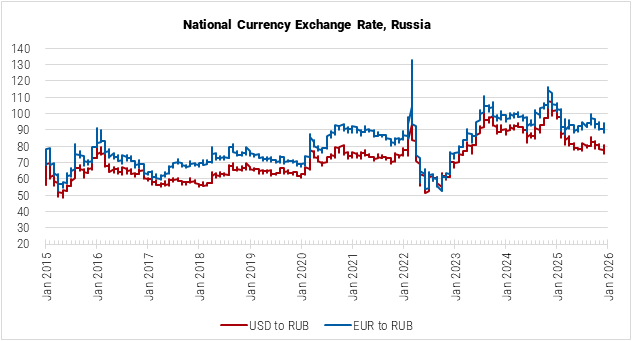
In this landscape, the Russian national currency remains weak, the exchange rate experiencing volatility and averaging RUB 83.25 per USD 1 and RUB 94.07 per EUR 1 in 2025, based on the CBRF official daily rates.
The overall risks to Russia's economic growth are diverse but largely tilted downwards. "Externally, key risks include lower oil prices and tightening of the sanctions regime, which could negatively impact growth and fiscal projections. Domestically, sectors not related to the war that are exposed to high interest rates could trigger a credit event, potentially requiring fiscal intervention or monetary financing, further weighing on growth," said the latest forecast from the European Commission.
On the upside, growth prospects could be improved by the end of the conflict in Ukraine, combined with potential sanctions relief and easing of global trade tensions.
Data Source: CBRF.
Sources:
- Federal State Statistics Service (Rosstat)
- National Accounts (RU): https://rosstat.gov.ru/
- Prices and Inflation (RU): https://rosstat.gov.ru/
- Construction (RU): https://rosstat.gov.ru/
- Labor force, Employment and Unemployment (RU): https://rosstat.gov.ru/
- Socio-Economic Situation in Russia, January-November 2025 (RU): https://rosstat.gov.ru/
- Bank of Russia (CBRF)
- Key Rate: https://www.cbr.ru/
- Bank of Russia Cuts the Key Rate by 50 bp to 16.00% p.a.: https://www.cbr.ru/
- Housing (Mortgage) Loan Market: https://www.cbr.ru/
- Information on the Housing Mortgage Lending Market in Russia, October 2025 (RU): https://www.cbr.ru/
- Dynamics of the Official Exchange Rates: https://www.cbr.ru/
- Federal Service for State Registration, Cadastre and Cartography (Rosreestr)
- Information, Analytical Reports (RU): https://rosreestr.gov.ru/
- International Monetary Fund (IMF)
- Country Overview: Russian Federation: https://www.imf.org/
- European Comission
- European Economic Forecast, Autumn 2025: https://economy-finance.ec.europa.eu/
- DOM.RF
- Multi-apartment Housing Review for Q3 2025 (RU): https://xn--d1aqf.xn--p1ai/
- Housing Rental Market Review for Q3 2025 (RU): https://xn--d1aqf.xn--p1ai/
- H1 2025 Results in the Housing Sector (RU): https://xn--d1aqf.xn--p1ai/
- Frank RG
- Mortgage Market Research (RU): https://frankrg.com/
- Mortgages 2025-2026: High-Rate Stress Test and Recovery Forecasts (RU): https://frankmedia.ru/
- Cian
- Real Estate Market in 2026: What Will Happen to Prices and Mortgages? (RU): https://ekb.cian.ru/
- Rent Prices Falling for the Second Month in a Row (RU): https://ekb.cian.ru/
- The Rental Housing Market Has Seen a Doubling of Supply (RU): https://ekb.cian.ru/
- Expert RA
- Rental Market Development Forecast for 2025-2030 (RU): https://raexpert.ru/
- RBC
- Rising Prices and Record Delays: Experts Forecast Housing Prices for 2026 (RU): https://realty.rbc.ru/
- Sberbank Has Forecast Growth for New Buildings in 2026 (RU): https://realty.rbc.ru/
- Housing Commission Has Lagged Behind Last Year's Figures… (RU): https://realty.rbc.ru/
- The Ministry of Construction Noted… (RU): https://realty.rbc.ru/
- The Bell
- Russia Ends Subsidized Mortgages, Leaving a Housing Bubble and Inequality Behind: https://en.thebell.io/
- RIA Novosti
- Expert: Housing Rentals in Major Russian Cities Will Become Cheaper in Early 2026 (RU): https://realty.ria.ru/
- The Moscow Times
- Russian Rental Prices Flat For the First Time Since 2022: https://www.themoscowtimes.com/
- Unified Register of Developers (ERZ)
- Marat Khusnullin: More than 100 million Square Meters of Housing... (RU): https://erzrf.ru/
- Banki.ru
- How Much Will Apartment Prices Increase in 2026? (RU): https://www.banki.ru/