Moldova's Residential Property Market Analysis 2026
In the environment of improved financing conditions and persistently high inventory levels, the Polish housing market continues to rebalance, with signs of price growth stabilization observed in both sales and rental segments.
This extended overview from Global Property Guide covers key aspects of the Polish housing market and takes a closer look at its most recent developments and long-term trends.
Table of Contents
- Property Prices and Price Index
- Historic Perspective
- Property Demand Trends
- Property Supply Trends
- Rental Market: Rents and Rental Yields
- Mortgage Market and Interest Rates
- Economic and Social Factors
Property Prices and Price Index
Moldova’s residential market continues to post strong price growth, although a stabilization phase is increasingly expected as demand softens and new supply expands. In Q3 2025, the Residential Property Price Index (RPPI) for Chișinău from the National Bank of Moldova (NBM) recorded a year-on-year increase of 33.91% (24.72% in real terms). Price growth remained broad-based across segments: primary-market prices (new dwellings) rose by 34.04% (24.84% inflation-adjusted), while the secondary market (existing dwellings) increased by 33.53% (24.36% inflation-adjusted).
Moldova's house price annual change:
Despite the strong headline price growth, local professionals increasingly expect the market to move toward a plateau as affordability constraints weigh on demand and new supply begins to catch up. Urbanism expert Roman Guniawy argues that the Chișinău market is nearing its price ceiling and that growth is likely to decelerate as the market transitions into a stabilization phase. He links this to an expanding supply pipeline and fading speculative activity, previously driven by purchases for resale at a markup, adding that “households simply do not have the incomes to buy at today’s prices, which is already reflected in the sharp drop in sales.” In his view, the next phase will be “a gradual market stabilization, with downward pressure on prices as supply continues to rise.”
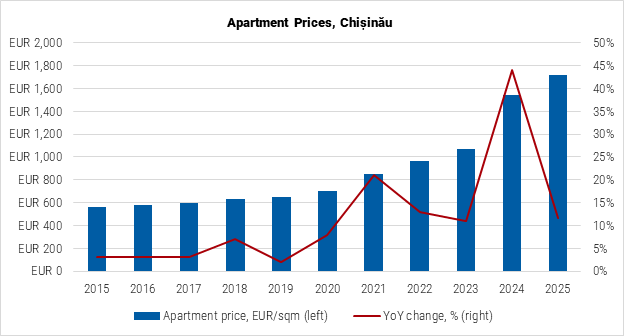
Acces Imobil’s market tracking also points to a shift toward a price plateau. By end-March 2025, the company estimated that apartment prices in Moldova’s capital reached a record EUR 1,720 (USD 1,859) per square meter, up by 11.69% from EUR 1,540 (USD 1,666) per square meter at end-2024. Real estate specialist Victor Cernomorcenco described the subsequent shift as a “capping phase,” noting that “prices are no longer increasing, but they are not decreasing either, reflecting the tension between sellers’ expectations and buyers’ ability to pay.”
Any adjustment, however, is likely to be uneven across submarkets. Realtors caution against assuming a broad-based correction: a meaningful decline is not expected in central locations and the main residential districts of Chișinău. Instead, any price softening is more likely to be concentrated in new-build schemes on the periphery.
Note: Properties for sale in Moldova are quoted in EUR.
Data Source: Acces Imobil.
Historic Perspective:
Key Milestones Behind the Surge of Chișinău’s Apartment Prices
Apartment prices in Chișinău have experienced significant fluctuations over the past decade, according to Acces Imobil specialists who analyzed the evolution of prices in the capital. Following the bankruptcy of major construction companies in the early 2010s, the market stabilized between 2014 and 2017, adjusting to new conditions. During this period, prices saw only modest annual inflation-related adjustments. Smaller construction companies entered the market, focusing on building compact apartments to cater to a broader buyer profile, diverging from the high-priced "elite" properties popular in the early 2000s. Although mortgages began to gain traction as a means of financing real estate purchases, strict lending conditions limited their accessibility.
The landscape shifted notably between 2018 and 2019 with the introduction of the state-backed Prima Casă program. This initiative allowed citizens to secure mortgage loans with reduced down payments and capped annual effective interest rates. The program's success transformed the mortgage market, prompting banks to ease lending conditions. As a result, approximately 30-40% of all apartment purchases were financed through mortgages, spurring an annual price increase of around EUR 40 (USD 47) per square meter — substantially higher than the EUR 10-15 (USD 13-17) per square meter growth seen earlier. During this period, smaller construction firms expanded, competition intensified, and the market diversified with offerings spanning affordable, mid-range, and premium segments. Concurrently, internal migration and financial inflows into Chișinău from both within Moldova and abroad accelerated.
The COVID-19 pandemic in 2020 disrupted the market. Investors, gripped by uncertainty, sought to withdraw funds from ongoing projects, delaying new construction starts. Simultaneously, consumer preferences shifted toward detached homes, duplexes, and larger apartments, driven by a desire for more spacious living environments. As the deferred demand from lockdowns surged, apartment prices in Chișinău increased rapidly — by EUR 110-145 (USD 119-172) per square meter annually.
The onset of the conflict in Ukraine in 2022 brought additional challenges. A large influx of refugees exerted immense pressure on the rental market, leading to a doubling of rents. Construction companies faced material shortages and soaring costs, which inflated the prices of unfinished apartments. Meanwhile, extraordinarily high inflation deterred long-term investments, causing a sharp drop in sales transactions and the withdrawal of many small investors from the market. Expensive loans further reduced the prevalence of mortgage-financed home purchases.
In 2023, inflationary pressures continued to drive home prices upward, with only a gradual easing observed in the latter half of the year. By 2024, reduced mortgage rates briefly stimulated demand amid a constrained supply of apartments, pushing Chișinău’s average apartment price to EUR 1,540 (USD 1,666) per square meter and further eroding affordability.
More recently, the market has begun to decouple: transaction activity in Chișinău has fallen sharply, yet prices have remained firm, with no broad-based correction evident. Since spring 2025, pricing has largely plateaued around EUR 1,720 (USD 1,859) per square meter, signaling a stabilization phase in which further growth has eased but downward adjustment has been limited, reflecting the gap between sellers’ pricing expectations and buyers’ affordability.
Apartment Prices in Chișinău:
| Year | Average Apartment Price, EUR/sqm |
YoY Change (%) | Year | Average Apartment Price, EUR/sqm |
YoY Change (%) | |
| 2008 | EUR 900 (USD 1,325) |
5.88% | 2017 | EUR 595 (USD 672) |
2.59% | |
| 2009 | EUR 720 (USD 1,003) |
-20.00% | 2018 | EUR 635 (USD 750) |
6.72% | |
| 2010 | EUR 610 (USD 809) |
-15.28% | 2019 | EUR 650 (USD 728) |
2.36% | |
| 2011 | EUR 525 (USD 731) |
-13.93% | 2020 | EUR 705 (USD 804) |
8.46% | |
| 2012 | EUR 535 (USD 688) |
1.90% | 2021 | EUR 850 (USD 1,006) |
20.57% | |
| 2013 | EUR 540 (USD 717) |
0.93% | 2022 | EUR 960 (USD 1,011) |
12.94% | |
| 2014 | EUR 550 (USD 731) |
1.85% | 2023 | EUR 1,070 (USD 1,157) |
11.46% | |
| 2015 | EUR 565 (USD 627) |
2.73% | 2024 | EUR 1,540 (USD 1,666) |
43.93% | |
| 2016 | EUR 580 (USD 642) |
2.65% | 2025 | EUR 1,720 (USD 1,859) |
11.69% | |
| Note: Properties for sale in Moldova are quoted in EUR. USD to EUR Annual Spot Exchange Rate as reported. | ||||||
| Data Source: Acces Imobil. | ||||||
Property Demand Trends
Transaction Volumes Collapse as Prices Outrun Affordability
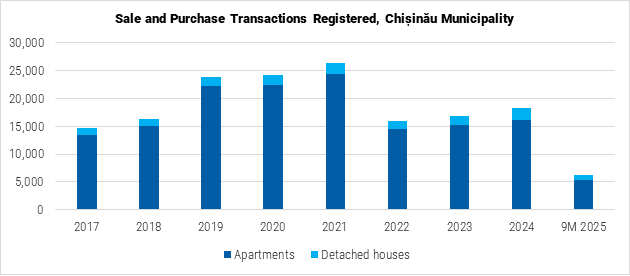
After acceleration throughout 2023–2024, Moldova’s housing market entered a phase of falling effective demand in 2025. In the first three quarters of the year, a total of 15,407 residential units, including apartments and detached houses, were sold nationwide, reflecting a 36.66% year-on-year drop in transactions, according to figures from the Real Estate Cadaster of Moldova (IPCBI).
Chișinău and its suburbs accounted for 40% of all sales, registering 6,187 sale and purchase agreements, down 52.25% year-on-year. In the capital, apartment transactions dropped by 52.58%, while detached house transactions decreased by 41.80%, underscoring a pronounced contraction in buyer activity.
Data Sources: IPCBI, ASP.
Acces Imobil’s Victor Cernomorcenco describes this development as a shift from an overheated boom to a market under pressure, noting “a downward trend, marking the third consecutive quarter of decline in the total number of sale-purchase transactions,” driven by “the continuous increase in apartment prices” and stricter rules on documenting the origin of funds and using bank transfers. He adds that apartments which used to sell in 1-2 months in 2020–2021 now take 3-4 months on average, and that “this slowdown in sales, coupled with the increasingly slower supply renewal, paints a picture of a partially blocked market, with more and more buyers postponing purchase decisions while the number of owners listing their homes at inflated prices continues to grow.”
Petr Oleinic, head of the Nika Imobil real estate agency, sees the current situation as a classic supply-and-demand adjustment. “When prices rise, demand declines, and the market reaches equilibrium. There's no longer the rush to buy that drove prices up last year. Prima Casă [a state-backed subsidized mortgage scheme for first-time buyers] is already a more or less stable product. Everyone who jumped on it early has already bought apartments. Everyone who wanted to invest cash in real estate has already done so,” he notes.
Moving forward, Oleinic expects the market to stagnate, with limited activity: “The number of transactions will be low, and most likely, there will be forced transactions, where the seller needs to sell urgently, for example, because they're moving away or need to urgently pay off financial obligations. Or the buyer urgently needs to buy: for a wedding, divorce, or family expansion.”
Property Supply Trends
Moderate Rebound in Completions, Thinning Pipeline Ahead
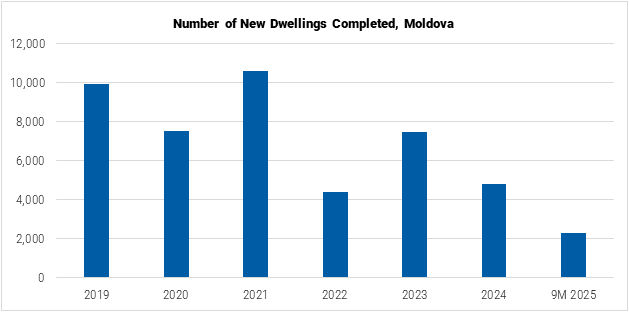
The supply of new residential units in Moldova demonstrated a moderate rebound in 2025. According to the National Bureau of Statistics of the Republic of Moldova (NBS Moldova), 2,323 dwellings were completed nationwide in the first nine months of the year, representing a 9.52% year-on-year increase. However, this growth is measured against the low base of 2024, which tempers the strength of the apparent recovery.
Data Source: NBS Moldova.
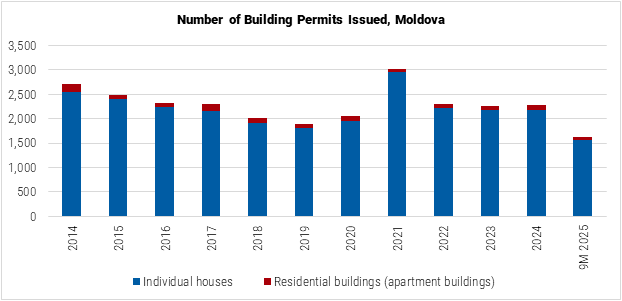
The picture of a sustained upturn in residential construction is further called into question by the downward trend in residential building permits, a key leading indicator for future activity. Between January and September 2025, a total of 1,562 residential permits were granted nationwide, translating into a 1.46% year-on-year decline, according to the NBS Moldova data, and signaling a likely easing in future completions once the current pipeline is delivered.
Data Source: NBS Moldova.
Regionally, the Chișinău area clearly dominates new residential activity, posting positive dynamics in both dwellings commissioned and permits issued and accounting for the largest share of construction nationwide. As Logos Press notes, “construction is becoming increasingly concentrated in the capital,” with multi-story residential complexes continuing to move ahead in Chișinău despite the weaker picture elsewhere.
Number of building permits issued by region:
| Number of Newly Built Dwellings, (Jan-Sep 2025) |
YoY, % | Number of Building Permits Issued, (Jan-Sep 2025) |
YoY, % | |
| Chișinău | 1,735 | 20.91% | 607 | 0.83% |
| North region | 108 | 44.00% | 180 | -6.25% |
| Center region | 364 | -0.27% | 584 | -3.15% |
| South region | 75 | -14.77% | 117 | -13.33% |
| ATU Gagauzia | 41 | -74.05% | 129 | 18.35% |
| Moldova Total | 2,323 | 9.52% | 1,617 | -1.46% |
| Data Source: NBS Moldova. | ||||
Looking ahead, local analysts caution that today’s construction pipeline, heavily focused on the capital, may gradually push the market from a period of chronic shortage towards a phase of excess supply. Angela Matkov, a consultant in property valuation and investment projects, expects that in 2026–2028 the stock of apartments in Chișinău will increase substantially, while “no significant reasons for demand growth” are visible, noting that around 13-15% of the existing multifamily stock is already vacant due to overpricing. In her view, this signals the end of the unsatisfied-demand phase and the onset of conditions in which a growing number of empty units is likely to put downward pressure on prices.
Rental Market: Rents and Rental Yields
Rental Inflation Still Elevated, Signs of Market Stabilization Emerge
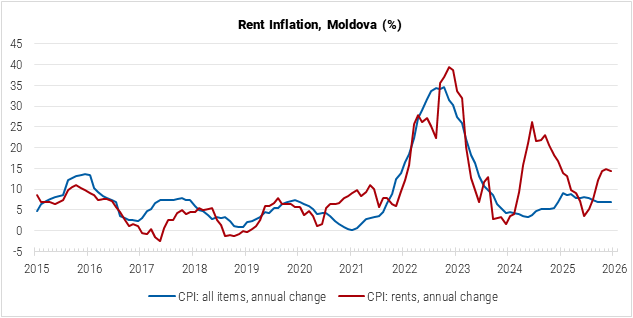
With only 4.8% of households renting rather than owning their residence, the rental market in Moldova is relatively small compared to other European countries. In recent years, it tilted notably towards demand, as the influx of foreign nationals since the beginning of the conflict in Ukraine in 2022 further shrunk the available offer, already limited due to constraints in new development.
Among other factors fueling accelerated rental inflation in the country have been increased tenant demand due to property prices exceeding affordability for many potential buyers, growing costs of communal services (which are typically passed on by landlords to tenants), and the authorities’ ongoing efforts to formalize the market and tax private landlords’ revenues. In the second half of 2025, the rent component of the consumer price index (CPI) reported by the NBS Moldova significantly outpaced the growth of the all-items CPI, most recently reported at 14.3% in December, while the overall price growth during the same period reached 6.8%.
Data Source: NBS Moldova.
For asking rates, previously, the analysis from Acces Imobil real estate agency estimated that apartment rents in the capital city of Chișinău increased 25-30% in 2024 compared to 2022-2023 levels. However, more recent assessments from local experts indicate that the capital’s rental market is more stable now, with demand drivers beyond traditional seasonal fluctuations not as significant.
“The rental housing market in Chișinău, after the agitation that was observed during the last three years, has finally calmed down and entered a phase of stabilization,” Petr Oleinic, the director of real estate agency Nika Imobil, told Logos Press in June 2025. “Demand has decreased due to two main factors: the inflow of Ukrainian citizens has decreased, and previously rented housing our fellow citizens, with the help of the Prima Casă program, moved into the category of owners. At the same time, the supply remained approximately at the same level, and as a result, prices stabilized.”
This view is shared by Ilya Sopivnik, the director of Imobilus real estate agency. “Now there is a trend of outflow of tenants from Ukraine, who vacate their apartments. Therefore, even the demand from students does not have a significant impact. Rather, a certain balance has been established in the market. Perhaps this is a temporary situation related to the season, but practically everything is rented at the right price,” he commented for Logos Press in September 2025.
According to Sopivnik, for apartments in Chișinău (in good condition, equipped with furniture and household appliances), depending on the neighborhood, average rent now reaches EUR 400-500 for a 1-bedroom unit and EUR 600-700 for a 2-bedroom unit. Apartments in older buildings are typically more affordable at EUR 300-350 and EUR 400-450, for 1- and 2-bedroom units, respectively.
Mortgage Market and Interest Rates
Lending Expands Sharply Despite Weaker Sales Activity
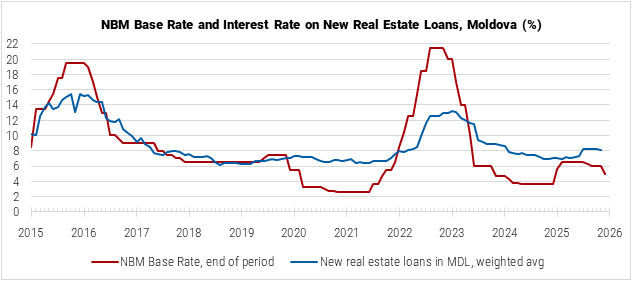
Throughout 2025, the NBM’s monetary policy reflected its primary objective of keeping inflation in the country close to the medium-term target of 5% ± 1.5 percentage points, which resulted in a temporary increase in the base rate at the beginning of the year. However, since August 2025, the regulator began easing its stance once again, eventually bringing the benchmark rate down to the current level of 5.0%.
Moldova's mortgage loan interest rates:
“The decision of the National Bank of Moldova [to further reduce the base rate] aims to stimulate aggregate demand, which is currently disinflationary, including by encouraging consumption and investment, balancing the national economy and the current account, as well as anchoring inflation expectations. The reduction of the base rate will <…> influence a decrease in interest rates on the monetary, deposit, and credit markets,” said the central bank’s release following the most recent rate cut in December 2025.
Data Source: NBM.
In line with the base rate trajectory, interest rates on real estate loans to individuals experienced an uptick from the low point previously reached at the end of 2024, but can be expected to decline as recent monetary policy decisions are passed on by the lenders. The weighted average interest rate on new mortgages in MDL, as reported by the NBM, reached 8.14% in November 2025, up from 6.89% a year earlier, but below the levels observed in 2022-2023.
Interest rates on real estate loans to individuals, monthly weighted average:
| November 2025 | YoY | November 2024 | YoY | November 2023 | |
| New loans in MDL: all terms | 8.14% | ↑ | 6.89% | ↓ | 8.84% |
| - New loans in MDL: 2 to 5 years term | 8.04% | ↑ | 7.68% | ↓ | 9.41% |
| - New loans in MDL: over 5 years term | 8.14% | ↑ | 6.88% | ↓ | 8.82% |
| Data Source: NBM. | |||||
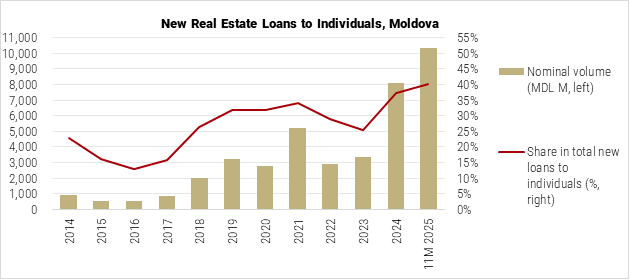
The easing of mortgage interest rates from peak levels continued to support a surge of lending activity in Moldova, despite the overall decline in housing transactions. The nominal value of new real estate loans extended to individuals in the eleven months of 2025 reached a record high of MDL 10.4 billion (USD 613.7 million), a 47.2% increase compared to the same period in 2024. The share of real estate credit in total new loans to individuals also grew from 25.6% in 2023 to 37.1% in 2024 and 40.1% in the eleven months of 2025.
“Although the Moldovan real estate market is facing a sharp decline in the number of transactions, mortgage lending is at its highest level ever. Thus, mortgage loans are becoming a ‘lifeline’ both for the banking system and for the population, which has no other options to finance the purchase of housing,” summarized Veaceslav Ionitsa from the independent think tank IDIS “Viitorul”, as quoted by Logos Press.
Data Source: NBM.
Overall, the development of the mortgage market in Moldova in recent years has been stimulated by the Prima Casă (First Home) program, which offers government-guaranteed loans to qualifying citizens. Initially launched in 2018, the program has been extended several times, facilitating home acquisition for over 8,000 households. In mid-2024, the authorities announced legislative amendments aiming to improve the accessibility of the program and offer more advantageous conditions for homebuyers. By lifting the employment in Moldova requirement, the amended Prima Casă Plus program became available to wider groups of citizens, such as freelancers, lawyers, artists, and others. In addition, the amendments increased the maximum price of property that can be purchased from MDL 1 million (about USD 55 thousand) to MDL 2.5 million (about USD 138 thousand) and increased the maximum loan period from 25 to 30 years. The amount of guarantee provided by the government for housing outside Chișinău was increased from 50% to 65-70% of the loan balance (depending on location). More than 3,000 applicants have reportedly obtained loans under the amended program since then.
For 2026, the Government of Moldova maintained a 3% maximum bank margin for loans granted under Prima Casă, effectively capping interest rates for participants of the program.
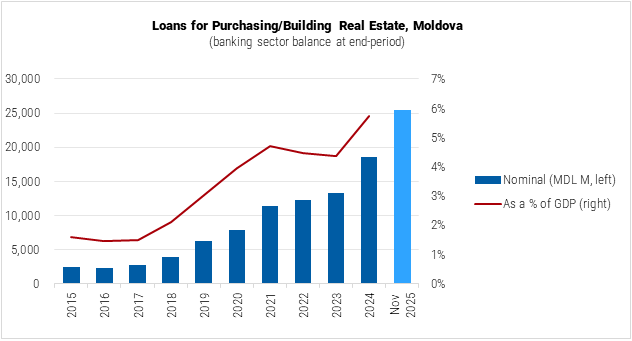
As of November 2025, the total value of outstanding loans to individuals for purchasing or building real estate, based on the banking sector balance reported by the NBM, reached MDL 25.5 billion (USD 1.5 billion), a 37.0% increase since the end of the previous year. The relative size of the market, measured by the housing loan stock to GDP ratio, notably increased over the last decade from 1.6% in 2015 to an estimated 5.7% of GDP at current prices in 2024, but remains limited compared to other European countries.
Data Sources: NBM, NBS Moldova.
Economic and Social Factors
Growth Rebounds, Inflation Eases Gradually After Energy-Related Spike
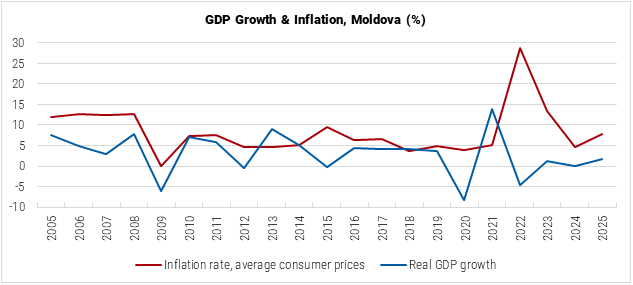
Following a stagnation in 2024, economic activity in Moldova picked up last year, driven by domestic demand, while broad-based energy support helped to mitigate the negative impact of the winter energy price increase on households’ income and companies’ operational costs. The estimated real GDP growth in 2025 reached 1.7% and is projected by the International Monetary Fund (IMF) to accelerate to 2.2% in 2026 and 3.5% in 2027. The European Commission expects growth rates of 2.6% and 3.7% in the next two years, respectively.
In the upcoming period, growth will also be facilitated by one of the EU’s largest financial support packages ever, which Moldova secured in 2025. A EUR 1.9 billion Reform and Growth Facility is designed to help implement broad economic and structural reforms and accelerate the country’s convergence with EU standards. “Real GDP growth is projected <…> to gain further momentum over the forecast period, as agriculture recovers, and the Reform and Growth Facility boosts consumption and investment,” said the latest forecast from the European Commission.
Against this background, consumer price index (CPI) inflation in the country has been receding gradually after an energy-related spike in the winter of 2024/25, when the supply of Russian gas to Transnistria was interrupted, affecting the country's electricity supply. It remains slightly above the NBM’s target, however, most recently reported at 6.8% in December 2025. The IMF projects the indicator to fall from the annual average level of 7.7% in 2025 to 5.5% in 2026 and 5.0% in 2027.
Data Source: IMF.
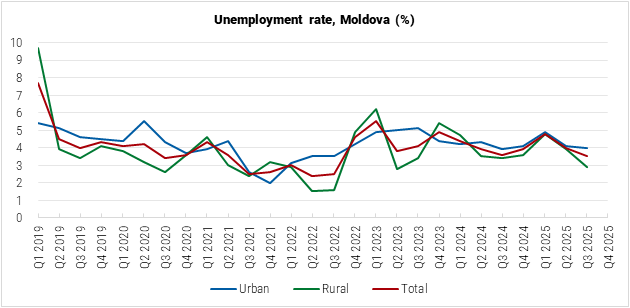
Alongside economic recovery, Moldova’s labor market resumed moderate growth, although labor shortages due to a persistent skills mismatch and widespread full-time or seasonal work abroad continue constraining its development, the European Commission noted. Real wage growth slowed in the first half of 2025 on account of higher inflation, but is expected to increase, supported by persistently strong demand for both low- and high-skilled labor, as well as by legislated increases in public and minimum wages. Unemployment in urban and rural areas alike has declined throughout the year and was most recently reported by the NBS Moldova at 3.5% nationwide in Q3 2025.
Data Source: NBS Moldova.
Overall, while the latest energy shock to Moldova’s economy was mitigated thanks to availability of external financing, alternative electricity imports, and increased domestic production, the country remains highly exposed to the impacts of the war in Ukraine and the frozen conflict in the region of Transnistria, as well as consistent risk of foreign interference in domestic politics, which could disrupt the ongoing EU integration process.
Previously, Moldova applied for EU membership and was granted candidate status in the summer of 2022, with formal accession negotiations opened in June 2024. In October 2024, the country held a constitutional referendum (which affirmed the integration plans) and re-elected President Maia Sandu for her second term. More recently, in the fall of 2025, the pro-European ruling Party of Action and Solidarity (PAS) won the national parliamentary election, confirming the public mandate for this development trajectory.
In September 2025, Fitch Ratings affirmed Moldova’s ‘B+’ credit rating with a stable outlook, noting the country’s commitment to policies that have preserved macroeconomic and financial stability through a series of potentially destabilizing shocks.
Sources:
- Government of Republic of Moldova
- First Home Plus: Government Extends Accessibility Of Program… https://gov.md/
- Prima Casă Program Overview (RO): https://primacasa.gov.md/
- The Maximum Margin for "First Home" Loans Remains at 3% in 2026 (RO): https://mf.gov.md/
- National Bank of Moldova (NBM)
- Financial Stability Assessment Report. Q3 2025 (RO): https://www.bnm.md/
- NBM Interest Rates: https://bnm.md/
- Monetary Policy Decision, 11.12.2025: https://bnm.md/
- Developments in the Loan Market in November 2025 (RO): https://www.bnm.md/
- Official Exchange Rates: https://www.bnm.md/
- National Bureau of Statistics of the Republic of Moldova (NBS Moldova)
- Housing Fund Related Statistics (RO): https://statistica.gov.md/
- Press Release: Building Permits Issued in January-September 2025 (RO): https://statistica.gov.md/
- Consumer Price Indices: https://statistica.gov.md/
- Employment and Unemployment: https://statistica.gov.md/
- Living Standard of the Population: https://statistica.gov.md/
- Real Estate Cadaster of Moldova (IPCBI)
- Information on Real Estate Registrations: https://ipcbi.gov.md/
- European Council
- Moldova: https://www.consilium.europa.eu/
- Moldova: Council Gives Final Green Light to Support Reforms and Economic Growth With EUR 1.9 Billion: https://www.consilium.europa.eu/
- European Commission
- European Economic Forecast, Autumn 2025: https://economy-finance.ec.europa.eu/
- EU-Moldova Relations: https://neighbourhood-enlargement.ec.europa.eu/
- International Monetary Fund (IMF)
- Country Overview: Republic of Moldova: https://www.imf.org/
- Republic of Moldova: Staff Concluding Statement of the 2025 Article IV Mission: https://www.imf.org/
- Fitch Ratings
- Fitch Affirms Moldova at 'B+'; Outlook Stable: https://www.fitchratings.com/
- Federal Reserve Bank of St. Louis (FRED)
- U.S. Dollars to Euro Spot Exchange Rate (annual): https://fred.stlouisfed.org/
- Access Immobil
- Real Estate Crisis in Chisinau Intensifies in Q3 2025: https://accesimobil.md/
- Apartment Price Trends in Chisinau (2015-2024): https://accesimobil.md/
- Analysis: Evolution of Apartment Prices in Chisinau (2007-2023): https://accesimobil.md/
- Analysis of Apartment Rental Prices in Chisinau, 2024-2025: https://accesimobil.md/
- Reuters
- Moldova's Pro-Western Sandu Claims Election Win After Meddling Allegations: https://www.reuters.com/
- The Guardian
- Moldovans Back Joining the EU by Razor-Thin Majority: https://www.theguardian.com/
- Logos Press
- Construction is Increasingly Concentrated in the Capital: https://logos-pres.md/
- The Real Estate Market is Heading Towards “Oversupply” (RO): https://logos-pres.md/
- Mortgage Loans Have Peaked: https://logos-pres.md/
- Price Balance in the Rental Housing Market: https://logos-pres.md/
- The Rental Market Has Entered a Stabilization Phase: https://logos-pres.md/
- Moldpress
- CEC Approved Final Results of 28 September Parliamentary Elections: https://www.moldpres.md/
- TV8
- Will Mass Construction Lower Housing Prices in Chisinau?... (RU): https://tv8.md/
- Will Apartments in Chisinau Become Cheaper?... (RU): https://tv8.md/
- NewsMaker
- Moldova’s Real Estate Market Has Hit a Record Low… (RU): https://newsmaker.md/