Estonia Residential Real Estate Market Analysis 2025
Estonia's residential real estate market is stabilizing, supported by modest house price gains and a gradual recovery in demand, but growth remains subdued amidst persistent challenges facing the wider economy.
This report provides an overview of Estonia's housing sector, covering market trends, demand and supply dynamics, historical developments, rental and mortgage conditions, and the broader socio-economic context.
Table of Contents
- Housing Market Snapshot
- Demand Highlights
- Supply Highlights
- Historic Perspective
- Rental Market
- Mortgage Market
- Socio-Economic Context
Housing Market Snapshot
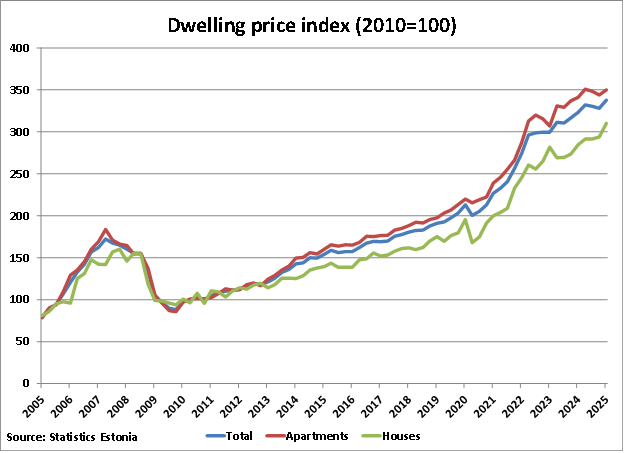
During the year to Q1 2025, the nationwide dwelling price index rose by a modest 4.62%, following year-on-year increases of 3.59% in Q4 2024, 6.44% in Q3, 6.69% in Q2, and 7.81% in Q1, according to figures released by Statistics Estonia. Though when adjusted for inflation, prices increased by just a miniscule 0.1% over the same period.
Quarter-on-quarter, nationwide house prices were up by 2.99% (0.85% inflation-adjusted) in Q1 2025.
Estonia's house price annual change:
Note: National House Price Index: Owner Occupied Residential Dwellings (2010 = 100)
Data Source: Statistics Estonia
By property type:
- Apartments: prices were up by 2.69% year-on-year in Q1 2025, following annual increases of 2.06% in Q4 2024, 5.79% in Q3, 6.03% in Q2, and 11.05% in Q1, according to Statistics Estonia. However, when adjusted for inflation, apartment prices actually declined by 1.74%. On a quarterly basis, prices increased slightly by 1.8% in Q1 2025 but fell by 0.32% in real terms.
- Houses: prices rose strongly by 8.93% year-on-year in Q1 2025, an acceleration from annual growth of 7.47% in Q4 2024, 8.13% in Q3, 8.4% in Q2, and 1.05% in Q1. In fact, it was the strongest showing since Q1 2023. When adjusted for inflation, house prices were up by 4.22% over the same period. Quarter-on-quarter, prices increased by 5.42% (3.23% inflation-adjusted).
In Tallinn, the country's capital, the average price of apartments stood at around €3,100 per square meter (sqm). For new apartments, the average price reached €4,200 per sqm, and has hardly moved in the past two years. For existing apartments, the average price was approximately €2,800 per sqm.
The highest price levels in the capital city can be found in northern Tallinn and Kristine, where a new two-bedroom apartment is typically offered for an average price of €225,000 and €210,000, respectively.
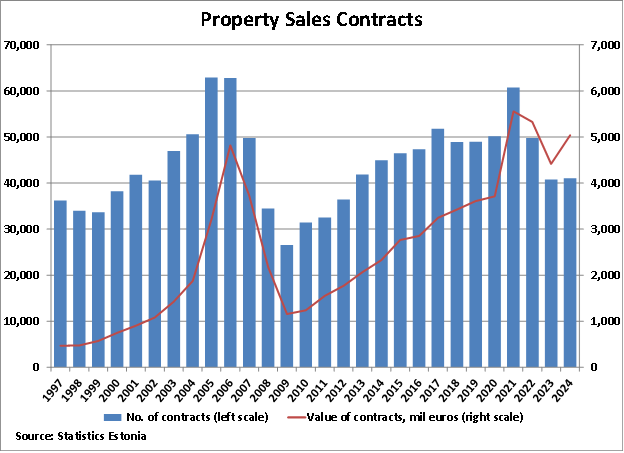
Demand seems to be recovering gradually, but weakness persists. During 2024, the total number of purchase-sale contracts of dwellings in Estonia increased slightly by 0.7% y-o-y to 41,033 units, an improvement from dramatic declines of 18.2% in 2023 and 18.1% in 2022, according to Estonia's Land and Spatial Development Board. Though despite the improvement, it remains the second-lowest level of sales transactions recorded since 2012. Likewise, the total value of contracts was up by 14.1% to €5.04 billion last year.
In the first eight months of 2025, the number and total value of purchase-sale contracts of dwellings in the country rose by 2.2% and 13.6%, respectively, as compared to the same period last year.
According to Siim Kabel of Domus Kinnisvara, the real estate market shows signs of stability, though current conditions favor buyers, making it very much a buyer's market.
"Subjectively, it is of course noticeable that clients have started to show a bit more interest in real estate..., but reaching a deal can be quite laborious and is taking more time than usual. I would confidently call the current market a buyer's market," said Kabel.
While the outlook for Estonia's housing market this year points to gradual improvement, it remains constrained by the country's weak overall economic performance.
Estonia's economy contracted by 0.3% in 2024 from a year earlier, following a decline of 3% in 2023, mainly due to weak investments, sluggish performance in key sectors like construction and manufacturing, and the drag of high inflation and tax increases, despite signs of recovery late in the year.
In Q2 2025, the economy expanded by 0.9% from the same period last year, an improvement from year-on-year contractions of 0.7% in Q1 2025, 0.5% in Q4 2024, and 0.3% in Q3 2024.
With this, the Estonian economy is forecast to return to growth this year, albeit at a subdued pace, with real GDP expected to rise by 1.1%, based on estimates released by the European Commission. The International Monetary Fund (IMF) offers an even more cautious outlook, forecasting only 0.7% growth for Estonia this year.
"Increasing real disposable incomes and lower borrowing rates, which reduce the interest burden quickly due to the prevalent use of loans at variable interest rates, supported consumption and investment. However, the sharp rise in global uncertainty following the announcements of US tariffs is set to weaken growth prospects, slowing private consumption growth until the impact on the economy and jobs becomes clear," said the European Commission.
"Investment, which in recent years was weak due to low capacity utilisation, is set to take a further hit due to uncertainty, as private projects are likely to be postponed or cancelled. A partially offsetting factor is an expected increase in public investment, as some large projects, such as the Rail Baltic, are implemented, and defence investments are expected to take place. As a result of these factors, Estonian real GDP is projected to grow by 1.1% in 2025," added the European Commission.
Demand Highlights:
Demand is stabilizing, but weakness persists
During 2024, the total number of purchase-sale contracts of dwellings in Estonia increased slightly by 0.7% y-o-y to 41,033 units, an improvement from dramatic declines of 18.2% in 2023 and 18.1% in 2022, according to Estonia's Land and Spatial Development Board. Though despite the improvement, it remains the second-lowest level of sales transactions recorded since 2012.
Likewise, the total value of contracts was up by 14.1% to €5.04 billion last year, in stark contrast with annual decreases of 17.1% in the preceding year and 4.1% two years earlier.
By major city:
- In Tallinn, the number of purchase-sales contracts fell slightly by 0.3% y-o-y to 10,681 units in 2024, an improvement from annual contractions of 14.1% in 2023 and 14% in 2022. On the other hand, the value of contracts increased by 14.5% during 2024 to €2.23 billion, after falling by 13% in 2023 and by 6.8% in 2022.
- In Tartu, the total number of purchase-sale contracts was up by 3.3% y-o-y to 4,962 units in 2024, while the value also increased by 12.4% y-o-y to €638.71 million.
- In Pärnu, the number of purchase-sale contracts was still down by 3.3% y-o-y to 2,742 units last year. However, the value of contracts already increased again by 10.6% to €287.42 million in 2024 from a year earlier.
The housing market continues to recover this year. In the first eight months of 2025, the number of purchase-sale contracts of dwellings in the country rose by 2.2% y-o-y to 26,291 units. Likewise, the total value of these said contracts was up by 13.6% y-o-y to €3.27 billion over the same period.
Foreign individuals and companies are allowed to acquire real estate in Estonia with the permission of the local authorities. There are legal restrictions on acquiring agricultural and woodland of 10 hectares or more, and permission from the county governor is needed. Foreign individuals are not allowed to acquire land located in smaller islands or listed territories adjacent to the Russian border.
Supply Highlights:
Residential construction activity showed mixed results
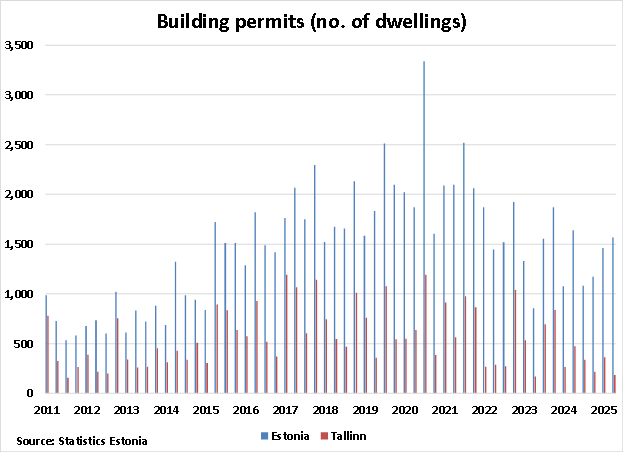
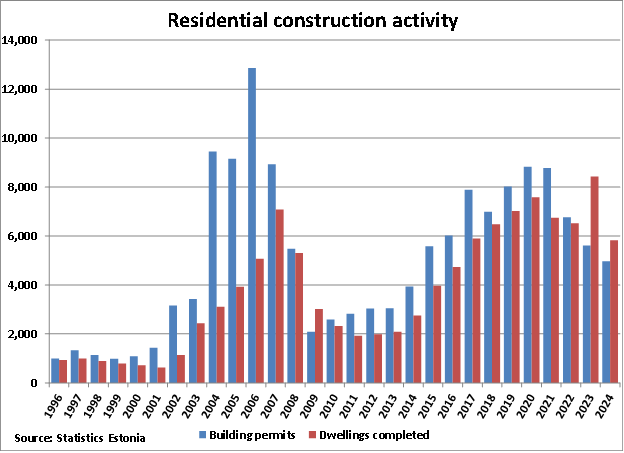
Residential construction activity is showing mixed results. During 2024, there were 4,973 dwelling units that were issued building permits, down by 11.4% from a year earlier, based on figures released by Statistics Estonia. This followed annual declines of 17% in 2023, 22.9% in 2022, and 0.7% in 2021. It was the lowest level recorded in a decade.
On the other hand, dwelling starts increased by 15.2% y-o-y to 4,935 units last year, while completions plummeted by 31% to 5,815 units.
In the first half of 2025, construction indicators continue to show opposing patterns.
For residential building permits:
- The number of dwellings issued building permits rose by 11.4% y-o-y to 3,028 units in H1 2025.
- The floor area of dwellings with permits also increased by 9.8% y-o-y to 280,000 sqm in H1 2025.
- The average floor area of a dwelling with permits rose by a modest 2.6% y-o-y to 96.4 sqm.
For dwelling starts:
- The number of dwellings started in Estonia fell sharply by 21.9% y-o-y to 2,258 units in H1 2025.
- Likewise, the floor area of dwellings started to drop by 14.8% y-o-y to 207,546 sqm over the same period.
- The total number of residential buildings increased by 5.9% y-o-y to 739 in H1 2025 as compared to the previous year.
For dwelling completions:
- The number of dwellings completed in Estonia fell slightly by 0.4% y-o-y to 2,973 units in H1 2025.
- Likewise, the floor area of dwellings completed increased modestly by 4% y-o-y to 281,200 sqm over the same period.
- The average floor area of dwellings completed in H1 2025 was 95.7 sqm, down by 3% from a year earlier.
Dwelling stock increasing
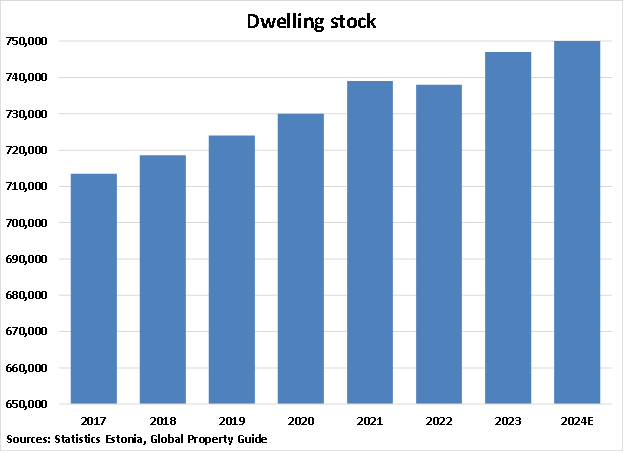
The total housing stock in Estonia has reached 747,000 units in 2023, up by 1.2% from the previous year and by 4% five years ago, according to Statistics Estonia. This was in contrast with the slight decline in dwelling stock of 0.1% y-o-y in 2022.
From 2017 to 2021, the country's dwelling stock had been growing slightly by an annual average of 0.9%.
In 2024, the total number of dwellings in Estonia was estimated to have surpassed 750,000 units, marking continued growth in the housing sector supported by urban development and rising demand for modernized living spaces.
Historic Perspective:
A short history of the Estonian property market cycle
After the break-up of the Soviet Union in 1991, housing construction in Estonia dramatically decelerated. In 2001, housing construction began to pick up, and Estonia's housing market was in a continuous boom from 2000 to 2007. The average price of two-bedroom flats in Tallinn rose by a whopping 448.7% from 2000 to 2007; in Tartu, prices rose 431.5%; and in Pärnu, prices increased by 440%. Price rises of three-bedroom flats were equally impressive, rising by 412% in Tallinn, 481% in Tartu, and 471.5% in Pärnu.
Owner-occupancy rates rose strongly, up from 85% in 2002 to 96% in 2004. The rental market shrank from 12% of households (with 9% privately renting and 3% in social rents) in 2002, to just 4% in 2004.
| HOUSE PRICE INDEX, ANNUAL CHANGE (%) | ||
| Year | Nominal | Inflation-adjusted |
| 2007 | 5.17 | -3.55 |
| 2008 | -19.64 | -25.71 |
| 2009 | -33.59 | -32.30 |
| 2010 | 12.88 | 7.33 |
| 2011 | 11.76 | 7.30 |
| 2012 | 5.84 | 2.09 |
| 2013 | 15.56 | 13.83 |
| 2014 | 10.05 | 10.63 |
| 2015 | 5.12 | 5.64 |
| 2016 | 7.72 | 6.32 |
| 2017 | 4.88 | 1.07 |
| 2018 | 5.70 | 1.91 |
| 2019 | 8.19 | 6.36 |
| 2020 | 4.80 | 6.00 |
| 2021 | 20.42 | 10.13 |
| 2022 | 16.85 | -2.98 |
| 2023 | 5.74 | 1.36 |
| 2024 | 3.59 | -0.28 |
| Sources: Statistics Estonia, Global Property Guide | ||
Then came the crash, amidst the 2008 global financial crisis. Estonia's house price fall in 2008 was among the biggest in the world, rivaled only by Latvia. House prices plunged by almost 34% in 2009, after falling by 20% in 2008.
Recovery began in 2010, with the average price of dwellings rising by 12.9% (7.3% inflation-adjusted). Dwelling completions began to rise in 2014, growing by 32.6% y-o-y to about 2,756 units. Completions have been increasing since, registering an annual average growth of almost 20% in 2015-20, until the completion slowdown in 2021-22.
Housing market prices have been continuously rising since, with prices rising by an average of about 8% (6.1% inflation-adjusted) annually from 2011 to 2020. Estonia's house price rises accelerated further to 20.4% (10.1% inflation-adjusted) in 2021 and 16.9% (-3% inflation-adjusted) in 2022.
During 2023, house price growth decelerated to 5.7% (1.4 inflation-adjusted), amidst falling demand and a struggling economy. The housing market continued to weaken last year, with house price growth slowing to 3.6% and actually declining slightly by 0.3% when adjusted for inflation.
Rental Market:
Moderate rental yields, weak luxury rental market
Gross rental yields for apartments in Estonia are moderate, ranging from 3.53% to 5.71% in Q2 2025, with a nationwide average of 4.23%, according to recent research conducted by the Global Property Guide. This was lower than the average yields of 4.51% recorded in the same period last year.
Estonia's rent price index:
Data Source: OECD
Yields have declined slightly, mainly due to the continued rise in house prices in the country in recent years. They remain, however, very reasonable at between €155,000 and €321,300 for a two-bedroom apartment.
In major Estonian cities:
- In Tallinn, the country's capital and largest city, gross rental yields ranged from 3.58% to 3.92% in the city center; 3.53% to 4.4% in Põhja-Tallinn; and 5% to 5.73% in Mustamäe. On average, Tallinn apartments offer an average rental yield of 4.41%.
- In Tartu, the country's second-largest city, apartments offer rental yields of between 3.96% and 5.03%, with a city average of 4.34%.
- In Pärnu, a popular holiday resort town in Estonia, yields are not significantly different, ranging from 3.57% to 4.33%, with a city average of 3.95%.
Round-trip transaction costs on residential property in Tallinn (i.e., the costs of buying and selling the property are low.
Due to the country's protracted economic recession, the rental market slowed dramatically in the past three years. Luxury apartments now take longer to be rented out, and rent prices are falling gradually. And despite the increased number of war refugees from Ukraine, they are on a tighter budget than the average Estonian.
"That's actually what's happening," said Uus Maa Real Estate analyst Risto Vähi. "Right now, people would rather rent a cheaper apartment with good accessory expenses."
Tallinn's most active rental markets are found in the city centre, as well as in the Lasnamäe and Mustamäe districts, according to Ober Haus' 2024 Baltics Real Estate Market Report.
Rental contracts typically run for one year, with no restrictions on leasing apartments. Residential rents are generally fixed rather than indexed, making lease terms relatively short. Utility costs such as electricity and heating are usually excluded from the rent and paid separately by the tenant. In practice, tenants also often cover the renovation fund, even though this obligation legally falls on the landlord.
Currently, two-bedroom apartments are rented out for about €600 to €945 per month, while three-bedroom apartments in prime locations are offered for monthly rents of €1,395 to €1,950.
Mortgage Market:
Mortgage interest rates are now trending downwards, but still at elevated levels
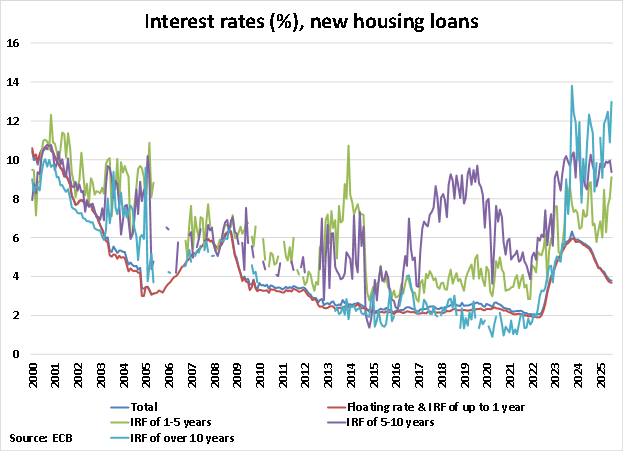
Interest rates for housing loans in Estonia are now declining, but still above historic norms. In July 2025, the average interest rate on new housing loans was 3.79%, down sharply from 5.53% in the previous year and 5.78% two years ago, according to the European Central Bank (ECB).
Estonia's mortgage loan interest rates:
Data Source: ECB
By initial rate fixation (IRF), in July 2025:
- Floating rate and IRF of up to 1 year: 3.68%, far lower than the 5.44% recorded in July 2024 and 5.65% in July 2023.
- IRF of 1-5 years: 9.1%, up from 8.75% in the previous year and 8.79% two years ago.
- IRF of 5-10 years: 9.37%, slightly down from 9.7% in the previous year and 10.2% two years earlier.
- IRF of over 10 years: 12.98%, slightly up from 12.33% a year earlier and far higher than the 9.01% registered two years ago.
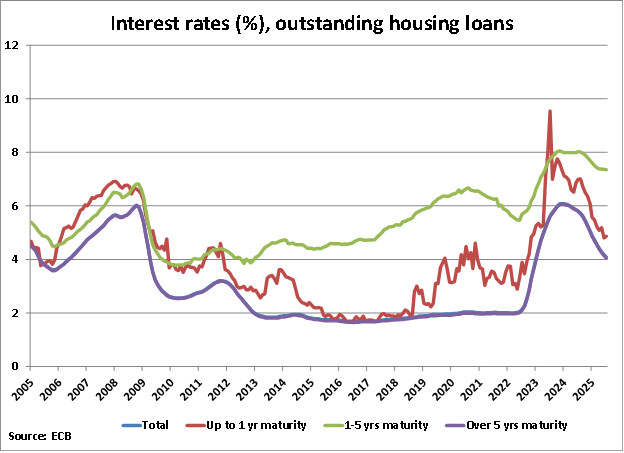
Likewise, interest rates for outstanding loans are also noticeably falling. In July 2025, the average interest rate on outstanding housing loans stood at 4.08%, sharply down from 5.81% in July 2024 and 5.62% in July 2023.
By original maturity, in July 2025:
- Up to 1 year: 4.87%, a dramatic decline from 6.99% in the prior year and far lower than the 9.54% recorded two years earlier.
- Over 1 and up to 5 years: 7.35%, down from 8.02% in the previous year and 7.75% two years ago.
- Over 5 years: 4.05%, lower than the 5.79% in July 2024 and 5.6% in July 2023
The sharp increase in housing loan interest rates in Estonia in recent years can be attributed to the successive key interest rate hikes implemented by the ECB from 2022 to 2023. The key interest rate on main refinancing operations was raised from 0.00% in June 2022 to 4.50% in September 2023, where it remained until May 2024.
Following the recent monetary policy shift, with the ECB cutting its key interest rate eight times over the past sixteen months to 2.15%, housing loan interest rates in Estonia have begun to decline.
In September 2025, the ECB kept its interest rates on the deposit facility, the main refinancing operations, and the marginal lending facility unchanged at 2.00%, 2.15% and 2.40% respectively, as inflation remains manageable.
"The Governing Council today decided to keep the three key ECB interest rates unchanged. Inflation is currently at around the 2% medium-term target, and the Governing Council's assessment of the inflation outlook is broadly unchanged," said the ECB in its September 2025 monetary policy decision.
"The new ECB staff projections present a picture of inflation similar to that projected in June. They see headline inflation averaging 2.1% in 2025, 1.7% in 2026, and 1.9% in 2027," added the ECB.
Housing loans continue to grow robustly
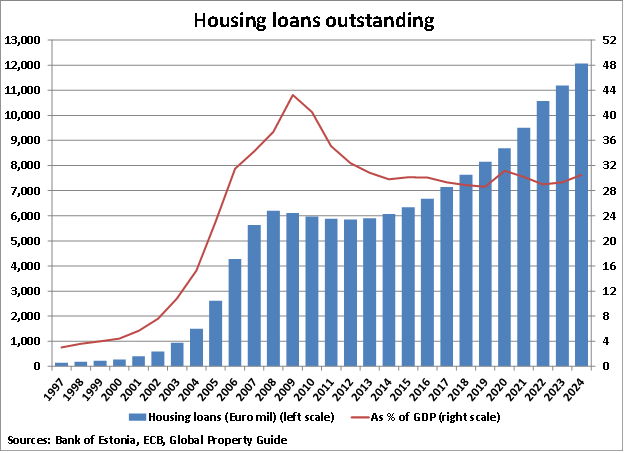
Estonia's original house price boom was supported by a massive expansion of the mortgage market, which grew by an average of 62% yearly from 2002 to 2006. After 2007, the mortgage market collapsed.
The mortgage market started to recover in 2013, and housing loans have been continuously rising since. Housing loans outstanding rose by an annual average of 6.6% from 2015 to 2021. Then housing loan growth accelerated to 11.3% in 2022 from a year earlier before stabilizing to a 5.9% expansion in 2023. During 2024, housing loans outstanding grew further by a robust 7.8% from a year earlier.
Then in July 2025, the total value of housing loans outstanding rose further by a robust 10% y-o-y to €12.77 billion, amidst gradually declining interest rates, according to figures from the Bank of Estonia.
However, as a percent of GDP, the size of the mortgage market has been more or less steady in the past decade, averaging at about 30% of GDP from 2012 to 2024, based on Global Property Guide estimates.
Mortgage loans are typically offered in euros with maturities of up to 30 years.
Socio-Economic Context:
Estonia's economic woes continue, unemployment remains high
Estonia's economy contracted by 0.3% in 2024 from a year earlier, following a decline of 3% in 2023, mainly due to weak investments, sluggish performance in key sectors like construction and manufacturing, and the drag of high inflation and tax increases, despite signs of recovery late in the year.
Then in Q2 2025, the economy expanded by 0.9% from the same period last year, an improvement from year-on-year contractions of 0.7% in Q1 2025, 0.5% in Q4 2024, and 0.3% in Q3 2024. The recent expansion was buoyed by a rebound in private consumption and an increase in government spending.
In Q2 2025:
- Private consumption grew by 0.9% from a year ago, following a y-o-y decline of 0.8% in the previous quarter.
- Government spending increased by 2.4% from a year earlier, an acceleration from a year-over-year growth of 1.3% in Q1 2025.
- Fixed investments dropped 0.3% y-o-y, following an increase of 4.3% in the previous quarter.
- In terms of trade, exports increased by 2.4% y-o-y in Q2 2025, a deceleration from the prior quarter's 5.7% growth. Over the same period, imports were up by 3.5%, up from the meager growth of 0.5% seen in the previous quarter.
Consequently, the Estonian economy is forecast to return to growth this year, albeit at a subdued pace, with real GDP expected to rise by 1.1%, based on estimates released by the European Commission. The International Monetary Fund (IMF) offers an even more cautious outlook, forecasting only 0.7% growth for Estonia this year.
"The Estonian economy is set to resume growing in 2025, albeit weakly amid very high global uncertainty and tax increases," said the European Commission. "Private consumption is projected to recover slowly. Uncertainty is set to heavily weigh on private investment, while public investment is expected to increase. Exports and imports are projected to contract due to the tariffs and their impact on global growth."
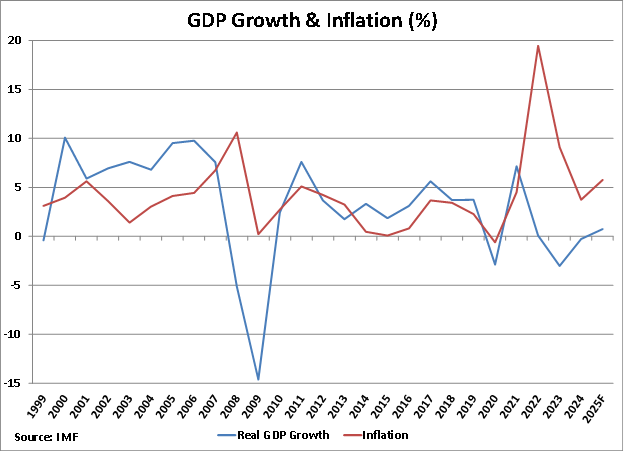
From 2000 to 2006, Estonia's economy expanded by an average of 8% annually. Unemployment fell from 14.6% in 2000 to just 4.6% in 2007.
The economy then contracted by a staggering 14.7% in 2009, following a decline of 5.4% in 2008, amidst the global financial crisis. Though it recovered with growth of 7.6% in 2011, on the back of strong exports, economic growth slowed to an annual average of 2.5% from 2012 to 2016, mainly due to a sharp slowdown in the electronics sector and shale oil sector, and a decline in demand from neighboring Russia.
The following years, 2017-19, saw average annual GDP growth of 4.4%, mainly driven by strong exports, construction, and manufacturing. As a result, unemployment dropped to a record low of 4.4% in 2019.
Then the economy contracted again by 2.9% in 2020 amidst the Covid-19 pandemic. Over the same period, the nationwide jobless rate increased to 6.8%, due to coronavirus-induced layoffs, according to Statistics Estonia. The jobless rate fell gradually to 6.2% in 2021 and further to 5.6% in 2022. But it increased again to 6.4% in 2023 and further to 7.5% in 2024, amidst the country's struggling economy.
The nationwide unemployment rate stood at 7.8% in Q2 2025.
The European Commission expects the overall jobless rate in Estonia to average 7.6% this year, as labor market conditions remain weak.
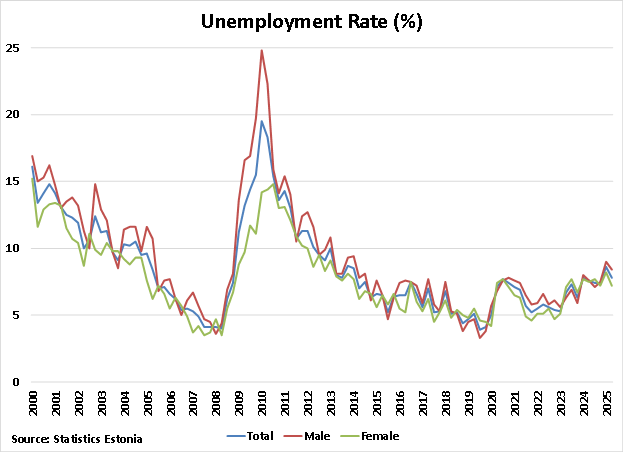
Consumer prices are rising fast again. In August 2025, the nationwide inflation rate accelerated to 6.1%, from 5.4% in the previous month and 3.2% in the same period last year, according to figures from Statistics Estonia. In fact, it was the highest reading since July 2023.
Inflation averaged just 2.5% from 2011 to 2021, before surging to 19.4% in 2022. Inflation remained high at an average of 9.1% in 2023. It eased to 3.7% in 2024.
The country's general government deficit was equivalent to about 1.7% of GDP last year, following shortfalls of 3.1% in 2023, 1.1% in 2022, 2.6% in 2021, and a record 5.4% in 2020.
"Compared with 2023, the increase in expenditures was slower, but general government expenditures still exceeded revenues by 665.7 million euros. The budget deficit was 1.7% of the GDP in 2024," said Pauline Kommer, team lead of government finance statistics at Statistics Estonia.
Accordingly, general government revenues increased by 8.5% in 2024 while expenditures were up by 4.7%.
The deficit is expected to narrow to 1.4% of GDP this year before increasing again to approximately 2.4% of GDP in 2026, based on the European Commission's projections.
"In 2025, the deficit is expected at 1.4% of GDP, mainly on the back of increases in revenue. These are projected to come mainly from increased tax rates, namely on personal and corporate income (both by 2 pps to 22%), income for credit institutions (by 4 pps to 18%), value added (of 2 pps to 24%), and from the introduction of a motor vehicle tax," noted the European Commission.
Estonia's national debt stood at 23.6% of GDP in 2024, up from 20.2% in the prior year and just 9% of GDP in the pre-pandemic year of 2019. It is expected to increase further to about 23.8% of GDP this year and 25.4% in 2026.
Despite the increase in the past five years, it remains the lowest debt level in the European Union.
From Kallas to Michal amid security and fiscal challenges
Kaja Kallas was reelected as prime minister when her center-right Reform Party won the March 2023 elections, defeating the far-right EKRE Party. Her victory ensured that Estonia remained among Ukraine's most steadfast allies in Europe. Estonia was one of the first countries to provide Kyiv with defense assistance even before Russia's full-scale invasion in February 2022 and has since contributed nearly €500 million or over 1.4% of GDP in military support.
Kallas, who had become Estonia's first female prime minister in January 2021 after the collapse of the Centre Party-led government, stepped down in 2024 to assume the role of the European Union's chief diplomat.
In July 2024, the Estonian parliament voted in Kristen Michal of the Reform Party as the new prime minister. Michal initially led the same majority coalition as his predecessor, consisting of the Reform Party, the liberal Estonia 200, and the center-left Social Democrats. His government pledged to strengthen state finances by raising income and purchase taxes, while also continuing heavy investment in defense and security.
Under Michal's leadership, Estonia committed to allocating about 5% of GDP to defense, one of the highest levels in NATO, while urging closer European cooperation in arms procurement and advocating the use of frozen Russian assets for Ukraine's reconstruction. On the domestic front, Michal's administration has advanced Estonia's digital leadership, most notably through a national AI education strategy, while navigating persistent inflation and high taxation pressures.
A major political shift came in March 2025, when the Social Democratic Party was expelled from the coalition after disputes over tax and welfare policy. The Social Democrats had pressed for more generous family benefits and social spending, but the Reform Party opposed such measures in favor of fiscal restraint. The resulting coalition between the Reform Party and Estonia 200 reflects a clear shift toward the center-right, with policy priorities reoriented toward defense spending, competitiveness, and business diplomacy. This realignment underscores Estonia's dual challenge of strengthening security and innovation while managing the political tensions of balancing fiscal consolidation with social protection in a period of elevated living costs.
Sources:
- Dwelling price index up by 3% in the first quarter (Statistics Estonia): https://stat.ee/
- Prices (Statistics Estonia): https://www.stat.ee/
- Real property price statistics (Land and Spatial Development Board): https://www.maaamet.ee/
- Baltic Real Estate Market Overview 2024 (In Real): https://www.inreal.lt/
- Apartment market in Estonia remains stable, house prices rising (ERR): https://news.err.ee/
- Baltic States Market Report 2024 (Ober Haus): https://www.ober-haus.lt/
- Key ECB interest rates (European Central Bank): https://www.ecb.europa.eu/
- Monetary policy decisions (European Central Bank): https://www.ecb.europa.eu/
- Gross rental yields in Estonia: Tallinn, Tartu, and Pärnu (Global Property Guide): https://www.globalpropertyguide.com/
- Aggregated balance sheet of monetary financial institutions (EUR million) (Bank of Estonia): https://statistika.eestipank.ee/
- Economic forecast for Estonia (European Commission): https://economy-finance.ec.europa.eu/
- Republic of Estonia (International Monetary Fund): https://www.imf.org/
- Republic of Estonia: Staff Concluding Statement of the 2025 Article IV Mission (International Monetary Fund): https://www.imf.org/
- Labour market (Statistics Estonia): https://www.stat.ee/
- Unemployment rate (Statistics Estonia): https://www.stat.ee/
- HICP flash estimate: prices up by 0.9% in August (Statistics Estonia): https://www.stat.ee/
- Estonia Government Budget (Trading Economics): https://tradingeconomics.com/
- General government debt continued to grow in 2024, while the budget deficit decreased (Statistics Estonia): https://www.stat.ee/
- Government debt at 87.4% of GDP in the euro area (European Commission): https://ec.europa.eu/
- Estonia country profile (BBC News): https://www.bbc.com/
- Estonia's Social Democrats to leave coalition government, PM says (Reuters): https://www.reuters.com/
- Kaja Kallas becomes Estonia's first female prime minister (Estonian World): https://estonianworld.com/
- Estonia's aid to Ukraine (Ministry of Foreign Affairs): https://vm.ee/