New Zealand Residential Property Market Analysis 2026
As buyer confidence improves, the sales segment of the housing market in New Zealand is entering an early stabilization phase, moving from broad-based declines to modest and regionally uneven gains, while demand for rentals continues to soften amid falling net migration.
This extended overview from Global Property Guide covers key aspects of New Zealand’s housing market and takes a closer look at its most recent developments and long-term trends.
Table of Contents
- Property Prices and Price Index
- Historic Perspective
- Property Demand Trends
- Property Supply Trends
- Rental Market: Rents and Rental Yields
- Mortgage Market and Interest Rates
- Economic and Social Factors
Property Prices and Price Index
New Zealand’s house prices shifted into an early stabilization phase through 2025, with the market moving from broad-based declines toward modest, uneven gains as borrowing costs eased and buyer confidence gradually improved. As of Q3 2025, the House Price Index (HPI) reported by the Reserve Bank of New Zealand (RBNZ) remained marginally negative, down 0.21% year-on-year, reinforcing the view that the earlier downswing was continuing to lose momentum rather than intensifying.
By year-end, December 2025 results from the Real Estate Institute of New Zealand (REINZ) pointed to low-single-digit nominal price growth: the national median house price rose by 1.4% year-on-year to NZD 786,977 (USD 455,069), while excluding Auckland it increased by 2.1% to NZD 718,000 (USD 415,184). Auckland’s median held above NZD 1 million for a third month at NZD 1,015,000 (USD 586,924), up 1.5% year-on-year.
New Zealand's house price annual change:
Regional disparities remained pronounced, with 12 of 16 regions recording annual median increases; REINZ highlighted continued confidence-building into year-end, noting that “overall, 2025 closed with confidence continuing to build <…> [and] momentum [is expected to] gradually improve” through 2026 as conditions stabilize.
Taken together, the near-flat RBNZ index reading and firmer REINZ medians are consistent with a market where participation is recovering, but price pressure remains contained. Elevated affordability constraints, an improved availability of listings relative to peak-cycle conditions, and a buyer cohort re-entering more cautiously than competitively have all contributed to a stabilizing, but still restrained, pricing environment.
Median house price, by region:
| Region | Median House Price, December 2025, NZD |
Median House Price, December 2025, USD |
YoY, % |
| Northland | NZD 695,000 | USD 401,884 | 6.9% |
| Auckland | NZD 1,015,000 | USD 586,924 | 1.5% |
| Waikato | NZD 755,000 | USD 436,579 | 4.1% |
| Bay of Plenty | NZD 840,000 | USD 485,730 | 1.7% |
| Gisborne | NZD 730,000 | USD 422,123 | 24.8% |
| Hawke's Bay | NZD 680,000 | USD 393,210 | -6.2% |
| Taranaki | NZD 620,000 | USD 358,515 | 2.0% |
| Manawatū-Whanganui | NZD 535,000 | USD 309,364 | -0.6% |
| Wellington | NZD 770,000 | USD 445,253 | 0.7% |
| Tasman | NZD 810,000 | USD 468,383 | -1.6% |
| Nelson | NZD 718,000 | USD 415,184 | -4.3% |
| Marlborough | NZD 660,000 | USD 381,645 | 6.5% |
| West Coast | NZD 385,000 | USD 222,626 | 6.6% |
| Canterbury | NZD 725,000 | USD 419,231 | 3.6% |
| Otago | NZD 705,000 | USD 407,666 | 0.7% |
| Southland | NZD 495,500 | USD 286,523 | 7.7% |
| New Zealand | NZD 786,977 | USD 455,069 | 1.4% |
| Note: Exchange rate as of December 2025, NZD 1 = USD 0.57825. | |||
| Data Source: Stats NZ. | |||
Forward-looking signals from policymakers broadly support a “measured recovery” base case rather than a sharp re-acceleration. In the RBNZ’s November 2025 Monetary Policy Statement, the Committee noted that house prices had “remained stable” despite lower mortgage rates and a pickup in activity, and it expects future house price growth to be “moderate” over the projection period.
Private-sector forecasts for 2026 generally cluster in the low-to-mid single digits, though the range has widened. Westpac’s September 2025 housing update projected 5.4% house price growth in 2026, reflecting a view that lower rates and improving sentiment will gradually lift values. More recently, ANZ cut its 2026 house price inflation forecast to 2% (from 5%), arguing that as the cycle progresses, mortgage rates may shift from a tailwind to a headwind if the OCR track turns less accommodative. Cotality struck a cautiously optimistic tone and flagged a potential 5% rise in values in 2026, conditional on lower mortgage rates and a firmer macro backdrop.
The key near-term swing factor for the upside/downside balance remains inflation and the resulting interest-rate path: a late-2025 inflation re-acceleration tempered expectations for faster monetary easing and increased the risk that the policy trajectory could shift back toward tightening later in 2026. In that scenario, mortgage rates would be less likely to fall as quickly as previously assumed, which would tend to cap the pace of house-price uplift even if sales volumes continue to improve.
Historic Perspective:
From Homeownership to Investment Asset, the Financialization of Housing
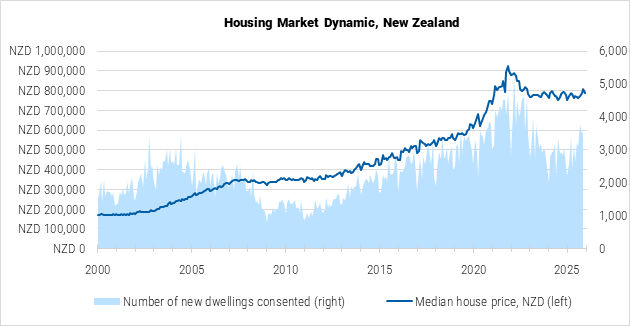
Over the past quarter-century, New Zealand’s housing market has shifted from a predominantly owner-occupier system toward a more financialized asset market, in which residential property increasingly functions both as shelter and as a core household investment. The national median selling price rose from around NZD 170,000 (USD 102,461) in 2000 to NZD 786,977 (USD 455,069) by December 2025, an increase of more than fourfold, alongside strong population growth that sustained underlying demand.
Policy reforms in the 1990s reduced the direct role of the state in supporting home ownership and reinforced reliance on market-based provision and finance. Over time, as credit availability broadened and investment participation increased, housing became more closely tied to financing conditions and expectations of capital gains, deepening the link between monetary settings, borrowing capacity, and price outcomes.
A series of shocks then compounded supply and affordability pressures. The Global Financial Crisis weakened credit availability and delayed development activity, the 2011 Christchurch earthquakes created a sustained rebuilding requirement that tightened local capacity, and the pandemic period amplified construction delays and cost volatility, reinforcing supply constraints at a time of heightened demand.
Across much of the 2010s, structurally lower interest rates lifted borrowing capacity, while house prices continued to outpace incomes, worsening affordability and intensifying intergenerational equity concerns. As a result, home ownership became increasingly difficult for many younger households, while residential property remained a dominant channel for savings and investment.
In response, policymakers deployed a broad toolkit over successive cycles, including macroprudential limits such as loan-to-value restrictions, tax and regulatory measures such as the bright-line test, restrictions on most non-resident buyers, and planning and infrastructure reforms intended to accelerate urban development. Even so, constraints around supply responsiveness have proved persistent, leaving affordability outcomes heavily shaped by the interaction between population growth, credit conditions, and the pace of new delivery.
25-year housing market dynamic (median house price vs number of new dwellings consented), New Zealand:
Data Sources: Stats NZ, REINZ.
Property Demand Trends
Activity Lifts Without Overheating, Signaling a More Balanced Phase
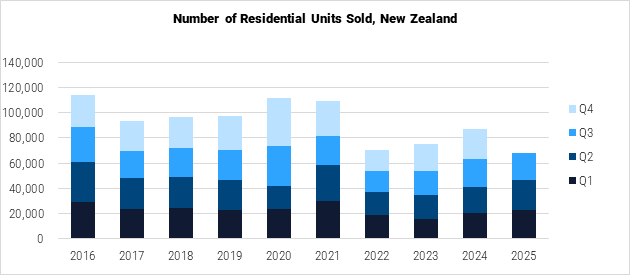
According to the latest data from the RBNZ, a total of 68,306 residential property sales were registered across the country in the first three quarters of 2025, representing a 7.49% year-on-year increase and indicating that the market continued to move out of the low-activity phase seen earlier in the cycle.
Data Source: RBNZ.
REINZ’s year-end review confirms that momentum was sustained through 2025, reporting that the annual national sales count rose by 10.3% compared with 2024 to 80,655, and noting that “underlying market activity strengthened, reflecting improved confidence as interest rates eased and OCR reductions flowed through to buyer behavior.”
Notably, the increase in turnover did not translate into renewed price acceleration, pointing to a demand recovery driven more by improving participation than by competitive bidding. REINZ describes a market where buyers “re-engaged cautiously rather than competitively,” with first-home buyers remaining value- and affordability-led and “unwilling to exceed the price considered reasonable and aligned with market value.” At the same time, higher inventory levels shifted negotiating power toward buyers; REINZ reports average inventory rising 5.9% year-on-year, giving purchasers more choice and reducing urgency.
Survey-based evidence on buyer composition is consistent with this profile. CBRE’s Q4 2025 Residential Valuer Insights note that first-home buyers remained the most active cohort nationally; across the first three quarters of 2025, they were reported as a top-four buyer group by over 90% of valuers, easing to 87% in the most recent survey. In parallel, indications of gradually improving investor participation emerged in late 2025, consistent with easing finance costs and a more supportive policy/tax backdrop.
At a regional level, outcomes diverged depending on affordability and the local supply–demand balance. According to REINZ data, Marlborough recorded the largest annual increase at 18.9%, with sales rising to 975, while strong growth was also observed in West Coast (+18.6%) and Southland (+18.2%). By contrast, Auckland and Wellington posted more moderate growth of 6.0% and 1.4%, respectively. “Generally speaking, activity in the main centers remains on the soft side, with more growth coming from our provincial towns and cities”, stated Cotality in its latest property market overview.
Looking ahead, market signals continue to support a balanced, more sustainable phase rather than a return to prior volatility. In CBRE’s Q4 2025 Residential Valuer Insights, “more than half” of valuers expect demand to increase slightly over the coming year (with the report citing a proportion of 58%), although expectations have moderated compared with earlier 2025 surveys. This aligns with Cotality’s outlook that “More sales growth is likely in 2026 on the back of reduced mortgage rates and a recovering economy”, with the expected uplift characterized as modest rather than sharp.
Property Supply Trends
Supply Recovery Takes Shape, Anchored by Multi-Unit Development Momentum
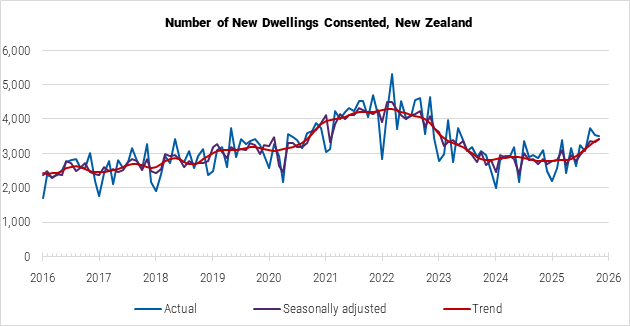
According to Statistics New Zealand (Stats NZ), 3,517 new dwellings were consented for construction in November 2025, representing a year-on-year increase of 13.45%. Over the year ended November 2025, the 12-month rolling total rose by 7.02% year-on-year to 35,969 dwellings, compared with the year ended November 2024. The improvement was accompanied by a shift toward higher-density delivery, with Stats NZ noting the recent lift was “led by multi-unit homes,” consistent with the market’s medium-term pivot toward townhouses and apartments.
Data Source: Stats NZ.
Regionally, consenting trends remained uneven. The strongest growth in new dwelling consents was recorded in Nelson (+36.00%), Southland (+27.67%), and Otago (+17.87%). In contrast, Marlborough (-26.78%), Hawke's Bay (-19.95%), and Northland (-14.88%) experienced the most pronounced declines.
Number of new dwellings consented, by region:
| Region | New Dwellings Consented, November 2025, annualized |
YoY, % |
| Northland | 738 | -14.88% |
| Auckland | 15,252 | 9.69% |
| Waikato | 3,027 | 6.73% |
| Bay of Plenty | 1,432 | -9.77% |
| Gisborne | 171 | 7.55% |
| Hawke's Bay | 622 | -19.95% |
| Taranaki | 440 | 1.62% |
| Manawatū-Whanganui | 1,011 | -14.76% |
| Wellington | 2,141 | 16.42% |
| Tasman | 299 | 2.40% |
| Nelson | 272 | 36.00% |
| Marlborough | 175 | -26.78% |
| West Coast | 182 | -12.08% |
| Canterbury | 7,135 | 9.74% |
| Otago | 2,665 | 17.87% |
| Southland | 406 | 27.67% |
| New Zealand | 35,968 | 7.02% |
| Data Source: Stats NZ. | ||
Market commentary suggests the sector is transitioning from stabilization into a measured upturn rather than a rapid rebound. Westpac IQ notes that consents “have continued to trend higher,” and that the annual total is “just shy of 36,000 - its highest level in more than a year,” while also cautioning that builders and developers continue to report “tough trading conditions.”
At the same time, Westpac observes “increased optimism about the year ahead as a result of lower interest rates,” which is supporting project progression. “Home building is likely to remain around current levels in the near term. However, with the pipeline of new projects now lifting, we expect to see residential construction turning higher over 2026,” experts noted in the most recent First Impressions commentary. Similarly, Cotality expects the construction sector to expand again in 2026, with cost growth likely to remain moderate relative to the post-COVID period, even if cost inflation edges up as activity returns.
Over a longer horizon, the National Construction Pipeline outlook from the Ministry of Business, Innovation & Employment reinforces the expectation of a measured upcycle. Overall sector activity is projected to return to growth, with consents increasingly led by multi-unit delivery. The latest forecast indicates that annual dwelling consents are expected to rise to 40,000 by 2030, while multi-unit consents are projected to account for a majority share, increasing from 53% to 56% over the six-year period.
Rental Market: Rents and Rental Yields
Softer Demand and Slowing Growth in Rents
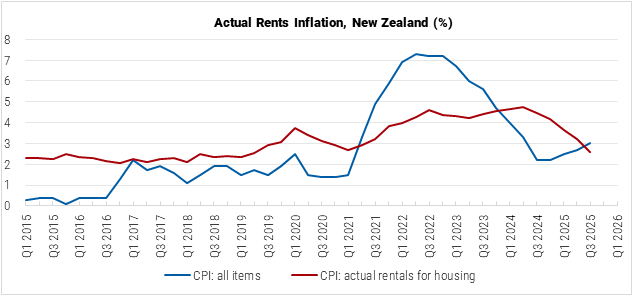
After reaching its peak level of 4.8% in Q2 2024, rental inflation in New Zealand has been on a downward trajectory. In Q3 2025, the actual rentals for the housing component of the consumer price index (CPI) registered a 2.6% year-on-year increase, falling below the overall price growth in the country, which during the same period was at 3.0%.
New Zealand's rent price index:
Similar to previous periods, the rental inflation trend is closely tied to international migration flows, which typically have a strong impact on demand for rental properties in New Zealand. Over the year to November 2025, Stats NZ reported an estimated net migration gain of 10,681, which was 63% below the levels observed during the same period in 2024 and 92% below the comparable 2023 level. The continuous decline in net migration has been supported not only by lower arrival numbers but also by record-high numbers of migrant departures.
Considering current market conditions, Cotality experts believe a return to strong growth in rents is unlikely in the near term. “Turning to rents, conditions remain subdued, with net migration having fallen a long way from its peak and the stock of available rental listings on the market still elevated,” said their January 2026 market overview. “There’s also another constraint on rental growth, given that their level is already high in relation to households’ incomes — at the same time, wage growth has slowed too.”
This view is supported by the latest market assessment from Bayleys, one of the country’s largest real estate agencies. “Softer migration gains and economic conditions have led to lower demand for rentals and a lack of growth for rental rates,” noted their Q4 2025 residential investment update. According to the agency, however, the market is stable overall, despite softer conditions, with quality properties in central areas still renting out quickly.
Data Source: Stats NZ.
In nominal terms, according to the figures from the MBIE, the mean weekly rent in New Zealand for the year to September 2025 reached NZD 568 (USD 334), showing a 0.6% decline compared to the year to September 2024.
Regionally, the highest weekly rent level was reported in Auckland (NZD 625 / USD 368), while the West Coast traditionally remained the most affordable (NZD 405 / USD 238). The most pronounced year-on-year growth (above 5%) was observed in Southland, Otago, and the West Coast. At the same time, several key submarkets demonstrated a decline in mean rents, namely Wellington, Bay of Plenty, Northland, and Auckland.
Mean weekly rent for the year, by region:
| Region | Mean Weekly Rent, NZD, Year to September 2025 |
Mean Weekly Rent, USD, Year to September 2025 |
YoY, Year to Sep 2025 vs Year to Sep 2024 |
| Auckland | NZD 625 | USD 368 | -1.1% |
| Northland | NZD 517 | USD 304 | -1.2% |
| Waikato | NZD 522 | USD 307 | 2.3% |
| Bay of Plenty | NZD 588 | USD 346 | -1.5% |
| Gisborne | NZD 559 | USD 329 | 1.6% |
| Hawke’s Bay | NZD 590 | USD 347 | 3.0% |
| Manawatu-Wanganui | NZD 483 | USD 284 | 0.3% |
| Taranaki | NZD 535 | USD 315 | 0.6% |
| Wellington | NZD 569 | USD 335 | -3.1% |
| Marlborough | NZD 510 | USD 300 | 3.0% |
| Nelson | NZD 501 | USD 295 | 1.8% |
| Tasman | NZD 539 | USD 317 | 1.5% |
| Canterbury | NZD 513 | USD 302 | 0.3% |
| Otago | NZD 574 | USD 338 | 5.9% |
| Southland | NZD 436 | USD 257 | 6.6% |
| West Coast | NZD 405 | USD 238 | 5.3% |
| New Zealand | NZD 568 | USD334 | -0.6% |
| Note: Exchange rate as of September 2025, NZD 1 = USD 0.58868. | |||
| Data Source: MBIE. | |||
In their most recent overview of the rental market, the local listing platform Trade Me Property also notes a continued cooling trend for asking rents, with median weekly rent based on current listings standing at NZD 610 (USD 352) in October 2025, down 1.6% year-on-year.
The ongoing adjustments in sales and rental price trends are reflected in estimated levels of gross rental yields for residential properties in the country. Global Property Guide research conducted in January 2026 found residential yields in New Zealand at the average level of 4.12%, up from 3.99% previously reported in July 2025 and down compared to 4.21% in December 2024. Similarly, the latest report from Cotality estimates rental yields at 3.80%.
Mortgage Market and Interest Rates
Increased Demand for Loans and Likely End of Rate-Cutting Cycle
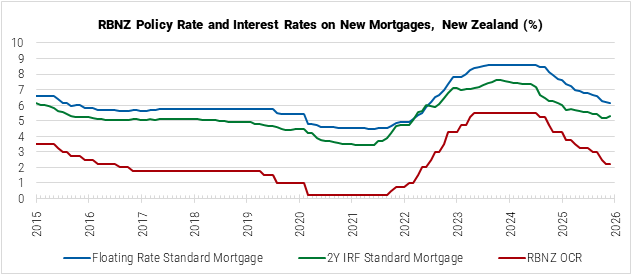
In the second half of 2025, the RBNZ continued its monetary policy easing cycle, with the latest cut in November bringing the official cash rate (OCR) to 2.25%, a cumulative 325 bps down since the beginning of the cycle in August 2024. “Economic activity was weak over mid-2025 but is picking up,” the central bank’s governor, Christian Hawkesby, commented on the most recent decision. “Lower interest rates are encouraging household spending, and the labour market is stabilizing.”
New Zealand's mortgage loan interest rates:
Considering improving growth indicators and accelerated inflation in the last quarter of 2025, however, the OCR has likely reached its lowest point in this cycle, with some experts now anticipating hikes later this year. "The market's now gone for pricing two hikes this year, which to us, is aggressive, but then you see data like we've seen today, and it's certainly not unrealistic," said Kiwibank Chief Economist Jarrod Kerr, as quoted by Reuters.
Data Source: RBNZ.
In line with the monetary policy trajectory, interest rates on new residential mortgages in New Zealand have also continued to decrease from peak levels of 2023-2024. In December 2025, the RBNZ reported the average floating rate on standard mortgages at 6.14%, down from 7.66% the previous year and 8.61% two years prior. A similar trend was also observed for interest rates with varying initial rate fixation (IRF) periods.
Average interest rates on new standard residential mortgages:
| December 2025 | YoY | December 2024 | YoY | December 2023 | |
| Floating rate | 6.14% | ↓ | 7.66% | ↓ | 8.61% |
| IRF 6 months | 5.35% | ↓ | 6.67% | ↓ | 7.83% |
| IRF 1 year | 5.12% | ↓ | 6.30% | ↓ | 7.76% |
| IRF 2 years | 5.32% | ↓ | 6.12% | ↓ | 7.54% |
| IRF 3 years | 5.52% | ↓ | 6.05% | ↓ | 7.22% |
| IRF 4 years | 5.71% | ↓ | 6.14% | ↓ | 7.23% |
| IRF 5 years | 5.77% | ↓ | 6.15% | ↓ | 7.20% |
| Data Source: RNBZ. | |||||
Cuts to the OCR and corresponding drops in mortgage interest rates have improved loan affordability and further strengthened household demand for this category of credit in New Zealand. According to the Q3 2025 Credit Condition Survey published by the RBNZ, lenders across the country report higher demand for residential mortgages and expect increases in available credit volumes over the next six months.
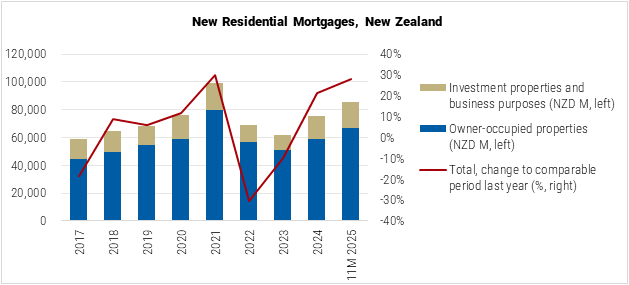
In the eleven months of 2025, over 220,000 new residential mortgages amounting to NZD 85.8 billion (USD 48.5 billion) were drawn, with the total value of new lending showing a 27.8% increase compared to the same period in 2024. Around 78% of the new lending was represented by loans to owner-occupiers, with the remaining 22% of credit taken for investment properties and other business purposes.
Looking ahead, Cotality’s January 2026 market overview expects cheaper credit to continue supporting transaction activity in New Zealand in the coming months: “Given the falls in mortgage rates over the past 12-18 months and the prospect of an expanding economy in 2026, sales are set to rise again [this] year.”
Data Source: RBNZ.
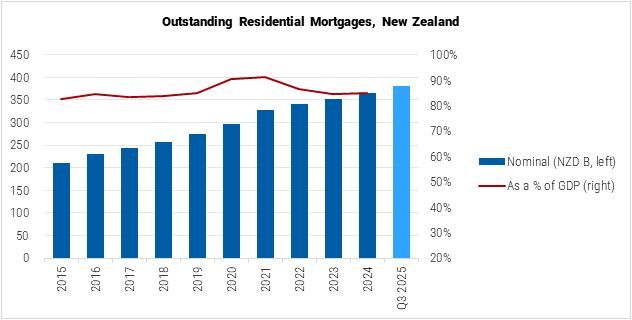
In this environment, the total value of outstanding residential mortgages in New Zealand also continues to grow, although the market has been expanding at a slower pace since 2022. According to the RBNZ reporting, in Q3 2025, the mortgage stock reached NZD 381.2 billion (USD 224.4 billion), demonstrating a 4.2% increase since the end of the previous year. The relative size of the market, represented by the ratio of outstanding mortgages to GDP at current prices, moderated from an estimated decade peak of 91.1% in 2021 to an estimated 85.1% in 2024.
Data Sources: RBNZ, World Bank.
Economic and Social Factors
Modest Recovery Underway, Inflation Re-Accelerates in Late-2025
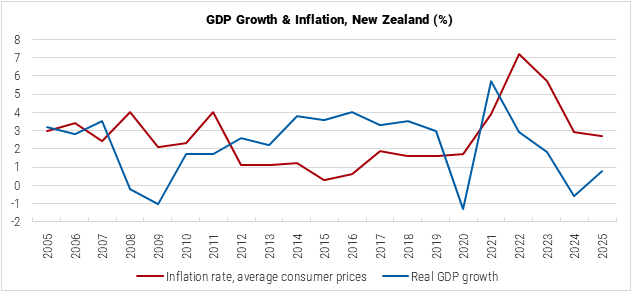
After contracting in 2024 amid tight financial conditions, the New Zealand Economy started to recover in 2025, with an estimated real GDP growth of 0.8%. The rebound was supported by lower interest rates, improving household real incomes, buoyant tourism, and firm commodity export earnings. Looking ahead, the recovery is expected to continue at a modest pace amid still elevated trade restrictions, with the International Monetary Fund (IMF) forecasting growth rates of 2.2% and 2.4% for 2026 and 2027, respectively.
Throughout the early recovery period, consumer price index (CPI) inflation in the country was contained within the central bank’s 1-3% target range, albeit at the upper end (2.9% in 2024 and 2.7% in 2025), reflecting higher food and electricity prices. Most recently, the indicator was reported by Stats NZ at 3.0% in Q3 2025, up from 2.5% in Q1, prompting the RBNZ to signal the end of the monetary policy easing cycle.
Data Source: IMF.
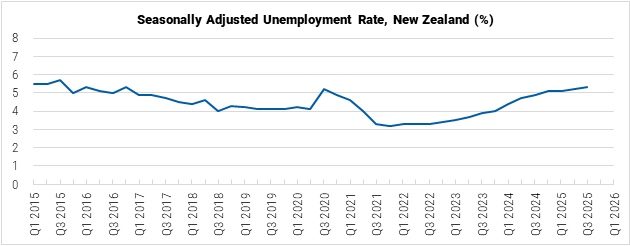
The ultra-tight conditions observed in New Zealand’s labor market in the post-pandemic period have notably softened, with the unemployment rate rising to 5.3% in Q3 2025, according to Stats NZ (the highest rate since 2020), while net migration has declined.
At the same time, the RBNZ notes early signs of stabilization in labor demand, with job vacancies and total hours worked increasing in Q3 2025. “This is expected to broaden into a wider improvement in labor market conditions over the coming quarters, which will support household confidence and spending,” said the central bank’s November 2025 monetary policy statement.
Gradual stabilization of the domestic labor market is also expected to limit outward migration from New Zealand in the coming periods. “Relative weakness in the labor market over the past two years has contributed to higher outward migration from New Zealand, particularly to Australia. <…> Outward migration is expected to reduce as the New Zealand economy and labor market recover, with net migration expected to increase towards long-run trends,” said the central bank’s statement.
Data Source: Stats NZ.
Overall, New Zealand remains a wealthy economy with robust governance standards and a policy framework. In the last six months, Moody’s, S&P, and Fitch Ratings have all maintained New Zealand’s sovereign credit ratings with stable outlooks.
According to the latest assessment from the Organization for Economic Co-operation and Development (OECD), risks to projected recovery for New Zealand include an escalation of trade tensions or climate-related events such as floods or droughts (which could weaken exports and constrain agriculture and hydro-electric generation). On the upside, a faster-than-expected pass-through of lower interest rates and a quicker pickup in business investment, helped by the “Investment Boost” tax incentive introduced in May 2025, may lift growth more rapidly.
As outlined in the 2025 Article IV staff report from the IMF, the current period of post-contraction recovery and return to more sustainable immigration levels is seen as an opportunity for a “bold reform agenda to address medium- and long-term challenges stemming from an aging population and weak productivity growth.”
Sources
- New Zealand Government
- Investment Boost: Tax Incentive to Lift Growth: https://www.beehive.govt.nz/
- Statistics New Zealand (Stats NZ)
- Consumers Price Index: September 2025 Quarter: https://www.stats.govt.nz/
- Building Consents Issued: November 2025: https://www.stats.govt.nz/
- International Migration: November 2025: https://www.stats.govt.nz/
- Labor Market Statistics: September 2025 Quarter: https://www.stats.govt.nz/
- Reserve Bank of New Zealand (RBNZ)
- Housing (M10): https://www.rbnz.govt.nz/
- Exchange and Interest Rates: https://www.rbnz.govt.nz/
- Monetary Policy Statement November 2025: https://www.rbnz.govt.nz/
- The Official Cash Rate (OCR): https://www.rbnz.govt.nz/
- Lending and Monetary Statistics: https://www.rbnz.govt.nz/
- Credit Conditions Survey Results, September 2025: https://www.rbnz.govt.nz/
- Ministry of Business, Innovation & Employment (MBIE)
- National Construction Pipeline Report 2025: https://www.mbie.govt.nz/
- Weekly Rent in New Zealand: https://webrear.mbie.govt.nz/
- Real Estate Institute of New Zealand (REINZ)
- New Zealand Property Report – December 2025 (Press Release): https://www.reinz.co.nz/
- 2025 in Review – How New Zealand’s Property Market Shifted From 2024: https://www.reinz.co.nz/
- International Monetary Fund (IMF)
- Country Overview: New Zealand: https://www.imf.org/
- 2025 Article IV Staff Report: https://www.imf.org/
- Organization for Economic Co-operation and Development (OECD)
- OECD Economic Outlook, Volume 2025 Issue 2: https://www.oecd.org/
- Cotality
- Monthly Housing Chart Pack - January 2026: https://www.cotality.com/
- NZ Property Values End 2025 in the Red, But There Could Be Signs of Growth…: https://www.cotality.com/
- Construction Cost Growth Rises Alongside Activity: https://www.cotality.com/
- Westpack Group
- ANZ Property Focus. January 2026: https://www.anz.co.nz/
- First Impressions: NZ building consents, November 2025: https://www.westpaciq.com.au/
- ANZ
- Economic Bulletin. Housing Market Update. September 2025: https://assets.dam.westpac.co.nz/
- Bayleys
- Q4 2025 Residential Investment Update: https://cms-cdn.bayleys.co.nz/
- CBRE
- Q4 2025 Residential Valuer Insights: https://mktgdocs.cbre.com/
- Trade Me Property
- Rental Price Index - November 2025: https://www.trademe.co.nz/
- Fitch Ratings
- Fitch Affirms New Zealand at 'AA+'; Outlook Stable: https://www.fitchratings.com/
- Reuters
- New Zealand Annual Inflation Accelerates, Supporting Expectations of Rate Hikes: https://www.reuters.com/