Latvia's Residential Real Estate Market Analysis 2026
Latvia's housing market has moved on sharply from the slow recovery described in our previous edition. House prices are now rising at double-digit rates, driven by existing homes, while the record transaction volumes of 2025 have stalled in 2026. Mortgage rates have turned up again as the European Central Bank raises interest rates, and a new Immigration Law has ended residence permits based on property purchases.
This extended overview from Global Property Guide covers key aspects of the Latvian housing market and takes a closer look at its most recent developments and long-term trends.
Table of Contents
- Property Prices and Price Index
- Property Demand Trends
- Property Supply Trends
- Rental Market: Rents and Rental Yields
- Mortgage Market and Interest Rates
- Economic and Social Factors
Property Prices and Price Index
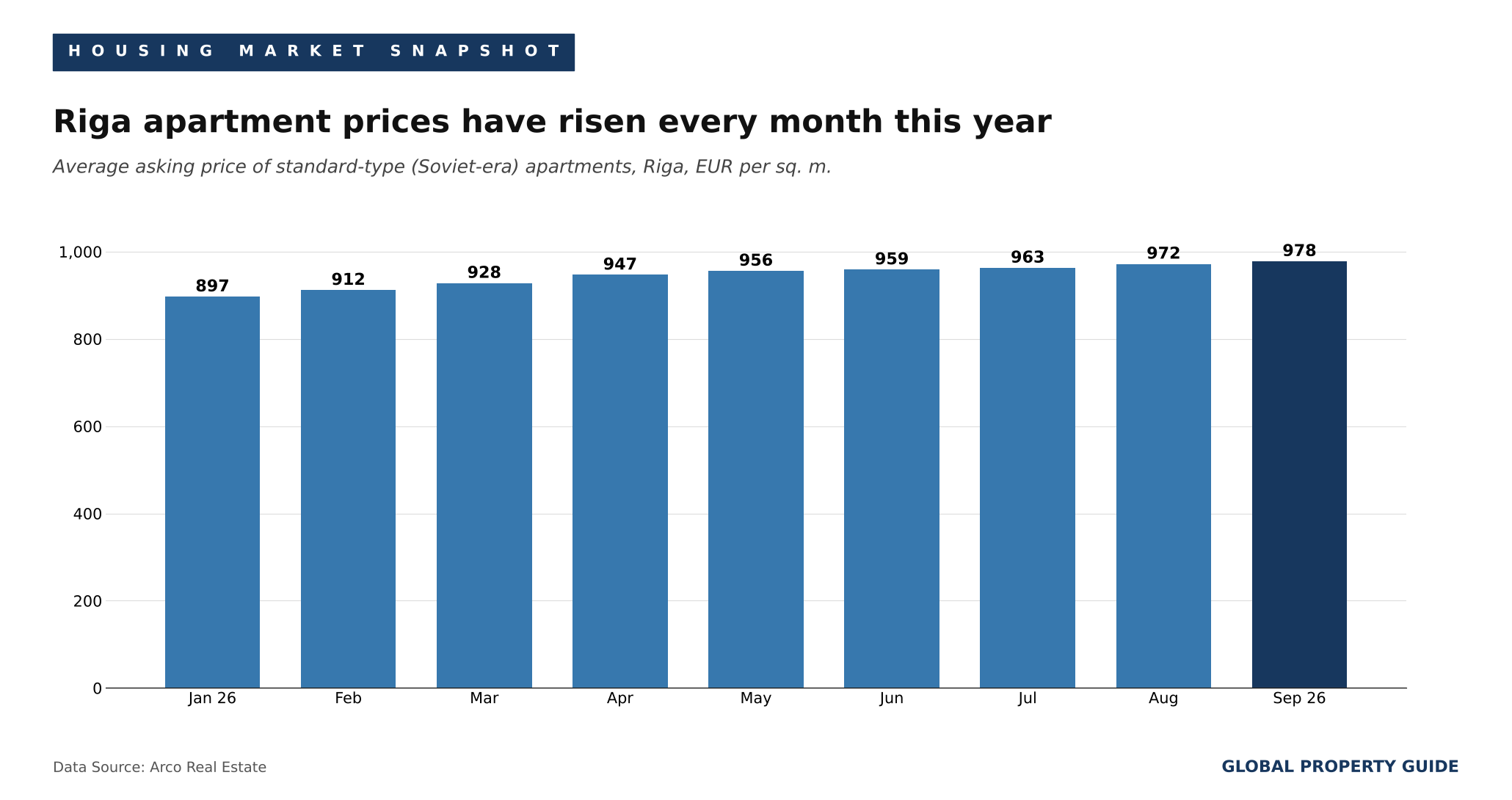
In Riga, Latvia's capital, the average asking price of standard-type (Soviet-era) apartments rose to EUR 978 (USD 1,096) per square meter in September 2026, up 0.6% from the previous month, according to Arco Real Estate. Prices have risen every month this year, and were 13.1% higher than the EUR 865 (USD 969) per square meter recorded in September 2025, based on GPG calculations from Arco's published prices. Adjusted for inflation, prices rose by about 9.6% year-on-year.
Latvia's house price annual change:
That is a marked acceleration. In our previous edition, Riga apartment prices were rising by less than 2% a year. During the whole of 2025, prices rose 4.1%, and by September 2026 they were already 10.3% above their December 2025 level. The number of apartments offered for sale in Riga was 15% lower than a year earlier, and 20% lower in the largest housing estates.
Nationwide, house prices rose by 11.4% in Q2 2026 from a year earlier, and by 3.9% from the previous quarter, according to the Central Statistical Bureau of Latvia (CSB), as reproduced by the official portal LV portals. It was the third consecutive quarter of double-digit growth, after increases of 10.5% in Q4 2025 and 10.3% in Q1 2026, according to the CSB series published by Eurostat. Adjusted for inflation, house prices rose by about 7.7% year-on-year.
The Q2 2026 figures are provisional. The CSB has revised its provisional figures down by between 0.3 and 0.6 percentage points for every quarter since Q2 2025. The Q3 2026 house price index is due on 14 December 2026.
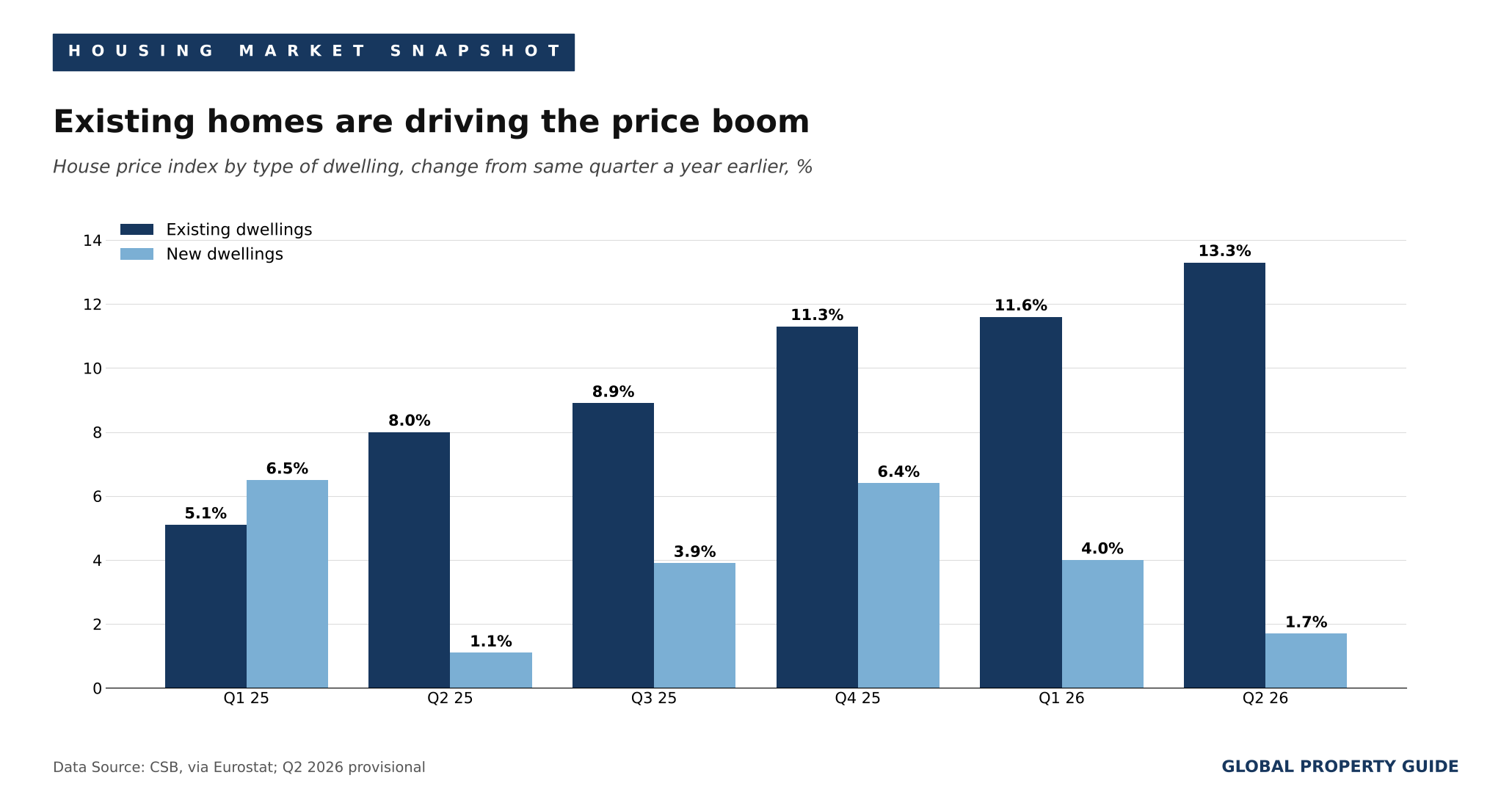
By property type, the boom is concentrated in existing homes:
- Existing dwellings: prices rose by 13.3% year-on-year in Q2 2026, and by 4.6% quarter-on-quarter.
- New dwellings: prices rose by just 1.7% year-on-year, and by 0.7% quarter-on-quarter.
The gap is visible in the new-build market. In Q2 2026, the average advertised price of new-build apartments in Riga was EUR 3,220 (USD 3,608) per square meter, up 5% from a year earlier, but actual transaction prices were 16% lower and slightly down year-on-year, according to real estate company Latio.
Latvijas Banka, the central bank, said in its Financial Stability Report 2026 that housing affordability had returned in 2025 to levels seen before the sharp rise in interest rates, but that the improvement "came to a halt at the end of 2025".
The wider economy is also stronger than previously thought. Following a benchmark revision by the CSB, Latvia's economy is now estimated to have grown by 0.5% in 2024, rather than contracting, and by 2.4% in 2025. In Q2 2026, real GDP grew by 3.5% year-on-year.
Local house price variations
Prices of standard-type apartments are also rising in the towns around Riga, according to Arco Real Estate:
- In Ogre, the average price was EUR 977 (USD 1,095) per square meter in September 2026, up 11% since the start of the year.
- In Salaspils, prices averaged EUR 913 (USD 1,023) per square meter, up 8% since the start of the year.
- In Kauguri, Jurmala, prices averaged EUR 887 (USD 994) per square meter, up 7% since the start of the year.
- In Jelgava, prices averaged EUR 807 (USD 904) per square meter, up 5% since the start of the year.
| Average asking price of standard-type apartments in Riga and nearby towns: | |||||
| Sep 2026, EUR/sqm |
Sep 2026, USD/sqm |
Sep 2025, EUR/sqm |
Sep 2025, USD/sqm |
YoY, % | |
| Riga | 978 | 1,096 | 865 | 969 | 13.1% |
| Ogre | 977 | 1,095 | 873 | 978 | 11.9% |
| Salaspils | 913 | 1,023 | 838 | 939 | 8.9% |
| Kauguri (Jurmala) | 887 | 994 | 817 | 916 | 8.6% |
| Jelgava | 807 | 904 | 758 | 849 | 6.5% |
| Note: Exchange rate EUR 1 = USD 1.1206 (ECB euro reference rate, 9 October 2026), applied throughout this article. | |||||
| Data source: Arco Real Estate. | |||||
In Riga's new residential projects, the average transaction price in the housing estates was EUR 2,202 (USD 2,468) per square meter in 2025, up 6% from 2024, according to Arco. In the centre of Riga, the average price was EUR 1,874 (USD 2,100) per square meter in 2025, up 4%, according to Arco.
Latvia's housing boom and bust
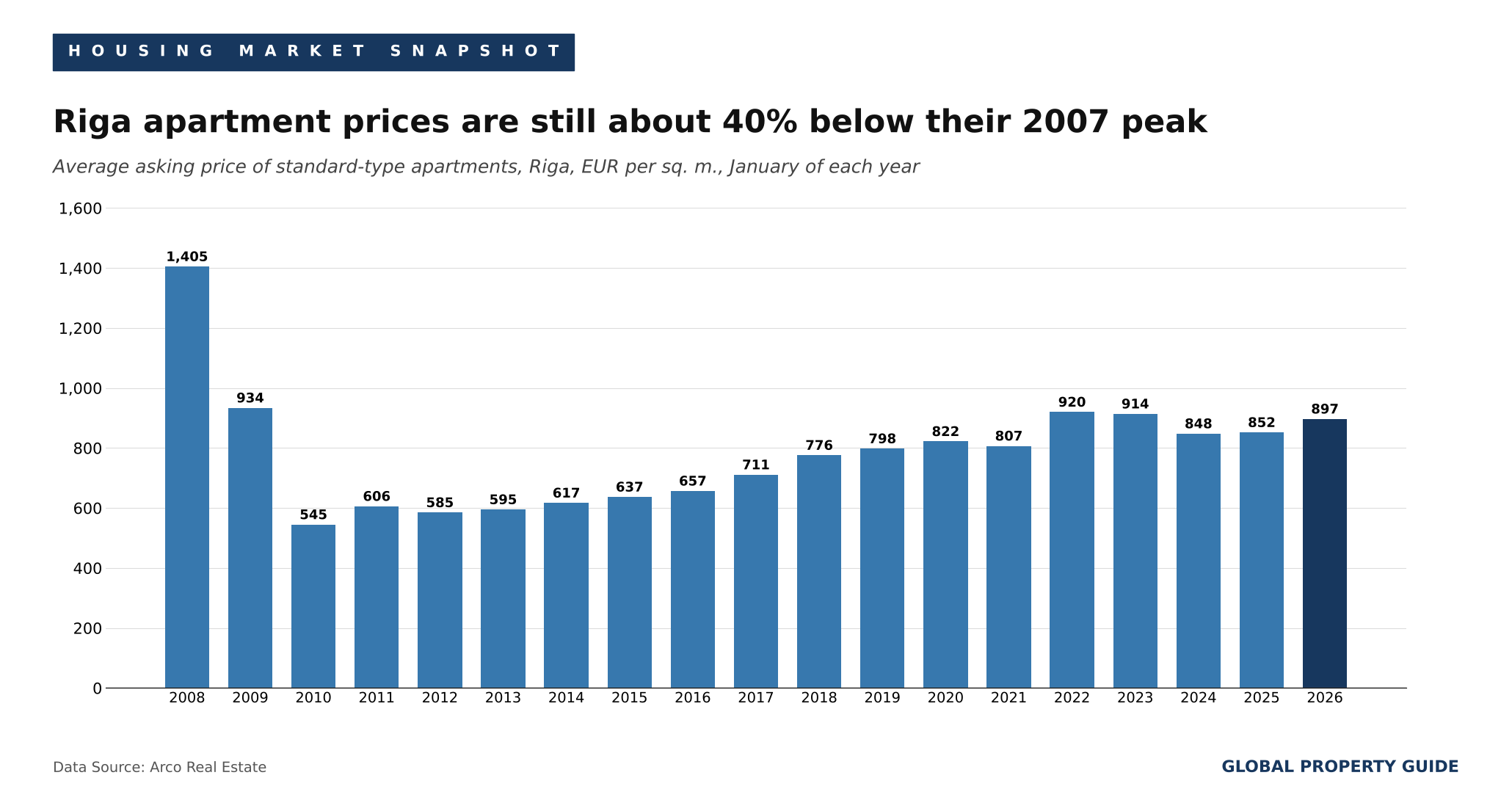
Latvia had one of the world's biggest housing market crashes after 2007. The average price of standard-type apartments in Riga peaked at EUR 1,620 (USD 1,815) per square meter in 2007, then fell by 66.4% to EUR 545 per square meter by January 2010, according to Arco Real Estate.
The economy collapsed with it. Real GDP shrank by 3.4% in 2008, 16.0% in 2009 and 3.7% in 2010, according to Eurostat, and the unemployment rate rose to 19.7% in 2010. Latvia secured a EUR 7.5 billion rescue package from a group led by the European Union and the International Monetary Fund, coupled with harsh austerity measures.
Prices recovered only slowly in the decade that followed. Even after this year's gains, Riga's standard-type apartments remain about 40% below their 2007 peak, although they are 79.4% above their January 2010 low.
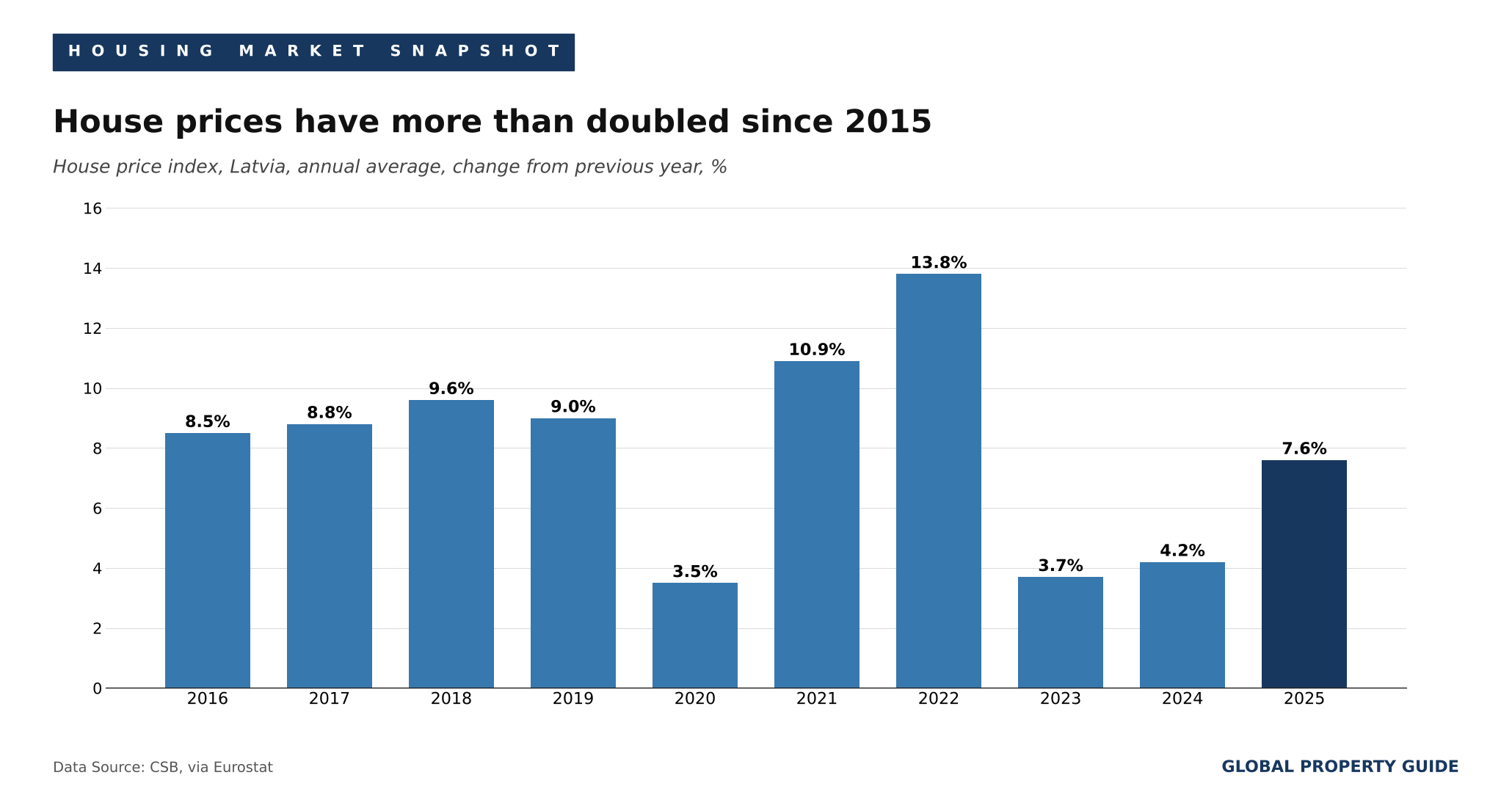
The CSB's house price index, which covers all dwellings nationwide, has risen faster. Prices more than doubled between 2015 and 2025, according to Eurostat. Annual price growth averaged 9% from 2016 to 2019, slowed to 3.5% in 2020, then surged to 10.9% in 2021 and 13.8% in 2022.
As interest rates rose, growth slowed to 3.7% in 2023 and 4.2% in 2024. It picked up again to 7.6% in 2025, with existing dwellings up 8.3% and new dwellings up 4.4%. Adjusted for inflation, house prices rose by about 3.7% in 2025.
Property Demand Trends
2025 was a record year for transactions
Housing transactions surged in 2025. About 28,000 housing transactions were registered in Latvia during the year, up 7.5% from 2024, according to Latio. Of these, about 22,900 were apartment sales. In Riga, apartment transactions rose by 19% to 11,650.
Other sources confirm the trend. Riga apartment transactions reached their highest level since 2007, according to property data firm Cenu Banka. Eurostat data show dwelling sales in Latvia up 9.2% in 2025, with sales of newly built dwellings up 32.7% and existing dwellings up 7.9%. Latvijas Banka said that house purchase activity in 2025 exceeded the previous peak reached in 2021, and that the share of bank-financed transactions exceeded 30%, the highest in seven years.
In Riga's new residential projects, transactions rose by 28% in 2025, with sales in the housing estates up 33% and in the centre up 8%, according to Arco. In the centre of Riga, 2,395 apartments were sold in 2025, up 24% and the most in 12 years.
Sales have stalled in 2026
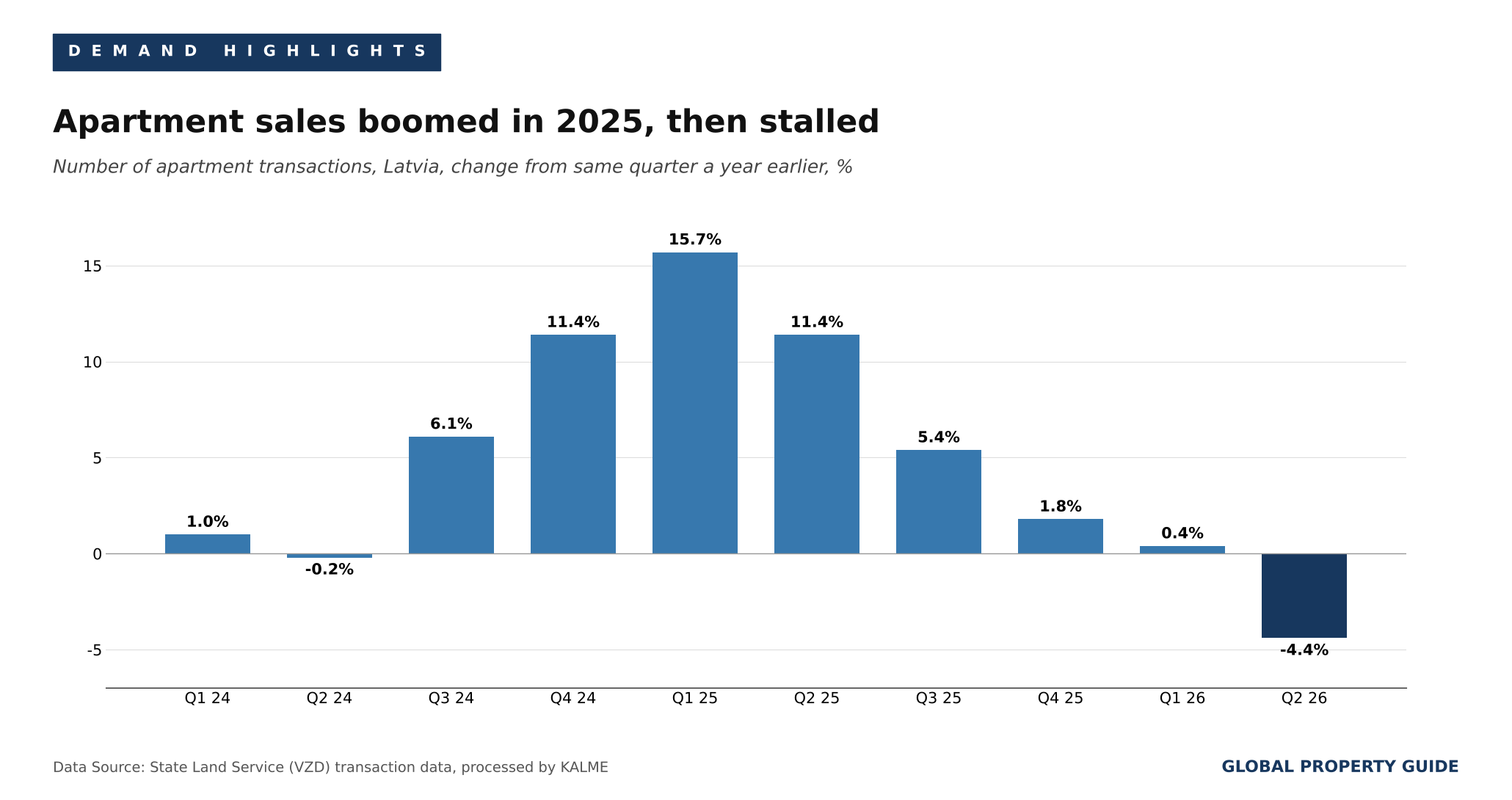
The momentum has faded this year. The number of apartment transactions in Latvia rose just 0.4% year-on-year in Q1 2026 and fell 4.4% in Q2 2026, according to State Land Service transaction data analysed by data company KALME. In the first half of 2026, apartment transactions were 2.1% lower than a year earlier. Growth had already slowed in the second half of 2025, from 15.7% year-on-year in Q1 2025 to 1.8% in Q4 2025.
In Riga, apartment transactions fell by 5% year-on-year in Q1 2026, according to Cenu Banka. Sales of new-project apartments fell 10%, while sales of pre-war apartments rose 12%.
The premium segment has held steady. In Q1 2026, premium residential transactions in Riga, its suburbs and Jurmala totalled EUR 117.8 million (USD 132.0 million), close to the level of a year earlier, according to Latvia Sotheby's International Realty. There were 354 premium apartment transactions in Riga, compared with 370 in Q1 2025.
Residence permits through property purchase have ended
The biggest change for foreign buyers is legal. A new Immigration Law, in force since 15 September 2026, no longer allows foreigners to obtain a residence permit by buying real estate. The Saeima, Latvia's parliament, adopted the law in June 2026. After the President returned it for reconsideration, parliament adopted it again on 20 August 2026, after a proposal to keep five-year permits for property worth at least EUR 300,000 failed to win support.
Under the transitional rules, applications submitted before the law took effect are decided under the old rules, and existing permits remain valid. Two investment routes remain:
- An investment in a company's share capital of EUR 50,000 (USD 56,030) for a small company or EUR 100,000 (USD 112,060) for a larger one, plus a EUR 10,000 (USD 11,206) state fee, for a permit of up to two years.
- A new route requiring an investment of at least EUR 150,000 (USD 168,090) for five years with a state-established alternative investment fund, plus a EUR 10,000 state fee. This route is not yet operational.
Russian and Belarusian citizens are barred from these routes. In September 2026, a bill that would also remove the investment fund route was referred to parliament.
The property route had already lost most of its importance. Between July 2010 and the end of 2025, the programme attracted investments of EUR 1.67 billion (USD 1.87 billion), about 83% of it in real estate, and 20,131 first-time residence permits were issued to investors and their families, according to an Interior Ministry report reported by LETA. Investment through the programme fell from EUR 447.5 million in 2014 to EUR 18.4 million in 2024, with real estate permits falling sharply after restrictions on Russian and Belarusian citizens in 2022. In 2025, there were just 192 investor applications, with investments of EUR 30.3 million (USD 34.0 million), about three-quarters of it in real estate.
Foreign demand is concentrated in Jurmala and central Riga. The last official breakdown, published by the State Land Service for 2010 to 2012, showed foreign buyers accounting for about 30% of the value of apartment transactions nationwide, and about three-quarters in Jurmala.
Property Supply Trends
Dwellings authorised reach a ten-year high
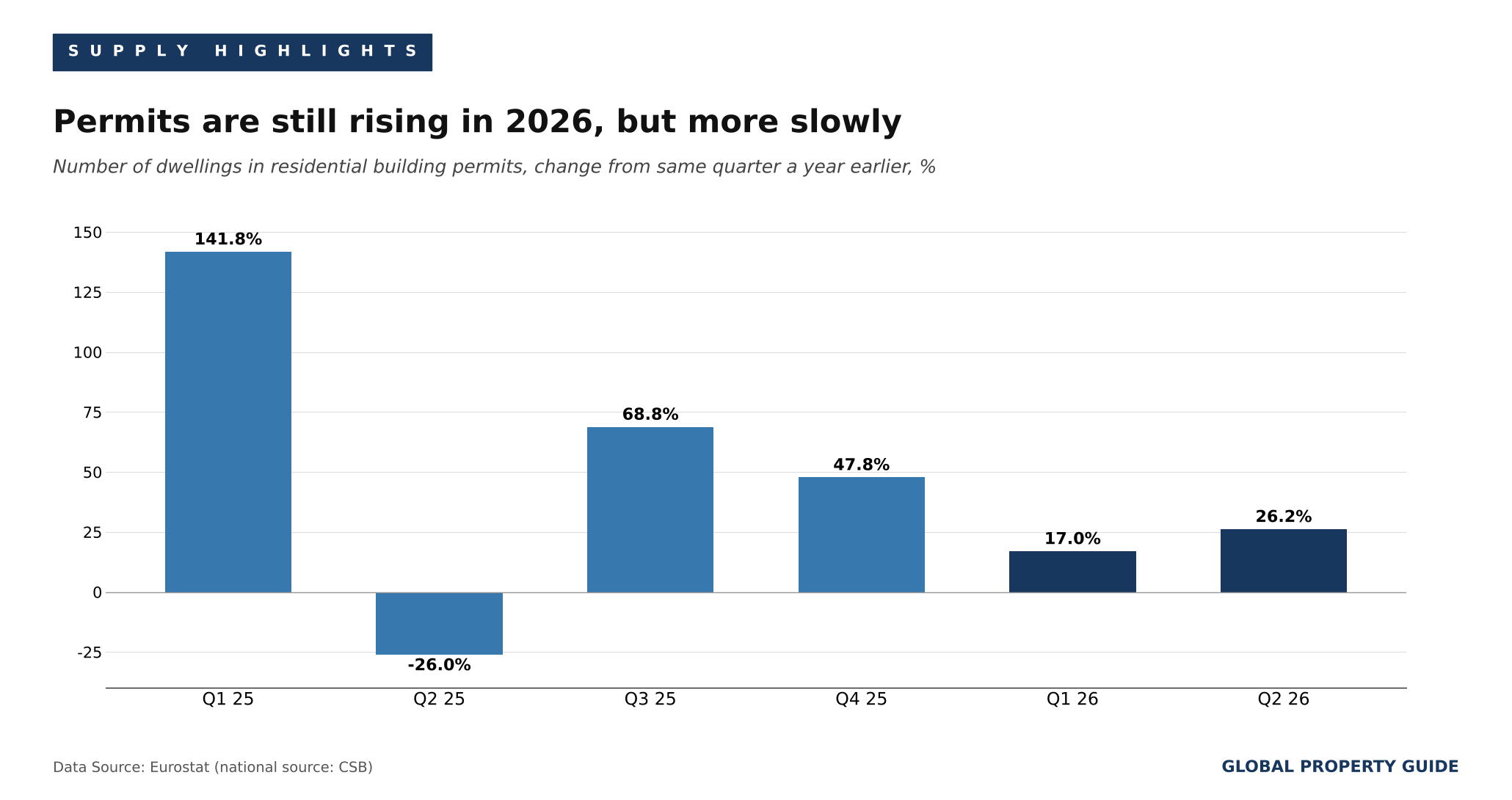
Residential construction is booming. In 2025, building permits were issued for 7,000 dwellings in residential buildings, up 37.4% from 2024 and the highest number since at least 2015, according to Eurostat, which publishes the CSB's data. The growth came from apartment buildings: dwellings in buildings with two or more dwellings rose by 64.8%, while dwellings in single-dwelling houses rose by just 2.2%.
The CSB counted 3,410 building permits for residential buildings in 2025, with a total area of 1.11 million square meters. Of these, 2,068 permits were for new single-dwelling houses.
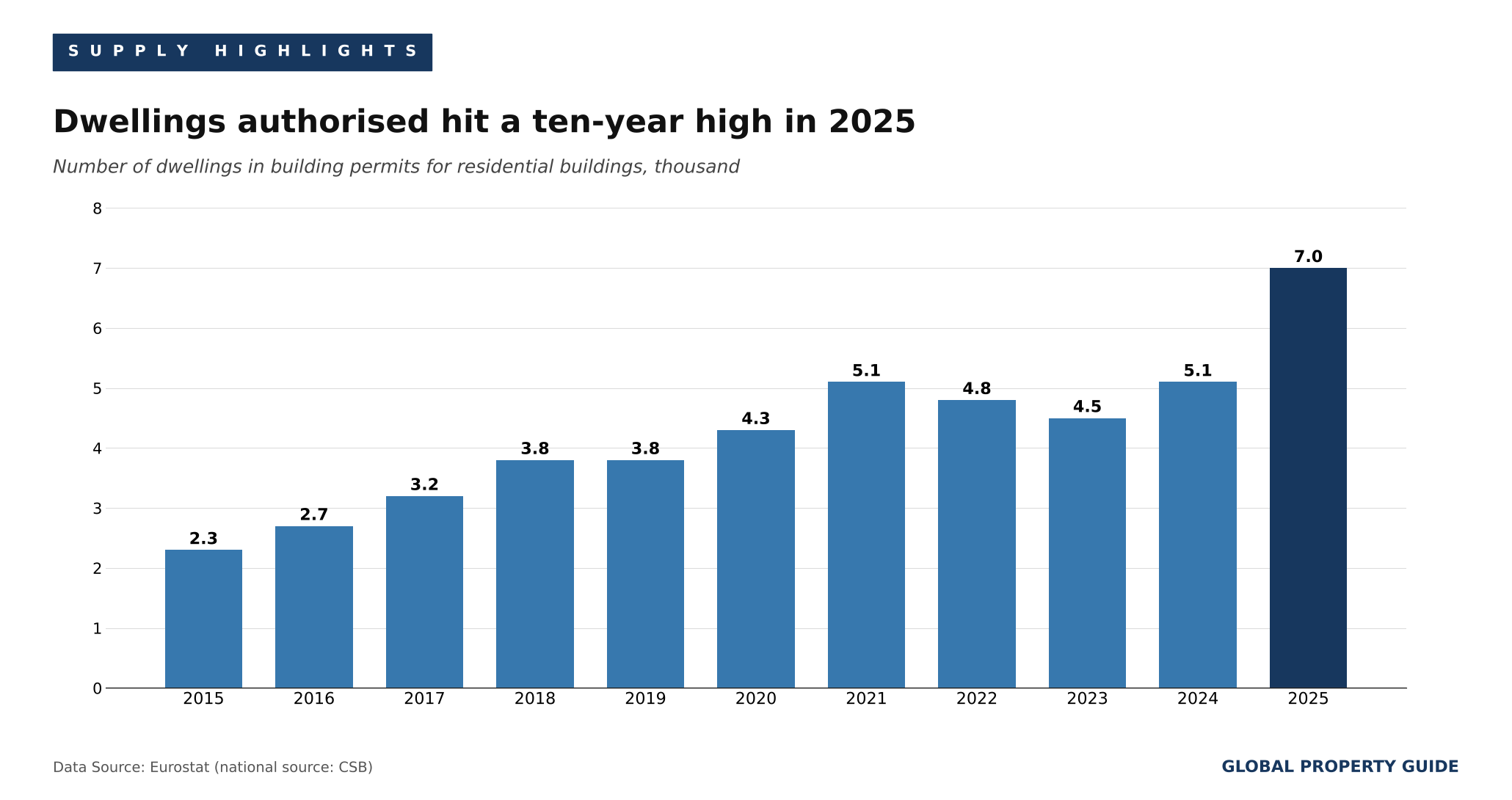
Permits are still rising in 2026, though more slowly. The number of dwellings authorised rose by 17.0% year-on-year in Q1 2026 and by 26.2% in Q2 2026. Dwellings in buildings with two or more dwellings rose by 41.5% and 65.9% respectively, while dwellings in single-dwelling houses fell by 38.9% and 34.9%.
Construction activity is following. Residential construction output rose by just 1.2% in 2025, according to the CSB. But in Q2 2026, building construction rose by 12.6% year-on-year, mainly driven by higher activity in residential construction, according to the Ministry of Economics.
Fewer homes on the market, but more new projects
Supply of existing apartments is shrinking. In September 2026, the number of apartments offered for sale in Riga was 15% lower than a year earlier, according to Arco. Latvijas Banka said that listings fell in all segments in 2025, by 15% on average in Riga, and that the stock of unsold new apartments fell by 22%.
New-build supply, by contrast, has grown. In August 2026 there were about 3,830 apartments for sale in Riga, of which 2,350 were in new projects sold by developers, according to Latio. Primary new-build supply has risen by 50% since 2022, which helps explain why new-build prices are barely rising.
Rental Market: Rents and Rental Yields
Rent growth is slowing
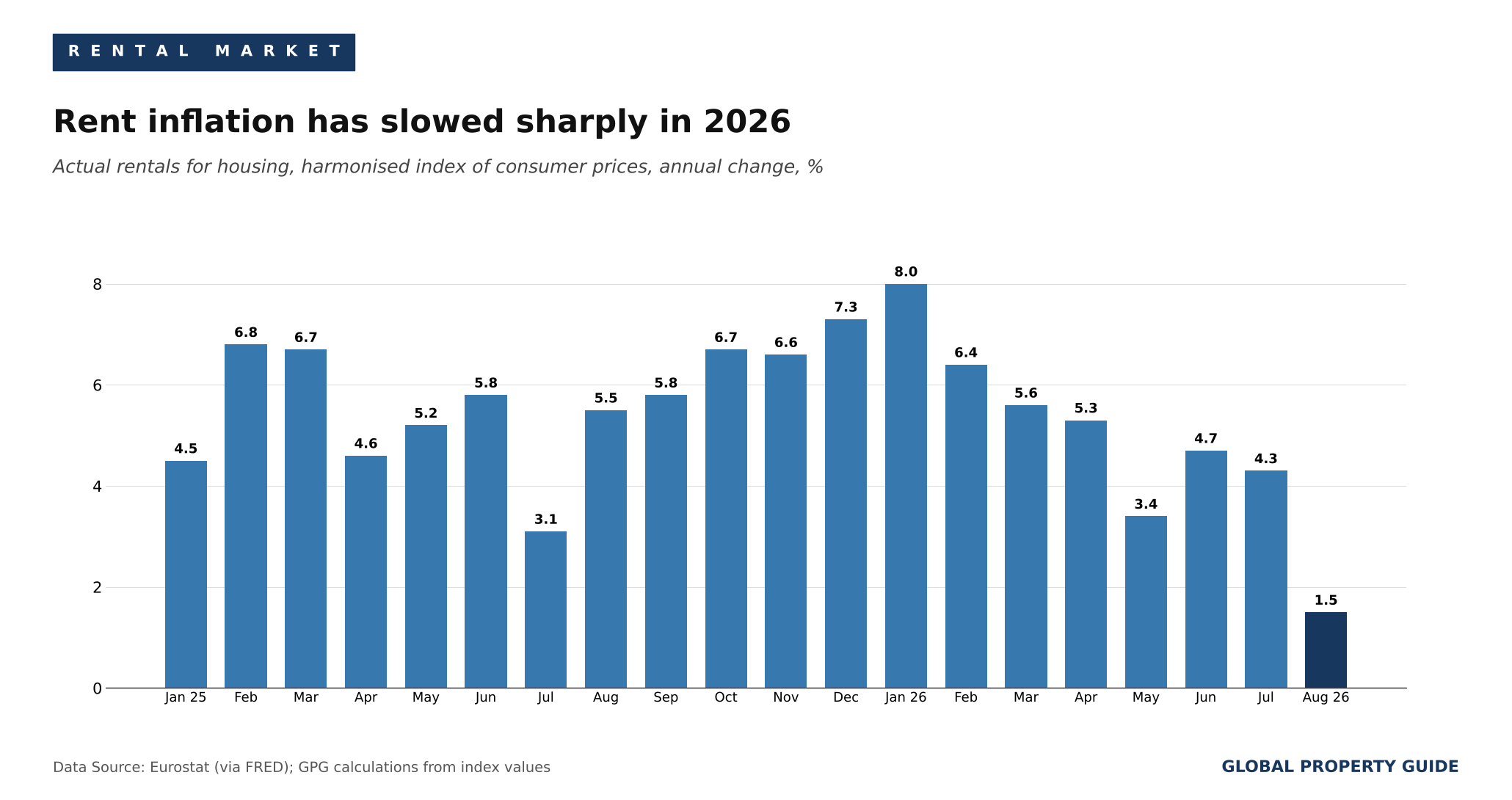
Rent inflation has eased this year. Actual rents for housing rose by 1.5% year-on-year in August 2026, down from 5.5% in August 2025 and a peak of 8.0% in January 2026, based on GPG calculations from the harmonised index of consumer prices published by Eurostat. In September 2026, rents fell by 0.9% from the previous month, according to the CSB.
Latvia's rent price index:
Market rents in Riga are still rising, but more slowly than prices. Average apartment rents in Riga were up 5% to 6% from a year earlier in mid-2026, while sale prices were rising about twice as fast, according to Latio. About one in five Latvian residents rents their home. In the first half of 2026, rents for one-room apartments in new projects were around EUR 540 (USD 605) per month in the centre and EUR 460 in Agenskalns, while rents for two-room apartments in new projects were around EUR 760 (USD 852) per month in the centre and EUR 610 in Teika.
In April 2026, the average rent for a two-room apartment in a new project in Riga was EUR 615 (USD 689) per month, up 2% from a year earlier, while the average rent for a two-room apartment in a standard-type building was EUR 375 (USD 420), up 10%, according to Cenu Banka.
| Asking rents for apartments in selected Riga neighborhoods, EUR per month, 2025: | |||
| Neighborhood | Project type | 1-room apartment | 2-room apartment |
| Centre | Pre-war, non-renovated | 410 | 570 |
| Centre | New project | 520 | 800 |
| Agenskalns | Standard-type | 325 | 420 |
| Agenskalns | New project | 500 | 685 |
| Imanta | Standard-type | 295 | 350 |
| Imanta | New project | 455 | 550 |
| Teika | Standard-type | 300 | 390 |
| Teika | New project | 345 | 600 |
| Purvciems | Standard-type | 285 | 330 |
| Purvciems | New project | 410 | 540 |
| Kengarags | Standard-type | 270 | 330 |
| Kengarags | New project | 300 | 460 |
| Data source: Latio. | |||
Rental yields have fallen
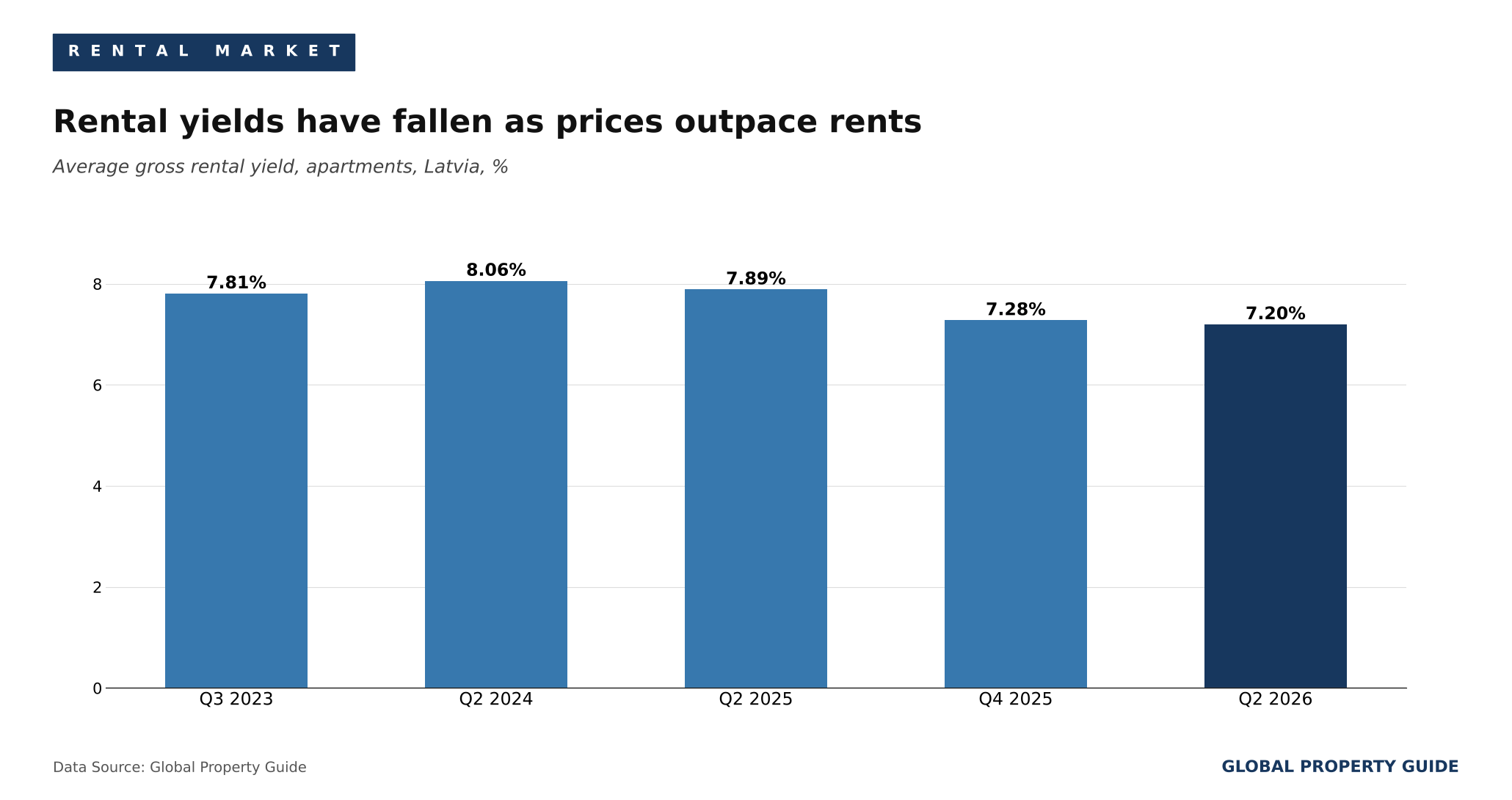
Gross rental yields in Latvia averaged 7.20% in Q2 2026, down from 7.28% in Q4 2025 and 7.89% in Q2 2025, according to research by Global Property Guide. Prices have risen faster than rents.
- In Riga, the average gross rental yield was 7.47%. Across the city, yields range from 6.67% for studios to 8.34% for two-bedroom apartments, which cost around EUR 187,000 (USD 209,552) and rent for around EUR 1,300 (USD 1,457) per month.
- In the city centre, yields range from 5.53% to 6.72%. A two-bedroom apartment in the centre costs around EUR 249,900 (USD 280,038) and rents for around EUR 1,400 (USD 1,569) per month.
- In Agenskalns, yields range from 5.22% to 6.39%, and in Vecriga, the old town, from 5.27% to 6.67%.
- In Jurmala, the average gross rental yield was 6.93%.
Round-trip transaction costs are low to moderate in Latvia. See our Property transaction costs analysis for Latvia.
Landlord and tenant rules
Several changes affect owners and landlords:
- Since January 2026, buyers of an apartment are liable for the previous owner's unpaid management costs, utility bills and reserve fund contributions arising in the three years before the purchase. Buyers can request a payment statement before buying.
- An amendment to the Residential Tenancy Law, in force since 1 July 2026, changes the transitional rules for open-ended leases in municipal housing.
- Since 10 July 2026, short-term rental accommodation has been treated as tourist accommodation and must report data on its guests.
- From 1 January 2027, Riga's tourist fee doubles from EUR 0.89 to EUR 1.78 per guest per night in tourist accommodation.
In Riga, residential property with at least one declared resident is taxed at 0.2% to 0.6% of its cadastral value in 2026, while property with no declared resident is taxed at 1.5%, according to the Riga City Council.
The state is also funding low-rent housing outside Riga. Through Altum, the state development finance institution, at least 1,140 low-rent apartments are under construction or contracted, with financing of EUR 97.7 million (USD 109.5 million), according to Altum. Rents in these apartments are capped at EUR 6.71 per square meter per month in 2026, less than half the market rents of EUR 13 to EUR 15 per square meter in Riga and its suburbs, according to LSM.
Mortgage Market and Interest Rates
Interest rates are rising again
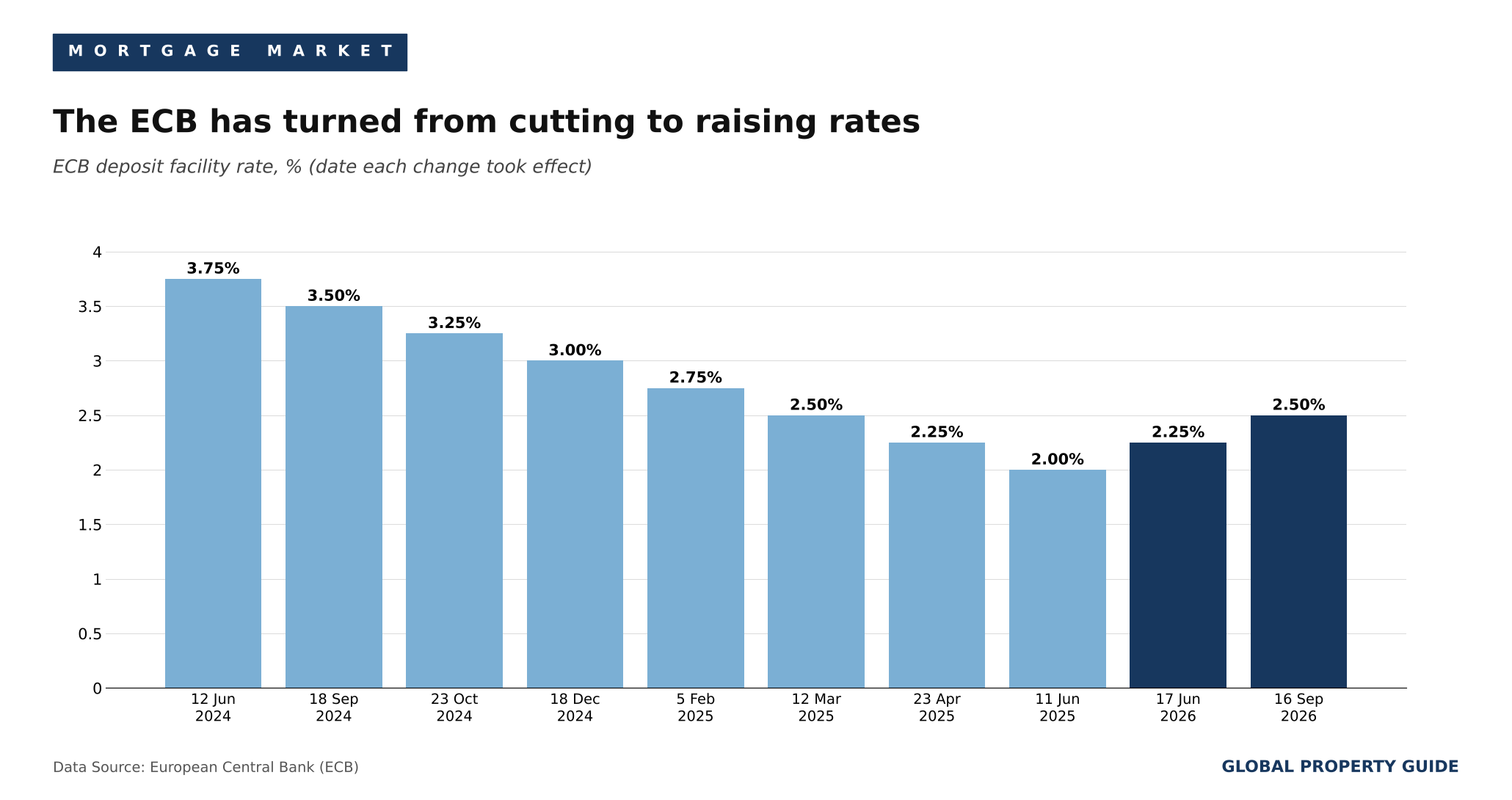
Latvia uses the euro, so its interest rates follow the ECB. After cutting its deposit facility rate eight times between June 2024 and June 2025, to 2.00%, the ECB held rates in early 2026 and then raised them twice, in June and September 2026. Since 16 September 2026, the deposit facility rate has been 2.50%, the main refinancing operations rate 2.65% and the marginal lending facility rate 2.90%.
Latvia's mortgage loan interest rates:
"The conflict in the Middle East continues to generate inflation pressures," the ECB said in September 2026, adding that inflation "is set to remain well above target for an extended period." ECB staff expect euro area inflation to average 3.0% in 2026 and 2.5% in 2027. The next ECB decision is due on 29 October 2026.
Market rates have followed. The six-month Euribor, the benchmark for variable-rate loans, rose to 2.909% on 9 October 2026, from 2.105% at the start of the year.
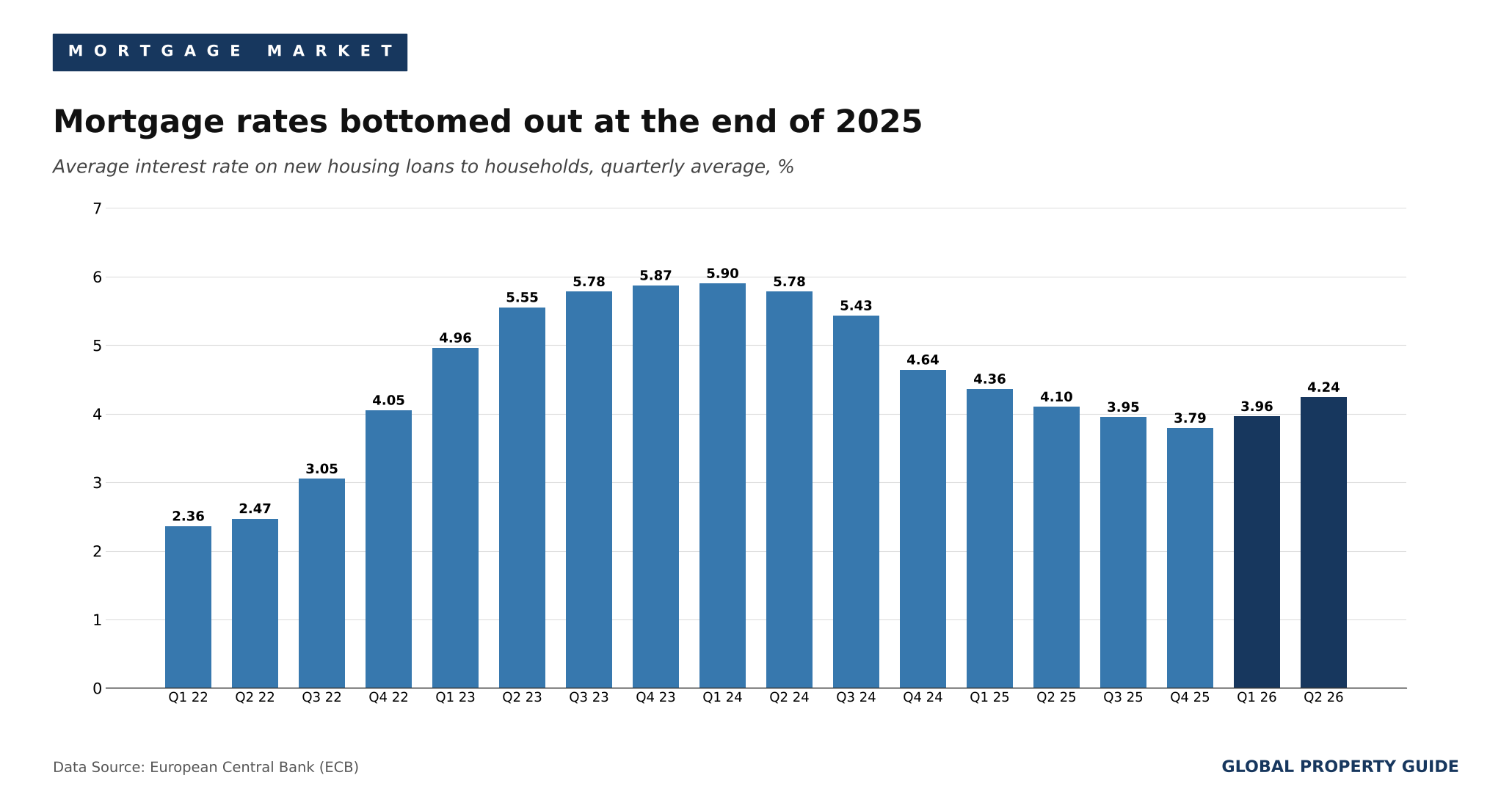
Latvian mortgage rates have turned up. The average interest rate on new housing loans was 4.39% in August 2026, according to ECB data. On a quarterly basis, the average rate fell from a peak of 5.90% in Q1 2024 to a low of 3.79% in Q4 2025, before rising to 3.96% in Q1 2026 and 4.24% in Q2 2026, according to the Global Property Guide.
By initial rate fixation, in August 2026:
- Floating rate and up to 1 year: 4.20%.
- Over 1 and up to 5 years: 7.75%.
- Over 5 and up to 10 years: 8.10%.
- Over 10 years: 5.34%.
For outstanding housing loans, the average interest rate was 4.57% in August 2026.
Housing loans are growing fast
Mortgage lending is expanding at its fastest pace in years. Outstanding loans for house purchase reached EUR 5,944 million (USD 6,661 million) in August 2026, up 9.2% from a year earlier, according to ECB data. In 2025, loans to households grew by 9.9%, according to Latvijas Banka, and overall loan growth was the fastest in 18 years. Rising Euribor rates since spring 2026 have not slowed lending so far, according to LSM.
Competition among banks has intensified. In 2025, 11,505 mortgages were refinanced, about 18% of the mortgage portfolio, after refinancing commissions were banned and the state fee for re-registering collateral was removed. Banks cut their margins by 0.45 percentage points for borrowers who stayed and by 0.8 percentage points for those who switched. The average margin on new mortgages has stabilised at around 1.6 percentage points, according to Latvijas Banka.
Even so, the mortgage market remains small. Outstanding mortgage loans were about 13% of GDP at the start of 2025, compared with 17% in Lithuania and 31% in Estonia, according to Latvijas Banka.
Borrowing limits are unchanged. Housing loans are capped at 90% of the property's value, or 95% with a state guarantee, with a debt-service-to-income limit of 40%, a debt-to-income limit of six times annual income and a maximum maturity of 30 years.
State support for buyers
State guarantees now play a large role. More than 40% of new housing loans in each quarter of 2025 and in Q1 2026 were state-guaranteed, according to Latvijas Banka. Under Altum's housing guarantee programme, families with children buying a home worth up to EUR 300,000 (USD 336,180) can receive a guarantee covering part of the down payment, ranging from 10% to 30% of the loan in Riga and its suburbs and 30% to 50% elsewhere, depending on the number of children. Altum's housing guarantee portfolio reached EUR 261.8 million (USD 293.4 million) in H1 2026, up EUR 35.9 million from a year earlier.
Since October 2025, Altum has also offered housing loans in the regions outside Riga and its surrounding areas, of up to EUR 74,000 (USD 82,924) for up to 30 years and up to 100% of the property's value.
Economic and Social Factors
Growth has been revised up and is accelerating
Latvia's economy is in better shape than earlier data suggested. In a benchmark revision published on 30 September 2026, the CSB raised its estimate of real GDP growth by 0.5 percentage points for 2024 and by 0.3 percentage points for 2025. According to Eurostat, the economy contracted by 1.0% in 2023, then grew by 0.5% in 2024 and 2.4% in 2025.
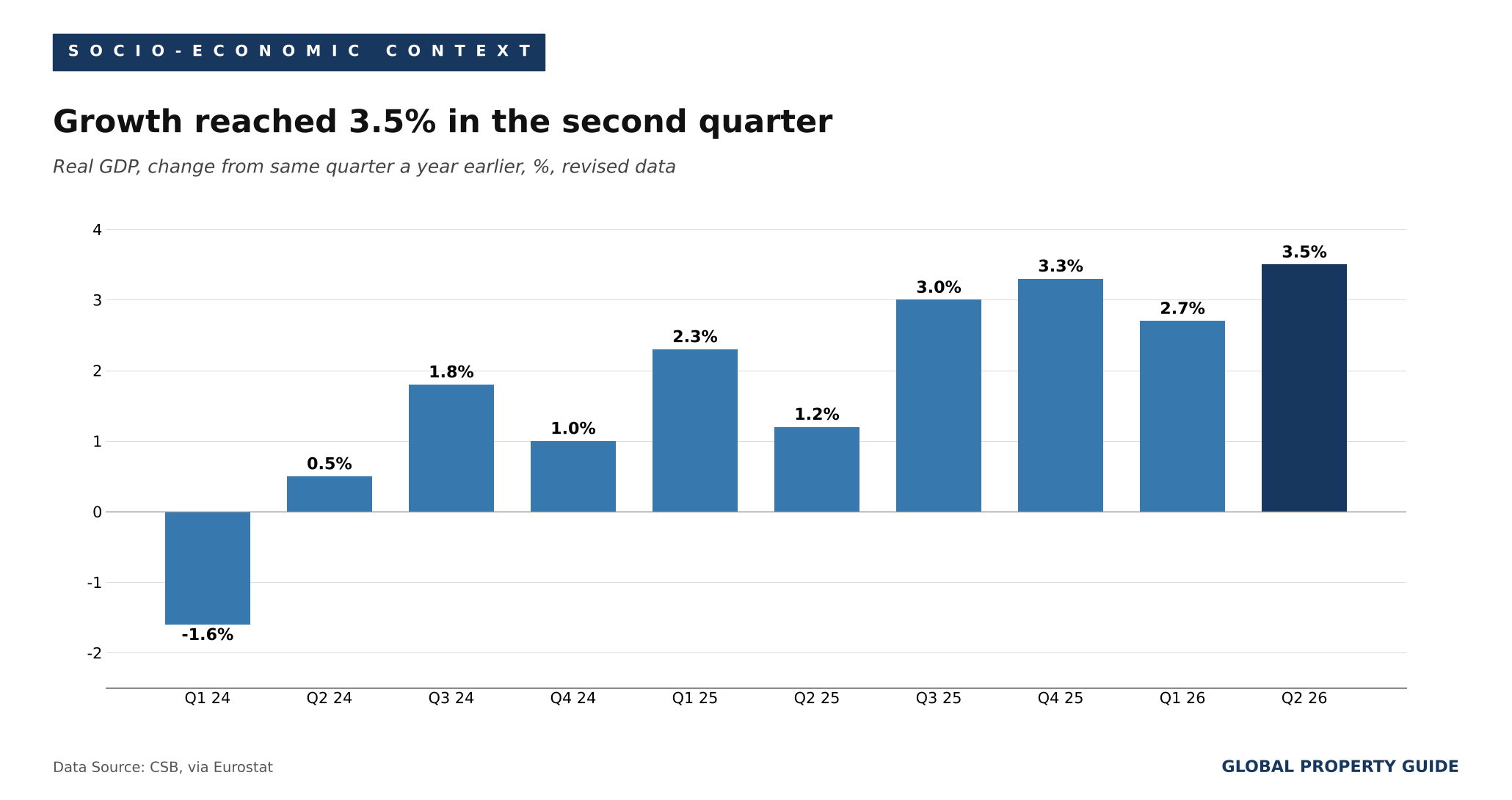
Growth has picked up further this year. In Q2 2026, real GDP rose by 3.5% year-on-year and by 0.9% quarter-on-quarter, according to revised data published by Eurostat, up from the CSB's first estimate of 3.0%. Household consumption rose by 2.4%, government consumption by 6.0% and exports by 5.7%.
Forecasts for 2026 range from 1.4% to 2.4%. The European Commission projects growth of 1.4% in 2026 and 1.6% in 2027, while Latvijas Banka expects 2.0% in 2026 and 2.4% in 2027. In September 2026, the Ministry of Finance raised its 2026 forecast to 2.4%. These forecasts predate the CSB's benchmark revision. The IMF, which concluded its 2026 Article IV consultation with Latvia in September, said that "Latvia faces significant structural challenges and public spending pressures."
Inflation remains above 3%
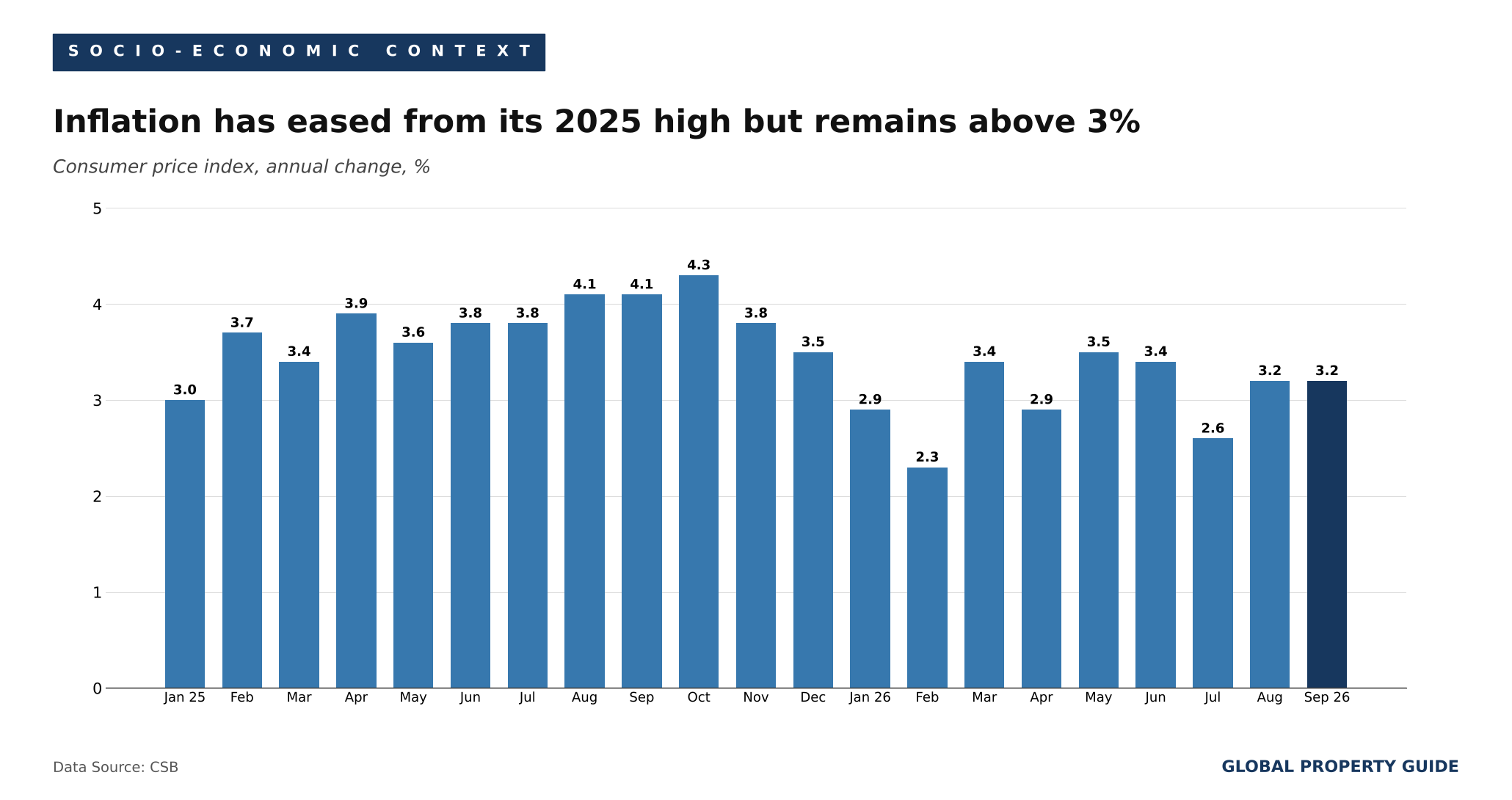
Consumer price inflation was 3.2% in September 2026, down from 4.1% a year earlier, according to the CSB. Transport prices rose by 12.6% and housing and utility costs by 7.3%, while food prices fell by 4.8%. Harmonised inflation, the measure used by the ECB, was 2.9% in September, according to Eurostat's flash estimate.
Harmonised inflation averaged 3.8% in 2025, up from 1.3% in 2024, according to Eurostat. That is far below the 17.2% of 2022 and 9.1% of 2023. Latvijas Banka and the European Commission both expect harmonised inflation of 3.6% in 2026.
The labor market has softened slightly. The unemployment rate was 7.0% in Q2 2026, up from 6.7% a year earlier, with 66,200 people unemployed, according to the CSB, as reported by Trading Economics.
Defence spending is pushing up the deficit
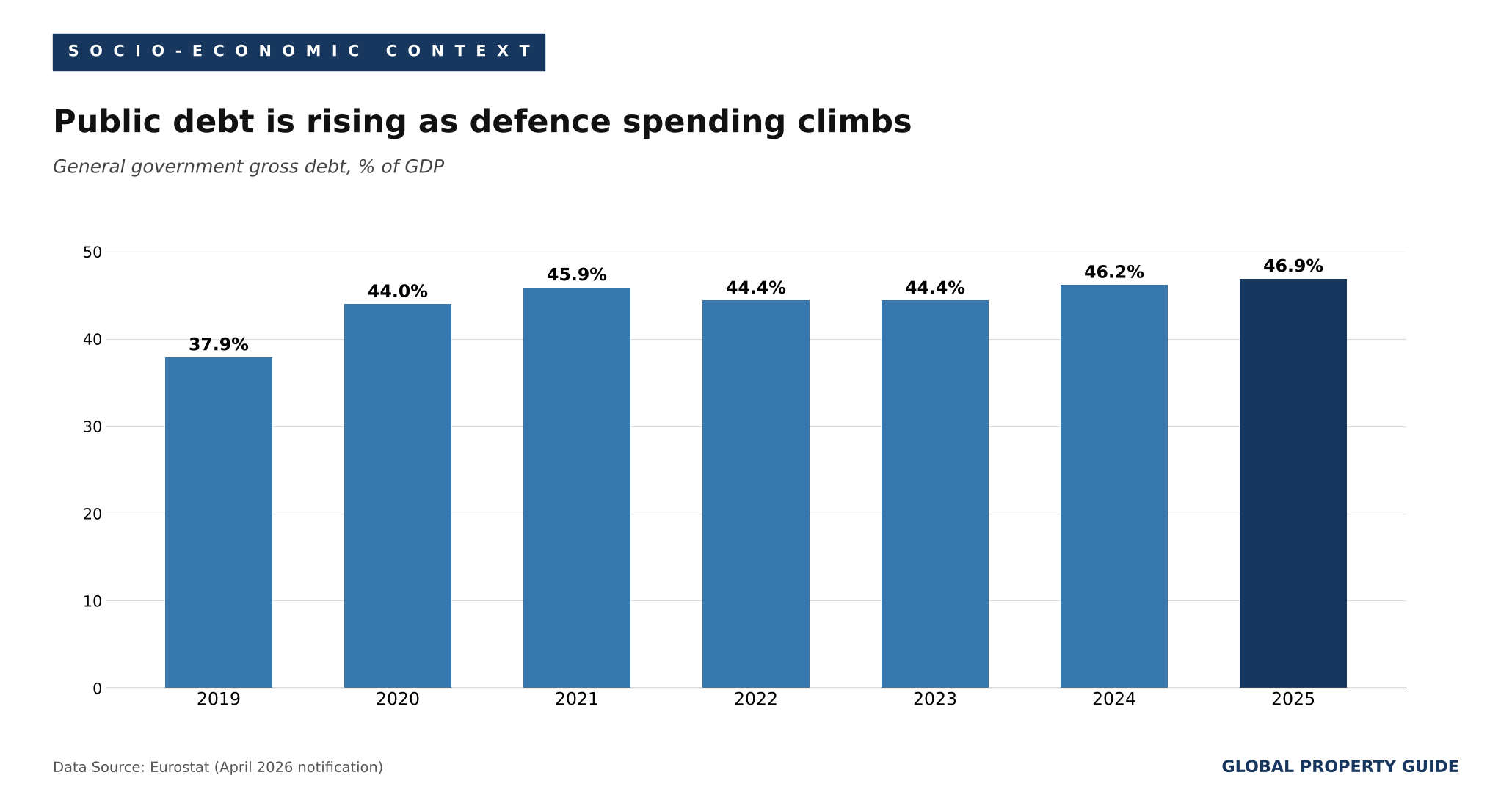
The general government deficit widened to 2.5% of GDP in 2025, from 1.8% in 2024, according to Eurostat. Public debt rose to 46.9% of GDP, up from 37.9% in 2019. Eurostat's October notification, due later this month, will restate these ratios on the basis of the revised GDP data.
Defence is the main driver. In March 2026, the Saeima set defence spending at a minimum of 5% of GDP each year from 2027, with spending in 2026 projected at 4.9% of GDP. The European Commission expects the deficit to widen to 3.3% of GDP in 2026 and 4.3% in 2027, and public debt to rise to 53.8% of GDP by 2027.
In the first seven months of 2026, the general government consolidated budget recorded a small surplus of EUR 51.1 million (USD 57.3 million), according to the Ministry of Finance.
Latvia's credit ratings are stable. S&P Global Ratings affirmed its A rating in May 2026, Fitch affirmed its A- rating in April 2026, and Moody's kept its A3 rating unchanged in July 2026, all with stable outlooks. Parliamentary elections were held on 3 October 2026.
Latvia adopted the euro on 1 January 2014 and joined the OECD in July 2016.
Sources:
- Central Statistical Bureau of Latvia (CSB)
- Changes in Dwelling Prices, Q2 2026 (LV portals, LV): lvportals.lv
- Detailed GDP Estimate for 2024: stat.gov.lv
- Gross Domestic Product, Q2 2026: stat.gov.lv
- Construction Output and Building Permits, 2025 (LV portals, LV): lvportals.lv
- Consumer Prices, September 2026 (LV portals, LV): lvportals.lv
- Eurostat
- House Price Index, Quarterly, Latvia: ec.europa.eu
- House Price Index, Annual, Latvia: ec.europa.eu
- Building Permits, Dwellings, Annual, Latvia: ec.europa.eu
- Building Permits, Dwellings, Quarterly, Latvia: ec.europa.eu
- Real GDP Growth, Annual, Latvia: ec.europa.eu
- Real GDP Growth, Quarterly, Latvia: ec.europa.eu
- Real GDP Growth, 2007-2013, Latvia: ec.europa.eu
- Unemployment Rate, Annual, Latvia: ec.europa.eu
- HICP, Monthly Annual Rate, Latvia: ec.europa.eu
- HICP, Annual Average Rate, Latvia: ec.europa.eu
- Government Deficit and Debt, Latvia: ec.europa.eu
- HICP, Actual Rentals for Housing, Latvia (FRED): fred.stlouisfed.org
- Latvijas Banka
- Financial Stability Report 2026: datnes.latvijasbanka.lv
- Annual Report 2025, Lending: gadaparskats.latvijasbanka.lv
- Financing of the Economy 2025: datnes.latvijasbanka.lv
- Borrower-Based Measures: bank.lv
- Macroeconomic Forecasts, June 2026 (LV portals, LV): lvportals.lv
- European Central Bank (ECB)
- Key ECB Interest Rates: ecb.europa.eu
- Monetary Policy Decisions, 10 September 2026: ecb.europa.eu
- Governing Council Meeting Calendar: ecb.europa.eu
- Euro Foreign Exchange Reference Rates: ecb.europa.eu
- Interest Rates on New Housing Loans, Latvia (DBnomics): db.nomics.world
- Interest Rates on Outstanding Housing Loans, Latvia (DBnomics): db.nomics.world
- Outstanding Loans for House Purchase, Latvia (DBnomics): db.nomics.world
- Government of Latvia
- Building Construction, Q2 2026 (Ministry of Economics): em.gov.lv
- Macroeconomic and Budgetary Review No 7/2026 (Ministry of Finance): fm.gov.lv
- Ministry of Finance Raises Growth Forecast (LV portals, LV): lvportals.lv
- S&P Global Affirmed Latvia's Credit Rating (State Treasury): kase.gov.lv
- Fitch Ratings Affirms Latvia's Credit Rating (State Treasury): kase.gov.lv
- Moody's Keeps Latvia's Credit Rating at A3 (State Treasury): kase.gov.lv
- State Land Service, Real Estate Market Overview, Q1 2013 (LV): vzd.gov.lv
- Laws and Regulations
- New Immigration Law Takes Effect (LV portals, LV): lvportals.lv
- The New Immigration Law: What to Expect (LV portals, LV): lvportals.lv
- Report: Residence Permits Are Not an Effective Tool for Attracting Foreign Capital (LV portals, LV): lvportals.lv
- Debt Follows the Apartment from January (LV portals, LV): lvportals.lv
- Short-Term Rentals Must Report Guest Data (LV portals, LV): lvportals.lv
- Property Tax in Riga in 2026 (LV portals, LV): lvportals.lv
- Amendment to the Residential Tenancy Law (Likumi, LV): likumi.lv
- Riga Tourist Fee Regulations (Likumi, LV): likumi.lv
- Altum
- Arco Real Estate
- Standard-Type Apartments in Riga and Surroundings, September 2026 (LV): arcoreal.lv
- Standard-Type Apartments, 1 October 2025 (LV): arcoreal.lv
- Standard-Type Apartment Market Overview, August 2026 (LV): arcoreal.lv
- Apartments in New Projects in Riga, 2025 (LV): arcoreal.lv
- Apartments in the Centre of Riga, 2025 (LV): arcoreal.lv
- Standard-Type Apartment Prices in Riga Rose 4.1% Last Year (bb.lv, LV): lat.bb.lv
- Global Property Guide
- Gross Rental Yields in Latvia: globalpropertyguide.com
- Mortgage Interest Rates in Latvia: globalpropertyguide.com
- Buying Guide for Latvia: globalpropertyguide.com
- Other Sources
- Housing Market 2025 Report (Latio, LV): latio.lv
- New Project Developers Are Holding Back Their Own Market (Baltic News): balticnews.com
- Riga Housing Prices Rising Twice as Fast as Rents (Apollo, LV): apollo.lv
- Riga Apartment Market Reaches Highest Transaction Level Since 2007 (Investoru Klubs, LV): investoruklubs.lv
- Riga Apartment Market Newsletter, May 2026 (Cenu Banka): cenubanka.lv
- Number of Transactions in Latvia (KALME, LV): kalme.lv
- Premium Housing Market in Latvia, Q1 2026 (Latvia Sotheby's International Realty): latviasothebysrealty.com
- House Sales Were on the Rise in Latvia Last Year (LSM): eng.lsm.lv
- Saeima Re-Adopts the New Immigration Law (LSM, LV): lsm.lv
- Residence Permits Restricted for Russian and Belarusian Investors (LSM, LV): lsm.lv
- Lending Has Grown Since the Start of the Year (LSM, LV): lsm.lv
- Low-Rent Apartments (LSM, LV): lsm.lv
- Saeima Sets Latvia's Defence Spending at Minimum 5% of GDP from 2027 (LSM): eng.lsm.lv
- Interior Ministry Report on Residence Permits for Investors (Liepajniekiem, LV): liepajniekiem.lv
- Economic Forecast for Latvia (European Commission): economy-finance.ec.europa.eu
- Latvia Concludes 2026 Article IV Consultation (International Monetary Fund): imf.org
- Euribor 6 Months (Euribor-rates.eu): euribor-rates.eu
- Latvia Inflation Rate (Trading Economics): tradingeconomics.com
- Latvia Unemployment Rate (Trading Economics): tradingeconomics.com