Czech Republic's Residential Property Market Analysis 2025
The Czech housing market has spent a year doing exactly what the central bank feared. Prices are still compounding at double digits, mortgage lending has run at record volumes, and the supply response has arrived too late to matter. The Czech National Bank has responded by raising interest rates for the first time in four years and tightening the rules on buy-to-let borrowing, turning the policy backdrop from a tailwind into a brake.
This extended overview from Global Property Guide covers key aspects of the Czech housing market and takes a closer look at its most recent developments and long-term trends.
Table of Contents
- Property Prices and Price Index
- House Price Variations
- Property Demand Trends
- Property Supply Trends
- Rental Market: Rents and Rental Yields
- Mortgage Market and Interest Rates
- Historic Perspective
- Economic and Social Factors
Property Prices and Price Index
According to the latest data from the Czech Statistical Office (CZSO), the House Price Index for the Czech Republic rose by 10.06% year-on-year in Q1 2026, a fifth consecutive quarter of double-digit growth. Adjusted for average consumer price inflation of 1.6% over the quarter, the index gained 8.33% in real terms, the strongest inflation-adjusted increase since the 2021 boom.
Czech Republic's house price annual change:
The composition of that growth has changed in a way the headline number conceals. Prices for residential units in new buildings rose by 10.01%, while prices in existing buildings rose by 10.07%. A year earlier, the same two series stood at 13.00% and 9.32% respectively. New-build inflation has therefore decelerated by three percentage points while the existing stock has accelerated, and the two segments have converged on effectively identical rates for the first time in this cycle.
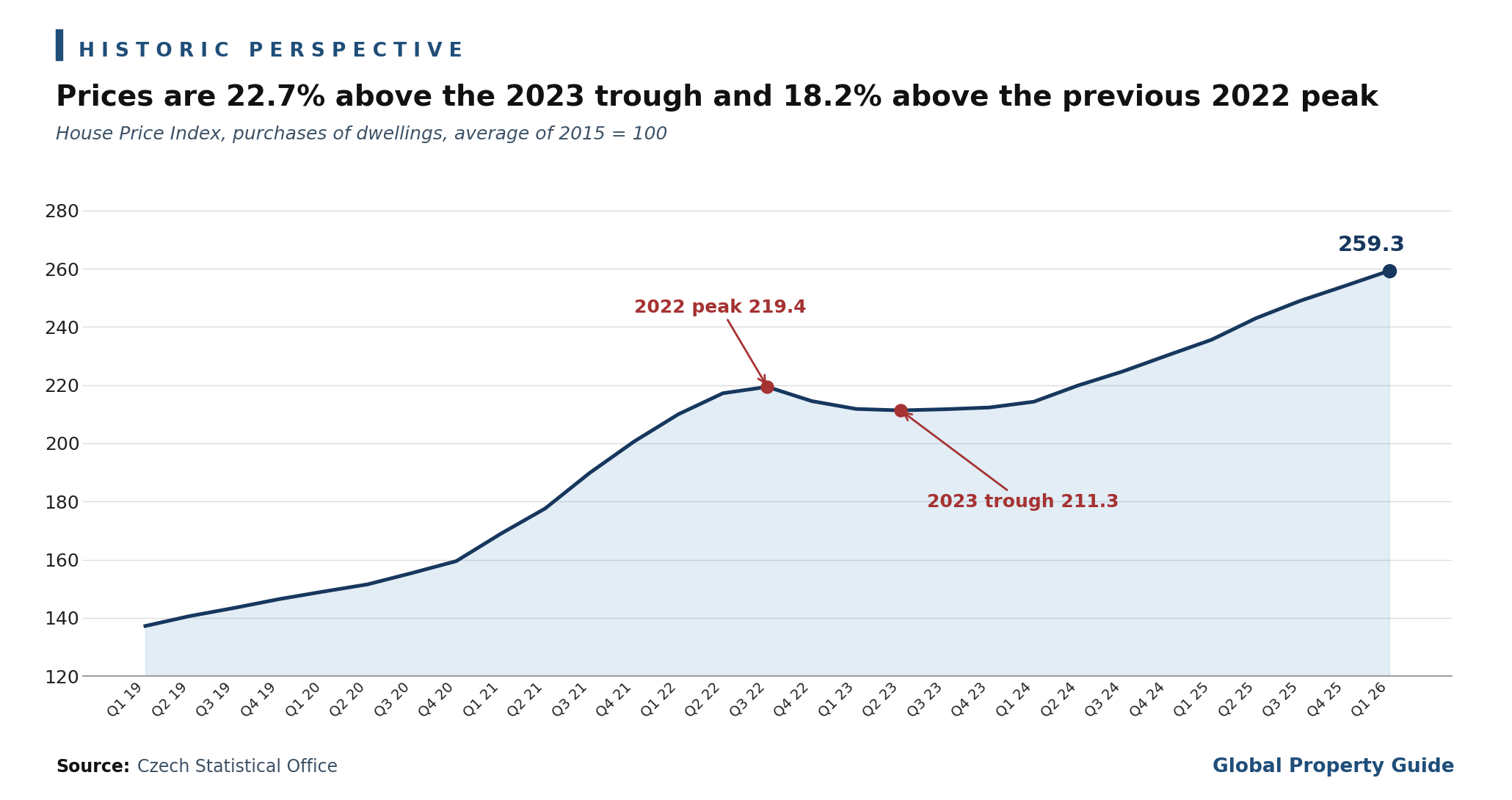
Prices rose 2.05% in the quarter alone. The index now stands at 259.3 against a 2015 average of 100, meaning Czech homes have more than doubled in nominal value over eleven years. Prices are 18.2% above the previous cyclical peak reached in Q3 2022 and 22.7% above the Q2 2023 trough.
The Czech National Bank (CNB) no longer treats this as benign. In a thematic article published with its Monetary Policy Report, the central bank concluded that residential property prices are in the upward phase of the cycle, that real apartment prices have surpassed their 2022 highs, and that housing affordability has recently deteriorated. When the Bank Board raised rates in June 2026, an overheating housing market was named among the sources of elevated core inflation.
House Price Variations
Growth has been broad but far from uniform, and the segment ranking has inverted relative to the previous edition of this report.
Older stock outperformed new construction
Flat Zone data presented to EUROCONSTRUCT put average nationwide residential price growth at 12% in 2025. Within that, existing apartments rose 18%, family houses 14%, resales of relatively new apartments 13%, and first sales of new apartments only 9%.
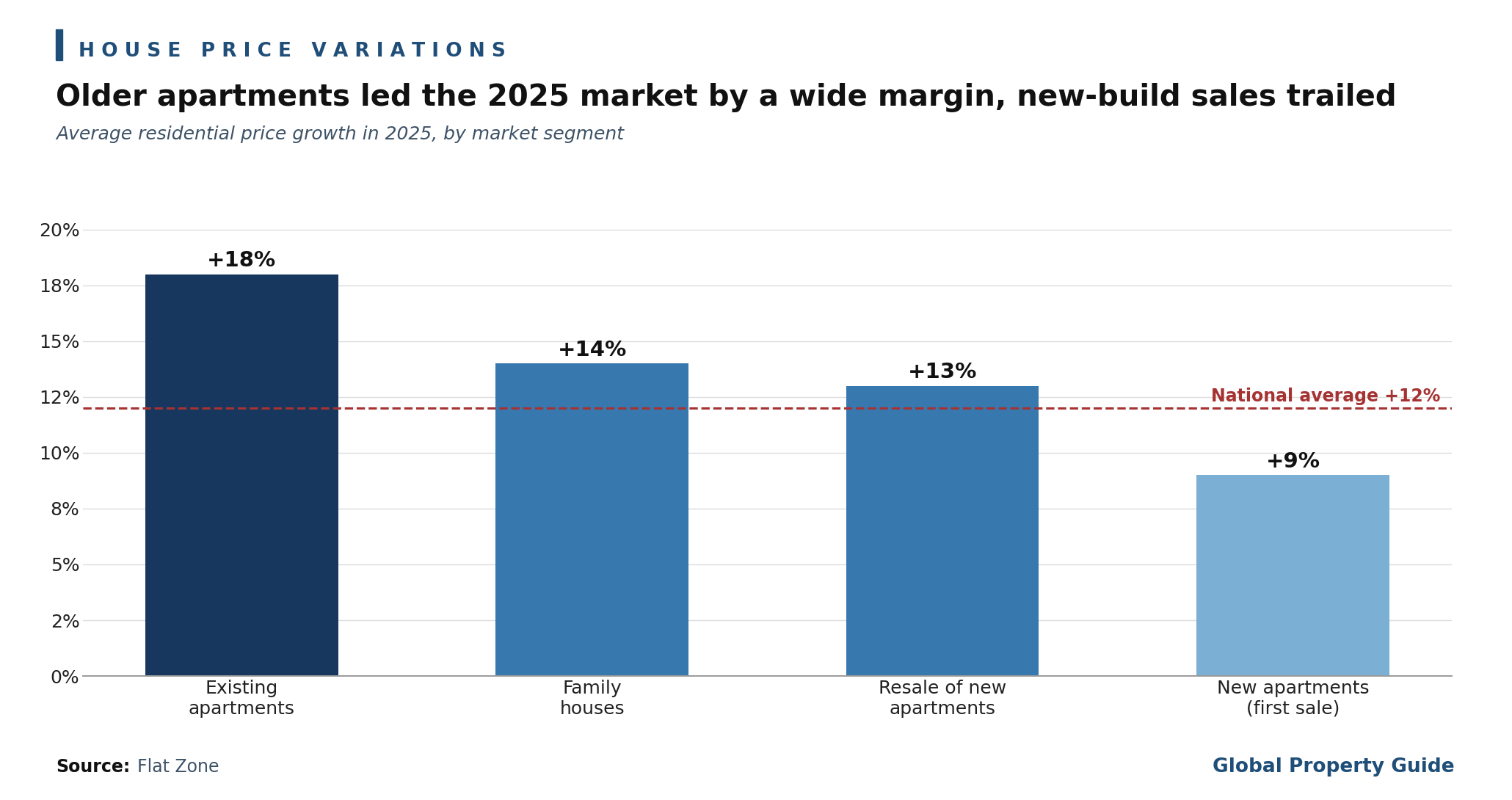
The pattern is consistent with buyers being pushed down-market by affordability. First-sale new-build pricing sits at a level that a shrinking pool of households can reach, so demand has spilled into the second-hand stock, where the price gap is closing from below rather than the premium segment being pulled up.
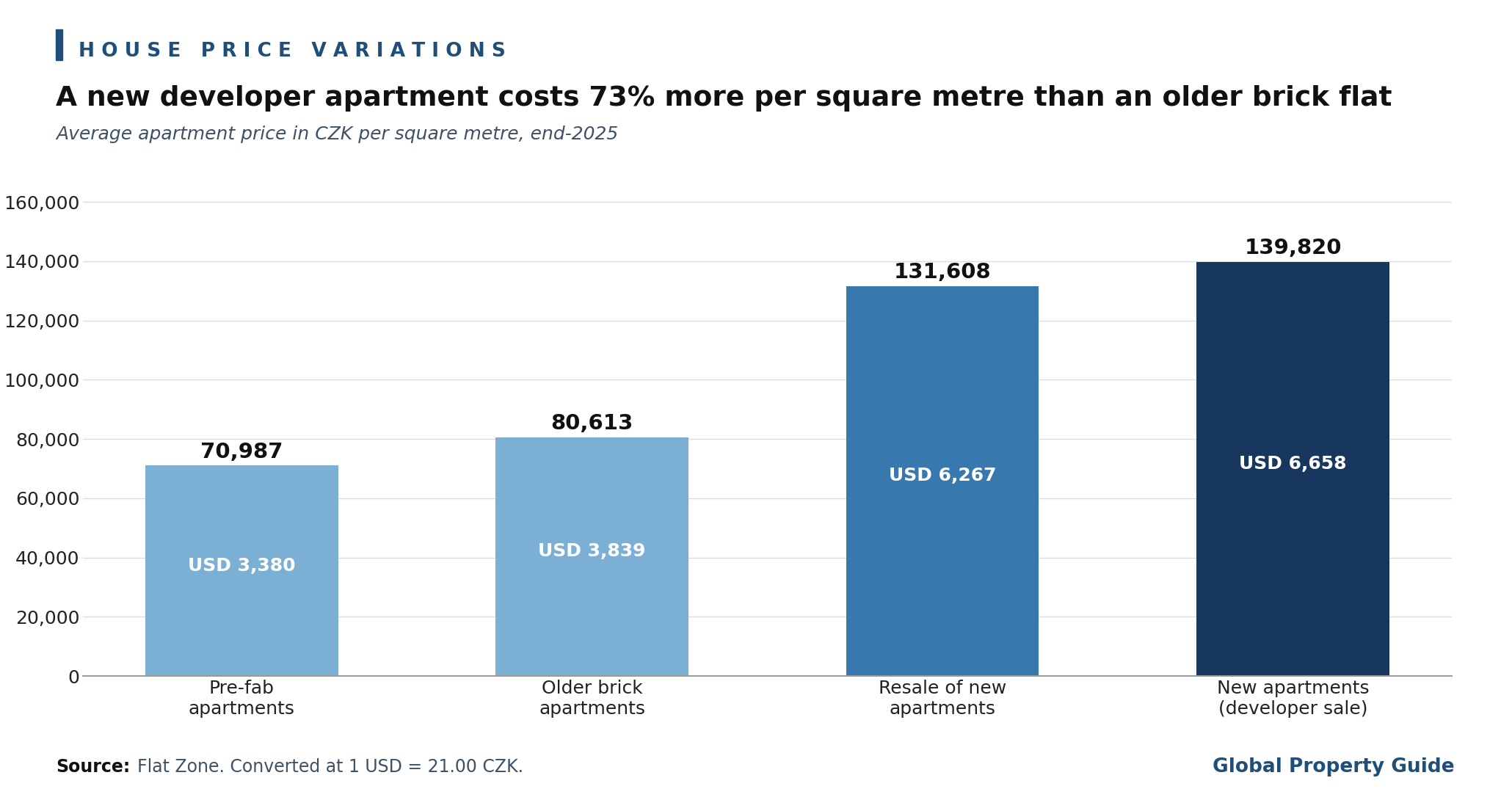
The absolute levels remain widely separated. At the end of 2025, a new developer apartment averaged CZK 139,820 (USD 6,658) per square metre, a resale of a relatively new apartment CZK 131,608 (USD 6,267), an older brick apartment CZK 80,613 (USD 3,839), and a pre-fabricated panel apartment CZK 70,987 (USD 3,380). The average family house transacted at CZK 6.2 million (USD 295,238).
Prague remains a market apart
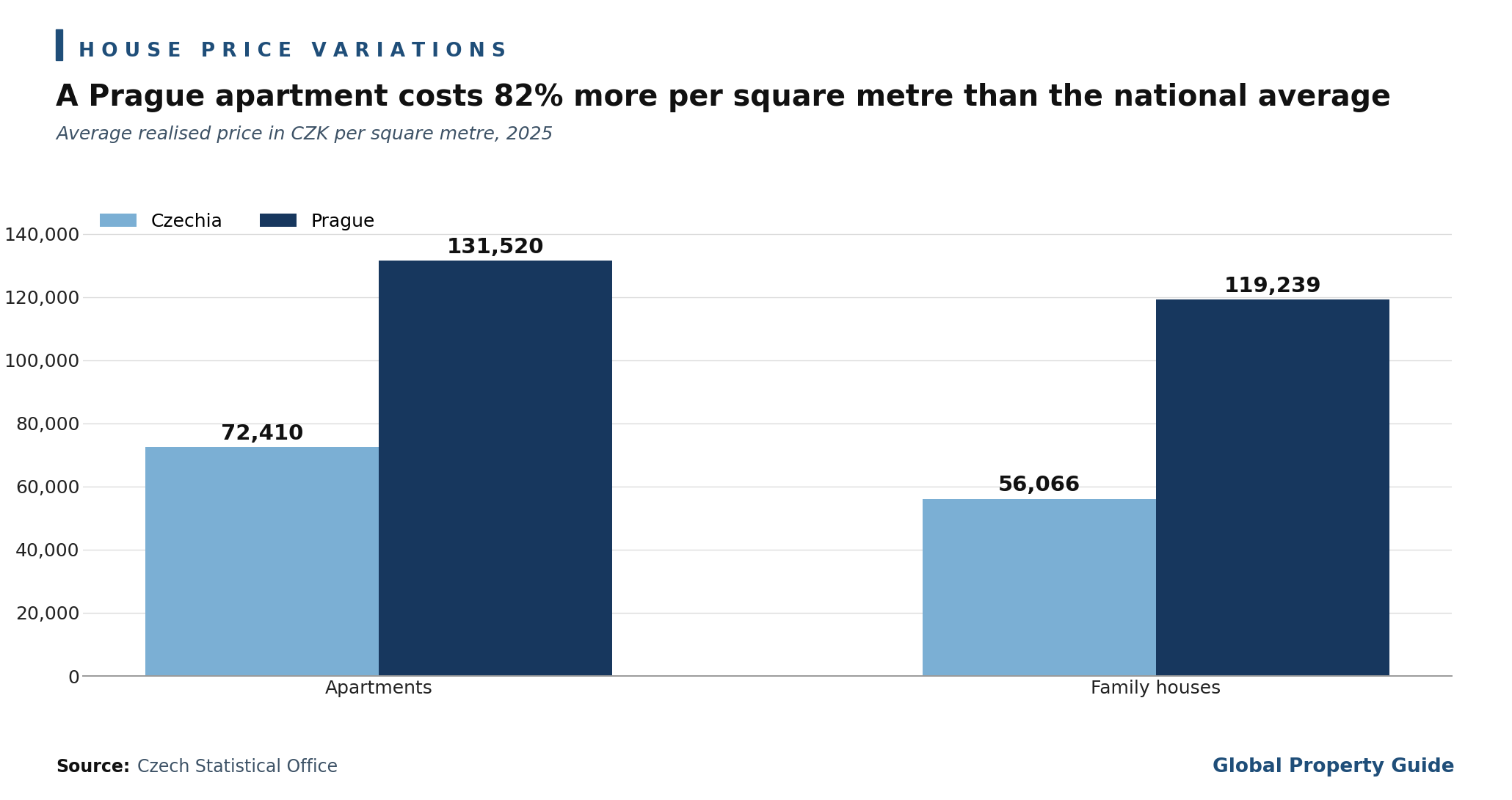
The CZSO's annual property price statistics confirm the scale of the regional gap. In 2025, an apartment in the Czech Republic sold for an average of CZK 72,410 (USD 3,448) per square metre, against CZK 131,520 (USD 6,263) in Prague, a premium of 82%. Family houses averaged CZK 56,066 (USD 2,670) per square metre nationally and CZK 119,239 (USD 5,678) in Prague, a premium of 113%. Apartment prices rose 10.6% across the country in 2025 and family house prices 6.7%, giving an aggregate property price index of 109.0.
Flat Zone quantifies the divergence differently, noting that older apartments in Prague and Brno cost roughly three times as much as in towns of fewer than 10,000 inhabitants and about twice as much as in other larger cities, while for family houses the metropolitan-to-rural gap approaches fourfold.
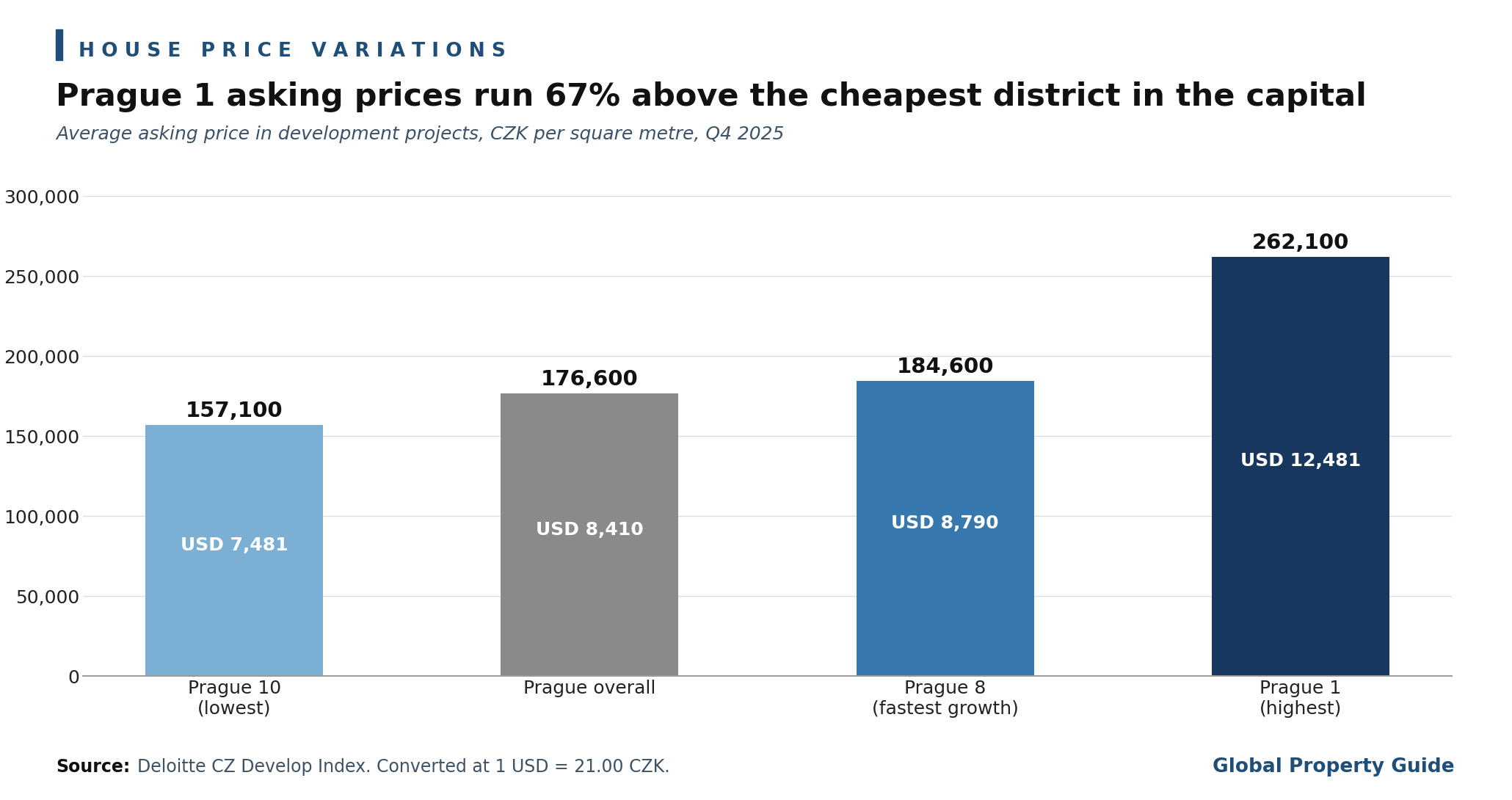
Within the capital, the Deloitte Develop Index put average asking prices in Prague development projects at CZK 176,600 (USD 8,410) per square metre in Q4 2025, up 2.9% on the quarter. Prague 1 was the most expensive district at CZK 262,100 (USD 12,481), Prague 10 the cheapest at CZK 157,100 (USD 7,481), and Prague 8 recorded the fastest growth at 8% to CZK 184,600 (USD 8,790).
Property Demand Trends
Transaction volumes settled at a higher plateau
Residential demand held its recovery through 2025 without repeating the explosive rebound of the previous two years. Total transaction volumes increased by 11% year-on-year, roughly 6,500 additional apartment and house sales compared with 2024, according to Flat Zone. Sales of existing apartments grew 12%, with Prague and the Usti Region the most active, while house transactions rose 4%, concentrated in the Central Bohemian Region. New apartment sales were strongest in Prague, the South Moravian Region and the Central Bohemian Region.
That is a marked moderation from the 33.6% jump recorded in 2024, and it reflects a market that has completed its return to pre-crisis levels rather than one still catching up.
The imbalance is now the binding constraint
By the end of 2025, developers held nearly 17,500 newly built apartments in their portfolios, and supply had increased year-on-year in every region except Prague. The exception matters, because Prague is where the shortfall is structural rather than cyclical.
Flat Zone frames the outstanding problem plainly: insufficient construction in high-demand metropolitan areas, particularly Prague and Brno, with long permitting processes and limited land availability continuing to constrain supply. On that reading, transaction volumes have recovered, but the underlying imbalance has not been addressed, which is why price pressure in the two largest cities is unlikely to ease in the short term.
Demographics continue to work against any easing. The country's population reached almost 10.9 million in Q1 2026, and inward migration remains concentrated in Prague and Brno, where students, foreign workers and young households compete for a stock that is barely growing.
Investors have been partially crowded out
The most significant change in the demand mix this year is regulatory rather than economic. From 1 April 2026, the CNB applies tighter limits to what it terms investment mortgages, meaning loans for a third or subsequent residential property or for a property intended to be let. The recommended ceilings are a loan-to-value ratio of 70% and a debt-to-income ratio of seven times net annual income, against a general limit of 80% loan-to-value and 90% for applicants under 36.
The CBA estimates that investment mortgages exceeding the new thresholds accounted for roughly 9% of new lending, implying a mechanical impact of CZK 2.1 billion to CZK 2.5 billion a month, or CZK 26 billion to CZK 31 billion a year. The measure is a recommendation rather than a legally enforceable rule, though Czech banks have historically followed such guidance closely.
The effect showed up quickly. Borrowers brought purchases forward ahead of the April deadline, and the CBA attributes part of the unusually large average loan size in early 2026 to that front-loading. The next macroprudential review is scheduled for 10 September 2026.
Property Supply Trends
Permits and starts have turned, decisively
The forward-looking indicators have reversed. In the first half of 2026, the CZSO recorded 31,576 building permits granted, up 8.1% year-on-year, driven by new construction across all categories. Construction of 22,785 dwellings started, an increase of 39.8%. The floor area of new residential buildings rose 54.4%, and total new-building floor area rose 31.8% to 3,893 thousand square metres.
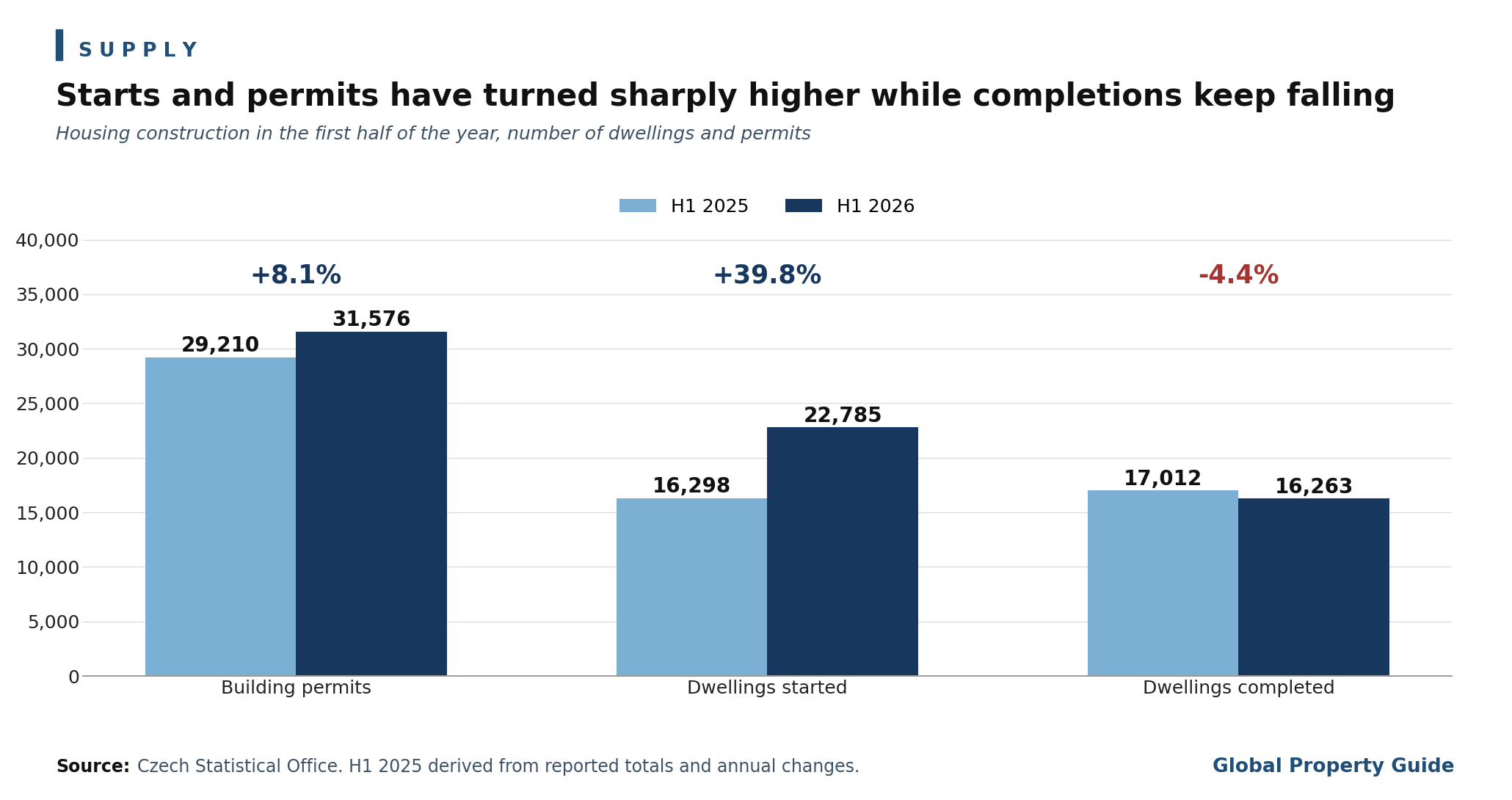
Completions continue to fall. In the first half of 2026, 16,263 dwellings were completed, down 4.4% year-on-year, with declines in both quarters. New family houses fell 13.7%, while completions in multi-dwelling buildings rose. In June alone, 4,013 dwellings were started against 2,699 completed, a 52.9% rise and a 17.8% fall respectively.
The gap is the point. Starts exceeded completions by 6,522 units in the first half, a ratio of 1.40 to 1, which means the pipeline is finally refilling even as the delivery of finished homes keeps shrinking. Petra Curinova, Head of the Construction Statistics Unit of the CZSO, attributes the April surge to family houses combined with permits being granted for a larger number of big housing complexes, mainly in Prague. In June, she observed that family house starts reached their highest level in four years, while the increase in multi-dwelling starts partly reflected a weak comparison base.
Delivery still lags where demand is highest
Regional detail shows the pipeline concentrating in the right places. The South Moravian Region led starts in the first half with 4,312 dwellings, mostly in multi-dwelling buildings. Prague was second, only 75 dwellings behind, again dominated by apartment buildings. The Central Bohemian Region ranked third with 3,601 dwellings started, almost half of them family houses.
Completions tell the opposite story. Prague completed 3,542 dwellings in the first half, the highest of any region, and 84% of them in multi-dwelling buildings, but the capital is working through projects permitted years ago. Across 2025 as a whole, Prague started 7,380 dwellings, down 9.9%, and completed 5,303, down 18.3%, the steepest regional fall in the country. In the first quarter of 2026, Prague starts fell 49.4%, the largest decline of any region, and permits fell 20.6%, making the capital the only region to record a permit decline that quarter.
Construction output rose 4.2% in the first half of 2026, entirely on the strength of building construction, which gained 6.4% while civil engineering output slipped 0.4%. Construction enterprises with fifty or more employees concluded 32,399 orders worth CZK 222.7 billion (USD 10.6 billion) at current prices, with the value of new building construction orders up 13.9%.
Rental Market: Rents and Rental Yields
The tenant pool keeps growing
Within the last decade, the share of renters in the Czech Republic increased from 21.1% in 2014 to 25.3% in 2024, according to Eurostat, and the direction of travel has not changed. With a 70 square metre apartment at the national average price costing CZK 5.07 million (USD 241,367), equivalent to about 8.1 gross annual average wages, and the same apartment in Prague costing CZK 9.21 million (USD 438,400) or roughly 14.7 annual wages, ownership is receding for a widening group of households.
Rent inflation is running well ahead of the price level
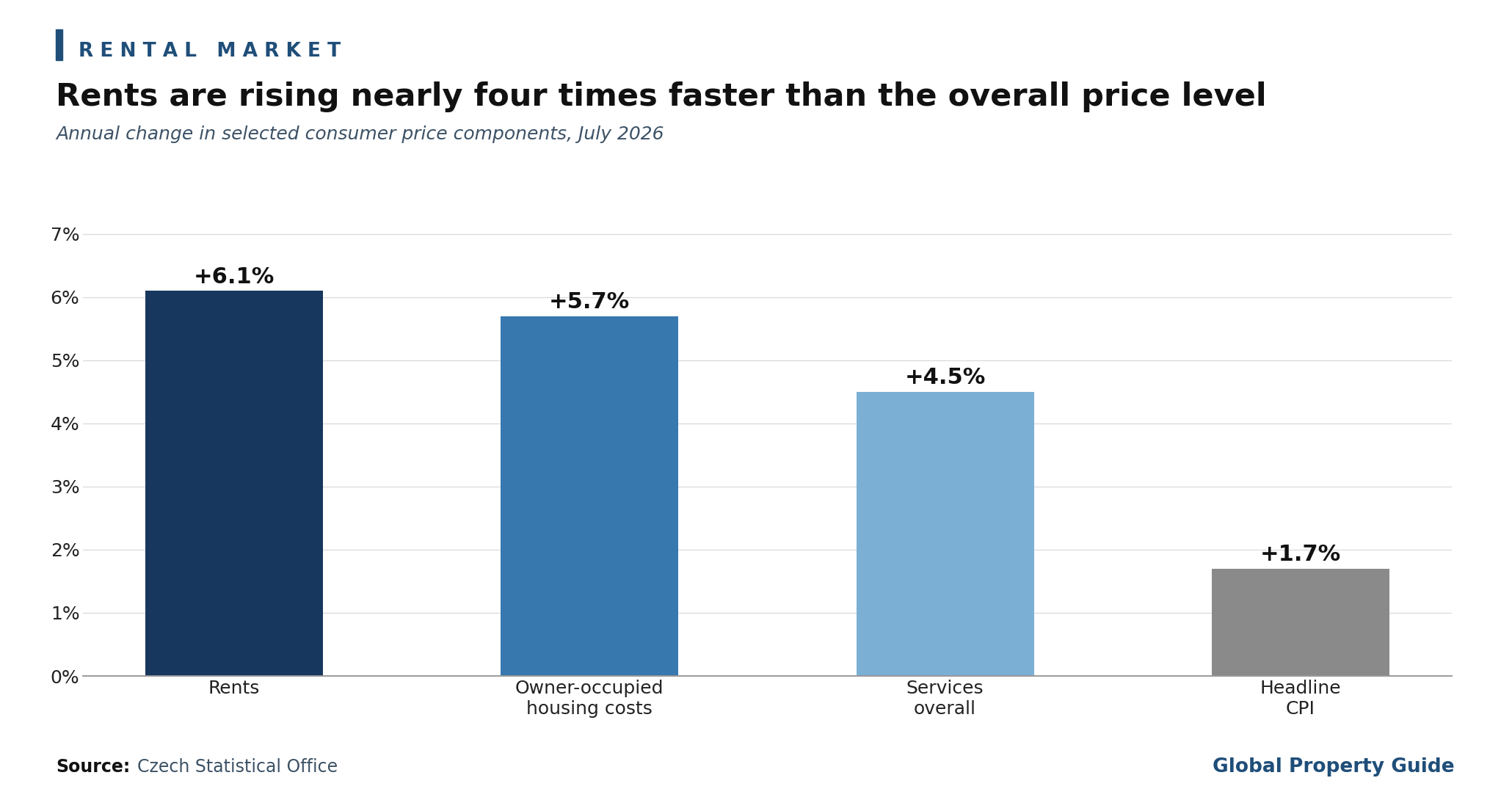
Rental inflation remains the most persistent component of Czech consumer prices. The CZSO reported that actual rentals for housing rose 6.1% year-on-year in July 2026, while owner-occupied housing costs measured as imputed rent rose 5.7%, largely because of higher new property prices and construction work prices. Services prices overall rose 4.5%. Headline consumer price inflation was just 1.7%.
Czech Republic's rent price index:
A rent inflation premium of 4.4 percentage points over the headline rate is the clearest single measure of how far housing costs have detached from the rest of the Czech cost of living.
Supply outside Prague has improved sharply
The nominal rent series has nonetheless flattened. The Q4 2025 edition of Deloitte's Rent Index put the average rent for advertised apartments at CZK 332 (USD 15.81) per square metre nationwide, a fall of 1.2% on the quarter, and CZK 459 (USD 21.86) in Prague, up 0.7%. Karlovy Vary recorded the fastest quarterly growth at 4.9% to CZK 256 (USD 12.19), while Jihlava and Olomouc both fell 2.7%, to CZK 256 and CZK 293 (USD 13.95) respectively.
The reason is a genuine supply response in the regions. Flat Zone reports that long-term rental supply outside Prague rose to more than 18,500 apartments during 2025, an increase of nearly 7,000 units year-on-year. Prague moved the other way, with supply slipping to just over 5,000 units, roughly 500 fewer than in 2024. Rents rose 4% to 6% nationally, reached as much as 10% in the Moravian-Silesian Region, and ranged from 4% to 12% within Prague depending on location and the share of new-build apartments offered to let.
Yields remain thin and are falling again
Rental profitability continues to be squeezed between high purchase prices and financing costs that have started rising again. Research conducted by Global Property Guide in Q2 2026 found gross rental yields for Czech residential units averaging 3.39%, down from 3.44% in Q4 2025 though still above the 3.28% recorded in Q2 2025.
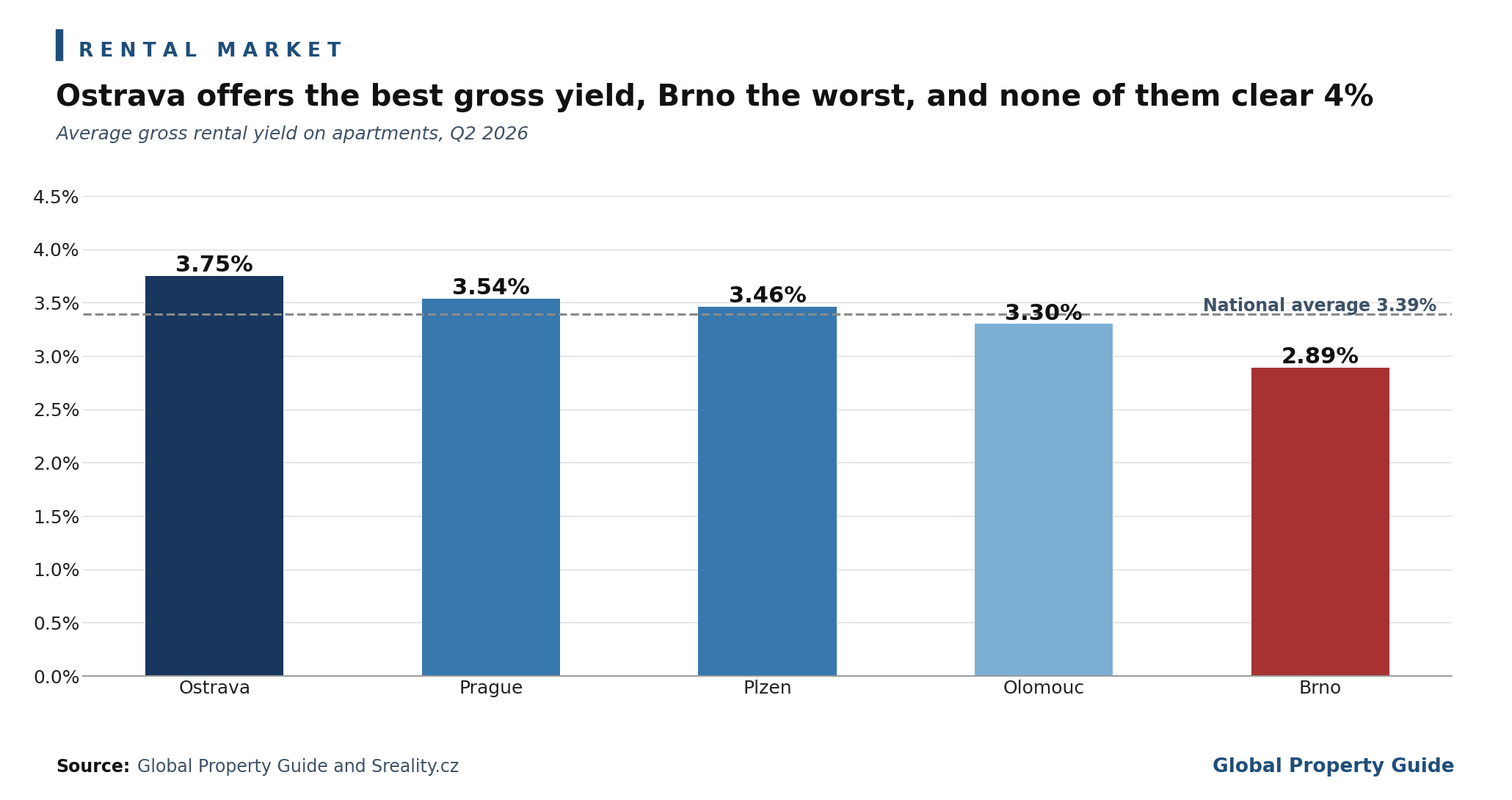
Ostrava offered the highest average yield at 3.75%, followed by Prague at 3.54%, Plzeň at 3.46% and Olomouc at 3.30%. Brno was the weakest of the five cities surveyed at 2.89%, the consequence of purchase prices approaching Prague levels without matching rents. Within Prague, the spread by district and unit size is wide, from 2.30% for a two-bedroom apartment in Prague 1 to 3.97% for a studio in Prague 3. Net yields are typically 1.5 to 2.0 percentage points below gross.
Mortgage Market and Interest Rates
Policy has reversed direction
The easing cycle that framed the previous edition of this report has ended and turned. After holding the two-week repo rate at 3.50% from May 2025, the CNB Bank Board raised it by 0.25 percentage points to 3.75% on 18 June 2026, with the discount rate rising to 2.75% and the Lombard rate to 4.75% with effect from 19 June. It was the first increase since June 2022. At its meeting on 6 August, the Board kept all three rates unchanged.
Czech Republic's mortgage loan interest rates:
The vote was six to one. Persistently high core inflation was the primary reason, along with robust credit growth, and an overheating housing market was identified as one of the sources of elevated core inflation, alongside strong growth in services prices. The Bank Board assessed the balance of risks as pro-inflationary overall, citing labour market tightness and solid wage growth.
The CNB's Summer 2026 forecast has inflation close to 3% in late 2026 and early 2027 before returning near target during 2027. The CBA expects a further increase to 4.00% at the September meeting. The Board also raised the countercyclical capital buffer by 0.25 percentage points to 1.5% with effect from July 2027.
Mortgage rates bottomed in March
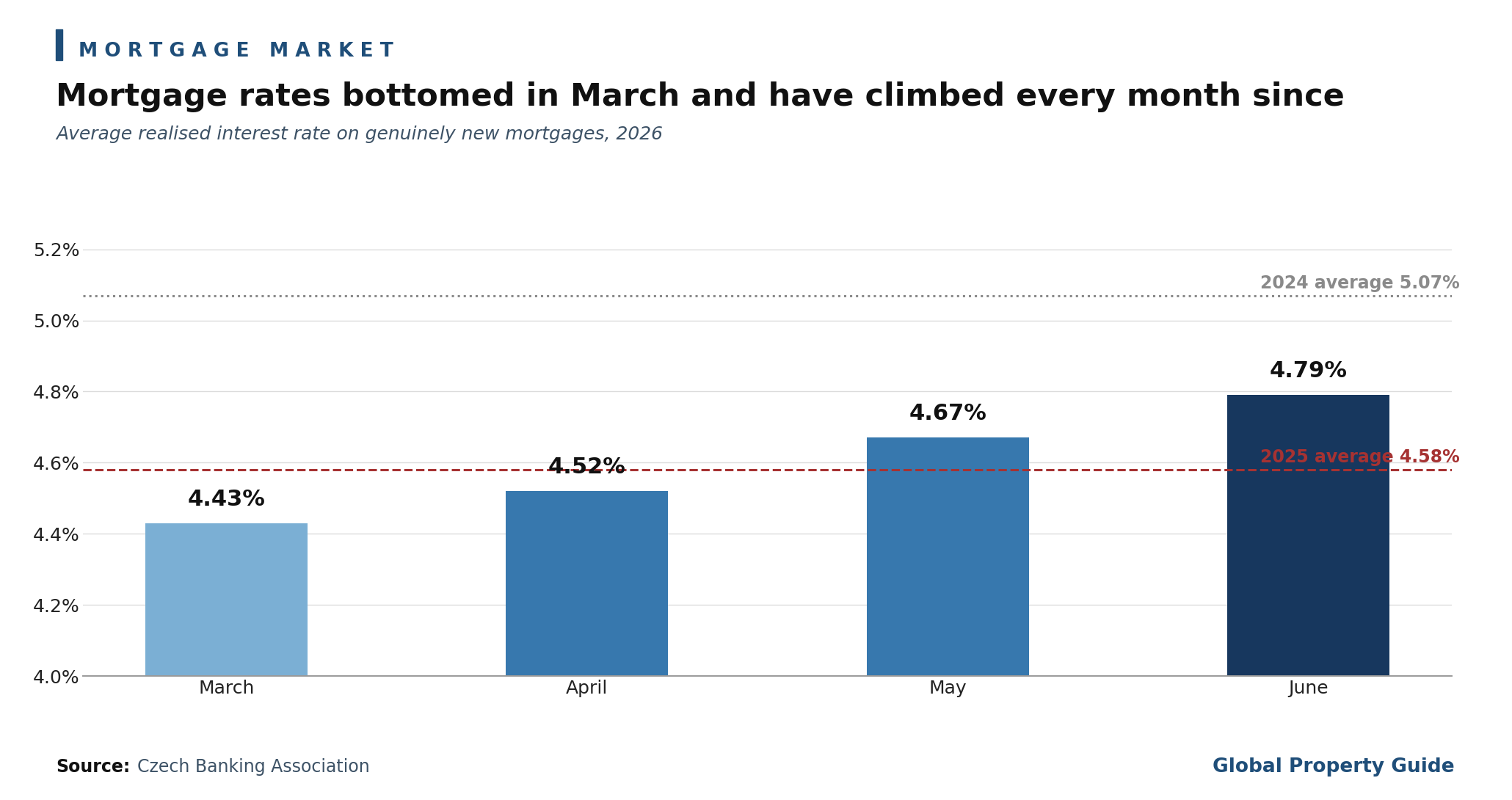
Client rates followed the market with a lag and have now clearly turned. The average realised interest rate on genuinely new mortgages reached 4.79% in June 2026, up from 4.67% in May, 4.52% in April and 4.43% in March. That is 0.23 percentage points above the 4.56% recorded a year earlier and 0.21 percentage points above the 2025 average of 4.58%, which in turn was half a percentage point below the 2024 average of 5.07%.
Offer rates have moved further. The Swiss Life Hypoindex, which tracks average advertised rates on loans up to 80% of property value, reached 5.32% in July 2026 after starting the year below 5%. Three-year fixes were the cheapest at an average 5.02%, one-year fixes 5.11% and five-year fixes 5.28%.
The CNB's own interest rate statistics show the average rate on new mortgage loans at 4.65% in June 2026, up 0.05 percentage points year-on-year, and on housing loans more broadly at 4.73%. On the outstanding stock, the rate on mortgage loans rose to 3.90% and on housing loans to 4.02%, against 3.53% and comparable levels reported in May 2025. That upward drift on the back book is the refixing wave working through, and it will continue regardless of what the policy rate does next.
Interest rates on loans to households for house purchase:
| Category | June 2026 | Year-on-Year |
| New mortgage loans (CNB) | 4.65% | up |
| New housing loans, all types (CNB) | 4.73% | up |
| New building savings loans (CNB) | 5.82% | up |
| Outstanding mortgage loans (CNB) | 3.90% | up |
| Outstanding housing loans (CNB) | 4.02% | up |
| Average realised new mortgage rate (CBA) | 4.79% | up |
| Data Sources: CNB, CBA. | ||
2025 was the second strongest year on record
Lending volumes have been extraordinary. Over the whole of 2025, banks and building societies provided CZK 321 billion (USD 15.3 billion) in genuinely new mortgage loans, CZK 93 billion more than in 2024 and an increase of 41%. Adding refinancing of CZK 85 billion, the whole market grew to CZK 406 billion (USD 19.3 billion) from CZK 275 billion. The number of new mortgages rose by almost a quarter to more than 76,110, and the average loan size rose almost 15% to CZK 4.21 million. Mortgage activity climbed from 2.6% of GDP in 2024 to 3.8% in 2025.
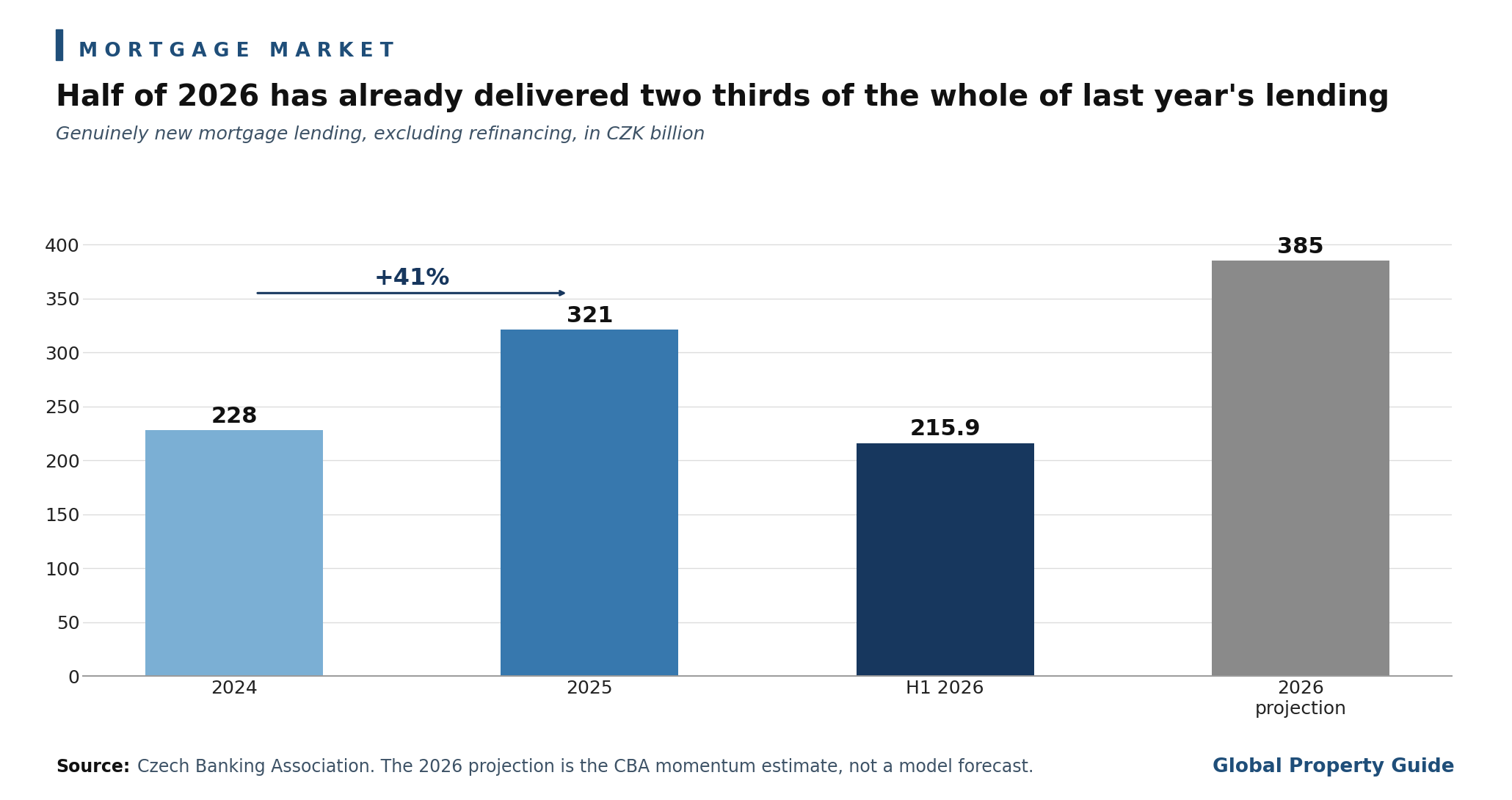
The first half of 2026 has been stronger still. New lending excluding refinancing reached CZK 215.9 billion (USD 10.28 billion) across 45,520 loans, CZK 66 billion more than the same period last year and a rise of 24% in loan numbers. Including refinancing, the market reached CZK 294.1 billion (USD 14.00 billion), up 59% on the first half of 2025. Refinancing alone accounted for CZK 78.2 billion, and its 25.4% share of June lending sat well above the 21% average for 2025, reflecting long fixes from the cheap-money era and short fixes from the expensive years maturing at the same time.
June brought the first clear correction. Genuinely new lending fell about 4% month-on-month to CZK 36.5 billion, against a typical June increase of 7%, and on seasonally adjusted terms the decline was 17%. The average new mortgage fell almost 3% to CZK 4.68 million (USD 222,857), still 11% above a year earlier but a retreat from April's 20% annual gain. The illustrative monthly instalment on an average new loan slipped back below CZK 26,000 (USD 1,231).
Jaromir Sindel, Chief Economist of the CBA, attributed the slowdown to the central bank's stricter rules, the pass-through of higher market rates into mortgage pricing, and ever more expensive property, describing the result as "calm to the June mortgage market" after months of unusually strong activity. He characterised the month as a correction rather than the onset of a weaker phase.
On current momentum, the CBA expects roughly 82,000 new mortgages for the full year, nearly 8% more than in 2025 but still far below the 114,000 of 2021, with total volumes near CZK 385 billion (USD 18.3 billion).
The refixing wave is the standing risk
The CNB estimates that mortgage fixes worth an average of CZK 534 billion a year will mature between 2026 and 2028. The CBA calculates that the negative interest rate shock on fixes expiring from the low-rate period will reach approximately 3.5% of the average family income of mortgage applicants this year, roughly half that across all households, and should moderate to a range of 0.1 to 0.6 percentage points in 2027 and 2028 from 1.1 to 1.4 points this year. In both cases, expected real wage growth should cover it.
Households refinancing in June 2026 did so at 4.63%, twelve basis points above a year earlier but nearly two tenths of a point below the rate on genuinely new loans. Against the 2.33% average on new mortgages in 2021, refinancing at current rates raises the monthly instalment on an average loan by more than CZK 3,100, about 6.1% of the current gross average wage, though that wage has risen 33% since the end of 2021.
Martin Vasek, Chief Executive and Chairman of the Board of CSOB Hypotecni banka and CSOB Stavebni sporitelna, told the CBA that interest in home ownership remains enormous and the housing finance market remains strong, that property prices are at historic highs though the pace of increase has moderated in recent months, and that mortgage rates continue to be significantly influenced by the geopolitical situation in the Middle East. He added that his group is developing support and financing for cooperative housing as one route to improving affordability.
Historic Perspective
From accession boom to financial crisis
Following the country's EU accession in 2004, the Czech housing market saw substantial growth, driven by economic integration and increasing foreign interest. Restrictions on property purchases by non-Czech EU citizens initially limited foreign demand, which only fully materialised after those restrictions were lifted in 2009.
The years 2006 to 2008 marked peak housing construction, with over 43,700 new dwellings started annually. The 2008 global financial crisis ended that boom. By the end of 2009, nominal house prices had dropped by 6.76% year-on-year, with an inflation-adjusted decline of 7.20%, and new dwelling starts bottomed out at 22,108 units in 2013.
Expansion, overheating and correction
The recovery was gradual, supported by low interest rates and government initiatives such as the State Housing Development Fund. By 2014 real house prices had started rising again, and from 2015 the market entered a phase of significant expansion. By the end of 2021 house prices had surged by more than 25% year-on-year, and nearly 45,000 new dwellings were started that year.
The CNB, which had begun tightening from 2017 to cool the market, raised interest rates sharply again from 2021 as inflationary pressures built. By the end of 2022, nominal prices still rose 6.93% year-on-year, but inflation-adjusted prices fell 7.58%. The decline continued through 2023 in both nominal and real terms.
The current expansion has erased the correction
The 2024 recovery has since become a full expansion. End-of-year prices rose 8.43% in 2024 and 10.38% in 2025, the latter equivalent to 8.11% after inflation. The index has now spent nine consecutive quarters rising, and the cumulative gain of 22.7% from the Q2 2023 trough has more than reversed the entire 2022 to 2023 correction.
20-year annual house price change, based on end-of-year CZSO house price index:
| Year | Nominal House Prices | Inflation-Adjusted House Prices | Year | Nominal House Prices | Inflation-Adjusted House Prices | |
| 2006 | n/a | n/a | 2016 | 10.91% | 9.31% | |
| 2007 | n/a | n/a | 2017 | 8.42% | 5.67% | |
| 2008 | n/a | n/a | 2018 | 9.89% | 7.65% | |
| 2009 | -6.76% | -7.20% | 2019 | 8.93% | 5.74% | |
| 2010 | 0.00% | -2.01% | 2020 | 8.95% | 6.16% | |
| 2011 | -0.84% | -3.13% | 2021 | 25.77% | 18.50% | |
| 2012 | -0.74% | -3.51% | 2022 | 6.93% | -7.58% | |
| 2013 | 0.11% | -1.04% | 2023 | -1.03% | -7.98% | |
| 2014 | 3.73% | 3.28% | 2024 | 8.43% | 5.44% | |
| 2015 | 4.52% | 4.42% | 2025 | 10.38% | 8.11% | |
| Note: The 2025 real figure is deflated by December-on-December consumer price inflation of 2.1%. | ||||||
| Data Source: CZSO. | ||||||
An ageing stock limits the supply response
The composition of the housing stock explains much of the current constraint. The Czech Republic holds nearly 2 million privately owned apartments and 2.1 million family houses. More than 1 million of those apartments sit in approximately 70,000 pre-fabricated buildings, primarily in larger cities. Post-1990s development projects account for only about 305,000 units in 18,000 buildings, with nearly 80% located in Prague and the regional capitals. New supply is therefore a small fraction of a stock that is mostly several decades old, which is why marginal changes in construction have outsized effects on price.
Economic and Social Factors
Growth accelerated, then eased
The Czech economy expanded by 2.6% in real terms in 2025, more than doubling the 1.1% recorded in 2024, driven mainly by household consumption and government spending, with improved fixed investment linked to housing and construction. Quarterly momentum has since slowed, with GDP growth of 0.2% in Q1 2026 according to the OECD, as domestic demand carried growth while international trade subtracted from it.
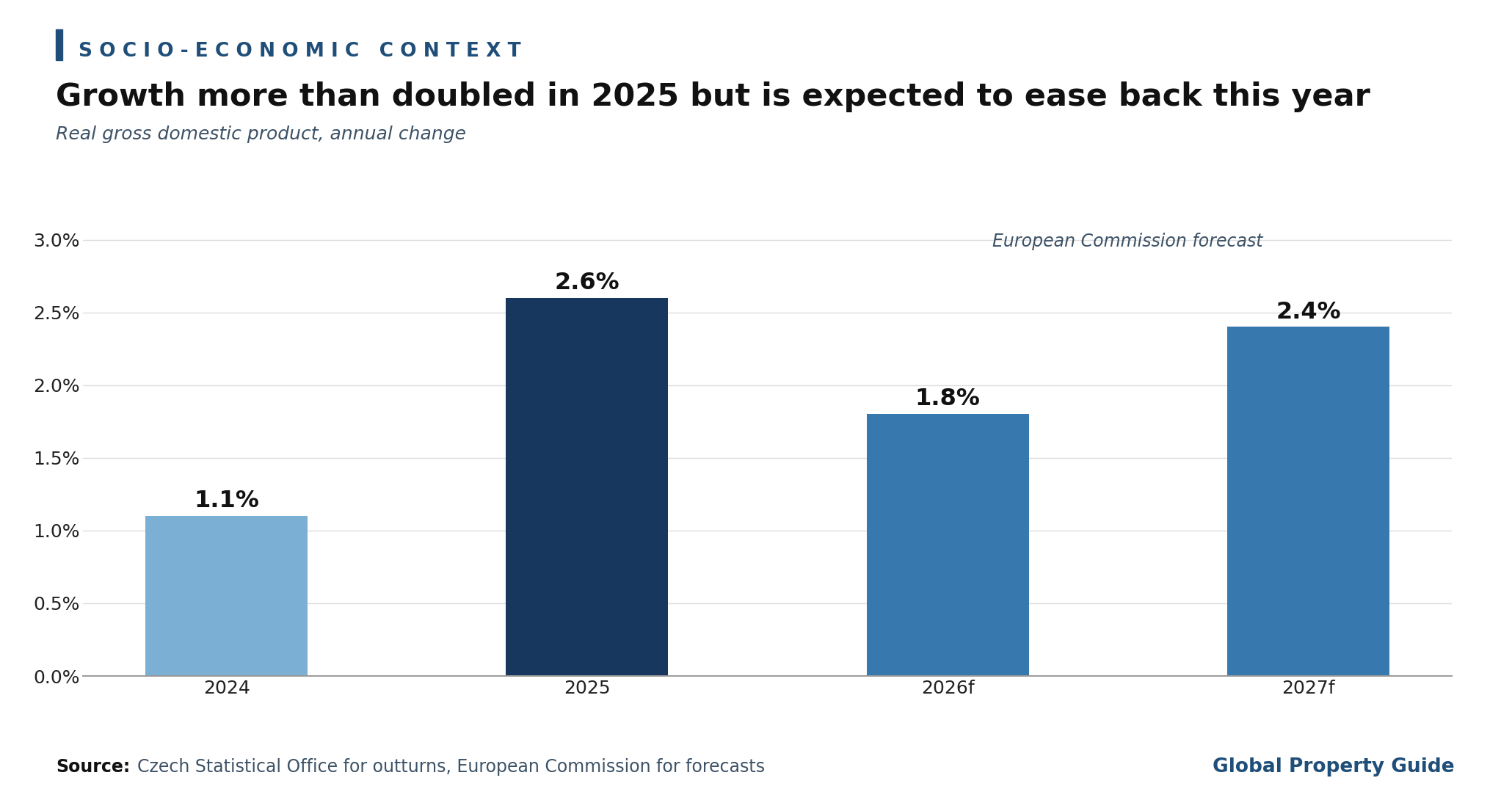
The European Commission forecasts real GDP growth of 1.8% in 2026 before a recovery to 2.4% in 2027. The CNB is more optimistic for the current year at 2.2%. The unresolved conflict affecting Persian Gulf energy production is the dominant external risk, and the OECD has published both a time-limited and a prolonged disruption scenario in recognition of it.
Inflation is low at the headline and stubborn underneath
Consumer price inflation has fallen sharply from the record 15.1% of 2022 to 10.7% in 2023, 2.4% in 2024 and an annual average of 2.5% in 2025. In July 2026, the CZSO recorded an annual rate of 1.7%, up 0.2 percentage points on June, with the twelve-month average at 2.0%.
The composition is the problem. Goods prices fell 0.4% year-on-year in June while services rose 4.5%. Core inflation has held near 2.9%. Fuel prices, down for two months, returned to growth in July and stood almost 17% above a year earlier. Electricity prices fell 11.4% and natural gas 5.0%, flattering the headline in ways that will not repeat.
The labour market remains the tightest constraint
Unemployment averaged 2.78% in 2025 and remains among the lowest in Europe, with the OECD recording a labour force survey rate of 3.1% in March 2026. Nominal wages grew 8.1% year-on-year in Q1 2026, the fastest in three years, and the average gross monthly wage reached CZK 52,283 (USD 2,490) in Q4 2025.
Wage growth well ahead of productivity is precisely what the CNB is leaning against. The CBA characterises the gap between low headline inflation and persistent domestic inflationary pressure as a non-trivial economic and political dilemma for the central bank.
Bank credit grew 9.2% year-on-year in June 2026, driven principally by mortgages, while the non-performing loan ratio stood at 1.4%. Two separate stress tests concluded that Czech banks remain resilient.
Politics has changed the housing conversation
The October 2025 general election returned Andrej Babis to office. His ANO movement won 34.5% of the vote and 80 of 200 seats in the Chamber of Deputies on the highest turnout since 1998, and he was sworn in as prime minister on 9 December 2025 at the head of a coalition with Freedom and Direct Democracy and Motorists for Themselves. Stagnant wages and an escalating housing crisis were among the factors that contributed to public dissatisfaction with the outgoing Fiala government.
Fiscal policy has loosened. The state budget recorded a CZK 290.7 billion deficit in 2025, and the 2026 budget plans a deficit of CZK 310 billion. The CNB has treated the fiscal stance as a source of upward price pressure, and the prime minister has publicly criticised the central bank over the lending impact of its June rate increase, an unusual friction between the two institutions.
Overall, the Czech housing market enters the second half of 2026 with strong nominal momentum and a policy mix that is finally pushing against it. Prices are still compounding at double digits, but mortgage rates have bottomed, buy-to-let borrowing has been curtailed, and the supply pipeline is refilling for the first time in three years. Whether that combination cools prices or merely slows them will depend on how quickly the record volume of starts converts into completed homes in the two cities where the shortage actually binds.
Sources:
- Czech National Bank (CNB)
- Bank Board Decisions: https://www.cnb.cz/
- CNB Increases Interest Rates: https://www.cnb.cz/
- CNB Keeps Interest Rates Unchanged: https://www.cnb.cz/
- Forecast, Summer 2026: https://www.cnb.cz/
- The Czech Housing Market in the Upward Phase of the Cycle: https://www.cnb.cz/
- Commentary on MFI Interest Rates: https://www.cnb.cz/
- Monetary and Financial Statistics: https://www.cnb.cz/
- Stricter Limits Recommended for Investment Mortgages (CZ): https://www.cnb.cz/
- Central Bank Exchange Rate Fixing, Monthly Averages: https://www.cnb.cz/
- Czech Statistical Office (CZSO)
- House Price Index, Owner-Occupied Housing Price Index, Q1 2026: https://csu.gov.cz/
- Prices of Real Estate: https://csu.gov.cz/
- Construction, June 2026: https://csu.gov.cz/
- Construction, April 2026: https://csu.gov.cz/
- Residential and Non-residential Construction and Building Permits: https://csu.gov.cz/
- Prague Housing Construction in 2025 (CZ): https://csu.gov.cz/
- Prague Housing Construction, Q1 2026 (CZ): https://csu.gov.cz/
- Consumer Price Indices, Inflation, July 2026 (CZ): https://csu.gov.cz/
- Consumer Price Indices, Inflation, June 2026 (CZ): https://csu.gov.cz/
- Consumer Price Indices, Inflation, December 2025 (CZ): https://csu.gov.cz/
- Inflation, Consumer Prices: https://csu.gov.cz/
- Employment and Unemployment (LFS): https://csu.gov.cz/
- Annual National Accounts: https://csu.gov.cz/
- Czech Banking Association (CBA)
- CBA Hypomonitor: Higher Rates and Regulation Slowed Mortgages (CZ): https://www.cbamonitor.cz/
- CNB Tightens Conditions for Investment Mortgages (CZ): https://www.cbamonitor.cz/
- Realised Apartment Prices Are Rising More Slowly (CZ): https://www.cbamonitor.cz/
- Strong Growth in Apartment Asking Prices in Early 2026 (CZ): https://www.cbamonitor.cz/
- The Wave of Mortgage Refixing Is Strengthening (CZ): https://www.cbamonitor.cz/
- Property Prices (CZ): https://www.cbamonitor.cz/
- CBA Hypomonitor Statistics (CZ): https://www.cbamonitor.cz/
- EUROCONSTRUCT and Flat Zone
- Czech Residential Market 2025: Strong Recovery, Structural Imbalance Remains: https://www.euroconstruct.org/
- Deloitte CZ
- Deloitte Develop Index: https://www.deloitte.com/
- Deloitte Rent Index: https://www.deloitte.com/
- Deloitte Real Index: https://www.deloitte.com/
- European Commission and Eurostat
- Economic Forecast for Czechia: https://economy-finance.ec.europa.eu/
- Distribution of Population by Tenure Status, EU-SILC Survey: https://ec.europa.eu/
- OECD
- Czechia, OECD Economic Outlook, Volume 2026 Issue 1: https://www.oecd.org/
- Global Property Guide
- Gross Rental Yields, Czech Republic: https://www.globalpropertyguide.com/
- Czech Republic Home Price Trends: https://www.globalpropertyguide.com/
- ING
- Czech National Bank Hikes Rates to Keep Inflation in Check: https://think.ing.com/
- Euronews
- Czech Republic Coverage: https://www.euronews.com/