Hard crash for Latvia’s housing market
Latvia is suffering one of the worst house price crashes, of all the bubbles bursting in Europe and the rest of the world.
Latvia’s house prices started falling in early 2007. The average price of standard apartments in Riga fell 35% during the year to December 2008, according to Arco Real Estate, a leading Baltic real estate developer. By December, the average price of standard apartments had fallen to €934 per sq. m., about the same level as in December 2005, and 45% down from the peak of April 2007.
Prices of standard apartments in Riga fell 2.85% in 2007, after a 62% rise in 2006, and a 35% rise in 2005.
The bubble burst was initially caused by the government’s effort to tame inflation and discourage property speculation. Then the global financial meltdown hit Latvia’s economy, leading to a house price freefall in 2008.
The recession began in the last quarter of 2007, and Latvia’s economy shrank by 0.9% in 2008. GDP is expected to fall by as much as 5% in 2009, and again by 3% in 2010 - a dramatic reversal from Latvia’s average annual GDP growth of 11% between 2005 and 2007, and 7.5% from 2000 to 2004.
With the banking and financial sectors in near-collapse, housing oversupply continues to rise. The economic crisis has now spilt over into the political arena. Protests are rocking the capital, and the unrest may worsen Latvia’s house price crash.
The cure that killed the patient
In January 2007, one out of every three Latvian borrowers were already encountering difficulties making their monthly mortgage repayments. The situation then dramatically worsened as global inflation impacted Latvia, and as the government brought in measures to reduce housing speculation.
In 2007 the government brought in:
- a reduction in credit availability. Buyers were required to fund at least 10% of the amount loaned;
- an increase in Land Registry and mortgage registration fees;
- buyers were required to secure certification of their legal income from the State Revenue Center; and
- additional taxes on speculative real estate transactions.
Combined with rapidly rising interest rates and tightening credit conditions, these measures choked the housing market. The government also reduced spending, while banks applied stricter lending criteria. The number of real estate transactions fell by 65% in 2008, to its lowest level in seven years.
|
More Global Property Guide pages: |
Falling property prices led to substantial losses for banks and other financial institutions. In December 2008 the government nationalized Latvia’s largest domestically-owned bank, Parex.
New developments have practically disappeared. Yet oversupply continues to mount. It remains cheaper to construct a new house than to buy an existing one, due to the recent drop in construction prices.
Anatomy of a housing crash
Latvia’s house price boom was one of the strongest in Europe, with prices doubling, tripling or even quadrupling from 2004 to 2007.
The national average price of dwellings in Latvia rose 311% from LVL148 (€210) per sq. m. in 2004 to LVL862 (€529) per sq. m. in 2006, according to data from the Central Statistical Bureau (CSB). In Riga, the capital, average prices rose 267% from LVL229 to LVL841 per sq. m. (from €325 to €1,193) over the same period.
The house price boom was not limited to major urban centres. All regions registered remarkable price increases. The average property price rose by around 300% from 2004 to 2007 in the regions of Vidzeme and Kurzeme and Zemgale. The average dwelling price rose least in the Latgale region south-eastern Latvia, up 211% over the same period.
Strong demand and lack of new supply were major causes of these phenomenal house price gains.
Until recently, Latvia was one of the fastest growing countries in Europe. After a successful transition to a market based economy, Latvia’s average annual GDP growth from 1996 to 2000 was 5.7%, rising to 8.2% between 2001 and 2005. In 2006 the economy expanded by 11.9%, followed by a 10.2% GDP rise in 2007.
Real GDP per capita has more than doubled since independence, to around US$11,985 in 2007. Unemployment has fallen to 6% in 2007, down from 12% in 2002. Owner occupancy has risen dramatically, from 21% in 1990, to 87% in 2006.
Property speculation played a significant role. Some surveys showed that speculators bought around 15% to 30% of all properties during the house price boom.
Stupendous mortgage market growth
The rapid expansion of Latvia’s mortgage market was a key factor in the boom. Relatively low interest rates encouraged households to borrow. The entry of foreign banks and financial market developments also helped. The pace of growth was amazing - housing loans outstanding expanded by almost 90% annually from 2004 to 2006.
Despite early signs of trouble in 2007, the mortgage market nevertheless grew 44% during that year. Total mortgage debt rose from 2% of GDP in 2000, to 33.75% of GDP in 2007; or from LVL98.8 million to LVL 4.7 billion (from €141 million to €6.7 billion).
Pressures on Latvia’s currency peg
Although Latvia joined the European Union on 1 May 2004, it has not yet met the ERM II requirements for euro adoption. Instead, the Latvian lat has been pegged to the euro at €1 = LVL0.702804 (with a margin of +/- 1%) since January 2005.
The currency peg pressures Latvia to shadow key European Central Bank (ECB) rates, and during the boom Latvian interest rates fell in line with eurozone rates. For instance, Latvian floating rate mortgage rates dropped from more than 8% during the first half of 2004, to around 5% in late-2005 (from 1999 to 2002, Latvian banks’ mortgage rates had typically ranged from 8% to 12%).
However the difference between a euro peg, and euro adoption, becomes painfully obvious when a run on the lat is feared. When the ECB raised its key rates in 2006 and 2007, Latvian mortgage rates rose disproportionately as pressure on the peg rose. Latvian floating rate mortgages soared to more than 10% in mid-2007 and peaked at 14.7% in November 2007. During this period, the ECB key rate was 4%. The impact of Latvia’s much higher rates has been punishing, because Latvian mortgage loans are almost all variable rate (with either floating interest rates, or rates fixed for less than five years).
Latvian floating rate mortgage interest rates adjusted downward to 8.69% in June 2008, but rose once more to 12.77% in November 2008. The key euro rate meanwhile moved up to 4.25% in Jul 2008, but was then sharply reduced three times to 3% in December 2008.
These enormous interest rate rises have devastated the Latvian economy and housing market.
Inflationary pressures
By mid-2007, Latvia’s low interest rates combined with its high GDP growth rates had caused its economy to overheat, as did the housing market. Latvian banks were lending money to consumers at interest rates lower than the inflation rate.
Annual inflation rose from an average of 2.5% between 1999 and 2003, to 6.5% from 2004 to 2006. In 2007, inflation was 10.1%, way beyond the EU limit of 3.2%.
With the currency peg, the Bank of Latvia lost its ability to tame inflationary pressures by raising interest rates. Hence, the fiscal and monetary authorities had to resort to other measures to bring down inflation. Access to credit was limited; taxes were raised. The government sharply reduced spending, leading to economic contraction.
Despite the recession in 2008, inflation still moved up to 15.9%, one of the highest rates in EU. Inflation will likely remain high in 2009, at more than 10%.
The lat has been under tremendous pressure to depreciate due to inflation imbalance between Latvia and the rest of Euro zone. The government would not, however, abandon the peg. With more 85% of loans in Latvia tied to the Euro, devaluation would however cause substantial financial, economic and political havoc.
Over-supply
The immense house price boom during this decade was also due to a significant mismatch between supply and demand. Before independence, more than 10,000 apartments were completed annually. After independence the number of apartment completions dropped to below 2,000 units between 1995 and 1999, and to less than 1,000 between 2000 and 2003.
It was only in 2004 that housing construction began to pick up. Dwellings completed increased significantly to 2,821 units in 2004, to 3,807 in 2005, 5,896 in 2006 and to 9,319 units in 2007. However the sudden increase in supply flooded the market, pushing prices down.
Units started in 2006 and 2007 are still being completed. The overhang continues to pile up.
Rental yields
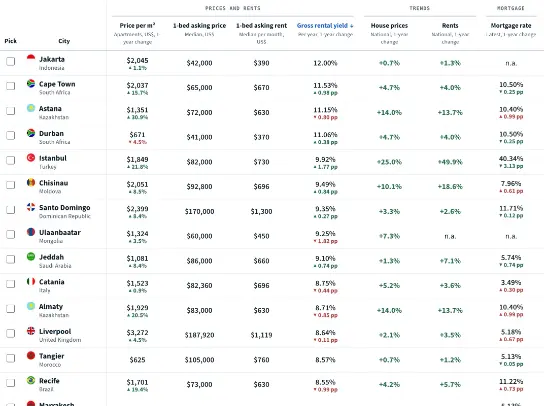
Latvia’s rental market is also suffering. In the past, rapid property appreciation pushed rental yields down. Most apartments in Riga earn yields of around 4% to 4.6%, while only the smallest units (around 40 sq. m.) earn yields of 6.5%.
Apartments within the suburbs of Riga earn slightly higher yields, ranging from 4.8% to 5.3%, according to Global Property Guide data.
The recent housing glut and the precipitous drop in house prices has forced a lot of households to rent out units they originally intended to sell. But the number of potential tenants has contracted due to the economic recession. As the situation worsens, rents are expected to drop.
A delicate balancing act
To help the Latvian government as it struggles through the crisis, a group of international lenders including the International Monetary Fund (IMF) pledged to provide €7.5 billion (US$10.5 billion) in financial aid last December 2008. With a population of only 2.3 million, the assistance is much bigger, on a per person basis, than the assistance given to other countries.
The package is expected to increase liquidity in Latvia’s financial system, restore economic stability and strengthen competitiveness. However, it requires the government to reduce the current-account deficit and inflation. The budget is to be reduced by cutting expenditures. Public sector wages will fall by 15% in 2009, a move to be followed by the private sector.
Also in December, the central banks of Denmark and Sweden also extended a €500 million credit line to Latvia to help it support the currency peg to the euro.
The government is involved in a delicate balancing act. It needs to boost the economy but inflation remains very high. It cannot increase government spending due to the limits on debt and deficit spending set by the ERM II. Financial assistance from other countries will push the current account deficit higher, making the lat more vulnerable to speculative attacks. Latvia’s current account deficit was 22.9% of GDP in 2007 before falling to 15% of GDP in 2008 - still one of the highest in Europe.
In conclusion: Latvia’s economy is in a mess. It is very difficult to imagine any recovery in the housing market for at least another couple of years. The economy would have to stabilize. Interest rates would have to fall. Rental yields would need to become attractive once again. All these requirements for recovery are at present a distant dream, and seem far off, like the happy boom years which Latvia experienced only so very recently.