Latvian house prices begin to fall
House prices have begun to fall in the Greater Riga area – a fall of 3.5% in the month of June 2007, following a fall of 1% in May 2007, according to Latio, Latvia’s leading research-oriented realtor. Prices have fallen “for the first time in history”, Latio says, which if not quite accurate, emphasizes the sense of shock.
These disappointing one-month figures are consistent with recent warning signs. But they are all the more shocking in that it came shorly after the announcement that year-on-year to Q1 2007, Latvia was Europe’s strongest performing housing market with house price rises of 61.91% during the year, according to Latio.
The number of transactions has fallen, though albeit not drastically. Buyers now tend to take a waiting position, expecting prices to fall, according to Latio. Projects with no interior decoration, or with long lead times, are not selling. Pre-sold apartments are increasingly being re-sold before occupation on the secondary market.
However, the price of building land is still rising. Rents too continue to rise.
Standard & Poor’s (S&P;) changed its outlook in February on Latvia’s long-term forex-denominated liabilities to negative, and then on 17 May lowered the rating from A- to BBB+. This brings Latvia back to the credit-worthiness rating it held in 2002.
The Lats, pegged to the Euro since January 1 2005, came under pressure in February in response to the S&P; revision, and the Bank of Latvia had to intervene. The Euribor interest rate on Euro variable rate loans jumped to 10% in June 2007, from 5% this January.
Economic Growth
Latvia’s economic growth has been the strongest in Europe, so it is unsurprising that its housing market has been doing well till now. Gross domestic product (GDP) grew by 11.2% year-on-year to the first quarter of 2007, including 10% growth in total value added. Unemployment has fallen to 6.1% Real GDP per capita has more than doubled since independence, to around US$8,400 in 2006.
Yet the consensus view is that the Latvian economy is in for a ‘hard landing’ after the rapid growth of the past few years.
Problem signs:
- The current account deficit rose to 26.3% of GDP in 4Q 2006, from 15.2% a year earlier.
- Inflation was sharply up at 8.9% in April 2007, up from 6.5% last year, and 1.9% in 2002.
- Loans to residents grew 60.4% in the year to Q4 2006 (58.2% and 61.7% in the previous two years).
- Long-term interest rates are sharply up.
Latvian banks have been lending money to consumers at an interest rate lower than the inflation rate. Inflationary pressures last spring prompted Standard & Poor’s to predict several years' delay for Latvia's inclusion into the eurozone. Another sign of inflationary pressure is arguably the economic growth of 11%, which some believe exceeds the 6-7% that is long-term economically sustainable.
Has the Bank of Latvia allowed inflation to spiral out of control? Is the whole trend of central bank policy misguided?
Well perhaps so, but the context should be understood. One of the criteria for joining the Euro is two years’ participation in the Exchange Rate Mechanism II (ERM II). Latvia joined ERM II on May 2, 2005. Therefore, the Bank of Latvia’s intermediate target has become not inflation (which remains a long term target, albeit now distant) but the external stability of the Lats to the euro at the rate 1 EUR = 0.702804 LVL. Note that Latvia has a regime of totally free capital movement and unlimited currency convertibility.
This exchange rate regime is not unlike Hong Kong’s, and is arguably appropriate for a small open economy. However, it is well-established that an economy cannot target both currency stability and inflation and allow free movement of capital (two out of three only are possible, is the rule). Central banks in open fixed exchange rate regimes necessarily lose short-term control of inflation, as in Hong Kong (and all Euro-denominated economies, taken individually). When the economy booms, inflation takes off. Local interest rates may fall temporarily fall below inflation, adding fuel to the fire. The economy will eventually equilibrate, but only by inflating itself into an ‘overpriced’ situation, which may result in a current account deficit. Thus local inflation does the job which in a closed economy might be done by currency appreciation.
That process of inflationary equilibration is what is occurring in Latvia now. It may be fair to criticize the Bank of Latvia for having been part of the political process which led to Latvia joining the ERM, or for having joined at the wrong exchange rate. But criticizing it for inflation is to misunderstand how pegs work.
In any case, the government has been intervening, in another way. From July 12, Latvians have had to provide lending institutions with a statement of income from the revenue service, if they are seeking a large mortgage. Being forced to come clean with the taxman is likely to deter many consumers from procuring loans.
Adjustments
Local players can be expected to adjust to the new realities, but with a delay, which can be expected to exaggerate the downturn. In June 2007, 19 new housing projects were announced, after 15 projects in May, April, March, and January this year (February saw a spike in apartment project launches to 26). This means that by historical standards, a very large number of new apartment projects continues to come on to the market.
Also significant, is that the number of loans for house purchases increased in the first quarter of the year. However, the number of credits granted for consumption decreased, a sign that banks are somewhat aware of the situation, and are becoming more conservative.
Property prices
The price of good quality used apartments in prime locations in Central Riga ranges from €2,900 to €3,143 per square metre, according to the Global Property Guide (survey conducted 24 Nov 2006). Houses in similar locations are slightly cheaper, ranging from €2,521 to €2,700 per square metre.
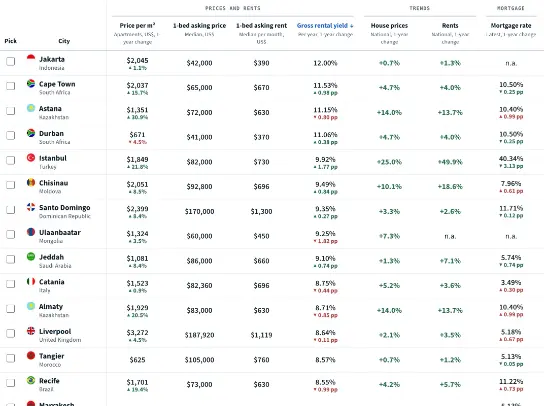
These prices are highly relative to Latvia’s GDP per capita, being at with other Scandinavian countries (see table).
In Riga, city centre average prices rose from around €1,264 per sq. m. in August 2004, to around €3,011 at end-2006 – a 138% increase in just over two years.
Meanwhile in Riga, average monthly rents have risen, but not nearly so much, from around €8.20 per sq. m. to around €12.64 per sq. m. – an increase of around 54%. Riga rental income returns (average for all sizes) have therefore fallen over the past two years, from around 7.85% to an average of 5.04% (the figures in the House Prices in Northern Europe table represent not average yields, but yields for apartments of 120 sq. m.).
These yields are not unreasonable. However in the particular situation of Latvia, such moderate yields, in the context of a continued very strong stream of new apartment offerings, and a sharp uptick in local long-term interest rates, would make us very cautious. Unless the economic cycle has disappeared from economics, it would seem to us that a cyclical peak has approached, and that for the moment investors should pause.
Foreigners can freely buy, develop and dispose of movable property (buildings) in Latvia, provided that the property was acquired separately from the land on which it stands. Direct acquisition of land by foreigners is subject to permission of the local municipality. However, foreigners may lease land for a period of up to 99 years without any restrictions.