Italy's Residential Property Market Analysis 2024
Italy's housing market is improving gradually, amidst recovering demand and stabilizing residential construction activity.
Table of Contents
- Housing Market Snapshot
- Demand Highlights
- Supply Highlights
- Rental Market
- Mortgage Market
- Historic Perspective
- Socio-Economic Context
Housing Market Snapshot
In Q3 2024, nationwide house prices rose by a modest 2.2% to an average of €1,851 (US$2,033) per square meter (sq. m), according to real estate portal Idealista. When adjusted for inflation, house prices increased by 1.5% over the same period.
Quarter-on-quarter, nationwide house prices were up by 1.6% (1.3% inflation-adjusted) in Q2 2024.
Italy's house price annual change
In Rome, Italy's capital and largest city, homes prices stood at €3,036 (US$3,334) per sq. m., on average, during the year to Q3 2024, up slightly by 0.9% from a year earlier (0.2% inflation-adjusted).
Milan, Bolzano, and Venice have the most expensive housing in the country, with average house prices currently at €4,988 (US$5,478), €4,610 (US$5,063), and €4,529 (US$4,974) per sq. m., respectively.
Nationwide, the latest figures from the National Institute of Statistics (ISTAT) showed that the overall house price index rose by 2.94% during the year to Q2 2024 (2.17% inflation-adjusted). On a quarterly basis, prices were up by 3.23% (2.97% inflation-adjusted) in Q2 2024.
By submarket:
- New house prices rose strongly by 8.08% (7.27% inflation-adjusted) y-o-y in Q2 2024. Quarter-on-quarter, they increased by 4.76% (4.5% inflation-adjusted).
- Existing house prices were up by 1.88% (1.12% inflation-adjusted) from a year earlier and by 2.94% (2.69% inflation-adjusted) from the previous quarter.
"The increase of HPI occurred in the context of a slight recovery of the sales volumes (it was +1.2% the annual rate of change registered for the residential sector in the second quarter of 2024 by the Observatory of Real Estate Market belonging to Tax Office, up from -7.2% of the previous quarter)," said ISTAT. "The increase on a quarterly basis of the HPI (+3.2%) is also attributable to both the prices of new and existing dwellings, increasing by 4.8% and 2.9% respectively."
"In the second quarter of 2024, HPI increased in all the geographical areas. The highest trend growth is recorded in the South and Islands (+3.9%) driven by the prices of new dwellings, which increased by 9.5%. This was followed by the North-East (from +1.6% to +3.7% ), the North-West (from +1.9% to +2.5%) and the Center (from +0.6% to +2.2%)," added the county's statistics agency.
Property transactions are noticeably improving. In Q4 2023, sales of real estate units and other kinds of property transactions reached 277,415, up by 3.4% from the previous quarter and by 0.5% from the same period last year, according to the latest figures released by ISTAT. Of which, transfers of residential properties accounted for about 93.3% share.
While residential demand remains weak as compared to its long-term historical average, "the number of house sales went up both quarter on quarter and year on year, while the average discount on asking prices and the time on the market held close to their lowest levels since the survey began," according to the Banca D'Italia's Q2 2024 Italian Housing Market Survey of 1,564 real estate agents.
There are also indications that the residential construction sector is now stabilizing. In the first quarter of 2024, authorized new residential buildings rose slightly by 1.1% to 14,393 units as compared to the same period last year, following an annual decline of 7.7% in 2023, according to ISTAT figures. Likewise, the floor area of new residential building permits increased slightly by 0.6% y-o-y to 1.22 million sq. m in Q1 2024.
However, the overall economy remains weak. During 2023, the eurozone's third-largest economy grew by a paltry 0.9%, a sharp slowdown from annual expansions of 4% in 2022 and 8.3% in 2021.
Italy's economic performance is expected to remain weak in the medium term, with a projected real GDP growth rate of 1% this year and 1.1% in 2025. "In 2024, the GDP growth rate will be supported by the contribution of both domestic demand net of inventories and net foreign demand (+0.7 percentage points each), with a still negative contribution from inventories (-0.4 p.p.). In 2025, the growth of the Italian economy will be predominantly driven by domestic demand (+0.9 p.p.)," according to Italy's Economic Outlook 2024-2025 report released by ISTAT.
Local house price variations
Milan, Italy's second most populous city, has recently overtaken Venice as the most expensive city in the country, with an average house price of €4,988 (US$5,478) per sq. m. in Q3 2024, up slightly by 0.4% from a year earlier, according to national listing portal Idealista.
In Venice, known as the "City of Canals" and one of Italy's most picturesque cities, the average house price rose by a modest 2.5% y-o-y to €4,529 (US$4,974) per sq. m over the same period.
In Rome, Italy's capital and largest city, home prices stood at €3,036 (US$3,334) per sq. m, on average, up slightly by 0.9% from a year earlier.

In other major Italian cities:
- Bolzano, a gateway to the Dolomites mountain range in the Italian Alps, has one of the most expensive housing in the country, with the average price of homes reaching €4,610 (US$5,063) per sq. m in Q3 2024, up by 2.5% from a year earlier.
- In Turin, the average price of homes increased by 2.1% in Q3 2024 from a year earlier, to €1,885 (US$2,070) per sq. m.
- In Bologna, home prices increased by 2.3% y-o-y to €3,526 (US$3,872) per sq. m over the same period.
- In Florence, house prices rose by 1.9% y-o-y to an average of €4,157 (US$4,565) per sq. m.
- In Naples, Italy's third biggest city, home prices increased strongly by 8.6% y-o-y to an average of €2,830 (US$3,108) per sq. m.
- In Palermo, house prices increased by a modest 2.8% y-o-y to €1,372 (US$1,507) per sq. m.
- In Genoa, the average price of homes rose slightly by 1.3% y-o-y to €1,411 (US$1,550) per sq. m.
- In Catania, house prices fell slightly by 0.1% y-o-y to €1,203 (US$1,321) per sq. m in Q3 2024.
Demand Highlights
Home sales improving again; demand shifting to the South, and larger homes
Real estate activity shows some improvements. In Q4 2023 (the latest figures available in ISTAT), sales of real estate units and other kinds of property transactions reached 277,415, up by 3.4% from the previous quarter and by 0.5% from the same period last year. Of which, transfers of residential properties accounted for about 93.3% share.
All regions saw an increase in real estate sales during the period - Centre (+5.9%), Islands (+4.7%), South (+4%), Northwest (+2.9%), and Northeast (+2.6%).
Demand started to slow in the second half of 2022, amidst surging inflation and global economic slowdown. It began to recover only by the second half of 2023.
Southern Italy continues to experience robust demand, mainly due to the rise of "smart working" and work-from-home setups, according to Idealista. Moreover, a recent report published by Gabetti, Professionecasa, and Grimaldi noted that demand is growing for the following types of properties:
- Multifunctional homes, with larger dimensions and modular spaces adapted for remote working;
- Properties with outdoor spaces, gardens, or terraces;
- Condo units with services, such as gym, garage, and multifunctional rooms, and;
- Bigger-sized second homes.

New tax measures to buoy southern Italian homes market
A recent measure extended the benefit period for the 7% flat tax for pensioners who decide to retire to southern Italy from five years to nine years. The law, which has been effective since January 2019, requires the pensioner to transfer his tax residence to an Italian municipality with no more than 20,000 inhabitants located in one of the following regions: Sicily, Calabria, Sardinia, Campania, Basilicata, Abruzzo, Molise, or Puglia.
The new rule applies a substitute tax of 7% on pensions and all other foreign incomes. Other benefits include an exemption from payment of tax on the value of real estate located abroad (IVIE) and the tax on the value of financial assets held abroad (IVAFE).
Earlier, other tax measures were launched by the government:
- Abolition in 2016 of the Tassa sui Servizi Indivisibili (TASI) and Imposta Municipale Propria (IMU), which are taxes on principal homes (except luxury homes and castles).
- 25% discount on the IMU tax for houses being lent on an "agreed rental" (canone concordato) contract for a minimum of 3 years plus two years of automatic renewal which complies with the local authorities' minimum and maximum rents.
- A flat rate of 4 per thousand and a €200-worth standard deduction on IMU tax for luxury homes and castles.
- Differentiation between mountain land and land on the flat, with the first getting IMU exemption.
Italian towns selling homes for €1 continue to increase
Since early 2016, a growing number of small, rural towns in Italy have been selling abandoned, dilapidated homes for €1 to international buyers, in an effort to repopulate the towns.
"In the last 40 years people, especially young people, left the countryside to find work in bigger cities, and those small villages like Mussomeli became abandoned all over Italy," said Italian real estate expert Stefan Neuhaus.
The Italian towns currently offering €1 home include Ollolai (Sardinia), Sambuca (Sicily), Cantiano (Le Marche), Mussomeli (Sicily), Zungoli (Campania), Gangi (Sicily), Bivona (Sicily), Cammarata (Sicily), Borgomezzavalle (Piedmont), Nulvi (Sardinia), Fabbriche di Vergemoli (Tuscany), Oyace (Aosta Valley), Troina (Sicily), Delia (Sicily), Taranto (Apulia), and Cinquefrondi (Calabria), among others.
Since 2021, more Italian towns started to offer houses for just over a dollar, including the Sicilian town of Castiglione di Sicilia, the Sardinian town of Bonnanaro, and the Bucolic town of Maenza. For instance in Castiglione di Sicilia, roughly 900 abandoned homes are currently offered for €1. Then in June 2023, the municipality of Ripacandida also joined the €1 house program.
In 2024, more municipalities have joined the program, including the UNESCO World Heritage Site Sicilian city of Caltagirone, the Sicilian municipality of Troina, and the village of Cattolica Eraclea in the province of Agrigento.
However, there is a catch. Prospective buyers must agree to repair and restore the property, which could cost a lot. In addition, buyers must comply with a number of conditions. First, buyers must provide an insurance deposit of between €1,000 and €5,000 depending on the town. Then, buyers need to submit their renovation plans to the town council, which must be completed within a set time frame, typically in three years. The specific process and requirements vary by municipality.
Also, even if there were interested buyers, some sales transactions did not materialize because owners of abandoned homes were impossible to track down as they had already migrated to other places.
Because of these obstacles, the €1 scheme has been less effective than it was initially planned.
To address this, a number of Italian towns are now introducing other ways to lure new residents. The towns of Carrega Ligure in Piedmont, Latronico in Basilicata, Biccari in Puglia, and Troina in Sicily have launched websites to showcase cheap, renovated homes. They have also opened real estate agencies to support interested homebuyers in contacting old owners who have abandoned their properties.
"We attempted in 2014 to sell stone mountain cottages for one euro, but over the past decades the owners had all migrated beyond the Alps and we couldn't get hold of them. Also, the properties were divided among too many heirs which made things way too complicated," said Carrega Ligure mayor Luca Silvestri.
"So we thought the best way was to help locals willing to offload their old homes by giving them an online platform, handled by village authorities, where they can either sell or rent the properties. Supply meets demand," Silvestri added.
There are no restrictions on foreign ownership in Italy.
'Superbonus' tax credit scrapped
In 2023, the government announced the end of the popular Superbonus 110, which was introduced in 2020 to provide homeowners with a tax credit of up to 110% on the cost of upgrading their property.
While the tax credit led to a surge in home renovations and helped to fuel the country's economy after the effects of the Covid-19 pandemic, the tax measure proved to be too costly. In April 2024, Economy Minister Giancarlo Giorgetti said that take-up of the incentives had hit €219 billion (US$240.5 billion). It also pushed up building costs and was stained by widespread fraud.
Recently, the government agreed on a limited extension of the Superbonus subsidies for low-income households who had not completed home renovations last year. However, they otherwise faced having to draw on less generous 70% tax credits this year.
Supply Highlights
Residential construction activity stabilizing
In the first quarter of 2024, authorized new residential buildings rose slightly by 1.1% to 14,393 units as compared to the same period last year, following an annual decline of 7.7% in 2023, and increases of 0.1% in 2022 and 21.9% in 2021, according to ISTAT figures.
Likewise, the floor area of new residential building permits increased by a meager 0.6% y-o-y to 1.22 million sq. m in Q1 2024.
Before the Covid-19 pandemic, residential construction activity in Italy declined to an average of 49,900 dwelling permits annually in 2013-19, from 129,000 units in 2008-12 and 265,00 units in 2004-07.

Rental Market
Good rental yields
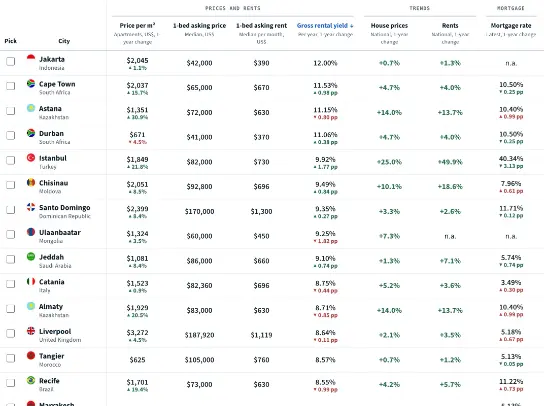
In Italy, gross rental yields - the return earned on the purchase price of a rental property, before taxation, vacancy costs, and other costs - are good, averaging 7.04% in Q3 2024, slightly down from 7.67% in Q1 2024 and 7.49% in Q3 2023, according to the recent study conducted by the Global Property Guide.
By major cities, in Q3 2024:
- In Rome, gross rental yields for apartments range from 3.72% to 8.53%, with a city average of 6.82%.
- In Milan, apartments offer lower rental yields of between 2.9% and 6.51%, with a city average of 4.6%.
- In Florence, rental yields for apartments range from 5.71% to 7.83%, with a city average of 6.75%.
- In Turin, apartment rental yields are much higher than the national average, at around 4.46% to 9.44% in Q3 2024, with a city average of 7.62%.
- In Palermo, rental yields are also high, ranging from 5.75% to 10.17%, with a city average of 7.96%.
- In Naples, apartments offer rental returns ranging from 4.36% to 11.2%, with a city average of 7.07%.
- In Catania, rental yields range from 6.09% to 10.29%, with a city average of 8.42%.
Despite good rental yields, round-trip transaction costs can be high on residential property in Italy and the country's predatory taxation system makes things worse.
Rent controls
Despite good rental yields, private renting is unattractive for Italian landlords because of rent controls and other restrictions.
The standard rental contract allows free negotiation of the initial rent but commits the landlord to a four-year contract and gives the tenant the option of extending for another four years. Rents can only be increased annually by 75% of the cost of living index; i.e. if inflation is 2%, then you can only increase your rent by 1.5%.
Because of these restrictions on rent increases, most landlords prefer to 'frontload' long rental contracts to take into account anticipated future rent increases, inflation, and capital value appreciation. Frontloading, in turn, artificially raises rents for new contracts.
Despite this, average rents have failed to keep up with inflation since the mid-1990s. While house prices rose by an average of 6.3% from 2000 to 2008, rents rose by an average of only 2.4% over the same period.
However, in recent years, the gap has been narrowing because of the sluggish housing market, with house prices falling by a cumulative 21.4% (-36.2% inflation-adjusted) from 2011 to 2023. Over the same period, rents rose by 9% (but still declined by 11.6% when adjusted for inflation).

Mortgage Market
Housing loan interest rates falling again
Interest rates for both new and outstanding housing loans in Italy are now declining again, following the European Central Bank's recent monetary policy shift amidst easing inflationary pressures.
In August 2024, the average interest rate for new housing loans in Italy stood at 3.59%, down from 4.29% in the prior year but still up from 2.07% two years ago, according to the ECB. Over the same period:
- The floating rate and an initial rate fixation (IRF) of up to 1 year: 4.68% in August 2024, slightly down from 4.81% a year earlier but still far higher than the 1.72% two years ago.
- IRF of 1-5 years: 3.06% in August 2024, down from 4.79% a year ago but still up from 2.62% two years prior.
- IRF of 5-10 years: 3.87%, down from 4.28% in August 2023 but still up from 2.53% in August 2022.
- IRF of over 10 years: 3.41%, down from 4.07% in the previous year but still higher than the 2.39% two years ago.

On the other hand, the average interest rate for outstanding housing loans was 3.05% in August 2024, at par with the 3.04% in August 2023 but still far higher than the 1.74% in August 2022.
For outstanding housing loans:
- Original maturity up to 1 year: 5.9% in August 2024, almost unchanged from 5.91% a year earlier but up from 3.34% two years ago.
- Original maturity of 1-5 years: 4.59%, slightly down from 4.96% in the previous year but far higher than the 2.45% two years ago.
- Original maturity of over 5 years: 3.05%, slightly up from 3.03% a year ago and far higher than the 1.73% two years earlier.

Italy's mortgage market slowing
Italy's mortgage market continues to slow, despite falling interest rates. In August 2024, the total value of outstanding housing loans amounted to €422.74 billion (US$464.25 billion), slightly down by 0.5% from the same period last year, based on ECB figures.
Housing loans started to decline last year, registering an annual fall of 0.5%, in contrast with the annual average growth of 1.4% from 2012 to 2022.
Italy's mortgage market is relatively small, with outstanding mortgages equivalent to less than 21% of GDP in 2023, less than half of EU 28's average of about 47% of GDP.

This is largely attributable to the length and cost of the loan recovery process, which makes Italian banks very cautious.
From the time a borrower defaults, legal proceedings usually take from five to seven years. Italian house buyers are also reluctant to use mortgage facilities, despite the tax benefits, according to the Royal Institution of Chartered Surveyors (RICS). The take-up of mortgages expanded sharply when interest rates on new house purchases fell to historical lows of 2.7% in 2010, but since then the demand for new loans for house purchases has slowed sharply, despite generally very low interest rates in the past decade.
The decline in demand is more pronounced in 2023 when interest rates were high, further discouraging potential homebuyers.
Historic Perspective
Italy's long house price decline
From 2000 to H1 2008, house prices in Italy rose 85% (53% inflation-adjusted), according to Nomisma. However house prices started to fall in H2 2008, and unlike in Europe's more economically vibrant countries, house prices have not yet recovered.
From H2 2008 to 2011, house prices fell 1.9% (-7.8% inflation-adjusted). The price drop worsened dramatically from 2011 to 2014, with the Eurozone debt crisis impacting Italy's sluggish economy, and the property tax Tassa sui Servizi Indivisibili (TASI) hindering any recovery. During this period, house prices fell by 13.5% (-16.3% inflation-adjusted), according to the ECB figures.
From 2015 to 2019, house prices fell by an annual average of 0.7% (-1.25% inflation-adjusted).
In the succeeding two years, house price growth gained some momentum, despite the Covid-19 pandemic. House prices rose by 1.52% (1.75% inflation-adjusted) in 2020 and by another 4% (0.44% inflation-adjusted) in 2021.
Despite the increase in nominal house prices of 2.7% in 2022, real figures declined by a huge 8.1%. During 2023, house prices were up slightly by 1.8% (0.8% inflation-adjusted).

More Italians now live in their own homes than in the 1980s
Currently, about 75% of the country's total households are owner-occupiers, an increase from 72.4% in 2020 and from 59% of total households in 1980, according to Eurostat figures.
Sardinia and Sicily have the most owner-occupiers, at around 84.1%. The South and North-West regions have relatively lower rates of owner-occupiers at 78.7% and 77.7%, respectively.
Why the rapid increase in home ownership?
- Living standards have risen, despite relatively slow economic growth.
- There are tax breaks for ownership, mortgage relief, and low-value assessments when calculating imputed income tax and capital gains taxes.
- The new housing supply is almost exclusively destined for homeownership.
- The Fair Rent Act of 1978 established a common four-year lease, and continued rent controls, making being a landlord unattractive.

Socio-Economic Contex
Italy's economy remains weak, inflation eases
Italy has never fully recovered from the 2008-09 global crisis and the Covid-19 pandemic has added another blow to the country's still weak economy. Before the financial crisis, the Italian economy was growing sluggishly, with average GDP growth of 1.2% from 2001 to 2007. It has been a miserable decade since then. The economy contracted by 1% in 2008 and by another 5.3% in 2009.
The country went back to 1.7% growth in 2010 and 0.7% in 2011, but contracted by 3% in 2012 and 1.8% in 2013.
Italy's economy stabilized in 2014, then grew slightly by 0.8% in 2015, 1.3% in 2016, 1.7% in 2017, and 0.9% in 2018. Italy's economy grew by a minuscule 0.5% in 2019, amidst trade tensions and a weaker investment outlook.
The economy suffered a huge contraction of 9% in 2020, during the onset of the Covid-19 pandemic. Then the economy grew by 8.3% in 2021, amidst the easing of pandemic-related restrictions and the low base effects - but still inadequate to fully offset the prior year's sharp decline. Then in 2022, the economy grew by a more modest 4%, as the surge in inflation adversely affected consumers' purchasing power.

During 2023, the eurozone's third-largest economy grew by a minuscule 0.9%, amidst a decline in fixed investment and international trade.
Italy's economic performance is expected to remain weak in the medium term, with the government projecting a real GDP growth rate of 1% this year and 1.1% in 2025. The European Commission's forecast is even more pessimistic, with Italy's economy expected to expand by a meager 0.9% both in 2024 and 2025.
"In 2024, economic activity is set to expand at the same rate as in the previous year (0.9%). Government incentives for housing investment are projected to unwind, while investment in infrastructure and equipment picks up gradually. Despite the recovery in real disposable incomes, households are set to increase savings, taking advantage of higher interest rates. Annual household consumption is thus expected to remain subdued, also given the drag from the final quarter of 2023," said the European Commission.
Nationwide inflation decelerated sharply to 0.7% in September 2024, from 5.34% in the same period last year, based on figures from ISTAT. From an annual average of just 1.2% in 2011-2021, inflation surged to 8.7% in 2022 and remained high at 6% in 2023.
Labor market conditions continue to improve. Overall unemployment fell to 6.2% in August 2024, the lowest level in 17 years. Unemployment averaged 10.5% from 2013 to 2023.
Public finances gradually improving
During 2023, Italy's government recorded a budget deficit equivalent to about 7.2% of GDP, down from shortfalls of 8.1% in 2022, 8.7% in 2021, and 9.4% in 2020. Yet it remains far below the annual budget deficit of just 1.5% to 3% from 2012 to 2019.
The deficit is expected to fall sharply to about 4.4% of GDP this year, based on European Commission estimates.
"The deficit is forecast to drop to 4.4% of GDP in 2024, benefiting from the complete phase-out of energy-related measures and from legislative changes to housing tax credits leading to a smaller impact on the deficit. Current revenue is expected to rise along nominal GDP growth, as further cuts to the labor tax wedge are balanced by stronger wage dynamics," said the European Commission.
Prime Minister Giorgia Meloni pledged to rein in the deficit and bring the deficit-to-GDP ratio below the EU's 3% ceiling by 2026.
Likewise, public debt, which amounted to nearly €2.9 trillion (US$3.2 trillion) in 2023, was equivalent to around 134.6% of GDP in 2023, down from 138.1% in 2022, 147.1% in 2021, and 154.9% in 2020. Yet, the European Commission projected that it will increase again to about 138.6% of GDP this year.

Sources:
- Price evolution of housing for sale in Italy (Idealista): https://www.idealista.it/
- History of sale prices in Roma (Idealista): https://www.idealista.it/
- House prices (provisional) - Q2 2024 (ISTAT): https://www.istat.it/
- Sales of real estate units and loans - Q4 2023 (ISTAT): https://www.istat.it/
- Italian Housing Market Survey. Short-term Outlook - 2024 Q2 (Banca D'Italia): https://www.bancaditalia.it/
- Italy's 7% Flat Tax Incentive for pensioners (Itaxa): https://www.itaxa.it/
- Tax relief for pensioners who move to the south of Italy (Idealista): https://www.idealista.it/
- Property Taxes in Italy: What's in Store for 2017? (Gateaway Blog): https://www.gate-away.com/
- Italy's one euro houses: Who can buy one and how does it work? (Independent): https://www.independent.co.uk/
- Another Italian town is selling houses for one euro (CNN): https://edition.cnn.com/
- 1 euro houses in Italy 2022: the Sardinian village of Bonnanaro launches its project (Idealista): https://www.idealista.it/
- Village near Rome joins Italy's €1 home sell-off (CNN): https://edition.cnn.com/
- Italy offers 1 euro houses once again (Immigrant Invest): https://immigrantinvest.com/
- 1 euro houses in Italy 2024 (Idealista): https://www.idealista.it/
- Italy Home Ownership Rate (Trading Economics): https://tradingeconomics.com/
- Building permits indicators - Q1 2024 (ISTAT): https://www.istat.it/
- Mercato Immobiliare: Compravendite e Mutui Di Fonte Notarile (ISTAT): https://www.istat.it/
- Owning or renting? What is the EU's housing situation? (Eurostat): https://ec.europa.eu/
- Key ECB interest rates (European Central Bank): https://www.ecb.europa.eu/
- Gross rental yields in Italy: Rome and 6 other cities (Global Property Guide): https://www.globalpropertyguide.com/
- Italy scraps green tax credit scheme as construction sector suffers (The Guardian): https://www.theguardian.com/
- Italy to partially extend costly 'superbonus' tax credits (Business World): https://www.bworldonline.com/
- Explainer: Why Italy's Superbonus blew a hole in state accounts (Reuters): https://www.reuters.com/
- Economic forecast for Italy (European Commission): https://economy-finance.ec.europa.eu/
- Italy's Economic outlook 2024-2025 (ISTAT): https://www.istat.it/
- Consumer prices - September 2024 (ISTAT): https://www.istat.it/
- Employment and unemployment (Provisional data) - August 2024 (ISTAT): https://www.istat.it/
- Italy to stick with commitment to cut deficit below EU's 3% ceiling in 2026 (Reuters): https://www.reuters.com/
- Italy's president says need to bring down public debt is "inescapable" (Reuters): https://www.reuters.com/