Italy’s housing market is cooling
Like dominoes, Europe’s housing markets are falling one by one. Will Italy’s housing market be the next casualty?
At the end of the first half of 2008, house prices in Italy’s 13 major cities had risen by 4.2% from a year earlier, according to figures from Nomisma Real Estate. When adjusted for inflation, prices rose by a mere 1.1% over the same period.
House price increases have been slowing since the second half of 2003, when prices rose 10.6% (7.7% in real terms) from a year earlier. House prices increases rose 8.7% in 2004, 7.1% in 2005 and 6.2% in 2006.
The decade long house price rally is finally coming to an end. From 1997 to 2007, house prices rose by almost 100% (60% in real terms).
House prices are expected to fall in the second-half of 2008, bringing them back to their level at the start of the year at around €2,400 per sq. m.
The housing market slowdown is largely attributable to weaker demand due to higher mortgage rates, higher inflation and weaker economic growth.
Italy’s small mortgage market
Mortgage market developments in Italy have lagged compared to other less-developed countries in Europe.
Although Italy’s mortgage market grew by 15% each year annually from 1998 to 2006, the total outstanding mortgage debt stood at just 19% of GDP in 2006, up from 8% of GDP in 1998. This is significantly lower than the EU’s average, which stands at 50% of GDP.
The length and cost of the loan recovery process is one cause. From the time a borrower has defaulted, it takes around five to seven years until final settlement of the legal proceedings. This makes Italian banks relatively cautious about extending mortgage loans.
Italian borrowers are sensitive to interest rate changes, because about 90% of mortgage loans are floating rates, or fixed for only one year; less than 10% of mortgage loans are fixed for ten years or more.
Mortgage rates have risen in line with successive interest rate hikes by the European Central Bank since Dec 2005. From a low of 3.58% in September 2005, interest rates on new house purchases rose to 5.92% in July 2008.
Lackluster economy
From 2001 to 2007, the Italian economy grew by an average rate of less than 1% per annum, one of Europe’s lowest economic growth rates. Although the economy performed slightly better in 2007 with a 1.4% GDP growth rate, it is expected to slow in 2008 to just 0.5% GDP growth.
In Q2 2008, the economy shrank 0.3% compared to the previous quarter, while it was unchanged from a year earlier.
Italy’s unemployment rate was high at 6.8% in 2007, although it improved slightly from 7.1% in 2007. Real wages rose by 2.6% in 2007, after an average of 2.2% annual wage increase from 2001 to 2006.
Inflation was 1.9% in 2007, down from 2.2% in 2006. With rising fuel and food prices, inflation surged to 4.1% in July and August 2008, the highest in more than a decade.
Limited supply
The rapid increase in Italian house prices during the past decade has been very surprising, given Italy’s dismal economic performance and lackluster mortgage market. One reason for the price rises is the extremely inelastic supply of housing in Italy’s main cities, where demand is concentrated.
Total dwellings completed have risen to more than 200,000 annually since 2000, from around 150,000 annually from 1997 to 1999. Dwellings completed per 1,000 inhabitants also rose to 4.4 and 2003 from 3.0 in 1997-1998. But despite this increase in supply, the total supply of new dwellings has been insufficient.
Around 83% of Italian households own their homes, up from 74% in 1993. The increase has partly been due to the favourable tax treatment of owner-occupied housing (mortgage interest relief, no tax on imputed rental income and capital gains tax exemption for homeowners).
Demographics also play a role. Most renters are young, single people, while older people are more likely to purchase their own house. Italy’s population is aging, and a typical homebuyer is in the 34-54 age range.
Italy’s private rental market is over-regulated
Because of rent controls and other restrictions, rental properties have long yielded poor returns in Italy. When a law was passed in 1978 encouraging landlords to sell, a lot of landlords grabbed the chance.
|
More Global Property Guide pages: |
Despite the passage of the 1998 rental law, private renting remains unattractive. The standard contract enables free negotiation of the initial rent, but commits the landlord to a four-year contract and gives the tenant the option of another four-year extension. Yet rents can only be increased annually by 75% of the cost of living index; i.e. if the inflation is 2% then you can only increase your rent by 1.5%.
Because of the restrictions on rent increases, most landlords prefer to ‘frontload’ long rental contracts to take account anticipated future rent increases, and inflation and capital value appreciation. Frontloading, in turn, artificially raises rents for new contracts. Despite this, average rents have failed to keep up with inflation since the mid-1990s.
While house prices have been growing at an average rate of 8.2% from 1999 to 2006, rents have risen by an average of only 2.6% over the same period. In 2006, rents rose by only 2.4%, slightly higher than the 2.2% increase in 2005.
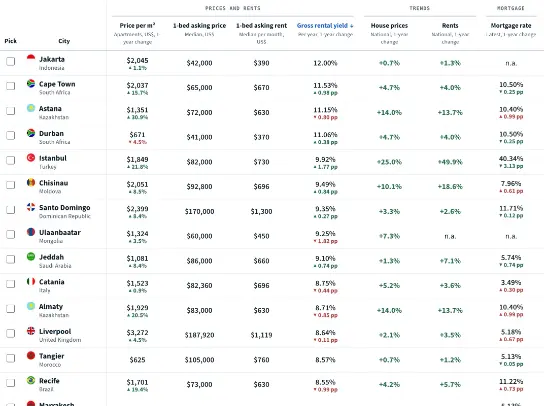
Rental yields in Italy are generally low at 3% to 6%, based on Global Property Guide figures. Apartments in the historical centre of Rome yield 3.2% - 4.5%, while similar apartments in Milan produce slightly higher returns, ranging from 4% - 5.7%. It is not quite clear why there is this somewhat unusual pattern of very low city-centre yields.
Hot spots for foreigners
Foreign demand for Italian real estate is important - around 20% to 25% of all buyers are foreigners. The top 5 most requested and visited regions for foreign buyers were Liguria, Tuscany, the Northern Lakes, Puglia and Umbria, according to Homes in Italy, a property sales service.
Liguria was the most visited region of Italy by overseas buyers, thanks to the picturesque beauty of its little villages, the proximity to France and the presence of nearby Nice and Geno airports. It may well be the most expensive region but Tuscany offers a rich combination of landscape, art, history, food, and wine. Property in the north of the region, around Bagni di Lucca still remains affordable. The Northern Lakes continue to be of interest, its proximity to northern Cities, skiing and general tourism appeal to buyers.
Puglia which is home to many picturesque and traditional properties is also in the list. Puglia’s interest has been boosted by the low prices it offers in comparison to other areas of Italy. Umbria completes the top 5 listing and a region that still attracts strong demand and a broad range of properties on the market.
The large property segment is dominated by foreign buyers, according to the Italian Federation of Professional Estate Agents (F.I.A.P). Nevertheless, small houses (up to 60 sq. m.) are the most requested by foreign buyers. Around 81% of foreign buyers buy small houses, followed by medium sized properties (60 to 120 sq. m.) at 14.7% of all requests. Large properties (over 120 sq. m.) account for only 4.4% of buyers’ requests.