House price growth in Egypt continues strong
Last Updated: Oct 03, 2007
House price growth in Egypt continues strong
The property buying opportunities in Egypt can be conceptually divided into three areas:
- Cairo
- The Red Sea
- The Mediterranean Coast
History of the property market
After years of only state-built housing, in the early 1990s the government allowed private housing projects. Inexperienced companies jumped in. Soon there was massive oversupply. Egypt was suddenly full of empty housing blocks. Developers went bankrupt, and from 1997 on there was a massive housing oversupply crisis.
Now the situation has turned around. Egypt’s property market is booming again, for four reasons:
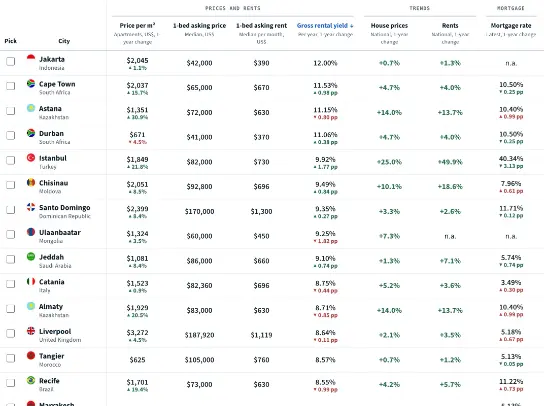
- Egypt offers excellent rental income returns.
- The Gulf is now exploding with new oil money, and sees Egypt as less risky than Lebanon or Jordan.
- Egypt has a rapidly-growing economy with a fast-growing outsourcing sector.
- There is enormous European interest in Red Sea property.
The government initiated a managed float of the Egyptian Pound in January 2003, leading to a sharp drop in its value (though it has somewhat recovered). The lower currency has encouraged expatriate Egyptians to buy, boosting the market.
The passing of the Real Estate Finance Law (148/2001) in May 2001 created a mortgage market. For the first time since the 1948 civil code, banks can now repossess properties and evict owners who default on loan repayments. Total mortgage lending is expected to grow rapidly to LE 4 billion (US$690 million) by the end of 2007, as the Egyptian Company for Mortgage Refinancing (ECMR) begins operations. ECMR is likely to help lower interest rates, which have hitherto been an obstacle to lower income groups. Lending rates in the 12% - 14% range have discouraged housing purchases.
Last year the property registration fee was reduced to a maximum of LE2,000 (US$350).
1. Big changes in Cairo
The ‘big thing’ in Cairo over the past two years has been the coming of Emaar, Dubai’s best developer, which has launched the sale of Uptown Cairo, a new development located in Mokattam Hills, East of Cairo.
Uptown Cairo
Uptown Cairo is a US$2.1 billion development, with several residential villages, a golf course, malls, sports and leisure facilities, as well as a business park. This is the first wholly foreign-owned developer to enter the Egyptian market, and the market is excited by the prospect of finish and amenities of an international standard.
Emaar has a number of other Cairo developments (its biggest sales office in the region is in Cairo) as well as Marassi Egypt, a luxury upscale resort development in Sidi Abdel Rahman, near El Alamein.
Katameya Heights
The super-luxury new areas launched prior to this such as Katameya Heights to the South of Cairo, now 7 years old, were purely local. Formerly a stretch of desert, Katameya Heights is now a large suburban area, with large houses, and has attracted enormous interest.
Land prices in Katameya Heights have been pushed up to spectacular heights. The reason for the excitement is that in a city of crowded, run-down housing with only piecemeal developments, Katameya Heights was one of the first gated villages with a suburban concept, with its own luxurious club-house. The houses are surrounded with green, they are luxurious and prestigious, and they offer an escape from the chaos of Cairo.
Foreign families have moved to Katameya Heights because it is close to Maadi - the heartland of the foreign presence in Egypt – and also close to international schools, several of which are planning to move near Katameya Heights. There is already a French and a German University, a branch of the British School has moved, and the International School has plans to move from Maadi. Of the foreign schools, only the Lycee reports no moving plans.
A second phase of Katameya Heights, Katameya Dunes, has been built and it still being sold. Emaar is also building a 5,000-home 3.8 m sq. m. project, New Cairo City, near where the prestigious American University is moving.
Rehab City and Madinaty
Katameya heights was preceded by Rehab City, located on the Cairo-Suez road, and built by Talaat Moustafa Group (TMG). It is on an even bigger scale and is preferred by many upscale locals.
TMG is now building a new mega-project, Madinaty. Three American urban-planning firms have helped in the design. It will include 80,000 residential villas, townhouses and apartments. There will also be recreational and commercial areas, schools, medical facilities and hotels. Prices in Madinaty of built apartments are around US$800 per sq. m.
Emaar is also developing a gated community, next to Cairo’s Smart Village. And near the now-ancient Sixth of October developments, are Gardenia and Palm Hills, more resort-like developments with club houses and golf resorts.
Are the new developments good investments?
It is not immediately obvious that these new developments are desirable investments. Prices have risen very high. Meanwhile in the traditional expatriate areas, such as Maadi, buying prices have stalled, and they may present better value for money.
Rising land prices in these new developments have caused repeated forecasts of a crash since 2005. That crash has not occurred, probably because Egypt is seen by Gulf investors as a safer investment than Beirut or Jordan, and because the upward movement of prices is supported by Egypt’s strong economic growth, including substantial rises in salaries at upper-management levels, especially in new industries such as finance, oil and gas, and business process outsourcing and information technology (IT) industries.
The best value is Maadi
Developers argue that you do not buy in Katameya Heights and similar developments just to rent – but for capital appreciation. Perhaps, but at present prices it is not clear how much further capital values can rise.
Meanwhile, rental yields are very good in the ‘old’ elite areas, such as Maadi, because for a substantial section of the foreign population Maadi is still the most attractive place to live, alongside Zamaalek (though Zamaalek has suffered enormously by its bifurcation by a motorway), and to a lesser extent Heliopolis (which caters mainly to the Egyptian rich).
A cautious, conservative investor might well conclude that Maadi’s low prices and high yields offer an investment opportunity, while Katameya’s high land prices are not supported by any clear profit prospects. On the other hand Katameya Heights has momentum – the pull of the future – powering it; so it is a hard decision.
2. The Red Sea
Quite separate from the Cairo market are the burgeoning developments on the Red Sea and, to a lesser extent, on the Mediterranean Coast. These are beneficiaries of low air travel costs and short flight times, which place Egypt within a few hours of Paris, London, and Berlin.
The magnificent beaches on the Red Sea are swiftly being covered with tourist and housing developments, in a repetition of the ‘holiday-isation’ of the European Mediterranean from Portugal to Sicily.
Sharm el Sheikh
Sharm el Sheikh was captured by Israel in 1956 and was only returned to Egypt in 1982. The Israelis opened the first tourist establishments. Now Sharm is Egypt’s most luxurious and attractive resort, newer and more upscale than Hurghada, host to 5-star hotels and international conferences.
Sharm has a dramatic landscape. There are clear and calm waters, and long stretches of good natural beaches, and the climate is dry and temperate climate all year round. Zoning laws limit building heights, which has prevented the surroundings’ natural beauty from being spoiled by high rises.
Sharm has a vibrant night life, and boasts many nightclubs, the longest continuous bar in the Middle East, and a marina which can handle private yachts and sailboats.
Sharm’s development has been led by tourism, though hotels such as the Ritz-Carlton have sold private villas.
New residential developments tend to follow this hotel-based pattern, such as the just-completed Sierra Resort Nabq Bay; the Laguna Vista Residence in Naqb Bay; the Carlton Resort, Hadava. Fully residential is Montazah in Ras Nasranr.
Hurghada
Hurghada is the most popular seaside resort in Egypt, though it is overcrowded and now slightly seedy. About 500 kilometres from Cairo, it was formerly a small fishing village, but in the last ten years has grown into a town of 35,000 inhabitants and become an international dive centre. The beach stretches nearly 40 kilometres along the Red Sea. Hurghada has an international airport with direct flights to major European countries, as well as flights to Cairo.
The biggest development near Hurghada is El Gouna, built by the Orascom Group. This tourism and housing development stretches over 37.8m sq.m., of which 9 million have been developed, golf courses and 14 hotels, a vast polo club, its own airport. It has 10 kilometres of beach front, and is built around lagoons. El Gouna will eventually have an international school.
Gamsha Bay
In Gamsha Bay, 60 kilometers north of Hurghada, a 320 million-square-metre US$16 billion tourism and housing project is being developed by Damac, which developed the Dubai Towers, and will be completed over 10 years.
Sahl Hasheesh
Eighteen kilometers South of Hurghada lies Sahl Hasheesh Bay, where a purpose-built resort flanking 12.5 kilometres of sandy beach is being built. Covering 32 million square metres, by the time it is completed in 2014 Sahl Hasheesh will have 20 5-star hotels and 8 golf courses. The Egyptian Resorts Company (ERC), owns the exclusive development rights.
The most upscale of all Sahl Hasheesh resorts is the US$3 billion Serrenia, being developed by Jordanian-owned Sbig Holdings in cooperation with Normal Foster Architectural design. It claims it will be ‘the most exclusive waterside address anywhere in the world’, with its own private airstrip and helicopter taxi service, and a Foster-designed marina to house the biggest yachts in the world.
Sahl Hasheesh has a ‘sunken city’ with ‘ancient’ ruins newly-built for the amusement of divers. There are bars, restaurants and first-rate sports facilities. There will even be a ‘Little Venice’ - a miniature version of the Italian city. Included in the plans are canals and gondolas, plus floating boutiques and bridges.
Near Sahl Hasheesh. Travco, the main German tour company, is building Madinat Makadi, a 2,500 residence development targeting Europeans. A German school will be built nearby.
Port Ghalib
Much further south near Marsah Alam, two and a half hours from Luxor, the Port Ghalib project is being developed by Al Kharafi Group of Kuwait along 18 kilometres of shoreline. It is opening in November 2007, with around 100 properties for sale, and a further 350 in the pipeline. Marsah Alam has a newly-built international airport, an international convention centre, a man-made lagoon, and a multiplicity of sports facilities. A marina and the usual mix of hotel/residential mix are planned.
3. The Mediterranean Coast
Traditionally the North Coast - the Mediterranean - has been very popular with Egyptians because of its proximity to Cairo and Alexandria. Most of the coastline is featureless and flat with little water movement, flanked by ugly uniform rows of holiday houses, some from the Socialist era, in various stages of decay. These offer Egyptians a summer escape from their overcrowded and dusty cities.
In the more remote parts of the North Coast, partly with the European market in view, some interesting developments are now being built.
Marassi and Almaza Bay
Emaar is developing the Marassi resort in Sidi Abdel Rahman on the Mediterranean near El Alamein, which includes seven kilometres of coastline that used to belong to the state-owned Egyptian General Company for Tourism and Hotels. Despite being on the Mediterranean, the sea here is very beautiful. The new resort will include several hotels, luxury villas, chalets, a marina and an 18-hole golf course, and should be finished in five years.
Travco, the main German tour, is also building Almaza Bay at Marsa Matruh on the Mediterranean between Alexandria and Libya.
Conclusion: coast or Cairo?
By international standards, the coastal developments are still very inexpensive, though prices are rising rapidly. Well-positioned, well-built houses and apartments seem likely to appreciate. Those who want to pursue a more cautious strategy, supported by good rental incomes (in the context of Egypt’s very low tax environment) are likely to invest in central Cairo.