Brazil's Residential Property Market Analysis 2025
Brazil's residential real estate market is growing robustly, buoyed by the continued surge in property demand and increasing construction activity.
This extended overview from the Global Property Guide covers key aspects of the Brazil housing market and takes a closer look at its most recent developments and long-term trends.
Table of Contents
- Housing Market Snapshot
- House Price Variations
- Demand Highlights
- Supply Highlights
- Rental Market
- Mortgage Market
- Historic Perspective
- Socio-Economic Context
Housing Market Snapshot
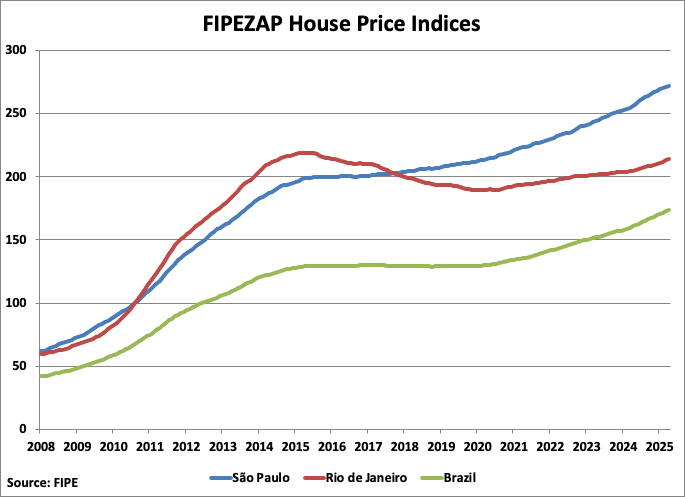
In April 2025, Brazil's FIPEZAP house price index was up by 7.97% from a year earlier, an acceleration from the 5.76% y-o-y growth seen in April 2024, according to figures released by Fundação Instituto de Pesquisas Econômicas (FIPE). However, when adjusted for inflation, nationwide house prices rose by a more modest 2.31% over the same period.
Brazil's house price annual change:
[hp_graph]
The national figure conceals large variations in local house price movements. In the country's five most populous cities:
- In São Paulo, house prices rose by 6.11% (0.55% inflation-adjusted), higher than the 4.93% y-o-y growth recorded in April 2024. In the past six months, the city has experienced its sharpest rise in house prices in a decade.
- In Rio de Janeiro, house prices rose by a modest 4.62% y-o-y in April 2025 and actually fell slightly by 0.87% when adjusted for inflation. Despite this, it is already the highest y-o-y growth recorded in the city since March 2015.
- In Brasilia, house prices rose by 4.7% in April 2025 from a year earlier, slightly up from a y-o-y growth of 4.44% in April 2024. But when adjusted for inflation, prices actually declined by 0.79% over the same period.
- In Fortaleza, house prices increased strongly by 12.33% y-o-y in April 2025 - marking one of its best showing in the past decade. In real terms, house prices were up by 6.44% over the same period.
- Salvador registered the highest year-on-year house price growth among the country's 16 large towns, at 20.63% in April 2025. It is also the city's strongest increase since records began in August 2010. When adjusted for inflation, house prices were up by 14.31%.
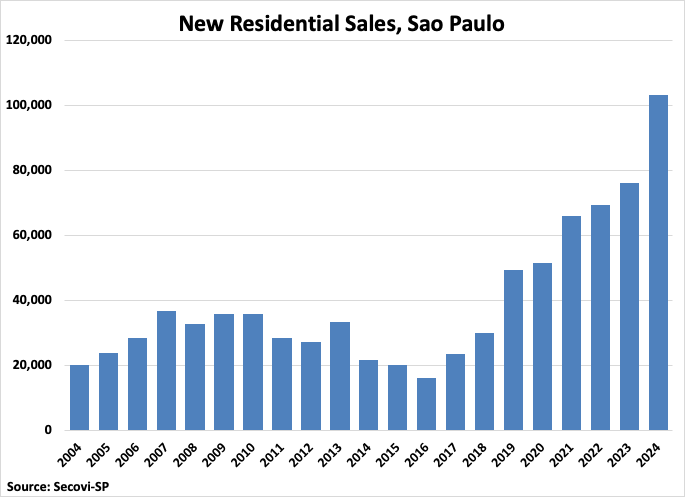
Demand continues to grow strongly. In the first two months of 2025, there were 17,156 residential sales recorded in the city of São Paulo, up by a huge 40.6% as compared to the previous year, according to Secovi-SP. Sales have been increasing continuously in the past eight years, growing by an average of 27.6% annually from 2017 to 2024.
There is also a renewed interest by foreign investors in Brazilian real properties recently, which is expected to boost the housing market further in the coming years. Foreign individuals and nonresidents may invest in urban and rural properties in Brazil through direct ownership from abroad, or resident companies or partnerships. To be able to buy a property, a tax registration number from the Cadastro de Pessoa Fisica (CPF) is required.
However, there are restrictions on investments in rural properties. Foreign individuals who intend to migrate to Brazil may acquire rural properties directly from abroad only if they come to live in Brazil within three years from the date of acquisition. In addition, rural properties acquired by foreign companies must be destined for the implementation of agricultural, industrial, or settlement projects and these activities must be related to the companies' purposes.
Residential construction activity is also picking up. In the first two months of 2025, the number of launches in São Paulo rose by a whopping 130.3% to 16,940 units as compared to the same period last year. This followed a 42.6% surge in residential launches during the whole year of 2024.
Overall, the housing market is projected to grow further this year and residential property prices will continue rising in the coming months.
During 2024, Brazil's economy expanded modestly by 3.4%, following annual growth of 3.2% in 2023, 3% in 2022 and 4.8% in 2021, according to the Instituto Brasileiro de Geografia e Estatística (IBGE). The growth last year was primarily attributed to strong gains in investment and household consumption, amidst government policies aimed at increasing disposable income.
The Brazilian economy is expected to continue growing this year, albeit at a slower pace, with the country's Finance Ministry and The World Bank projecting a real GDP growth rate of 2.3% and 2.2%, respectively. The forecast released by the International Monetary Fund (IMF) is even more conservative, at 2%.
House Price Variations:
Local house price variations
All of Brazil's 16 large towns saw house price rises in April 2025 as compared to a year earlier.
Salvador saw the highest nominal house price growth out of the 16 large towns at 20.63% (14.31% inflation-adjusted) y-o-y in April 2025, followed by João Pessoa (18.25%), Vitória (17.09%), Curitiba (14.43%), Belo Horizonte (13.95%), and Fortaleza (12.33%).
Strong house price increases were also recorded in Florianópolis (9.98%), Manaus (9.15%), Campo Grande (9.02%), Porto Alegre (8.34%), Goiânia (7.32%), Maceió (6.96%), and São Paulo (6.11%).
Modest house price rises were seen in Brasilia (4.7%), Rio de Janeiro (4.62%), and Recife (2.81%).
However, when inflation is taken into consideration, real house price increases were more moderate, and 3 out of the 16 large towns saw a slight decline in house prices in April 2025 as compared to the same period last year.
| HOUSE PRICE CHANGE (%) | |||||
| 2008-2015 | 2015-2019 | 2019-2021 | 2021-2024 | April 2025 (y-o-y) |
|
| FipeZap HPI | 209.38 | -0.17 | 9.15 | 20.23 | 7.97 |
| São Paulo | 224.74 | 5.98 | 8.07 | 17.21 | 6.11 |
| Rio de Janeiro | 259.08 | -11.83 | 3.80 | 6.89 | 4.62 |
| Belo Horizonte | - | 8.67 | 7.66 | 30.80 | 13.95 |
| Brasilia | - | -5.73 | 19.23 | 7.42 | 4.70 |
| Salvador | - | 3.17 | 5.24 | 30.46 | 20.63 |
| Fortaleza | - | -12.41 | 8.44 | 27.22 | 12.33 |
| Porto Alegre | - | 2.06 | 8.27 | 11.41 | 8.34 |
| Curitiba | - | 6.82 | 24.75 | 42.67 | 14.43 |
| Florianópolis | - | 14.06 | 23.87 | 36.34 | 9.98 |
| Vitória | - | 9.60 | 28.80 | 41.18 | 17.09 |
| Goiânia | - | 1.60 | 19.15 | 54.81 | 7.32 |
| João Pessoa | - | - | 13.10 | 39.89 | 18.25 |
| Campo Grande | - | - | 12.23 | 33.65 | 9.02 |
| Maceió | - | - | 27.86 | 45.13 | 6.96 |
| Manaus | - | - | 19.08 | 29.09 | 9.15 |
| Recife | - | -1.87 | 3.81 | 24.92 | 2.81 |
| Sources: FIPE, Global Property Guide | |||||
Demand Highlights:
Residential sales in São Paulo increasing strongly
Demand continues to increase strongly. During 2024, the total number of residential sales in São Paulo surged by 35.7% to 103,346 units from a year earlier, according to Secovi-SP. This followed annual growth of 9.9% in 2023, 4.9% in 2022, 28.5% in 2021 and 4.5% in 2020.
It is now the eight consecutive year of annual growth and the highest number of residential sales ever recorded in the city.
The upward trend continues this year. In the first two months of 2025, there were 17,156 residential sales recorded in the city of São Paulo, up by a huge 40.6% as compared to the same period last year.
Supply Highlights:
Supply increasing rapidly
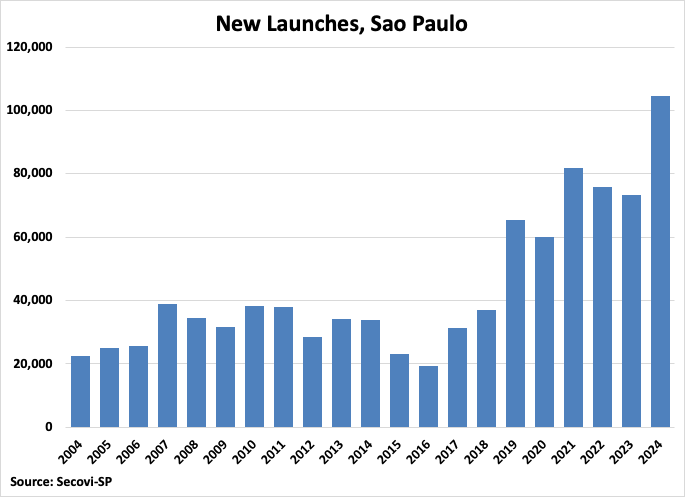
During 2024, residential launches soared by 42.6% y-o-y to 104,431 units, in stark contrast to annual contractions of 3.2% in 2023 and 7.5% in 2022, based on figures from Secovi-SP. It is now considered the highest number of residential launches recorded in a year in recent history.
With strong demand, supply continues to improve. In the first two months of 2025, launches surged by 130.3% to 16,940 units as compared to the same period last year.
Case Verde e Amarela replaces Minha Casa Minha Vida housing program
The Minha Casa Minha Vida program (MCMV), launched in March 2009, was one of the popular federal government programs introduced during former President Lula da Silva's 8-year term. Under the program, subsidized mortgage loans were extended to middle and lower-income homebuyers through the state-owned bank, Caixa Economica Federal (CEF). The MCMV program has produced significantly more housing units than any other social housing program in Brazil, having delivered more than one million housing units for the poorest families in the country.
However, after more than a decade, the federal government ended the Minha Casa Minha Vida program (My Home, My Life housing program) in late 2020 to implement the new Casa Verde e Amarela program (Green and Yellow House program), named in reference to the colors of Brazil's flag. While the new housing program retains its predecessor's regulations for the construction of new housing units, it adds avenues for land regularization and renovations for existing housing. The government plans to regularize up to 2 million homes and renovate more than 400,000 over the next four years.
Under the new Casa Verde e Amarela program, the program has facilitated the construction of over 1.2 million housing units as of 2022, benefiting nearly 5 million people. Around 384,000 units were allocated to socially vulnerable families, reaching around 1.5 million individuals.
Moreover, about 1.6 million families have been served through housing financing. Around BRL 25 billion (US$4.46 billion) from the Guarantee Fund for Length of Service (FGTS) and BRL 500 million (US$89.14 million) from the Social Development Fund (FDS) were allocated to the program.
The new program also offers lower interest rates as compared to the MCMV program. For instance, families with a monthly income of at most BRL 2,000 (US$357) and live in the North or Northeast region will see a reduction of up to 0.5% in annual interest rates while those with a monthly income between BRL 2,000 (US$357) and BRL 2,600 (US$464) will have an interest rate reduction of 0.25%.
From four different categories under the MCMV program, the Casa Verde e Amarela program has only three:
- Range 1.5: families with a monthly income of at most BRL 2,000 (US$357) - subsidy up to BRL 47,500 (US$8,469), interest rate of 4.5%
- Range 2.0: families with a monthly income of up to BRL 4,000 (US$713) - a subsidy of up to BRL 29,000 (US$5,170), interest rate of 4.75%
- Range 3.0: families with monthly income from BRL 4,000 (US$713) to BRL 7,000 (US$1,248), interest rate of 7.66%
In the first category, families can benefit from reduced interest rates, subsidized housing units, property reform, as well as land regularization.
Rental Market:
Moderately good rental yields
Brazil's big cities offer moderate to good rental yields - what you can earn from an apartment before tax and other expenses. In Q1 2025, the average gross rental yields on apartments in Brazil stood at 5.28%, slightly down from 5.62% in Q3 2024 and 6.24% in Q1 2024, according to research conducted by the Global Property Guide.
In Brazil's major cities:
- In Sao Paulo, apartments offer rental yields ranging from 4.08% to 8.23% in Q1 2025, with a city average of 5.94%.
- In Rio de Janeiro, apartment rental returns are relatively lower, ranging from 2.89% to 7.33%, with a city average of 3.84%.
- In Fortaleza, rental yields are very low, ranging from 2.13% to 4.08%, with a city average of 3.41%.
- In Guarapari, rental yields range from 4.5% to 5.14%, with a city average of 4.8%.
- Recife apartments offer high rental yields of around 6.75% to 10.69%, with a city average of 9.17%.
- In Vitoria, gross rental yields ranged from 4.23% to 4.8%, with a city average of 4.51%.
Brazil's rent price index:
[rp_graph]
Mortgage Market:
Selic rate raised again to rein in inflation
From an annual average of 3.5% in 2017-20, nationwide inflation surged to 8.3% in 2021 and further to 9.3% in 2022, as the reopening of the economy, coupled with global supply issues, a weaker currency, and severe drought, pushed up prices. To rein in inflationary pressures, the central bank hiked the Selic interest rate twelve times from a record-low of 2.0% in February 2021 to 13.75% in August 2022, where it remained unchanged until July 2023.
Brazil's mortgage loan interest rates:
[mortgage_graph]
As such, inflation moderated to an annual average of 4.5% in 2023-24, prompting the central bank to reverse its monetary policy and cut the Selic rate by a cumulative 325 basis points to 10.5% in May 2024.
However, by the end of 2024, there were clear indications that inflationary pressures were resurfacing. In response, the Banco Central do Brasil's Monetary Policy Committee raised the Selic rate by 25 basis points to 10.75% in September 2024. This marked the beginning of a new tightening cycle, with additional rate hikes implemented in the following months most recent being a 50 basis point increase in May 2025.
"Copom decided to increase the Selic rate by 0.50 p.p. to 14.75% p.a., and judges that this decision is consistent with the strategy for inflation convergence to a level around its target throughout the relevant horizon for monetary policy," said the central bank in its Monetary Policy Statement released in May 2025.
"The risks to its inflation scenarios, both to the upside and to the downside, are higher than usual," noted the central bank. It also added that "the external environment, in particular the U.S. trade policy, and the domestic environment, particularly the fiscal policy, have been influencing the behavior of asset prices and expectations."

Real estate credit increasing again
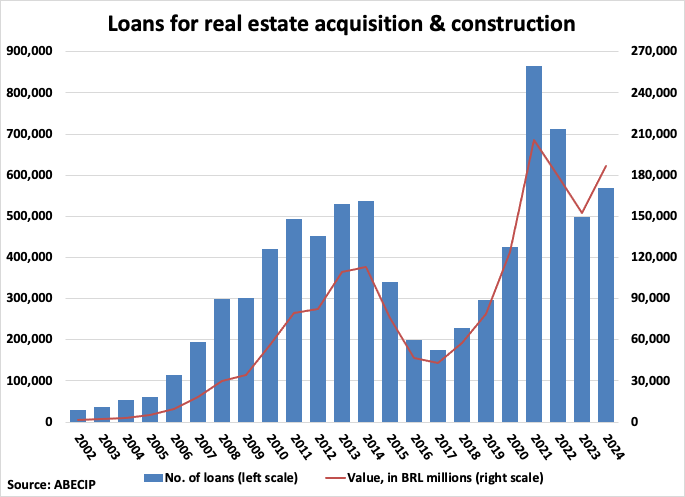
After 2017, the economy came out of the post-2014 economic slump, and loans for real estate acquisition and construction began to rise again. During 2021, real estate loans soared 65.7% y-o-y to reach a record-high of BRL 205.41 billion (US$36.62 billion), following strong growth of 57.5% in 2020, 37.1% in 2019, and 33% in 2018, according to ABECIP.
Likewise, the total number of real estate loans drawn more than doubled to 866,331 in 2021 from a year earlier. It was also the highest ever recorded.
However, real estate credit has slowed in the succeeding years, despite strong property demand. The total value of real estate loans fell by 12.8% y-o-y to BRL 179.16 billion (US$31.94 billion) in 2022 and by another 14.8% y-o-y to BRL 152.68 billion (US$27.22 billion) in 2023. Similarly, the number of loans fell by a huge 30% y-o-y to 499,149 in 2023, following a 17.7% decline in the prior year.
The market showed some signs of recovery last year, with the total value of real estate loans surging by 22.3% y-o-y to BRL 186.67 billion (US$33.28 billion). Likewise, the number of loans was also up by 13.8% to 568,163 in 2024.
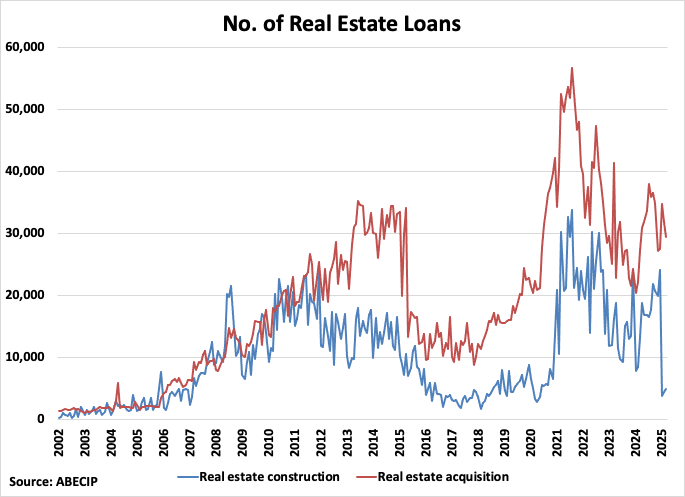
The recovery of the real estate credit market continued this year, despite increasing interest rates. In the first quarter of 2025, the total amount and number of loans rose by 16.2% and 10% y-o-y, respectively.
- Acquisition: total loan value for the purchase of real estate increased by 32.5% y-o-y to BRL 34.61 billion (US$6.17 billion) in Q1 2025. Also, the number of loans rose strongly by 37.6% y-o-y to 95,912 over the same period.
- Construction: total amount of loans for the construction of properties fell by 45.8% y-o-y to BRL 3.7 billion (US$660.4 million) in Q1 2025. Likewise, the number of said loans plummeted by 55.4% to 13,115.
Outstanding home loans represent more than 10% of the country's gross domestic product.
Historic Perspective:
Looking back: the amazing Lula housing boom
House prices in São Paulo rose by an amazing 224.74% from January 2008 to December 2015 (106.3% inflation-adjusted), and in Rio de Janeiro by an even more spectacular 266.1% (134% inflation-adjusted).
Pro-market reforms under former President Lula da Silva greatly helped boost mortgage lending, which rose by at least 25% per year between 2007 and 2014. Plus, interest rates were progressively cut from 26% to 7.25% between 2003 and 2012. The rapid growth of the middle class was another important factor. All of these elements contributed to the house price boom.
The 2007 discovery of enormous oil fields deep beneath a layer of salt in the Atlantic seabed boosted the energy industry's demand for residential and office space. Demand continued to surge following the 2009 announcement that Rio de Janeiro would host the 2016 Olympic Games.
The property had by then become increasingly unaffordable due to the surge in house prices, leading many Brazilians to rent rather than own. "In the major cities, young professionals were struggling to afford the kind of prices now being asked for properties in good areas," according to Colordarcy Investment.
However, in 2014, nominal house price rises slowed dramatically, ending the year with 6.7% growth (0.3% inflation-adjusted). Beginning in 2015, national house prices began to fall in real terms.
| ANNUAL HOUSE PRICE CHANGE (%), SAO PAULO | ||
| Year | Nominal | Inflation-adjusted |
| 2009 | 21.58 | 16.55 |
| 2010 | 23.99 | 17.08 |
| 2011 | 26.96 | 19.21 |
| 2012 | 15.78 | 9.39 |
| 2013 | 13.91 | 7.55 |
| 2014 | 7.33 | 0.87 |
| 2015 | 2.51 | -7.38 |
| 2016 | 0.41 | -5.53 |
| 2017 | 1.40 | -1.50 |
| 2018 | 1.79 | -1.89 |
| 2019 | 2.26 | -1.96 |
| 2020 | 3.79 | -0.70 |
| 2021 | 4.13 | -5.39 |
| 2022 | 5.06 | -0.68 |
| 2023 | 4.69 | 0.07 |
| 2024 | 6.56 | 1.65 |
| Sources: FIPE, Global Property Guide | ||
The crisis and its aftermath, Bolsonaro came to power
Brazil's decade-long troubles began with the global recession in 2008. To boost the economy, the Central Bank of Brazil slashed the benchmark Selic rate from 13.75% in December 2008 to 8.75% by July 2009.
Brazil was swamped with consumer credit, and there was a surge in inflation. Even so, economic growth fell to 1.9% in 2012, 3% in 2013, and 0.5% in 2014.
In June 2013, riots exploded, precipitated by a BRL0.20 (USD0.04) rise in public transport fares and complaints about excessive spending on mega-sporting events. Brazil is not a poor country. But tax rates are extremely high, yet many Brazilians spend up to four hours per day in traffic jams, either in their cars or on crowded public transport. The protests were an outburst of popular frustration at corruption - a protest against an intolerable situation.
Alarmed at the inflation the central bank raised the benchmark interest rate nine times from 7.25% in March 2013 to 14.25% in 2015, the highest level for almost six years.
Mortgage lending slowed sharply, with the total value of loans plunging by 33% in 2015 and by another 38.3% in 2016, according to the Brazilian Association of Real Estate Loans and Savings Companies (ABECIP), amidst the ongoing political turmoil in the country. The decline continued in 2017, with real estate credit falling by 7.4% compared to the prior year.
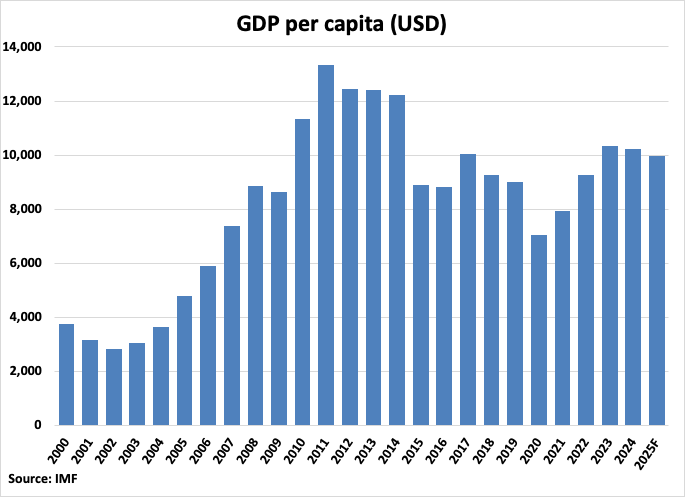
A slump followed, and the currency fell. GDP per capita fell 32.4% between 2011 and 2019, to US$9,010, according to the IMF, though this was largely an artifact of the currency's decline - in fact, real GDP fell by only 3.5% in 2015 and by 3.3% in 2016. Then came a corruption scandal involving oil giant Petrobras and the country's largest engineering and construction firms. The investigation has implicated politicians, mostly from President Dilma Rousseff's Workers' Party.
Protests in the streets escalated, worsening the country's already ailing economy. In August 2016, Rousseff was removed from office, and Michel Temer was sworn in as Brazil's new president.
Although the public did not hit the streets to protest against Temer, his approval ratings remained in single-digit figures. Corruption controversies led him to become even more unpopular, and after his term of office ended, Temer was arrested in March 2019 on corruption and money laundering charges. Worse, the massive bribery scandal involving Brazilian construction giant Odebrecht exploded. Odebrecht was behind the construction of venues for the 2014 World Cup, the 2016 Olympics, the metro systems in Caracas, and other huge infrastructure projects.
The crisis helped right-wing candidate and retired army officer Jair Bolsonaro sweep to victory during the October 2018 presidential election on a populist, anticorruption platform.
Bolsonaro's defeat and Lula's return to power
Bolsonaro, a free marketeer, has very worrying anti-environmentalist and anti-human rights views. He has failed to deliver on most of his promises. During the onset of the Covid-19 pandemic, Bolsonaro had been widely criticized for his handling of the health crisis, refusing to support measures to halt the spread of the virus.
The economy contracted by 3.3% during 2020, following annual average growth of 1.4% in 2017-19. It was at par with the decline seen in 2016.
In fact, the country's GDP per capita plummeted by almost 22% in just a year, falling to US$7,057 in 2020.
In July 2021, tens of thousands of people took to the streets to protest amidst the allegations of corruption involving the purchase of vaccines by the government. In October 2021, a Senate investigative committee found that Bolsonaro committed nine crimes related to his administration's handling of the health crisis, amidst delayed vaccines, oxygen shortages, and ineffective treatments.
With the incumbent president's poor approval ratings leading to the October 2022 general elections, it is not surprising that he lost to his leftist rival, ex-president Lula da Silva, who was inaugurated as president on January 1, 2023.
Currently, Lula prioritizes lowering food prices to ease the burden on working families, improving public security through police reform and cybercrime measures, and advancing major infrastructure projects under the Novo PAC to drive economic growth.
Socio-Economic Context:
Economic growth to slow this year, Brazilian Real remains weak
During 2024, Brazil's economy expanded modestly by 3.4%, following annual growth of 3.2% in 2023, 3% in 2022, and 4.8% in 2021, according to the Instituto Brasileiro de Geografia e Estatística (IBGE). The growth last year was primarily attributed to strong gains in investment and household consumption, amidst government policies aimed at increasing disposable income.
But the Brazilian economy is expected to slow this year, with the country's Finance Ministry and The World Bank projecting a real GDP growth rate for 2025 of 2.3% and 2.2%, respectively. The International Monetary Fund (IMF) is even more pessimistic, forecasting a real GDP growth for Brazil of 2% this year.
"Real GDP growth is expected to moderate to 2.2% in 2025 as higher interest rates and an adverse external environment weigh on investment, and household consumption slows due to rising household debt, lower transfers, and diminishing labor market gains," said The World Bank.
Labor market conditions remain tight. In Q1 2025, the nationwide unemployment rate stood at 7%, up from 6.2% in the previous quarter but down from 7.9% in the same period last year, according to figures released by IBGE. The jobless rate reached a record low of 6.1% in the three months ending November 2024.
From an annual average of 7.7% in 2010-15, the jobless rate rose to 12.6% in 2016-21. Unemployment fell again to 9.3% in 2022, to 8% in 2023, and finally to 6.9% in 2024.
There were about 7.7 million unemployed persons in Brazil in March 2025, down by 10.7% from the previous year.
Overall inflation rose to 5.53% in April 2025, slightly up from 5.48% in the previous month and far higher than the prior year's 3.69%, according to IBGE. It was the highest level registered since February 2023 and still above the central bank's target rate of 3.0%, with a tolerance interval of plus or minus 1.50 percentage points.
From an annual average of just 3.5% in 2017-20, inflation surged to 8.3% in 2021 and to 9.3% in 2022. It reached a 19-year peak of 12.13% in April 2022, prompting the central bank to hike its benchmark Selic rate several times to rein in inflationary pressures.
Inflation eased to an average of 4.6% in 2023 and to 4.4% in 2024 but expected to increase again to 5.3% this year, according to the IMF.
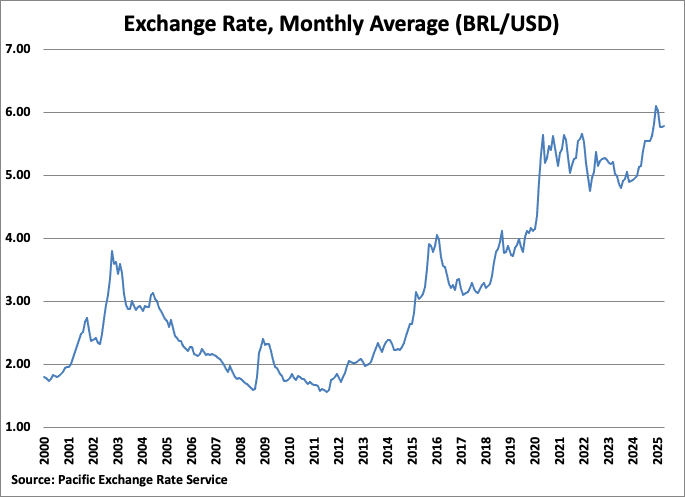
Since the onset of the pandemic, the Brazilian Real (BRL) has weakened sharply. By end-2022, the average monthly exchange rate stood at BRL 5.2478 per US dollar, losing nearly 22% of its value against the dollar from three years ago.
The domestic currency remained generally weak since losing another 10.3% of its value against the dollar from January 2023 to April 2025, reaching an average exchange rate of BRL 5.7832 per US dollar.
Sources:
- FIPEZAP Residential Index (Fipe): https://www.fipe.org.br/
- Anuário Do Mercado Imobiliário 2024 (Secovi-SP): https://secovi.com.br/
- Selic interest rate (Banco Central do Brazil): https://www.bcb.gov.br/
- Copom increases the Selic rate to 14.75% p.a. - 270th Meeting - May 2025 (Banco Central do Brazil): https://www.bcb.gov.br/
- Financiamento Imobiliário (Brazilian Association of Real Estate Loans and Savings Companies): https://www.abecip.org.br/
- Gross rental yields in Brazil: Sao Paulo and 4 other cities (Global Property Guide): https://www.globalpropertyguide.com/
- Housing for vulnerable communities: Casa Verde e Amarela (Government of Brazil): https://www.gov.br/
- Casa Verde e Amarela atuará com regularização, melhoria habitacional e incluirá 1 milhão de famílias no crédito imobiliário (Governo Federal): https://www.gov.br/
- The Most Attractive Market for Property Investors (Colordarcy Investment): https://www.colordarcy.com/
- Crédito imobiliário tem virada promissora em dezembro (Brazilian Association of Real Estate Loans and Savings Companies): https://www.abecip.org.br/
- Boletim Informativo de Crédito Imobiliário e Poupança (Brazilian Association of Real Estate Loans and Savings Companies): https://www.abecip.org.br/
- Former Brazil president Michel Temer arrested on corruption charges (The Washington Post): https://www.washingtonpost.com/
- Brazil country profile (BBC News): https://www.bbc.com/
- Brazil's economy grows 3.4% in 2024 but year-end weakness signals fewer rate hikes (Reuters): https://www.reuters.com/
- Brazil (International Monetary Fund): https://www.imf.org/
- Brazil's government maintains 2025 GDP forecast, sees higher inflation (Reuters): https://www.reuters.com/
- Brazil Unemployment Rate (Trading Economics): https://tradingeconomics.com/
- Inflation targeting (Banco Central do Brasil): https://www.bcb.gov.br/