Sydney keeps getting more expensive!
The Australian housing market accelerated in 2007, amid the meltdown in US sub-prime mortgages and global credit crunch.
The weighted average established homes price index for 8 Australian capital cities rose by 12.3% in 2007, higher than 2006’s 9.7% growth, and significantly more than 2005’s 2.3% price increase.
Australia’s capital city indexes all rose in 2007 – Brisbane (21.6%), Adelaide (20.26%), Melbourne (18.1%), Canberra (14.3%), Hobart (11.1%), Darwin (11.1%), Sydney (8%) and Perth (1.1%).
Australia has followed a somewhat different house price cycle from other developed countries. It experienced a sharp slowdown in 2003/4, somewhat similar to the present US crash (though less severe), since which it has been in continuous recovery.
As of December 2007, Sydney had the highest median house price of any Australian capital city at Au$551,000. It may be one of the world's most liveable cities, but Sydney is now one of the least affordable. It was ranked the 13th most expensive city in the world in a 2008 list compiled by Global Property Guide Research.
Melbourne, the second most populous city in Australia, has the second most expensive house prices at Au$485,000. Perth comes in a close third at Au$465,000. The median house price in Canberra, the administrative capital, was Au$413,000 at end-2007.
Perth house prices have been the most volatile. Annual Perth house price growth peaked at 47.5% in September 2006, falling dramatically to 1.1% in December 2007. Hobart and Canberra have had the most stable house prices among major cities.
Interest rate rises continue
The standard variable mortage rate rose to 9% in March 2008, up from 8.70% in January 2008, and 8.55% in December 2007, and from a low of 6.05% in December 2001. Average 3-year fixed mortgage rates have also been rising, and stood at 13.60% in February 2008.
The Reserve Bank projects inflation to reach 3.5% this year, compared to 2007’s 2.2%.
Clearly, some households are affected by rising interest rates. However the Australian property market remain strong, supported by a buoyant economic environment. The Australian economy has seen uninterrupted economic growth from 1992 to 2007, growing by 3.6% on average, according to the Australian Bureau of Statistics (ABS).
Other key factors driving house prices higher have been strong earnings growth (4.8% for full-time adult males and 5.0% for full-time adult females) combined with income tax cuts, a low unemployment rate (4.58%) and significant population growth (1.5%) driven by high net overseas migration (177,600 per year).
However the proportion of a family’s income spent on an average home loan rose to 37.4% in the December quarter 2007, the highest level recorded by the Real Estate Institute of Australia since it began measuring affordability 22 years ago.
![]() Housing stock shortage
Housing stock shortage
One explanation for the paradox of rising house prices despite higher interest rates is that the supply of residential properties still lags demand. Estimates from ANZ Banking Group shows that supply of homes will be only 145,000 in 2007-2008, while demand will surpass 180,000. By 2009-2010 the housing shortage will approach an unprecedented 200,000 dwellings.
Rents are soaring as rental vacancies tumble
Rents for three-bedroom homes have risen by 82% since 1996, and BIS Shrapnel, a forecasting service, predicts they will increase a futher 28.5% by the end of the decade. Renting families required 23.9% of their median family income to meet rent payments in December 2007, up from 22.4% in December 2006.
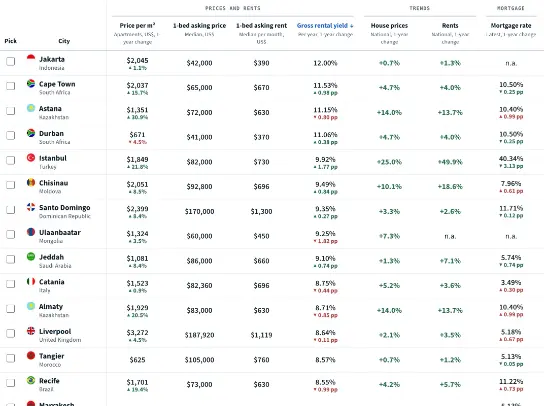
Gross rental yields for Sydney apartments are now around 7% for very small units (50 sq. m.), and average around 5.6%, according to Global Property Guide research (August 2007 figures).
The average cost of central Sydney apartments was US$7,690 per sq. m., with apartments of 150 sq. m. and larger costing around US$9,693 per sq. m., according to Global Property Guide research.
The continued strength in demand for rental properties, coupled with a limited supply of new housing units, has brought the national vacancy rate to a record low of 2%. Vacancy rates were at historic lows in New South Wales (0.8%), Victoria (1%), and Queensland (1-1.5%) in March 2008. In South Australia, rental vacancy remains close to 1%. Vacancy rates were also below historic averages in Western Australia, Tasmania, and the Australian Capital Territory. The rental market in the Northern Territory remains very tight, with vacancy rates in Darwin just over 1%.