Colombia Residential Real Estate Market Analysis 2026
Colombia's residential property market is at a turning point. House prices keep rising well above inflation, and sales staged a strong recovery in 2025, but housing starts have been falling for almost three years, the central bank is raising interest rates again, and the country has just elected a new president who will take office in August 2026.
This extended overview from Global Property Guide covers key aspects of the Colombian housing market and takes a closer look at its most recent developments and long-term trends.
Table of Contents
- Housing Market Snapshot
- Demand Highlights
- Supply Highlights
- Rental Market
- Mortgage Market
- Socio-Economic Context
Housing Market Snapshot
During 2025, the latest full year available, Colombia's house price index (IPVU) in Bogotá increased by 6.12% from a year earlier (0.25% inflation-adjusted), its strongest annual growth in the past four years, based on figures from the country's central bank, Banco de la República Colombia (Banrep).
The IPVU is Banrep's quarterly used housing price index, based on the loan appraisals reported by various banks and calculated using the repeat-sales methodology. It covers six main urban areas (Bogotá, Medellín, Cali, Soacha, Bello, and Envigado) and has been published since 1988.
Colombia's house price annual change:
More timely indicators for newly built housing point in the same direction. In Q1 2026, the new house price index (IPVN) rose by 8.47% from a year earlier, following full-year growth of 9.93% in 2025, based on figures from the National Administrative Department of Statistics (DANE). Although this marks a mild deceleration from 2025, new house price growth remains far above consumer price inflation, which stood at 5.56% in March 2026, implying real (inflation-adjusted) growth of roughly 2.8% year-on-year.
Quarter-on-quarter, new house prices were up by 2.79% in Q1 2026, slightly below the 3.46% quarterly increase recorded in the same period of 2025. By property type, apartment prices rose by 8.5% year-on-year in Q1 2026, while house prices increased by 7.15%.
Price pressures are broad-based but uneven across cities, based on DANE figures reported by El Colombiano:
- Pasto recorded the country's strongest annual new house price growth in Q1 2026, at 19.59%.
- Cali followed with an annual increase of 12.51%, and also led the quarterly ranking with a 5.49% rise. Housing aimed at lower-income strata in Cali became dramatically more expensive, with segment increases of close to 45% over the year.
- Pereira posted an annual growth of 12.05%.
- Popayán was the only major urban area where new house prices declined, falling by 0.90% year-on-year.
- Cúcuta registered the smallest quarterly increase, at 1.52%.
According to the OECD's residential price series, Colombia now ranks among the six OECD member countries with the largest cumulative house price increases since 2015, with the index up roughly 53% in nominal terms over the decade to Q1 2026.
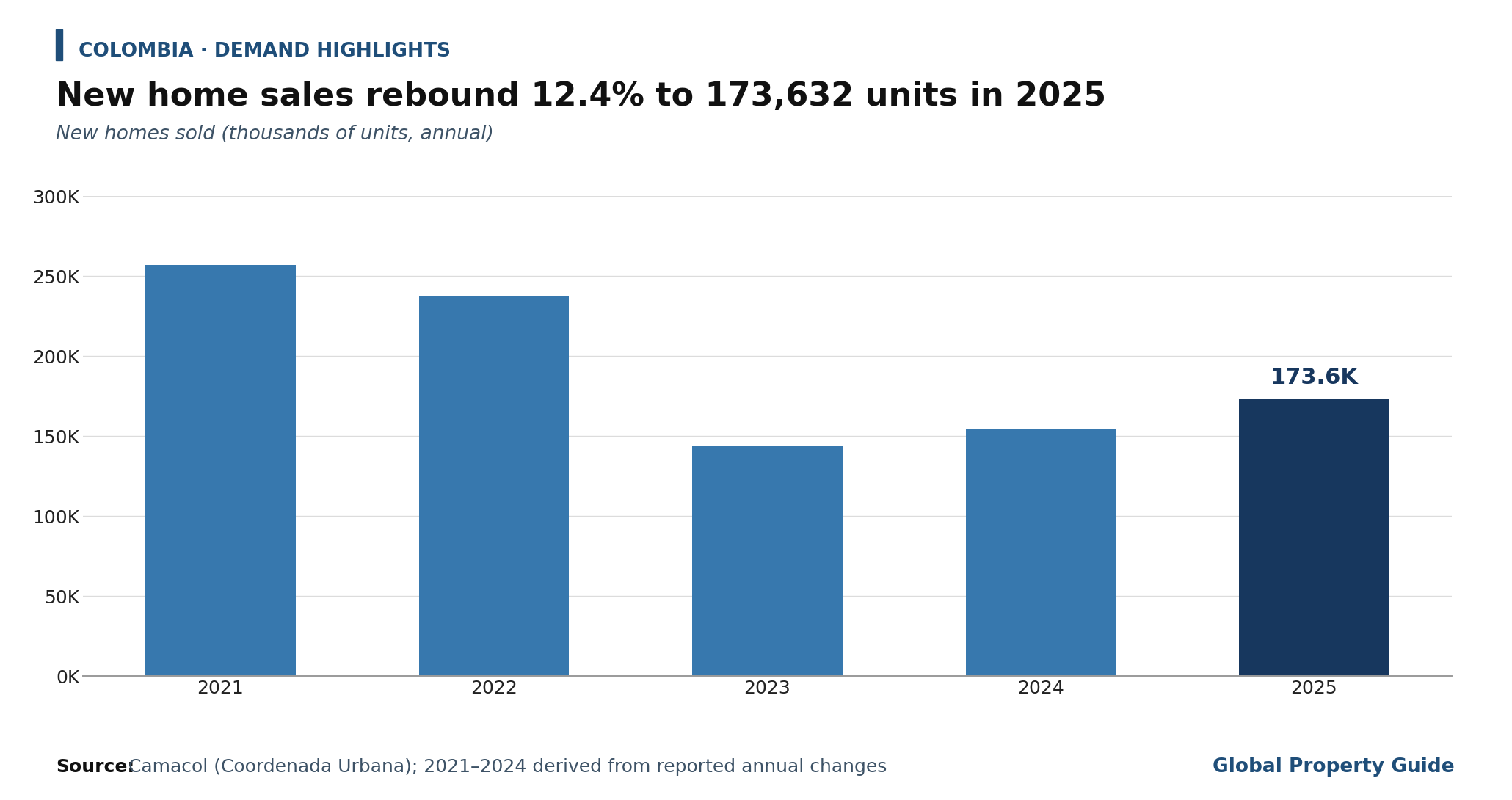
The paradox of the current market is that prices are climbing while construction shrinks. The Colombian Chamber of Construction (Camacol) describes 2025 as a year of commercial recovery without construction backing: new home sales rose by 12.4% to 173,632 units, and project launches increased by 15.3% to 140,365 units, yet housing starts fell by 17.4% to 115,687 units, completing almost three consecutive years (33 straight months) of declines and dropping below pandemic-era levels.
Over the past two decades, existing house prices have outpaced inflation in every year except 2022 and 2023, when double-digit consumer price inflation eroded real values:
| Colombia (Bogotá) House Price Index, Annual Change (%) | ||
| Year | Nominal | Inflation-adjusted |
| 2004 | 10.12 | 6.01 |
| 2005 | 19.09 | 14.01 |
| 2006 | 17.75 | 11.15 |
| 2007 | 9.24 | 3.43 |
| 2008 | 8.14 | 4.41 |
| 2009 | 12.64 | 9.70 |
| 2010 | 13.98 | 10.08 |
| 2011 | 16.78 | 13.74 |
| 2012 | 11.19 | 8.52 |
| 2013 | 7.25 | 3.93 |
| 2014 | 7.62 | 1.91 |
| 2015 | 7.42 | 1.36 |
| 2016 | 8.10 | 3.74 |
| 2017 | 6.06 | 2.75 |
| 2018 | 5.97 | 2.11 |
| 2019 | 6.21 | 4.25 |
| 2020 | 10.28 | 5.62 |
| 2021 | 8.88 | 2.40 |
| 2022 | 6.56 | -2.65 |
| 2023 | 5.68 | 0.22 |
| 2024 | 5.46 | 0.16 |
| 2025 | 6.12 | 0.25 |
| Data Source: Banco de la República Colombia (Banrep) | ||
The macroeconomic backdrop is mixed. Colombia's economy grew by 2.6% in 2025, an improvement over the 1.7% expansion of 2024, driven by private and public consumption, while construction contracted by 2.8% and mining by 6.2%, according to DANE. In Q1 2026, GDP expanded by 2.2% year-on-year. However, inflation has re-accelerated, reaching 6.14% in June 2026, its highest level in nearly two years, prompting the central bank to reverse course and raise its policy rate aggressively, from 9.25% at the start of 2026 to 12% by the end of June.
Politically, 2026 is a watershed year. In a razor-thin runoff on June 21, 2026, right-wing lawyer Abelardo de la Espriella defeated left-wing senator Iván Cepeda by roughly 250,000 votes out of some 26 million cast, with record runoff turnout of about 63.6%. He is scheduled to take office on August 7, 2026, succeeding Gustavo Petro, and has campaigned on a free-market economic agenda. The construction industry has urged the incoming government to restore national housing subsidies after the suspension of the flagship Mi Casa Ya program.
Demand Highlights:
Sales recovered strongly in 2025, but momentum is cooling in 2026
During 2025, the total number of new homes sold in Colombia rose by 12.4% year-on-year to 173,632 units, a figure also 20.4% above the 2023 level, based on figures from Camacol's Coordenada Urbana system. Project launches climbed 15.3% to 140,365 units.
The recovery was led by higher-priced housing:
- Non-VIS (market-rate) homes: sales up 24.3% in 2025, the strongest segment.
- VIS social housing (excluding VIP): sales up 22.3%, supported largely by local subsidy programs.
- VIP (priority-interest housing): sales down 29.2%, reflecting the collapse of national subsidy availability for the lowest-income buyers.
The growth was also geographically concentrated. Camacol calculates that Bogotá, Antioquia, and Atlántico jointly explained about 88% of the national sales increase in 2025, helped by local government programs. In Bogotá, initiatives such as Oferta Preferente, Reactiva tu Compra, and Reduce tu Cuota supported purchases by low- and middle-income households; Antioquia's sales rose 32.2% and Atlántico's 27.4% over the first nine months of the year.
However, the market entered 2026 in a cooling phase. According to Camacol's Coordenada Urbana market monitoring, in the first two months of the year, sales fell by around 11% year-on-year, launches dropped 11.6%, and available inventory shrank by 3.5%, with the social-housing segment hit hardest. Rising mortgage rates, the withdrawal of national subsidies, and a roughly 23% minimum-wage increase for 2026 (which mechanically raises VIS price caps and construction labor costs) are all weighing on affordability.
Camacol's executive president, Guillermo Herrera, has projected that sales could grow between 5% and 12% in 2026 and housing starts could rebound by more than 13%, but only if credit conditions improve and confidence returns. He has also warned that public investment in housing will fall by 35.7% in 2026, with the total housing program budget of about COP 1.7 trillion largely pre-committed, leaving very little room for new subsidies.
Supply Highlights:
Licensing recovers, but housing starts remain in deep contraction
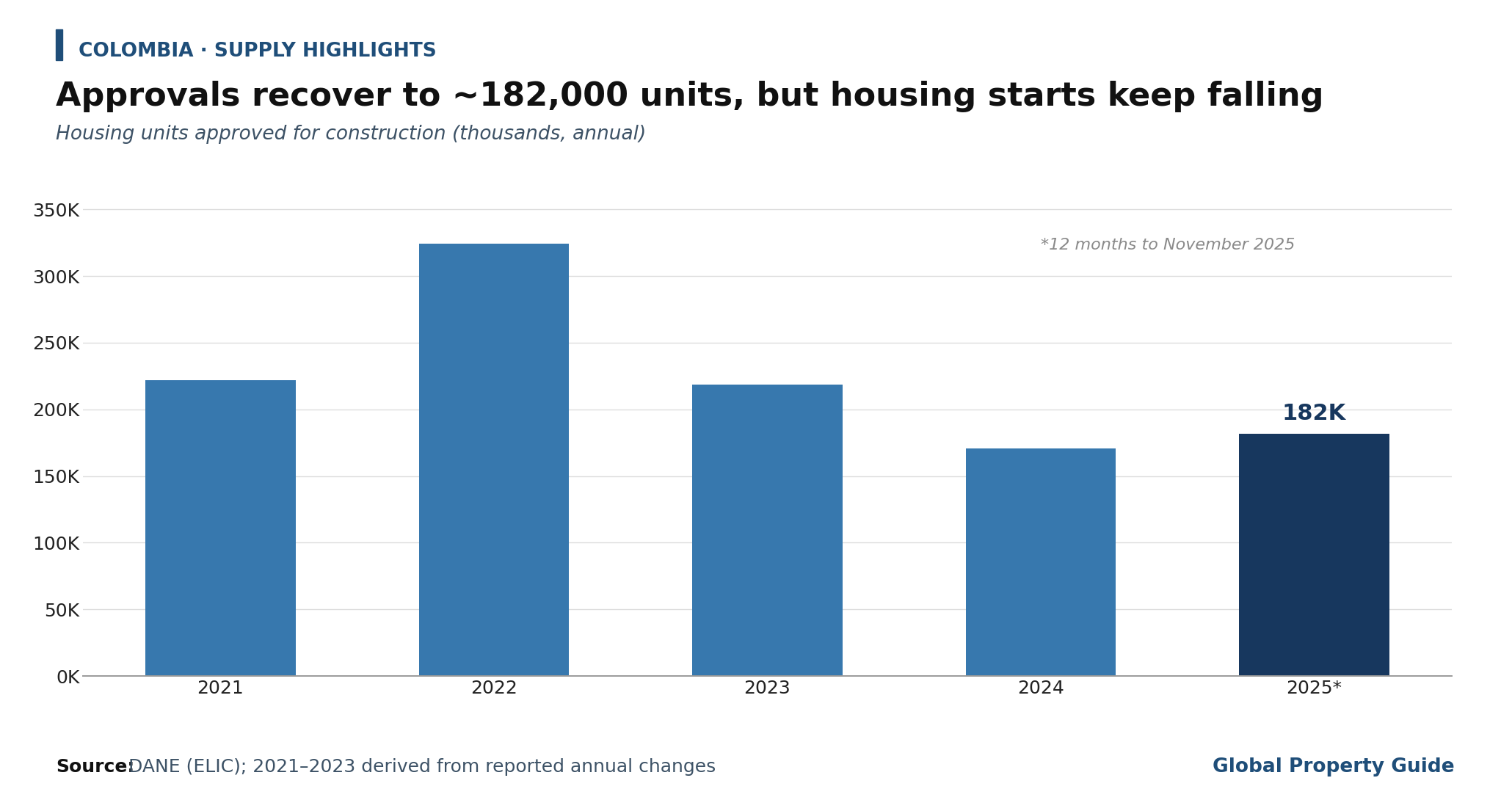
Building permit activity, a leading indicator of future supply, improved in 2025 after two very weak years. In the period from January to November 2025, a total of 19.03 million square meters (sqm) were licensed for construction, up 11.2% from the same period of 2024, according to DANE's ELIC statistics. Over the twelve months to November 2025, 181,858 housing units were approved: 99,957 non-VIS units and 81,901 VIS units.
The year ended on a weak note, with the licensed area falling 28.1% year-on-year in December 2025, but activity rebounded in January 2026, when 1.95 million sqm were approved, a 16.5% annual increase. The rebound, however, is being driven almost entirely by the market-rate segment: in January 2026, the area approved for non-VIS housing jumped 47.2% year-on-year, while the area licensed for social-interest housing fell 19.6%.
The critical bottleneck is housing starts. Only 115,687 units began construction in 2025, down 17.4% from 2024 and 23.8% below 2023, a level beneath even the pandemic trough. Builders cite tighter bank requirements for construction finance, licensing and urban-review delays, rising land-servicing costs, and, above all, uncertainty over subsidy schemes. The gap between recovering sales and collapsing starts points to tighter inventories and continued upward pressure on prices in 2026 and 2027 if construction does not restart.
Based on the latest estimates, there are over 16 million housing units in Colombia, of which about 40% are located in the five major cities of Barranquilla, Bogotá, Cali, Cartagena, and Medellín.
| EXISTING HOUSING STOCK | |
| Major Cities | Housing Units |
| Barranquilla | 559,049 |
| Bogotá | 3,138,369 |
| Cali | 924,259 |
| Cartagena | 392,718 |
| Medellín | 1,393,745 |
| Colombia | 16,070,893 |
| Data Sources: DANE, Massachusetts Institute of Technology | |
The housing deficit remains high, and the flagship subsidy program is gone
Colombia's housing deficit, meaning the share of households either poorly housed or not housed at all, stood at 25.6% in 2025, equivalent to about 4.81 million families, according to Camacol's analysis of DANE's Encuesta de Calidad de Vida. The quantitative deficit (homes that need to be built from scratch) is estimated at about 1.18 million units.
Over the past decade and a half, successive governments attacked this deficit with an alphabet of programs: free VIP homes for the poorest (from 2012), VIS subsidies for low-income buyers, Semillero de Propietarios and Casa Digna Vida Digna (2018), and, most importantly, Mi Casa Ya (from 2014), which combined down-payment subsidies with interest-rate coverage and became the country's most successful demand-side housing tool.
That era effectively ended in December 2024, when the government suspended new applications to Mi Casa Ya amid a severe fiscal shortfall following the collapse of its proposed tax reform. The suspension persisted throughout 2025 and into 2026, leaving tens of thousands of low-income households without access to subsidized interest rates. Local governments in Bogotá, Antioquia, and Atlántico launched their own subsidy schemes to partially fill the gap, which explains why those regions drove national sales growth, but industry representatives argue this has concentrated housing access in the largest cities while smaller markets languish.
The subsidy vacuum is now a central policy question for the incoming administration. Camacol has publicly called on the next government to restore a national program along the lines of Mi Casa Ya, warning that the VIP and VIS segments cannot recover without it. A related controversy concerns VIS price caps, which are indexed to the minimum wage: after the roughly 23% minimum-wage increase decreed for 2026, the VIS ceiling rose to COP 262.6 million (150 monthly minimum wages), and Camacol estimates the cap has increased 76% during the outgoing administration, far faster than household incomes, squeezing precisely the buyers the program is meant to serve.
Rental Market:
Rental yields are good and improving
Gross rental yields in Colombia (the return earned on the purchase price of a rental property, before taxes, vacancy, and other costs) are attractive by international standards, and rents have been rising quickly: rents are one of the main drivers of current services inflation, as they are indexed to the previous year's CPI.
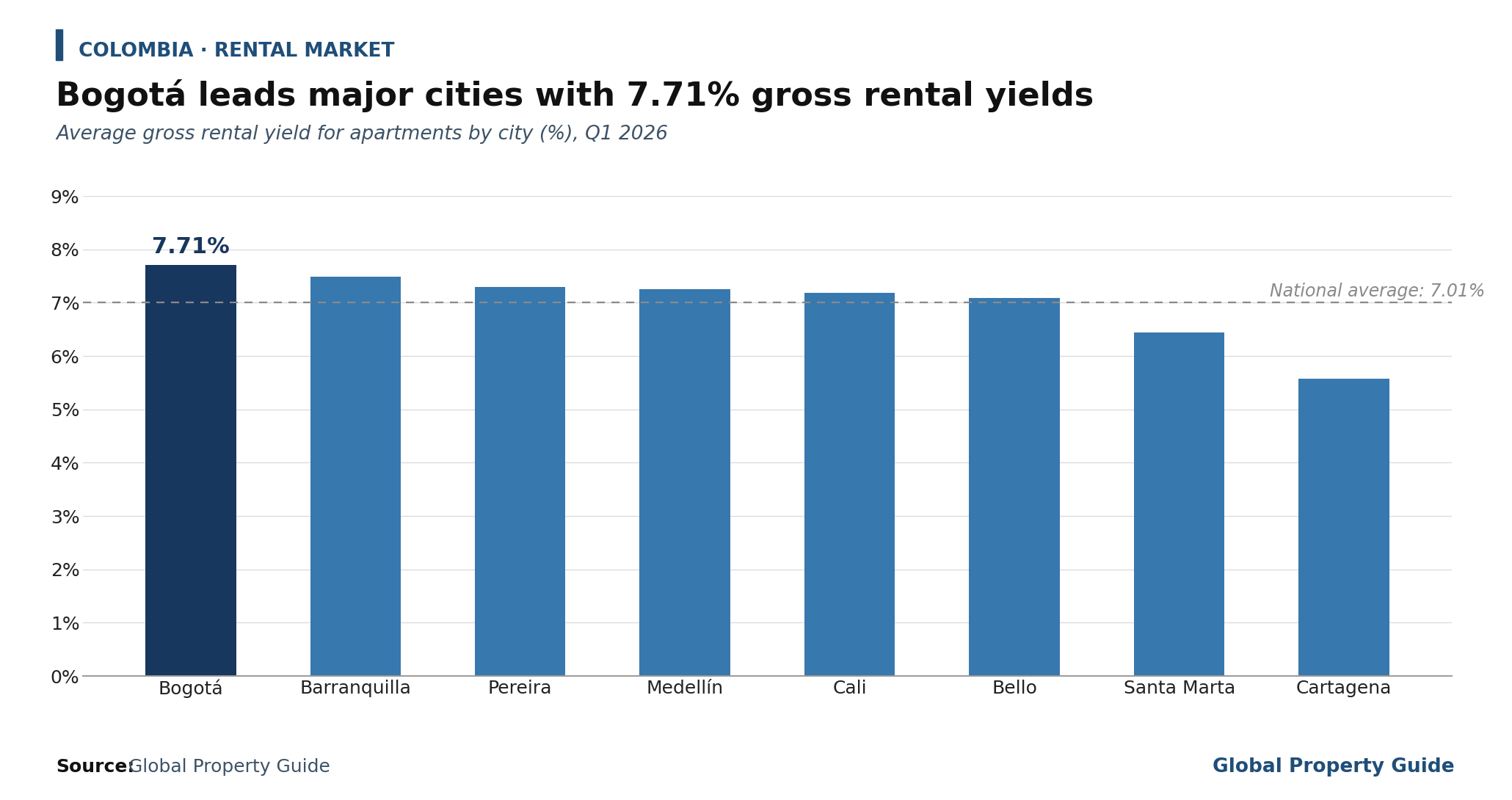
In Q1 2026, the average gross rental yield in Colombia stood at 7.01%, up from 6.88% in Q3 2025, according to research by the Global Property Guide.
Colombia's rent price index:
By city (Q1 2026):
- Bogotá offers the strongest returns among the major cities, with an average gross yield of 7.71%; one-bedroom apartments city-wide yield around 7.9%.
- Barranquilla averages 7.49%.
- Pereira averages 7.29%.
- Medellín averages 7.25%, with prime areas such as El Poblado yielding 7.1% to 7.7% depending on unit size.
- Cali averages 7.19%.
- Bello averages 7.09%.
- Santa Marta averages 6.44%.
- Cartagena remains the outlier at the bottom, averaging 5.58%, as tourist-driven purchase prices outpace long-term rents.
Given that managing a property typically costs the equivalent of 1.5% to 2% of gross yield, Colombian residential property still delivers a reasonable to good net return, and structurally rising rental demand, with more households renting for longer as ownership affordability deteriorates, supports investor interest in smaller units near universities and business districts.
Round-trip transaction costs are low in Colombia (i.e., the total costs of buying and selling a property).
Mortgage Market:
The rate-cutting cycle is over: borrowing costs are rising again
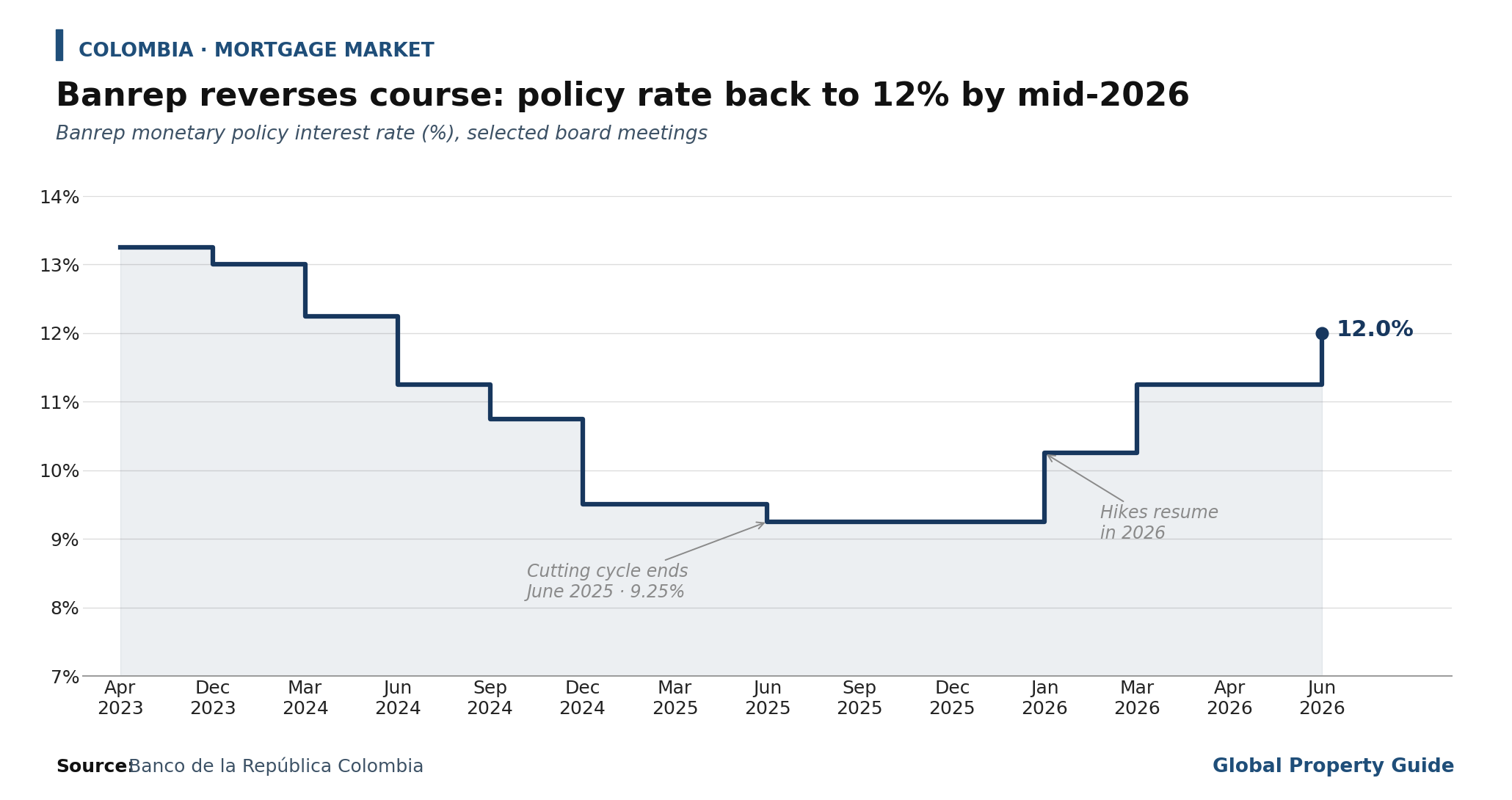
Colombia's monetary policy took a sharp turn in 2026. After ten rate cuts between December 2023 and mid-2025 had brought the benchmark rate down to 9.25%, Banco de la República Colombia (Banrep) reversed course as inflation re-accelerated:
- January 30, 2026: a surprise 100-basis-point hike to 10.25%.
- March 31, 2026: another 100-basis-point hike to 11.25%.
- April 30, 2026: rate held at 11.25% amid the electoral period.
- June 30, 2026: a 75-basis-point hike to 12%, the most restrictive stance since April 2024, in a divided board vote.
In its June 2026 minutes, the board justified the tightening by pointing to headline inflation of 5.8% in May (6.14% by June), core inflation of 6.0%, de-anchored inflation expectations of around 6.5% for end-2026, strong domestic demand, historically low unemployment (8.1% nationally in May 2026, seasonally adjusted), and cost pressures from the 2026 minimum-wage increase. Banrep's technical staff expects inflation to end 2026 above 6%, ease toward 4% in 2027, and only approach the 3% target in 2028.
Mortgage rates have followed the policy rate upward. Sector estimates put the average rate on peso-denominated housing loans at around 13% to 13.5% effective annual in early 2026 (Camacol estimated 13.47% in pesos and UVR + 7.12% in the inflation-indexed modality in February 2026). By June 2026, Superintendencia Financiera data showed weighted-average rates of about 15.2% for non-VIS mortgages and 14% for VIS loans, with a spread of more than five percentage points between the cheapest lender (the state-backed Fondo Nacional del Ahorro, at around 10.8% to 12.2% depending on segment) and the most expensive banks.
Camacol's sensitivity estimates illustrate why this matters so much for the market: a one-percentage-point rise in mortgage rates historically reduces VIS sales by about 9.3% (versus roughly 3.9% for non-VIS), with the full effect arriving about nine months later, implying the 2026 rate hikes will bite hardest in late 2026 and into 2027.
Structurally, mortgage borrowing in Colombia remains underdeveloped. Outstanding housing loans amount to only around 8% of GDP, only a small fraction of adults hold a mortgage, and lending remains concentrated in the subsidized and lower-priced segments, with traditional mortgages accounting for roughly 80% of the housing portfolio and leasing habitacional (housing leasing) the remainder.
Socio-Economic Context:
Moderate growth, stubborn inflation, and a strong peso
Colombia's economy grew by 2.6% in 2025, up from 1.7% in 2024 and 0.7% in 2023, according to DANE. Growth was driven by commerce, transport and hospitality (+4.6%), public administration, education and health (+4.5%), and a boom in arts and entertainment (+9.9%), while construction contracted by 2.8% and mining by 6.2%, as reported by the Ministry of Finance. Consumption did the heavy lifting: final consumption expanded 4.2% in the year, while investment grew a modest 2.1% and actually contracted sharply in the fourth quarter.
In Q1 2026, GDP grew 2.2% year-on-year, with domestic demand still outpacing production, one of the imbalances the central bank cites for its tightening cycle.
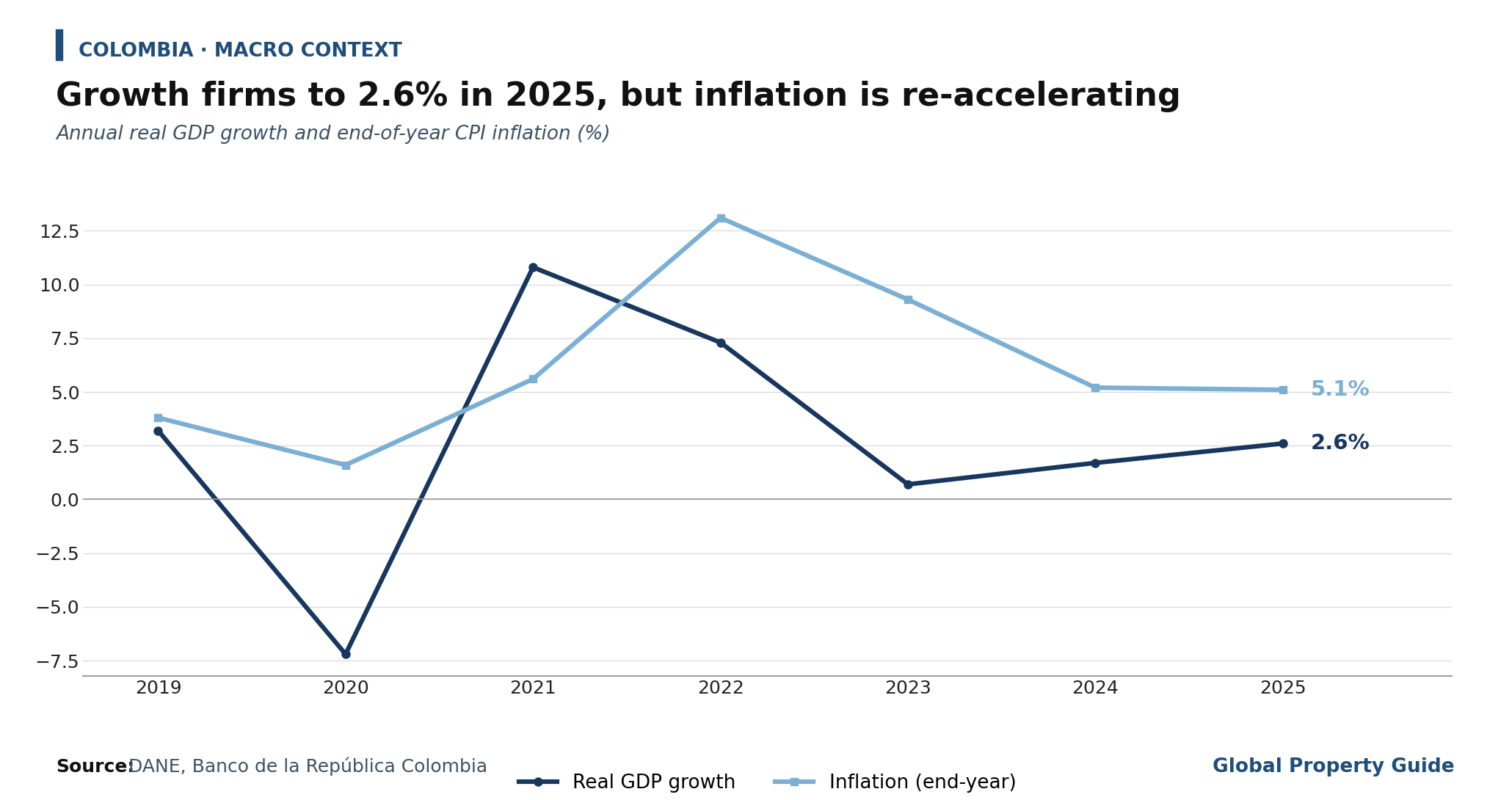
Inflation is the economy's sore spot. After easing to a post-2021 low of 4.82% in June 2025, annual consumer price inflation climbed steadily to 6.14% by June 2026, its highest level since July 2024 and more than double the central bank's 3% target, driven by food, rents and other indexed services, utilities, and the pass-through of the 2026 minimum-wage increase.
The labor market, by contrast, is unusually strong. The national unemployment rate stood at 8.1% in May 2026 (seasonally adjusted), historically low for Colombia, according to DANE, whose jobless rate averaged over 11% between 2004 and 2024.
The Colombian peso has been one of the world's best-performing currencies. From a record low of about COP 4,918 per US dollar in November 2022, the peso strengthened to roughly COP 3,757 by the end of 2025 and then rallied further in 2026, including a 7.4% jump in June alone after the election result, reaching about COP 3,249 per dollar in mid-July 2026, its strongest level since 2019, based on the official market representative exchange rate (TRM). The peso is up roughly 13.5% year-to-date and about 19% year-on-year, cheering importers and dollar-earning households but squeezing exporters and making Colombian property more expensive for foreign buyers.
Tourism: record foreign arrivals, but a weaker headline number
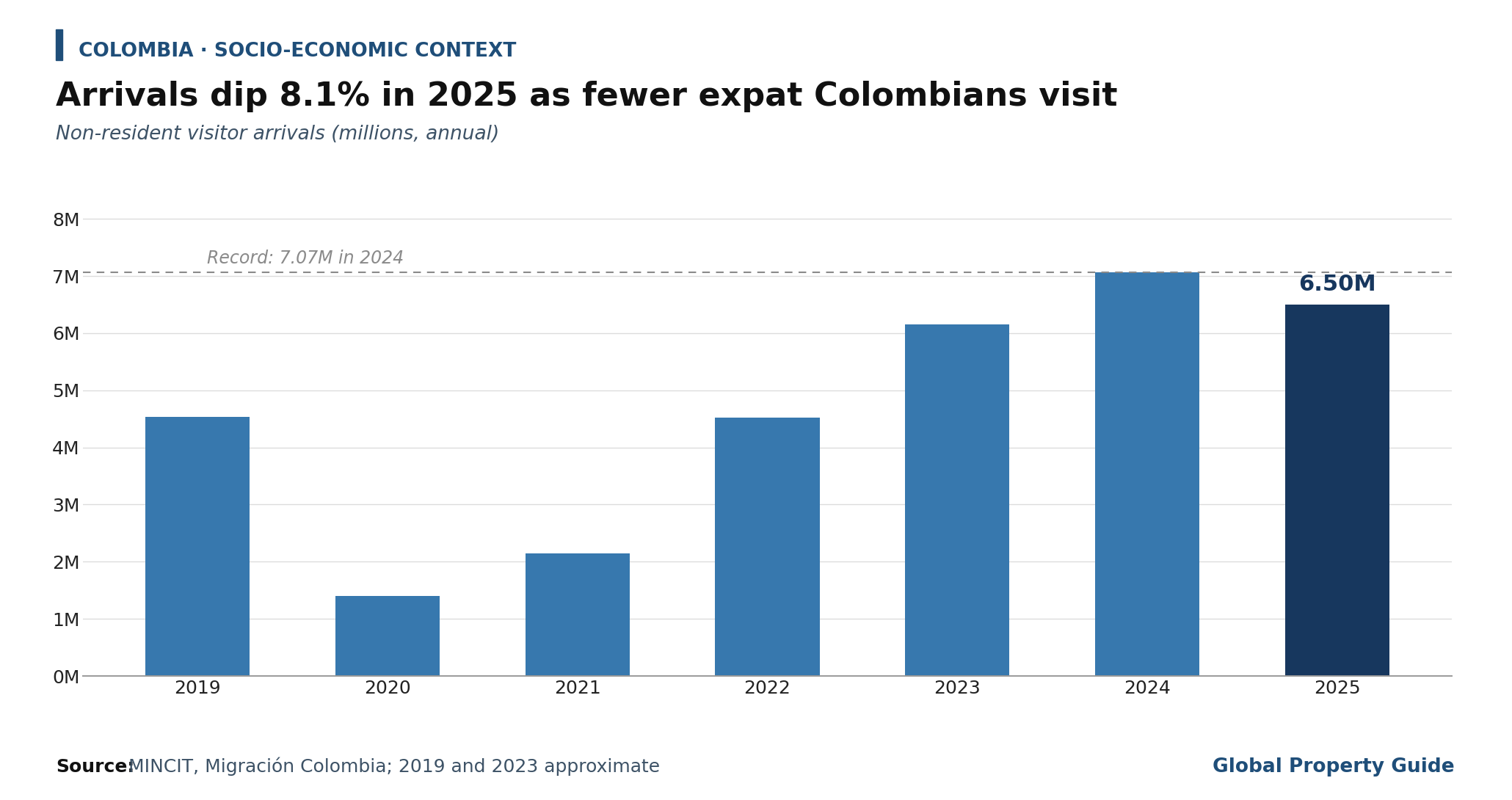
Colombia's headline tourism figure declined in 2025: total non-resident visitors fell by 8.1% to 6,496,458, down from the all-time record of 7,071,459 in 2024, according to figures from the Ministry of Commerce, Industry and Tourism (MINCIT) analyzed by travel-industry association Anato.
The composition of the decline matters. Arrivals of foreign non-resident visitors, the core inbound tourism metric, actually grew by 3.8% to a record 4,677,267, and international cruise passengers rose 4.3% to 320,591. The overall drop came entirely from Colombians residing abroad visiting their home country, whose trips collapsed by 33.7% (roughly 760,000 fewer visits), a trend widely attributed to migration-enforcement pressures in the United States, home to the largest Colombian diaspora.
Tourism's economic footprint kept growing regardless: foreign visitors' credit-card spending reached a record US$2.48 billion in 2025, up 5.2%, and tourism-related foreign exchange has overtaken coal exports as a source of external income. The United States remains the top source market (around 26% of foreign arrivals), followed by Mexico and Ecuador, and Bogotá, Antioquia (Medellín), and Bolívar (Cartagena) remain the top destinations. Bogotá's El Dorado airport ranked as Latin America's second-busiest by passenger traffic in 2025, behind only São Paulo.
Political transition: from Petro to De la Espriella
Colombia's political landscape shifted decisively in 2026. President Gustavo Petro, who became the country's first left-wing president when elected in 2022, ends his term in August 2026. His approval ratings, which had sunk below 30% in mid-2025 amid security deterioration, stalled reforms, and the Mi Casa Ya suspension, recovered notably in his final year, reaching roughly 49% to 50% by early 2026 on the back of minimum-wage increases, labor reform, and falling unemployment and poverty. His "Total Peace" policy of negotiating with armed groups, however, is widely judged a failure, with record cocaine production and worsening rural security.
In the March 8, 2026, legislative elections, Petro's Historic Pact won the most seats in both chambers but fell far short of majorities, confirming a fragmented, polarized Congress.
The presidential race produced one of the closest results in Colombia's modern history. Right-wing lawyer and political outsider Abelardo de la Espriella, who was endorsed by U.S. President Donald Trump, won the May 31 first round with 44% against 41% for left-wing senator Iván Cepeda, then prevailed in the June 21 runoff by around 250,000 votes out of nearly 26 million cast, with record runoff turnout of 63.6%. Cepeda conceded after initial disputes over the count, and electoral authorities and international observers vouched for the process. De la Espriella, who campaigned on an "iron fist" security platform, lower taxes, smaller government, and closer ties with Washington, takes office on August 7, 2026.
For the housing market, the transition carries three immediate implications: whether the new government restores a national housing subsidy program to replace Mi Casa Ya; how quickly fiscal consolidation can ease the risk premium and allow the central bank to stop hiking; and whether renewed investor confidence, already visible in the peso's post-election rally, translates into a recovery in construction starts. Financial markets' initial verdict was positive, but with a wafer-thin mandate and only a handful of seats in Congress for his movement, the new president's room to legislate remains uncertain.
Sources:
- New House Price Index (IPVN), Q1 2026 (DANE): https://www.dane.gov.co/
- Used Housing Price Index (IPVU) (Banco de la República Colombia): https://suameca.banrep.gov.co/
- Housing Prices indicator (OECD): https://www.oecd.org/
- El Gobierno de Colombia suspende las postulaciones para el programa Mi Casa Ya (El País): https://elpais.com/
- Construction in figures / Coordenada Urbana, 2025 year-end results (Camacol): https://camacol.co/
- La vivienda: sector estratégico para el próximo gobierno (Camacol): https://camacol.co/
- Building Permit Statistics (ELIC) (DANE): https://www.dane.gov.co/
- GDP, Q4 2025 and Q1 2026 (DANE): https://www.dane.gov.co/
- CPI, June 2026 (DANE): https://www.dane.gov.co/
- Monetary policy decision and minutes, June 2026 (Banco de la República Colombia): https://www.banrep.gov.co/
- Camacol informó que se vendieron 174.000 unidades de vivienda durante 2025 (La República): https://www.larepublica.co/
- Precio de la vivienda nueva subió 8% en 2026, con un desplome en la oferta (El Colombiano): https://www.elcolombiano.com/
- Las tasas para la compra de vivienda están entre 11,8% y 17,7%, según la Superfinanciera (La República): https://www.larepublica.co/
- Gross rental yields in Colombia: Bogotá and other cities, Q1 2026 (Global Property Guide): https://www.globalpropertyguide.com/
- La economía colombiana creció 2,6% durante 2025 (Presidencia de la República / DANE): https://www.presidencia.gov.co/
- Economía colombiana creció 2,6% en 2025 (Ministerio de Hacienda): https://www.minhacienda.gov.co/
- Tourism 2025 results (Ministry of Commerce, Industry and Tourism / Anato): https://www.mincit.gov.co/
- Colombia's 2026 Presidential Election (U.S. Congressional Research Service): https://www.congress.gov/
- What to Know About Colombia's 2026 Presidential Runoff Results (AS/COA): https://www.as-coa.org/
- TRM (Tasa Representativa del Mercado) (Banco de la República / Superintendencia Financiera): https://suameca.banrep.gov.co/
- Ministry of Housing, City, and Territory (Minvivienda): https://minvivienda.gov.co/