Italy's Residential Property Market Analysis 2026
Italy's housing market has lost momentum since the spring. The energy shock from the war in the Middle East has pushed inflation to 5.4%, the European Central Bank (ECB) has raised interest rates twice, and mortgage rates are edging up. Home sales have stalled, and house price growth, still about 4% a year, is now falling behind consumer prices.
This extended overview from Global Property Guide covers key aspects of the Italian housing market and takes a closer look at its most recent developments and long-term trends.
Table of Contents
- Property Prices and Price Index
- Property Demand Trends
- Property Supply Trends
- Rental Market: Rents and Rental Yields
- Mortgage Market and Interest Rates
- Economic and Social Factors
Property Prices and Price Index
In our May 2026 edition, house prices were rising by about 4% a year, sales had just had their second-best year in a decade, inflation was 2.8% and the ECB had kept its rates on hold for almost a year. Six months later, much of that picture has changed. The ECB has raised its deposit rate from 2.00% to 2.50%, inflation has jumped to 5.4%, sales growth has come to a halt and real house price growth is close to zero.
Italy's house price annual change:
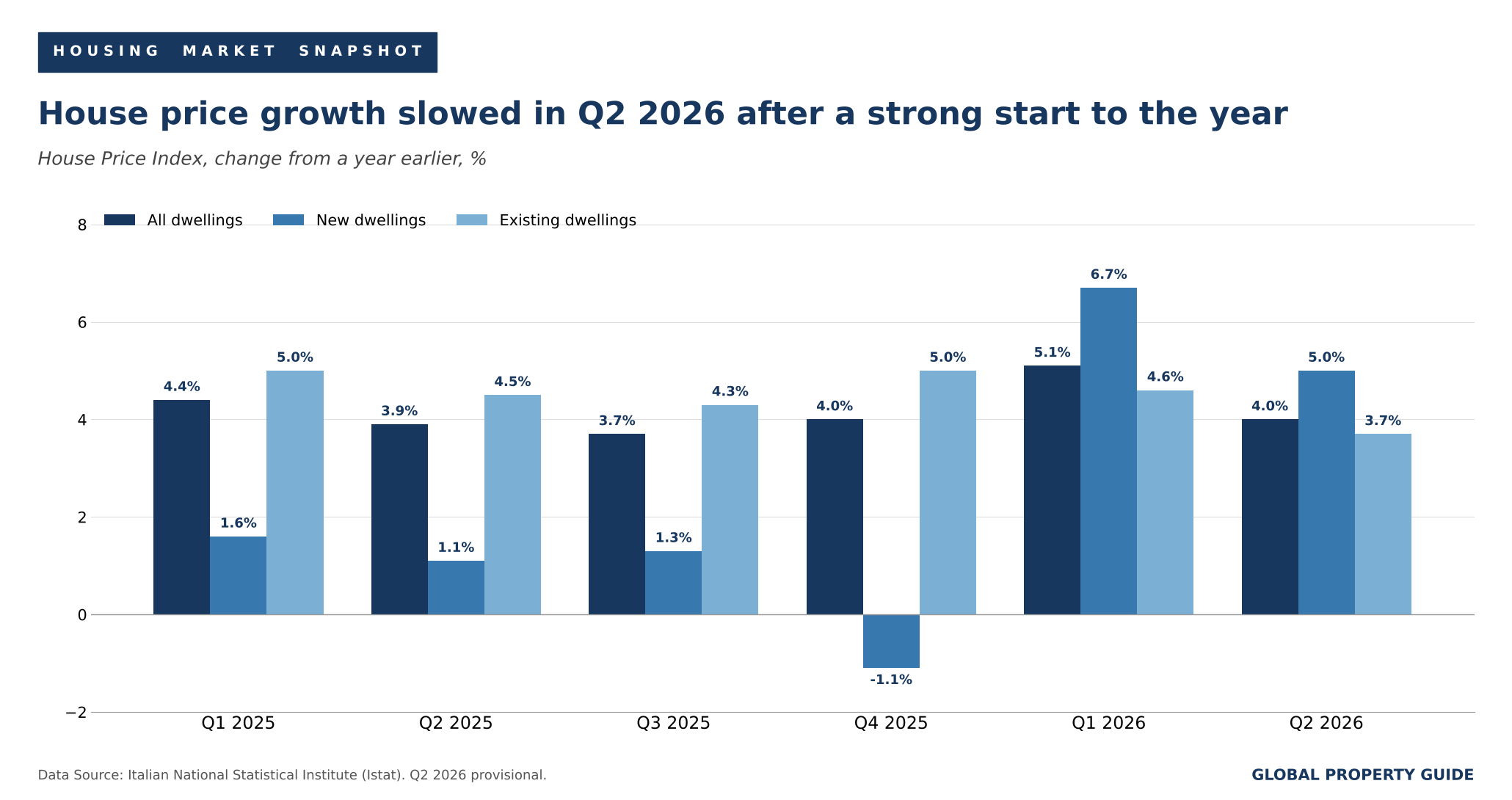
The Italian National Statistical Institute (Istat) reports that house prices rose by 4.0% in the year to Q2 2026. That was a slowdown from 5.1% in Q1 2026. Consumer prices rose by about 3.0% over the same period, so house prices rose by only about 1.0% in real terms. From Q1 to Q2, prices rose by 1.7%.
The pattern between new and existing homes has reversed. In our previous edition, prices of new dwellings were falling, down 1.2% in the year to Q4 2025, while existing homes drove growth. In Q2 2026, prices of new dwellings rose by 5.0% from a year earlier, while prices of existing dwellings rose by 3.7%, Istat's full release shows. Growth slowed in both segments compared with Q1, when new-home prices were up 6.7% and existing-home prices 4.6%.
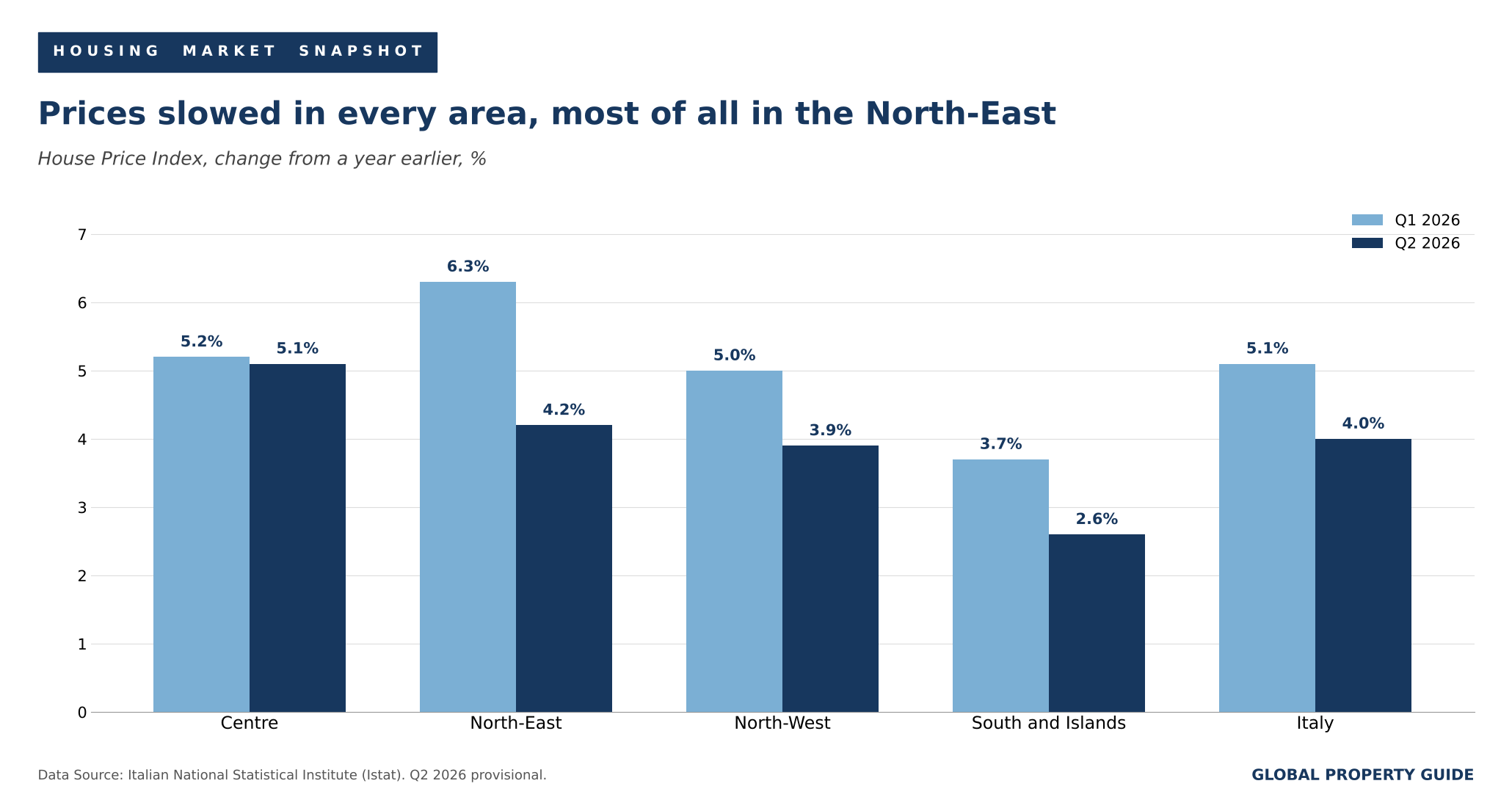
Price growth slowed in every part of the country. Central Italy had the fastest growth in Q2, at 5.1%, almost unchanged from Q1. The slowdown was sharpest in the North-East, where growth fell from 6.3% to 4.2%. In the North-West, prices rose by 3.9%, and in the South and Islands by 2.6%, the weakest of the four areas, Istat said.
Asking prices, which are more up to date, are still rising. The average asking price for a home in Italy was EUR 2,229 (USD 2,502) per square meter in October 2026, up 5.0% from a year earlier, data from the property portal Immobiliare.it show. Turin (+8.9%) and Genoa (+8.1%) had the fastest growth among the big cities, and Naples (+1.2%) and Milan (+1.7%) the slowest. Milan remains by far the most expensive city, at EUR 5,667 (USD 6,361) per square meter, about 2.5 times the national average.
Average asking prices in selected cities:
| City | EUR per sq. m., October 2026 |
USD per sq. m., October 2026 |
Change from October 2025 |
| Rome | EUR 3,895 | USD 4,372 | 6.5% |
| Milan | EUR 5,667 | USD 6,361 | 1.7% |
| Turin | EUR 2,297 | USD 2,578 | 8.9% |
| Genoa | EUR 1,891 | USD 2,122 | 8.1% |
| Naples | EUR 3,044 | USD 3,417 | 1.2% |
| Palermo | EUR 1,598 | USD 1,794 | 5.1% |
| Bologna | EUR 3,824 | USD 4,292 | 3.0% |
| Florence | EUR 4,787 | USD 5,373 | 2.2% |
| Italy | EUR 2,229 | USD 2,502 | 5.0% |
| Note: Converted at EUR 1 = USD 1.1224, the ECB reference rate on 5 November 2026. | |||
| Data source: Immobiliare.it. | |||
Estate agents report that the market is cooling. In the Bank of Italy's survey of estate agents for Q2 2026, the share of agents reporting higher prices, minus the share reporting lower prices, fell to 7 percentage points, from 12 points in Q1, the central bank found. Agents described this as a slowdown in prices. Buyers still have little room to negotiate: the average discount on the asking price was 7.1%, and homes took 5.2 months to sell, both close to the lowest levels since the survey began.
With inflation at 5.4% in October, house prices are now likely to fall in real terms in the second half of 2026 unless price growth picks up. Istat will publish its flash estimate for Q3 2026 on 17 December.
All dollar conversions in this article use the ECB reference rate for 5 November 2026, EUR 1 = USD 1.1224, as published by the ECB. Compared with the rate used in our previous edition (EUR 1 = USD 1.1706), the euro has lost 4.1% of its value against the dollar.
Property Demand Trends
Sales have stalled
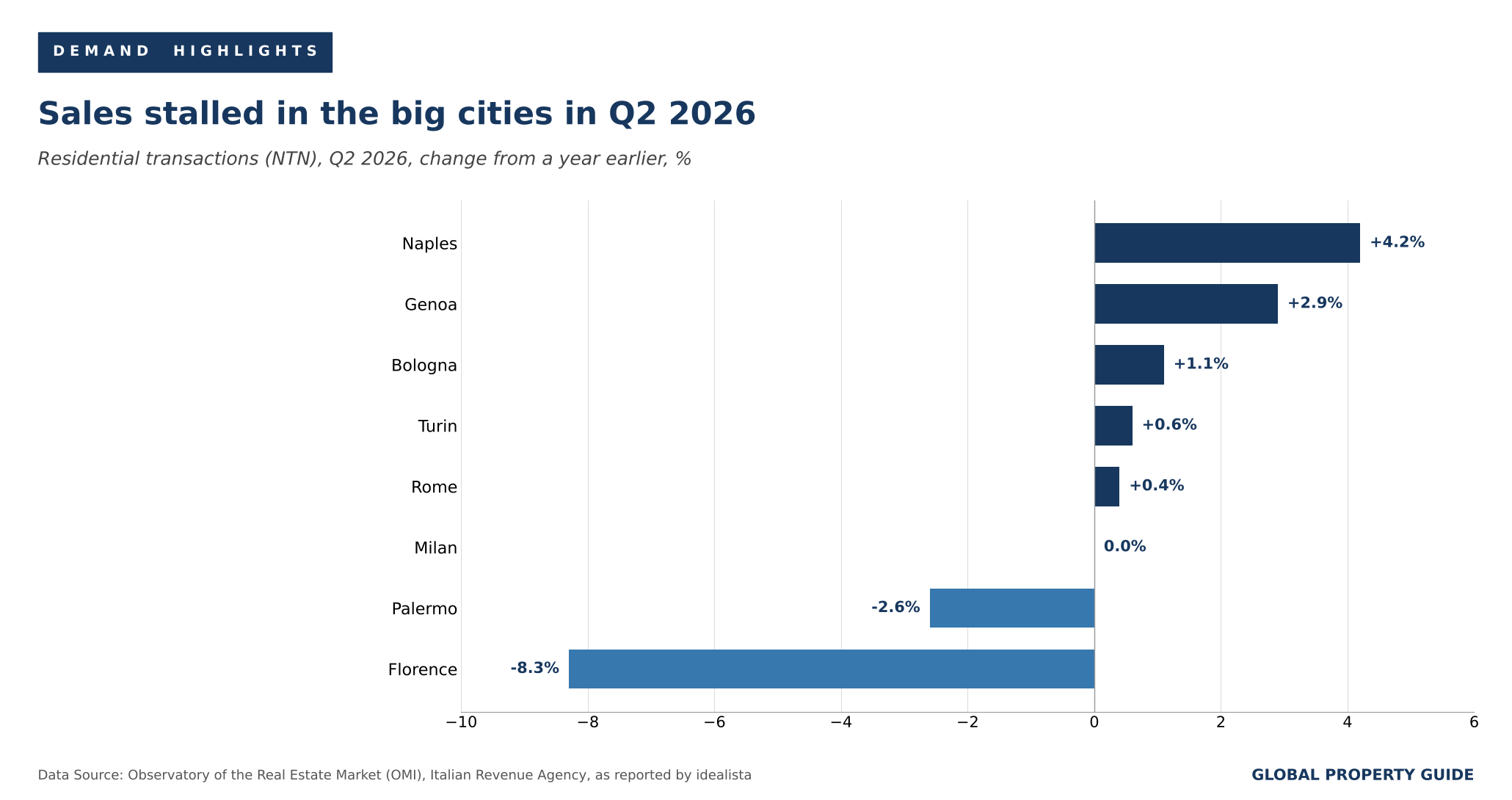
After two years of recovery, home sales have stopped growing. The Observatory of the Real Estate Market (OMI) of the Italian Revenue Agency reports that residential sales rose by just 0.1% from a year earlier in Q2 2026, down from growth of 4.4% in Q1, as cited by Istat. Just over 201,000 homes were sold in the quarter, according to OMI data reported by the property portal idealista. Sales rose by 0.5% in provincial capitals and were flat elsewhere.
The eight largest cities saw combined growth of only 0.3%, the same report said. Naples (+4.2%) and Genoa (+2.9%) had the strongest growth. Sales were flat in Milan, up only 0.4% in Rome, and fell in Palermo (-2.6%) and Florence (-8.3%).
Buyers are holding back
The Bank of Italy's survey confirms that demand has weakened. Estate agents reported that the number of sales they handled fell slightly from a year earlier in Q2 2026, and that demand remained subdued, the central bank said. The share of agents reporting more potential buyers, minus the share reporting fewer, was -15 points, a little better than -19 a year earlier.
Agents are more hopeful about the longer term. Their balance of expectations for the national market over the next two years improved to -10 points, from -22 in Q1, the Bank of Italy's survey showed. The Bank of Italy will publish its Q3 survey between 16 and 23 November.
Credit still supports purchases
Mortgages remain central to buying a home. About 47% of homes bought by individuals in Q2 2026 were financed with a mortgage, at an average initial rate of about 3.6%, OMI data reported by idealista show. In the agency market, the share is higher: 63.1% of purchases handled by agents in Q2 were financed with a mortgage, at an average loan-to-value ratio of 78.2%, the Bank of Italy said. Only 18% of agents said difficulty getting a loan was a main reason for sales falling through, the lowest share since the series began.
Property Supply Trends
Permits are rising from a low base
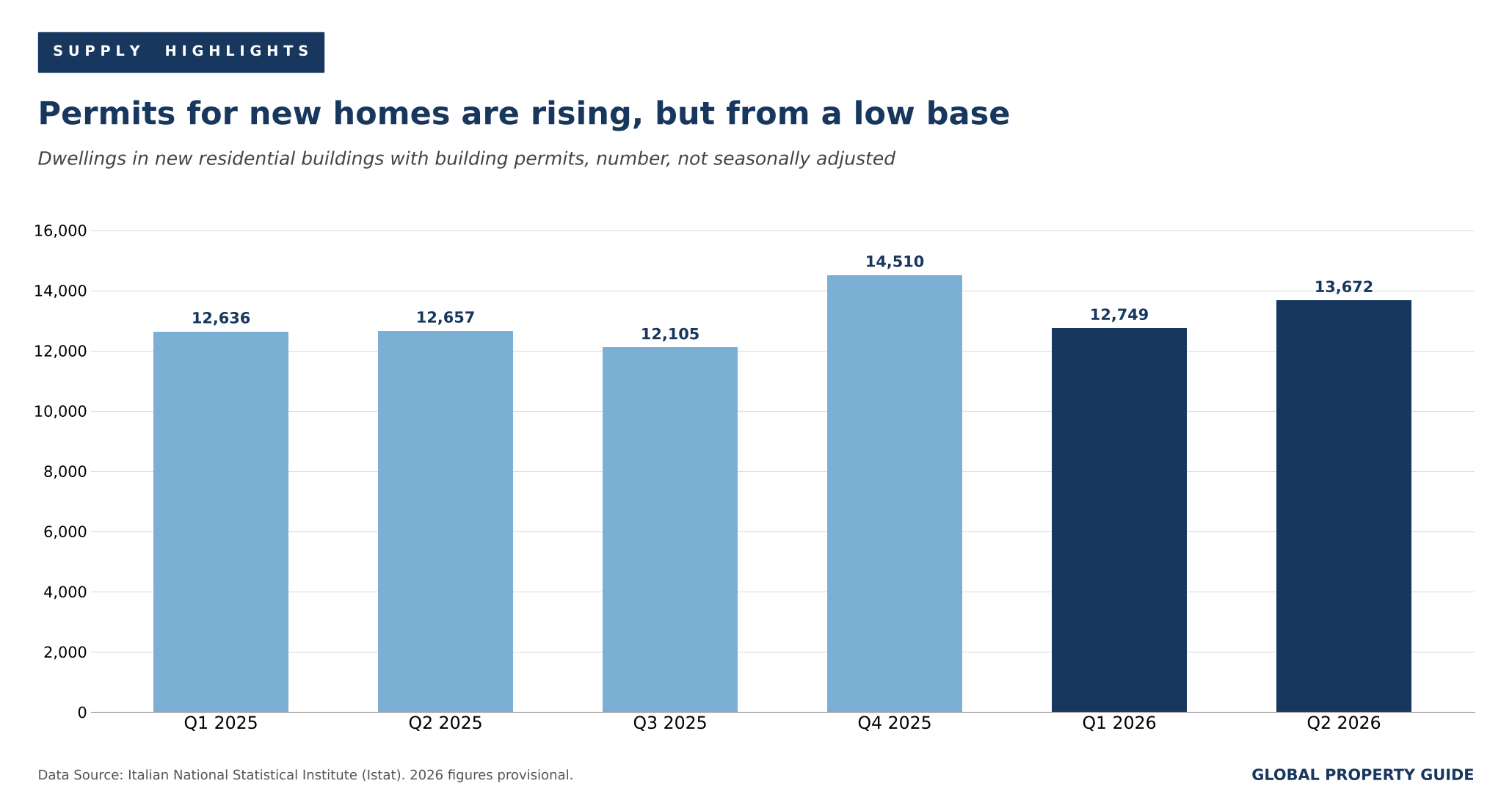
Permits for new homes have started to rise. In Q2 2026, permits were issued for 13,672 dwellings in new residential buildings, up 8.0% from a year earlier, Istat data show. In H1 2026, 26,421 dwellings were permitted, 4.5% more than in H1 2025.
Last year was weaker than first reported. Istat now puts the number of dwellings permitted in 2025 at 51,908, down 6.1% from 2024. In April, it had reported 53,024 dwellings, a fall of 4.0%.
Fewer homes are coming up for sale
The supply of existing homes for sale is still shrinking. In the Bank of Italy's Q2 survey, the share of agents reporting fewer new sale instructions, minus the share reporting more, was 26 points. The survey said that supply continued to contract.
The government's housing plan
In May, the government launched a housing plan, the Piano Casa, by Decree-Law 66 of 7 May 2026, which Parliament converted into Law 116 of 2 July 2026. The plan has three parts, according to an analysis by ANCE, the national association of building contractors. The first uses EUR 7.37 billion (USD 8.27 billion) of existing public funds to renovate public housing and bring empty public homes back into use. The second is a housing fund that could draw on up to about EUR 3 billion (USD 3.37 billion) of cohesion funds, although it receives only EUR 100 million in 2026.
The third part relies on private investment in mixed developments. At least 70% of the investment must go to subsidized housing, priced or let at least 33% below OMI reference values for at least 30 years. The plan also allows long-term rentals with an option to buy for young people, young couples and separated parents, and simplifies planning rules for renovation and rebuilding. Most of the money is for renovating existing public housing, so the plan is unlikely to add much new supply in the near term.
Rental Market: Rents and Rental Yields
Asking rents are still rising
Asking rents are rising faster than six months ago, according to one portal. The average asking rent in Italy was EUR 15.09 (USD 16.94) per square meter per month in October 2026, up 5.5% from a year earlier, Immobiliare.it figures show. In April, rent growth had slowed to 3.4%. Genoa (+9.7%), Rome (+8.8%) and Naples (+8.2%) had the fastest growth among the big cities. Rents rose only 0.6% in Milan and fell by 2.4% in Bologna.
Average asking rents in selected cities:
| City | EUR per sq. m. per month, October 2026 |
USD per sq. m. per month, October 2026 |
Change from October 2025 |
| Rome | EUR 19.75 | USD 22.17 | 8.8% |
| Milan | EUR 22.52 | USD 25.28 | 0.6% |
| Turin | EUR 13.08 | USD 14.68 | 5.3% |
| Genoa | EUR 11.26 | USD 12.64 | 9.7% |
| Naples | EUR 15.77 | USD 17.70 | 8.2% |
| Palermo | EUR 9.66 | USD 10.84 | 4.9% |
| Bologna | EUR 16.50 | USD 18.52 | -2.4% |
| Florence | EUR 21.64 | USD 24.29 | 2.7% |
| Italy | EUR 15.09 | USD 16.94 | 5.5% |
| Note: Converted at EUR 1 = USD 1.1224, the ECB reference rate on 5 November 2026. | |||
| Data source: Immobiliare.it. | |||
Rents are now rising more slowly than inflation
Other data point to a slowdown. Asking rents rose by just 1.8% in the year to Q3 2026, and by 0.5% from Q2, to an average of EUR 14.6 (USD 16.4) per square meter, according to idealista. "The third quarter of 2026 would seem to mark a change of pace in the rental market," said Vincenzo De Tommaso, head of research at idealista. He noted that "rents are now below general inflation," and linked the slowdown to more homes for rent returning to the market.
Italy's rent price index:
Estate agents still report rising rents, but less widely than a year ago. In the Bank of Italy's Q2 survey, the share of agents reporting higher rents, minus the share reporting lower rents, was 32 points, compared with 43 points a year earlier. In the consumer price index, prices of services related to housing rose by 4.3% in the year to October, Istat reported, well below overall inflation of 5.4%.
Rental yields
Gross rental yields on apartments in Italy averaged 7.23% in January 2026, down from 7.50% a year earlier, Global Property Guide research shows. Yields were highest in Catania (9.17%) and Palermo (8.25%), and lowest in Florence (5.88%) and Milan (5.26%).
Mortgage Market and Interest Rates
The ECB has raised rates twice
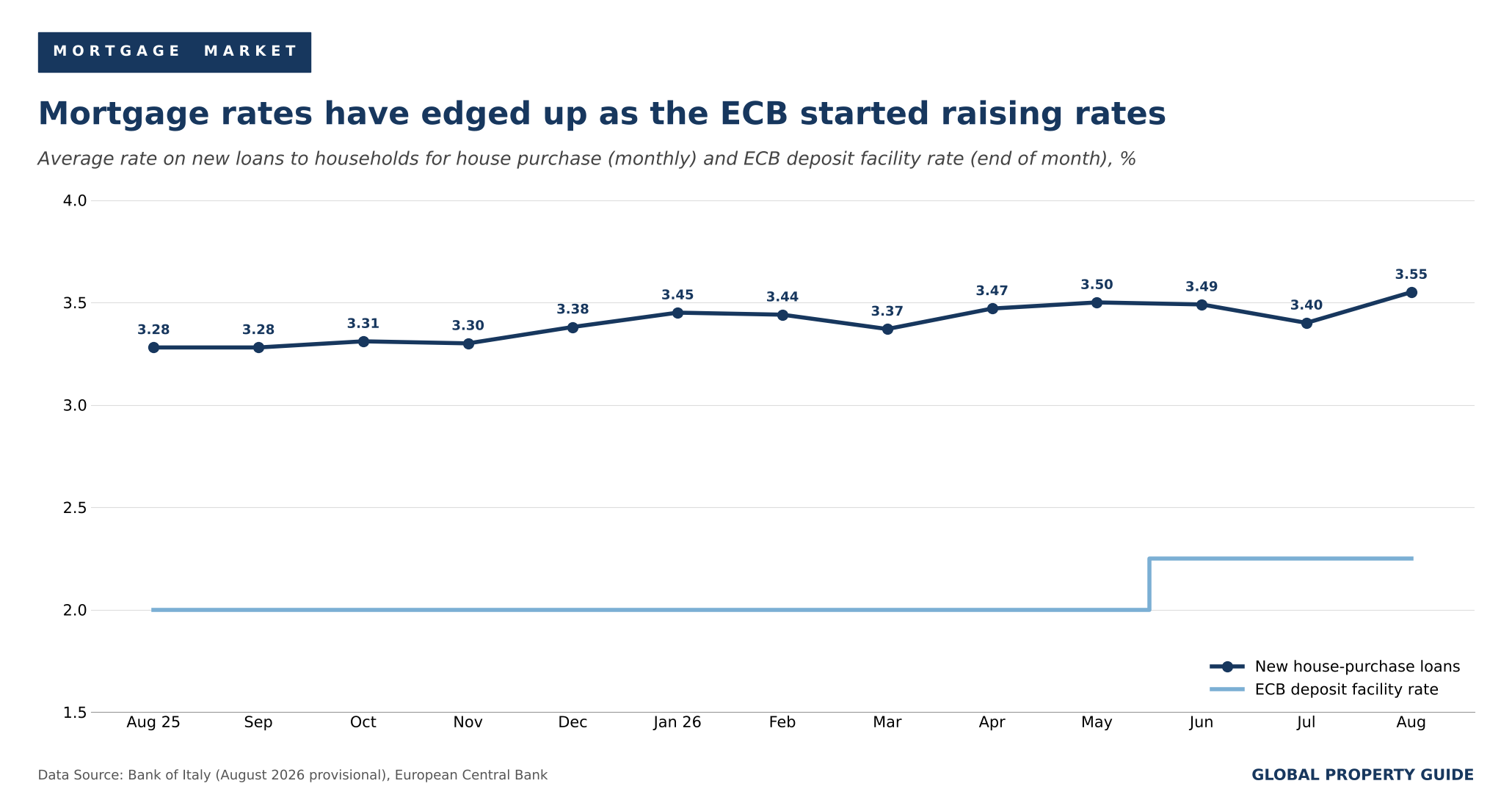
The ECB has started raising interest rates in response to the energy shock. In our May edition, its deposit facility rate stood at 2.00%, where it had been since June 2025. On 10 September 2026, the ECB raised its three key rates by 25 basis points for the second time this year, taking the deposit facility rate to 2.50%. It said that "inflation is set to remain well above target for an extended period." ECB staff expect euro area inflation of 3.0% in 2026, 2.5% in 2027 and 2.1% in 2028.
Italy's mortgage loan interest rates:
On 29 October, the ECB kept its rates unchanged. It pointed to "the increased magnitude and duration of the energy shock" and said financing conditions had tightened since its previous meeting. It said it is "not pre-committing to a particular rate path."
Mortgage rates are edging up
Italian mortgage rates have risen modestly. The average interest rate on new loans to households for house purchase was 3.55% in August 2026, provisional Bank of Italy figures show. That was up from 3.44% in February, the latest figure in our previous edition, and from 3.28% a year earlier. Including fees, the annual percentage rate of charge (APRC) was 3.99%, up from 3.67% a year earlier. Rates fixed for more than a year averaged 3.61%, and floating rates 3.37%.
Borrowing costs could rise further. The yield on 10-year Italian government bonds reached 4.6% after the start of the conflict, the Bank of Italy's October Economic Bulletin notes, and in a bank lending survey, euro area banks said they had tightened their lending standards for mortgages in Q2.
Lending is still growing
So far, higher rates have not stopped households from borrowing. Bank loans to households were 2.9% higher in August 2026 than a year earlier, up from 2.6% in July, the Bank of Italy reported. Banks made EUR 41.5 billion (USD 46.6 billion) of new house-purchase loans in the first seven months of 2026. July, at EUR 7.9 billion, was the strongest month in more than a year.
Economic and Social Factors
Growth has stalled
Italy's economy stopped growing in the third quarter. GDP was unchanged from Q2 2026 and 0.8% higher than a year earlier, Istat's preliminary estimate shows. Services and agriculture grew, while industry shrank.
Forecasts for the year as a whole have still improved, because growth in the first half was stronger than expected. In October, the Bank of Italy projected growth of 0.9% in 2026, 0.7% in 2027 and 0.8% in 2028, up from 0.5% for 2026 in its June projections. The International Monetary Fund (IMF) expects growth of 0.8% in 2026 and 0.6% in 2027. The Bank of Italy expects household spending to weaken in late 2026 and in 2027, as inflation erodes real incomes.
Inflation has jumped
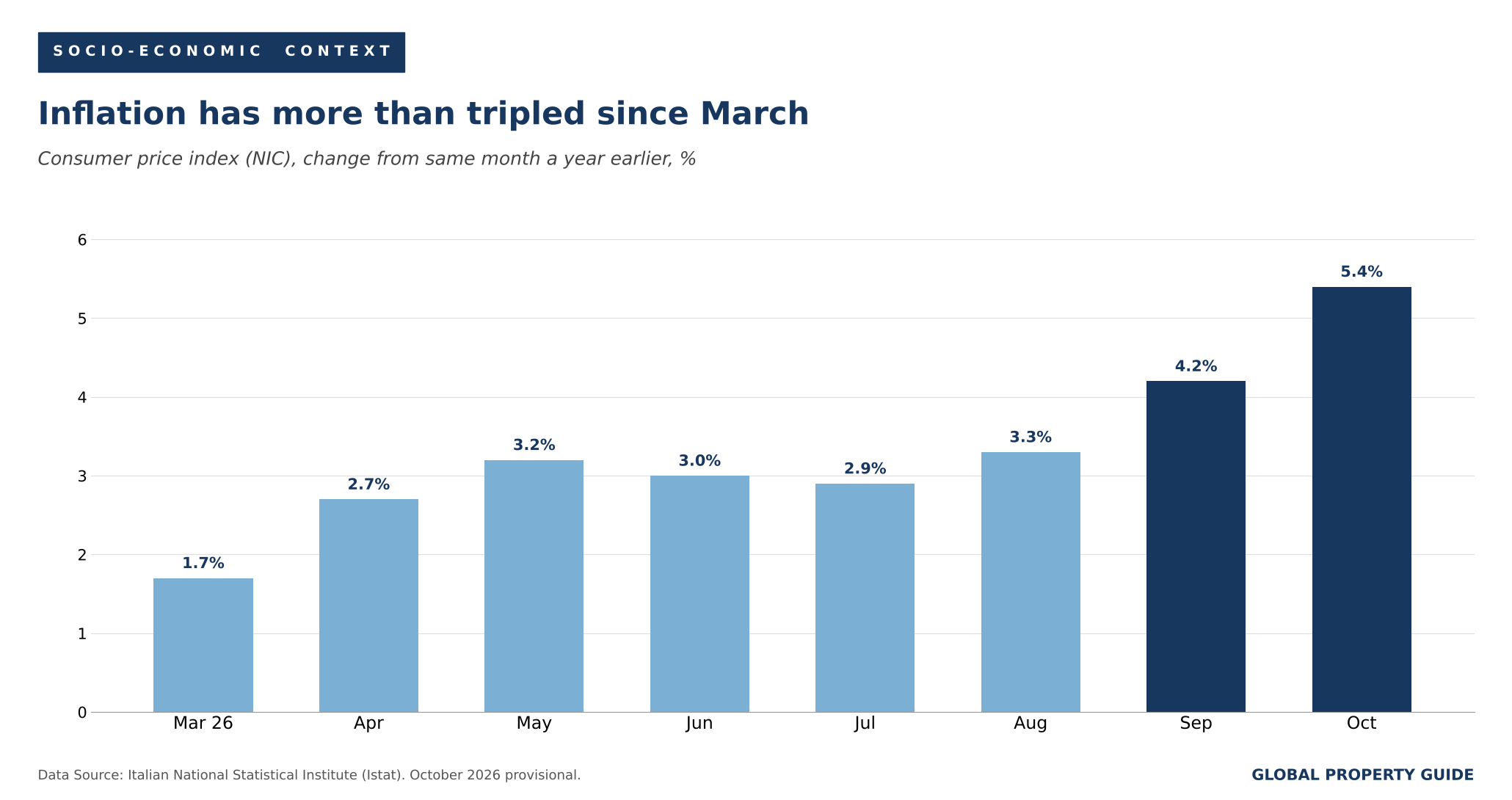
Inflation has risen sharply since our previous edition. Consumer prices rose by 5.4% in the year to October 2026, up from 4.2% in September, Istat estimates. In April, inflation had been 2.7%, Istat said. Energy is the main reason: energy prices were 31.4% higher than a year earlier, and regulated energy prices 59.5% higher. Core inflation, excluding energy and unprocessed food, was much lower, at 2.0%.
The Bank of Italy's October projections put harmonized inflation at 3.2% in 2026, 2.4% in 2027 and 1.7% in 2028. Its forecasts assume that the price of Brent crude will average USD 114 a barrel in Q4 2026 and then fall. The IMF expects inflation of 5.1% at the end of 2026.
Unemployment has risen
The unemployment rate was 6.3% in September 2026, unchanged from August, according to Istat. That is well above the 5.2% reported for March. Employment is still growing: 198,000 more people were in work than a year earlier, an increase of 0.8%.
Risks to the outlook
The main risk is a longer energy shock. In a severe scenario, the Bank of Italy estimates that GDP would be about 2 percentage points lower in total over 2026 to 2028, and inflation more than 3 points higher. Higher long-term interest rates would also hurt. A quick fall in energy prices after an end to the conflict would improve the outlook.
For the housing market, this means a period of slow growth. With few homes for sale, prices are unlikely to fall sharply in nominal terms. But with inflation above 5%, mortgage rates rising and sales flat, real house prices are likely to fall in the coming quarters.
Sources:
- Italian National Statistical Institute (Istat)
- House Prices (Provisional), Q2 2026: istat.it
- House Prices (Provisional), Q2 2026, Full Text: istat.it
- Building Permits Indicators, Q2 2026: istat.it
- Building Permits Indicators, Q4 2025: istat.it
- Consumer Prices, Provisional Data, October 2026: istat.it
- Consumer Prices, April 2026: istat.it
- Consumer Prices, Final Data, June 2026: istat.it
- Preliminary Estimate of GDP, Q3 2026: istat.it
- Employment and Unemployment, Provisional Data, September 2026: istat.it
- Employment and Unemployment, Provisional Data, March 2026: istat.it
- Bank of Italy
- Italian Housing Market Survey, Q2 2026: bancaditalia.it
- Italian Housing Market Survey, Q2 2026, Statistical Tables (IT): bancaditalia.it
- Banks and Money: National Data, 9 October 2026 (IT): bancaditalia.it
- Macroeconomic Projections for the Italian Economy, October 2026 (IT): bancaditalia.it
- Economic Bulletin No. 4, 2026 (IT): bancaditalia.it
- European Central Bank (ECB)
- Monetary Policy Decisions, 10 September 2026: ecb.europa.eu
- Monetary Policy Decisions, 29 October 2026: ecb.europa.eu
- Euro Foreign Exchange Reference Rates, US Dollar: ecb.europa.eu
- International Monetary Fund (IMF)
- World Economic Outlook, October 2026, Online Statistical Appendix Tables A: imf.org
- ANCE
- The Measures of the New Housing Plan, DL 66/2026 as Converted (IT): ance.it
- Immobiliare.it
- Property Prices in Italy (IT): immobiliare.it
- idealista
- OMI Observatory: Housing Market Stable in Q2 2026, Up 0.1% (OMI data, IT): idealista.it
- Rents Up Slightly (0.5%) in Q3 2026, 1.8% Year-on-Year (IT): idealista.it
- Global Property Guide
- Gross Rental Yields in Italy: globalpropertyguide.com