Is the United Kingdom a Good Country to Buy Property?
The United Kingdom is one of Europe’s most established and liquid property markets, attracting investors through legal transparency, strong rental demand, and varied city-level opportunities. Foreign buyers encounter no ownership restrictions, which simplifies entry compared to many other countries, although enhanced source-of-funds checks and transaction taxes such as Stamp Duty Land Tax still apply. The UK offers diverse investment options, from global hubs like London to fast-growing regional cities including Manchester, Birmingham, and Leeds, supporting capital appreciation, rental income, and long-term stability.
Although price growth has slowed from previous highs, the market remains resilient due to strong fundamentals, improving mortgage conditions, and steady demand in major urban centers. Rental yields are still attractive in many regional cities, despite borrowing costs remaining above pre-2022 levels. Investors should carefully assess affordability, regulations, financing, and long-term returns, and understand how the UK's cities, taxes, landlord laws, and mortgage environment interact before investing.
10 Things to Know Before Buying a Property in The United Kingdom
- Can Foreigners Buy Property in the United Kingdom
- Best Cities and Regions to Invest
- Square Meter / Square Foot Prices
- Median Asking Prices
- Rental Yields and Rents
- Market Performance (Past and Present)
- Landlord and Tenant Laws
- Property Related Taxes
- Buying (and Selling) Costs
- Mortgage and Financing Options
1. Can Foreigners Buy Property in the United Kingdom?
Yes, foreigners can own property in the United Kingdom without specific restrictions on non-residents. Buyers are subject to enhanced source-of-funds checks under anti-money laundering regulations and must pay applicable taxes, including Stamp Duty Land Tax, which varies by purchase price.
2. Best Regions and Cities to Invest
London
As the capital and financial center of the UK, London is a premier location for both residential and commercial real estate. Areas like Mayfair, Kensington, and Shoreditch are especially popular for their vibrant lifestyle, cultural significance, and world-class amenities. London offers a diverse range of properties, from luxury apartments and townhouses to commercial spaces, making it an ideal choice for investors seeking strong rental demand and long-term appreciation.
Manchester
Known for its booming tech, media, and education sectors, Manchester is rapidly emerging as a hotspot for real estate investment. Popular neighborhoods like Deansgate, Ancoats, and the Northern Quarter offer a mix of residential apartments and mixed-use developments. With its young, diverse population and strong demand for rental properties, Manchester is ideal for investors looking for a growing and dynamic market.
Birmingham
As the UK’s second-largest city, Birmingham is a key player in the country's real estate market. Areas like the Jewellery Quarter, Digbeth, and Edgbaston attract both residential and commercial investors due to their thriving job market, transportation infrastructure, and cultural attractions. Birmingham’s ongoing regeneration projects make it an appealing choice for long-term investments.
Edinburgh
Edinburgh, Scotland's capital, offers a unique blend of historic charm and modern living. Areas like New Town, Stockbridge, and the Old Town are popular with both locals and international buyers. Known for its strong economy driven by the financial sector, tourism, and education, Edinburgh presents a solid real estate market with significant rental potential and property value growth.
Liverpool
With a thriving arts, culture, and music scene, Liverpool is gaining popularity among property investors. Neighborhoods like the Baltic Triangle, the Waterfront, and Allerton offer a range of residential and commercial investment opportunities. The city’s ongoing urban renewal projects, combined with its affordable property prices, make it an attractive option for those seeking high rental yields and capital appreciation.
Leeds
As one of the UK’s largest financial and legal hubs outside of London, Leeds is an emerging market for both residential and commercial real estate. Areas like the Leeds Dock, Headingley, and the City Centre are popular for their proximity to offices, universities, and transport links. The city’s strong job market and vibrant student population create consistent demand for rental properties, making it a great option for investors.
Glasgow
Scotland’s largest city, Glasgow, has seen significant growth in both the residential and commercial property markets. The city’s west end, Finnieston, and Merchant City are particularly sought after, offering a mix of traditional and modern properties. Glasgow’s economic growth and growing popularity as a cultural destination continue to drive demand for both long-term investments and short-term rental opportunities.
Belfast
As the capital of Northern Ireland, Belfast is a growing hub for both residential and commercial real estate. Areas like the Titanic Quarter, Queen's Quarter, and the Cathedral Quarter are particularly popular for their vibrant culture, excellent transport links, and proximity to business districts. Belfast's relatively low property prices, combined with its expanding economy and ongoing regeneration projects, offer attractive investment opportunities, particularly for those seeking affordable entry points with significant growth potential.
Cardiff
The capital of Wales, Cardiff is a dynamic city with a thriving economy and a strong property market. Popular neighborhoods such as Cardiff Bay, Roath, and Pontcanna are particularly sought after by both residential and commercial investors. Cardiff benefits from a growing population, a vibrant student market, and significant investment in infrastructure, making it an appealing location for investors seeking stable rental income and long-term capital growth.
3. Square Meter / Square Foot Prices
Square-meter prices in the UK are lower compared to other EU countries.
As of December 2025, square meter prices were as follows in the UK:
- London - €8,466
- Bristol - €4,610
- Manchester - €3,573
- Birmingham - €3,572
- Leeds - €3,458
- Liverpool - €2,650
4. Median Asking Prices
The UK has a high median asking prices. As of December 2025, one-bedroom apartments ranged from €136,000 to €524,000.
One-bedroom prices as of December 2025 were as follows:
- London - €524,000
- Bristol - €228,000
- Edinburgh - €222,300
- Manchester - €212,000
- Birmingham - €171,000
- Liverpool - €169,000
- Leeds - €148,000
- Glasgow - €136,800
5. Rental Yields and Rents
The UK’s rental yields are good, with a rating of 6.98%.
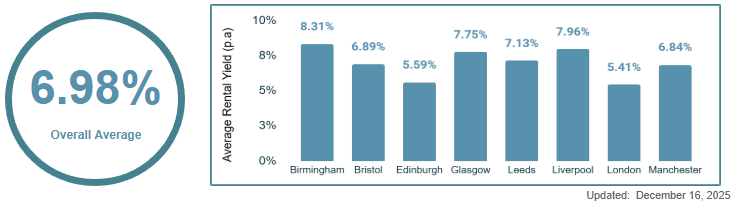
As of December 2025, average yields for one-bedroom apartments across the UK are as follows:
- Birmingham - 8.31%
- Liverpool - 7.96%
- Glasgow - 7.75%
- Leeds - 7.13%
- Bristol - 6.89%
- Manchester - 6.84%
- Edinburgh - 5.59%
- London - 5.41%
The United Kingdom's rent price index:
Data Source: OECD.
6. Market Performance (Past and Present)
The United Kingdom’s housing market has experienced strong long-term growth, with average prices rising significantly over the past decade. Recent data, however, indicate a slower and more moderate pace of appreciation. The Nationwide index reports that house prices in early 2025 were up about 3.9 percent year-on-year and near previous record levels, reflecting recovery after earlier volatility. Official national estimates show annual gains of approximately 2.6 to 3.7 percent through 2025, below the double-digit growth of previous years. Regional performance varies, with some areas maintaining solid price increases while others, particularly in higher-priced southern markets, have seen slower growth or slight declines. This points to a more balanced market environment.
In recent quarters, residential price growth has remained positive but subdued, shaped by factors such as interest rates, affordability, and changes in tax and housing policy. Annual growth has slowed compared to earlier peaks. Monthly indexes occasionally show small declines, highlighting the market’s moderation after rapid expansion. Despite this slowdown, property values remain high relative to historical averages. Long-term trends indicate continued appreciation, suggesting that while short-term momentum has eased, underlying price resilience remains across much of the UK.
The United Kingdom's house price annual change:
Data Source: Land Registry.
7. Landlord and Tenant Laws
The United Kingdom’s landlord-tenant framework is generally balanced, with recent reforms strengthening tenant protections. Rent levels are usually agreed upon by both parties, but regulations restrict how and when rents may be increased, depending on contract type and jurisdiction. Tenancies are typically fixed-term or periodic. Landlords must follow statutory procedures for eviction, including serving notice and often obtaining a court order. Security deposits are capped and must be held in government-approved schemes. Recent legal changes have improved standards, prevented retaliatory eviction, and clarified the rights and obligations of both parties. The system is now more structured and tenant-friendly than in the past.
8. Property Related Taxes
Council tax in the United Kingdom is a local tax on residential properties, set by local authorities. The amount is based on the property’s valuation band and the number of occupants. Single adult households receive a discount on the occupancy-based portion. Typically, tenants pay council tax under assured tenancies, while property owners are liable when a property is unoccupied.
9. Buying (and Selling) Costs
Foreign buyers can obtain mortgage financing in the United Kingdom, but lending terms are typically more restrictive than for residents. Lenders usually require a down payment of at least 25 percent and conduct thorough income, employment, and creditworthiness checks. Due diligence is essential and includes verifying legal title, planning permissions, and any factors that may affect the property's use or value. A local solicitor typically manages conveyancing, conducts title checks, and oversees the legal transfer of ownership. Buyers should also budget for additional costs, including Stamp Duty Land Tax, registration fees, and legal expenses.
Here's a full breakdown:
| Transaction Costs | ||
| Who Pays? | ||
| Property Transfer Tax | 0.00% - 12.00% | buyer |
| Legal Fees | 0.50% - 1.00% | buyer |
| Notary Fees | 0.10% - 0.50% | buyer |
| Real Estate Agent Fee | 2.00% - 3.50% | seller |
| Costs Paid by Buyer | 0.60% - 13.50% | |
| Costs Paid by Seller | 2.00% - 3.50% | |
| Round-trip Transaction Costs | 2.60% - 17.00% | |
| Source: Global Property Guide, Deloitte, PWC, gov.uk, revenue.scot, gov.wales | ||
10. Mortgage and Financing Options
The UK’s interest rate environment is easing, with the Bank of England reducing the bank rate to 4.25 percent by May 2025 after several cuts from its 2024 peak. This reflects progress in controlling inflation, though policymakers remain cautious due to global trade uncertainty and mixed economic signals. Mortgage rates have also declined, with the average effective rate on new mortgages falling to 4.49 percent by April 2025. While this is lower than a year ago, it remains above pre-2022 levels. Lower loan-to-value mortgages offer the most competitive rates, but interest rates on existing mortgages remain high as earlier fixed-rate deals expire.
Mortgage market activity has begun to recover following a prolonged slowdown. In 2024, newly approved mortgage values increased sharply, and lending growth continued into early 2025, supported by better borrowing conditions and rising confidence. Although monthly approvals fell in April after a stamp duty increase, overall sentiment remains cautiously positive. Further growth is likely if interest rates continue to fall. Outstanding mortgage balances reached GBP 1.66 trillion in early 2025, with modest year-on-year growth. Mortgage lending is expected to expand further in 2025 and 2026. Despite this recovery, the mortgage market’s share of GDP has declined from pandemic-era highs, suggesting a more stable, measured housing finance environment.
The United Kingdom's mortgage loan interest rates:
Data Source: Bank of England.
Need Help?
Buying property in a foreign country can feel overwhelming, but we're here to help.
At Global Property Guide, we offer:
- Data-backed insights on property prices, rental yields, and taxes
- Country-specific legal and tax guidance through our partner network
- Pre-screened investment properties, including income-generating Airbnb units
- 1-on-1 consultations with real estate experts focused on international buyers
- Step-by-step buyer support, from due diligence to closing
Whether you're looking for your first investment in the United Kingdom or expanding your international portfolio, we can help you make smart, secure decisions.
Contact our team or book a free consultation to get started.