Slovenia's Residential Property Market Analysis 2026
Against the backdrop of persistent supply shortages in the country’s most in-demand locations, sales prices in the Slovenian housing market are set to continue rising, supported by a recovery in the secondary segment buyer activity and lower interest rates.
This extended overview from Global Property Guide covers key aspects of the Slovenian housing market and takes a closer look at its most recent developments and long-term trends.
Table of Contents
- Property Prices and Price Index
- Property Demand Trends
- Property Supply Trends
- Rental Market: Rents and Rental Yields
- Mortgage Market and Interest Rates
- Economic and Social Factors
Property Prices and Price Index
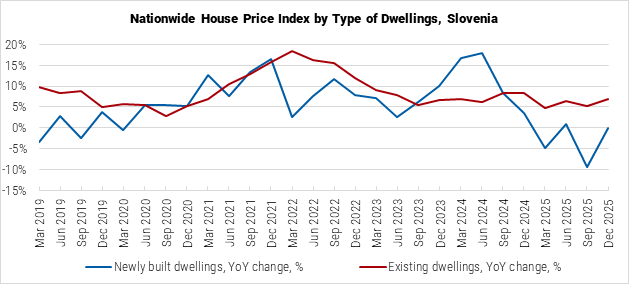
Housing prices in Slovenia continued to rise in 2025, supported by a recovery in market activity, easing borrowing conditions, resilient household fundamentals, and a persistent shortage of available housing in the country’s most sought-after locations. According to the Statistical Office of the Republic of Slovenia (SURS), in Q4 2025, the nationwide House Price Index increased by 5.77% year-on-year (2.99% inflation-adjusted).
Slovenia's house price annual change:
Price growth remained concentrated in the existing-home segment: prices of existing dwellings rose by 6.92% year-on-year, with existing apartments up 8.27% and existing family houses up 4.85%. By contrast, the newly built segment was much more mixed, with prices of newly built family houses rising by 11.21% while prices of newly built apartments edged down by 1.68%.
Data Source: SURS.
Transaction-based evidence from the Surveying and Mapping Authority of the Republic of Slovenia (GURS) points to even stronger momentum in the resale market. The nationwide median price of second-hand apartments sold in 2025 reached EUR 3,200 (USD 3,723) per square meter, up 9.59% from a year earlier. Ljubljana remained the country’s most expensive apartment market, with the median price rising by 11.97% year-on-year to EUR 5,050 (USD 5,875) per square meter, followed by the Coastal Area at EUR 4,810 (USD 5,596) per square meter, up 11.34%.
Detached houses also recorded solid gains, with the nationwide median price of second-hand houses sold increasing by 10.30% year-on-year to EUR 182,000 (USD 211,739) per unit. Among the selected submarkets, Ljubljana remained by far the most expensive house market, at EUR 460,000 (USD 535,164) per unit, while the Alpine Tourist Area and the northern and southern surroundings of Ljubljana also stood out with comparatively high price levels.
Median prices of secondary apartments and houses sold in selected submarkets:
| Median price of secondary apartments, 2025, per sqm |
YoY, % | Median price of secondary houses, 2025, per unit |
YoY, % | |
| Ljubljana | EUR 5,050 (USD 5,875) |
11.97% | EUR 460,000 (USD 535,164) |
13.58% |
| Maribor | EUR 2,670 (USD 3,106) |
14.59% | EUR 204,000 (USD 237,334) |
4.62% |
| Coastal Area | EUR 4,810 (USD 5,596) |
11.34% | EUR 329,000 (USD 382,759) |
6.82% |
| Kranj and surroundings | EUR 3,620 (USD 4,212) |
12.42% | EUR 320,000 (USD 372,288) |
11.11% |
| Northern surroundings of Ljubljana | EUR 4,060 (USD 4,723) |
12.78% | EUR 350,000 (USD 407,190) |
6.06% |
| Southern surroundings of Ljubljana | EUR 4,000 (USD 4,654) |
12.99% | EUR 304,000 (USD 353,674) |
-10.59% |
| Celje | EUR 2,660 (USD 3,095) |
15.15% | EUR 220,000 (USD 255,948) |
29.41% |
| Alpine Tourist Area | EUR 4,530 (USD 5,270) |
18.59% | EUR 412,000 (USD 479,321) |
17.71% |
| Nationwide | EUR 3,200 (USD 3,723) |
9.59% | EUR 182,000 (USD 211,739) |
10.30% |
| Exchange rate as of Q4 2025, USD 1 = EUR 0.8595. | ||||
| Note: Coastal Area includes Koper, Piran, Portorož, Izola, and Ankaran. The Alpine Tourist Area includes Kranjska Gora, Bled, and the Lake Bohinj area. | ||||
| Data Source: GURS. | ||||
Experts note that the 2025 price increase was underpinned by both cyclical and structural factors. In its annual market report, GURS said the rebound in residential transactions after three years of decline was driven mainly by lower interest rates and a resulting increase in housing lending. At the same time, the Bank of Slovenia (BSI) continues to argue that residential supply has long trailed demand, with falling loan rates, low unemployment, and low household indebtedness reinforcing a new upward phase in the housing cycle. In other words, Slovenia’s price growth in 2025 was not just a function of stronger buyer sentiment, but also of a market still constrained by limited supply, especially in Ljubljana and other high-demand urban and tourist areas.
Looking ahead, housing prices in Slovenia are expected to continue rising, albeit at a more moderate pace. GURS warns that stronger inflationary pressures and any renewed increase in key interest rates could weaken market activity and at least moderate house-price growth. However, the agency’s central view is that, unless there is a severe global economic downturn, a noticeable fall in Slovenian residential property prices is not expected.
Property Demand Trends
Buyer Activity Rebounded, Led by Resales and Lower Borrowing Costs
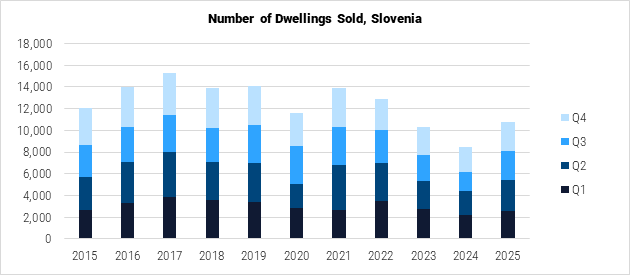
After three consecutive years of annual declines, housing demand in Slovenia strengthened in 2025, with transaction activity recovering markedly as buyer conditions improved, although the rebound remained concentrated in the secondary market. According to provisional SURS data, a total of 10,731 dwellings were sold nationwide in 2025, representing a year-on-year increase of 26.62%, while the total value of residential transactions rose by 32.41% to EUR 1.90 billion (USD 2.21 billion).
Data Source: SURS.
The pickup in market activity was driven overwhelmingly by existing homes, which accounted for 96% of all residential transactions in 2025, with sales reaching 10,334 units, up 34.02% year-on-year. Within this segment, apartments remained the dominant product type, representing 59% of existing-home transactions. A total of 6,135 existing apartments were sold during the year, up 36.33% from 2024. In Ljubljana, 1,571 sales were recorded, an increase of 24.29%, while Maribor saw 784 transactions, up 34.02%. Existing apartment sales in the rest of the country rose even faster, increasing by 42.59% year-on-year to 3,780 units.
Commenting on the movement, the GURS said the rebound was “evidently the result of stronger solvent demand,” driven above all by the “marked fall in fixed mortgage rates” since mid-2024. The Authority added that high employment, real wage growth, and a continued imbalance between strong buyer demand and limited housing supply also supported stronger buyer and investor activity throughout the year.
By contrast, newly built dwellings accounted for only 397 transactions in 2025, or about 4% of the total, down 48.04% year-on-year. That weakness, however, should be interpreted with caution. GURS notes that reliable monitoring of the primary market remains difficult because reporting on new-build sales subject to VAT is still incomplete. It also states that new-build supply in urban areas remains insufficient, with limited availability and high prices of development land, long construction lead times, and elevated building costs continuing to constrain the market.
Looking ahead, the official outlook for housing demand in 2026 is cautious. GURS warns that heightened geopolitical uncertainty, possible further energy price increases, stronger inflationary pressures, and renewed rises in key interest rates could weigh on activity in Slovenia’s housing market again, potentially resulting in “a renewed decline in the number of transactions.” At the same time, Zoran Đukić of Stoja Trade argues that the Slovenian market tends to react more slowly to interest-rate changes because purchases are financed not only through bank loans, but also through own funds, family support, and a strong ownership culture, making the impact of higher rates “slower and milder than elsewhere.”
Property Supply Trends
Pipeline Weakness Persists Despite Still-Solid Completions
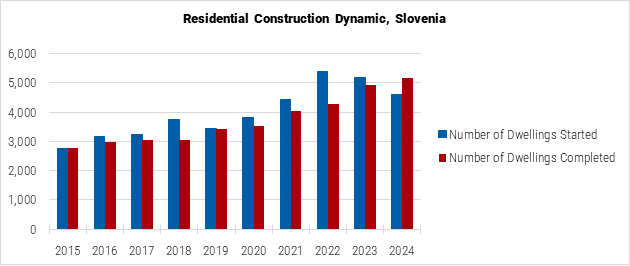
Slovenia’s housing supply remains structurally constrained, with the latest available data indicating that recent completions were still being supported by earlier project launches, while the forward delivery pipeline remained weak. According to SURS, 5,165 dwellings were completed in 2024, up 5.00% year-on-year. At the same time, the number of dwelling starts fell by 11.55% for the second consecutive year, suggesting that underlying supply conditions had not materially improved. As BSI noted, “demand for residential real estate still outstrips supply,” and the decline in planned new residential construction suggests this imbalance will persist.
Data Source: SURS.
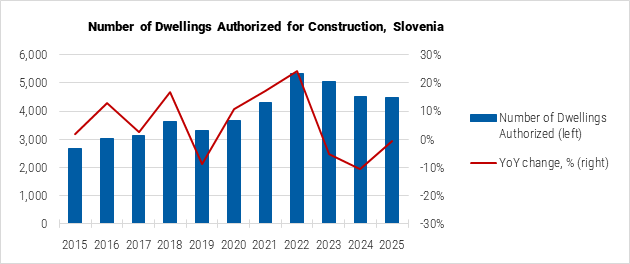
More recent permitting data indicate that the development pipeline has continued to soften. Based on SURS provisional data, 4,487 dwellings were authorized for construction in 2025, down 0.73% year-on-year, marking a third consecutive annual decline in planned dwellings. The weakness was concentrated in the multi-dwelling segment: planned dwellings in one-dwelling buildings rose by 3.35% year-on-year, while those in two- and more-dwelling buildings fell by 6.47%, pointing to a softer apartment pipeline. Early-2026 data show no meaningful turnaround, with 658 dwellings authorized in January and February 2026, down 16.92% year-on-year.
Data Source: SURS.
The regional split in authorized dwellings points to a highly uneven supply pipeline in 2025. Podravska recorded the largest volume of planned dwellings and a strong annual increase, while Central Slovenia saw a sharp decline despite remaining one of the country’s largest markets by volume. Although some western regions, notably Goriška and Obalno-Kraška, posted strong gains, the overall pattern remained mixed, suggesting that permitting activity was concentrated in a limited number of stronger local markets.
Number of dwellings authorized for construction by statistical region:
| Region | Number of Dwellings Authorized, 2025 |
YoY, % |
| Podravska | 1,201 | 35.10% |
| Central Slovenia | 796 | -34.97% |
| Gorenjska | 503 | 8.87% |
| Savinjska | 420 | -6.87% |
| South-East Slovenia | 404 | -18.55% |
| Obalno-Kraška | 285 | 52.41% |
| Goriška | 278 | 60.69% |
| Pomurska | 225 | -22.41% |
| Koroška | 132 | 21.10% |
| Posavska | 103 | 22.62% |
| Primorsko-Notranjska | 83 | -11.70% |
| Zasavska | 52 | -7.14% |
| Data Source: SURS. | ||
Supply-side constraints also remain significant, even as financing conditions have started to improve. SURS reported that construction costs for new residential buildings were 8.9% higher year-on-year in the fourth quarter of 2025, while labor costs rose by 15.6%. BSI has likewise stressed that new residential construction continues to be constrained by high construction costs, labor shortages, and a shortage of land suitable for residential construction. Together, these factors continue to limit the market’s ability to respond quickly to strong underlying demand.
Overall, the supply pipeline suggests that housing market tightness is likely to persist through 2026.
The Slovenian Institute of Macroeconomic Analysis and Development (IMAD) expects housing investment to recover only gradually following a two-year contraction, pointing to stabilization rather than a strong rebound in residential delivery. At the same time, recent permit data indicate that new residential development remains subdued, while the constraints highlighted by BSI continue to weigh on new-build activity. As a result, near-term completions may still reflect earlier project momentum, but the underlying flow of new supply remains insufficient to generate a meaningful easing in market tightness.
Rental Market: Rents and Rental Yields
Inflation Slows, Government Implements Measures to Increase Supply
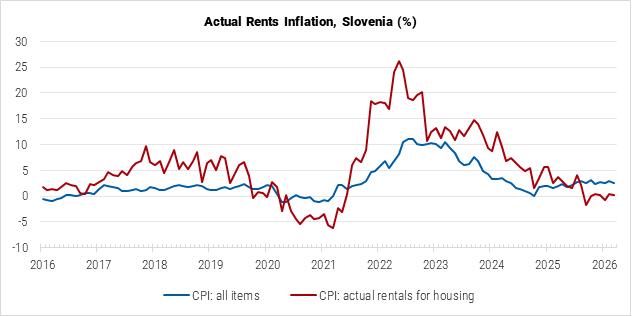
Throughout 2025, rental inflation in Slovenia, as measured by the annual change in the actual rentals for the housing component of the consumer price index (CPI), continued to ease from extraordinary double-digit peak levels registered in the previous years, eventually falling below the overall price growth in the country for the first time since 2021. According to SURS, in March 2026, the indicator stood at just 0.2% (down from 3.8% a year ago and 9.6% two years ago), while the all-item CPI posted a 2.5% year-on-year growth.
Slovenia's rent price index:
In nominal terms, according to the survey conducted by EUROSTAT in cooperation with real estate agencies in major European cities, the average monthly rent for quality apartments in Ljubljana (within residential areas of good quality, typically favored by expatriates and professional people) in 2025 reached EUR 950 (USD 1,074) for 1-bedroom units, EUR 1,350 (USD 1,526) for 2-bedroom units, and EUR 1,950 (USD 2,204) for 3-bedroom units. Over the past five years, the average rates increased by 34-44% for the types of apartments surveyed.
Across a wider spectrum of properties, the research by Global Property Guide conducted in February 2026 found average asking rents in the capital city at EUR 700 (USD 828) for studios, EUR 1,050 (USD 1,242) for 1-bedroom units, EUR 1,450 (USD 1,714) for 2-bedroom units, and EUR 2,450 (USD 2,897) for 3-bedroom units. In the region of Gorenjska, asking rents were notably lower, reaching EUR 540 (USD 638) for studios, EUR 800 (USD 946) for 1-bedroom units, and EUR 950 (USD 1,123) for 2-bedroom units. The corresponding gross rental yields averaged 4.08% across these submarkets, with Gorenjska (4.14%) demonstrating slightly higher potential performance than Ljubljana (4.01%).
Data Source: SURS.
Overall, like many other Eastern European countries, Slovenia is characterized by a high homeownership rate, partly as a legacy of mass privatization during the transition to a market-oriented economy in the early 1990s. As a result, the private rental market is comparatively small, with only 7.6% of households being tenants paying market rents as of 2025 (up from 4.8% reported in 2015) and a further 18.2% paying reduced non-profit rents or occupying properties rent-free.
The 2026 Foundations for Growth and Competitiveness report from the Organization for Economic Co-operation and Development (OECD) characterized Slovenia’s private rental sector as underdeveloped, with strict rental regulations often bypassed, creating tenant vulnerabilities and uncertainty for landlords.
In response to growing concerns over the availability and affordability of housing, the Slovenian Government previously adopted a new Hospitality Industry Act (in effect since January 2026), which included regulations on short-term rentals (STR). Among other changes, the legislation introduced a time limit for STRs in municipalities where they pose a high risk of negatively affecting the long-term rental market. Under the general rule, apartments in such municipalities may be rented on a short-term basis for no more than 60 days per calendar year, with local authorities having an option to set an even stricter (down to 30 days per year) or a more permissive regime (up to 270 days per year), depending on market conditions in each municipality.
The measures, expected to return some of the existing supply in high-demand submarkets from tourism to residential use, provoked a strong backlash from the industry, with property owners claiming the changes could eliminate 90% of private short-term rental operators in the country. The authorities, however, view the action as proportionate and necessary, considering the state of the housing market. "The rationale for this regulation is to return apartments to permanent forms of residency. Given the inaccessibility of housing — the fact that we have a housing crisis in the country — state intervention is justified," said Matevž Frangež, a state secretary at the Ministry of the Economy, Tourism, and Sport, as quoted by The Slovenia Times.
The Slovenian government has announced plans to annually invest EUR 100 million in the construction of new units, adding 20,000 public rental apartments to the market over the next decade.
Speaking at the launch of a new public rental development in late 2025, Prime Minister Robert Golob called the initiative “one of the government’s priorities”.
Mortgage Market and Interest Rates
Demand for Housing Loans Rebounds Strongly Upon Interest Rates Decline
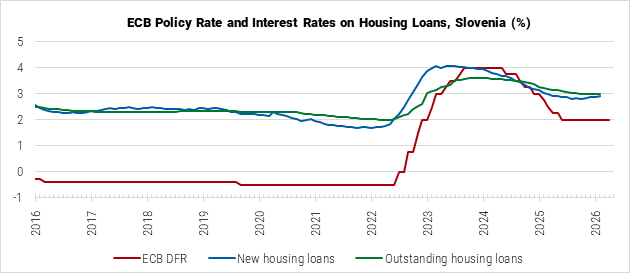
After a series of cuts through 2024 and early 2025, the European Central Bank (ECB) has kept its key rates unchanged since last June, making no further moves at the latest meeting of the monetary policy committee at the end of April 2026. At the same time, in a post-decision press statement, the regulator noted that upside risks to inflation and downside risks to growth have intensified, as the war in the Middle East has led to a sharp increase in energy prices, pushing up inflation and weighing on economic sentiment.
Slovenia's mortgage loan interest rates:
In light of recent developments, most economists polled by Reuters earlier in April stated the ECB is now likely to raise its key rates in June, although the path after that is highly uncertain and will depend on the intensity and duration of the energy price shock and the scale of its effects on the euro area economy.
A potential policy shift can be expected to impact average interest rates on loans to households for house purchase in Slovenia, which have been following the trajectory of ECB key rates and remained relatively stable in the second half of 2025 and early 2026. The average interest rate on new housing loans was most recently reported at 2.91% in February 2026, down 1.16 p.p. from its 2023 peak level. For outstanding housing loans, the average interest rate reached 2.99%, 0.62 p.p. down from the peak.
Data Source: ECB.
Average interest rates on loans to households for house purchase:
| Feb 2026 | YoY | Feb 2025 | YoY | Feb 2024 | |
| New housing loans | 2.91% | ↓ | 3.03% | ↓ | 3.88% |
| - Floating rate and IRF up to 1 year | 3.56% | ↓ | 4.33% | ↓ | 5.22% |
| - IRF of over 1 and up to 5 years | 3.17% | = | 3.17% | ↓ | 3.83% |
| - IRF of over 5 and up to 10 years | 2.93% | ↑ | 2.90% | ↓ | 3.71% |
| - IRF of over 10 years | 2.89% | ↓ | 3.04% | ↓ | 3.86% |
| Outstanding housing loans | 2.99% | ↓ | 3.23% | ↓ | 3.59% |
| - Original maturity up to 1 year | 3.80% | ↓ | 4.05% | ↓ | 4.80% |
| - Original maturity over 1 and up to 5 years | 3.39% | ↓ | 3.35% | ↑ | 3.15% |
| - Original maturity of over 5 years | 2.99% | ↓ | 3.23% | ↓ | 3.59% |
| Data Source: ECB. | |||||
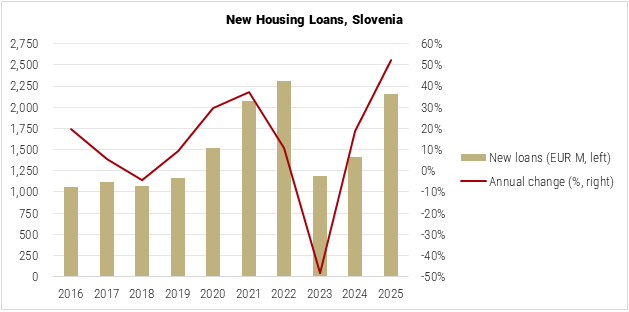
As outlined in the latest financial stability review from the Bank of Slovenia, new lending increased sharply last year upon the decline in interest rates. According to ECB figures, the total value of new housing loans (including pure new loans and renegotiations) issued between January and December 2025 reached EUR 2.15 billion (USD 2.4 billion), a substantial 52.4% increase compared to the 2024 level. This growth momentum also carried into early 2026, with double-digit year-on-year increases in the value of new loans registered in January and February, indicating the continued recovery of the market.
Data Source: ECB.
In the long term, the use of mortgages for house purchase has become more common in Slovenia over the recent decades. “The share of residents with a mortgage has increased sharply since 2010, albeit from low levels in international comparison, reflecting strong housing demand patterns and the willingness and growing capacity of younger cohorts to form independent households,” noted the OECD Economics Department in a working paper on the housing market in the country. As of 2025, 15.4% of Slovenian households were homeowners with an outstanding mortgage or housing loan, up from 7.7% in 2010, according to EUROSTAT figures.
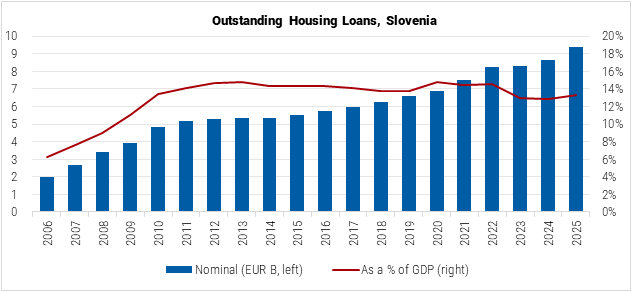
Driven by stronger lending activity, the expansion of the housing loan stock in Slovenia accelerated in 2025, reaching an 8.4% year-on-year growth compared to 4.0% in 2024. As of February 2026, the total value of outstanding housing loans stood at EUR 9.5 billion (USD 11.2 billion). The relative size of the market, represented by the ratio of outstanding housing loans to GDP at current prices, edged up from an estimated 12.8% in 2024 to 13.3% in 2025, remaining, however, notably lower than in many other EU countries.
Data Sources: ECB, SURS.
Economic and Social Factors
Growth Set to Strengthen, but Risks are Skewed to the Downside
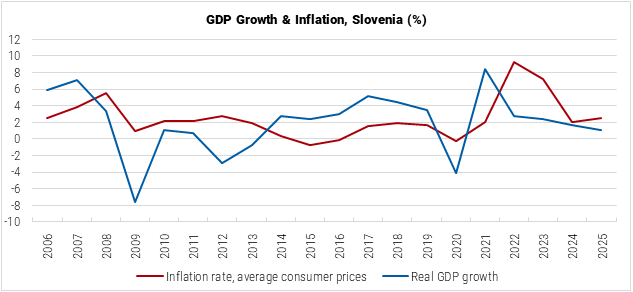
Slovenia continues to show resilience in the face of multiple shocks. The economic slowdown that began in 2024 continued into early 2025, but activity has since picked up. Real GDP growth for the year reached 1.1%, and the International Monetary Fund (IMF) projects it to accelerate to 2.0% in 2026 and 2.1% in 2027. Similarly, IMAD’s baseline scenario (not assuming persistently elevated oil and gas prices or disruptions to their supply) currently projects 2.0% growth in 2026.
The April 2026 macroeconomic developments review from the Bank of Slovenia supports these projections, noting that growth in economic activity is expected to have persisted in the first quarter of 2026, although “risks to economic activity and inflation have increased in the context of heightened geopolitical tensions”.
Headline inflation in Slovenia previously slowed from 8.8% in 2022 to 1.7% in 2024, but re-accelerated to 2.5% in 2025, primarily due to higher prices for food and services. Most recently, the indicator was also reported by SURS at 2.5% in March 2026. The IMAD now anticipates it will remain broadly in line with last year’s level throughout 2026, as above-average growth in services and food prices is expected to persist. Barring shocks, inflation is projected to decline towards 2% in the following years. This IMF forecast currently places the indicator slightly higher at 2.9% for 2026 and 2.1% for 2027.
Data Source: IMF.
Despite some signs of softening, Slovenia’s labor market remains tight, with job vacancies still above long-term averages, especially in construction, trade, hospitality, and health sectors. The aging population transitioning to inactivity or retirement continues to constrain labor supply, while migration inflows play a role in helping stabilize the labor force and employment.
“Labor market developments are increasingly influenced by demographic changes; owing to the limited labor supply, employment is expected to stagnate this year and over the following two years, while unemployment will remain low,” said the IMAD spring 2026 forecast.
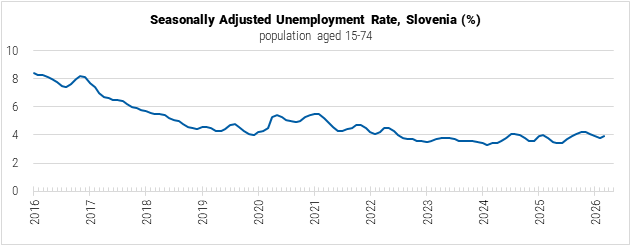
According to SURS figures, the seasonally adjusted ILO unemployment rate in the country has been largely stable, most recently reported at 3.9% in March 2026.
Data Source: SURS.
Overall, as outlined by the IMF in the latest Article IV staff report, Slovenia’s economy is expected to perform well in the near term, with growth strengthening over the next two years from improved investor confidence and increased export demand, before moderating to its potential over the medium term, alongside a gradual decline in inflation. Risks to the outlook, however, are tilted to the downside, including from prolonged global uncertainty, renewed commodity price volatility, and, domestically, delays in key investment projects and structural reforms.
Earlier last year, reflecting Slovenia’s continued fiscal consolidation, Fitch Ratings upgraded the country’s IDR from ‘A’ to ‘A+’ with a stable outlook. The agency noted the declining public debt and fiscal outperformance, as well as substantial progress made with key reforms to address ageing-related pressures.
Sources:
- Statistical Office of the Republic of Slovenia (SURS)
- Residential Housing Price Indices, 4th Quarter 2025: https://www.stat.si/
- Estimation of the Construction of Buildings and Dwellings, 2024: https://www.stat.si/
- Statistics of Building Permits, December 2025: https://www.stat.si/
- Statistics of Building Permits, February 2026: https://www.stat.si/
- Construction Costs Indices for Residential Building, 4th Quarter 2025: https://www.stat.si/
- GDP and National Accounts: https://www.stat.si/
- Consumer Price Indices, March 2026: https://www.stat.si/
- The Monthly ILO Unemployment Rate 3.9%: https://www.stat.si/
- Bank of Slovenia (BSI)
- Review of Macroeconomic Developments, April 2026: https://www.bsi.si/
- Financial Stability Review, October 2025: https://www.bsi.si/
- Financial Stability Review, April 2025: https://www.bsi.si/
- Government of the Republic of Slovenia
- Prime Minister Golob: National Housing Program…: https://www.gov.si/
- Housing Policy With New Momentum: €100 Million Annually for Public Rental Housing: https://www.gov.si/
- Housing Policy: https://www.gov.si/
- Legal Information System of the Republic of Slovenia
- Hospitality Act (ZGos-1): https://pisrs.si/
- Surveying and Mapping Authority of the Republic of Slovenia (GURS)
- Slovenian Property Market Report, 2025 (SL): https://www.e-prostor.gov.si/
- Institute of Macroeconomic Analysis and Development (IMAD)
- Spring Forecast of Economic Trends 2026: https://www.umar.gov.si/
- European Central Bank (ECB)
- ECB Data Portal: https://data.ecb.europa.eu/
- Key ECB Interest Rates: https://www.ecb.europa.eu/
- Monetary Policy Decisions, 30 April 2026: https://www.ecb.europa.eu/
- European Commission
- Economic Forecast for Slovenia: https://economy-finance.ec.europa.eu/
- Distribution of Population by Tenure Status, Type of Household and Income group: https://ec.europa.eu/
- Average Rent Per Month in Cities by Type of Dwelling: https://ec.europa.eu/
- International Monetary Fund (IMF)
- Country Overview: Republic of Slovenia: https://www.imf.org/
- 2025 Article IV Staff Report: https://www.imf.org/
- Organization for Economic Co-operation and Development (OECD)
- Foundations for Growth and Competitiveness 2026: https://www.oecd.org/
- Housing Market Challenges and Policy Options in Slovenia: https://www.oecd.org/
- Fitch Ratings
- Fitch Upgrades Slovenia to 'A+'; Outlook Stable: https://www.fitchratings.com/
- Reuters
- ECB to Raise Rates in June on War-Driven Inflation but Path Beyond Unclear: Reuters Poll: https://www.reuters.com/
- The Slovenia Times
- Backlash as Govt Moves to Curb Short-Term Rentals: https://sloveniatimes.com/
- Delo
- Housing Loans Will Be More Expensive… (SL): https://www.delo.si/
- Plan for 20,000 Apartments in Ten Years (SL): https://www.delo.si/