Romania's Residential Property Market Analysis 2026
After a period of strong price growth across all segments, which outpaced consumer inflation last year, the housing market in Kazakhstan is expected to start cooling, with price resilience concentrated in larger urban markets and higher-quality properties.
This extended overview from Global Property Guide covers key aspects of Kazakhstan’s housing market and takes a closer look at its most recent developments and long-term trends.
Table of Contents
- Property Prices and Price Index
- Historic Perspective
- Property Demand Trends
- Property Supply Trends
- Rental Market: Rents and Rental Yields
- Mortgage Market and Interest Rates
- Economic and Social Factors
Property Prices and Price Index
Residential pricing in Romania continues to rise in nominal terms, broadly in line with the wider European trend. Eurostat data shows the national House Price Index up 6.60% year-on-year in Q3 2025 (-1.21% inflation-adjusted), slightly above the EU average (5.51% year-on-year). Growth remains uneven across segments: new dwellings increased by 3.93% annually (-3.69% inflation-adjusted), while existing homes rose by 8.02% (0.10% inflation-adjusted), indicating a stronger momentum in the resale market.
Romania's house price annual change:
Institutional and industry commentary attributes this resilience to sustained demand meeting structurally constrained supply. The National Bank of Romania (NBR) notes that price dynamics reflect “persistent robust demand, continued tightening of housing supply, and the impact of recent fiscal changes” [including VAT-related adjustments affecting parts of the residential market]. Colliers similarly highlights “stable demand and continued price growth despite high interest rates and a weaker economic backdrop,” pointing to constrained new supply, particularly in Bucharest, as a key support for pricing.
Portal indicators suggest even stronger momentum in asking prices. Imobiliare.ro reports a national average listed apartment price of EUR 1,965 (USD 2,301) per square meter as of December 2025, up 13.8% year-on-year. Cluj-Napoca remained the most expensive market at EUR 3,235 (USD 3,788) per square meter (+9.7% year-on-year), while Bucharest averaged EUR 2,204 (USD 2,581) per square meter (+16.6% year-on-year).
The average listed price for apartments in key submarkets:
| Avg price per sqm, new apartments, Dec 2025 |
YoY, % | Avg price per sqm, existing apartments, Dec 2025 |
YoY, % | Avg price per sqm, Dec 2025 |
YoY, % | |
| Bucharest | EUR 2,500 (USD 2,927) |
17.2% | EUR 2,159 (USD 2,528) |
16.8% | EUR 2,204 (USD 2,581) |
16.6% |
| Brașov | EUR 2,698 (USD 3,159) |
11.1% | EUR 2,166 (USD 2,536) |
9.2% | EUR 2,228 (USD 2,609) |
8.3% |
| Cluj-Napoca | EUR 3,303 (USD 3,867) |
5.1% | EUR 3,227 (USD 3,778) |
10.9% | EUR 3,235 (USD 3,788) |
9.7% |
| Constanța | EUR 2,058 (USD 2,410) |
5.9% | EUR 1,916 (USD 2,243) |
12.6% | EUR 1,943 (USD 2,275) |
11.9% |
| Timișoara | EUR 2,131 (USD 2,495) |
10.6% | EUR 1,820 (USD 2,131) |
11.9% | EUR 1,865 (USD 2,184) |
11.2% |
| Iași | EUR 1,972 (USD 2,309) |
10.7% | EUR 1,904 (USD 2,229) |
11.4% | EUR 1,913 (USD 2,240) |
11.1% |
| Note: Exchange rate as of Dec 2025, EUR 1 = USD 1.1709. | ||||||
| Data Source: Imobiliare.ro. | ||||||
For 2026, industry experts project continued nominal growth with greater segmentation by city, location, and quality. With a thin forward delivery pipeline in Bucharest–Ilfov, Andrei Sârbu, CEO of SVN Romania, argues that the supply–demand gap should keep prices firm, stating that “the main effect [of subdued supply] will be a higher price increase pace.” At the same time, lower mortgage rates should offer a liquidity boost: Ipotecare.ro and SVN Romania Credit & Financial Solutions expect easing conditions in early 2026, with Alexandru Rădulescu noting that “2026 is set to be at least as good a year” for the mortgage market if macro conditions remain stable. Demand is likely to remain affordability sensitive, especially in entry-level new builds, where VAT-related cost changes have reduced purchasing power, so adjustment should occur more through volumes and negotiation than broad-based price declines. In prime locations, Cushman & Wakefield Echinox expects continued upward pressure, arguing that constrained supply supports further gains for truly prime properties.
Historic Perspective:
Evolution of Residential Real Estate Landscape in Romania
Romania’s residential market experienced a pronounced upswing in the early 2000s, supported by rapid economic growth, improving credit availability, and rising investor confidence. EU accession in 2007 reinforced the cycle by strengthening capital inflows and household sentiment, while expanding mortgage access lifted effective demand. The 2008–2010 global financial crisis interrupted this momentum. A sharp tightening in credit conditions, weaker labor-market confidence, and reduced purchasing power weighed on transactions and development activity, marking a clear cyclical reset.
From 2011 to 2014, the market moved into a gradual recovery phase as macro conditions stabilized and wage growth resumed. By 2014, residential pricing and construction activity had largely normalized, setting the stage for renewed confidence. Between 2015 and 2019, improving GDP growth and supportive lending conditions underpinned demand. Public programs such as Prima Casă (later Noua Casă) helped broaden access to mortgage finance for first-time buyers, reinforcing household formation and incremental absorption.
The pandemic period introduced a short-lived shock in 2020, followed by a rapid rebound. As mobility restrictions eased and preferences shifted toward larger or higher-quality homes, demand recovered quickly, and prices remained resilient across key urban markets.
In 2023, activity cooled from post-pandemic peaks as financing costs rose and affordability tightened. This adjustment extended into 2024, with monetary conditions still restrictive and inflation continuing to erode real purchasing power. In 2025, nominal price growth re-accelerated despite affordability pressures, and the August VAT changes appear to have affected transaction timing and buyer mix more than underlying demand for housing.
Annual house price change (based on end-of-year Eurostat House Price Index):
| Year | Nominal house prices (%) | Inflation-adjusted house prices (%) | Year | Nominal house prices (%) | Inflation-adjusted house prices (%) | |
| 2011 | -13.96% | -16.80% | 2018 | 5.35% | 1.81% | |
| 2012 | -1.05% | -5.45% | 2019 | 4.72% | 1.00% | |
| 2013 | -0.12% | -1.36% | 2020 | 1.98% | 0.20% | |
| 2014 | 0.03% | -1.40% | 2021 | 7.45% | 0.77% | |
| 2015 | 2.81% | 3.87% | 2022 | 6.78% | -6.39% | |
| 2016 | 7.31% | 7.40% | 2023 | 3.71% | -3.44% | |
| 2017 | 5.62% | 3.17% | 2024 | 3.99% | -1.23% | |
| Data Sources: Eurostat, Global Property Guide. | ||||||
Construction activity dynamic (authorized and completed housing units):
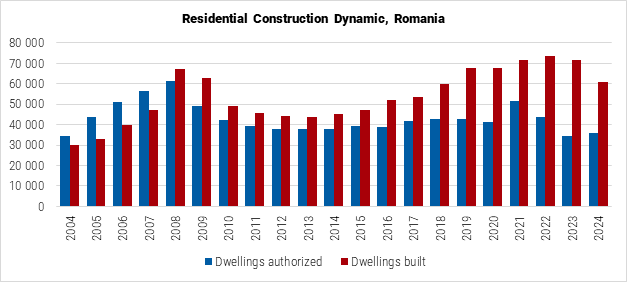
Data Source: INS.
Property Demand Trends
Activity Moderates, with Affordability Pressures Concentrated in the Mass Market
According to transaction statistics from the National Agency for Cadaster and Land Registration (ANCPI), Romania’s housing market moderated in 2025, with 159,879 residential unit sales recorded nationwide, demonstrating a 5.4% year-on-year decline. Activity remained heavily concentrated in the capital region: Bucharest–Ilfov accounted for roughly 35% of national transactions (55,297 units), but volumes there fell by about 8.5% year-on-year, underperforming the national trend.
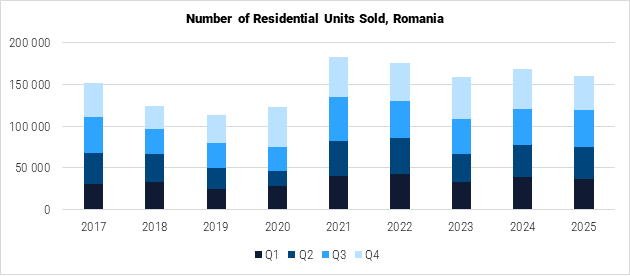
Data Source: ANCPI.
Number of residential units sold in key submarkets:
| Region/county | Number of residential units sold, 2025 |
YoY, % |
| Bucharest – Ilfov | 55,297 | -8.55% |
| Brașov | 8,066 | -13.88% |
| Cluj | 9,811 | 1.78% |
| Constanța | 9,415 | -0.13% |
| Iași | 7,064 | -23.51% |
| Timiș | 9,902 | -6.44% |
| Data Source: ANCPI. | ||
Intra-year dynamics also reflected a temporary timing effect linked to fiscal changes. Sales peaked in July as part of the demand was brought forward ahead of the VAT changes affecting parts of the new-home segment from 1 August 2025, with the clearest impact in the mass-market new-build cohort. Andrei Sârbu (SVN Romania) noted that the mass-market segment “slowed sharply after July,” while the middle market remained “very good,” arguing that “the need for housing is real” and demand was “solid overall,” even as affordability weakened for budget-constrained buyers and could push part of demand toward renting in the near term.
Beyond headline volumes, market sentiment points to a more buyer-led, slower-closure environment. Imobiliare.ro describes a shift where “power moves to the buyer,” and Daniel Crainic expects at least two quarters (Q4 2025–Q1 2026) of temporary transaction compression, implying longer decision cycles and a greater role for negotiation and deal structuring. This is consistent with brokerage observations: George Șeicaru (RE/MAX Evolution) notes that buyers have become more prudent, “analyze options more carefully,” and “compare more properties before making a decision,” reinforcing the picture of more selective demand.
Looking into 2026, Colliers frames the year as “transitional,” with modest growth and fiscal consolidation pressures but easing inflation and the potential for rate cuts supporting a gradual improvement in sentiment. Imobiliare.ro similarly expects activity to remain subdued into early 2026 before improving as the market absorbs the new fiscal framework and decision cycles normalize. Overall, demand is likely to persist but remain segmented: better-capitalized households and buyers with stronger location preferences should continue to transact, while budget-constrained cohorts stay more price- and timing-sensitive, sustaining a negotiation-led market environment.
Property Supply Trends
Pipeline Tightness Persists, Keeping Near-Term Deliveries Constrained
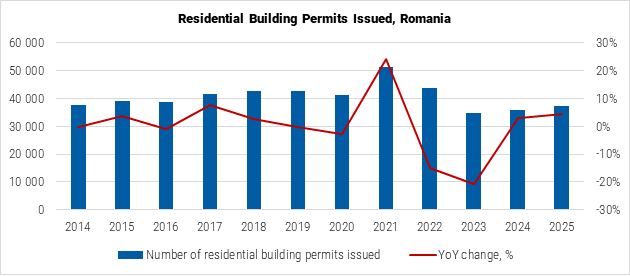
Residential construction activity in Romania remains subdued. Provisional INS data shows that 40,322 dwellings were completed in the first three quarters of 2025, indicating a 4.7% year-on-year decline. This weakness largely reflects the lagged impact of a thinner development pipeline originating in 2022–2023, when permit issuance fell at double-digit rates, alongside project-level timing effects.
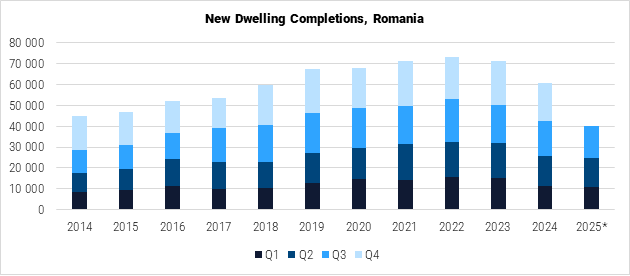
Note: *Provisional Data
Data Source: INS.
New delivery remains concentrated in the Bucharest–Ilfov region, which accounted for about 31% of completed units. While the region recorded the strongest annual increase in completions in 2025 (+3.37% year-on-year), activity is still significantly below prior peaks, remaining more than 24% under 2022 levels. SVN Romania links the slowdown in completed housing to a “dramatic decrease in the number of building permits and the total area authorized” for residential projects in Bucharest in recent years, supporting the view that the pipeline has tightened structurally rather than merely pausing cyclically.
Number of new dwellings completed, by development region:
| Region | Number of dwellings completed, Q1-Q3 2025 |
YoY, % |
| North-East | 4,926 | 1.15% |
| South-East | 4,211 | -5.03% |
| South-Muntenia | 3,318 | -6.56% |
| South-WestOltenia | 2,103 | -9.28% |
| West | 3,689 | -8.46% |
| North-West | 5,573 | -9.92% |
| Center | 4,039 | -17.69% |
| Bucharest-Ilfov | 12,463 | 3.73% |
| Data Source: INS. | ||
Against this backdrop, the recent improvement in permitting is better read as a stabilization signal than a near-term uplift in deliveries. Nationally, residential building authorizations increased for a second consecutive year to 37,252 in 2025, up 4.44% year-on-year, according to INS. However, permit volumes should be interpreted cautiously and not as a one-for-one predictor of completions. In a Digi24 analysis, real estate expert Alexandru Ispir argues the increase “is primarily a signal of intention, not a full market recovery,” noting that output still depends on financing conditions, construction costs, and execution pace.
Data Source: INS.
Regionally, the North-East accounted for the largest share of permits (19%), followed by South-Munteniaand North-West (16% each). Bucharest–Ilfov recorded 4,013 permits, up 4.70% year-on-year, representing around 11% of the national total. Ispir notes that regional trends diverge with local economic conditions and cost structures, and that Bucharest–Ilfov’s higher costs and sizeable recently delivered stock have moderated new authorizations. SVN Romania adds that permitting in Bucharest–Ilfov remains “roughly 40% lower” than in 2021–2022 and suggests a meaningful portion of 2025 activity may reflect reissued older permits rather than a broad-based restart of new development, implying limited translation into near-term output.
Number of residential building permits issued, by development region:
| Region | Number of permits issued, 2025 |
YoY, % |
| North-East | 7,142 | 2.38% |
| South-East | 4,019 | 4.25% |
| South-Muntenia | 5,876 | 2.24% |
| South-WestOltenia | 2,808 | 5.44% |
| West | 3,748 | 6.03% |
| North-West | 5,807 | 5.62% |
| Center | 3,839 | 7.84% |
| Bucharest-Ilfov | 4,013 | 4.70% |
| Data Source: INS. | ||
Looking ahead, the supply outlook remains tight through 2026–2027. SVN Romania identifies around 6,700 homes in various stages of development in Bucharest–Ilfov region that are expected to be completed mainly in 2026 and 2027, describing this as “one of the lowest levels recorded in recent years” and materially below the pipeline visible in early 2024. On this basis, 2026 is seen to be another year of constrained new-home deliveries in Bucharest and its surrounding areas, with the still-depressed permit base versus 2021–2022 continuing to weigh on completions.
Rental Market: Rents and Rental Yields
Measures for Owners Expected to Put Further Upward Pressure on Rents
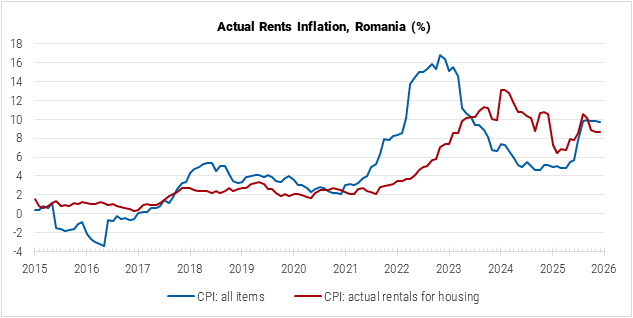
With just 5.7% of households renting rather than owning their residences, and only 2.1% of those paying market-level rates, the rental market in Romania remains small. Against this background, over the last two years, rental inflation in the country (measured by the annual change in actual rentals for the housing component of the consumer price index) demonstrated strong fluctuations, generally trending above the overall price growth. In the second half of 2025, it eased somewhat, falling from 10.6% in August to 8.6% in December, according to the INS reporting. The all-item CPI registered a 9.7% year-on-year growth in December 2025.
Romania's rent price index:
In nominal terms, the average asking rent per residential unit in Romania reached EUR 550 (USD 642) in Q3 2025, according to reporting from the property platform Imobiliare.ro, up 6% from the same period a year prior. Among key submarkets, the highest average rents were traditionally observed in Bucharest and Cluj-Napoca. Within the capital city, monthly rents varied from EUR 420 (USD 491) in the Giurgiului area to EUR 2,199 (USD 2,569) in Primăverii. The report notes a continued narrowing of the available rental offer in the capital (-9% year-on-year).
Data Source: INS.
Good Rental Yields
More recently, research conducted by Global Property Guide in January 2026 found gross rental yields for residential units in Romania at the average level of 6.02%, down from 6.55% previously reported in January 2025. Regionally, the highest yields among the assessed submarkets were observed in Galați (8.09%) and Bucharest (7.52%), while Cluj-Napoca (4.41%) showed the lowest potential performance.
Average asking rents per submarket and unit type:
| City | Studio, Q3 2025 |
1-Bedroom, Q3 2025 |
2-Bedroom, Q3 2025 |
| Bucharest | EUR 390 (USD 456) |
EUR 600 (USD 701) |
EUR 850 (USD 993) |
| Cluj-Napoca | EUR 400 (USD 467) |
EUR 590 (USD 689) |
EUR 700 (USD 818) |
| Brașov | EUR 350 (USD 409) |
EUR 500 (USD 584) |
EUR 600 (USD 701) |
| Timișoara | EUR 270 (USD 315) |
EUR 430 (USD 502) |
EUR 500 (USD 584) |
| Constanța | EUR 330 (USD 385) |
EUR 500 (USD 584) |
EUR 700 (USD 818) |
| Iași | EUR 350 (USD 409) |
EUR 450 (USD 526) |
EUR 550 (USD 642) |
| Note: Average rents in EUR as listed in the Imobiliare.ro report. Exchange rate as of Q3 2025, EUR 1 = 1.1681 USD. | |||
| Data Sources: Imobiliare.ro, Global Property Guide. | |||
Looking ahead, the rental segment of the Romanian housing market is likely to continue gaining traction, affected by persistent constraints in new supply and affordability of homeownership. Local experts anticipate further upward adjustments in rental rates connected to fiscal measures implemented by the authorities.
“The rental market continues to be lively, especially in university centers, where demand remains high due to the constant flow of students and young professionals. However, some price adjustments are expected in the coming months, amid the increase in taxes applied to owners and their need to recalibrate their incomes,” property platform Imobiliare.ro wrote in October 2025.
Mortgage Market and Interest Rates
Lower Interest Rates and a Continued Surge in Lending Activity
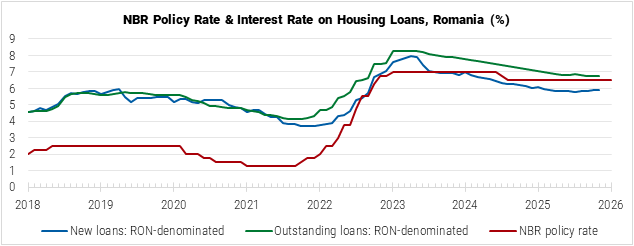
While an EU member since 2007, Romania has yet to adopt the Euro, and interest rates on loans in the country are primarily affected by the monetary policy of the National Bank of Romania (NBR). Following a 25 b.p. cut in August 2024, the central bank has maintained its policy rate at 6.50%. At the most recent policy meeting in January 2026, the regulator reaffirmed its stance, citing still-elevated assessments of uncertainties and risks to the economic activity outlook and inflation developments.
Romania's mortgage loan interest rates:
The benchmark consumer credit reference index (IRCC), based on interbank transactions and used to calculate variable interest rates on RON-denominated loans with a delay of one quarter, most recently decreased from a peak level of 6.06% applied in Q4 2025 to 5.68% applied in Q1 2026, with further reductions expected in 2026. "Rates on variable interest loans will register decreases from the beginning of January, due to the change in the IRCC," Claudiu Trandafir, a financial expert, commented, as cited by Digi24.
Data Source: NBR.
In this environment, the average interest rates on housing loans in Romania have continued to fall gradually, according to the NBR reporting. In November 2025, the average interest rate on new RON-denominated housing loans (making up the vast majority of new lending in recent years) reached 5.89%, down from 6.14% during the same time a year prior. For EUR-denominated housing loans, the average interest rate was reported at 5.37%, down from 7.01% in November 2024.
While still remaining above the pre-2022 baseline, average interest rates on outstanding housing loans are also trending downward. For RON-denominated loans, the indicator was reported at 6.73% in November 2025, down from 7.16% a year prior. For EUR-denominated loans, it stood at 5.99%, also down from 7.23% in November 2024.
Average interest rates on RON-denominated loans to households for house purchase:
| Nov 2025 | YoY | Nov 2024 | YoY | Nov 2023 | |
| New housing loans | 5.89% | ↓ | 6.14% | ↓ | 6.90% |
| - Floating rate and IRF up to 1 year | 6.64% | ↓ | 7.11% | ↓ | 7.66% |
| - IRF of over 1 and up to 5 years | 5.70% | ↓ | 5.80% | ↓ | 6.34% |
| - IRF of over 5 and up to 10 years | n/a | n/a | n/a | n/a | n/a |
| - IRF of over 10 years | 6.46% | ↑ | 6.33% | ↓ | 7.02% |
| Outstanding housing loans | 6.73% | ↓ | 7.16% | ↓ | 7.88% |
| - Original maturity up to 1 year | 7.33% | n/a | n/a | n/a | n/a |
| - Original maturity over 1 and up to 5 years | 5.98% | ↓ | 6.48% | ↓ | 7.08% |
| - Original maturity of over 5 years | 6.73% | ↓ | 7.16% | ↓ | 7.88% |
| Data Source: NBR. | |||||
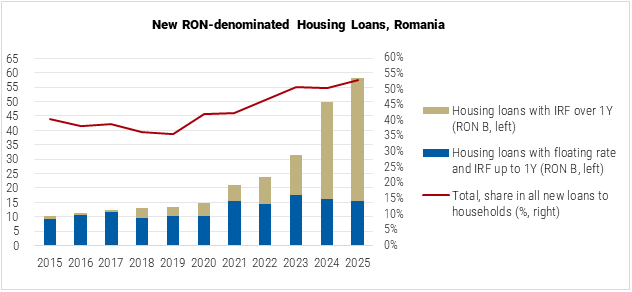
In terms of new loans granted, based on the NBR figures, the Romanian mortgage market recorded a 16.8% year-on-year increase in the value of new business (including pure new loans, as well as refinancing and restructuring), which reached RON 58.3 billion (USD 13.04 billion) for RON-denominated loans in 2025. The share of housing loans in total credit extended to households increased from 50.6% in 2024 to 53.1% in 2025, a new high. At the same time, the total value of EUR-denominated housing loans granted in 2025 dropped by 38.0% year-on-year, amounting to EUR 36.6 million (USD 41.4 million) and marking the continued restructuring of the market.
"2025 will set new records for mortgage loan volumes in Romania. 2026 is set to be at least as good a year, barring negative macroeconomic events,” commented Alexandru Radulescu, Managing Partner at SVN Romania Credit & Financial Solutions, adding that the most important factor impacting the market’s development in the upcoming period is inflation evolution, which will determine the trajectory for loan interest rates.
Data Source: NBR.
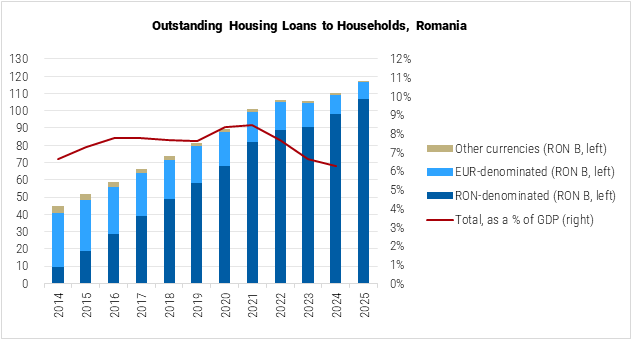
The overall composition of the mortgage stock in Romania has shifted significantly towards the national currency over the last decade. Based on the NBR data, at the end of 2025, RON-denominated loans represented 90.8% of the stock compared to 21.2% in 2014.
This re-composition is, in large part, attributed to Prima Casă (launched in 2009) and, consequently, Noua Casă (from 2020) government-backed programs that benefit first-time buyers and provide only RON-denominated loans. As of 2025, the Noua Casă (New Home) Program offers the following key conditions:
- RON-denominated loans of up to EUR 66,500 with a 5% downpayment (for homes priced up to EUR 70,000) or up to EUR 119,000 with a 15% downpayment (for homes priced up to EUR 140,000);
- Government guarantee of up to 60% of the loan amount;
- Variable interest rate calculated as IRCC + fixed margin of 2%.
Supported by the surge in new disbursements, the total value of outstanding housing loans in the country continues to grow, reaching RON 117.3 billion (USD 26.2 billion) at the end of 2025, a 6.5% year-on-year increase. The relative size of the market, at the same time, remains limited. Compared to the national economy, it was estimated to equal just 6.3% of the GDP at current prices in 2024, down from 8.4% in 2021. The share of Romanian households owning their residences with an outstanding mortgage or housing loan decreased is just 1.5%, according to the Eurostat figures.
Data Source: NBR.
Economic and Social Factors
Subdued Growth Amid Fiscal Consolidation
Romania’s economic growth has been subdued, as the necessary fiscal consolidation addressing twin deficit issues dampens private and public consumption, in turn further affected by a surge in inflation.
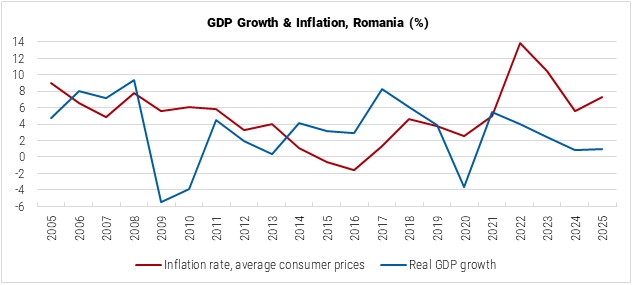
The country’s real GDP growth reached just 0.8% in 2024 and is estimated at 1.0% for 2025. According to the European Commission’s assessment, continued, albeit limited, growth last year was supported by a gradual recovery in private investment, an acceleration of RRP-funded spending, and a sizeable improvement in net exports.
Looking ahead, the economy is expected to expand gradually in the near term, converging to its potential over the medium term. The European Commission forecast anticipates real GDP growth at 1.1% in 2026 and 2.1% in 2027, while the International Monetary Fund (IMF) projects slightly higher growth rates of 1.4% and 2.7% for the respective years.
In parallel, after falling from its peak of 13.8% in 2022 to 5.6% in 2024, consumer price index (CPI) inflation in Romania reaccelerated to the average annual level of 7.3% in 2025, impacted by the elimination of the cap on electricity prices for households in July and the rise in VAT and excises. Most recently, the indicator was reported by the INS at 9.7% in December 2025. The European Commission expects factors such as the upcoming removal of the cap on natural gas prices in March 2026 to slow the disinflationary process in the country, pushing the return of inflation to the central bank’s target towards the end of the year. The average inflation is projected to reach 5.9% in 2026 and 3.8% in 2027.
Data Source: IMF.
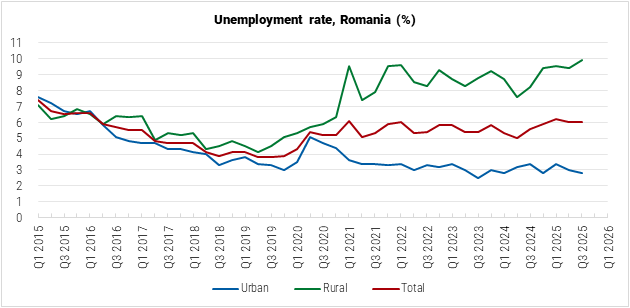
Due to softer economic activity, employment in Romania’s labor market started to decline in 2025, leading to a gradual increase in the unemployment rate, especially notable in rural areas. The most recent figures from the INS show the countrywide ILO unemployment rate at 6.0% in Q3 2025. The gap between unemployment in urban (2.8%) and rural (9.9%) areas remained significant.
The European Commission’s analysis also notes that the freeze in public wages and moderation of private ones in 2025 and 2026 are set to strongly slow nominal wage growth, turning it negative in real terms.
Data Source: INS.
In public finances, aiming to reduce general government deficit which peaked at 9.3% of GDP in 2024, Romania continued to adopt fiscal consolidation measures, such as a nominal freeze in public wages and pensions and significant tax revenue increases (increase in VAT rates, broadening of the base of health contributions, increases in excises, a higher dividend tax rate, and an increase in recurrent taxation on residential property and environmental taxes). This sizable consolidation is projected to bring the deficit down to 5.9% by 2027. At the same time, driven by high deficits and a projected increase in interest payments, Romania’s government debt is projected to increase from less than 55% of GDP in 2024 to around 63% in 2027.
In August 2025, Fitch Ratings affirmed Romania’s ‘BBB-’ standing with a negative outlook, noting that the political uncertainty in the country has eased after the pro-EU centrist candidate won the May presidential election, allowing the new government to quickly legislate and implement an ambitious package of measures addressing the deterioration in public finances. Nonetheless, significant risks to medium-term fiscal consolidation remain, stemming from weak growth, implementation challenges, and high political polarization.
Sources:
- National Institute of Statistics (INS)
- Residential Construction, Q3 2025 (Preliminary Data) (RO): https://insse.ro/
- Building Permits Issued, December 2025 (RO): https://insse.ro/
- Annual GDP Release (RO): https://insse.ro/
- Inflation and the Evolution of Consumer Prices: December 2025: https://insse.ro/
- Employment and Unemployment, Q3 2025: https://insse.ro/
- National Bank of Romania (NBR)
- NBR Board Decisions on Monetary Policy, January 2026: https://www.bnr.ro/
- Loans to Households: https://www.bnr.ro/
- Financial Markets: https://www.bnr.ro/
- Exchange Rates: https://www.bnr.ro/
- Monthly Bulletins: https://www.bnr.ro/
- Financial Stability Report, December 2025 (RO): https://www.bnr.ro/
- National Agency for Cadastre and Land Registration (ANCPI)
- Transactions in December 2025 (RO): https://www.ancpi.ro/
- European Commission
- Housing Price Statistics – House Price Index: https://ec.europa.eu/
- Distribution of Population by Tenure Status, Type of Household, and Income group: https://ec.europa.eu/
- Economic Forecast for Romania: https://economy-finance.ec.europa.eu/
- International Monetary Fund (IMF)
- Country Overview: Romania: https://www.imf.org/
- 2025 Article IV Staff Report: https://www.imf.org/
- Organization for Economic Co-operation and Development (OECD)
- Romania Economic Snapshot: https://www.oecd.org/
- Fitch Ratings
- Fitch Affirms Romania at 'BBB-'; Outlook Negative https://www.fitchratings.com/
- National Credit Guarantee Fund for Small and Medium Enterprises (FNGCIMM)
- Noua Casa (RO): https://www.fngcimm.ro/
- SVN Romania
- History of Mortgage Credit in Romania (RO): https://www.svn.ro/
- Romania Market Drive 2025: https://www.svn.ro/
- Imobiliare.ro
- Imobiliare.ro Index (RO): https://www.imobiliare.ro/
- Residential Real Estate Market, Q3 2025 (RO): https://market360.imobiliare.ro/
- Real Estate Market Trends Before the End of 2025 (RO): https://hub.imobiliare.ro/
- Colliers
- Colliers’ 2025 Forecast Broadly Confirmed: https://www.colliers.com/
- Top 10 Predictions 2026: https://www.colliers.com/
- Cushman & Wakefield Echinox
- Premium Residential Market Prices Have Doubled…: https://cwechinox.com/
- Ziarul Financiar
- Lower Interest Rates in 2026… (RO): https://www.zf.ro/
- Business Forum
- Resi Pipeline in Bucharest Region Totals 18,000 Units in 2025: https://www.businessforum.ro/
- Property Forum
- Romanian Mortgage Rates Set to Drop in Early 2026: https://www.property-forum.eu/
- Romania Libera
- Real Estate Market Slows Down: Home Sales Fell in 2025 (RO): https://romanialibera.ro/
- Digi24
- Analysis: More Building Permits in 2025 But Smaller Projects… (RO): https://www.digi24.ro/
- Romanian Rates Could Drop Slightly From 2026… (RO): https://www.digi24.ro/