Jamaica's Residential Property Market Analysis 2025
The Jamaican housing market continues to benefit from sustained infrastructure investment and tourism-driven demand for luxury properties and short-term rentals, while structural challenges persist in the affordable segment.
This extended overview from Global Property Guide covers key aspects of the Jamaican housing market and takes a closer look at its most recent developments and long-term trends.
Table of Contents
Market Defining Features and Trends
Jamaica's housing market is distinctly segmented into affordable and high-end categories, each shaped by different demand drivers and development patterns. The luxury segment primarily appeals to foreign investors and members of the Jamaican diaspora, drawn by its lifestyle offerings and income-generating potential. Development activity is concentrated along the Northern Corridor, extending from Hanover and St. James in the west through St. Ann and St. Mary in the east, while St. Andrew parish, including the capital city of Kingston, functions as a separate urban center for premium residential demand. The segment is led by private developers delivering gated communities, branded residences, and eco-luxury retreats, typically featuring amenities such as private beach access, concierge services, and 24-hour security. Supported by robust year-round tourism and direct international access via Sangster, Norman Manley, and Ian Fleming airports, the high-end market benefits from strong rental yields and sustained capital appreciation.
According to a market survey conducted by the property platform Jamaica Homes, as of April 2025, Hanover parish reported the highest property values, anchored by the exclusive Tryall Club enclave, which includes landmark estates such as Seaclusion and Little Hill. St. James followed closely, with high-end listings concentrated in Montego Bay's upscale communities, including Spring Farm, Freeport, The Lagoons, and Reading. In the capital, Kingston 6 in St. Andrew - encompassing Beverly Hills, Cherry Gardens, and surrounding high-rise developments - remained the most sought-after area among professionals, diplomatic staff, and returning diaspora. In St. Ann, coastal communities such as Richmond and Drax Hall near Ocho Rios continued to draw upper-tier buyers, while Portland parish stood out for its boutique eco-resorts and scenic settings, particularly in areas such as San San and Drapers.
Residential property prices, selected parishes:
| Parish | No. of Listings | Average Price, JMD, Apr 2025 |
Average Price, USD, Apr 2025 |
Median Price, JMD, Apr 2025 |
Median Price, USD, Apr 2025 |
| Hanover | 19 | JMD 390,613,700 | USD 2,460,249 | JMD 150,672,676 | USD 949,000 |
| St. James | 119 | JMD 199,187,300 | USD 1,254,565 | JMD 126,089,239 | USD 794,163 |
| Portland | 16 | JMD 175,153,700 | USD 1,103,191 | JMD 116,969,577 | USD 736,723 |
| St. Elizabeth | 13 | JMD 139,192,300 | USD 876,691 | JMD 140,000,000 | USD 881,779 |
| St. Andrew | 262 | JMD 129,744,000 | USD 817,182 | JMD 95,000,000 | USD 598,350 |
| St. Ann | 193 | JMD 125,526,200 | USD 790,617 | JMD 87,231,549 | USD 549,421 |
| St. Mary | 45 | JMD 114,385,800 | USD 720,450 | JMD 93,575,662 | USD 589,379 |
| Kingston | 2 | JMD 111,021,971 | USD 699,263 | JMD 111,021,971 | USD 699,263 |
| Trelawny | 17 | JMD 108,626,000 | USD 684,172 | JMD 87,231,549 | USD 549,421 |
| Westmoreland | 42 | JMD 102,780,900 | USD 647,357 | JMD 78,508,394 | USD 494,479 |
| Note: Exchange rate as of April 2025, USD 1 = JMD 158.77. | |||||
| Data Source: Jamaica Homes. | |||||
By contrast, demand in the affordable segment is largely driven by population growth, urbanization, and the aspiration for homeownership among local residents. This segment is principally supported by the National Housing Trust (NHT), the government agency tasked with expanding the country's housing supply and facilitating access to financing. Structural challenges persist, however, as the market remains undersupplied and affordability continues to be constrained by long-term price growth and limited real wage increases.
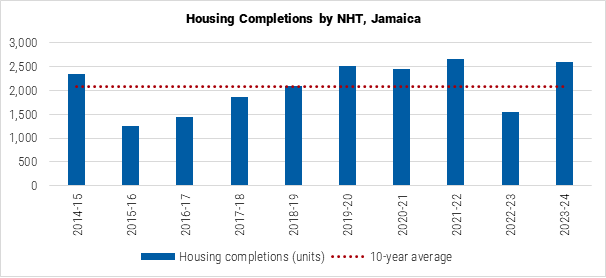
In the 2023-24 financial year, the NHT completed 2,582 housing units, according to its latest annual report. Of these, 897 were delivered through individual projects, representing 35% of total completions - a sharp decline from 78% the previous year. The remaining 1,685 units were provided through various NHT programs, including the Interim Financed, Labor and Small Materials Program, Community Renewal, and the Guaranteed Purchase Program. While completions rose by 67.21% year-on-year and exceeded the 10-year average, the figure still fell short of the 4,141-unit target set for the period. The report cited delays in achieving project milestones, as well as labor force shortages and infrastructure implementation setbacks, as key reasons for the shortfall.
In July 2025, Prime Minister Dr. Andrew Holness announced that the NHT had fulfilled its mandate of delivering 43,000 housing solutions by 2026. A new target of 60,000 housing solutions over the next five years has been established, with 40,000 of those to be delivered by the trust.
Data Source: NHT.
Selected NHT projects under construction:
| Project Name | Location | No. of Units | Completion Date |
| Hummingbird Meadows Phase 2 | Clarendon | 182 | 2025 |
| Perth Phase 2 | Manchester | 468 | 2025 |
| Howard Apartments | St. Andrew | 248 | 2025 |
| Foreshore Estate | St. Andrew | 170 | 2025 |
| White Wing | St. Andrew | 112 | 2025 |
| Union Acres (Irwin Estates) | St. James | 104 | 2025 |
| The Villages of Colbeck Castle Phase 1 & 2 | St. Catherine | 539 | 2026 |
| SilverSun Estate | St. Catherine | 165 | 2026 |
| The Estuary, Phase 2 | St. James | 401 | 2026 |
| Windsor Housing Development 1&2 | Trelawny | 116 | 2026 |
| Maxfield Park | St. Andrew | 210 | 2027 |
| The Villages of Colbeck Castle Phase 3 & 4 | St. Catherine | 785 | 2027 |
| Catherine Estates | St. Catherine | 575 | 2027 |
| Friendship Oaks Phase 1 | St. Elizabeth | 150 | 2027 |
| Note: Selected NTH developments under construction comprising more than 100 units. | |||
| Data Source: NHT. | |||
The residential sector's performance is also closely tied to infrastructure development. A nationwide program of upgrades is currently underway for 2024-2025, centred on the SPARK initiative - a JMD 45 billion investment aimed at rehabilitating and realigning more than 100 community, local, and secondary roads across the island. The initiative is expected to significantly improve connectivity and stimulate residential development in surrounding areas. In parallel, the Southern Coastal Highway Improvement Project is approaching completion of two critical segments: Harbour View to Yallahs and May Pen to Williamsfield. These upgrades are essential for strengthening east-west transport corridors and supporting coastal housing expansion. "We hope that we will be able to complete this project before the beginning of the next financial year [2025/2026], because we understand the significant economic impact that it is to have on the residents of St. Thomas and Portland," stated Hon. Robert Morgan, Minister without Portfolio in the Ministry of Economic Growth and Job Creation with responsibility for works.
Additional infrastructure improvements have been prioritized for key entry points into Kingston, with JMD 2 billion allocated to upgrade strategic routes such as Airport Road from Norman Manley International Airport to Mountain View, as well as Spanish Town Road, Washington Boulevard, and Dunrobin Avenue. These projects aim to enhance access to urban residential areas and improve connectivity to key transportation hubs. In Portland parish, construction of the Port Antonio bypass road is progressing in two phases - from Norwich to Turtle Crawl, and then to Boston Bay - with the objective of easing congestion and unlocking inland development potential, including new housing opportunities.
While Jamaica's real estate market continues to benefit from sustained infrastructure investment and tourism-driven demand, longstanding structural challenges remain. High crime rates, low productivity, and vulnerability to external shocks continue to weigh on the sector's long-term growth prospects.
Mortgage Market:
DTI Interest Rates Still Elevated Despite Policy Cuts, New Lending Grows
Based on the type of lender, the mortgage market in Jamaica consists of two main segments, each regulated and reported on separately: deposit-taking institutions (DTI), which include banks and building societies, and the National Housing Trust (NHT) - a government-run housing institution working to increase homeownership among low- to middle-income earners in Jamaica. Mortgage credit is also offered by some other non-deposit-taking institutions, such as credit unions and insurance companies, but their market share is insignificant.
Jamaica's mortgage loan interest rates:
Data Source: Bank of Jamaica.
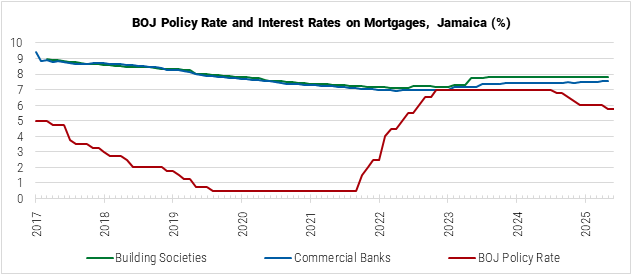
The Bank of Jamaica (BOJ), which supervises the DTI segment of the market, has begun gradually easing its monetary stance in August 2024, with several consecutive cuts bringing the policy rate 125 bps down to 5.75% by May 2025. At the most recent policy meeting at the end of June 2025, the regulator decided to hold the rate, determining that its current standing continues to be appropriate to maintain inflation within the target range over the next two years.
"This view is in a context of continued uncertainty around global trade policy and the path of interest rates in the major developed markets, as well as recent geopolitical developments that have shifted inflation risks to the upside," noted the central bank.
Nonetheless, further cuts are anticipated later in 2025. Experts from BMI forecast the BOJ policy rate could reach 5.00% by the end of the year.
Data Source: BOJ.
The transmission of monetary policy to loan products offered by individual DTIs, however, has been weak in Jamaica due to several fundamental factors outlined by The Gleaner earlier this year. The country's banking sector is highly concentrated, with limited competition and a few dominant players controlling most of the market. Despite signals from the central bank, commercial lenders perceive credit risk in the local economy as high, which also discourages them from promptly lowering rates. In addition, banks in Jamaica typically pass on to borrowers the high operational and compliance expenses they face.
As a result, interest rates on mortgages in the DTI segment remain elevated. In May 2025, the BOJ reporting showed the rates on loans in domestic currency (representing the majority of the market) above 7% for commercial banks and building societies, with no change in the indicator from the same period last year for building societies and a slight increase for banks. A similar trend was observed for loans in foreign currency, where, as of March 2025 (the latest available figures), the average rates remained largely stable, registering only a marginal uptick from the comparable period a year prior.
Earlier this year, Jamaica's Minister of Industry, Investment, and Commerce, Aubyn Hill, called on banks to lower their interest rates on loans, arguing that high borrowing costs are stifling economic growth. "We want our banks to be profitable. When you have a growing economy, banks benefit most [as] there are more transactions being done. [But] in order to have a growing economy, you must have reasonable and reasonably low interest rates," he said, as quoted by Caribbean National Weekly.
The NHT currently offers mortgage loans to qualifying contributors at rates between 0% and 5%, depending on the borrower's income.
Weighted average interest rates on mortgage credit by DTIs:
| Domestic currency loans | May 2025 | YoY | May 2024 | YoY | May 2023 |
| Commercial banks | 7.53 | ↑ | 7.44 | ↑ | 7.16 |
| Building societies | 7.82 | = | 7.82 | ↑ | 7.76 |
| Foreign currency loans | March 2025 | YoY | March 2024 | YoY | March 2023 |
| Commercial banks | 6.46 | ↑ | 6.42 | ↓ | 6.86 |
| Building societies | 7.02 | ↑ | 7.00 | ↑ | 5.25 |
| Data Source: BOJ. | |||||
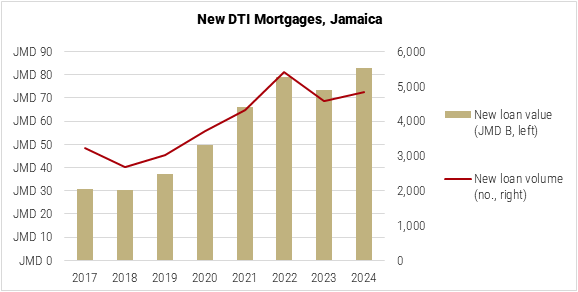
Despite high interest rates, after a dip in 2023, new mortgage lending in the DTI segment returned to growth last year. In 2024, the BOJ reported a total of 4,822 new mortgage accounts (5.4% year-on-year), amounting to JMD 82.9 billion (12.8% year-on-year). In its annual financial stability report, the central bank noted that mortgages were the largest driver of the overall growth of lending to households throughout the year and tied the increased lending activity to moderating inflation, improved macro-financial conditions, and marketing efforts of individual DTIs.
"The growth in mortgages largely reflected more intensified marketing efforts on the part of some DTIs, amidst increased competition in the mortgage market," said the BOJ.
As for the affordable housing segment, the latest available data from the NHT shows that during the 2023-24 financial year (April 2023 to March 2024), a total of 4,384 new mortgage loans at a value of JMD 22.05 billion were granted to the trust's contributors directly by the NHT, which was a nearly 30% decrease in volume and 37% decrease in value compared to main new loans previously reported in 2022-23.
Aiming to make homeownership more affordable and accessible for Jamaicans, in March 2025, the government announced a series of new and expanded benefits from the NHT, including increased loan limits, reduced deposit requirements, and expanded grants. The measures took effect on July 1, 2025.
Data Source: BOJ.
The overall size of the DTI residential mortgage stock increased by 15.0% in 2024 and reached JMD 488.1 billion (USD 3.1 billion) in April 2025, according to the BOJ reporting. Earlier BOJ figures indicate that approximately 15% of the DTI mortgage stock can be attributed to overseas customers, most of whom obtained funding to acquire property in Jamaica, with the remaining 85% taken out by the locals.
The NHT loans receivable stood at JMD 278.8 billion (USD 1.9 billion) at the end of the financial year 2023-24, bringing the value of the combined market to over JMD 756 billion (USD 4.8 billion) in 2024. Sized against the national economy, the combined stock is estimated to equal about 24% of GDP at current prices.
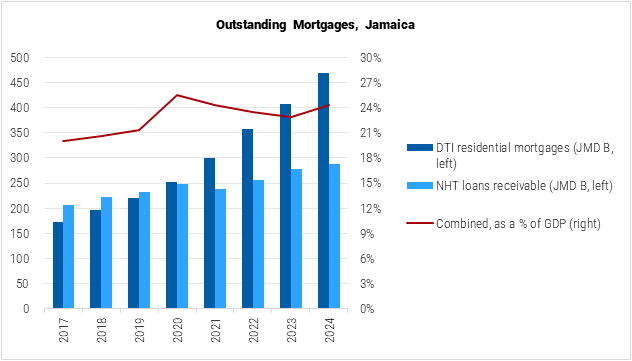
Note: For illustrative purposes only. Annual data shown represents years ending in December for DTI and years ending in March for the NHT.
Data Sources: BOJ, NHT, World Bank.
Rental Market:
Short-Term Rentals Continue to Surge
The traditional long-term rental market in Jamaica is relatively limited. The latest available data from the 2011 Population and Housing Census shows 21.8% of dwellings (about 534 thousand units) across the country occupied by paying tenants under a lease or rental agreement, against 60.6% owned and 17.6% squatted, occupied rent-free, or not reported dwellings. The share of leased or rented dwellings in the parish of Kingston stands notably higher, however, reaching 33.2%.
Jamaica's rent price index:
Data Source: Statistical Institute of Jamaica.
In the last three months, rental inflation in Jamaica has been outpacing the overall price growth. The actual rentals for the housing component of the nationwide consumer price index (CPI) registered an accelerated 7.3% year-on-year growth in June 2025, up from 4.2% a year ago and the highest price increase observed for rents since the fall of 2022. During the same period, the all-item CPI registered a notably lower annual increase of 3.7%.
It should be noted that under the Rent Restriction Act, the maximum legally allowed rent increase in Jamaica is 7.5% per year, with any increases above this threshold requiring approval from the Rent Assessment Board.
The research conducted by Global Property Guide in April 2025 found the average monthly rent in Kingston and the surrounding St. Andrew parish at USD 950 for 1-bedroom units, USD 1,500 for two-bedroom units, and USD 2,500 for 3-bedroom units. The corresponding gross rental yields for residential properties averaged 6.39% (down from 6.73% previously reported in July 2024).
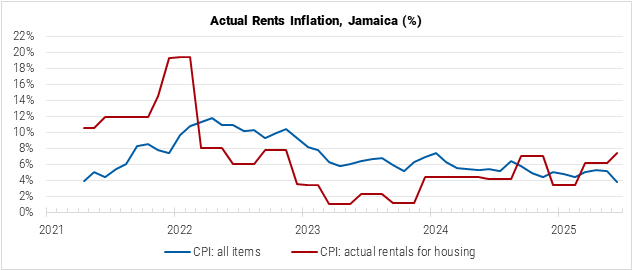
Data Source: STATIN.
With annual increases on existing contracts capped by the law, while asking rents for new clients keep growing consistently, long-term tenants are reportedly becoming less attractive to landlords in Jamaica, many now opting to offer shorter contracts with monthly rents or switch to holiday rentals catering to tourists.
The short-term rental (STR) sector in Jamaica has been growing rapidly in recent years, now expanding beyond major tourist hubs along the North Coast to towns and communities across the country. In a recent speech, Minister of State in the Ministry of Tourism, Delano Seiveright, stated that the number of Airbnb guests in Jamaica skyrocketed from 59,500 in 2017 to over 800,000 in 2024, bringing over JMD 32 billion in earnings to owners.
"This is the democratization of tourism. From Trench Town to Treasure Beach, from Portland to Negril, every day Jamaicans are opening their doors, their culture, and their talents to the world - and earning income. This is community tourism in action," Seiveright said, as quoted by The Jamaica Observer.
At the same time, the surge of the STR sector raises concerns over the lack of regulation for such properties in Jamaica, as well as the disruption it brings to traditional hotels, with an estimated 30% of the business of small and medium-sized operators now taken by STR listing platforms.
The July 2025 data from AirDNA shows the largest number of active short-term rental listings and the highest average occupancy in Kingston. Among the more active local submarkets (with 300 or more active listings), the highest average daily rates over the last twelve months were observed in the parishes of Saint Ann and Saint Catherine.
Key short-term rental indicators across selected submarkets as of July 2025:
| Total Active Listings | Avg Daily Rent over the last 12 months (JMD) | Avg Daily Rent over the last 12 months (USD) | Avg Occupancy over the last 12 months (%) | |
| Kingston | 1,885 | JMD 20,200 | USD 126 | 47% |
| Saint Ann | 1,260 | JMD 47,500 | USD 296 | 39% |
| Saint Catherine | 775 | JMD 14,400 | USD 90 | 43% |
| Montego Bay | 849 | JMD 28,400 | USD 177 | 44% |
| Trelawny | 318 | JMD 35,900 | USD 224 | 39% |
| Saint Elizabeth | 321 | JMD 42,300 | USD 264 | 38% |
| Ocho Rios | 554 | JMD 31,300 | USD 195 | 43% |
| Note: Submarkets with at least 300 active listings were selected. - Total active listings - number of listings viewable on Airbnb and/or VRBO with at least one prior booked night. - Exchange rate as of June 2025, USD 1 = JMD 160.48. | ||||
| Data Source: AirDNA. | ||||
Socio-Economic Context:
Incipient Recovery After Weather-Related Economic Shocks
A series of weather-related shocks (hurricane Beryl and tropical storm Raphael, which damaged agriculture and infrastructure and undermined tourism) and the completion of the post-pandemic rebound of the Jamaican economy resulted in an estimated GDP contraction of 0.8 percent for 2024, according to the data from the International Monetary Fund (IMF). Economic activity in the country is expected to normalize, however, as the impact of the weather events wanes. The IMF projects Jamaica's real GDP growth to reach 2.1% in 2025. Over the medium term, growth is forecast to converge to its potential, averaging 1.6%.
Responding to monetary policy tightening, Consumer Price Index (CPI) inflation in the country eased from an annual level of 10.3% in 2022 to 5.5% in 2024, effectively converging to the central bank's target band. Most recently, the STATIN reported the indicator at 3.7% in June 2025. Inflation is expected to remain close to the mid-point of the BOJ target band (around 5%) over the medium term.
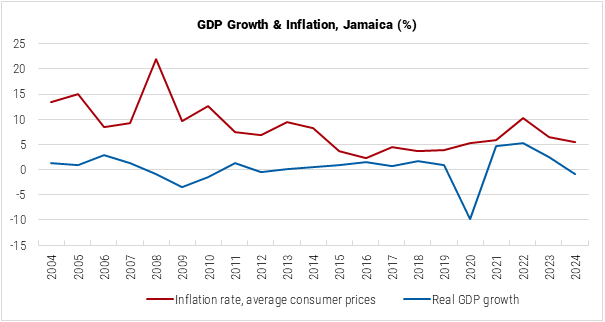
Data Source: IMF.
Tourism remains a key pillar of Jamaica's economy, representing one of the country's primary sources of foreign exchange earnings and employment. The number of stopover arrivals recorded steady growth from 2006 to 2019 before declining in 2020 due to the global impact of the COVID-19 pandemic. A partial recovery emerged in 2021, followed by a stronger rebound in subsequent years. According to the Jamaica Tourist Board (JTB), 986,392 stopover visitors were recorded between January and April 2025, reflecting a modest year-on-year decline of 3.32%. A similar trend was observed in the cruise segment, with a more pronounced year-on-year decrease of 14.70%, resulting in 587,257 cruise passenger arrivals during the same period.
Despite this temporary decline, sector representatives have expressed confidence in a recovery during the remainder of the year. Jamaica Hotel and Tourist Association (JHTA) President Robin Russell and Minister of Tourism Edmund Bartlett cited seasonal factors and travel uncertainty in key source markets, particularly the United States, as contributing to the downturn. "This fall-off can be attributed to what is happening in the United States, where travelers are somewhat skittish because of uncertainty about immigration," Russell noted to The Gleaner, adding that green card holders have shown hesitancy to travel, though he did not view this as a long-term concern.
Minister Bartlett reaffirmed the sector's growth prospects, stating: "Jamaica's tourism industry remains on a strong trajectory, the outlook for 2025 is highly optimistic," during the inaugural Jamaican Forum on Gastronomy and Tourism in June 2025. He further emphasized the importance of diversifying source markets beyond traditional partners such as the United States, Canada, and Europe, with increased focus on expanding into high-growth regions including Latin America, Asia-Pacific, and the Middle East.
The Jamaica Tourist Board projects that total arrivals in 2025 will reach approximately 4.5 million, comprising just over three million stopover visitors and 1.4 million cruise passengers. By 2026, the country aims to attract 3.4 million stopover visitors and 1.6 million cruise passengers, with total tourism earnings targeted at USD 5 billion, in alignment with the Ministry of Tourism's strategic growth objectives.
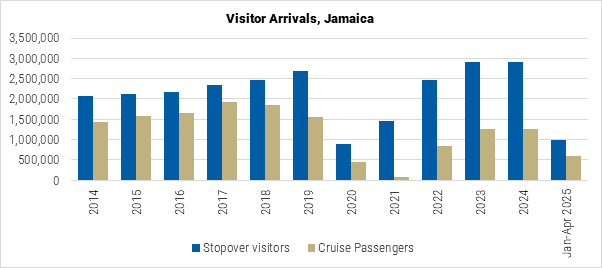
Data Source: JTB.
In Jamaica's labor market, unemployment has fallen to all-time low levels, according to the IMF 2025 Article IV staff report. The latest statistical release from STATIN shows total unemployment at 3.3% in April 2025, down from 4.2% a year ago in April 2024. The indicator stood at 2.5% (down from 3.2%) for the male population and at 4.3% (down from 5.3%) for the female population.
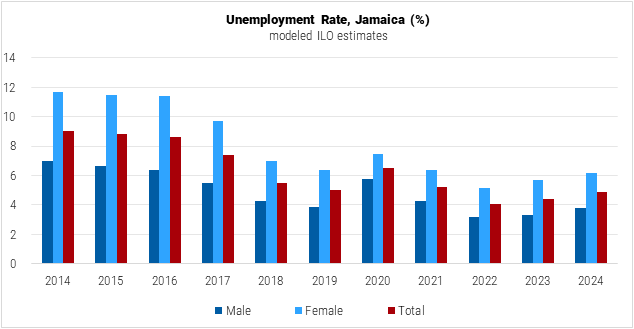
Data Source: World Bank.
In February 2025, Fitch Ratings affirmed Jamaica's 'BB-' standing with a positive outlook, noting the country has stronger governance than the peer median and has made significant progress with debt reduction, with the Debt-to-GDP ratio falling to a forecast 70.8% in fiscal year 2024-25 from a high of 135.3% of GDP in fiscal year 2012-13.
Overall, while Jamaica's economy is expected to continue recovering and return to expansion this year, tighter global financial conditions, lower growth in key source markets for tourism, trade policy disruptions, and the potential for storms and hurricanes all pose downside risks to the outlook. Beyond vulnerability to external shocks, the country's growth potential is also subdued by domestic issues, including a high crime rate, low productivity, and weak demographics.
The course of the country's development in the upcoming periods will also be impacted by the results of the expected 2025 general election, the date for which hasn't been announced yet. Under Jamaica's Constitution, Parliament automatically dissolves five years after its first sitting following the last election - in this case, by September 2025 - with the election then held no later than three months of that date. According to the BMI analysis, the upcoming election will likely bring a change in Jamaica's government, but the policy implications of such a shift are limited.
Sources:
- Statistical Institute of Jamaica (STATIN)
- Consumer Price Index June 2025: https://statinja.gov.jm/
- April 2025 Labor Force Survey (LFS) Findings: https://statinja.gov.jm/
- Number of Households by Tenure of Dwelling by Parish, Special Area and Enumeration District: 2011: https://statinja.gov.jm/
- Bank of Jamaica (BOJ)
- Monetary Policy Decisions & Schedule: https://boj.org.jm/
- Interest Rates Statistics: https://boj.org.jm/
- Banking System Statistics: https://boj.org.jm/
- NFIS Impact Indicators: https://boj.org.jm/
- Financial Stability Report 2024: https://boj.org.jm/
- Average Exchange Rates: https://boj.org.jm/
- Office of the Prime Minister (OPM)
- Government Expands NHT Benefits to Increase Homeownership and Financial Relief for Jamaicans: https://opm.gov.jm/
- Jamaica Set for Major Infrastructural Advancements in 2025/2026: https://opm.gov.jm/
- Post Cabinet Press Briefing Report- Wednesday, April 30, 2025: https://opm.gov.jm/
- Laws of Jamaica
- Rent Restriction Act: https://laws.moj.gov.jm/
- Jamaica Information Service
- Gov't Working Towards Completing the Southern Coastal Highway Improvement Project This Year: https://jis.gov.jm/
- National Housing Trust of Jamaica
- Annual Report 2023-24: https://www.nht.gov.jm/
- Upcoming Schemes: https://www.nht.gov.jm/
- NHT Interest Rates: https://www.nht.gov.jm/
- Jamaica Tourist Board (JTB)
- Report and Statistics: https://www.jtbonline.org/
- International Monetary Fund (IMF)
- Country Overview: Jamaica: https://www.imf.org/
- 2025 Article IV Staff Report: https://www.imf.org/
- World Bank
- Jamaica MPO, April 2025: https://thedocs.worldbank.org/
- World Development Indicators: https://datacatalog.worldbank.org/
- AirDNA
- Short-Term Rental Markets: Jamaica: https://app.airdna.co/
- Fitch Ratings
- Fitch Affirms Jamaica's Ratings at 'BB-'; Outlook Positive: https://www.fitchratings.com/
- BMI
- Jamaica: Central Bank Holds Policy Rate At 5.75% In June, More Cuts Expected In 2025: https://www.fitchsolutions.com/
- Jamaica: Consumption-Driven Growth Outlook Dampened By Downbeat External Conditions: https://www.fitchsolutions.com/
- Jamaica: Change In Government Likely In 2025, But Policy Implications Limited: https://www.fitchsolutions.com/
- Jamaica Homes
- The Most Expensive Places to Buy Property in Jamaica Right Now - 2025 Update: https://jamaica-homes.com/
- Caribbean National Weekly
- Jamaican Minister Pushes for Banks to Lower Loan Rates: https://www.caribbeannationalweekly.com/
- PM Holness Ramps Up Campaign Ahead of Jamaica General Election: https://www.caribbeannationalweekly.com/
- The Gleaner
- Why Interest Rates Remain High: https://jamaica-gleaner.com/
- Short-Term Rentals Growing in Kingston: https://jamaica-gleaner.com/
- Tourism Leaders Warn Against Surge in Short-Term Rentals: https://jamaica-gleaner.com/
- NHT Surpasses 43,000 Units as Government Hits Housing Milestone: https://jamaica-gleaner.com/
- The Jamaica Observer
- Long-Term Tenants Less Lucrative for Landlords: https://www.jamaicaobserver.com/
- Seiveright Touts 'Airbnb Revolution': https://www.jamaicaobserver.com/
- Gov't to Spend $2 Billion on Entrance Corridors to Kingston - Holness: https://www.jamaicaobserver.com/